Freezing and Near Freezing Tissue
Injuries
TLO
• Given a simulated casualty, treat cold
injuries, in accordance with the references.
ELO’s
• From a given list select the correct definition of
frostbite.
• From a given list select the correct two
mechanisms of injury for frostbite.
• From a given list select the correct signs and
symptoms of frostbite.
• From a given list select the correct favorable post
thaw signs of a frostbite injury.
ELO’s
• From a given list select the correct
unfavorable post thaw signs of a frostbite
injury.
• From a given list select the correct field
treatment for frostbite.
• From a given list select the correct primary
field treatment consideration when treating
frostbite in the field.
ELO’s
• From a given list select the correct methods
to reduce the chance of becoming a frostbite
casualty.
• From a given list select the correct
definition of immersion foot.
• From a given list select the correct
mechanism of injury for immersion foot.
ELO’s
• Given a list of categories and characteristics
match the category of immersion foot to its
characteristics.
• From a given list select the correct field
treatment of immersion foot.
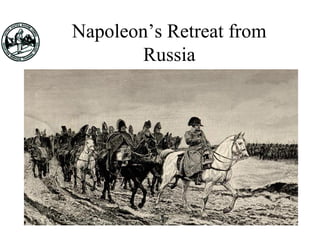
Napoleon’s Retreat from
Russia
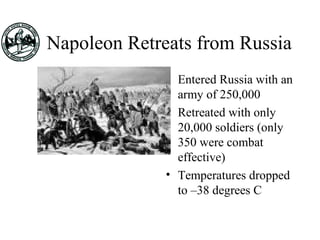
Napoleon Retreats from Russia
• Entered Russia with an
army of 250,000
• Retreated with only
20,000 soldiers (only
350 were combat
effective)
• Temperatures dropped
to –38 degrees C
WWII
• In November and December 1942, the
Germans performed 15,000 amputations for
cold injuries.
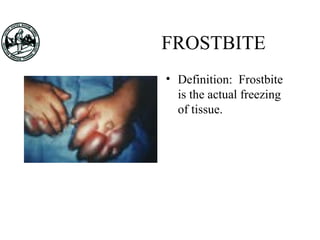
FROSTBITE
• Definition: Frostbite
is the actual freezing
of tissue.
Mechanisms of Injury
• Actual freezing of the tissues.
– Ice crystals form extracellularly and grow by
extracting water from the cells.
– Cells are injured by dehydration and electrolyte
disturbances.
– Ice crystals that form intracellularly are much
more damaging, but this requires much colder
temperature and faster freezing time.
Mechanisms of injury
• Obstruction of blood supply
– Cells lining the capillaries and small veins are
damaged, this allows serum to leak out into the tissues
and activates coagulation cascade
– Serum leakage increases viscosity and reduces blood
flow.
– The reduced fluid volume and activation of coagulation
cascade causes obstruction.
– This obstructs blood flow and circulation, this produces
irreversible damage.
Frostbite Signs and Symptoms
• Sensation
– Numbness
– Paresthesias
– Pain – after extremity is rewarmed
Frostbite Signs and Symptoms
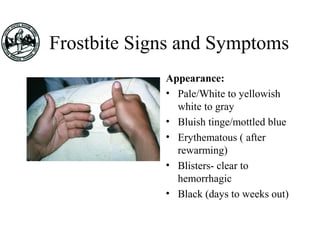
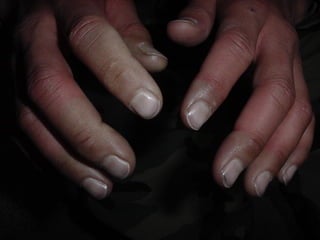
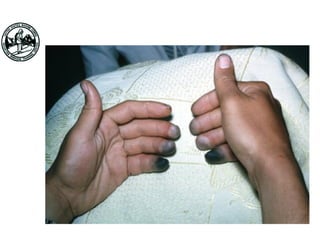
Appearance:
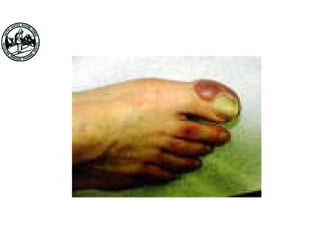
• Pale/White to yellowish
white to gray
• Bluish tinge/mottled blue
• Erythematous ( after
rewarming)
• Blisters- clear to
hemorrhagic
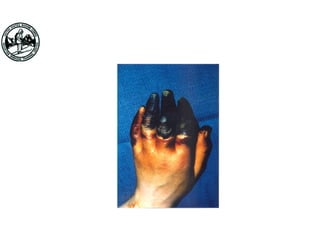
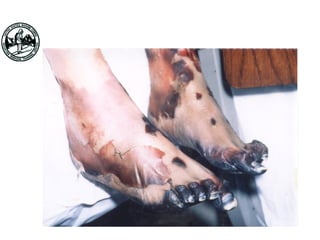
• Black (days to weeks out)
Frostbite Signs and Symptoms
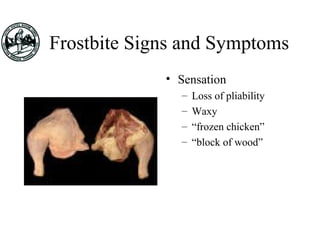
• Sensation
– Loss of pliability
– Waxy
– “frozen chicken”
– “block of wood”
Late Frostbite Signs and
Symptoms
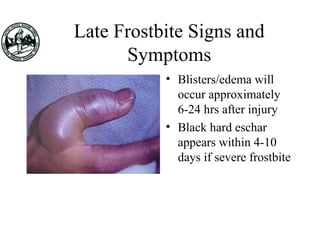
• Blisters/edema will
occur approximately
6-24 hrs after injury
• Black hard eschar
appears within 4-10
days if severe frostbite
Frostbite Classification
• Classification must be done retrospectively.
• 1st- Erythema, edema, tingling, burning.
• 2nd- CLEAR BLISTERS, edema,
anesthesia or paresthesias.
• 3rd- Entire thickness of skin and
subcutaneous tissue. Hemorrhagic blisters.
• 4th- Entire thickness of skin including bone.
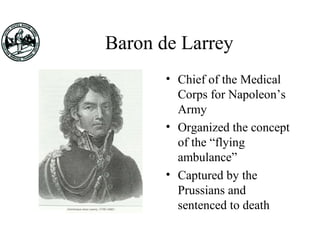
Baron de Larrey
• Chief of the Medical
Corps for Napoleon’s
Army
• Organized the concept
of the “flying
ambulance”
• Captured by the
Prussians and
sentenced to death
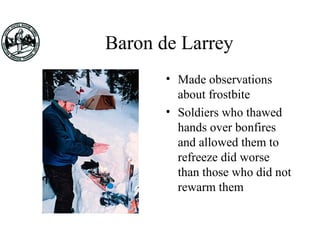
Baron de Larrey
• Made observations
about frostbite
• Soldiers who thawed
hands over bonfires
and allowed them to
refreeze did worse
than those who did not
rewarm them
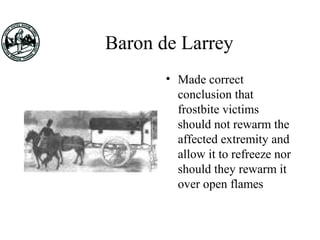
Baron de Larrey
• Made correct
conclusion that
frostbite victims
should not rewarm the
affected extremity and
allow it to refreeze nor
should they rewarm it
over open flames
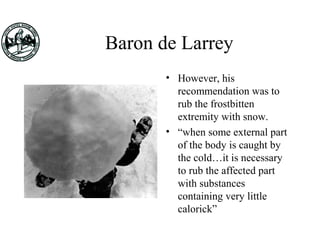
Baron de Larrey
• However, his
recommendation was to
rub the frostbitten
extremity with snow.
• “when some external part
of the body is caught by
the cold…it is necessary
to rub the affected part
with substances
containing very little
calorick”
Primary Consideration
• Do not rewarm the extremity if there is a
chance of it refreezing.
• This will greatly increase the amount of
tissue damage.
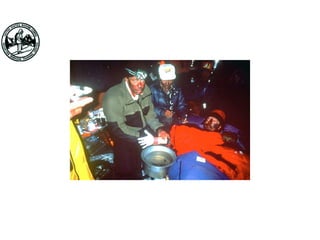
Field Treatment
(Frostbite)
• Rapid rewarming produces the best results.
• Immersion of the affected part in warm
water.
• Water temperature: 99-102 (F) until tissues
of distal extremities are flush
• This is extremely painful: NARCOTIC
ANALGESIA.
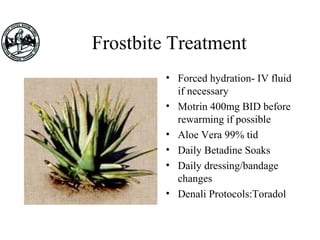
Frostbite Treatment
• Forced hydration- IV fluid
if necessary
• Motrin 400mg BID before
rewarming if possible
• Aloe Vera 99% tid
• Daily Betadine Soaks
• Daily dressing/bandage
changes
• Denali Protocols:Toradol
Frostbite Treatment
• No nicotine
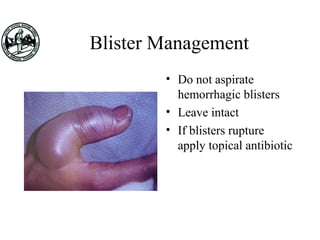
Blister Management
• Do not aspirate
hemorrhagic blisters
• Leave intact
• If blisters rupture
apply topical antibiotic
Amputation
• Keep orthopedic surgeons away from
patient
• Amputate late
Experimental Treatments
• Vasodilators
• Heparin
• Hyperbaric oxygen
• Topical nitrates
Favorable Signs
(Frostbite)
• Warmth of tissue.
• Normal tissue color.
• Preservation of sensation.
• Blisters extending all the way distally on
the affected part.
• Edema persisting more than 24 hours.
• Good capillary refill.
Unfavorable Signs
• These signs indicate a poor prognosis with
probable tissue loss.
– Complete absence of edema.
– Cyanotic tissue.
– Continued loss of sensation.
– Affected areas continue to stay cold.
QUESTIONS?
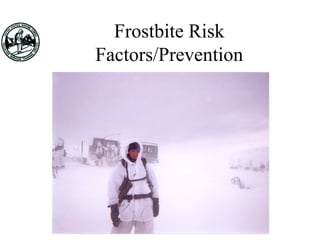
Frostbite Risk
Factors/Prevention
Frostbite Risk
Factors/Prevention
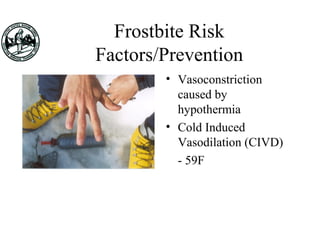
• Vasoconstriction
caused by
hypothermia
• Cold Induced
Vasodilation (CIVD)
- 59F
Frostbite Risk
Factors/Prevention
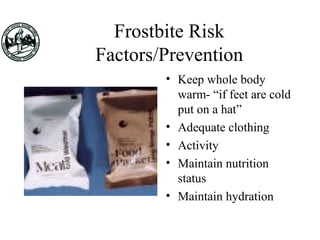
• Keep whole body
warm- “if feet are cold
put on a hat”
• Adequate clothing
• Activity
• Maintain nutrition
status
• Maintain hydration
Frostbite Risk
Factors/Prevention
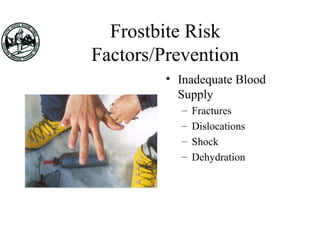
• Inadequate Blood
Supply
– Fractures
– Dislocations
– Shock
– Dehydration
Frostbite Risk
Factors/Prevention
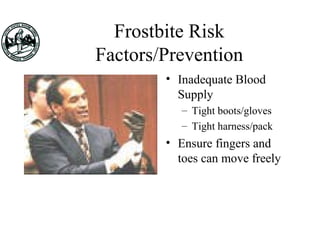
• Inadequate Blood
Supply
– Tight boots/gloves
– Tight harness/pack
• Ensure fingers and
toes can move freely
Frostbite Risk
Factors/Prevention
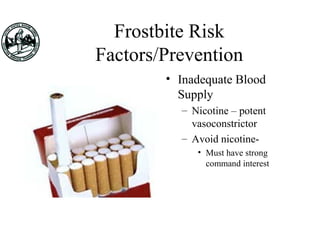
• Inadequate Blood
Supply
– Nicotine – potent
vasoconstrictor
– Avoid nicotine-
• Must have strong
command interest
Frostbite Risk
Factors/Prevention
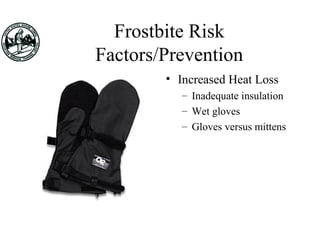
• Increased Heat Loss
– Inadequate insulation
– Wet gloves
– Gloves versus mittens
Frostbite Risk
Factors/Prevention
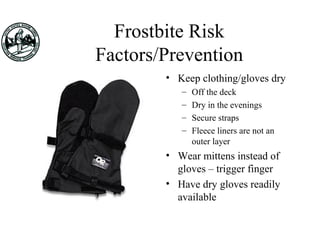
• Keep clothing/gloves dry
– Off the deck
– Dry in the evenings
– Secure straps
– Fleece liners are not an
outer layer
• Wear mittens instead of
gloves – trigger finger
• Have dry gloves readily
available
Frostbite Risk
Factors/Prevention
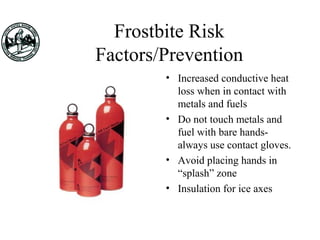
• Increased conductive heat
loss when in contact with
metals and fuels
• Do not touch metals and
fuel with bare hands-
always use contact gloves.
• Avoid placing hands in
“splash” zone
• Insulation for ice axes
Rewarming Cold Hands
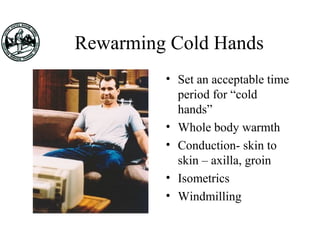
• Set an acceptable time
period for “cold
hands”
• Whole body warmth
• Conduction- skin to
skin – axilla, groin
• Isometrics
• Windmilling
Frostbite Risk
Factors/Prevention
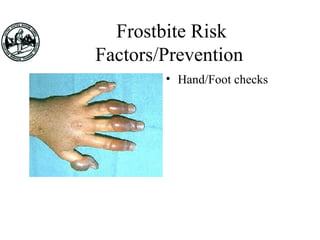
• Hand/Foot checks
Frostbite Risk
Factors/Prevention
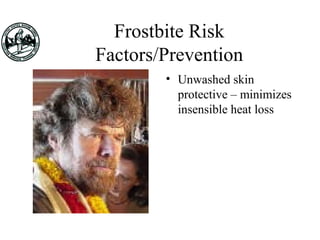
• Unwashed skin
protective – minimizes
insensible heat loss
Frostbite Risk
Factors/Prevention
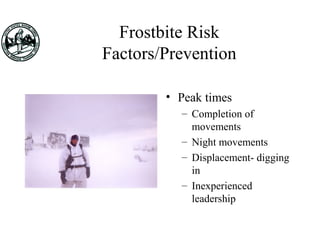
• Peak times
– Completion of
movements
– Night movements
– Displacement- digging
in
– Inexperienced
leadership
Questions?
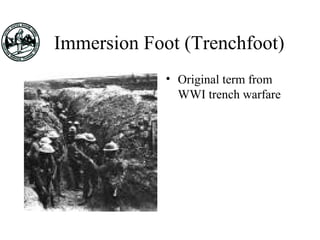
Immersion Foot (Trenchfoot)
• Original term from
WWI trench warfare
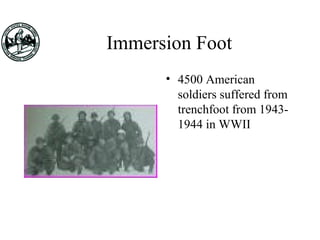
Immersion Foot
• 4500 American
soldiers suffered from
trenchfoot from 1943-
1944 in WWII
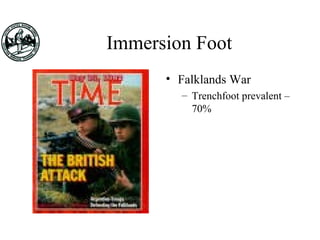
Immersion Foot
• Falklands War
– Trenchfoot prevalent –
70%
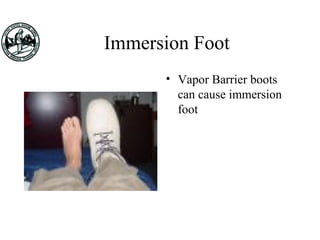
Immersion Foot
• Vapor Barrier boots
can cause immersion
foot
IMMERSION FOOT
• DEFINITION: Immersion foot is a non-
freezing injury of the extremities in which
the tissues are damaged.
Mechanism of Injury
• Occurs in wet cold (nonfreezing)
environment
• Prolonged exposure
• Cold induced vasoconstriction
– Nerve Injury
– Epidermal Damage
– ? Reperfusion Injury
Timeline of Injury- Signs and
Symptoms
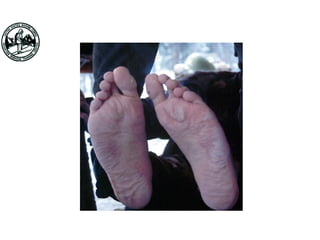
• Prehyperemic Phase
– “cold and numb”
– Pulses may be initially absent
– Blanched, yellowish/white appearance
– “walking on wooden limbs”
Timeline of Injury- Signs and
Symptoms
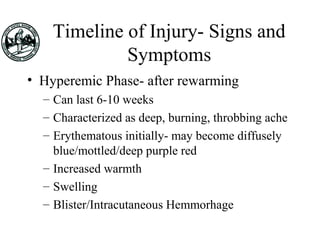
• Hyperemic Phase- after rewarming
– Can last 6-10 weeks
– Characterized as deep, burning, throbbing ache
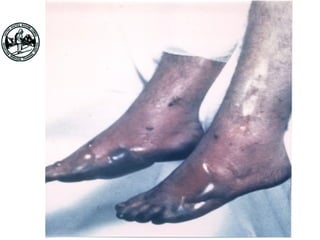
– Erythematous initially- may become diffusely
blue/mottled/deep purple red
– Increased warmth
– Swelling
– Blister/Intracutaneous Hemmorhage
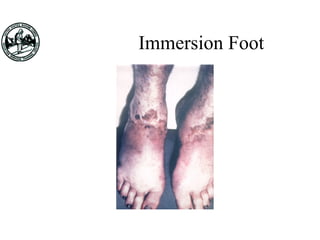
Immersion Foot
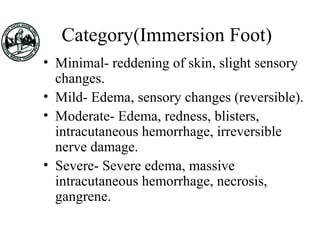
Category(Immersion Foot)
• Minimal- reddening of skin, slight sensory
changes.
• Mild- Edema, sensory changes (reversible).
• Moderate- Edema, redness, blisters,
intracutaneous hemorrhage, irreversible
nerve damage.
• Severe- Severe edema, massive
intracutaneous hemorrhage, necrosis,
gangrene.
Field Treatment
(Immersion Foot)
• Pat drying of extremity.
• Gentle rewarming- damage may occur secondary
to reperfusion.
• Elevation of affected extremity.
• Bed rest.
• Treatment after this is supportive.
– debridement, resection.
– tetanus booster.
– no nicotine.
Treatment of Immersion Foot
• Significant Risk of Infection
• Pain is difficult to control
– Neurogenic pain
• Wet gangrene-
– Look for fever, increased CPK and leukocytosis.
– Treatment is early surgical intervention and sequential
amputations. Do not put these patients in water!
– Severe chronic pain syndromes may develop.
Prevention
• Change out socks frequently
• Dry out feet at night
• Antiperspirants
• Do not wear boots while in the sleeping
bag!
Review
• Frostbite Definition
• Frostbite Diagnosis / Treatment
• Frostbite Risk Factors / Prevention
• Immersion Foot Definition
• Immersion Foot Diagnosis / Treatment
• Immersion Foot Risk Factors / Prevention

Cold Injuries

  • 1.
    Freezing and NearFreezing Tissue Injuries
  • 2.
    TLO • Given asimulated casualty, treat cold injuries, in accordance with the references.
  • 3.
    ELO’s • From agiven list select the correct definition of frostbite. • From a given list select the correct two mechanisms of injury for frostbite. • From a given list select the correct signs and symptoms of frostbite. • From a given list select the correct favorable post thaw signs of a frostbite injury.
  • 4.
    ELO’s • From agiven list select the correct unfavorable post thaw signs of a frostbite injury. • From a given list select the correct field treatment for frostbite. • From a given list select the correct primary field treatment consideration when treating frostbite in the field.
  • 5.
    ELO’s • From agiven list select the correct methods to reduce the chance of becoming a frostbite casualty. • From a given list select the correct definition of immersion foot. • From a given list select the correct mechanism of injury for immersion foot.
  • 6.
    ELO’s • Given alist of categories and characteristics match the category of immersion foot to its characteristics. • From a given list select the correct field treatment of immersion foot.
  • 7.
  • 8.
    Napoleon Retreats fromRussia • Entered Russia with an army of 250,000 • Retreated with only 20,000 soldiers (only 350 were combat effective) • Temperatures dropped to –38 degrees C
  • 9.
    WWII • In Novemberand December 1942, the Germans performed 15,000 amputations for cold injuries.
  • 10.
    FROSTBITE • Definition: Frostbite isthe actual freezing of tissue.
  • 11.
    Mechanisms of Injury •Actual freezing of the tissues. – Ice crystals form extracellularly and grow by extracting water from the cells. – Cells are injured by dehydration and electrolyte disturbances. – Ice crystals that form intracellularly are much more damaging, but this requires much colder temperature and faster freezing time.
  • 12.
    Mechanisms of injury •Obstruction of blood supply – Cells lining the capillaries and small veins are damaged, this allows serum to leak out into the tissues and activates coagulation cascade – Serum leakage increases viscosity and reduces blood flow. – The reduced fluid volume and activation of coagulation cascade causes obstruction. – This obstructs blood flow and circulation, this produces irreversible damage.
  • 13.
    Frostbite Signs andSymptoms • Sensation – Numbness – Paresthesias – Pain – after extremity is rewarmed
  • 14.
    Frostbite Signs andSymptoms Appearance: • Pale/White to yellowish white to gray • Bluish tinge/mottled blue • Erythematous ( after rewarming) • Blisters- clear to hemorrhagic • Black (days to weeks out)
  • 20.
    Frostbite Signs andSymptoms • Sensation – Loss of pliability – Waxy – “frozen chicken” – “block of wood”
  • 21.
    Late Frostbite Signsand Symptoms • Blisters/edema will occur approximately 6-24 hrs after injury • Black hard eschar appears within 4-10 days if severe frostbite
  • 24.
    Frostbite Classification • Classificationmust be done retrospectively. • 1st- Erythema, edema, tingling, burning. • 2nd- CLEAR BLISTERS, edema, anesthesia or paresthesias. • 3rd- Entire thickness of skin and subcutaneous tissue. Hemorrhagic blisters. • 4th- Entire thickness of skin including bone.
  • 25.
    Baron de Larrey •Chief of the Medical Corps for Napoleon’s Army • Organized the concept of the “flying ambulance” • Captured by the Prussians and sentenced to death
  • 26.
    Baron de Larrey •Made observations about frostbite • Soldiers who thawed hands over bonfires and allowed them to refreeze did worse than those who did not rewarm them
  • 27.
    Baron de Larrey •Made correct conclusion that frostbite victims should not rewarm the affected extremity and allow it to refreeze nor should they rewarm it over open flames
  • 28.
    Baron de Larrey •However, his recommendation was to rub the frostbitten extremity with snow. • “when some external part of the body is caught by the cold…it is necessary to rub the affected part with substances containing very little calorick”
  • 29.
    Primary Consideration • Donot rewarm the extremity if there is a chance of it refreezing. • This will greatly increase the amount of tissue damage.
  • 30.
    Field Treatment (Frostbite) • Rapidrewarming produces the best results. • Immersion of the affected part in warm water. • Water temperature: 99-102 (F) until tissues of distal extremities are flush • This is extremely painful: NARCOTIC ANALGESIA.
  • 32.
    Frostbite Treatment • Forcedhydration- IV fluid if necessary • Motrin 400mg BID before rewarming if possible • Aloe Vera 99% tid • Daily Betadine Soaks • Daily dressing/bandage changes • Denali Protocols:Toradol
  • 33.
  • 34.
    Blister Management • Donot aspirate hemorrhagic blisters • Leave intact • If blisters rupture apply topical antibiotic
  • 35.
    Amputation • Keep orthopedicsurgeons away from patient • Amputate late
  • 36.
    Experimental Treatments • Vasodilators •Heparin • Hyperbaric oxygen • Topical nitrates
  • 37.
    Favorable Signs (Frostbite) • Warmthof tissue. • Normal tissue color. • Preservation of sensation. • Blisters extending all the way distally on the affected part. • Edema persisting more than 24 hours. • Good capillary refill.
  • 38.
    Unfavorable Signs • Thesesigns indicate a poor prognosis with probable tissue loss. – Complete absence of edema. – Cyanotic tissue. – Continued loss of sensation. – Affected areas continue to stay cold.
  • 39.
  • 40.
  • 41.
    Frostbite Risk Factors/Prevention • Vasoconstriction causedby hypothermia • Cold Induced Vasodilation (CIVD) - 59F
  • 42.
    Frostbite Risk Factors/Prevention • Keepwhole body warm- “if feet are cold put on a hat” • Adequate clothing • Activity • Maintain nutrition status • Maintain hydration
  • 43.
    Frostbite Risk Factors/Prevention • InadequateBlood Supply – Fractures – Dislocations – Shock – Dehydration
  • 44.
    Frostbite Risk Factors/Prevention • InadequateBlood Supply – Tight boots/gloves – Tight harness/pack • Ensure fingers and toes can move freely
  • 45.
    Frostbite Risk Factors/Prevention • InadequateBlood Supply – Nicotine – potent vasoconstrictor – Avoid nicotine- • Must have strong command interest
  • 46.
    Frostbite Risk Factors/Prevention • IncreasedHeat Loss – Inadequate insulation – Wet gloves – Gloves versus mittens
  • 47.
    Frostbite Risk Factors/Prevention • Keepclothing/gloves dry – Off the deck – Dry in the evenings – Secure straps – Fleece liners are not an outer layer • Wear mittens instead of gloves – trigger finger • Have dry gloves readily available
  • 48.
    Frostbite Risk Factors/Prevention • Increasedconductive heat loss when in contact with metals and fuels • Do not touch metals and fuel with bare hands- always use contact gloves. • Avoid placing hands in “splash” zone • Insulation for ice axes
  • 49.
    Rewarming Cold Hands •Set an acceptable time period for “cold hands” • Whole body warmth • Conduction- skin to skin – axilla, groin • Isometrics • Windmilling
  • 50.
  • 51.
    Frostbite Risk Factors/Prevention • Unwashedskin protective – minimizes insensible heat loss
  • 52.
    Frostbite Risk Factors/Prevention • Peaktimes – Completion of movements – Night movements – Displacement- digging in – Inexperienced leadership
  • 53.
  • 54.
    Immersion Foot (Trenchfoot) •Original term from WWI trench warfare
  • 55.
    Immersion Foot • 4500American soldiers suffered from trenchfoot from 1943- 1944 in WWII
  • 56.
    Immersion Foot • FalklandsWar – Trenchfoot prevalent – 70%
  • 57.
    Immersion Foot • VaporBarrier boots can cause immersion foot
  • 58.
    IMMERSION FOOT • DEFINITION:Immersion foot is a non- freezing injury of the extremities in which the tissues are damaged.
  • 59.
    Mechanism of Injury •Occurs in wet cold (nonfreezing) environment • Prolonged exposure • Cold induced vasoconstriction – Nerve Injury – Epidermal Damage – ? Reperfusion Injury
  • 60.
    Timeline of Injury-Signs and Symptoms • Prehyperemic Phase – “cold and numb” – Pulses may be initially absent – Blanched, yellowish/white appearance – “walking on wooden limbs”
  • 62.
    Timeline of Injury-Signs and Symptoms • Hyperemic Phase- after rewarming – Can last 6-10 weeks – Characterized as deep, burning, throbbing ache – Erythematous initially- may become diffusely blue/mottled/deep purple red – Increased warmth – Swelling – Blister/Intracutaneous Hemmorhage
  • 63.
  • 65.
    Category(Immersion Foot) • Minimal-reddening of skin, slight sensory changes. • Mild- Edema, sensory changes (reversible). • Moderate- Edema, redness, blisters, intracutaneous hemorrhage, irreversible nerve damage. • Severe- Severe edema, massive intracutaneous hemorrhage, necrosis, gangrene.
  • 66.
    Field Treatment (Immersion Foot) •Pat drying of extremity. • Gentle rewarming- damage may occur secondary to reperfusion. • Elevation of affected extremity. • Bed rest. • Treatment after this is supportive. – debridement, resection. – tetanus booster. – no nicotine.
  • 67.
    Treatment of ImmersionFoot • Significant Risk of Infection • Pain is difficult to control – Neurogenic pain • Wet gangrene- – Look for fever, increased CPK and leukocytosis. – Treatment is early surgical intervention and sequential amputations. Do not put these patients in water! – Severe chronic pain syndromes may develop.
  • 68.
    Prevention • Change outsocks frequently • Dry out feet at night • Antiperspirants • Do not wear boots while in the sleeping bag!
  • 69.
    Review • Frostbite Definition •Frostbite Diagnosis / Treatment • Frostbite Risk Factors / Prevention • Immersion Foot Definition • Immersion Foot Diagnosis / Treatment • Immersion Foot Risk Factors / Prevention

Editor's Notes
  • #9 Only one major engagement between the Russians and French- the Russian peasants enacted a “scorched earth” policy – burning crops and killing livestock and throwing them into the wells- cutting off all logistical support for the French.
  • #11 Debate- however the tissue is between 27-29 degrees F before it freezes
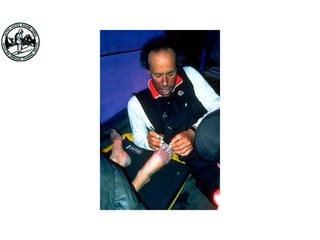
  • #17 Barry Bishop, one of the first Americans to summit Everest- afterwards
  • #18 Ken Kamler MD treating Makalu Gau- picking out bits of sock. For more details read “Doc on Everest” by Kamler or “Into Thin Air” by Jon Krakauer
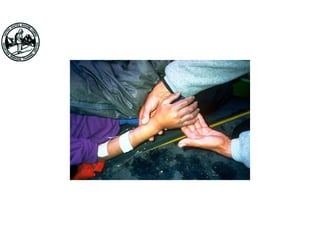
  • #19 Once again – Makalu Gau
  • #21 Waxy- smooth and hard as if the fingers have been dipped in wax.
  • #26 However he was freed when the Prussian battalion surgeon recognized him as a former attending when he was a med student and pleaded with his father (and the battalion commander) for his release
  • #30 William Mills reports that this is by far the worst category of frostbite he has ever seen- 2nd worst was frostbitten tissue warmed over a flame
  • #32 Beck Weathers and Ken Kamler- see “Into Thin Air” and “Doc on Everest” – Beck Weathers also wrote a book entitled “Left for Dead”
  • #34 Potent vasocontrictor
  • #37 None of these really work well
  • #38 Need blood flow in order to form blisters
  • #41 Failed 40 km ski march in central Norway- this is the turn around point.
  • #42 CIVD – otherwise know as Hunter’s Reflex. This can be trained. More pronounced in Eskimos and Laplanders.
  • #43 Hypothermia equals peripheral vasoconstriction making one vulnerable to frostbite.
  • #45 Avoid tight mountaineering boots- be able to move toes freely.
  • #47 When possible remove trigger finger and place with rest of mitten
  • #49 Hackett had a good story where it was 20 below on Denali and he reached for a metal flask of booze outside of his tent- until he realized that the flask was stuck to his lips – he then took a swig to gather up the courage to rip off the flask and nearly got frostbite on his esophagus and the worst brain freeze imaginable.
  • #50 Know when to stop training and get your hands warm. Windmilling for 1 minute provides 250mm Hg of blood pressure to distal extremities.
  • #51 Daily.
  • #53 Anything with movement (sweating) which leads to hypothermia/exhaustion poor judgement or digging (wet gloves) or movement at night (cold temps, longer exposure when adjusting bindings)
  • #57 The Falklands are peat bogs are the Brits were constantly on the move – unable to change socks. There are still trenchfoot clinics in Britain for Falkland War vets.