Hypothermia and Frostbite
1
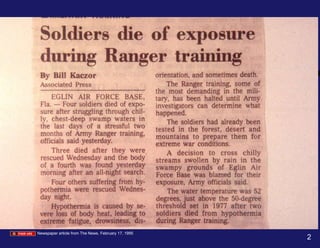
Newspaper article from The News. February 17, 1995
2
Hypothermia
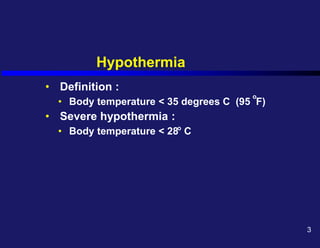
• Definition :
• Body temperature < 35 degrees C (95 F)
• Severe hypothermia :
• Body temperature < 28 C
o
o
3
Hypothermia : Disjointed Facts
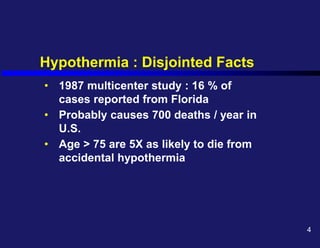
• 1987 multicenter study : 16 % of
cases reported from Florida
• Probably causes 700 deaths / year in
U.S.
• Age > 75 are 5X as likely to die from
accidental hypothermia
4
Hypothermia : Mortality
• If severe trauma and hypothermic : 69 %
mortality
• Mild (> 32 C) hypothermia : 0 to 10 %
mortality
• If underlying disease : up to 90 % mortality
• Presence of ETOH : not correlated
o
5
Hypothermia : Body Heat Production
• 1/2 of body heat generated by the
liver, heart and brain
• At rest, muscle contributes 25 %
• Exposure to cold leads to increase in
muscle tone which increases body
heat production by 50 to 100 %
• Shivering increases body heat
production 400 %
6
Hypothermia : Body Heat Dissipation
• Radiation (infrared) : 65 %
• Conduction : increased 25X by water
immersion
• Convection : loss by air currents ("wind
chill")
• Evaporation : 20 to 30 %
7
Conditions Predisposing to Hypothermia
1. Extremes of age
2. Metabolic diseases
Hypothyroidism
Diabetes
Renal failure
Hypoadrenalism
3. CNS diseases
Cerebrovascular disease
Any degenerative CNS
disease
Head trauma
Parkinson's
4. Shock
AMI / CHF
Hemorrhage
5. Malnutrition
6. Drugs
Any CNS depressant
ETOH
7. Dermal diseases
8. Paget's disease
9. Infections
10. Pancreatitis
8
Causes of Vulnerability to Hypothermia
by the Elderly
• Lack of ability to shiver
• Thinner epidermis ; less effective
insulator
• Lack of cardiovascular reserve for
compensation
• Tendency toward baseline
dehydration
• Movement impairment
• Effects of concurrent medications
9
Other Potential Effects of Exposure to Cold
• Diuresis from decreased reabsorption in the kidney
• Greater susceptibility to viral infections
• Greater risk of pneumonia
• Increased incidence of acute M.I. in the winter
• Sudden breathing of very cold air can provoke angina
; may be partially preventable by wearing cloth mask
over face
• Remember also the increased incidence of carbon
monoxide poisoning in the winter from malfunctioning
heaters
10
Time of Onset of Hypothermia
• Onset time depends on temperature differential
between body & environment
• Risk of hypothermia starts at about 65 F (differential
of 30 F) ; time of onset then is > 2 hours to days
• If differential 60 to 70 degrees : time of onset about
one hour
• If differential 100 degrees or more: time of onset just a
few minutes
• If associated with water immersion : time of onset
accelerated
o
o
11
Hypothermia in Trauma Patients
• If occurs, shown to increase mortality compared
to that expected from their Injury Severity Score
(ISS)
• Can occur in just a few minutes after E.D. arrival
• Exacerbated by soak dressings for burns or
wounds
• Often first manifested by sudden coagulopathy &
capillary bleeding
• Always should not just measure temp. early, but
also continue to monitor core temp.
• Can cause "masking" of pain from injuries
12
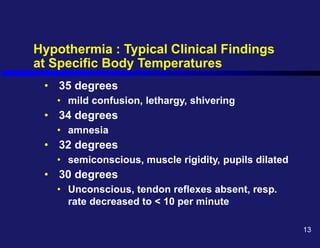
Hypothermia : Typical Clinical Findings
at Specific Body Temperatures
• 35 degrees
• mild confusion, lethargy, shivering
• 34 degrees
• amnesia
• 32 degrees
• semiconscious, muscle rigidity, pupils dilated
• 30 degrees
• Unconscious, tendon reflexes absent, resp.
rate decreased to < 10 per minute
13
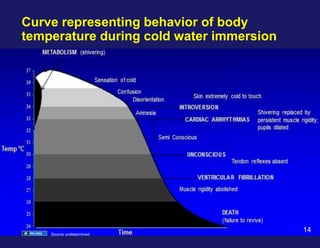
Curve representing behavior of body
temperature during cold water immersion
14
Source undetermined
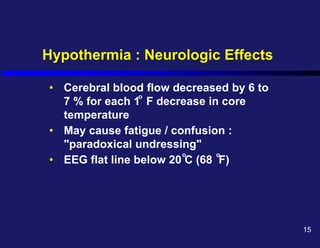
Hypothermia : Neurologic Effects
• Cerebral blood flow decreased by 6 to
7 % for each 1 F decrease in core
temperature
• May cause fatigue / confusion :
"paradoxical undressing"
• EEG flat line below 20 C (68 F)
o
o o
15
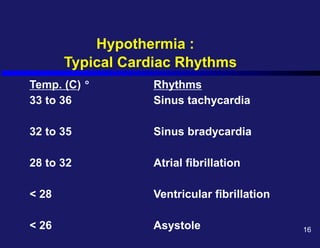
Rhythms
Sinus tachycardia
Sinus bradycardia
Atrial fibrillation
Ventricular fibrillation
Asystole
Temp. (C)
33 to 36
32 to 35
28 to 32
< 28
< 26
Hypothermia :
Typical Cardiac Rhythms
o
16
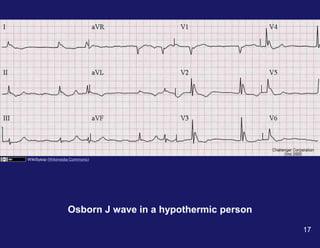
Osborn J wave in a hypothermic person
WikiSysop (Wikimedia Commons)
17
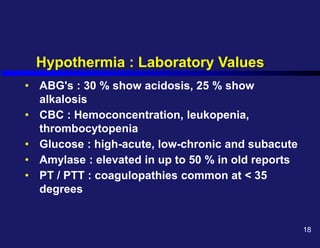
Hypothermia : Laboratory Values
• ABG's : 30 % show acidosis, 25 % show
alkalosis
• CBC : Hemoconcentration, leukopenia,
thrombocytopenia
• Glucose : high-acute, low-chronic and subacute
• Amylase : elevated in up to 50 % in old reports
• PT / PTT : coagulopathies common at < 35
degrees
18
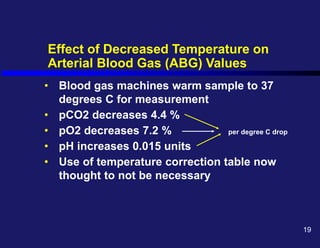
Effect of Decreased Temperature on
Arterial Blood Gas (ABG) Values
• Blood gas machines warm sample to 37
degrees C for measurement
• pCO2 decreases 4.4 %
• pO2 decreases 7.2 % per degree C drop
• pH increases 0.015 units
• Use of temperature correction table now
thought to not be necessary
19
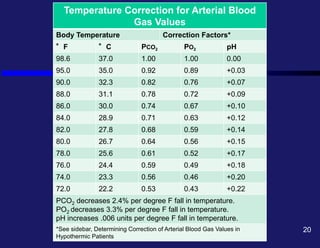
Temperature Correction for Arterial Blood
Gas Values
Body Temperature Correction Factors*
°F °C PCO2 PO2 pH
98.6 37.0 1.00 1.00 0.00
95.0 35.0 0.92 0.89 +0.03
90.0 32.3 0.82 0.76 +0.07
88.0 31.1 0.78 0.72 +0.09
86.0 30.0 0.74 0.67 +0.10
84.0 28.9 0.71 0.63 +0.12
82.0 27.8 0.68 0.59 +0.14
80.0 26.7 0.64 0.56 +0.15
78.0 25.6 0.61 0.52 +0.17
76.0 24.4 0.59 0.49 +0.18
74.0 23.3 0.56 0.46 +0.20
72.0 22.2 0.53 0.43 +0.22
PCO2 decreases 2.4% per degree F fall in temperature.
PO2 decreases 3.3% per degree F fall in temperature.
pH increases .006 units per degree F fall in temperature.
*See sidebar, Determining Correction of Arterial Blood Gas Values in
Hypothermic Patients
20
Acid - Base Status in Hypothermia
• No consistent predictable acid-base pattern is
seen
• Decreased CO2 production but also usually
hypoventilation
• O2 consumption is decreased 50 % at temp.
of 30 degrees C
• Acidosis more prevalent in some series, but
alkalosis found in 1/2 of cases in other series
• Routine use of Na HCO3 not indicated
21
Hematologic Effects of Hypothermia
• Rise in hematocrit
(hemoconcentration)
• Increase in viscosity
• Leukopenia
• Thrombocytopenia
• Altered function of coagulation
proteins
• WBC count not predictive of
presence of infection or of mortality
22
Lab Values Not Consistently
Altered by Hypothermia
• Serum sodium & potassium
• Plasma cortisol
• Serum creatinine (BUN sometimes
increased due to hemoconcentration)
• TSH & T4 levels
• Insulin levels
• Liver & muscle enzymes
• Amylase (some old reports however had
high incidence of pancreatitis)
23
Core Temperature
Measurement Techniques
• Best techniques (in rough order of accuracy) :
• Esophageal
• Thermistor in central IV line or Swan-Ganz catheter
• Tympanic (anesthesia monitoring probe type)
• Urine ; accurate; can be done by thermistor in foley
• Rectal ; lags behind esophageal during rewarming
• Important in all cases to have a low-reading
thermometer (standard oral / rectal mercury
thermometers only go down to 33 to 34 C)
o
24
General Management of the
Hypothermic Patient
• ABC's first ; oxygen always
• Support ventilation
• Obtain accurate temp. by low reading thermometer
• Start rewarming measures
• Rehydrate ; may need to be rate cautious in elderly
patients; may need central line to assess fluid
resuscitation status
• Foley / NG tube
• Continuous core temp. & cardiac monitoring
• Assess for & treat associated illnesses & injuries
• Consider ICU admission
25
Factors to Assess Which Influence the
Severity and Prognosis of Hypothermia
• Body temperature (severe if < 28 degrees C)
• Patient age
• State of consciousness
• Cardiorespiratory status
• Metabolic status
• Associated diseases
• Associated injuries
• Etiology of hypothermia
• Duration of hypothermia
• Response to initial care measures
26
Lab Tests to Consider for Most
Cases of Profound Hypothermia
• ABG +/- carboxyhemoglobin
• CBC, glucose
• Electrolytes, BUN, creatinine, calcium
• PT, PTT, platelets
• Amylase
• Alcohol +/- drug levels
• Thyroid function tests
• Serum cortisol
• Liver function tests, muscle / cardiac
enzymes
• Cultures, etc. if infection suspected
• Type & crossmatch 27
Effect of Hypothermia on Medications
• Antiarrhythmic meds generally ineffective
if core temp. < 30 degrees C
• Few case reports of "chemical
defibrillation" by bretylium at core temp.
< 30 degrees C
• Medications administered early may show
sudden exaggerated effects once core
temp. increases & circulation restored
(especially insulin)
28
• Objective of rewarming :
• Core temperature rise > 1 C per hour
• If this cannot be achieved, then either
more aggressive rewarming measures
need to be done, or the patient is dead &
unresuscitatible
Hypothermia : Rewarming
o
29
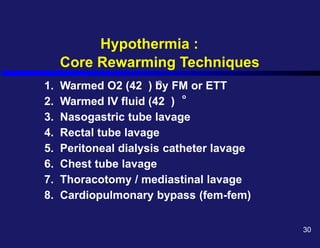
Hypothermia :
Core Rewarming Techniques
1. Warmed O2 (42 ) by FM or ETT
2. Warmed IV fluid (42 )
3. Nasogastric tube lavage
4. Rectal tube lavage
5. Peritoneal dialysis catheter lavage
6. Chest tube lavage
7. Thoracotomy / mediastinal lavage
8. Cardiopulmonary bypass (fem-fem)
o
o
30
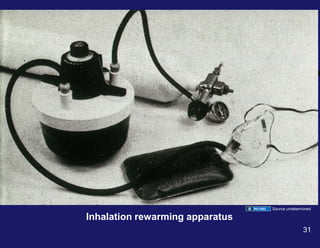
Inhalation rewarming apparatus
Source undetermined
31
Hypothermia :
External Rewarming Techniques
• Warm blankets ; cover scalp
• Warm environment (heat the room or
ambulance)
• Hypo / hyperthermic blanket (water
pump)
• Warm water bath
• Axillary / groin hot packs
32
Disadvantages of Active External
Rewarming as Sole Rewarming Technique
• May cause :
• Core temp. "afterdrop"
• May result in V-fib
• Hypotension / cardiovascular collapse
from peripheral vasodilatation
• Increased hypoxia & acidosis if
peripheral metabolism increases but the
"cold" heart not yet able to compensate
33
"Afterdrop" Phenomenon
• This is defined as a drop in core temperature after
external rewarming is started
• Thought to be due to shunting of cold blood from
the skin & extremities (due to vasodilation induced
by external rewarming) to the core of the body
• Older series reported higher mortality with external
versus passive rewarming, and "afterdrop" was
thought to be the cause
• Some of this mortality may have instead been due to
cardiovascular collapse from hypovolemia from
peripheral vasodilation 34
Core Rewarming by Immersion
• Two early reports of this technique had
respectively zero, and one in 18 mortality
• Uses Hubbard tank with 40 to 42 degree C
water
• All hypothermic patients in one report
were admitted directly to the burn center
• All patients in one series were rewarmed
to 37 degrees C in < 3 hours
35
Hypothermia : Field Care
• Core Temperature < 28 C
• Hold CPR if :
• No monitor available
• Any patient movement observed
• Respiratory rate 4 to 6 breaths / min.
• Sinus bradycardia or atrial fib on monitor
• Pulse present (even if slow)
o
36
Hypothermia : Field Care
• CPR if :
• VF or asystole on monitor
• Arrested and only mild hypothermia (32 to
35 C)
• IV Glucose or checking dextrostick
should be routine (+/- naloxone)
o
o
37
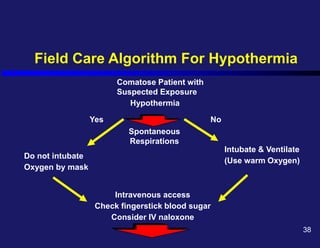
Field Care Algorithm For Hypothermia
Comatose Patient with
Suspected Exposure
Hypothermia
Spontaneous
Respirations
Do not intubate
Oxygen by mask
Intubate & Ventilate
(Use warm Oxygen)
Intravenous access
Check fingerstick blood sugar
Consider IV naloxone
Yes No
38
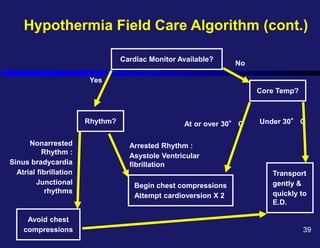
Hypothermia Field Care Algorithm (cont.)
Cardiac Monitor Available?
Nonarrested
Rhythm :
Sinus bradycardia
Atrial fibrillation
Junctional
rhythms
Arrested Rhythm :
Asystole Ventricular
fibrillation
Yes
No
At or over 30° C Under 30° C
39
Rhythm?
Avoid chest
compressions
Begin chest compressions
Attempt cardioversion X 2
Core Temp?
Transport
gently &
quickly to
E.D.
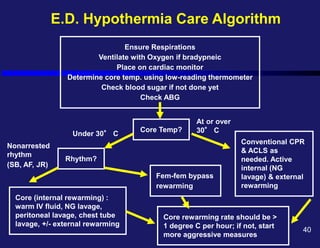
E.D. Hypothermia Care Algorithm
40
Ensure Respirations
Ventilate with Oxygen if bradypneic
Place on cardiac monitor
Determine core temp. using low-reading thermometer
Check blood sugar if not done yet
Check ABG
Rhythm?
Core Temp?
At or over
30° C
Under 30° C
Nonarrested
rhythm
(SB, AF, JR)
Core (internal rewarming) :
warm IV fluid, NG lavage,
peritoneal lavage, chest tube
lavage, +/- external rewarming
Conventional CPR
& ACLS as
needed. Active
internal (NG
lavage) & external
rewarming
Fem-fem bypass
rewarming
Core rewarming rate should be >
1 degree C per hour; if not, start
more aggressive measures
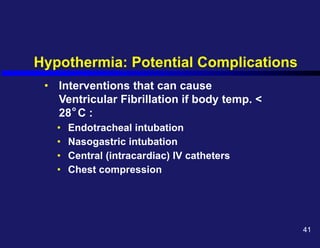
Hypothermia: Potential Complications
• Interventions that can cause
Ventricular Fibrillation if body temp. <
28 C :
• Endotracheal intubation
• Nasogastric intubation
• Central (intracardiac) IV catheters
• Chest compression
o
41
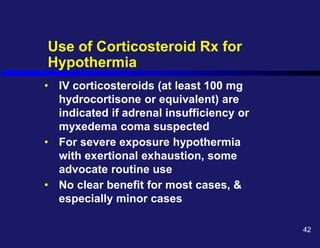
Use of Corticosteroid Rx for
Hypothermia
• IV corticosteroids (at least 100 mg
hydrocortisone or equivalent) are
indicated if adrenal insufficiency or
myxedema coma suspected
• For severe exposure hypothermia
with exertional exhaustion, some
advocate routine use
• No clear benefit for most cases, &
especially minor cases
42
Prevention of Hypothermia in
Trauma Patients
• Warm the trauma resuscitation room
• Should have separate thermostat from rest
of E.D.
• Limit personnel traffic in & out of room
• Heating lamps
• Heating blanket
• Have in place before patient placed on
stretcher
• Warm all IV fluids & blood
• Cover patient's scalp once it is examined
• Maintain coverage of patient's body with
blankets once exam is complete 43
Prevention of Hypothermia in
the Elderly
• Consider home visit by health professional for
environmental assessment
• Improve insulation +/- add storm windows +/- carpeting
• Eliminate air leak drafts
• Check furnace function
• Keep thermostat at 68 degrees F or higher
• Check for adequate bedding material +/- electric blankets
• Wear layers of clothing even when indoors
• Proper nutrition & fluid intake
• Consider alternative supplemental heaters
• Usually hazardous however
44
General Prevention Measures
for Exposure Hypothermia
• Adequate clothing in layers
• Cover scalp
• Avoid alcohol / sedatives
• Limit wind exposure
• Maintain fluid intake
• Change wet clothes promptly
• If getting wet is unavoidable, use wool garments (wool
maintains insulation effect even when wet, unlike cotton)
• Trip planning
• If immersed in cold water, extend survival time by
remaining still, huddling in group, and H.E.L.P. posture
45
Survival Times in 50 F Water
Situation Hours of Survival
No Flotation
Drownproofing
Treading water
1.5
2.0
With Flotation
Swimming
Holding still
H.E.L.P.
Huddle
2.0
2.7
4.0
4.0
o
46
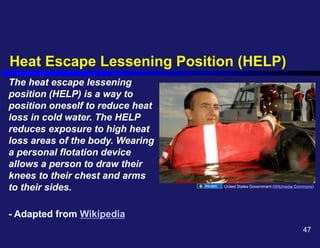
Heat Escape Lessening Position (HELP)
The heat escape lessening
position (HELP) is a way to
position oneself to reduce heat
loss in cold water. The HELP
reduces exposure to high heat
loss areas of the body. Wearing
a personal flotation device
allows a person to draw their
knees to their chest and arms
to their sides.
- Adapted from Wikipedia
United States Government (Wikimedia Commons)
47
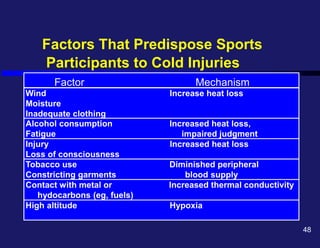
Factors That Predispose Sports
Participants to Cold Injuries
Factor Mechanism
Wind Increase heat loss
Moisture
Inadequate clothing
Alcohol consumption Increased heat loss,
Fatigue impaired judgment
Injury Increased heat loss
Loss of consciousness
Tobacco use Diminished peripheral
Constricting garments blood supply
Contact with metal or Increased thermal conductivity
hydocarbons (eg, fuels)
High altitude Hypoxia
48
Frostbite
• Freezing cold injury = frostbite
• Nonfreezing cold injury
• Trenchfoot (immersion foot) : due to
exposure to wet cold for 1 to 2 days;
causes skin damage like partial
thickness burns ; deep damage rare
• Chilblain (pernio) : due to prolonged
exposure of limb to dry cold : small
painful ulcers over exposed areas
49
Frostnip
• The initial clinical response to cold
(reversible)
• Skin becomes blanched and numb,
followed by sudden cessation of cold &
discomfort
• If treated quickly with rewarming, will
not progress to frostbite
50
Frostbite : Pathophysiology
• Extracellular ice formation
• Intracellular ice formation
• Cell dehydration and shrinkage
• Abnormal intracellular electrolytes
• Thermal shock
• Lipid-protein denaturation
51
Frostbite : Pathophysiology
• Pre-freeze phase (38 to 50 F)
• Vasospasticity and vascular leak
• Freeze-thaw phase (5 to 21 F)
• Ice crystal formation
• Vascular stasis phase
• Blood vessel dilation, coagulation
• Late ischemic phase
• From thrombosis and shunting
o
o
52
Frostbite : Two Types
• Superficial : skin is cold, pale, gray,
bloodless, but pliable and soft
beneath the surface
• Deep : tissue feels woody or stony
• Can diagnose these only prior to
thawing
53
Superficial Frostbite: Clinical Progression
• 24 hours : large clear blisters
• 2 to 7 days : skin blackens,
demarcates (dry gangrene)
• Several months : peels off, revealing
sensitive new skin
54
Deep Frostbite
• May include muscle, bone or tendon
necrosis
• Distal portions remain cold and cyanotic
after rewarming
• Risk of rhabdomyolysis
55
Frostbite : Clinical Presentation
• First degree
• Erythema, yellowish plaque
• Second degree
• Skin vesicles filled with clear or milky fluid
• Third degree
• Skin vesicles filled with bloody fluid
• Fourth degree
• Injury across dermis ; dysfunction and
damage of deep structures
56
Frostbite : Treatment
• Rapid rewarming in 42 C water (do not thaw
in field if refreezing might occur)
• Narcotics
• Tetanus prophylaxis
• Topical antibiotics as for 2nd degree burns
• No debridement surgery for at least several
months unless wet gangrene / infection
occur
• If large amounts of tissue involved, watch for
rhabdomyolysis / renal failure
o
57
Treatments Shown to Not be
Effective for Rx of Frostbite
• Heparin
• Oral anticoagulants
• Dextran
• Surgical sympathectomy
• Steroids
• Vasodilator drugs
58
*Interpret these signs with caution; extent of
injury is often overestimated
Prognostic Signs for the Recovery of
Frostbitten Tissue After Thawing *
Favorable
Sensation to pinprick
Normal color
Warmth of tissues
Early appearance of large,
clear bullae that extend
across the affected part
Unfavorable
Cold, cyanotic distal part
Late appearance of small
dark bullae that do not
extend across the
affected part
Absence of edema
59
Frostbite : Sequelae
• Hyperhydrosis
• Joint stiffness
• Scarring
• Bone injury
• Premature closure of epiphyses
• Nail and nail color abnormalities
• Cold intolerance
60
General Prevention Measures for Frostbite
• Adequate clothing & footwear
• Cover digits & ears
• Limit wind exposure
• Rapidly rewarm area if frostnip occurs
• Don't thaw frostbitten part if refreezing will
occur before accessing medical care
• Avoid weight-bearing on frostbitten foot
prior to accessing medical care
61
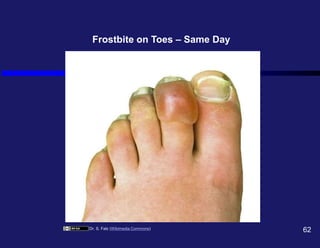
Dr. S. Falz (Wikimedia Commons)
62
Frostbite on Toes – Same Day
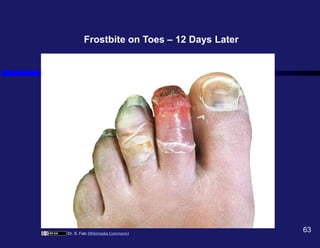
Dr. S. Falz (Wikimedia Commons)
63
Frostbite on Toes – 12 Days Later
Dr. S. Falz (Wikimedia Commons) 64
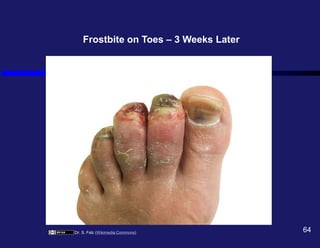
Frostbite on Toes – 3 Weeks Later
James Heilman, MD (Wikimedia Commons)
65
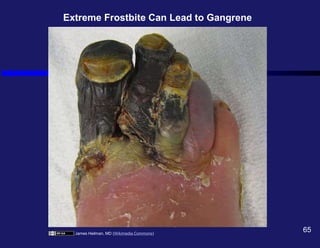
Extreme Frostbite Can Lead to Gangrene
Extensive frostbite of both feet makes the patient at risk
for rhabdomyolysis, which is a condition in which
damaged skeletal muscle tissue breaks down rapidly.
- Adapted from Wikipedia
Extreme frostbite may result in fingers and toes being
amputated if the area becomes infected with gangrene,
which is a condition that arises when considerable mass of
body tissue dies.
- Adapted from Wikipedia (1, 2)
66

hypotherm-oer.ppt

  • 1.
  • 2.
    Newspaper article fromThe News. February 17, 1995 2
  • 3.
    Hypothermia • Definition : •Body temperature < 35 degrees C (95 F) • Severe hypothermia : • Body temperature < 28 C o o 3
  • 4.
    Hypothermia : DisjointedFacts • 1987 multicenter study : 16 % of cases reported from Florida • Probably causes 700 deaths / year in U.S. • Age > 75 are 5X as likely to die from accidental hypothermia 4
  • 5.
    Hypothermia : Mortality •If severe trauma and hypothermic : 69 % mortality • Mild (> 32 C) hypothermia : 0 to 10 % mortality • If underlying disease : up to 90 % mortality • Presence of ETOH : not correlated o 5
  • 6.
    Hypothermia : BodyHeat Production • 1/2 of body heat generated by the liver, heart and brain • At rest, muscle contributes 25 % • Exposure to cold leads to increase in muscle tone which increases body heat production by 50 to 100 % • Shivering increases body heat production 400 % 6
  • 7.
    Hypothermia : BodyHeat Dissipation • Radiation (infrared) : 65 % • Conduction : increased 25X by water immersion • Convection : loss by air currents ("wind chill") • Evaporation : 20 to 30 % 7
  • 8.
    Conditions Predisposing toHypothermia 1. Extremes of age 2. Metabolic diseases Hypothyroidism Diabetes Renal failure Hypoadrenalism 3. CNS diseases Cerebrovascular disease Any degenerative CNS disease Head trauma Parkinson's 4. Shock AMI / CHF Hemorrhage 5. Malnutrition 6. Drugs Any CNS depressant ETOH 7. Dermal diseases 8. Paget's disease 9. Infections 10. Pancreatitis 8
  • 9.
    Causes of Vulnerabilityto Hypothermia by the Elderly • Lack of ability to shiver • Thinner epidermis ; less effective insulator • Lack of cardiovascular reserve for compensation • Tendency toward baseline dehydration • Movement impairment • Effects of concurrent medications 9
  • 10.
    Other Potential Effectsof Exposure to Cold • Diuresis from decreased reabsorption in the kidney • Greater susceptibility to viral infections • Greater risk of pneumonia • Increased incidence of acute M.I. in the winter • Sudden breathing of very cold air can provoke angina ; may be partially preventable by wearing cloth mask over face • Remember also the increased incidence of carbon monoxide poisoning in the winter from malfunctioning heaters 10
  • 11.
    Time of Onsetof Hypothermia • Onset time depends on temperature differential between body & environment • Risk of hypothermia starts at about 65 F (differential of 30 F) ; time of onset then is > 2 hours to days • If differential 60 to 70 degrees : time of onset about one hour • If differential 100 degrees or more: time of onset just a few minutes • If associated with water immersion : time of onset accelerated o o 11
  • 12.
    Hypothermia in TraumaPatients • If occurs, shown to increase mortality compared to that expected from their Injury Severity Score (ISS) • Can occur in just a few minutes after E.D. arrival • Exacerbated by soak dressings for burns or wounds • Often first manifested by sudden coagulopathy & capillary bleeding • Always should not just measure temp. early, but also continue to monitor core temp. • Can cause "masking" of pain from injuries 12
  • 13.
    Hypothermia : TypicalClinical Findings at Specific Body Temperatures • 35 degrees • mild confusion, lethargy, shivering • 34 degrees • amnesia • 32 degrees • semiconscious, muscle rigidity, pupils dilated • 30 degrees • Unconscious, tendon reflexes absent, resp. rate decreased to < 10 per minute 13
  • 14.
    Curve representing behaviorof body temperature during cold water immersion 14 Source undetermined
  • 15.
    Hypothermia : NeurologicEffects • Cerebral blood flow decreased by 6 to 7 % for each 1 F decrease in core temperature • May cause fatigue / confusion : "paradoxical undressing" • EEG flat line below 20 C (68 F) o o o 15
  • 16.
    Rhythms Sinus tachycardia Sinus bradycardia Atrialfibrillation Ventricular fibrillation Asystole Temp. (C) 33 to 36 32 to 35 28 to 32 < 28 < 26 Hypothermia : Typical Cardiac Rhythms o 16
  • 17.
    Osborn J wavein a hypothermic person WikiSysop (Wikimedia Commons) 17
  • 18.
    Hypothermia : LaboratoryValues • ABG's : 30 % show acidosis, 25 % show alkalosis • CBC : Hemoconcentration, leukopenia, thrombocytopenia • Glucose : high-acute, low-chronic and subacute • Amylase : elevated in up to 50 % in old reports • PT / PTT : coagulopathies common at < 35 degrees 18
  • 19.
    Effect of DecreasedTemperature on Arterial Blood Gas (ABG) Values • Blood gas machines warm sample to 37 degrees C for measurement • pCO2 decreases 4.4 % • pO2 decreases 7.2 % per degree C drop • pH increases 0.015 units • Use of temperature correction table now thought to not be necessary 19
  • 20.
    Temperature Correction forArterial Blood Gas Values Body Temperature Correction Factors* °F °C PCO2 PO2 pH 98.6 37.0 1.00 1.00 0.00 95.0 35.0 0.92 0.89 +0.03 90.0 32.3 0.82 0.76 +0.07 88.0 31.1 0.78 0.72 +0.09 86.0 30.0 0.74 0.67 +0.10 84.0 28.9 0.71 0.63 +0.12 82.0 27.8 0.68 0.59 +0.14 80.0 26.7 0.64 0.56 +0.15 78.0 25.6 0.61 0.52 +0.17 76.0 24.4 0.59 0.49 +0.18 74.0 23.3 0.56 0.46 +0.20 72.0 22.2 0.53 0.43 +0.22 PCO2 decreases 2.4% per degree F fall in temperature. PO2 decreases 3.3% per degree F fall in temperature. pH increases .006 units per degree F fall in temperature. *See sidebar, Determining Correction of Arterial Blood Gas Values in Hypothermic Patients 20
  • 21.
    Acid - BaseStatus in Hypothermia • No consistent predictable acid-base pattern is seen • Decreased CO2 production but also usually hypoventilation • O2 consumption is decreased 50 % at temp. of 30 degrees C • Acidosis more prevalent in some series, but alkalosis found in 1/2 of cases in other series • Routine use of Na HCO3 not indicated 21
  • 22.
    Hematologic Effects ofHypothermia • Rise in hematocrit (hemoconcentration) • Increase in viscosity • Leukopenia • Thrombocytopenia • Altered function of coagulation proteins • WBC count not predictive of presence of infection or of mortality 22
  • 23.
    Lab Values NotConsistently Altered by Hypothermia • Serum sodium & potassium • Plasma cortisol • Serum creatinine (BUN sometimes increased due to hemoconcentration) • TSH & T4 levels • Insulin levels • Liver & muscle enzymes • Amylase (some old reports however had high incidence of pancreatitis) 23
  • 24.
    Core Temperature Measurement Techniques •Best techniques (in rough order of accuracy) : • Esophageal • Thermistor in central IV line or Swan-Ganz catheter • Tympanic (anesthesia monitoring probe type) • Urine ; accurate; can be done by thermistor in foley • Rectal ; lags behind esophageal during rewarming • Important in all cases to have a low-reading thermometer (standard oral / rectal mercury thermometers only go down to 33 to 34 C) o 24
  • 25.
    General Management ofthe Hypothermic Patient • ABC's first ; oxygen always • Support ventilation • Obtain accurate temp. by low reading thermometer • Start rewarming measures • Rehydrate ; may need to be rate cautious in elderly patients; may need central line to assess fluid resuscitation status • Foley / NG tube • Continuous core temp. & cardiac monitoring • Assess for & treat associated illnesses & injuries • Consider ICU admission 25
  • 26.
    Factors to AssessWhich Influence the Severity and Prognosis of Hypothermia • Body temperature (severe if < 28 degrees C) • Patient age • State of consciousness • Cardiorespiratory status • Metabolic status • Associated diseases • Associated injuries • Etiology of hypothermia • Duration of hypothermia • Response to initial care measures 26
  • 27.
    Lab Tests toConsider for Most Cases of Profound Hypothermia • ABG +/- carboxyhemoglobin • CBC, glucose • Electrolytes, BUN, creatinine, calcium • PT, PTT, platelets • Amylase • Alcohol +/- drug levels • Thyroid function tests • Serum cortisol • Liver function tests, muscle / cardiac enzymes • Cultures, etc. if infection suspected • Type & crossmatch 27
  • 28.
    Effect of Hypothermiaon Medications • Antiarrhythmic meds generally ineffective if core temp. < 30 degrees C • Few case reports of "chemical defibrillation" by bretylium at core temp. < 30 degrees C • Medications administered early may show sudden exaggerated effects once core temp. increases & circulation restored (especially insulin) 28
  • 29.
    • Objective ofrewarming : • Core temperature rise > 1 C per hour • If this cannot be achieved, then either more aggressive rewarming measures need to be done, or the patient is dead & unresuscitatible Hypothermia : Rewarming o 29
  • 30.
    Hypothermia : Core RewarmingTechniques 1. Warmed O2 (42 ) by FM or ETT 2. Warmed IV fluid (42 ) 3. Nasogastric tube lavage 4. Rectal tube lavage 5. Peritoneal dialysis catheter lavage 6. Chest tube lavage 7. Thoracotomy / mediastinal lavage 8. Cardiopulmonary bypass (fem-fem) o o 30
  • 31.
  • 32.
    Hypothermia : External RewarmingTechniques • Warm blankets ; cover scalp • Warm environment (heat the room or ambulance) • Hypo / hyperthermic blanket (water pump) • Warm water bath • Axillary / groin hot packs 32
  • 33.
    Disadvantages of ActiveExternal Rewarming as Sole Rewarming Technique • May cause : • Core temp. "afterdrop" • May result in V-fib • Hypotension / cardiovascular collapse from peripheral vasodilatation • Increased hypoxia & acidosis if peripheral metabolism increases but the "cold" heart not yet able to compensate 33
  • 34.
    "Afterdrop" Phenomenon • Thisis defined as a drop in core temperature after external rewarming is started • Thought to be due to shunting of cold blood from the skin & extremities (due to vasodilation induced by external rewarming) to the core of the body • Older series reported higher mortality with external versus passive rewarming, and "afterdrop" was thought to be the cause • Some of this mortality may have instead been due to cardiovascular collapse from hypovolemia from peripheral vasodilation 34
  • 35.
    Core Rewarming byImmersion • Two early reports of this technique had respectively zero, and one in 18 mortality • Uses Hubbard tank with 40 to 42 degree C water • All hypothermic patients in one report were admitted directly to the burn center • All patients in one series were rewarmed to 37 degrees C in < 3 hours 35
  • 36.
    Hypothermia : FieldCare • Core Temperature < 28 C • Hold CPR if : • No monitor available • Any patient movement observed • Respiratory rate 4 to 6 breaths / min. • Sinus bradycardia or atrial fib on monitor • Pulse present (even if slow) o 36
  • 37.
    Hypothermia : FieldCare • CPR if : • VF or asystole on monitor • Arrested and only mild hypothermia (32 to 35 C) • IV Glucose or checking dextrostick should be routine (+/- naloxone) o o 37
  • 38.
    Field Care AlgorithmFor Hypothermia Comatose Patient with Suspected Exposure Hypothermia Spontaneous Respirations Do not intubate Oxygen by mask Intubate & Ventilate (Use warm Oxygen) Intravenous access Check fingerstick blood sugar Consider IV naloxone Yes No 38
  • 39.
    Hypothermia Field CareAlgorithm (cont.) Cardiac Monitor Available? Nonarrested Rhythm : Sinus bradycardia Atrial fibrillation Junctional rhythms Arrested Rhythm : Asystole Ventricular fibrillation Yes No At or over 30° C Under 30° C 39 Rhythm? Avoid chest compressions Begin chest compressions Attempt cardioversion X 2 Core Temp? Transport gently & quickly to E.D.
  • 40.
    E.D. Hypothermia CareAlgorithm 40 Ensure Respirations Ventilate with Oxygen if bradypneic Place on cardiac monitor Determine core temp. using low-reading thermometer Check blood sugar if not done yet Check ABG Rhythm? Core Temp? At or over 30° C Under 30° C Nonarrested rhythm (SB, AF, JR) Core (internal rewarming) : warm IV fluid, NG lavage, peritoneal lavage, chest tube lavage, +/- external rewarming Conventional CPR & ACLS as needed. Active internal (NG lavage) & external rewarming Fem-fem bypass rewarming Core rewarming rate should be > 1 degree C per hour; if not, start more aggressive measures
  • 41.
    Hypothermia: Potential Complications •Interventions that can cause Ventricular Fibrillation if body temp. < 28 C : • Endotracheal intubation • Nasogastric intubation • Central (intracardiac) IV catheters • Chest compression o 41
  • 42.
    Use of CorticosteroidRx for Hypothermia • IV corticosteroids (at least 100 mg hydrocortisone or equivalent) are indicated if adrenal insufficiency or myxedema coma suspected • For severe exposure hypothermia with exertional exhaustion, some advocate routine use • No clear benefit for most cases, & especially minor cases 42
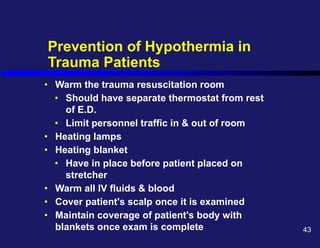
  • 43.
    Prevention of Hypothermiain Trauma Patients • Warm the trauma resuscitation room • Should have separate thermostat from rest of E.D. • Limit personnel traffic in & out of room • Heating lamps • Heating blanket • Have in place before patient placed on stretcher • Warm all IV fluids & blood • Cover patient's scalp once it is examined • Maintain coverage of patient's body with blankets once exam is complete 43
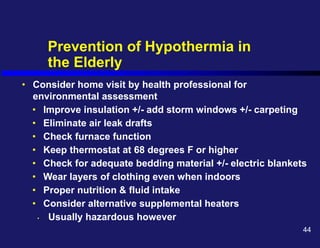
  • 44.
    Prevention of Hypothermiain the Elderly • Consider home visit by health professional for environmental assessment • Improve insulation +/- add storm windows +/- carpeting • Eliminate air leak drafts • Check furnace function • Keep thermostat at 68 degrees F or higher • Check for adequate bedding material +/- electric blankets • Wear layers of clothing even when indoors • Proper nutrition & fluid intake • Consider alternative supplemental heaters • Usually hazardous however 44
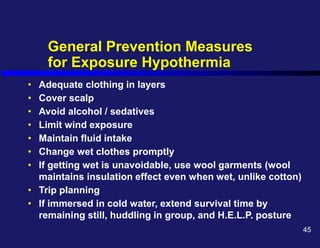
  • 45.
    General Prevention Measures forExposure Hypothermia • Adequate clothing in layers • Cover scalp • Avoid alcohol / sedatives • Limit wind exposure • Maintain fluid intake • Change wet clothes promptly • If getting wet is unavoidable, use wool garments (wool maintains insulation effect even when wet, unlike cotton) • Trip planning • If immersed in cold water, extend survival time by remaining still, huddling in group, and H.E.L.P. posture 45
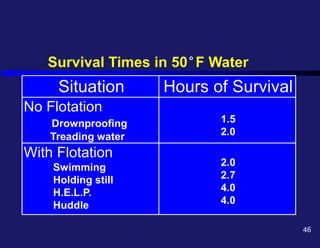
  • 46.
    Survival Times in50 F Water Situation Hours of Survival No Flotation Drownproofing Treading water 1.5 2.0 With Flotation Swimming Holding still H.E.L.P. Huddle 2.0 2.7 4.0 4.0 o 46
  • 47.
    Heat Escape LesseningPosition (HELP) The heat escape lessening position (HELP) is a way to position oneself to reduce heat loss in cold water. The HELP reduces exposure to high heat loss areas of the body. Wearing a personal flotation device allows a person to draw their knees to their chest and arms to their sides. - Adapted from Wikipedia United States Government (Wikimedia Commons) 47
  • 48.
    Factors That PredisposeSports Participants to Cold Injuries Factor Mechanism Wind Increase heat loss Moisture Inadequate clothing Alcohol consumption Increased heat loss, Fatigue impaired judgment Injury Increased heat loss Loss of consciousness Tobacco use Diminished peripheral Constricting garments blood supply Contact with metal or Increased thermal conductivity hydocarbons (eg, fuels) High altitude Hypoxia 48
  • 49.
    Frostbite • Freezing coldinjury = frostbite • Nonfreezing cold injury • Trenchfoot (immersion foot) : due to exposure to wet cold for 1 to 2 days; causes skin damage like partial thickness burns ; deep damage rare • Chilblain (pernio) : due to prolonged exposure of limb to dry cold : small painful ulcers over exposed areas 49
  • 50.
    Frostnip • The initialclinical response to cold (reversible) • Skin becomes blanched and numb, followed by sudden cessation of cold & discomfort • If treated quickly with rewarming, will not progress to frostbite 50
  • 51.
    Frostbite : Pathophysiology •Extracellular ice formation • Intracellular ice formation • Cell dehydration and shrinkage • Abnormal intracellular electrolytes • Thermal shock • Lipid-protein denaturation 51
  • 52.
    Frostbite : Pathophysiology •Pre-freeze phase (38 to 50 F) • Vasospasticity and vascular leak • Freeze-thaw phase (5 to 21 F) • Ice crystal formation • Vascular stasis phase • Blood vessel dilation, coagulation • Late ischemic phase • From thrombosis and shunting o o 52
  • 53.
    Frostbite : TwoTypes • Superficial : skin is cold, pale, gray, bloodless, but pliable and soft beneath the surface • Deep : tissue feels woody or stony • Can diagnose these only prior to thawing 53
  • 54.
    Superficial Frostbite: ClinicalProgression • 24 hours : large clear blisters • 2 to 7 days : skin blackens, demarcates (dry gangrene) • Several months : peels off, revealing sensitive new skin 54
  • 55.
    Deep Frostbite • Mayinclude muscle, bone or tendon necrosis • Distal portions remain cold and cyanotic after rewarming • Risk of rhabdomyolysis 55
  • 56.
    Frostbite : ClinicalPresentation • First degree • Erythema, yellowish plaque • Second degree • Skin vesicles filled with clear or milky fluid • Third degree • Skin vesicles filled with bloody fluid • Fourth degree • Injury across dermis ; dysfunction and damage of deep structures 56
  • 57.
    Frostbite : Treatment •Rapid rewarming in 42 C water (do not thaw in field if refreezing might occur) • Narcotics • Tetanus prophylaxis • Topical antibiotics as for 2nd degree burns • No debridement surgery for at least several months unless wet gangrene / infection occur • If large amounts of tissue involved, watch for rhabdomyolysis / renal failure o 57
  • 58.
    Treatments Shown toNot be Effective for Rx of Frostbite • Heparin • Oral anticoagulants • Dextran • Surgical sympathectomy • Steroids • Vasodilator drugs 58
  • 59.
    *Interpret these signswith caution; extent of injury is often overestimated Prognostic Signs for the Recovery of Frostbitten Tissue After Thawing * Favorable Sensation to pinprick Normal color Warmth of tissues Early appearance of large, clear bullae that extend across the affected part Unfavorable Cold, cyanotic distal part Late appearance of small dark bullae that do not extend across the affected part Absence of edema 59
  • 60.
    Frostbite : Sequelae •Hyperhydrosis • Joint stiffness • Scarring • Bone injury • Premature closure of epiphyses • Nail and nail color abnormalities • Cold intolerance 60
  • 61.
    General Prevention Measuresfor Frostbite • Adequate clothing & footwear • Cover digits & ears • Limit wind exposure • Rapidly rewarm area if frostnip occurs • Don't thaw frostbitten part if refreezing will occur before accessing medical care • Avoid weight-bearing on frostbitten foot prior to accessing medical care 61
  • 62.
    Dr. S. Falz(Wikimedia Commons) 62 Frostbite on Toes – Same Day
  • 63.
    Dr. S. Falz(Wikimedia Commons) 63 Frostbite on Toes – 12 Days Later
  • 64.
    Dr. S. Falz(Wikimedia Commons) 64 Frostbite on Toes – 3 Weeks Later
  • 65.
    James Heilman, MD(Wikimedia Commons) 65 Extreme Frostbite Can Lead to Gangrene
  • 66.
    Extensive frostbite ofboth feet makes the patient at risk for rhabdomyolysis, which is a condition in which damaged skeletal muscle tissue breaks down rapidly. - Adapted from Wikipedia Extreme frostbite may result in fingers and toes being amputated if the area becomes infected with gangrene, which is a condition that arises when considerable mass of body tissue dies. - Adapted from Wikipedia (1, 2) 66