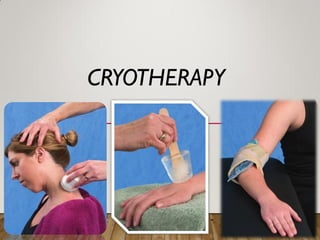
CRYOTHERAPY
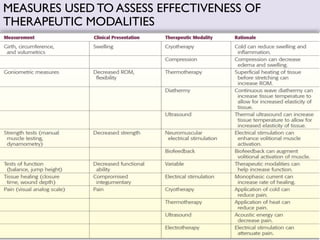
MEASURES USED TO ASSESS EFFECTIVENESS OF
THERAPEUTIC MODALITIES
CRYOTHERAPY
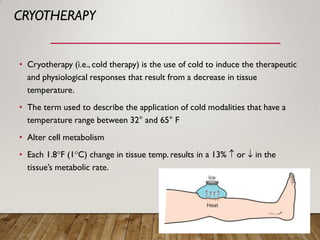
• Cryotherapy (i.e., cold therapy) is the use of cold to induce the therapeutic
and physiological responses that result from a decrease in tissue
temperature.
• The term used to describe the application of cold modalities that have a
temperature range between 32° and 65° F
• Alter cell metabolism
• Each 1.8°F (1°C) change in tissue temp. results in a 13%  or  in the
tissue’s metabolic rate.
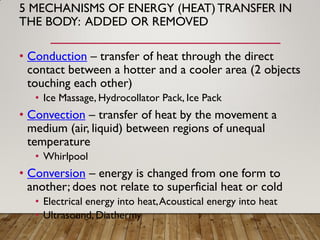
5 MECHANISMS OF ENERGY (HEAT)TRANSFER IN
THE BODY: ADDED OR REMOVED
• Conduction – transfer of heat through the direct
contact between a hotter and a cooler area (2 objects
touching each other)
• Ice Massage, Hydrocollator Pack, Ice Pack
• Convection – transfer of heat by the movement a
medium (air, liquid) between regions of unequal
temperature
• Whirlpool
• Conversion – energy is changed from one form to
another; does not relate to superficial heat or cold
• Electrical energy into heat,Acoustical energy into heat
• Ultrasound, Diathermy
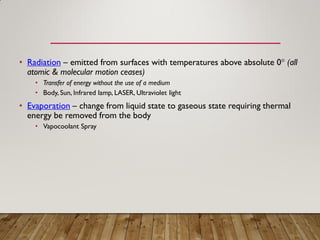
• Radiation – emitted from surfaces with temperatures above absolute 0° (all
atomic & molecular motion ceases)
• Transfer of energy without the use of a medium
• Body, Sun, Infrared lamp, LASER, Ultraviolet light
• Evaporation – change from liquid state to gaseous state requiring thermal
energy be removed from the body
• Vapocoolant Spray
CRYOTHERAPY – COLDTHERAPY
• Heat is removed from the body & absorbed by the
cold modality
• Cryotherapy exerts its therapeutic effects by
influencing hemodynamic, neuromuscular, and
metabolic processes.
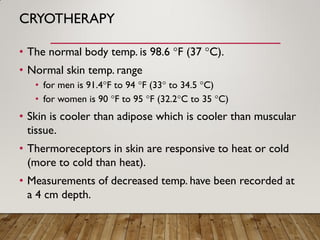
CRYOTHERAPY
• The normal body temp. is 98.6 °F (37 °C).
• Normal skin temp. range
• for men is 91.4°F to 94 °F (33° to 34.5 °C)
• for women is 90 °F to 95 °F (32.2°C to 35 °C)
• Skin is cooler than adipose which is cooler than muscular
tissue.
• Thermoreceptors in skin are responsive to heat or cold
(more to cold than heat).
• Measurements of decreased temp. have been recorded at
a 4 cm depth.
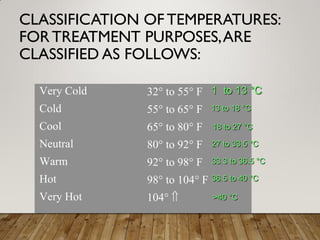
CLASSIFICATION OF TEMPERATURES:
FORTREATMENT PURPOSES,ARE
CLASSIFIED AS FOLLOWS:
Very Cold 32 to 55 F
Cold 55 to 65 F
Cool 65 to 80 F
Neutral 80 to 92 F
Warm 92 to 98 F
Hot 98 to 104 F
Very Hot 104 
Hot
1 to 13 °C
13 to 18 °C
18 to 27 °C
27 to 33.5 °C
33.3 to 36.5 °C
36.5 to 40 °C
>40 °C
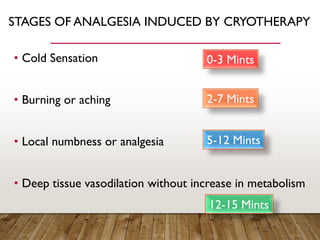
STAGES OF ANALGESIA INDUCED BY CRYOTHERAPY
• Cold Sensation
• Burning or aching
• Local numbness or analgesia
• Deep tissue vasodilation without increase in metabolism
12-15 Mints
0-3 Mints
2-7 Mints
5-12 Mints
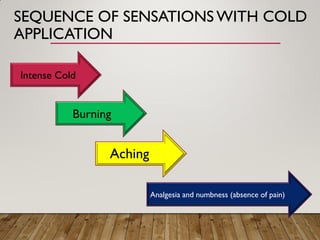
SEQUENCE OF SENSATIONS WITH COLD
APPLICATION
Intense Cold
Burning
Aching
Analgesia and numbness (absence of pain)
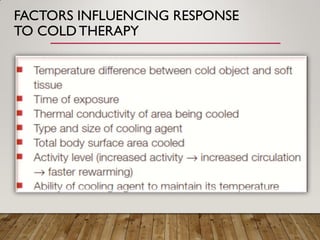
FACTORS INFLUENCING RESPONSE
TO COLDTHERAPY
CRYOTHERAPY CONTRAINDICATIONS
• Cold Hypersensitivity (Cold-induced Urticaria).
• Cryoglobulinemia
• Paroxysmal cold hemoglobinuria
• Raynaud's disease or Raynaud's phenomenon
Contraindications…
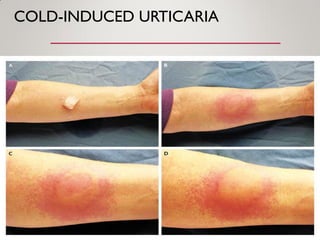
COLD HYPERSENSITIVITY (COLD-INDUCED
URTICARIA).
• Some individuals have a familial or acquired
hypersensitivity to cold that causes them to develop a
vascular skin reaction in response to cold exposure.
• This reaction is marked by the transient appearance of
smooth, slightly elevated patches, which are redder or
more pale than the surrounding skin and are often
attended by severe itching.
• These symptoms can occur only in the area of
application or all over the body.
Contraindications…
COLD-INDUCED URTICARIA
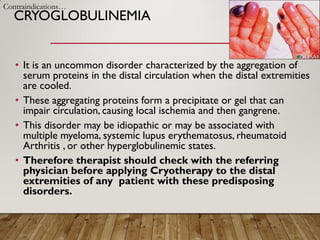
CRYOGLOBULINEMIA
• It is an uncommon disorder characterized by the aggregation of
serum proteins in the distal circulation when the distal extremities
are cooled.
• These aggregating proteins form a precipitate or gel that can
impair circulation, causing local ischemia and then gangrene.
• This disorder may be idiopathic or may be associated with
multiple myeloma, systemic lupus erythematosus, rheumatoid
Arthritis , or other hyperglobulinemic states.
• Therefore therapist should check with the referring
physician before applying Cryotherapy to the distal
extremities of any patient with these predisposing
disorders.
Contraindications…
PAROXYSMAL COLD HEMOGLOBINURIA
• It is the release of hemoglobin into the urine from lysed red
blood cells in response to local or general exposure to cold
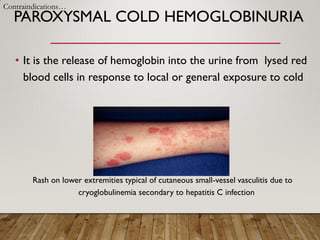
Rash on lower extremities typical of cutaneous small-vessel vasculitis due to
cryoglobulinemia secondary to hepatitis C infection
Contraindications…
RAYNAUD’S DISEASE OR RAYNAUD'S
PHENOMENON
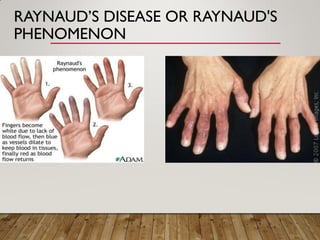
• Raynaud’s Disease It is the primary or idiopathic form of
paroxysmal digital cyanosis
• Raynaud's phenomenon, which is more common, is paroxysmal
digital cyanosis due to some other regional or systemic
disorder.
• Both conditions are characterized by sudden pallor and
cyanosis followed by redness of the skin of the digits
precipitated by cold or emotional upset and relieved
by warmth
• These disorders occur primarily in young women
• In Raynaud's disease the symptoms are bilateral and symmetric
even when cold is applied to only one area
• In Raynaud's phenomenon, the symptoms generally occur only
in the cooled extremity
• Raynaud's phenomenon may be associated with thoracic
outlet syndrome, carpal tunnel syndrome, or trauma.
Contraindications…
RAYNAUD’S DISEASE OR RAYNAUD'S
PHENOMENON
ASKTHE PATIENT:
• Do you have any unsual responses to cold?
• If yes to this question, ask for further details. Include the
following questions:
• Do you develop a rash when cold?
• a sign of cold hypersesnsitivity
• Do you have severe pain, numbness and color changes in
your fingers when expose to cold?
• Signs of Raynaud’s disease/phenomenon
• Do you get blood in your urine after being cold?
• A sign of paroxysmal cold hemoglobinuria
• If the responses are positive then cold should not be
applied
Contraindications…
OVER REGENERATING PERIPHERAL NERVES
• Cryotherapy should not be applied directly over a regenerating peripheral
nerve because local vasoconstriction or altered nerve conduction may delay
nerve regeneration.
Contraindications…
ASKTHE PATIENT:
• Do you have any nerve damage in this area?
• Do you have any numbness or tingling in this limb?
• If so, where?
• ASSESS:
• Test sensation
• In the presence of sensory impairment or other signs of nerve
dysfunction,
• cryotherapy should not be applied directly
over the affected nerve.
Contraindications…
OVER AN AREAWITH CIRCULATORY
COMPROMISE OR
PERIPHERALVASCULAR DISEASE
• Cryotherapy should not be applied over an area with impaired
circulation because it may aggravate the condition by causing
vasoconstriction and increasing blood viscosity.
• Circulatory impairment may be the result of peripheral
vascular disease, trauma to the vessels, or early healing, and is
often associated with edema.
• W hen edema is present, it is important that its cause be
determined, since edema due to inflammation can benefit from
cryotherapy, while edema due to impaired circulation may be
increased
• These causes of edema can be distinguished by observation of
local skin coloration and temperature.
• Edema due to inflammation is characterized by warmth and
redness whereas edema due to poor circulation is
characterized by coolness and pallor.
Contraindications…
ASKTHE PATIENT
• Do you have poor circulation in this limb?
• Assess
• Skin temperature and color
• If the patient has signs of impaired circulation, such as pallor and coolness of the skin in
the area being considered for treatment, cyrotherapy should not be applied.
Contraindications…
CRYOTHERAPY INDICATIONS
• Acute injury or inflammation
• Pain
• Muscle spasm, acute or chronic
• Restoration of ROM
• Small, superficial, 1st degree burns
• Post-surgical pain & edema
• Neuralgia
• Post-exercise
• Decrease Muscle spasiticity
• Reduce Secondary Tissue Injury
PRECAUTIONS
• Over the superficial main branch of a nerve
• Over an open wound
• Hypertension
• In patients with poor sensation or poor mentation
• Very young and very old patients
OVER A SUPERFICIAL MAIN BRANCH OF
A NERVE
• Applying cold directly over the superficial main branch
of a nerve, such as the peronei nerve at the lateral knee
or the radial nerve at the posterolateral elbow, may
cause a nerve conduction b1ock.
• Therefore when applying cryotherapy to such an area,
one should monitor for signs of changes in nerve
conduction, such as distal numbness or tingling, and
discontinue cryotherapy if these occur.
Precautions…
OVER AN OPEN WOUND
• Cryotherapy should not be applied directly over any deep
open wound because it can delay wound healing by reducing
circulation and metabolic rate. as Cryotherapy may be applied
in areas of superficial skin damage.
• however, it is important to realize that this can reduce the
efficacy and safety of the treatment because when there is
superficial skin damage, the cutaneous thermal receptors may
also be damaged or absent.
• These receptors play a part in activating the vasoconstriction,
pain control, and spasticity reduction produced by cryotherapy;
therefore, these responses are likely to be less pronounced
when cryotherapy is applied to areas with superficial skin
damage, caution should also be used if cryotherapy is applied
to such areas because the absence of skin reduces the
insulating protection of the subcutaneous layers and increases
the risk of excessivce cooling to these tissues.
Precautions…
ASSESS:
• Inspect the skin closely for deep wounds, cuts, or abrasions.
• Do not apply cryotherapy in the area of a deep wound, and use less intense
cooling if cuts or abrasions are present
Precautions…
WHENTREATING PATIENTS WITH
HYPERTENSION
• Since cold can cause transient increases in systolic or diastolic blood pressure,
patients with should be carefully monitored during the application of
cryotherapy
• Treatment should be discontinued if blood pressure increases beyond safe
levels
• Treatment.Guidelines for safe blood pressures individual patients should be
obtained from physician.
Precautions…
WHENTREATING PATIENTS WITH POOR
SENSATION OR MENTATION
• Although adverse effects with cryotherapy are rare, if the the patient cannot
sense or report discomfort of other abnormal responses
• The clinician should monitor the patient's response directly.
• Check for adverse response to cold such as abnormal changes in color or
strength, both in the area of cold application and generally.
Precautions…
WHENTREATINGVERYYOUNG AND
VERY OLD
• Caution should be used when applying cryotherapy to the very young or the
very old because these individuals frequently have impaired thermal and a
limited ability to communicate
Precautions…
IMMEDIATE RESPONSE TOTHERMAL
MODALITY
• Mild heat or coolness may produce an analgesic effect in the area of application,it
may reduce local pain or muscle spasm and promote general relaxation.
• If the temperature change is too much then other reactions occur, examples
• Moderate temperature change may serve as a general stimulant that produces an arousing,
invigorating effect.
• If temp. change is too hot or too cold then the experience will be of pain or fear, which will
stimulate the fight or flight responses of eye dilation and changes in facial and skin color, blood
pressure and pulse
LOCAL EFFECTS OF CRYOTHERAPY
•  cell metabolism rate – PRIMARY BENEFIT
•  need for oxygen
• Lowers tissue temperature
• Vasoconstriction
•  production of cellular wastes
• Prevents or limits swelling
•  in pain by  pain threshold
•  in acute & chronic muscle spasm
• Limits area of original injury
• Deeper tissues cool more slowly & to a lesser
extent than skin
• Muscle tissue requires longer to cool than bony areas
• Deeper tissue temps. have been proven to drop for several
minutes following the removal of an ice pack
• Research has shown that deeper tissues remaining at rest
will be cooled for 2 hr or more after a 20- to 30- min. ice
pack application
MUSCLE SPASM
• Cold therapy affects pain threshold
•  nerve conduction velocity by slowing communication at
the synapse
•  pain by reducing the threshold of afferent nerve endings.
•  sensitivity of muscle spindles
• May inhibit the stretch reflex mechanism reducing
muscle spasm & breaking pain-spasm cycle
INFLAMMATION
• Changes in cellular function & blood dynamics
serve to control effects of acute inflammation.
• Cold suppresses the inflammatory response by:
•  the release of inflammatory mediators (histamine,
prostaglandin)
•  prostaglandin synthesis
•  capillary permeability
•  leukocyte/endothelial interaction
•  creatine-kinase activity
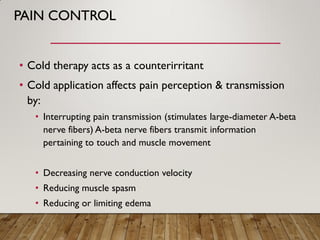
PAIN CONTROL
• Cold therapy acts as a counterirritant
• Cold application affects pain perception & transmission
by:
• Interrupting pain transmission (stimulates large-diameter A-beta
nerve fibers) A-beta nerve fibers transmit information
pertaining to touch and muscle movement
• Decreasing nerve conduction velocity
• Reducing muscle spasm
• Reducing or limiting edema
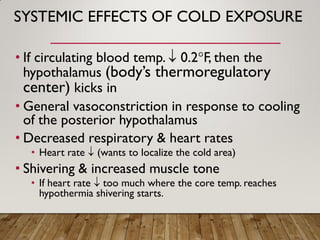
SYSTEMIC EFFECTS OF COLD EXPOSURE
• If circulating blood temp.  0.2°F, then the
hypothalamus (body’s thermoregulatory
center) kicks in
• General vasoconstriction in response to cooling
of the posterior hypothalamus
• Decreased respiratory & heart rates
• Heart rate  (wants to localize the cold area)
• Shivering & increased muscle tone
• If heart rate  too much where the core temp. reaches
hypothermia shivering starts.
CELLULAR RESPONSE
•  cellular metabolic rate
• During a 20-min. treatment, cell metabolism  19%
• With  b. flow, there is less metabolic activity & O2 demand
on the cells
•  need for O2
• Reduces number of cells killed by lack of O2
• Reduces secondary hypoxic injury damage
• Reduces amount of chemical mediators released in area
• Slows nerve conduction
VASCULAR RESPONSES
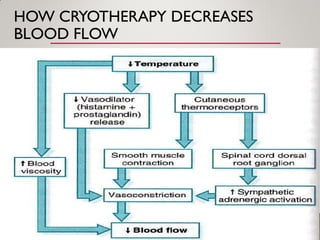
•Vasoconstriction occurs due to
stimulation of nerve receptors
• Viscosity of blood & tissue fluids 
• Resistance to blood flow 
• Soft tissue  of 26% & skeletal blood flow  of
19% with 20-min. ice pack in injured ankles
HOW CRYOTHERAPY DECREASES
BLOOD FLOW
COLD-INDUCEDVASODILATION
LATER INCREASE IN BLOOD FLOW
• when cold is applied for longer periods of time or when
the tissue temperature reaches less than 10 'C (50 'F),
vasodilation may occur.This phenomenon is known as
cold-induced vasodilation( CIVD) and was first reported
by Lewis in 1930.
• His findings were replicated in a number of later studies;
however, vasodilation has not been found to be a
consistent response to prolonged cold application
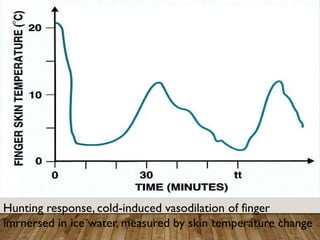
Hunting response, cold-induced vasodilation of finger
imrnersed in ice water, measured by skin temperature change
• Lewis reported that when an individual's fingers are immersed in an ice bath,
their temperature initially decreased however, after 15 minutes, their
temperature cyclically increased and decreased.
• Lewis correlated this temperature cycling with alternating vasoconstriction and
vasodilation and called it the “Huntingr response”
• It is proposed that the hunting Response is mediated by an axon reflex in
response to the pain of prolonged cold or very low temperatures,or that it is
caused by inhibition of contraction in the smooth muscles of the blood vessel
walls by extreme cold.
• Maintained vasodilation, without cycling has also been observed with cooling
human forearms at 1" C (35" F for 15 minutes)
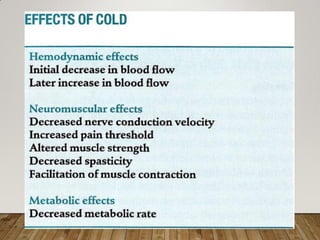
NEUROMUSCULAR EFFECTS
• Cold has a variety of effects on neuromuscular function,
including
• decreasing nerve conduction velocity
• elevating the pain threshold
• altering muscle force generation
• Decreasing spasticity
• Facilitating muscle contraction.
Decreased nerve conduction velocity has been
documented in response to the application of a
superficial cooling agent to the skin for 5 minutes or
longer.
DECREASED NERVE CONDUCTIONVELOCITY
• When nerve temperature is decreased nerve conduction velocity decreases in
proportion to the degree and duration of the temperature change.
• Decreased nerve conduction velocity has been documented in response to the
application of a superficial cooling agent to the skin for 5 minutes or longer.
DECREASED NERVE CONDUCTIONVELOCITY
• The decrease in nerve conduction velocity that occurs with 5 minutes of
cooling fully reverses within 15 minutes in individuals with normal circulation
• after 20 minutes of cooling,nerve conduction velocity may take 30 minutes or
longer to recover due to the greater reduction in temperature caused by the
longer duration of cooling
DECREASED NERVE CONDUCTIONVELOCITY
• Cold can decrease the conduction velocity of both sensory and motor nerves
• It has the greatest effect on conduction by myelinated and small fibers and the
least effect on conduction bv unmvelinated and large fiber
DECREASED NERVE CONDUCTIONVELOCITY
• Aδ (A-delta) fibers, which are small-diameter myelinated, pain-transmitting
fibers, demonstrate the greatest decrease in conduction velocity in response to
cooling
PAIN CONTROL
• Cryotherapy directly and rapidly modifies the sensation of pain by
gating pain transmission with activity of the cutaneous thermal
receptor
• Applying cryotherapy for 10 to 15 minutes or longer can control
pain for 1 or more hours
• This prolonged effect is thought to be the result of blocking
conduction by deep pain-transmitting A -delta fibers, and by gating
of pain transmission by the cutaneous thermal receptor
• Rewarming of the area is slow because cold-induced
vasoconstriction limits the flow of warm blood into the area and
subcutaneous fat insulates the deeper tissues from rewarming by
conduction from the ambient air
INCREASED PAINTHRESHOLD
• The application of Cryotherapy can increase the pain threshold and decrease
the sensation of pain.
• The proposed mechanisms for these effects include counter-irritation via the
gate control mechanism and the reduction of muscle spasm, sensory nerve
conduction velocity
INCREASED PAINTHRESHOLD
• Stimulation of the cutaneous cold receptors by cold may provide sufficient
sensory input to block the transmission of painful stimuli fully or partially along
the spinal cord to the cerebral cortex, increasing pain threshold or decreasing
pain sensation.
• Such gating of the sensation of pain can also reduce muscle spasms by
interrupting the pain-spasm-pain cycle
INCREASED PAINTHRESHOLD
•Cryotherapy may also reduce the pain
associated with an acute injury by reducing
the rate of blood flow in an area and
decreasing the rate of reactions related to
acute inflammation, thus controlling post-injury edema formation.
• Reducing edema can aileviate pain that results from compression of nerves or
other pressure-sensitive structures.
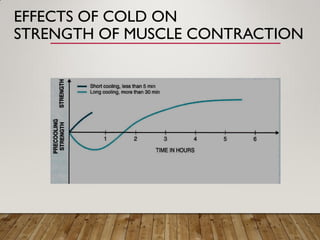
ALTERED MUSCLE STRENGTH
• Depending on the duration of treatment and the timing of measurement
cryotherapy has been associated with both increases and decrease in muscle
strength
• after cooling for 30 minutes or longer, isometric muscle strength has
been found to decrease initially and then to increase an hour later, to
reach greater than precooling strength for the following 3 hours or
longer
ALTERED MUSCLE STRENGTH
• The proposed mechanisms for the reduced strength after prolonged cooling
include reduction of blood flow to the muscles, slowed motor nerve
conduction,increased muscle viscosity, and increased joint or soft tissue
stiffness
ALTERED MUSCLE STRENGTH
• Isometric muscle strength has been found to incraese directly after the
application of ice massage for 5 min or less; however the duration of this effect
has not been documented.
• The proposed mechanism for this response to brief cooling include facilitation
of motor nerve excitability and an increased psychological motivation to
perform.
EFFECTS OF COLD ON
STRENGTH OF MUSCLE CONTRACTION
MODIFICATION OF SPASTICITY
• Cryotherapy can be used to temporarily reduce
spasticity in patients with upper motor neuron
dysfunction
• brief applications of cold, lasting for about 5 minutes,
cause an almost immediate decrease in deep tendon
reflexes
• reflexes. Longer applications, for 10 to 30 minutes, also
decrease or eliminate clonus and decrease the resistance
of muscles to passive stretch
• Because longer applications of cryotherapy control more
of the signs of spasticity cryotherapy should be applied
for up to 30 minutes
• The decrease in spasticity produced by prolonged
cooling generally lasts for 1 hour or longer after the
treatment, which is sufficient to allow for a variety of
therapeutic interventions, including active exercises,
stretching, functional activities.
FACILITATION
• The rapid application of ice as a stimulus to elicit desired motor patterns,
known a quick icing
• this technique may be used effectively in the rehabilitation of patients with
flaccidity resulting from upper motor neuron dysfunction, it tends to have
unreliable results and is therefore not commonly used
FACILITATION
• T he results of quick icing are unreliable because the
initial phasic withdrawal pattern stimulated in the agonist
muscles may lower the resting potential of the
antagonists, so that a second stimulus elicits activity in
the antagonist muscles rather than in the agonists.
• This produces motion first in the desired direction.
followed by a rebound movement in the opposite
direction.
• It has also been proposed that icing may adversely
impact motor control caused by dysynchronization of
the cortex as a result of increased sympathetic tone
DOES INFLAMMATION INCREASED OR
DECREASED BY COLD?
• Decreases in posttraumatic edema, in which inflammation is induced by
mediators such as histamine and serotonin during the acute stage.
BUT
• Increases in other forms of inflammation,particularly those mediated by
prostaglandins.
• Cryotherapy is not effective in controlling the formation of edema caused by
immobility and poor circulation
• In such cases, increased rather than decreased venous or lymphatic circulation
is required to move fluid out of the affected area
• This is best accomplished with compression, elevation, heat, exercise, and
massage
COOLING TO DEEPERTISSUES
• Superficial cold modality has deeper effect than superficial heating modality.
• Bc of the difference in temperature gradient between these two modalities.
• Example
• With application of ice, muscle at a maximum depth of 2 cm will cool approx.
3.4 F(2 C) in 10 minutes if the subject’s fat layer is less than 1 cm thick.
WHY DOES SKIN APPEAR BLUE
• Because of the lack of blood
• Increase in amount of CO2
SUMMARY
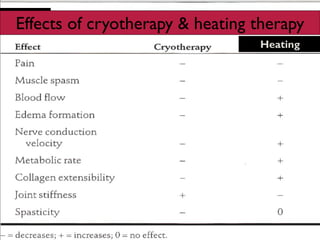
Effects of cryotherapy & heating therapy
Heating
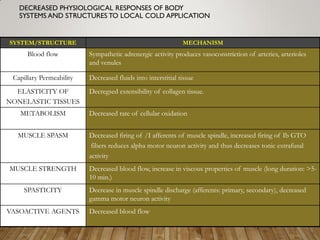
DECREASED PHYSIOLOGICAL RESPONSES OF BODY
SYSTEMS AND STRUCTURES TO LOCAL COLD APPLICATION
SYSTEM/STRUCTURE MECHANISM
Blood flow Sympathetic adrenergic activity produces vasoconstriction of arteries, arterioles
and venules
Capillary Permeability Decreased fluids into interstitial tissue
ELASTICITY OF
NONELASTIC TISSUES
Decregsed extensibility of collagen tissue.
METABOLISM Decreased rate of cellular oxidation
MUSCLE SPASM Decreased firing of /I afferents of muscle spindle, increased firing of Ib GTO
fibers reduces alpha motor neuron activity and thus decreases tonic extrafusal
activity
MUSCLE STRENGTH Decreased blood flow, increase in viscous properties of muscle (long duration: >5-
10 min.)
SPASTICITY Decrease in muscle spindle discharge (afferents: primary, secondary), decreased
gamma motor neuron activity
VASOACTIVE AGENTS Decreased blood flow
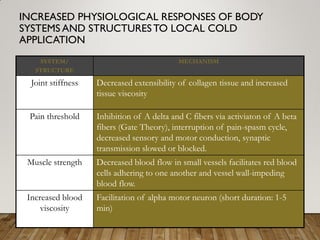
INCREASED PHYSIOLOGICAL RESPONSES OF BODY
SYSTEMS AND STRUCTURESTO LOCAL COLD
APPLICATION
SYSTEM/
STRUCTURE
MECHANISM
Joint stiffness Decreased extensibility of collagen tissue and increased
tissue viscosity
Pain threshold Inhibition of A delta and C fibers via activiaton of A beta
fibers (Gate Theory), interruption of pain-spasm cycle,
decreased sensory and motor conduction, synaptic
transmission slowed or blocked.
Muscle strength Decreased blood flow in small vessels facilitates red blood
cells adhering to one another and vessel wall-impeding
blood flow.
Increased blood
viscosity
Facilitation of alpha motor neuron (short duration: 1-5
min)
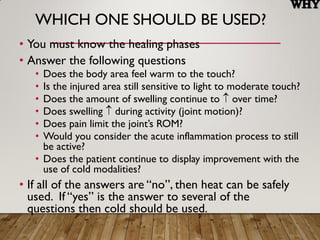
WHICH ONE SHOULD BE USED?
• You must know the healing phases
• Answer the following questions
• Does the body area feel warm to the touch?
• Is the injured area still sensitive to light to moderate touch?
• Does the amount of swelling continue to  over time?
• Does swelling  during activity (joint motion)?
• Does pain limit the joint’s ROM?
• Would you consider the acute inflammation process to still
be active?
• Does the patient continue to display improvement with the
use of cold modalities?
• If all of the answers are “no”, then heat can be safely
used. If “yes” is the answer to several of the
questions then cold should be used.
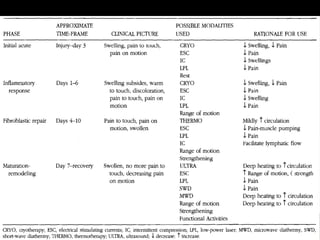
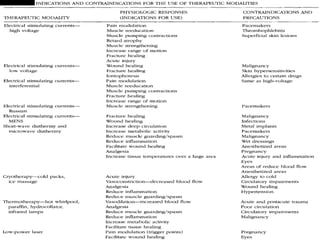
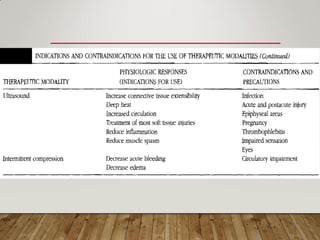
CLINICAL DECISION MAKING ONTHE USE OFVARIOUS THERAPEUTIC MODALITIES
DURINGTHEVARIOUS STAGES OF HEALING
Cryotherapy2019.pdf
Cryotherapy2019.pdf

Cryotherapy2019.pdf

  • 1.
  • 2.
    MEASURES USED TOASSESS EFFECTIVENESS OF THERAPEUTIC MODALITIES
  • 3.
    CRYOTHERAPY • Cryotherapy (i.e.,cold therapy) is the use of cold to induce the therapeutic and physiological responses that result from a decrease in tissue temperature. • The term used to describe the application of cold modalities that have a temperature range between 32° and 65° F • Alter cell metabolism • Each 1.8°F (1°C) change in tissue temp. results in a 13%  or  in the tissue’s metabolic rate.
  • 4.
    5 MECHANISMS OFENERGY (HEAT)TRANSFER IN THE BODY: ADDED OR REMOVED • Conduction – transfer of heat through the direct contact between a hotter and a cooler area (2 objects touching each other) • Ice Massage, Hydrocollator Pack, Ice Pack • Convection – transfer of heat by the movement a medium (air, liquid) between regions of unequal temperature • Whirlpool • Conversion – energy is changed from one form to another; does not relate to superficial heat or cold • Electrical energy into heat,Acoustical energy into heat • Ultrasound, Diathermy
  • 5.
    • Radiation –emitted from surfaces with temperatures above absolute 0° (all atomic & molecular motion ceases) • Transfer of energy without the use of a medium • Body, Sun, Infrared lamp, LASER, Ultraviolet light • Evaporation – change from liquid state to gaseous state requiring thermal energy be removed from the body • Vapocoolant Spray
  • 6.
    CRYOTHERAPY – COLDTHERAPY •Heat is removed from the body & absorbed by the cold modality • Cryotherapy exerts its therapeutic effects by influencing hemodynamic, neuromuscular, and metabolic processes.
  • 8.
    CRYOTHERAPY • The normalbody temp. is 98.6 °F (37 °C). • Normal skin temp. range • for men is 91.4°F to 94 °F (33° to 34.5 °C) • for women is 90 °F to 95 °F (32.2°C to 35 °C) • Skin is cooler than adipose which is cooler than muscular tissue. • Thermoreceptors in skin are responsive to heat or cold (more to cold than heat). • Measurements of decreased temp. have been recorded at a 4 cm depth.
  • 9.
    CLASSIFICATION OF TEMPERATURES: FORTREATMENTPURPOSES,ARE CLASSIFIED AS FOLLOWS: Very Cold 32 to 55 F Cold 55 to 65 F Cool 65 to 80 F Neutral 80 to 92 F Warm 92 to 98 F Hot 98 to 104 F Very Hot 104  Hot 1 to 13 °C 13 to 18 °C 18 to 27 °C 27 to 33.5 °C 33.3 to 36.5 °C 36.5 to 40 °C >40 °C
  • 10.
    STAGES OF ANALGESIAINDUCED BY CRYOTHERAPY • Cold Sensation • Burning or aching • Local numbness or analgesia • Deep tissue vasodilation without increase in metabolism 12-15 Mints 0-3 Mints 2-7 Mints 5-12 Mints
  • 11.
    SEQUENCE OF SENSATIONSWITH COLD APPLICATION Intense Cold Burning Aching Analgesia and numbness (absence of pain)
  • 12.
  • 13.
    CRYOTHERAPY CONTRAINDICATIONS • ColdHypersensitivity (Cold-induced Urticaria). • Cryoglobulinemia • Paroxysmal cold hemoglobinuria • Raynaud's disease or Raynaud's phenomenon Contraindications…
  • 14.
    COLD HYPERSENSITIVITY (COLD-INDUCED URTICARIA). •Some individuals have a familial or acquired hypersensitivity to cold that causes them to develop a vascular skin reaction in response to cold exposure. • This reaction is marked by the transient appearance of smooth, slightly elevated patches, which are redder or more pale than the surrounding skin and are often attended by severe itching. • These symptoms can occur only in the area of application or all over the body. Contraindications…
  • 15.
  • 16.
    CRYOGLOBULINEMIA • It isan uncommon disorder characterized by the aggregation of serum proteins in the distal circulation when the distal extremities are cooled. • These aggregating proteins form a precipitate or gel that can impair circulation, causing local ischemia and then gangrene. • This disorder may be idiopathic or may be associated with multiple myeloma, systemic lupus erythematosus, rheumatoid Arthritis , or other hyperglobulinemic states. • Therefore therapist should check with the referring physician before applying Cryotherapy to the distal extremities of any patient with these predisposing disorders. Contraindications…
  • 17.
    PAROXYSMAL COLD HEMOGLOBINURIA •It is the release of hemoglobin into the urine from lysed red blood cells in response to local or general exposure to cold Rash on lower extremities typical of cutaneous small-vessel vasculitis due to cryoglobulinemia secondary to hepatitis C infection Contraindications…
  • 18.
    RAYNAUD’S DISEASE ORRAYNAUD'S PHENOMENON • Raynaud’s Disease It is the primary or idiopathic form of paroxysmal digital cyanosis • Raynaud's phenomenon, which is more common, is paroxysmal digital cyanosis due to some other regional or systemic disorder. • Both conditions are characterized by sudden pallor and cyanosis followed by redness of the skin of the digits precipitated by cold or emotional upset and relieved by warmth • These disorders occur primarily in young women • In Raynaud's disease the symptoms are bilateral and symmetric even when cold is applied to only one area • In Raynaud's phenomenon, the symptoms generally occur only in the cooled extremity • Raynaud's phenomenon may be associated with thoracic outlet syndrome, carpal tunnel syndrome, or trauma. Contraindications…
  • 19.
    RAYNAUD’S DISEASE ORRAYNAUD'S PHENOMENON
  • 20.
    ASKTHE PATIENT: • Doyou have any unsual responses to cold? • If yes to this question, ask for further details. Include the following questions: • Do you develop a rash when cold? • a sign of cold hypersesnsitivity • Do you have severe pain, numbness and color changes in your fingers when expose to cold? • Signs of Raynaud’s disease/phenomenon • Do you get blood in your urine after being cold? • A sign of paroxysmal cold hemoglobinuria • If the responses are positive then cold should not be applied Contraindications…
  • 21.
    OVER REGENERATING PERIPHERALNERVES • Cryotherapy should not be applied directly over a regenerating peripheral nerve because local vasoconstriction or altered nerve conduction may delay nerve regeneration. Contraindications…
  • 22.
    ASKTHE PATIENT: • Doyou have any nerve damage in this area? • Do you have any numbness or tingling in this limb? • If so, where? • ASSESS: • Test sensation • In the presence of sensory impairment or other signs of nerve dysfunction, • cryotherapy should not be applied directly over the affected nerve. Contraindications…
  • 23.
    OVER AN AREAWITHCIRCULATORY COMPROMISE OR PERIPHERALVASCULAR DISEASE • Cryotherapy should not be applied over an area with impaired circulation because it may aggravate the condition by causing vasoconstriction and increasing blood viscosity. • Circulatory impairment may be the result of peripheral vascular disease, trauma to the vessels, or early healing, and is often associated with edema. • W hen edema is present, it is important that its cause be determined, since edema due to inflammation can benefit from cryotherapy, while edema due to impaired circulation may be increased • These causes of edema can be distinguished by observation of local skin coloration and temperature. • Edema due to inflammation is characterized by warmth and redness whereas edema due to poor circulation is characterized by coolness and pallor. Contraindications…
  • 24.
    ASKTHE PATIENT • Doyou have poor circulation in this limb? • Assess • Skin temperature and color • If the patient has signs of impaired circulation, such as pallor and coolness of the skin in the area being considered for treatment, cyrotherapy should not be applied. Contraindications…
  • 25.
    CRYOTHERAPY INDICATIONS • Acuteinjury or inflammation • Pain • Muscle spasm, acute or chronic • Restoration of ROM • Small, superficial, 1st degree burns • Post-surgical pain & edema • Neuralgia • Post-exercise • Decrease Muscle spasiticity • Reduce Secondary Tissue Injury
  • 26.
    PRECAUTIONS • Over thesuperficial main branch of a nerve • Over an open wound • Hypertension • In patients with poor sensation or poor mentation • Very young and very old patients
  • 27.
    OVER A SUPERFICIALMAIN BRANCH OF A NERVE • Applying cold directly over the superficial main branch of a nerve, such as the peronei nerve at the lateral knee or the radial nerve at the posterolateral elbow, may cause a nerve conduction b1ock. • Therefore when applying cryotherapy to such an area, one should monitor for signs of changes in nerve conduction, such as distal numbness or tingling, and discontinue cryotherapy if these occur. Precautions…
  • 28.
    OVER AN OPENWOUND • Cryotherapy should not be applied directly over any deep open wound because it can delay wound healing by reducing circulation and metabolic rate. as Cryotherapy may be applied in areas of superficial skin damage. • however, it is important to realize that this can reduce the efficacy and safety of the treatment because when there is superficial skin damage, the cutaneous thermal receptors may also be damaged or absent. • These receptors play a part in activating the vasoconstriction, pain control, and spasticity reduction produced by cryotherapy; therefore, these responses are likely to be less pronounced when cryotherapy is applied to areas with superficial skin damage, caution should also be used if cryotherapy is applied to such areas because the absence of skin reduces the insulating protection of the subcutaneous layers and increases the risk of excessivce cooling to these tissues. Precautions…
  • 29.
    ASSESS: • Inspect theskin closely for deep wounds, cuts, or abrasions. • Do not apply cryotherapy in the area of a deep wound, and use less intense cooling if cuts or abrasions are present Precautions…
  • 30.
    WHENTREATING PATIENTS WITH HYPERTENSION •Since cold can cause transient increases in systolic or diastolic blood pressure, patients with should be carefully monitored during the application of cryotherapy • Treatment should be discontinued if blood pressure increases beyond safe levels • Treatment.Guidelines for safe blood pressures individual patients should be obtained from physician. Precautions…
  • 31.
    WHENTREATING PATIENTS WITHPOOR SENSATION OR MENTATION • Although adverse effects with cryotherapy are rare, if the the patient cannot sense or report discomfort of other abnormal responses • The clinician should monitor the patient's response directly. • Check for adverse response to cold such as abnormal changes in color or strength, both in the area of cold application and generally. Precautions…
  • 32.
    WHENTREATINGVERYYOUNG AND VERY OLD •Caution should be used when applying cryotherapy to the very young or the very old because these individuals frequently have impaired thermal and a limited ability to communicate Precautions…
  • 33.
    IMMEDIATE RESPONSE TOTHERMAL MODALITY •Mild heat or coolness may produce an analgesic effect in the area of application,it may reduce local pain or muscle spasm and promote general relaxation. • If the temperature change is too much then other reactions occur, examples • Moderate temperature change may serve as a general stimulant that produces an arousing, invigorating effect. • If temp. change is too hot or too cold then the experience will be of pain or fear, which will stimulate the fight or flight responses of eye dilation and changes in facial and skin color, blood pressure and pulse
  • 34.
    LOCAL EFFECTS OFCRYOTHERAPY •  cell metabolism rate – PRIMARY BENEFIT •  need for oxygen • Lowers tissue temperature • Vasoconstriction •  production of cellular wastes • Prevents or limits swelling •  in pain by  pain threshold •  in acute & chronic muscle spasm • Limits area of original injury
  • 35.
    • Deeper tissuescool more slowly & to a lesser extent than skin • Muscle tissue requires longer to cool than bony areas • Deeper tissue temps. have been proven to drop for several minutes following the removal of an ice pack • Research has shown that deeper tissues remaining at rest will be cooled for 2 hr or more after a 20- to 30- min. ice pack application
  • 36.
    MUSCLE SPASM • Coldtherapy affects pain threshold •  nerve conduction velocity by slowing communication at the synapse •  pain by reducing the threshold of afferent nerve endings. •  sensitivity of muscle spindles • May inhibit the stretch reflex mechanism reducing muscle spasm & breaking pain-spasm cycle
  • 37.
    INFLAMMATION • Changes incellular function & blood dynamics serve to control effects of acute inflammation. • Cold suppresses the inflammatory response by: •  the release of inflammatory mediators (histamine, prostaglandin) •  prostaglandin synthesis •  capillary permeability •  leukocyte/endothelial interaction •  creatine-kinase activity
  • 38.
    PAIN CONTROL • Coldtherapy acts as a counterirritant • Cold application affects pain perception & transmission by: • Interrupting pain transmission (stimulates large-diameter A-beta nerve fibers) A-beta nerve fibers transmit information pertaining to touch and muscle movement • Decreasing nerve conduction velocity • Reducing muscle spasm • Reducing or limiting edema
  • 39.
    SYSTEMIC EFFECTS OFCOLD EXPOSURE • If circulating blood temp.  0.2°F, then the hypothalamus (body’s thermoregulatory center) kicks in • General vasoconstriction in response to cooling of the posterior hypothalamus • Decreased respiratory & heart rates • Heart rate  (wants to localize the cold area) • Shivering & increased muscle tone • If heart rate  too much where the core temp. reaches hypothermia shivering starts.
  • 40.
    CELLULAR RESPONSE • cellular metabolic rate • During a 20-min. treatment, cell metabolism  19% • With  b. flow, there is less metabolic activity & O2 demand on the cells •  need for O2 • Reduces number of cells killed by lack of O2 • Reduces secondary hypoxic injury damage • Reduces amount of chemical mediators released in area • Slows nerve conduction
  • 41.
    VASCULAR RESPONSES •Vasoconstriction occursdue to stimulation of nerve receptors • Viscosity of blood & tissue fluids  • Resistance to blood flow  • Soft tissue  of 26% & skeletal blood flow  of 19% with 20-min. ice pack in injured ankles
  • 42.
  • 43.
    COLD-INDUCEDVASODILATION LATER INCREASE INBLOOD FLOW • when cold is applied for longer periods of time or when the tissue temperature reaches less than 10 'C (50 'F), vasodilation may occur.This phenomenon is known as cold-induced vasodilation( CIVD) and was first reported by Lewis in 1930. • His findings were replicated in a number of later studies; however, vasodilation has not been found to be a consistent response to prolonged cold application
  • 44.
    Hunting response, cold-inducedvasodilation of finger imrnersed in ice water, measured by skin temperature change
  • 45.
    • Lewis reportedthat when an individual's fingers are immersed in an ice bath, their temperature initially decreased however, after 15 minutes, their temperature cyclically increased and decreased. • Lewis correlated this temperature cycling with alternating vasoconstriction and vasodilation and called it the “Huntingr response”
  • 46.
    • It isproposed that the hunting Response is mediated by an axon reflex in response to the pain of prolonged cold or very low temperatures,or that it is caused by inhibition of contraction in the smooth muscles of the blood vessel walls by extreme cold. • Maintained vasodilation, without cycling has also been observed with cooling human forearms at 1" C (35" F for 15 minutes)
  • 47.
    NEUROMUSCULAR EFFECTS • Coldhas a variety of effects on neuromuscular function, including • decreasing nerve conduction velocity • elevating the pain threshold • altering muscle force generation • Decreasing spasticity • Facilitating muscle contraction. Decreased nerve conduction velocity has been documented in response to the application of a superficial cooling agent to the skin for 5 minutes or longer.
  • 48.
    DECREASED NERVE CONDUCTIONVELOCITY •When nerve temperature is decreased nerve conduction velocity decreases in proportion to the degree and duration of the temperature change. • Decreased nerve conduction velocity has been documented in response to the application of a superficial cooling agent to the skin for 5 minutes or longer.
  • 49.
    DECREASED NERVE CONDUCTIONVELOCITY •The decrease in nerve conduction velocity that occurs with 5 minutes of cooling fully reverses within 15 minutes in individuals with normal circulation • after 20 minutes of cooling,nerve conduction velocity may take 30 minutes or longer to recover due to the greater reduction in temperature caused by the longer duration of cooling
  • 50.
    DECREASED NERVE CONDUCTIONVELOCITY •Cold can decrease the conduction velocity of both sensory and motor nerves • It has the greatest effect on conduction by myelinated and small fibers and the least effect on conduction bv unmvelinated and large fiber
  • 51.
    DECREASED NERVE CONDUCTIONVELOCITY •Aδ (A-delta) fibers, which are small-diameter myelinated, pain-transmitting fibers, demonstrate the greatest decrease in conduction velocity in response to cooling
  • 52.
    PAIN CONTROL • Cryotherapydirectly and rapidly modifies the sensation of pain by gating pain transmission with activity of the cutaneous thermal receptor • Applying cryotherapy for 10 to 15 minutes or longer can control pain for 1 or more hours • This prolonged effect is thought to be the result of blocking conduction by deep pain-transmitting A -delta fibers, and by gating of pain transmission by the cutaneous thermal receptor • Rewarming of the area is slow because cold-induced vasoconstriction limits the flow of warm blood into the area and subcutaneous fat insulates the deeper tissues from rewarming by conduction from the ambient air
  • 53.
    INCREASED PAINTHRESHOLD • Theapplication of Cryotherapy can increase the pain threshold and decrease the sensation of pain. • The proposed mechanisms for these effects include counter-irritation via the gate control mechanism and the reduction of muscle spasm, sensory nerve conduction velocity
  • 54.
    INCREASED PAINTHRESHOLD • Stimulationof the cutaneous cold receptors by cold may provide sufficient sensory input to block the transmission of painful stimuli fully or partially along the spinal cord to the cerebral cortex, increasing pain threshold or decreasing pain sensation. • Such gating of the sensation of pain can also reduce muscle spasms by interrupting the pain-spasm-pain cycle
  • 55.
    INCREASED PAINTHRESHOLD •Cryotherapy mayalso reduce the pain associated with an acute injury by reducing the rate of blood flow in an area and decreasing the rate of reactions related to acute inflammation, thus controlling post-injury edema formation. • Reducing edema can aileviate pain that results from compression of nerves or other pressure-sensitive structures.
  • 56.
    ALTERED MUSCLE STRENGTH •Depending on the duration of treatment and the timing of measurement cryotherapy has been associated with both increases and decrease in muscle strength • after cooling for 30 minutes or longer, isometric muscle strength has been found to decrease initially and then to increase an hour later, to reach greater than precooling strength for the following 3 hours or longer
  • 57.
    ALTERED MUSCLE STRENGTH •The proposed mechanisms for the reduced strength after prolonged cooling include reduction of blood flow to the muscles, slowed motor nerve conduction,increased muscle viscosity, and increased joint or soft tissue stiffness
  • 58.
    ALTERED MUSCLE STRENGTH •Isometric muscle strength has been found to incraese directly after the application of ice massage for 5 min or less; however the duration of this effect has not been documented. • The proposed mechanism for this response to brief cooling include facilitation of motor nerve excitability and an increased psychological motivation to perform.
  • 59.
    EFFECTS OF COLDON STRENGTH OF MUSCLE CONTRACTION
  • 60.
    MODIFICATION OF SPASTICITY •Cryotherapy can be used to temporarily reduce spasticity in patients with upper motor neuron dysfunction • brief applications of cold, lasting for about 5 minutes, cause an almost immediate decrease in deep tendon reflexes • reflexes. Longer applications, for 10 to 30 minutes, also decrease or eliminate clonus and decrease the resistance of muscles to passive stretch
  • 61.
    • Because longerapplications of cryotherapy control more of the signs of spasticity cryotherapy should be applied for up to 30 minutes • The decrease in spasticity produced by prolonged cooling generally lasts for 1 hour or longer after the treatment, which is sufficient to allow for a variety of therapeutic interventions, including active exercises, stretching, functional activities.
  • 62.
    FACILITATION • The rapidapplication of ice as a stimulus to elicit desired motor patterns, known a quick icing • this technique may be used effectively in the rehabilitation of patients with flaccidity resulting from upper motor neuron dysfunction, it tends to have unreliable results and is therefore not commonly used
  • 63.
    FACILITATION • T heresults of quick icing are unreliable because the initial phasic withdrawal pattern stimulated in the agonist muscles may lower the resting potential of the antagonists, so that a second stimulus elicits activity in the antagonist muscles rather than in the agonists. • This produces motion first in the desired direction. followed by a rebound movement in the opposite direction. • It has also been proposed that icing may adversely impact motor control caused by dysynchronization of the cortex as a result of increased sympathetic tone
  • 64.
    DOES INFLAMMATION INCREASEDOR DECREASED BY COLD? • Decreases in posttraumatic edema, in which inflammation is induced by mediators such as histamine and serotonin during the acute stage. BUT • Increases in other forms of inflammation,particularly those mediated by prostaglandins.
  • 65.
    • Cryotherapy isnot effective in controlling the formation of edema caused by immobility and poor circulation • In such cases, increased rather than decreased venous or lymphatic circulation is required to move fluid out of the affected area • This is best accomplished with compression, elevation, heat, exercise, and massage
  • 66.
    COOLING TO DEEPERTISSUES •Superficial cold modality has deeper effect than superficial heating modality. • Bc of the difference in temperature gradient between these two modalities. • Example • With application of ice, muscle at a maximum depth of 2 cm will cool approx. 3.4 F(2 C) in 10 minutes if the subject’s fat layer is less than 1 cm thick.
  • 67.
    WHY DOES SKINAPPEAR BLUE • Because of the lack of blood • Increase in amount of CO2
  • 68.
  • 69.
    Effects of cryotherapy& heating therapy Heating
  • 70.
    DECREASED PHYSIOLOGICAL RESPONSESOF BODY SYSTEMS AND STRUCTURES TO LOCAL COLD APPLICATION SYSTEM/STRUCTURE MECHANISM Blood flow Sympathetic adrenergic activity produces vasoconstriction of arteries, arterioles and venules Capillary Permeability Decreased fluids into interstitial tissue ELASTICITY OF NONELASTIC TISSUES Decregsed extensibility of collagen tissue. METABOLISM Decreased rate of cellular oxidation MUSCLE SPASM Decreased firing of /I afferents of muscle spindle, increased firing of Ib GTO fibers reduces alpha motor neuron activity and thus decreases tonic extrafusal activity MUSCLE STRENGTH Decreased blood flow, increase in viscous properties of muscle (long duration: >5- 10 min.) SPASTICITY Decrease in muscle spindle discharge (afferents: primary, secondary), decreased gamma motor neuron activity VASOACTIVE AGENTS Decreased blood flow
  • 71.
    INCREASED PHYSIOLOGICAL RESPONSESOF BODY SYSTEMS AND STRUCTURESTO LOCAL COLD APPLICATION SYSTEM/ STRUCTURE MECHANISM Joint stiffness Decreased extensibility of collagen tissue and increased tissue viscosity Pain threshold Inhibition of A delta and C fibers via activiaton of A beta fibers (Gate Theory), interruption of pain-spasm cycle, decreased sensory and motor conduction, synaptic transmission slowed or blocked. Muscle strength Decreased blood flow in small vessels facilitates red blood cells adhering to one another and vessel wall-impeding blood flow. Increased blood viscosity Facilitation of alpha motor neuron (short duration: 1-5 min)
  • 72.
    WHICH ONE SHOULDBE USED? • You must know the healing phases • Answer the following questions • Does the body area feel warm to the touch? • Is the injured area still sensitive to light to moderate touch? • Does the amount of swelling continue to  over time? • Does swelling  during activity (joint motion)? • Does pain limit the joint’s ROM? • Would you consider the acute inflammation process to still be active? • Does the patient continue to display improvement with the use of cold modalities? • If all of the answers are “no”, then heat can be safely used. If “yes” is the answer to several of the questions then cold should be used.
  • 73.
    CLINICAL DECISION MAKINGONTHE USE OFVARIOUS THERAPEUTIC MODALITIES DURINGTHEVARIOUS STAGES OF HEALING