Ratheesh.R
SLMGNC
Introduction:
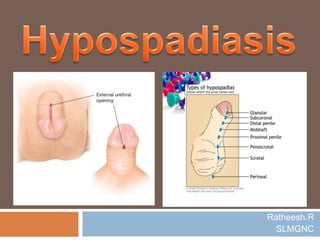
 Hypospadiasis is a congenital anomaly of
the male urethra that results in abnormal
ventral placement of the urethral opening.
The location of the displaced urethral
meatus may range anywhere within the
glans, the shaft of penis, the scrotum, or
perineum
Definition:
 It is a congenital condition in
which the Urethral Meatus opens
on the ventral side of the Penis.
 Incidence – 2-8/1000
 Occurance – More common in male than in
girls.
Etiology:
 Down ward penis (Chordee)
 Undescended testicle
 Inguinal hernia
 Male siblings
Pathophysiology:
 Due to any factor
 Decreased testosterone production in early
gestation
(Male) (Female)
Urethra opens on the ventral Urethra
opens into
aspects of the penis the vagina
(rare).
Clinical Manifestation:
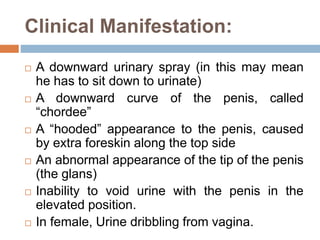
 A downward urinary spray (in this may mean
he has to sit down to urinate)
 A downward curve of the penis, called
“chordee”
 A “hooded” appearance to the penis, caused
by extra foreskin along the top side
 An abnormal appearance of the tip of the penis
(the glans)
 Inability to void urine with the penis in the
elevated position.
 In female, Urine dribbling from vagina.
Diagnostic Findings:
 History Collection
 Physical Examination
 Renal Ultrasound/Cystourethrography
-It is done to determine associated defects
with
Hypospadiasis.
 Chromosomal and Hormonal Studies.
Treatment:
Surgery:
 To reposition the opening of urethra at the tip
of the penis (urethroplasty)
 To straighten the penis, if chordee is present
(orthoplasty)
 To improve the outward appearance of the
penis (removing the hooded foreskin)
Cont….
After surgery:
 Depending on the extent of surgery, the child
may either go home the same day or stay in the
hospital overnight.
 The Children's nurses will talk with, how to care
for him at home and will provide detailed
instruction sheets (how to manage his dressing,
what activities should be avoided, etc.)
Cont….
For the child's recovery period, the doctor may
prescribe any or all of the following:
 Acetaminophen (Tylenol), to help ward off
soreness in the first few days after surgery
 Antibiotic ointment, to be applied to the penis
several times a day
 Oral antibiotics
 Antispasmodic medication, to alleviate bladder
spasms
Nursing Diagnosis:
 Pain r/t surgical incision and drainage tube.
 Risk for infection r/t surgical incision and
drainage tube.
 Body image disturbance r/t Appearance of
genitalia.
 Impaired urinary elimination r/t the condition
and surgical intervention.
 Risk for fluid volume deficit r/t surgical losses.
Complication:
 Urethral fistula (5-15%)
 Scar narrowing of the urethra (stricture)
 Recurrence of penile curvature by growth in
size of the penis with incomplete
chordeectomy.
 Urethral stenosis.
 Urethral diverticula.
 Scar deformation.
 Reproductive inability.

Hypospadiasis

  • 1.
  • 2.
    Introduction:  Hypospadiasis isa congenital anomaly of the male urethra that results in abnormal ventral placement of the urethral opening. The location of the displaced urethral meatus may range anywhere within the glans, the shaft of penis, the scrotum, or perineum
  • 3.
    Definition:  It isa congenital condition in which the Urethral Meatus opens on the ventral side of the Penis.  Incidence – 2-8/1000  Occurance – More common in male than in girls.
  • 4.
    Etiology:  Down wardpenis (Chordee)  Undescended testicle  Inguinal hernia  Male siblings
  • 5.
    Pathophysiology:  Due toany factor  Decreased testosterone production in early gestation (Male) (Female) Urethra opens on the ventral Urethra opens into aspects of the penis the vagina (rare).
  • 6.
    Clinical Manifestation:  Adownward urinary spray (in this may mean he has to sit down to urinate)  A downward curve of the penis, called “chordee”  A “hooded” appearance to the penis, caused by extra foreskin along the top side  An abnormal appearance of the tip of the penis (the glans)  Inability to void urine with the penis in the elevated position.  In female, Urine dribbling from vagina.
  • 7.
    Diagnostic Findings:  HistoryCollection  Physical Examination  Renal Ultrasound/Cystourethrography -It is done to determine associated defects with Hypospadiasis.  Chromosomal and Hormonal Studies.
  • 8.
    Treatment: Surgery:  To repositionthe opening of urethra at the tip of the penis (urethroplasty)  To straighten the penis, if chordee is present (orthoplasty)  To improve the outward appearance of the penis (removing the hooded foreskin)
  • 9.
    Cont…. After surgery:  Dependingon the extent of surgery, the child may either go home the same day or stay in the hospital overnight.  The Children's nurses will talk with, how to care for him at home and will provide detailed instruction sheets (how to manage his dressing, what activities should be avoided, etc.)
  • 10.
    Cont…. For the child'srecovery period, the doctor may prescribe any or all of the following:  Acetaminophen (Tylenol), to help ward off soreness in the first few days after surgery  Antibiotic ointment, to be applied to the penis several times a day  Oral antibiotics  Antispasmodic medication, to alleviate bladder spasms
  • 11.
    Nursing Diagnosis:  Painr/t surgical incision and drainage tube.  Risk for infection r/t surgical incision and drainage tube.  Body image disturbance r/t Appearance of genitalia.  Impaired urinary elimination r/t the condition and surgical intervention.  Risk for fluid volume deficit r/t surgical losses.
  • 12.
    Complication:  Urethral fistula(5-15%)  Scar narrowing of the urethra (stricture)  Recurrence of penile curvature by growth in size of the penis with incomplete chordeectomy.  Urethral stenosis.  Urethral diverticula.  Scar deformation.  Reproductive inability.