





Hypospadias
DR. UMBREEN MINHAS
PLASTIC SURGERY
HOLYFAMILY HOSPITAL.
Introduction
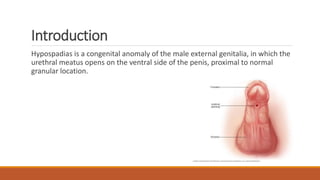
Hypospadias is a congenital anomaly of the male external genitalia, in which the
urethral meatus opens on the ventral side of the penis, proximal to normal
granular location.
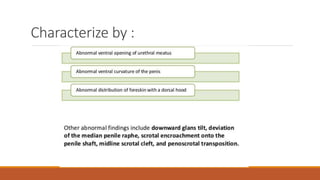
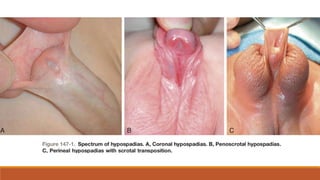
Characterize by :
Incidence
1:300 live male births (0.3 %)
Some genetic component
◦ 8% of patients have father with hypospadias
◦ 14% of patients have male siblings with hypospadias
More common in Caucasians
Etiology
 Mostly unknown
◦ Abnormal androgen production by the fetal testis
◦ Limited androgen sensitivity in target tissues
◦ Premature cessation of androgenic stimulation due to early atrophy of the Leydig cells of the
testes.
◦ Defect in testosterone biosynthetic pathway, specifically with impared 3beta-hydroxysteroid
dehydrogenase were reported in proximal hypospadias
Isolated versus Syndromic Hypospadias
Approximately 90 % cases are isolated penile defects
Syndromic hypospadias is suspected with development delay, dysmorphic facies, and/or
anorectal malformation
◦ Smith-Lemli-Opitz Syndrome
◦ WAGR syndrome
◦ G Syndrome
◦ 13q deletion syndrome
Associated anomalies include undescended testes, inguinal hernia and rarely upper tract
anomalies
Disorders of Sexual Development
 The coexistence of hypospadias with undescended testes may indicate a DSD
and may be an indication for karyotyping
◦ Most common diagnosis is mixed gonadal dysgenesis
◦ Ovotesticular DSD
◦ 5 alpha reductase deficiency
◦ Klinefelter syndrome
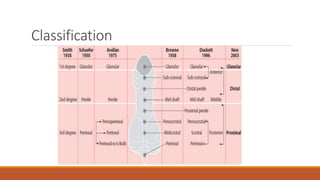
Classification
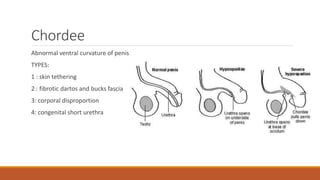
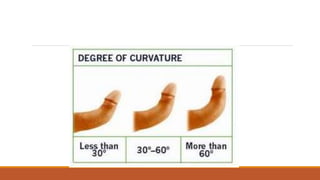
Chordee
Abnormal ventral curvature of penis
TYPES:
1 : skin tethering
2 : fibrotic dartos and bucks fascia
3: corporal disproportion
4: congenital short urethra
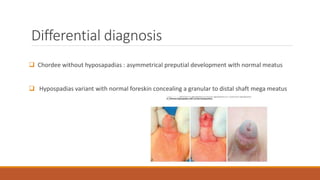
Differential diagnosis
 Chordee without hyposapadias : asymmetrical preputial development with normal meatus
 Hypospadias variant with normal foreskin concealing a granular to distal shaft mega meatus
Management
History
General physical examination
Local examination and examination of associated anomalies
Systemic examination
Diagnostic Evaluation
Diagnosis includes a description of the local findings:
◦ position, shape and width of the orifice
◦ Assessment of urethral plate width <1 or >1 cm
◦ appearance of the preputial hood and scrotum
◦ size of the penis
◦ curvature of the penis on erection
◦ Urogenital tract anomalies
Inguinoscrotal Examination
The diagnostic evaluation also includes an assessment of associated anomalies, which are:
◦ cryptorchidism (in up to 10% of cases of hypospadias);
◦ open processus vaginalis or inguinal hernia (in 9-15%).
◦ Severe hypospadias with unilaterally or bilaterally impalpable testis, or with ambiguous genitalia,
requires a complete genetic and endocrine work-up immediately after birth to exclude DSD, especially
congenital adrenal hyperplasia.
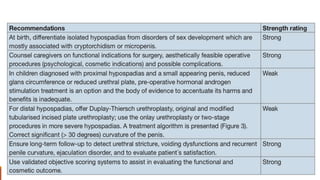
Correction is SURGICAL
 Urethroplasty
 Straightening of ventral penile curvature
 circumcision / perputioplasty
 scrotoplasty
Aims of Surgery
Functional penis with a normal cosmetic appearance
◦ Reconstruction of the missing portion of the urethra and extending it distally
◦ Widening of the meatus
◦ Correction of the curvature
◦ Restoration of the normal aspect of the external genitalia
Age of Surgery
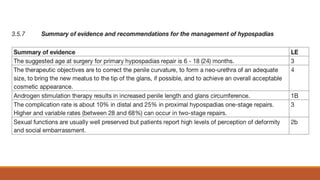
 3-18 months of age to minimize psychosexual stress
 More quick healing with fewer scars and young infants overcome the stress of surgery more
easily
 The highest incidence of post operative emotional disturbance has been noted at the age of 1-
3 years
Anesthesia :
General anesthesia with adjuvant penile or caudal nerve blocks
Preoperative Androgen Stimulation
The role of supplemental hormonal therapy before hypospadias surgery is not clear.
Androgens are documented to increase penile length and glans circumference
Usually limited to patients with proximal hypospadias, a small appearing penis, reduced glans
circumference or reduced urethral plate.
Key Steps
Degloving the penis
Correction of associated ventral curvature
Urethroplasty
Interposition of a tissue barrier layer between the neourethra and overlying skin closure
Management of the prepuce by either circumcision or foreskin reconstruction.
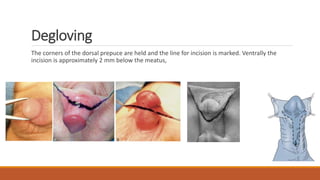
Degloving
The corners of the dorsal prepuce are held and the line for incision is marked. Ventrally the
incision is approximately 2 mm below the meatus,
Degloving is done in different planes: dorsally along the Buck fascia and ventrally just under the
shaft skin, preserving available dartos.
Dissection continues to the penopubic and penoscrotal junctions.
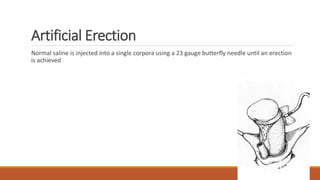
Artificial Erection
Normal saline is injected into a single corpora using a 23 gauge butterfly needle until an erection
is achieved
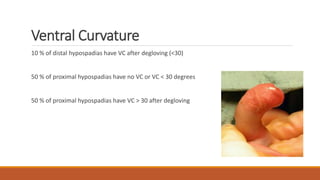
Ventral Curvature
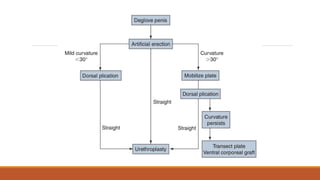
10 % of distal hypospadias have VC after degloving (<30)
50 % of proximal hypospadias have no VC or VC < 30 degrees
50 % of proximal hypospadias have VC > 30 after degloving
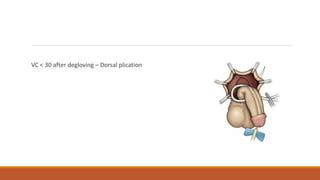
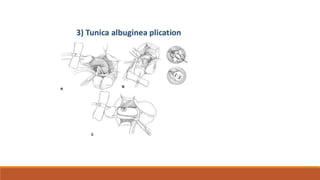
VC < 30 after degloving – Dorsal plication
VC > 30 after degloving and extended dissection
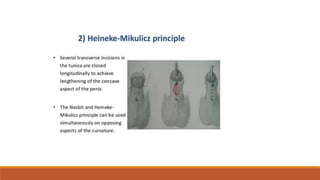
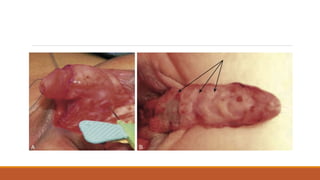
◦ ventral corporotomies with or without grafting
Ventral corporotomy
◦ Single incision and graft
◦ Three incisions without graft
Urethroplasty
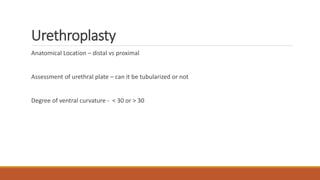
Anatomical Location – distal vs proximal
Assessment of urethral plate – can it be tubularized or not
Degree of ventral curvature - < 30 or > 30
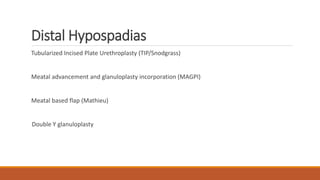
Distal Hypospadias
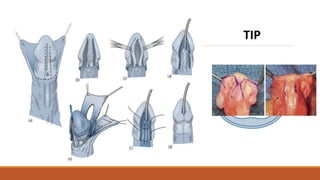
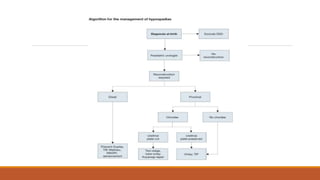
Tubularized Incised Plate Urethroplasty (TIP/Snodgrass)
Meatal advancement and glanuloplasty incorporation (MAGPI)
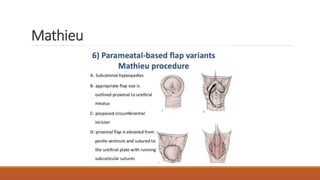
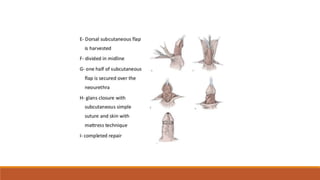
Meatal based flap (Mathieu)
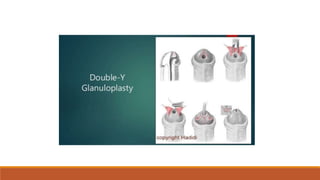
Double Y glanuloplasty
TIP
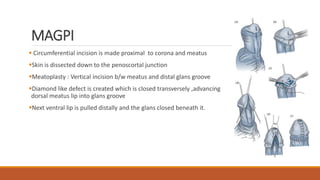
MAGPI
 Circumferential incision is made proximal to corona and meatus
Skin is dissected down to the penoscortal junction
Meatoplasty : Vertical incision b/w meatus and distal glans groove
Diamond like defect is created which is closed transversely ,advancing
dorsal meatus lip into glans groove
Next ventral lip is pulled distally and the glans closed beneath it.
Mathieu
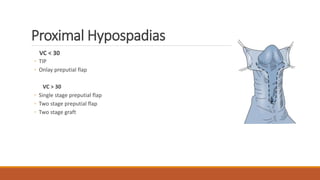
Proximal Hypospadias
VC < 30
◦ TIP
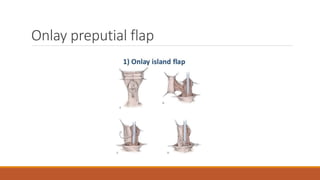
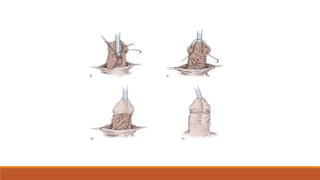
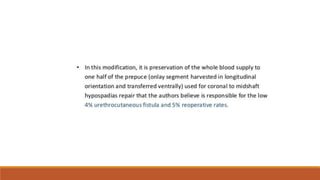
◦ Onlay preputial flap
VC > 30
◦ Single stage preputial flap
◦ Two stage preputial flap
◦ Two stage graft
TIP
Onlay preputial flap
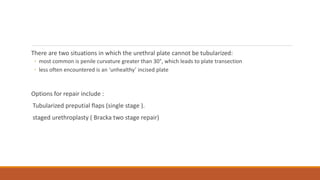
There are two situations in which the urethral plate cannot be tubularized:
◦ most common is penile curvature greater than 30°, which leads to plate transection
◦ less often encountered is an ‘unhealthy’ incised plate
Options for repair include :
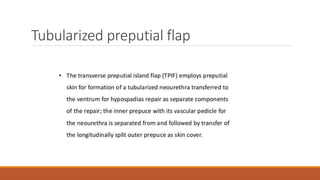
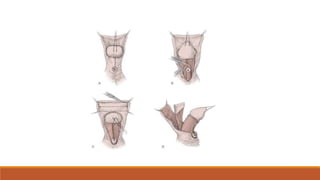
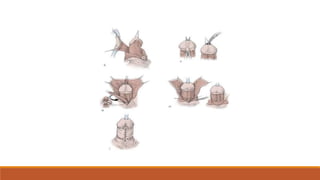
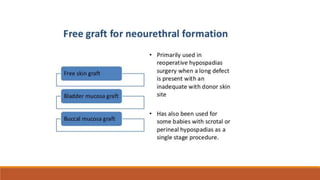
Tubularized preputial flaps (single stage ).
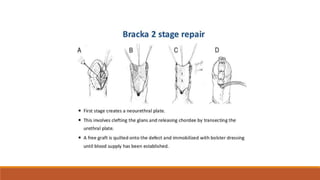
staged urethroplasty ( Bracka two stage repair)
Tubularized preputial flap
Factors for Technical Success
Use of vascularized tissues
Careful tissue handling
Tension-free anastomosis
Non-overlapping suture lines
Meticulous hemostasis
Fine suture material
Adequate urinary diversion
Post op Management
 Urinary Diversion :
Several studies proposed Distal TIP in pre-toilet trained boys can be
done without diversion expecting <5% to need catheterization early
post-operatively without increase in urethroplasty complications.
Stent must be placed ; sutured to glans or a balloon catheter taped
with abdomen
6-Fr bladder stent in pediatric age group
12-14 Fr post pubertal age group
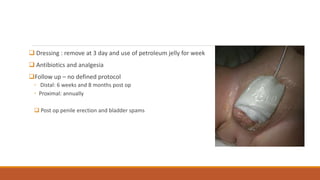
 Dressing : remove at 3 day and use of petroleum jelly for week
 Antibiotics and analgesia
Follow up – no defined protocol
◦ Distal: 6 weeks and 8 months post op
◦ Proximal: annually
 Post op penile erection and bladder spams
Complications
1. Bleeding and hematoma (most common )
2. Meatal stenosis (Tight granuloplasty )
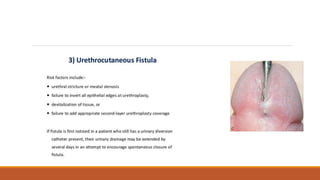
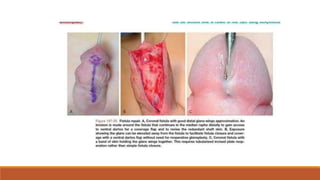
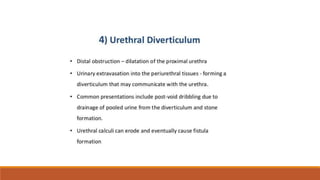
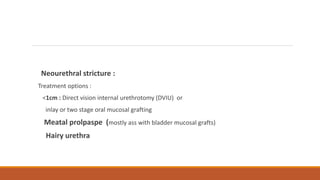
Neourethral stricture :
Treatment options :
<1cm : Direct vision internal urethrotomy (DVIU) or
inlay or two stage oral mucosal grafting
Meatal prolpaspe (mostly ass with bladder mucosal grafts)
Hairy urethra
Outcomes
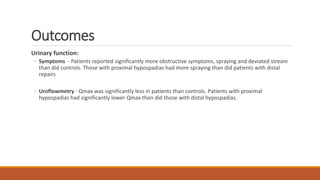
Urinary function:
◦ Symptoms - Patients reported significantly more obstructive symptoms, spraying and deviated stream
than did controls. Those with proximal hypospadias had more spraying than did patients with distal
repairs
◦ Uroflowmetry - Qmax was significantly less in patients than controls. Patients with proximal
hypospadias had significantly lower Qmax than did those with distal hypospadias.
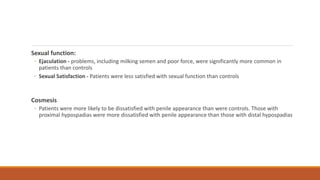
Sexual function:
◦ Ejaculation - problems, including milking semen and poor force, were significantly more common in
patients than controls
◦ Sexual Satisfaction - Patients were less satisfied with sexual function than controls
Cosmesis
◦ Patients were more likely to be dissatisfied with penile appearance than were controls. Those with
proximal hypospadias were more dissatisfied with penile appearance than those with distal hypospadias
THANK YOU !

Hypospadias ppt.

  • 1.
    Hypospadias DR. UMBREEN MINHAS PLASTICSURGERY HOLYFAMILY HOSPITAL.
  • 2.
    Introduction Hypospadias is acongenital anomaly of the male external genitalia, in which the urethral meatus opens on the ventral side of the penis, proximal to normal granular location.
  • 3.
  • 5.
    Incidence 1:300 live malebirths (0.3 %) Some genetic component ◦ 8% of patients have father with hypospadias ◦ 14% of patients have male siblings with hypospadias More common in Caucasians
  • 6.
    Etiology  Mostly unknown ◦Abnormal androgen production by the fetal testis ◦ Limited androgen sensitivity in target tissues ◦ Premature cessation of androgenic stimulation due to early atrophy of the Leydig cells of the testes. ◦ Defect in testosterone biosynthetic pathway, specifically with impared 3beta-hydroxysteroid dehydrogenase were reported in proximal hypospadias
  • 7.
    Isolated versus SyndromicHypospadias Approximately 90 % cases are isolated penile defects Syndromic hypospadias is suspected with development delay, dysmorphic facies, and/or anorectal malformation ◦ Smith-Lemli-Opitz Syndrome ◦ WAGR syndrome ◦ G Syndrome ◦ 13q deletion syndrome Associated anomalies include undescended testes, inguinal hernia and rarely upper tract anomalies
  • 8.
    Disorders of SexualDevelopment  The coexistence of hypospadias with undescended testes may indicate a DSD and may be an indication for karyotyping ◦ Most common diagnosis is mixed gonadal dysgenesis ◦ Ovotesticular DSD ◦ 5 alpha reductase deficiency ◦ Klinefelter syndrome
  • 9.
  • 10.
    Chordee Abnormal ventral curvatureof penis TYPES: 1 : skin tethering 2 : fibrotic dartos and bucks fascia 3: corporal disproportion 4: congenital short urethra
  • 12.
    Differential diagnosis  Chordeewithout hyposapadias : asymmetrical preputial development with normal meatus  Hypospadias variant with normal foreskin concealing a granular to distal shaft mega meatus
  • 13.
    Management History General physical examination Localexamination and examination of associated anomalies Systemic examination
  • 14.
    Diagnostic Evaluation Diagnosis includesa description of the local findings: ◦ position, shape and width of the orifice ◦ Assessment of urethral plate width <1 or >1 cm ◦ appearance of the preputial hood and scrotum ◦ size of the penis ◦ curvature of the penis on erection ◦ Urogenital tract anomalies
  • 15.
    Inguinoscrotal Examination The diagnosticevaluation also includes an assessment of associated anomalies, which are: ◦ cryptorchidism (in up to 10% of cases of hypospadias); ◦ open processus vaginalis or inguinal hernia (in 9-15%). ◦ Severe hypospadias with unilaterally or bilaterally impalpable testis, or with ambiguous genitalia, requires a complete genetic and endocrine work-up immediately after birth to exclude DSD, especially congenital adrenal hyperplasia.
  • 16.
  • 17.
     Urethroplasty  Straighteningof ventral penile curvature  circumcision / perputioplasty  scrotoplasty
  • 18.
    Aims of Surgery Functionalpenis with a normal cosmetic appearance ◦ Reconstruction of the missing portion of the urethra and extending it distally ◦ Widening of the meatus ◦ Correction of the curvature ◦ Restoration of the normal aspect of the external genitalia
  • 19.
    Age of Surgery 3-18 months of age to minimize psychosexual stress  More quick healing with fewer scars and young infants overcome the stress of surgery more easily  The highest incidence of post operative emotional disturbance has been noted at the age of 1- 3 years
  • 20.
    Anesthesia : General anesthesiawith adjuvant penile or caudal nerve blocks
  • 21.
    Preoperative Androgen Stimulation Therole of supplemental hormonal therapy before hypospadias surgery is not clear. Androgens are documented to increase penile length and glans circumference Usually limited to patients with proximal hypospadias, a small appearing penis, reduced glans circumference or reduced urethral plate.
  • 22.
    Key Steps Degloving thepenis Correction of associated ventral curvature Urethroplasty Interposition of a tissue barrier layer between the neourethra and overlying skin closure Management of the prepuce by either circumcision or foreskin reconstruction.
  • 23.
    Degloving The corners ofthe dorsal prepuce are held and the line for incision is marked. Ventrally the incision is approximately 2 mm below the meatus,
  • 24.
    Degloving is donein different planes: dorsally along the Buck fascia and ventrally just under the shaft skin, preserving available dartos. Dissection continues to the penopubic and penoscrotal junctions.
  • 25.
    Artificial Erection Normal salineis injected into a single corpora using a 23 gauge butterfly needle until an erection is achieved
  • 26.
    Ventral Curvature 10 %of distal hypospadias have VC after degloving (<30) 50 % of proximal hypospadias have no VC or VC < 30 degrees 50 % of proximal hypospadias have VC > 30 after degloving
  • 27.
    VC < 30after degloving – Dorsal plication
  • 31.
    VC > 30after degloving and extended dissection ◦ ventral corporotomies with or without grafting Ventral corporotomy ◦ Single incision and graft ◦ Three incisions without graft
  • 34.
    Urethroplasty Anatomical Location –distal vs proximal Assessment of urethral plate – can it be tubularized or not Degree of ventral curvature - < 30 or > 30
  • 35.
    Distal Hypospadias Tubularized IncisedPlate Urethroplasty (TIP/Snodgrass) Meatal advancement and glanuloplasty incorporation (MAGPI) Meatal based flap (Mathieu) Double Y glanuloplasty
  • 36.
  • 38.
    MAGPI  Circumferential incisionis made proximal to corona and meatus Skin is dissected down to the penoscortal junction Meatoplasty : Vertical incision b/w meatus and distal glans groove Diamond like defect is created which is closed transversely ,advancing dorsal meatus lip into glans groove Next ventral lip is pulled distally and the glans closed beneath it.
  • 40.
  • 43.
    Proximal Hypospadias VC <30 ◦ TIP ◦ Onlay preputial flap VC > 30 ◦ Single stage preputial flap ◦ Two stage preputial flap ◦ Two stage graft
  • 44.
  • 45.
  • 49.
    There are twosituations in which the urethral plate cannot be tubularized: ◦ most common is penile curvature greater than 30°, which leads to plate transection ◦ less often encountered is an ‘unhealthy’ incised plate Options for repair include : Tubularized preputial flaps (single stage ). staged urethroplasty ( Bracka two stage repair)
  • 50.
  • 57.
    Factors for TechnicalSuccess Use of vascularized tissues Careful tissue handling Tension-free anastomosis Non-overlapping suture lines Meticulous hemostasis Fine suture material Adequate urinary diversion
  • 58.
    Post op Management Urinary Diversion : Several studies proposed Distal TIP in pre-toilet trained boys can be done without diversion expecting <5% to need catheterization early post-operatively without increase in urethroplasty complications. Stent must be placed ; sutured to glans or a balloon catheter taped with abdomen 6-Fr bladder stent in pediatric age group 12-14 Fr post pubertal age group
  • 59.
     Dressing :remove at 3 day and use of petroleum jelly for week  Antibiotics and analgesia Follow up – no defined protocol ◦ Distal: 6 weeks and 8 months post op ◦ Proximal: annually  Post op penile erection and bladder spams
  • 60.
    Complications 1. Bleeding andhematoma (most common ) 2. Meatal stenosis (Tight granuloplasty )
  • 67.
    Neourethral stricture : Treatmentoptions : <1cm : Direct vision internal urethrotomy (DVIU) or inlay or two stage oral mucosal grafting Meatal prolpaspe (mostly ass with bladder mucosal grafts) Hairy urethra
  • 71.
    Outcomes Urinary function: ◦ Symptoms- Patients reported significantly more obstructive symptoms, spraying and deviated stream than did controls. Those with proximal hypospadias had more spraying than did patients with distal repairs ◦ Uroflowmetry - Qmax was significantly less in patients than controls. Patients with proximal hypospadias had significantly lower Qmax than did those with distal hypospadias.
  • 72.
    Sexual function: ◦ Ejaculation- problems, including milking semen and poor force, were significantly more common in patients than controls ◦ Sexual Satisfaction - Patients were less satisfied with sexual function than controls Cosmesis ◦ Patients were more likely to be dissatisfied with penile appearance than were controls. Those with proximal hypospadias were more dissatisfied with penile appearance than those with distal hypospadias
  • 73.

Editor's Notes

  • #15 Clinical diagnosis Most hypospadias patients are easily diagnosed at birth. degree of chordee( 10-20 mild, 30-40 mod, >50 severe)
  • #22 Preoperative treatment with local or parenteral application of testosterone, dihydrotestosterone or beta-chorionic gonadotropin is Also used in Ventral curvature and redo surgery 2 mg/kg testosterone enanthate given IM 5 and 2 weeks preoperatively testosterone enanthate 25 mg IM once monthly for 3 months before surgery.
  • #23 Since hypospadias is a complex surgery its important to divide it into parts for a better understanding No evidence that suture materials affect urethroplasty complications No role of preop antibiotics Penile block superior to caudal block Penile engorgement more after caudal block