Thyroid disorders
Dr Arinola Esan FMCP,FWACP,FACE
Consultant Endocrinologist
University College Hospital, Ibadan
Objectives
• To give an overview of thyroid disorders
• To discuss approach to management of some of them
Outline
• Introduction
• Brief Anatomy
• Functions
• Regulation of hormone production
• Classification of disorders
• Hyperthyroidism
• Hypothyroidism
• Goitres –non functional
Introduction
• Thyroid disorders are common in endocrinology
• These disorders affect most of the systems of the body
• Complications are usually difficult to manage
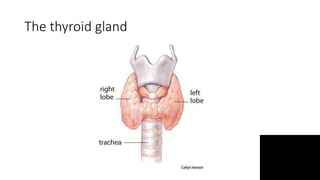
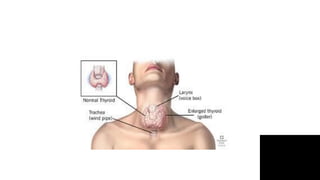
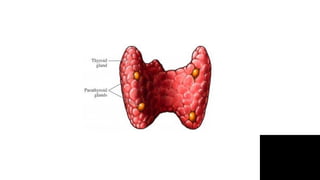
The thyroid gland
The thyroid gland
• 2 lobes connected in the middle by an isthmus
• Produces thyroxine (T4) & triidothyronine (T3)
• T4 secreted > than T3 ; T3 more biologically potent
• Most T3 derived from extrathyroidal conversion of T4
Functions of the thyroid gland
Thyroid hormones play critical role in:
• Cell differentiation during development
• maintaining thermogenesis
• metabolic homeostasis
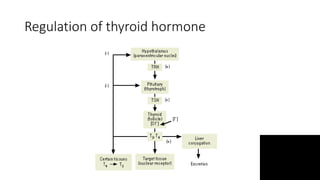
Regulation of thyroid hormone
Classification
• With goitre or without goitre
• Hyper or hypofunctioning
• Benign or malignant
Thyrotoxicosis or hyperthyroidism
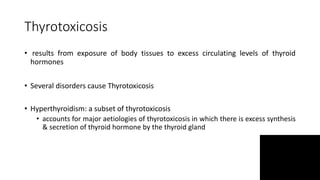
Thyrotoxicosis
• results from exposure of body tissues to excess circulating levels of thyroid
hormones
• Several disorders cause Thyrotoxicosis
• Hyperthyroidism: a subset of thyrotoxicosis
• accounts for major aetiologies of thyrotoxicosis in which there is excess synthesis
& secretion of thyroid hormone by the thyroid gland
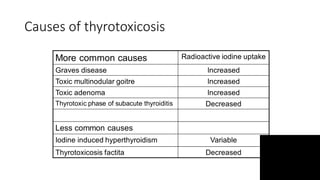
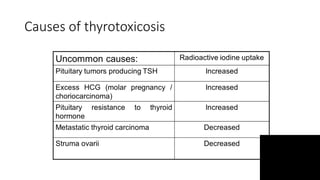
Causes of thyrotoxicosis
Thyrotoxicosis contd
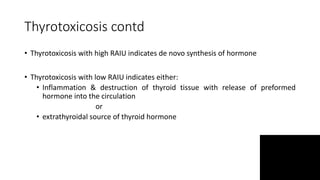
• Thyrotoxicosis with high RAIU indicates de novo synthesis of hormone
• Thyrotoxicosis with low RAIU indicates either:
• Inflammation & destruction of thyroid tissue with release of preformed
hormone into the circulation
or
• extrathyroidal source of thyroid hormone
Graves disease
Graves disease
• Most common cause of thyrotoxicosis (50- 80%)
• Autoimmune disorder resulting from TSH receptor antibodies (a.k.a. thyroid-
stimulating immunoglobulins), which activate receptor & stimulate thyroid gland
growth & thyroid hormone synthesis
• Characterized by a variety of circulating antibodies to thyroid components
including:
• TSH-R-stimulating Ab – specific for Graves disease
• anti-thyroid peroxidase (anti-TPO)
• antithyroglobulin (anti-TG) antibodies
Graves disease
• TSH-R-Ab is directed toward epitopes of the TSH receptor & acts as a
TSH-receptor agonist
• Similar to TSH, TSH-R-Ab binds to the TSH receptor on the thyroid
follicular cells to activate thyroid hormone synthesis, release &
thyroid growth
Graves disease
Consists of
• Hyperthyroidism
• Goiter
• Ophthalmopathy
• & occasionally a dermopathy (pretibial or localized myxedema)
Graves disease
• Peak incidence: 20-40yrs
• Prevalence varies among populations - areas of high iodine intake ass
with ↑ prevalence of Graves’
• Female:Male ratio reported as ~ 5-10:1
• Combination of genetic & environmental factors → ↑ susceptibility to
Graves’ disease
Graves disease: Precipitating factors
• Genetic susceptibility
• Abundant epidemiologic evidence in support
• Stress:
• Often hx of psychological stress before onset of dx. Suppression of
stress followed by immunologic hyperactivity → disease in
genetically susceptible
• Pregnancy: a time of immune suppression, with rebound post partum
Precipitating & Predisposing factors
• Sex steroids
• estrogen enhances immunologic activity
• Smoking
• Drugs: Iodine & iodine containing drugs may ppt disease in
susceptible individual
• may also damage thyroid cell directly & release thyroid antigens to
immune system
• Interferon α treatment of patients with hepatitis C infection
• Infections:
• Possible infections of the thyroid gland could initiate class II
molecule expression
Graves disease continued
• Usually thyroid gland palpable with diffusely enlarged smooth goitre,
initially soft
• May become progressively firmer
• Nodular Graves (Marine-Lenart syndrome)
• Graves disease in association with thyroid nodules reportedly increases risk of
thyroid carcinoma
Symptoms in thyrotoxicosis
• Tremors
• Heat intolerance
• Hyperkinesis
• Irritability, nervousness
• Jitteriness
• increased sweating
• Increased appetite
• Palpitations
• Eye symptoms (staring
gaze, increased
protrusion, pain, redness)
• Diarrhea /
Hyperdefaecation
• Weight loss despite good
or  appetite
• Dyspnoea on exertion
• Itching
• Muscle weakness/wasting
•may manifest as
exercise intolerance or
difficulty climbing stairs
• Menstrual irregularities
• Reduced libido/ED
Signs may include:
General /skin
• Fine tremor
• Evidence of weight loss
• Warm, moist skin
• Fine silky hair ± alopecia
• Hyperhidrosis
• Sweaty palms
• Palmar erythema
• Onycholysis
Signs in thyrotoxicosis
Eye signs
• Lid lag, Lid retraction
• Exophthalmos (Graves disease)
• Cranial nerve palsy
• Goitre
• Thyroid bruit
Signs in thyrotoxicosis
Cardiovascular
• Tachycardia
• Atrial fibrillation
• High output heart failure
• Systolic hypertension
• Pretibial myxedema (Graves disease)
Signs
Neurological
• Restlessness
• Other mental state changes
• Irritability, anxiety, emotional lability, depression, other psychiatric
reactions
• Proximal myopathy
• Hyperreflexia
Other findings in thyrotoxicosis
• Skin - hyperpigmentation, acropachy, urticaria, vitiligo
• CVS-premature atrial contractions
• GIT - hepatomegaly, LFT abnormalities, jaundice
• Metabolic-serum calcium & alkaline phosphatase, hypercalciuria,
glucose intolerance
• Neuromuscular-periodic paralysis(Asian males, sudden flaccid
paralysis of muscles, occ hypo K+), muscle atrophy
Other findings in thyrotoxicosis
• Osseous-osteoporosis
• Reproductive - gynecomastia, sub-fertility
• Hematopoietic- normochromic, normocytic anemia, lymphocytosis,
lymphadenopathy, thymus enlargement, splenomegaly
• Neurologic: Choreoathetosis
• Others: Syncope, Delirium, stupor, coma, vomiting, (in severe cases)
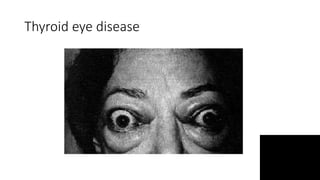
Thyroid eye disease
• Clinically evident in 20-25 %
• More may have evidence on USS, CT, MRI (enlarged retro-ocular
muscles)
• appears before, concurrently or after treatment in Graves
• most patients with ophthalmopathy have evidence of thyroid disease,
but absent in ~ 10% of patients
•“Euthyroid graves”
• Ophthalmopathy may occur in chronic autoimmune thyroiditis
(Hashimoto's) & may have TSHR receptor Ab (blocking )
Thyroid eye disease
Thyroid eye disease
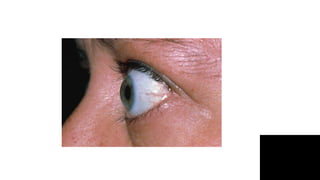
• Look out for: redness, congestion, periorbital oedema conjunctival
injection & oedema, proptosis, ophthalmoplegia
• Failure of lid apposition promotes drying & ulceration of cornea
• Objective measurement of degree of proptosis using an hertel’s
exophthalmometer
• measurement of distance b/w lateral angle of bony orbit &
imaginary line tangent to most anterior part of cornea
• upper limit of normal: 20 mm in whites; 22 mm in blacks
• Visual acuity, visual fields & color vision
Thyroid eye disease
• N –No signs or symptoms 0
• O – only symptoms 1
• S – soft tissue involvement 2
• P – proptosis 3
• E – Extraocular muscle involvement 4
• C- corneal involvement 5
• S – sight loss 6
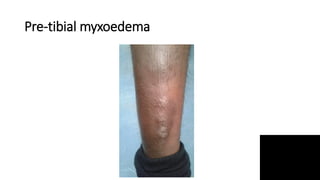
Pretibial myxoedema
• Accumulation of fluid & mucopolysaccharides in pretibial region
• Mild
• Severe
• Incapacitating
May appear as:
• Non pitting oedema
• Nodular
• Plaques
Pre-tibial myxoedema
Graves disease – some associations
• Addisons disease
• DM
• Vitiligo
• Myasthenia gravis
• SLE
• RA
• Scleroderma
• Thymic hyperplasia
• ITP
• Dermatitis herepetiformis
• Pernicious anaemia
• Albright syndrome
• Cutaneous pigmentation
• Precocious puberty
• Polyostotic fibrous dysplasia
Toxic multinodular goitre
• Orbitopathy, pretibial myxedema, acropachy not observed
• TSH-R antibodies absent
• Size of thyroid gland variable with a dominant nodule or multiple
irregular, variably sized nodules typically present
• Neck USS should help delineate discrete unpalpable nodules
Thyroiditis
Causes include:
• Direct chemical toxicity with inflammation (amiodarone)
• Radiation thyroiditis, from external radiation or after radioiodine
therapy
• Palpation thyroiditis e.g occurring during parathyroid surgery
Diff diagnosis of thyrotoxicosis
• Single nodule raises possibility of an autonomously functioning thyroid adenoma
• Painful, tender thyroid in subacute granulomatous thyroiditis
• Subacute lymphocytic (usually painless) thyroiditis may have no, minimal, or
modest thyroid enlargement
• Absence of any thyroid enlargement: consider exogenous thyroid hormone ingestion
or ectopic thyroid tissue
Investigation of thyroid function
• Sensitive TSH assay
• 3rd gen assays:10 fold greater functional sensitivity than 2nd gen
• Assay of circulating thyroid hormones
• Total (protein bound)
• Free T4/T3
Assessment of thyroid function
• Thyroid autoantibody tests
• Thyroid imaging - of value in assessment of thyroid size & differential
diagnosis – Ultrasound scan; CT; MRI
• Nuclear scintigraphy: Radionuclide imaging
• evaluate functional activity of thyroid -hot or cold
• determine location & size of functional thyroid tissue (& to
localize ectopic thyroid tissue)
• Fine needle aspiration cytology
• differentiating benign from malignant disease
Biochemical diagnosis of Hyperthyroidism
• Overt: except for lab error, all patients with low/undetectable serum
TSH & high free T4 & T3 concentrations have hyperthyroidism
• In some pts, only serum T3 or serum T4 is elevated
• T3 toxicosis – Low serum TSH; high free T3; normal free T4
• Tends to occur early in course of hyperthyroidism
• T4 toxicosis – Low serum TSH, high free T4, normal T3
• Pattern in pts with hyperthyroidism & non thyroidal illness
• May occur in persons with amiodarone induced thyrotoxicosis
Biochemical diagnosis of Hyperthyroidism
• TSH-induced hyperthyroidism: Very rare cause of hyperthyroidism,
due to:
TSH-secreting pituitary adenoma
or
partial resistance to feedback effect of thyroid hormones on TSH
secretion
defects in the T3-nuclear receptor
Normal or high serum TSH despite high free T4 & T3 concn
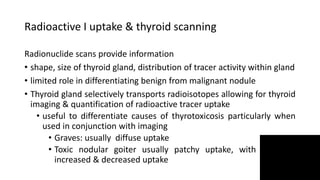
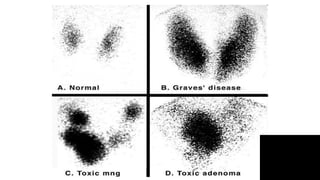
Radioactive I uptake & thyroid scanning
Radionuclide scans provide information
• shape, size of thyroid gland, distribution of tracer activity within gland
• limited role in differentiating benign from malignant nodule
• Thyroid gland selectively transports radioisotopes allowing for thyroid
imaging & quantification of radioactive tracer uptake
• useful to differentiate causes of thyrotoxicosis particularly when
used in conjunction with imaging
• Graves: usually diffuse uptake
• Toxic nodular goiter usually patchy uptake, with areas of
increased & decreased uptake
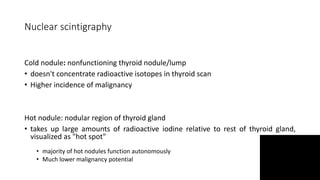
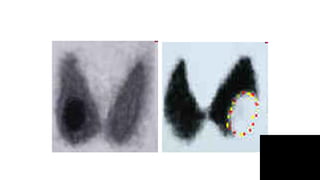
Nuclear scintigraphy
Cold nodule: nonfunctioning thyroid nodule/lump
• doesn't concentrate radioactive isotopes in thyroid scan
• Higher incidence of malignancy
Hot nodule: nodular region of thyroid gland
• takes up large amounts of radioactive iodine relative to rest of thyroid gland,
visualized as "hot spot"
• majority of hot nodules function autonomously
• Much lower malignancy potential
Treatment of hyperthyroidism
B-blockers
• relieves many of the symptoms (particularly palpitations, tremor,
anxiety)
• Atenolol – advantage of single daily dose & -1 selectivity
• Propanolol also reduces T4 to T3 conversion
• Contraindicated in asthma; caution in patients with heart
failure
Antithyroid drugs: Carbimazole, Methimazole, Propyl thiouracil
inhibit thyroid hormone biosynthesis & secretion
Thionamide therapy in Hyperthyroidism
• Aim: to restore euthyroid state as soon as possible, so as to achieve
lasting remission in patients with Grave's disease or to prepare
patients treatment with radioactive iodine or surgery
• Duration of treatment with drugs:– 12 to 24 months if ablation not
intended
• Reports of permanent remission after discontinuing drugs is achieved
- 15-80%
Side effects of Thionamides
• Rash
• Nausea
• Epigastric distress
• Agranulocytosis*
• Hepatitis
• Lupus like syndrome
• Vasculitis
• Polyarthritis
Other Medications
Iodides, Ipodate (iodinated radio contrast agent)
• Inhibit thyroid hormone synthesis and secretion
• Useful in lowering T3 & T4
• Can be used to quickly prepare patients for surgery, when there is
insufficient time to give thionamides
• Useful in combination treatment of thyroid storm
Radioactive iodine (I 131)
• Treatment of choice in patients with toxic nodular goitre
• 1st line for patients with Graves’ disease in US
• Increasingly used as first-line therapy for adults
• Contraindicated in children, during pregnancy & breast feeding
• Pregnancy contraindicated for 6-12 months after therapy
• Fixed or individualized doses
Radioactive iodine (I 131)
• Stop thionamides 3-5 days before RAI, to avoid impairing uptake;
restart few days later
• May aggravate uncontrolled hyperthyroidism
• Small but definite risk of development or worsening of
ophthalmopathy, esp if smoker or high T3 before therapy
• (Tx with prednisolone reported to prevent worsening)
• Toxic nodules require higher doses
• side effect – hypothyroidism, radiation thyroiditis
• life-long follow-up of thyroid function required
Thyroidectomy
• Those with very large goiters
• Where there is possibility of malignancy
• Severe or advancing ophthalmopathy
• Patient who relapses after medical therapy
• Pregnant patient on drugs whose disease is hard to control
• Those with severe reactions to antithyroid drugs
• Patients who have refused I 131 therapy
• Woman wishing to achieve a pregnancy in near future
Treatment of other causes
Self-limiting causes of thyrotoxicosis: subacute thyroiditis, iodine-
induced, exogenous administration of T4
• Treat symptomatically
• Therapy: beta-blockers for symptomatic control and
antiinflammatory drugs such as aspirin, or nonsteroidal
antiinflammatory drugs, or, in severe cases, prednisone
• Ipodate also useful: blocks conversion of T4 to T3 & reduces the
tissue effects of thyroid hormones
• Thionamides have no role in treatment, since new hormone is
not being synthesized
Hypothyroidism
Hypothyroidism
Clinical syndrome resulting from a deficiency of thyroid hormone →
to generalised slowing of metabolic process
Hypothyroidism
• Diagnosis relies heavily on lab tests
•many of the clinical manifestations non-specific
• Clinical presentation highly variable
•depends on age of onset and duration & severity of disease
•Presentation in adults varies from asymptomatic elevation in TSH
concentration to myxedema coma
Hypothyroidism
Classified as:
• Primary
• Secondary
• Tertiary
• Peripheral resistance to action of thyroid hormone
OR
• Goitrous
• Non- Goitrous
Primary Hypothyroidism: Causes
• Chronic autoimmune thyroiditis
• Iodine deficiency & iodine excess
• Post irradiation (I131, external irradiation)
• Post ablative
• Drug induced: Thionamides, lithium, amiodarone, IF-
• Infiltrative diseases: Sarcoidosis, haemochromatosis, amyloidosis,
• Congenital thyroid agenesis, dysgenesis or biosynthetic defects
Transient hypothyroidism
• Sub acute lymphocytic thyroiditis
• Sub acute granulomatous
• Postpartum thyroiditis
• After 131I treatment or subtotal thyroidectomy for Graves’ disease
Chronic Autoimmune thyroiditis
• Commonest cause of hypothyroidism in iodine-sufficient areas of the
world
• Commoner in older women
• cellular & antibody-mediated destruction of thyroid tissue
• Goitrous
• Atrophic
• differ in extent of lymphocytic infiltration, fibrosis, & follicular
cell hyperplasia of thyroid, but not in pathophysiology
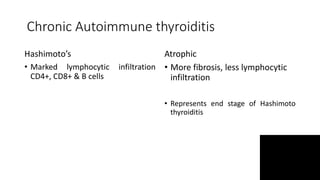
Chronic Autoimmune thyroiditis
Hashimoto’s
• Marked lymphocytic infiltration
CD4+, CD8+ & B cells
Atrophic
• More fibrosis, less lymphocytic
infiltration
• Represents end stage of Hashimoto
thyroiditis
Chronic autoimmune (Hashimoto's) thyroiditis
Role for genetic susceptibility
• more likely to have personal or family history of autoimmune
diseases
• Association with Turners syndrome
No well-defined environmental risk factors for chronic autoimmune
thyroiditis
• evidence linking a high iodine intake with this disorder
• serum antithyroid antibody concentrations increase after
dietary iodine intake is increased in endemic goiter regions
• Reports of association between cigarette smoking & risk of
hypothyroidism in pts with autoimmune thyroid disease
Hypothyroidism
Symptoms in adults often non-specific:
• Fatigue
• Cold intolerance
• Weight gain
• Constipation
• Myalgia
• Menstrual irregularities
• Slow movement and speech
Hypothyroidism
Older children may present on account of:
• Short stature due to linear growth retardation
• Retarded secondary sexual characteristics
• Delayed onset of puberty
• Poor school performance
Hypothyroidism
• Delayed relaxation of deep tendon reflexes
• Bradycardia
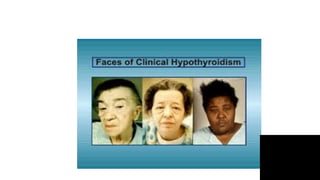
• Coarse hair and skin, puffy facies, loss of eyebrows, enlargement of
the tongue, voice hoarseness
• Overt muscle weakness
Other clinical features
• Entrapment neuropathy of median nerve
• producing paresthesia & weakness of hands
• Obstructive sleep apnoea
• Cardiomegaly: dilation of the heart; pericardial effusion
• Neuropsychiatric manifestations
• Adynamic ileus leading to mega colon & functional intestinal
obstruction
Investigations
• Primary hypothyroidsm – low or normal serum FT4 with elevated
TSH
• Secondary hypothyroidsm – low serum FT4 with low or
inappropriately normal TSH
• Subclinical hypothyroidsm – normal serum T4 & elevated serum
TSH (no symptoms or signs usually)
Investigation
• Raised TSH, normal free T4 or T3
• Recovery phase of non thyroidal illness
• Intermittent thyroxine therapy in hypothyroidism
• Interfering antibodies
• Drugs-cholestyramine, sertraline
• Congenital
• TSH receptor defects
• TSH resistance syndromes
Investigations
• Hyperlipidaemia – occurs with increased frequency in hypothyroidism
• Hyponatraemia – often resulting from inappropriate ADH secretion
• Elevated muscle enzymes (CPK, AST. LDH)
• Anaemia normochronic, normocytic
• E.C.G. changes- bradycardia, low amplitude QRS complexes, evidence
of ischaemic heart disease
• Thyroid autoantibodies (antithyroglobulin antibody, thyroid
peroxidase antibody)
Investigations contd
• Imaging studies of sellar and suprasellar region
• Evaluate for other hormone deficiencies
Treatment
• If no residual thyroid function, daily replacement of levothyroxine
@~1.6µg/kg( 1-2 µg/kg per day)
• Elderly (> 50-60) years & no evidence of heart disease, stat 50 µg
daily
• Those who have history of CHD initiate at 25 µg /day
• dose can be increased by 25 mcg/day every 3 to 6 wks until replacement
is complete
• Gradual increase, as rapid increase in dose may tax coronary or cardiac
reserve
Treatment
• Therapeutic goal: alleviation of clinical syndrome & normalization of
TSH in primary hypothyroidism
• After initiation of T4 therapy, reevaluate
• Serum T4 & TSH measured in 3 to 6 wks (depending upon patient's
symptoms) & dose adjusted accordingly
• process of increasing dose of Levothyroxine should continue,
based upon periodic measurements of serum TSH (& free T4 if
therapeutic goals have not been achieved)
Treatment
• Once desired T4 dose is established, annual evaluation
• Changing requirements
• Altered absorption
• Compliance issues
• Monitor for signs of overtreatment
• Life long therapy in majority
• Surgical therapy for huge goiters with compressive symptoms
•Subclinical hypothyroidism: Treat if there is goitre, suggestive
symptoms, low T3, drugs which may potentiate, uncertain follow
up, cholesterol
Thyroid cancer
• 95% of thyroid cancer presents as nodule or lump in thyroid gland
• Thyroid cancer may coexist with thyrotoxicosis
• Graves disease in association with thyroid nodules reportedly ↑ risk of
thyroid carcinoma
•
• Cold nodules frequent in hyperthyroid patients in endemic iodine-deficient
regions
• 3.8% in GD; 6.4% Toxic multinodular goitre; 12% in thyroid adenoma
• Older patients (>/=50 years) & cold nodules:- significant risk factors for
malignancy in patients with hyperthyroidism
Giles SY et al: Surgery 2008;144: 1028-36
Thyroid cancer
• Differentiated
• Papillary carcinomas
• Follicular carcinomas
• Undifferentiated
• Anaplastic
• Others
• Medullary thyroid cancer
• Lymphomas
• Sarcomas
• Metastases
Pathogenesis
• Radiation
• TSH & growth factors
• Oncogenes & tumour suppression
genes
• Approach to patients with thyroid
nodules
Thyroid cancer
Surgery is primary mode of therapy for patients with differentiated thyroid
cancer
• For most patients with papillary or follicular carcinoma:
• Total thyroidectomy followed by I131 ablation
Levothyroxine TSH suppression
• Diff thyroid cancers contain TSH receptors &TSH stimulates their growth
• Reduced recurrence & cancer specific mortality rates
Thyroid cancer
Follow-up
• long-term with physical examinations, biochemical testing (including
serum thyroglobulin measurements), radioiodine imaging, ultrasound
Thank you for your attention

Thyroid Disorders-1.pdf

  • 1.
    Thyroid disorders Dr ArinolaEsan FMCP,FWACP,FACE Consultant Endocrinologist University College Hospital, Ibadan
  • 2.
    Objectives • To givean overview of thyroid disorders • To discuss approach to management of some of them
  • 3.
    Outline • Introduction • BriefAnatomy • Functions • Regulation of hormone production • Classification of disorders • Hyperthyroidism • Hypothyroidism • Goitres –non functional
  • 4.
    Introduction • Thyroid disordersare common in endocrinology • These disorders affect most of the systems of the body • Complications are usually difficult to manage
  • 5.
  • 8.
    The thyroid gland •2 lobes connected in the middle by an isthmus • Produces thyroxine (T4) & triidothyronine (T3) • T4 secreted > than T3 ; T3 more biologically potent • Most T3 derived from extrathyroidal conversion of T4
  • 9.
    Functions of thethyroid gland Thyroid hormones play critical role in: • Cell differentiation during development • maintaining thermogenesis • metabolic homeostasis
  • 10.
  • 11.
    Classification • With goitreor without goitre • Hyper or hypofunctioning • Benign or malignant
  • 12.
  • 13.
    Thyrotoxicosis • results fromexposure of body tissues to excess circulating levels of thyroid hormones • Several disorders cause Thyrotoxicosis • Hyperthyroidism: a subset of thyrotoxicosis • accounts for major aetiologies of thyrotoxicosis in which there is excess synthesis & secretion of thyroid hormone by the thyroid gland
  • 14.
  • 15.
  • 16.
    Thyrotoxicosis contd • Thyrotoxicosiswith high RAIU indicates de novo synthesis of hormone • Thyrotoxicosis with low RAIU indicates either: • Inflammation & destruction of thyroid tissue with release of preformed hormone into the circulation or • extrathyroidal source of thyroid hormone
  • 17.
  • 18.
    Graves disease • Mostcommon cause of thyrotoxicosis (50- 80%) • Autoimmune disorder resulting from TSH receptor antibodies (a.k.a. thyroid- stimulating immunoglobulins), which activate receptor & stimulate thyroid gland growth & thyroid hormone synthesis • Characterized by a variety of circulating antibodies to thyroid components including: • TSH-R-stimulating Ab – specific for Graves disease • anti-thyroid peroxidase (anti-TPO) • antithyroglobulin (anti-TG) antibodies
  • 19.
    Graves disease • TSH-R-Abis directed toward epitopes of the TSH receptor & acts as a TSH-receptor agonist • Similar to TSH, TSH-R-Ab binds to the TSH receptor on the thyroid follicular cells to activate thyroid hormone synthesis, release & thyroid growth
  • 20.
    Graves disease Consists of •Hyperthyroidism • Goiter • Ophthalmopathy • & occasionally a dermopathy (pretibial or localized myxedema)
  • 21.
    Graves disease • Peakincidence: 20-40yrs • Prevalence varies among populations - areas of high iodine intake ass with ↑ prevalence of Graves’ • Female:Male ratio reported as ~ 5-10:1 • Combination of genetic & environmental factors → ↑ susceptibility to Graves’ disease
  • 22.
    Graves disease: Precipitatingfactors • Genetic susceptibility • Abundant epidemiologic evidence in support • Stress: • Often hx of psychological stress before onset of dx. Suppression of stress followed by immunologic hyperactivity → disease in genetically susceptible • Pregnancy: a time of immune suppression, with rebound post partum
  • 23.
    Precipitating & Predisposingfactors • Sex steroids • estrogen enhances immunologic activity • Smoking • Drugs: Iodine & iodine containing drugs may ppt disease in susceptible individual • may also damage thyroid cell directly & release thyroid antigens to immune system • Interferon α treatment of patients with hepatitis C infection • Infections: • Possible infections of the thyroid gland could initiate class II molecule expression
  • 24.
    Graves disease continued •Usually thyroid gland palpable with diffusely enlarged smooth goitre, initially soft • May become progressively firmer • Nodular Graves (Marine-Lenart syndrome) • Graves disease in association with thyroid nodules reportedly increases risk of thyroid carcinoma
  • 25.
    Symptoms in thyrotoxicosis •Tremors • Heat intolerance • Hyperkinesis • Irritability, nervousness • Jitteriness • increased sweating • Increased appetite • Palpitations • Eye symptoms (staring gaze, increased protrusion, pain, redness) • Diarrhea / Hyperdefaecation • Weight loss despite good or  appetite • Dyspnoea on exertion • Itching • Muscle weakness/wasting •may manifest as exercise intolerance or difficulty climbing stairs • Menstrual irregularities • Reduced libido/ED
  • 26.
    Signs may include: General/skin • Fine tremor • Evidence of weight loss • Warm, moist skin • Fine silky hair ± alopecia • Hyperhidrosis • Sweaty palms • Palmar erythema • Onycholysis
  • 27.
    Signs in thyrotoxicosis Eyesigns • Lid lag, Lid retraction • Exophthalmos (Graves disease) • Cranial nerve palsy • Goitre • Thyroid bruit
  • 28.
    Signs in thyrotoxicosis Cardiovascular •Tachycardia • Atrial fibrillation • High output heart failure • Systolic hypertension • Pretibial myxedema (Graves disease)
  • 29.
    Signs Neurological • Restlessness • Othermental state changes • Irritability, anxiety, emotional lability, depression, other psychiatric reactions • Proximal myopathy • Hyperreflexia
  • 30.
    Other findings inthyrotoxicosis • Skin - hyperpigmentation, acropachy, urticaria, vitiligo • CVS-premature atrial contractions • GIT - hepatomegaly, LFT abnormalities, jaundice • Metabolic-serum calcium & alkaline phosphatase, hypercalciuria, glucose intolerance • Neuromuscular-periodic paralysis(Asian males, sudden flaccid paralysis of muscles, occ hypo K+), muscle atrophy
  • 31.
    Other findings inthyrotoxicosis • Osseous-osteoporosis • Reproductive - gynecomastia, sub-fertility • Hematopoietic- normochromic, normocytic anemia, lymphocytosis, lymphadenopathy, thymus enlargement, splenomegaly • Neurologic: Choreoathetosis • Others: Syncope, Delirium, stupor, coma, vomiting, (in severe cases)
  • 32.
    Thyroid eye disease •Clinically evident in 20-25 % • More may have evidence on USS, CT, MRI (enlarged retro-ocular muscles) • appears before, concurrently or after treatment in Graves • most patients with ophthalmopathy have evidence of thyroid disease, but absent in ~ 10% of patients •“Euthyroid graves” • Ophthalmopathy may occur in chronic autoimmune thyroiditis (Hashimoto's) & may have TSHR receptor Ab (blocking )
  • 33.
  • 34.
    Thyroid eye disease •Look out for: redness, congestion, periorbital oedema conjunctival injection & oedema, proptosis, ophthalmoplegia • Failure of lid apposition promotes drying & ulceration of cornea • Objective measurement of degree of proptosis using an hertel’s exophthalmometer • measurement of distance b/w lateral angle of bony orbit & imaginary line tangent to most anterior part of cornea • upper limit of normal: 20 mm in whites; 22 mm in blacks • Visual acuity, visual fields & color vision
  • 36.
    Thyroid eye disease •N –No signs or symptoms 0 • O – only symptoms 1 • S – soft tissue involvement 2 • P – proptosis 3 • E – Extraocular muscle involvement 4 • C- corneal involvement 5 • S – sight loss 6
  • 37.
    Pretibial myxoedema • Accumulationof fluid & mucopolysaccharides in pretibial region • Mild • Severe • Incapacitating May appear as: • Non pitting oedema • Nodular • Plaques
  • 38.
  • 39.
    Graves disease –some associations • Addisons disease • DM • Vitiligo • Myasthenia gravis • SLE • RA • Scleroderma • Thymic hyperplasia • ITP • Dermatitis herepetiformis • Pernicious anaemia • Albright syndrome • Cutaneous pigmentation • Precocious puberty • Polyostotic fibrous dysplasia
  • 40.
    Toxic multinodular goitre •Orbitopathy, pretibial myxedema, acropachy not observed • TSH-R antibodies absent • Size of thyroid gland variable with a dominant nodule or multiple irregular, variably sized nodules typically present • Neck USS should help delineate discrete unpalpable nodules
  • 41.
    Thyroiditis Causes include: • Directchemical toxicity with inflammation (amiodarone) • Radiation thyroiditis, from external radiation or after radioiodine therapy • Palpation thyroiditis e.g occurring during parathyroid surgery
  • 42.
    Diff diagnosis ofthyrotoxicosis • Single nodule raises possibility of an autonomously functioning thyroid adenoma • Painful, tender thyroid in subacute granulomatous thyroiditis • Subacute lymphocytic (usually painless) thyroiditis may have no, minimal, or modest thyroid enlargement • Absence of any thyroid enlargement: consider exogenous thyroid hormone ingestion or ectopic thyroid tissue
  • 43.
    Investigation of thyroidfunction • Sensitive TSH assay • 3rd gen assays:10 fold greater functional sensitivity than 2nd gen • Assay of circulating thyroid hormones • Total (protein bound) • Free T4/T3
  • 44.
    Assessment of thyroidfunction • Thyroid autoantibody tests • Thyroid imaging - of value in assessment of thyroid size & differential diagnosis – Ultrasound scan; CT; MRI • Nuclear scintigraphy: Radionuclide imaging • evaluate functional activity of thyroid -hot or cold • determine location & size of functional thyroid tissue (& to localize ectopic thyroid tissue) • Fine needle aspiration cytology • differentiating benign from malignant disease
  • 45.
    Biochemical diagnosis ofHyperthyroidism • Overt: except for lab error, all patients with low/undetectable serum TSH & high free T4 & T3 concentrations have hyperthyroidism • In some pts, only serum T3 or serum T4 is elevated • T3 toxicosis – Low serum TSH; high free T3; normal free T4 • Tends to occur early in course of hyperthyroidism • T4 toxicosis – Low serum TSH, high free T4, normal T3 • Pattern in pts with hyperthyroidism & non thyroidal illness • May occur in persons with amiodarone induced thyrotoxicosis
  • 46.
    Biochemical diagnosis ofHyperthyroidism • TSH-induced hyperthyroidism: Very rare cause of hyperthyroidism, due to: TSH-secreting pituitary adenoma or partial resistance to feedback effect of thyroid hormones on TSH secretion defects in the T3-nuclear receptor Normal or high serum TSH despite high free T4 & T3 concn
  • 47.
    Radioactive I uptake& thyroid scanning Radionuclide scans provide information • shape, size of thyroid gland, distribution of tracer activity within gland • limited role in differentiating benign from malignant nodule • Thyroid gland selectively transports radioisotopes allowing for thyroid imaging & quantification of radioactive tracer uptake • useful to differentiate causes of thyrotoxicosis particularly when used in conjunction with imaging • Graves: usually diffuse uptake • Toxic nodular goiter usually patchy uptake, with areas of increased & decreased uptake
  • 49.
    Nuclear scintigraphy Cold nodule:nonfunctioning thyroid nodule/lump • doesn't concentrate radioactive isotopes in thyroid scan • Higher incidence of malignancy Hot nodule: nodular region of thyroid gland • takes up large amounts of radioactive iodine relative to rest of thyroid gland, visualized as "hot spot" • majority of hot nodules function autonomously • Much lower malignancy potential
  • 51.
    Treatment of hyperthyroidism B-blockers •relieves many of the symptoms (particularly palpitations, tremor, anxiety) • Atenolol – advantage of single daily dose & -1 selectivity • Propanolol also reduces T4 to T3 conversion • Contraindicated in asthma; caution in patients with heart failure Antithyroid drugs: Carbimazole, Methimazole, Propyl thiouracil inhibit thyroid hormone biosynthesis & secretion
  • 52.
    Thionamide therapy inHyperthyroidism • Aim: to restore euthyroid state as soon as possible, so as to achieve lasting remission in patients with Grave's disease or to prepare patients treatment with radioactive iodine or surgery • Duration of treatment with drugs:– 12 to 24 months if ablation not intended • Reports of permanent remission after discontinuing drugs is achieved - 15-80%
  • 53.
    Side effects ofThionamides • Rash • Nausea • Epigastric distress • Agranulocytosis* • Hepatitis • Lupus like syndrome • Vasculitis • Polyarthritis
  • 54.
    Other Medications Iodides, Ipodate(iodinated radio contrast agent) • Inhibit thyroid hormone synthesis and secretion • Useful in lowering T3 & T4 • Can be used to quickly prepare patients for surgery, when there is insufficient time to give thionamides • Useful in combination treatment of thyroid storm
  • 55.
    Radioactive iodine (I131) • Treatment of choice in patients with toxic nodular goitre • 1st line for patients with Graves’ disease in US • Increasingly used as first-line therapy for adults • Contraindicated in children, during pregnancy & breast feeding • Pregnancy contraindicated for 6-12 months after therapy • Fixed or individualized doses
  • 56.
    Radioactive iodine (I131) • Stop thionamides 3-5 days before RAI, to avoid impairing uptake; restart few days later • May aggravate uncontrolled hyperthyroidism • Small but definite risk of development or worsening of ophthalmopathy, esp if smoker or high T3 before therapy • (Tx with prednisolone reported to prevent worsening) • Toxic nodules require higher doses • side effect – hypothyroidism, radiation thyroiditis • life-long follow-up of thyroid function required
  • 57.
    Thyroidectomy • Those withvery large goiters • Where there is possibility of malignancy • Severe or advancing ophthalmopathy • Patient who relapses after medical therapy • Pregnant patient on drugs whose disease is hard to control • Those with severe reactions to antithyroid drugs • Patients who have refused I 131 therapy • Woman wishing to achieve a pregnancy in near future
  • 58.
    Treatment of othercauses Self-limiting causes of thyrotoxicosis: subacute thyroiditis, iodine- induced, exogenous administration of T4 • Treat symptomatically • Therapy: beta-blockers for symptomatic control and antiinflammatory drugs such as aspirin, or nonsteroidal antiinflammatory drugs, or, in severe cases, prednisone • Ipodate also useful: blocks conversion of T4 to T3 & reduces the tissue effects of thyroid hormones • Thionamides have no role in treatment, since new hormone is not being synthesized
  • 59.
  • 60.
    Hypothyroidism Clinical syndrome resultingfrom a deficiency of thyroid hormone → to generalised slowing of metabolic process
  • 61.
    Hypothyroidism • Diagnosis reliesheavily on lab tests •many of the clinical manifestations non-specific • Clinical presentation highly variable •depends on age of onset and duration & severity of disease •Presentation in adults varies from asymptomatic elevation in TSH concentration to myxedema coma
  • 62.
    Hypothyroidism Classified as: • Primary •Secondary • Tertiary • Peripheral resistance to action of thyroid hormone OR • Goitrous • Non- Goitrous
  • 63.
    Primary Hypothyroidism: Causes •Chronic autoimmune thyroiditis • Iodine deficiency & iodine excess • Post irradiation (I131, external irradiation) • Post ablative • Drug induced: Thionamides, lithium, amiodarone, IF- • Infiltrative diseases: Sarcoidosis, haemochromatosis, amyloidosis, • Congenital thyroid agenesis, dysgenesis or biosynthetic defects
  • 64.
    Transient hypothyroidism • Subacute lymphocytic thyroiditis • Sub acute granulomatous • Postpartum thyroiditis • After 131I treatment or subtotal thyroidectomy for Graves’ disease
  • 65.
    Chronic Autoimmune thyroiditis •Commonest cause of hypothyroidism in iodine-sufficient areas of the world • Commoner in older women • cellular & antibody-mediated destruction of thyroid tissue • Goitrous • Atrophic • differ in extent of lymphocytic infiltration, fibrosis, & follicular cell hyperplasia of thyroid, but not in pathophysiology
  • 66.
    Chronic Autoimmune thyroiditis Hashimoto’s •Marked lymphocytic infiltration CD4+, CD8+ & B cells Atrophic • More fibrosis, less lymphocytic infiltration • Represents end stage of Hashimoto thyroiditis
  • 67.
    Chronic autoimmune (Hashimoto's)thyroiditis Role for genetic susceptibility • more likely to have personal or family history of autoimmune diseases • Association with Turners syndrome No well-defined environmental risk factors for chronic autoimmune thyroiditis • evidence linking a high iodine intake with this disorder • serum antithyroid antibody concentrations increase after dietary iodine intake is increased in endemic goiter regions • Reports of association between cigarette smoking & risk of hypothyroidism in pts with autoimmune thyroid disease
  • 68.
    Hypothyroidism Symptoms in adultsoften non-specific: • Fatigue • Cold intolerance • Weight gain • Constipation • Myalgia • Menstrual irregularities • Slow movement and speech
  • 70.
    Hypothyroidism Older children maypresent on account of: • Short stature due to linear growth retardation • Retarded secondary sexual characteristics • Delayed onset of puberty • Poor school performance
  • 71.
    Hypothyroidism • Delayed relaxationof deep tendon reflexes • Bradycardia • Coarse hair and skin, puffy facies, loss of eyebrows, enlargement of the tongue, voice hoarseness • Overt muscle weakness
  • 72.
    Other clinical features •Entrapment neuropathy of median nerve • producing paresthesia & weakness of hands • Obstructive sleep apnoea • Cardiomegaly: dilation of the heart; pericardial effusion • Neuropsychiatric manifestations • Adynamic ileus leading to mega colon & functional intestinal obstruction
  • 73.
    Investigations • Primary hypothyroidsm– low or normal serum FT4 with elevated TSH • Secondary hypothyroidsm – low serum FT4 with low or inappropriately normal TSH • Subclinical hypothyroidsm – normal serum T4 & elevated serum TSH (no symptoms or signs usually)
  • 74.
    Investigation • Raised TSH,normal free T4 or T3 • Recovery phase of non thyroidal illness • Intermittent thyroxine therapy in hypothyroidism • Interfering antibodies • Drugs-cholestyramine, sertraline • Congenital • TSH receptor defects • TSH resistance syndromes
  • 75.
    Investigations • Hyperlipidaemia –occurs with increased frequency in hypothyroidism • Hyponatraemia – often resulting from inappropriate ADH secretion • Elevated muscle enzymes (CPK, AST. LDH) • Anaemia normochronic, normocytic • E.C.G. changes- bradycardia, low amplitude QRS complexes, evidence of ischaemic heart disease • Thyroid autoantibodies (antithyroglobulin antibody, thyroid peroxidase antibody)
  • 76.
    Investigations contd • Imagingstudies of sellar and suprasellar region • Evaluate for other hormone deficiencies
  • 77.
    Treatment • If noresidual thyroid function, daily replacement of levothyroxine @~1.6µg/kg( 1-2 µg/kg per day) • Elderly (> 50-60) years & no evidence of heart disease, stat 50 µg daily • Those who have history of CHD initiate at 25 µg /day • dose can be increased by 25 mcg/day every 3 to 6 wks until replacement is complete • Gradual increase, as rapid increase in dose may tax coronary or cardiac reserve
  • 78.
    Treatment • Therapeutic goal:alleviation of clinical syndrome & normalization of TSH in primary hypothyroidism • After initiation of T4 therapy, reevaluate • Serum T4 & TSH measured in 3 to 6 wks (depending upon patient's symptoms) & dose adjusted accordingly • process of increasing dose of Levothyroxine should continue, based upon periodic measurements of serum TSH (& free T4 if therapeutic goals have not been achieved)
  • 79.
    Treatment • Once desiredT4 dose is established, annual evaluation • Changing requirements • Altered absorption • Compliance issues • Monitor for signs of overtreatment • Life long therapy in majority • Surgical therapy for huge goiters with compressive symptoms •Subclinical hypothyroidism: Treat if there is goitre, suggestive symptoms, low T3, drugs which may potentiate, uncertain follow up, cholesterol
  • 80.
    Thyroid cancer • 95%of thyroid cancer presents as nodule or lump in thyroid gland • Thyroid cancer may coexist with thyrotoxicosis • Graves disease in association with thyroid nodules reportedly ↑ risk of thyroid carcinoma •
  • 81.
    • Cold nodulesfrequent in hyperthyroid patients in endemic iodine-deficient regions • 3.8% in GD; 6.4% Toxic multinodular goitre; 12% in thyroid adenoma • Older patients (>/=50 years) & cold nodules:- significant risk factors for malignancy in patients with hyperthyroidism Giles SY et al: Surgery 2008;144: 1028-36
  • 82.
    Thyroid cancer • Differentiated •Papillary carcinomas • Follicular carcinomas • Undifferentiated • Anaplastic • Others • Medullary thyroid cancer • Lymphomas • Sarcomas • Metastases Pathogenesis • Radiation • TSH & growth factors • Oncogenes & tumour suppression genes • Approach to patients with thyroid nodules
  • 83.
    Thyroid cancer Surgery isprimary mode of therapy for patients with differentiated thyroid cancer • For most patients with papillary or follicular carcinoma: • Total thyroidectomy followed by I131 ablation Levothyroxine TSH suppression • Diff thyroid cancers contain TSH receptors &TSH stimulates their growth • Reduced recurrence & cancer specific mortality rates
  • 84.
    Thyroid cancer Follow-up • long-termwith physical examinations, biochemical testing (including serum thyroglobulin measurements), radioiodine imaging, ultrasound
  • 85.
    Thank you foryour attention