高泌乳激素血症 (Hyperprolactinemia) 白永河 內分泌暨新陳代謝科 彰化基督教醫院
PRL Regulated by the hypothalamus 主要是   tonic inhibition Hypothalamus  分泌   2  種   hypothalamic factors PIF (PRL-inhibiting factor) Dopamine PRF (PRL-releasing factor) TRH, VIP
PRL Stimulate breast development Initiate and maintain lactation  PRL receptor alveolar surface of mammary cell liver, kidney ovary, testes, prostate Estrogen synergistic in promoting breast development antagonize in effect of lactation
Breast development 須要多種   hormone  的   coordinated action 包括   major stimuli: estrogen   progesterone   prolactin   GH placental mammotropic H minor stmuli: insulin   cortisol   thyroid hormone
Breast development Duct growth: estrogen Lobuloalveolar development: PRL+progesterone Lactation: PRL + oxytocin
Galactorrhea 需要   PRL + Gonadal steroid  才會出現 ∴   not necessarily seen in all prolactinomas 和   serum PRL level  無關 Galactorrhea  的   incidence  差異很大 女性   30 ~ -80% 男性常   no galactorrhea 即使有   galactorrhea,  其中 50% 病人的   PRL  可能正常 反之,即使   PRL> 100ng/ml,  也可能   no galactorrhea ∴   Galactorrhea  為   poor marker of hyperprolactinemia
PRL 1928 discovered in extract of bovine pituitary 1970 sensitive bioassay 1971 RIA (Friesen, Fournier, Desjardians) secreted by the erythrosinophilic subtype of chromophobic cells in the adenohypophysis
PRL A stress hormone Secreted in a pulsatile fashion highest in the early morning ( 睡醒之前 ) lower in the afternoon physiologic PRL ↑ pain nipple stimulation fondling (women only) pregnancy ( 可達   200-500 ng/ml) pelvic examination exercise sleep
PRL Daily secretion rate:  400 μ g/ 天 Metabolic clearance: 40 ml/m 2 /min Clearance pathway:  25% kidney    75% liver Plasma T 1/2 :  50 min Plasma level: < 15 ng/ml ♂ :5 ng/ml (3-10) ♀ :8 ng/ml (5-15)   fetal PRL > 300 ng/ml   umbilical PRL > maternal PRL Pituitary PRL: 100  μ g per pituitary
PRL PRL value  和   prolactinoma tumor size  成正比 PRL > 1000 ng/ml  -> tumor extension into cavernous sinus > 150 ng/ml  ->   幾乎一定就是   prolactinoma   100-150 ng/ml: (1) prolactinoma   (2) pseudoprolactinoma   (3) drug-induced   20-100 ng/ml:  須   repeat  檢查   ( ∵  pulsatile secretion) (1) stress of vein puncture (pain) (2) stress or physical examination (3) breast examination (4) pelvic examination
PRL Blood sampling  須注意事項 indwelling venous cannula at least 2 hr resting 20 minutes interval  × 3-6  次 sampling time usually not critical
Hyperprolactinemia Basic mechanisms ( Ⅰ ) Hypothalamic dopamine deficiency hypothalamic tumor AV malformation inflammatory process drugs: methyldopa (Aldomet)   reserpine Defective transport mechanisms pituitary or stalk tumor head injury section of pituitary stalk
Hyperprolactinemia Basic mechanisms ( Ⅱ ) Lactotroph insensitivity to dopamine dopamine receptor blocking agents phenothiazine (chlorpromazine) butyrophenones (haloperidol) benzamide: metoclopamide   sulpiride   domperidone Stimulation of lactotrophs Hypothyroidism TRH Estrogen Chest wall injury: herpes zoster, surgery PRL-producing tumor
Pituitary tumor 約佔   brain tumor  的   10%  左右 Prolactinoma 40-50% Non-functioning adenoma 30% Gonadotroph cell adenoma 10-15% Acromegaly 10% Cushing's disease TSH-secreting adenoma
Prolactinoma General population  中可能 5-10% 有   prolactinoma 這其中只有   5-10% come to clinical attension 2/3  microadenoma 1/3  macroadenoma Autopsy study 6.5-27% (11%)  有   pituitary adenoma no antemortem endocrine dysfunction 40-50% (+) for PRL by immunocytochemical stain 幾乎全部為   microadenoma
Prolactinoma Grow slowly over years Large tumor  ->  hypopituitarism   (singly or incombination)   GH deficiency  最常見 Impaired pulsatile gonadotropin (LH, FSH) (via alteration in hypothalamic LHRH  secretion) (increased endogenous opiate tone) BMD  ↓
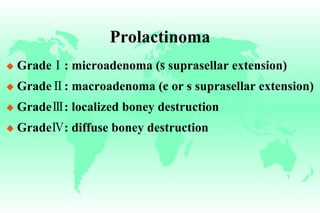
Prolactinoma Grade Ⅰ : microadenoma (s suprasellar extension) Grade Ⅱ : macroadenoma (c or s suprasellar extension) Grade Ⅲ : localized boney destruction Grade Ⅳ : diffuse boney destruction _ _ _
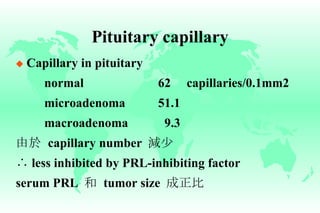
Pituitary capillary Capillary in pituitary normal 62  capillaries/0.1mm2 microadenoma 51.1 macroadenoma   9.3 由於   capillary number  減少 ∴   less inhibited by PRL-inhibiting factor serum PRL  和   tumor size  成正比
Prolactinoma Etiology: unclear ? Arise de novo ? Estrogen-induced ? Abnormality of hypothalamic regulation ? Monoclonal in origin
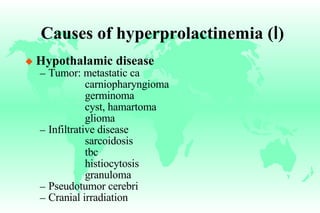
Causes of hyperprolactinemia ( Ⅰ ) Hypothalamic disease Tumor: metastatic ca   carniopharyngioma   germinoma   cyst, hamartoma   glioma Infiltrative disease   sarcoidosis   tbc   histiocytosis   granuloma Pseudotumor cerebri Cranial irradiation
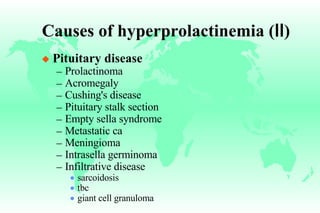
Causes of hyperprolactinemia ( Ⅱ ) Pituitary disease Prolactinoma Acromegaly Cushing's disease Pituitary stalk section Empty sella syndrome Metastatic ca Meningioma Intrasella germinoma Infiltrative disease sarcoidosis tbc giant cell granuloma
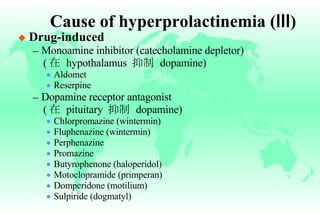
Cause of hyperprolactinemia ( Ⅲ ) Drug-induced Monoamine inhibitor (catecholamine depletor) ( 在   hypothalamus  抑制   dopamine) Aldomet Reserpine Dopamine receptor antagonist ( 在   pituitary  抑制   dopamine) Chlorpromazine (wintermin) Fluphenazine (wintermin) Perphenazine Promazine Butyrophenone (haloperidol) Motoclopramide (primperan) Domperidone (motilium) Sulpiride (dogmatyl)
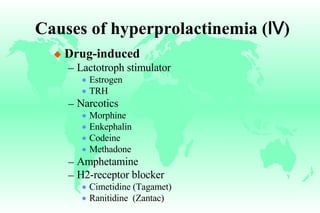
Causes of hyperprolactinemia ( Ⅳ ) Drug-induced Lactotroph stimulator Estrogen TRH Narcotics Morphine Enkephalin Codeine  Methadone Amphetamine H2-receptor blocker Cimetidine (Tagamet) Ranitidine  (Zantac)
Causes of hyperprolactinemia ( Ⅴ ) Major systemic disease 1 ° hypothyroidism CRF Liver cirrhosis Seizure Neurogenic breast manipulation chest wall lesion burn herpes zoster mastectomy Stress:  ‧   physical (pain) ‧   psychologic  PCO Idiopathic
Symptoms and Signs (Female) Delayed menarche Disturbance of menstrual function (60-90%) amenorrhea oligomenorrhea regular mens c infertility Galactorrhea (30-80%) 和   duration of gonadal dysfunction  有關 amenorrhea  愈久,較不會有   galactorrhea Estrogen deficiency libido ↓ hirsutism   vaginal dryness (DHEA by adrenal  ↑ ) dyspareunia (free testosterone  ↑ ) _
Symptoms and Signs (male) 男性和   postmenopausal  女性較常以 mass effect  表現 Headache (63%) Visual abnormality visual acuity ↓ ophthalmoplegia visual field defect ( 先   bitemporal upper quadrant anopia) ( 再   bitemporal hemianopia) Hypogonadism libido ↓  (83%) adiposity (70%) impotence galactorrhea (14-33%) infertility gynecomastia ( 少見 )
Mass effect Suprasellar extension: bitemporal hemianopia Extends posteriorly homonymous visual field defect Lateral extension (into the cavernous sinus) compress cranial nerve 3, 4, 5, 6 Extend into the temporal lobe : seizure
Hyperprolactinemia 干擾   hypothalamic-pituitary-ovarian axis  at 3 locations hypothalamic level interfer tonic or cyclic release of GnRH (LHRH) pituitary level desensitize gonadotropin  response to GnRH ovarian level impaires progesterone production (by ovarian granulosa cell)
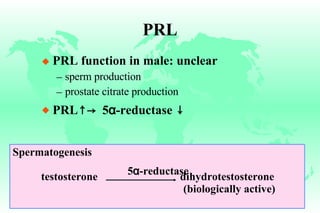
PRL PRL function in male: unclear sperm production prostate citrate production PRL ↑->   5 α -reductase  ↓ Spermatogenesis testosterone  dihydrotestosterone (biologically active)  5 α -reductase
Pseudoprolactinoma 任何   intrasellar or parasellar tumor   (non-PRL-secreting  pituitary adenoma) ->   pituitary stalk compression ->   interfer with PIF delivery (Dopamine) ->   PRL  ↑  ( 很少   > 150 ng/ml) 例如 : non-functioning pituitary adenoma craniopharyngioma tuberculum sella meningioma aneurysm
Normoprolactinemic galactorrhea enhanced sensitivity of breast to PRL 常見於   persistence of postpartum galactorrhea    after discontinuation of oral pills
Pregnancy with prolactinoma Microadenoma 5% progress to macroadenoma Macroadenoma 25% expand and produce symptoms (15-35%)
Primary hypothyroidism 常有   breast tenderness,  偶而   galactorrhea PRL  大部份正常 但也可能上昇,通常   < 100 ng /ml long-standing hypothyroidism  時 可能出現   sellar enlargement 如果又加上   PRL ↑ ,易誤為   prolactinoma PRL response to TRH ↑
CRF PRL ↑ in 60-70% ( < 150ng/ml) PRL response to TRH  ↓ receptor or postreceptor defect in the lactotroph not altered by HD reversed by renal transplantation
D.D. of hyperprolactinemia Prolactinoma Primary hypothyroidism (TSH) CRF (BUN/Cr) Liver cirrhosis (GOT/GPT, A/G) Cushing's syndrome (cortisol) Acromegaly (GH) Drug-induced (history taking) Pregnancy ( β -HCG) Pseudoprolactinoma Physiologic hyperprolactinemia
Treatment of microadenoma Disadvantage of untreated microadenoma loss of libido dyspareunia, hypogonadism BMD  ↓ premature CAD enlargement of tumor mass
Microadenoma Indication of treatment desire of becoming pregnant 須   eliminate galactorrhea 須   relieve symptoms of hypogonadism 如果上述   concern  不存在 periodically follow up  即可
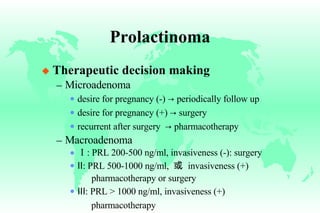
Prolactinoma Therapeutic decision making Microadenoma desire for pregnancy (-)  ->  periodically follow up desire for pregnancy (+)  ->  surgery recurrent after surgery  ->  pharmacotherapy Macroadenoma Ⅰ : PRL 200-500 ng/ml, invasiveness (-): surgery Ⅱ : PRL 500-1000 ng/ml,  或   invasiveness (+)   pharmacotherapy or surgery Ⅲ : PRL > 1000 ng/ml, invasiveness (+) pharmacotherapy
Pharmacotherapy of prolactinoma Ergot preparation Bromocriptin (approved by FDA) Lisuride Pergolide Metergoline Terguride (greater pituitary selectivity) Cabergoline (longer duration of action) non-Ergot preparation CV 205-502 (Octahydrobenzquinolone)
Bromocriptine Dopamine agonist, 1971 semisynthetic ergot alkaloid binds to the dopamine receptor affinity  為   dopamine  的   5-10X 使   PRL  恢復至   normal, in 64-100% 改善   galactorrhea, 57-100% 恢復   mens and ovulation, 57-100% 改善   visual field defect, 60-80% 使   tumor size reduction, 60-80% 但無法改善   loss of sleep-related PRL pulsatile secretion
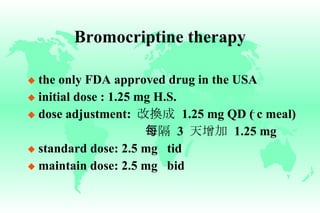
Bromocriptine therapy the only FDA approved drug in the USA initial dose : 1.25 mg H.S. dose adjustment:  改換成   1.25 mg QD ( c meal)   每隔   3  天增加   1.25 mg standard dose: 2.5 mg  tid maintain dose: 2.5 mg  bid _
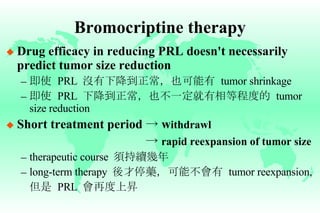
Bromocriptine therapy Drug efficacy in reducing PRL doesn't necessarily predict tumor size reduction 即使   PRL  沒有下降到正常,也可能有   tumor shrinkage 即使   PRL  下降到正常,也不一定就有相等程度的   tumor size reduction Short treatment period  ->  w ithdrawl   ->   rapid reexpansion of tumor size therapeutic course  須持續幾年 long-term therapy  後才停藥,可能不會有   tumor reexpansion, 但是   PRL  會再度上昇
Bromocriptine therapy Intolerate to oral therapy 時,可改用   vaginal administration (the same dosage) Patient  必須被告知可能   restore fertility ∴ 須事先使用   mechanical contraception   ( 否則會在服藥治療期間   conception  而不自知 )   直到   regular menstrual flow  ×  3 cycles Not teratogenic in human fetal loss congenital malformation  Injectable form available in Europe effective for 4-6 wk :  not increased ]
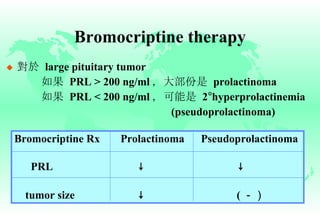
Bromocriptine therapy 對於   large pituitary tumor   如果   PRL > 200 ng/ml ,大部份是   prolactinoma   如果   PRL < 200 ng/ml ,可能是   2 ° hyperprolactinemia     (pseudoprolactinoma) Bromocriptine Rx   Prolactinoma Pseudoprolactinoma PRL   ↓   ↓ tumor size   ↓   ( -)
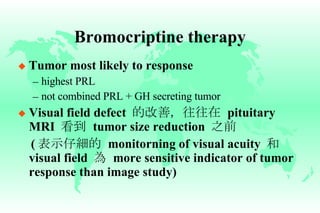
Bromocriptine therapy Tumor most likely to response highest PRL not combined PRL + GH secreting tumor Visual field defect  的改善,往往在   pituitary MRI  看到   tumor size reduction  之前 ( 表示仔細的   monitorning of visual acuity  和   visual field  為   more sensitive indicator of tumor response than image study)
Bromocriptine therapy Side effect GI upset : nausea, vomiting   abdominal fullness   abdominal cramping   constipation Dizziness (orthostatic hypotension) Headache Fatigue Nasal stuff CSF rhinorrhea Hallucination and psychosis (1.3%)
Transsphenoid hypophysectomy Indication of surgical therapy intolerate to pharmacologic agent inadequate to pharmacologic agent poor compliance irregular follow up desire of becoming pregnant cystic tumor tumor apoplexy
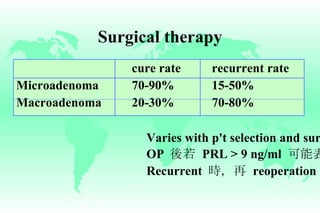
Surgical therapy cure rate recurrent rate Microadenoma 70-90% 15-50% Macroadenoma 20-30% 70-80% Varies with p't selection and surgical technique OP  後若   PRL > 9 ng/ml  可能表示會   recurrent  Recurrent  時,再   reoperation  的效果並不好
Transsphenoid hypophysectomy Criteria of cure total removal of tumor mass normalization of PRL resumption of ovulatory menstruation restore infertility no evidence of recurrence over 5 years Criteria of recurrence reappearance of hyper PRL over 5-yr period
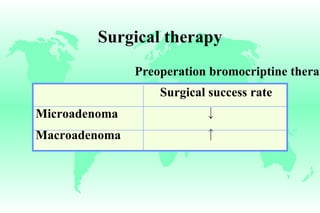
Surgical therapy Surgical success rate Microadenoma   ↓ Macroadenoma   ↑   Preoperation bromocriptine therapy:
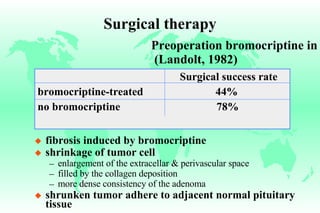
Surgical therapy Surgical success rate bromocriptine-treated   44% no bromocriptine   78% fibrosis induced by bromocriptine shrinkage of tumor cell enlargement of the extracellar & perivascular space filled by the collagen deposition more dense consistency of the adenoma shrunken tumor adhere to adjacent normal pituitary tissue Preoperation bromocriptine in microadenoma (Landolt, 1982)
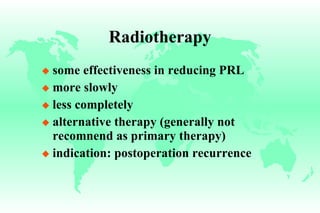
Radiotherapy some effectiveness in reducing PRL more slowly less completely alternative therapy (generally not recomnend as primary therapy) indication: postoperation recurrence
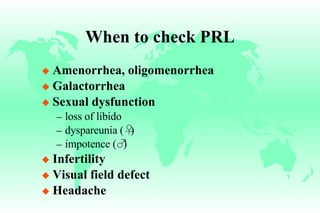
When to check PRL Amenorrhea, oligomenorrhea Galactorrhea Sexual dysfunction loss of libido dyspareunia ( ♀ ) impotence ( ♂ ) Infertility Visual field defect Headache

Hyperprolactinemia

  • 1.
    高泌乳激素血症 (Hyperprolactinemia) 白永河內分泌暨新陳代謝科 彰化基督教醫院
  • 2.
    PRL Regulated bythe hypothalamus 主要是 tonic inhibition Hypothalamus 分泌 2 種 hypothalamic factors PIF (PRL-inhibiting factor) Dopamine PRF (PRL-releasing factor) TRH, VIP
  • 3.
    PRL Stimulate breastdevelopment Initiate and maintain lactation PRL receptor alveolar surface of mammary cell liver, kidney ovary, testes, prostate Estrogen synergistic in promoting breast development antagonize in effect of lactation
  • 4.
    Breast development 須要多種 hormone 的 coordinated action 包括 major stimuli: estrogen progesterone prolactin GH placental mammotropic H minor stmuli: insulin cortisol thyroid hormone
  • 5.
    Breast development Ductgrowth: estrogen Lobuloalveolar development: PRL+progesterone Lactation: PRL + oxytocin
  • 6.
    Galactorrhea 需要 PRL + Gonadal steroid 才會出現 ∴ not necessarily seen in all prolactinomas 和 serum PRL level 無關 Galactorrhea 的 incidence 差異很大 女性 30 ~ -80% 男性常 no galactorrhea 即使有 galactorrhea, 其中 50% 病人的 PRL 可能正常 反之,即使 PRL> 100ng/ml, 也可能 no galactorrhea ∴ Galactorrhea 為 poor marker of hyperprolactinemia
  • 7.
    PRL 1928 discoveredin extract of bovine pituitary 1970 sensitive bioassay 1971 RIA (Friesen, Fournier, Desjardians) secreted by the erythrosinophilic subtype of chromophobic cells in the adenohypophysis
  • 8.
    PRL A stresshormone Secreted in a pulsatile fashion highest in the early morning ( 睡醒之前 ) lower in the afternoon physiologic PRL ↑ pain nipple stimulation fondling (women only) pregnancy ( 可達 200-500 ng/ml) pelvic examination exercise sleep
  • 9.
    PRL Daily secretionrate: 400 μ g/ 天 Metabolic clearance: 40 ml/m 2 /min Clearance pathway: 25% kidney 75% liver Plasma T 1/2 : 50 min Plasma level: < 15 ng/ml ♂ :5 ng/ml (3-10) ♀ :8 ng/ml (5-15) fetal PRL > 300 ng/ml umbilical PRL > maternal PRL Pituitary PRL: 100 μ g per pituitary
  • 10.
    PRL PRL value 和 prolactinoma tumor size 成正比 PRL > 1000 ng/ml -> tumor extension into cavernous sinus > 150 ng/ml -> 幾乎一定就是 prolactinoma 100-150 ng/ml: (1) prolactinoma (2) pseudoprolactinoma (3) drug-induced 20-100 ng/ml: 須 repeat 檢查 ( ∵ pulsatile secretion) (1) stress of vein puncture (pain) (2) stress or physical examination (3) breast examination (4) pelvic examination
  • 11.
    PRL Blood sampling 須注意事項 indwelling venous cannula at least 2 hr resting 20 minutes interval × 3-6 次 sampling time usually not critical
  • 12.
    Hyperprolactinemia Basic mechanisms( Ⅰ ) Hypothalamic dopamine deficiency hypothalamic tumor AV malformation inflammatory process drugs: methyldopa (Aldomet) reserpine Defective transport mechanisms pituitary or stalk tumor head injury section of pituitary stalk
  • 13.
    Hyperprolactinemia Basic mechanisms( Ⅱ ) Lactotroph insensitivity to dopamine dopamine receptor blocking agents phenothiazine (chlorpromazine) butyrophenones (haloperidol) benzamide: metoclopamide sulpiride domperidone Stimulation of lactotrophs Hypothyroidism TRH Estrogen Chest wall injury: herpes zoster, surgery PRL-producing tumor
  • 14.
    Pituitary tumor 約佔 brain tumor 的 10% 左右 Prolactinoma 40-50% Non-functioning adenoma 30% Gonadotroph cell adenoma 10-15% Acromegaly 10% Cushing's disease TSH-secreting adenoma
  • 15.
    Prolactinoma General population 中可能 5-10% 有 prolactinoma 這其中只有 5-10% come to clinical attension 2/3 microadenoma 1/3 macroadenoma Autopsy study 6.5-27% (11%) 有 pituitary adenoma no antemortem endocrine dysfunction 40-50% (+) for PRL by immunocytochemical stain 幾乎全部為 microadenoma
  • 16.
    Prolactinoma Grow slowlyover years Large tumor -> hypopituitarism (singly or incombination) GH deficiency 最常見 Impaired pulsatile gonadotropin (LH, FSH) (via alteration in hypothalamic LHRH secretion) (increased endogenous opiate tone) BMD ↓
  • 17.
    Prolactinoma Grade Ⅰ: microadenoma (s suprasellar extension) Grade Ⅱ : macroadenoma (c or s suprasellar extension) Grade Ⅲ : localized boney destruction Grade Ⅳ : diffuse boney destruction _ _ _
  • 18.
    Pituitary capillary Capillaryin pituitary normal 62 capillaries/0.1mm2 microadenoma 51.1 macroadenoma 9.3 由於 capillary number 減少 ∴ less inhibited by PRL-inhibiting factor serum PRL 和 tumor size 成正比
  • 19.
    Prolactinoma Etiology: unclear? Arise de novo ? Estrogen-induced ? Abnormality of hypothalamic regulation ? Monoclonal in origin
  • 20.
    Causes of hyperprolactinemia( Ⅰ ) Hypothalamic disease Tumor: metastatic ca carniopharyngioma germinoma cyst, hamartoma glioma Infiltrative disease sarcoidosis tbc histiocytosis granuloma Pseudotumor cerebri Cranial irradiation
  • 21.
    Causes of hyperprolactinemia( Ⅱ ) Pituitary disease Prolactinoma Acromegaly Cushing's disease Pituitary stalk section Empty sella syndrome Metastatic ca Meningioma Intrasella germinoma Infiltrative disease sarcoidosis tbc giant cell granuloma
  • 22.
    Cause of hyperprolactinemia( Ⅲ ) Drug-induced Monoamine inhibitor (catecholamine depletor) ( 在 hypothalamus 抑制 dopamine) Aldomet Reserpine Dopamine receptor antagonist ( 在 pituitary 抑制 dopamine) Chlorpromazine (wintermin) Fluphenazine (wintermin) Perphenazine Promazine Butyrophenone (haloperidol) Motoclopramide (primperan) Domperidone (motilium) Sulpiride (dogmatyl)
  • 23.
    Causes of hyperprolactinemia( Ⅳ ) Drug-induced Lactotroph stimulator Estrogen TRH Narcotics Morphine Enkephalin Codeine Methadone Amphetamine H2-receptor blocker Cimetidine (Tagamet) Ranitidine (Zantac)
  • 24.
    Causes of hyperprolactinemia( Ⅴ ) Major systemic disease 1 ° hypothyroidism CRF Liver cirrhosis Seizure Neurogenic breast manipulation chest wall lesion burn herpes zoster mastectomy Stress: ‧ physical (pain) ‧ psychologic PCO Idiopathic
  • 25.
    Symptoms and Signs(Female) Delayed menarche Disturbance of menstrual function (60-90%) amenorrhea oligomenorrhea regular mens c infertility Galactorrhea (30-80%) 和 duration of gonadal dysfunction 有關 amenorrhea 愈久,較不會有 galactorrhea Estrogen deficiency libido ↓ hirsutism vaginal dryness (DHEA by adrenal ↑ ) dyspareunia (free testosterone ↑ ) _
  • 26.
    Symptoms and Signs(male) 男性和 postmenopausal 女性較常以 mass effect 表現 Headache (63%) Visual abnormality visual acuity ↓ ophthalmoplegia visual field defect ( 先 bitemporal upper quadrant anopia) ( 再 bitemporal hemianopia) Hypogonadism libido ↓ (83%) adiposity (70%) impotence galactorrhea (14-33%) infertility gynecomastia ( 少見 )
  • 27.
    Mass effect Suprasellarextension: bitemporal hemianopia Extends posteriorly homonymous visual field defect Lateral extension (into the cavernous sinus) compress cranial nerve 3, 4, 5, 6 Extend into the temporal lobe : seizure
  • 28.
    Hyperprolactinemia 干擾 hypothalamic-pituitary-ovarian axis at 3 locations hypothalamic level interfer tonic or cyclic release of GnRH (LHRH) pituitary level desensitize gonadotropin response to GnRH ovarian level impaires progesterone production (by ovarian granulosa cell)
  • 29.
    PRL PRL functionin male: unclear sperm production prostate citrate production PRL ↑-> 5 α -reductase ↓ Spermatogenesis testosterone dihydrotestosterone (biologically active) 5 α -reductase
  • 30.
    Pseudoprolactinoma 任何 intrasellar or parasellar tumor (non-PRL-secreting pituitary adenoma) -> pituitary stalk compression -> interfer with PIF delivery (Dopamine) -> PRL ↑ ( 很少 > 150 ng/ml) 例如 : non-functioning pituitary adenoma craniopharyngioma tuberculum sella meningioma aneurysm
  • 31.
    Normoprolactinemic galactorrhea enhancedsensitivity of breast to PRL 常見於 persistence of postpartum galactorrhea after discontinuation of oral pills
  • 32.
    Pregnancy with prolactinomaMicroadenoma 5% progress to macroadenoma Macroadenoma 25% expand and produce symptoms (15-35%)
  • 33.
    Primary hypothyroidism 常有 breast tenderness, 偶而 galactorrhea PRL 大部份正常 但也可能上昇,通常 < 100 ng /ml long-standing hypothyroidism 時 可能出現 sellar enlargement 如果又加上 PRL ↑ ,易誤為 prolactinoma PRL response to TRH ↑
  • 34.
    CRF PRL ↑in 60-70% ( < 150ng/ml) PRL response to TRH ↓ receptor or postreceptor defect in the lactotroph not altered by HD reversed by renal transplantation
  • 35.
    D.D. of hyperprolactinemiaProlactinoma Primary hypothyroidism (TSH) CRF (BUN/Cr) Liver cirrhosis (GOT/GPT, A/G) Cushing's syndrome (cortisol) Acromegaly (GH) Drug-induced (history taking) Pregnancy ( β -HCG) Pseudoprolactinoma Physiologic hyperprolactinemia
  • 36.
    Treatment of microadenomaDisadvantage of untreated microadenoma loss of libido dyspareunia, hypogonadism BMD ↓ premature CAD enlargement of tumor mass
  • 37.
    Microadenoma Indication oftreatment desire of becoming pregnant 須 eliminate galactorrhea 須 relieve symptoms of hypogonadism 如果上述 concern 不存在 periodically follow up 即可
  • 38.
    Prolactinoma Therapeutic decisionmaking Microadenoma desire for pregnancy (-) -> periodically follow up desire for pregnancy (+) -> surgery recurrent after surgery -> pharmacotherapy Macroadenoma Ⅰ : PRL 200-500 ng/ml, invasiveness (-): surgery Ⅱ : PRL 500-1000 ng/ml, 或 invasiveness (+) pharmacotherapy or surgery Ⅲ : PRL > 1000 ng/ml, invasiveness (+) pharmacotherapy
  • 39.
    Pharmacotherapy of prolactinomaErgot preparation Bromocriptin (approved by FDA) Lisuride Pergolide Metergoline Terguride (greater pituitary selectivity) Cabergoline (longer duration of action) non-Ergot preparation CV 205-502 (Octahydrobenzquinolone)
  • 40.
    Bromocriptine Dopamine agonist,1971 semisynthetic ergot alkaloid binds to the dopamine receptor affinity 為 dopamine 的 5-10X 使 PRL 恢復至 normal, in 64-100% 改善 galactorrhea, 57-100% 恢復 mens and ovulation, 57-100% 改善 visual field defect, 60-80% 使 tumor size reduction, 60-80% 但無法改善 loss of sleep-related PRL pulsatile secretion
  • 41.
    Bromocriptine therapy theonly FDA approved drug in the USA initial dose : 1.25 mg H.S. dose adjustment: 改換成 1.25 mg QD ( c meal) 每隔 3 天增加 1.25 mg standard dose: 2.5 mg tid maintain dose: 2.5 mg bid _
  • 42.
    Bromocriptine therapy Drugefficacy in reducing PRL doesn't necessarily predict tumor size reduction 即使 PRL 沒有下降到正常,也可能有 tumor shrinkage 即使 PRL 下降到正常,也不一定就有相等程度的 tumor size reduction Short treatment period -> w ithdrawl -> rapid reexpansion of tumor size therapeutic course 須持續幾年 long-term therapy 後才停藥,可能不會有 tumor reexpansion, 但是 PRL 會再度上昇
  • 43.
    Bromocriptine therapy Intolerateto oral therapy 時,可改用 vaginal administration (the same dosage) Patient 必須被告知可能 restore fertility ∴ 須事先使用 mechanical contraception ( 否則會在服藥治療期間 conception 而不自知 ) 直到 regular menstrual flow × 3 cycles Not teratogenic in human fetal loss congenital malformation Injectable form available in Europe effective for 4-6 wk : not increased ]
  • 44.
    Bromocriptine therapy 對於 large pituitary tumor 如果 PRL > 200 ng/ml ,大部份是 prolactinoma 如果 PRL < 200 ng/ml ,可能是 2 ° hyperprolactinemia (pseudoprolactinoma) Bromocriptine Rx Prolactinoma Pseudoprolactinoma PRL ↓ ↓ tumor size ↓ ( -)
  • 45.
    Bromocriptine therapy Tumormost likely to response highest PRL not combined PRL + GH secreting tumor Visual field defect 的改善,往往在 pituitary MRI 看到 tumor size reduction 之前 ( 表示仔細的 monitorning of visual acuity 和 visual field 為 more sensitive indicator of tumor response than image study)
  • 46.
    Bromocriptine therapy Sideeffect GI upset : nausea, vomiting abdominal fullness abdominal cramping constipation Dizziness (orthostatic hypotension) Headache Fatigue Nasal stuff CSF rhinorrhea Hallucination and psychosis (1.3%)
  • 47.
    Transsphenoid hypophysectomy Indicationof surgical therapy intolerate to pharmacologic agent inadequate to pharmacologic agent poor compliance irregular follow up desire of becoming pregnant cystic tumor tumor apoplexy
  • 48.
    Surgical therapy curerate recurrent rate Microadenoma 70-90% 15-50% Macroadenoma 20-30% 70-80% Varies with p't selection and surgical technique OP 後若 PRL > 9 ng/ml 可能表示會 recurrent Recurrent 時,再 reoperation 的效果並不好
  • 49.
    Transsphenoid hypophysectomy Criteriaof cure total removal of tumor mass normalization of PRL resumption of ovulatory menstruation restore infertility no evidence of recurrence over 5 years Criteria of recurrence reappearance of hyper PRL over 5-yr period
  • 50.
    Surgical therapy Surgicalsuccess rate Microadenoma ↓ Macroadenoma ↑ Preoperation bromocriptine therapy:
  • 51.
    Surgical therapy Surgicalsuccess rate bromocriptine-treated 44% no bromocriptine 78% fibrosis induced by bromocriptine shrinkage of tumor cell enlargement of the extracellar & perivascular space filled by the collagen deposition more dense consistency of the adenoma shrunken tumor adhere to adjacent normal pituitary tissue Preoperation bromocriptine in microadenoma (Landolt, 1982)
  • 52.
    Radiotherapy some effectivenessin reducing PRL more slowly less completely alternative therapy (generally not recomnend as primary therapy) indication: postoperation recurrence
  • 53.
    When to checkPRL Amenorrhea, oligomenorrhea Galactorrhea Sexual dysfunction loss of libido dyspareunia ( ♀ ) impotence ( ♂ ) Infertility Visual field defect Headache