Panel Discussion 
Problems of MALE INFERTILITY & 
Management of 
Oligo Astheno Teratospermia 
(OAT) 
Dr. Sharda Jain 
Dr. Abhishek Parihar 
Dr. Jyoti Agarwal 
Dr. Jyoti Bhaskar
MODERATOR 
Brig. R.K. Sharma 
Dr. Sharda Jain 
PANELIST 
• Dr Shilpi Tiwari ,(Urologist) 
• Dr Aruna Saxena , ( IVF Expert ) 
• Dr Anita Sabharwal, (Gynaecologist) 
• Dr Sangeeta jain, ( IVF Expert ) 
• Dr Shweta Lochan, ( IVF Expert ) 
• Dr Abhishek S Parihar ( IVF Expert )
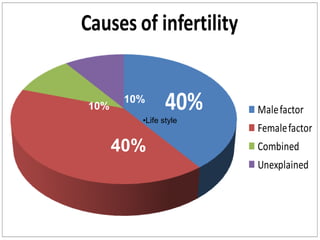
Causes of infertility 
Male factor 
Female factor 
Combined 
Unexplained 
40% 
40% 
10% 
10% 
•Life style
MALE INFERTILITY 
Male factor is solely responsible in about 20% 
of infertility couples & contributing in 
another 30 to 40% of infertility 
Human Reproduction 1991,6,811 
Another study suggested 
spermatozoal defect accounting for 30-50% 
cases of infertility 
Hull MG et al BMJ 1992,306,465
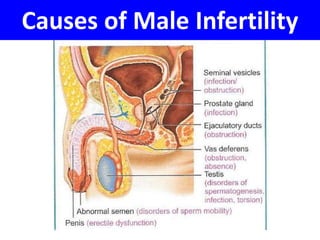
Causes of Male Infertility
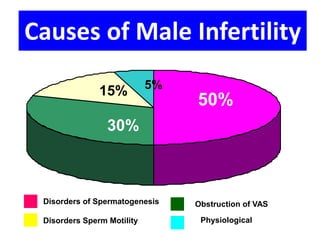
Causes of Male Infertility 15% 5% 
50% 
30% 
Disorders of Spermatogenesis Obstruction of VAS 
Disorders Sperm Motility Physiological
WHAT IS RECENT WHOCRITERIA FOR 
SEMEN ANALYSIS AND ITS LIMITATIONS??
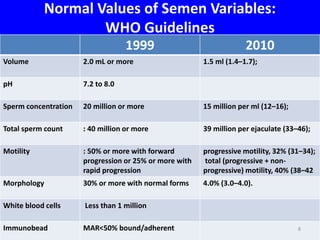
Normal Values of Semen Variables: 
WHO Guidelines 
1999 2010 
Volume 2.0 mL or more 1.5 ml (1.4–1.7); 
pH 7.2 to 8.0 
Sperm concentration 20 million or more 15 million per ml (12–16); 
Total sperm count : 40 million or more 39 million per ejaculate (33–46); 
Motility : 50% or more with forward 
progression or 25% or more with 
rapid progression 
progressive motility, 32% (31–34); 
total (progressive + non-progressive) 
motility, 40% (38–42 
Morphology 30% or more with normal forms 4.0% (3.0–4.0). 
White blood cells Less than 1 million 
Immunobead MAR<50% bound/adherent 8
VARIABILITY IN SEMEN 
PARAMETERS is universal 
• Day to Day variation 
– More than 50 % variation in two analyses 
• 2 semen reports at two different times 
• 2 evaluation are recommended to 
establish profile of seminal parameters. 
• Period of Abstinence 
– Counts increase with days of Abstinence 
– Quality declines with more than 7 days of 
Abstinence 
9
CAUTION 
• Semen analysis is guide to fertility 
but not absolute proof of fertility of 
an individual. 
• Pregnancy is the only irrefutable 
proof of the sperm's capability to 
fertilize. 
10
ROUTINE SEMEN ANALYSIS 
Provides useful information 
concerning sperm production by the 
testis, sperm motility and viability, 
the patency of the male genital 
tract, the secretions of the 
accessory organs, as well as 
ejaculation and emission
ROUTINE SEMEN ANALYSIS 
It is not a test of fertility, and it 
provides no insights into the 
functional potential of the 
spermatozoon to fertilize an ovum 
or to undergo the subsequent 
maturation processes that are 
required to achieve fertilization
What is Oligo-Astheno- 
Teratospermia?
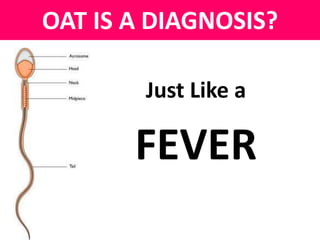
OAT IS A DIAGNOSIS? 
Just Like a 
FEVER
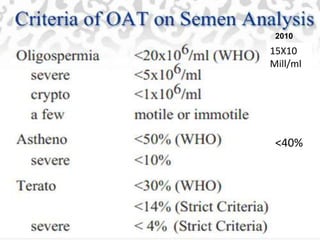
2010 
15X10 
Mill/ml 
<40%
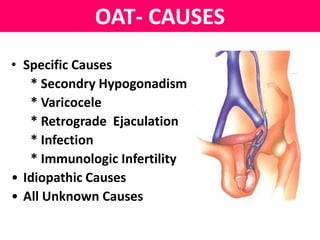
OAT- CAUSES 
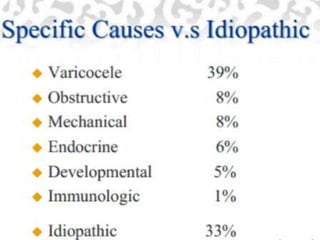
• Specific Causes 
* Secondry Hypogonadism 
* Varicocele 
* Retrograde Ejaculation 
* Infection 
* Immunologic Infertility 
• Idiopathic Causes 
• All Unknown Causes
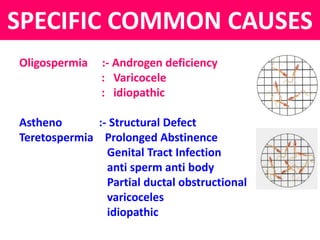
SPECIFIC COMMON CAUSES 
Oligospermia :- Androgen deficiency 
: Varicocele 
: idiopathic 
Astheno :- Structural Defect 
Teretospermia Prolonged Abstinence 
Genital Tract Infection 
anti sperm anti body 
Partial ductal obstructional 
varicoceles 
idiopathic
HOW DOES SMOKING 
AFFECTS MALE FERTILITY??
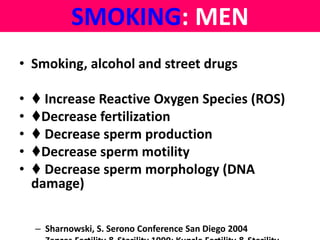
SMOKING: MEN 
• Smoking, alcohol and street drugs 
• ♦ Increase Reactive Oxygen Species (ROS) 
• ♦Decrease fertilization 
• ♦ Decrease sperm production 
• ♦Decrease sperm motility 
• ♦ Decrease sperm morphology (DNA 
damage) 
– Sharnowski, S. Serono Conference San Diego 2004 
– Zenzes Fertility & Sterility 1999; Kunzle Fertility & Sterility
WHAT ARE THE 
STEPS OF WORK-UP ?
Male WORK-UP 
• History & examination 
• Andrological diagnostic methods used in 
the clinical setting 
• “basic" semen analysis 
• ? analysis of sperm 
function/biochemical tests (second tier 
level)
HISTORY 
• Age 
Volume 
Decreases by 3-30% from age 30 to 50 
Concentration 
No change 
Motility 
Decrease 3-37% from age 30 to 50 
Morphology 
Decrease 4-22% from age 30 to 50 
Pregnancy rates 
Confounded by age but a trend for a 38% 
decrease from age 30 to 50 
Kidd et al. Fertil Steril 2001
• ETHNIC ORIGIN 
• MARRIED LIFE (together since / cohabit) 
• TRYING SINCE 
• PREVIOUS MARRIAGE 
• PRIMARY / SECONDARY 
• COITAL FREQUENCY& SEXUAL DYSFUNCTION 
(use of spermicidal agents) 
• RESULT OF ANY PREVIOUS EVALUATION OR 
TREATMENT FOR INFERTILITY 
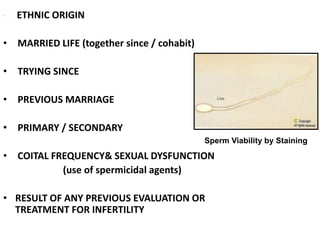
Sperm Viability by Staining
• OCCUPATION 
• WEIGHT (OBESITY) 
• HABITS smoking, alcohol, drug abuse. 
• H/O EXPOSURE TO ENVIRONMENTAL TOXINS
MEDICAL HISTORY 
• 1. DIABETES MELLITUS 
• 2. HTN 
• 3. PITUITARY DYSFUNCTION 
• 4. TUBERCULOSIS 
• 5. INFL. BOWEL DIS 
• 6. THYROID DISORDER 
• 7. HYPERPROLCATINEMIA 
• 8.RESPIRATORY DIS (chronic RTI / Bronchiectasis) 
• 9. PARASITIC DISORDER 
• 10. CYSTIC FIBROSIS 
• 11. A recent history of fever is important since 
semen quality can be suppressed for up to 3 
months after fever or illness
H/O INFECTIONS / PAST H/O 
• UTI 
• STI 
• MUMPS 
• TUBERCULOSIS 
• LEPROSY 
A 
B 
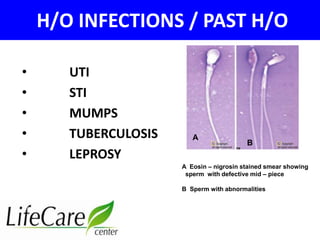
A Eosin – nigrosin stained smear showing 
sperm with defective mid – piece 
B Sperm with abnormalities
HISTORY OF MEDICATIONS & ALLERGIES 
A) IMPAIRED SPERMATOGENESIS 
Sulfasalazine, Mtx, Nitrofurautoin, CT 
B) PITUITARY SUPPRESSION-Testosterone 
injections, GnRH analogues 
C) ANTIANDROGENS- cimetidine, spironolactone 
D) EJACULATION FAILURE- alpha blockers, 
antidepressants, phenothiazines 
E) ERECTILE DYSFUNCTION- beta blockers, thiazides, 
metoclopramide 
F) DRUGS OF MISUSE- cannabis, heroin, cocaine
H/O PREVIOUS SURGERY 
*vasectomy / reversal 
*orchidectomy 
*orchidopexy 
*varicocelectomy 
*torsion 
*trauma 
*tumour 
*hernia 
*hydrocele 
*Appendecectomy
FAMILY HISTORY OF INFERTILITY 
• GENETIC CAUSE (CF) 
Personal history 
- Sauna / steam / tight underwear 
- Stress / irregular diet / Cig. > 10 per day / 
excess alcohol 
- Marijuana / recreational drugs
Examination 
• General examination 
Built 
Weight (Obesity) 
*Abnormalities of the secondary sex 
characteristics 
May indicate whether there is a 
congenital endocrine disorder - eunuchoid 
appearance associated with Klinefelter's 
syndrome.
Examination 
Gynaecomastia is suggestive of either an 
estrogen/androgen imbalance or an excess of 
Prolactin. 
Situs inversus raises the possibility of 
Kartagener's syndrome associated with 
immotile cilia and thus immotile sperm.
LOCAL EXAMINATION 
Penis – 
look for hypospadias 
Scrotum – 
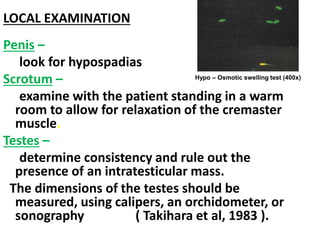
Hypo – Osmotic swelling test (400x) 
examine with the patient standing in a warm 
room to allow for relaxation of the cremaster 
muscle. 
Testes – 
determine consistency and rule out the 
presence of an intratesticular mass. 
The dimensions of the testes should be 
measured, using calipers, an orchidometer, or 
sonography ( Takihara et al, 1983 ).
Testes – 
Decreased testicular size, whether unilateral or 
bilateral, correlates with impaired spermatogenesis 
( Lipshultz and Corriere, 1977 ). 
Epididymis – 
Careful palpation of the head, body, and tail. 
- possibility of epididymal obstruction suggested by 
the presence of induration or cystic dilation of the 
epididymis. 
Vas Deferens – 
To rule out CBAVD
INVESTIGATIONS 
• BLOOD TESTS 
Complete blood count 
Tests for sexually transmitted disease 
PCR for tuberculosis in Semen 
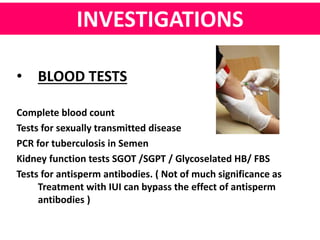
Kidney function tests SGOT /SGPT / Glycoselated HB/ FBS 
Tests for antisperm antibodies. ( Not of much significance as 
Treatment with IUI can bypass the effect of antisperm 
antibodies )
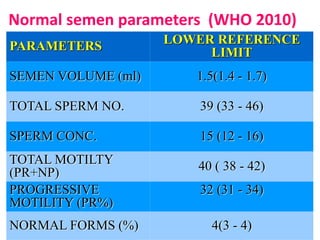
Normal semen parameters (WHO 2010) 
PARAMETERS 
LOWER REFERENCE 
LIMIT 
SEMEN VOLUME (ml) 1.5(1.4 - 1.7) 
TOTAL SPERM NO. 39 (33 - 46) 
SPERM CONC. 15 (12 - 16) 
TOTAL MOTILTY 
(PR+NP) 
40 ( 38 - 42) 
PROGRESSIVE 
MOTILITY (PR%) 
32 (31 - 34) 
NORMAL FORMS (%) 4(3 - 4)
Hormone Assays 
Fewer than 10% cases of male infertility are caused by 
primary endocrine defects 
Serum FSH and LH 
Useful for assessing testicular function 
If testicular failure is the cause of azoospermia or severe 
oligospermia, it is reflected by a raised FSH levels 
In a patient with azoospermia or severe oligospermia, 
biopsy is indicated. 
The anti-estrogen receptor clomiphene, often used for 
male infertility can also raise FSH levels.
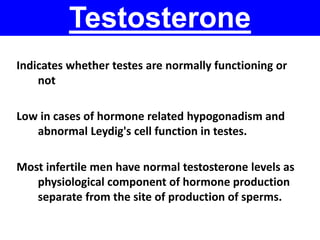
Testosterone 
Indicates whether testes are normally functioning or 
not 
Low in cases of hormone related hypogonadism and 
abnormal Leydig's cell function in testes. 
Most infertile men have normal testosterone levels as 
physiological component of hormone production 
separate from the site of production of sperms.
Serum Prolactin 
Measurement is must in infertile men with c/o sexual 
dysfunction and show any signs of pituitary disease. 
Causes of high Prolactin levels in blood – 
• Drugs – metoclopromide, chlorpromazine, 
antidepressants 
• Hypothyroid state 
• Prolactinoma
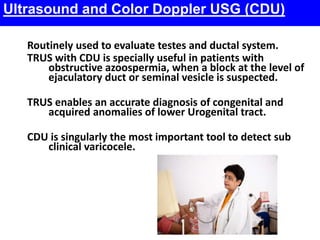
Ultrasound and Color Doppler USG (CDU) 
Routinely used to evaluate testes and ductal system. 
TRUS with CDU is specially useful in patients with 
obstructive azoospermia, when a block at the level of 
ejaculatory duct or seminal vesicle is suspected. 
TRUS enables an accurate diagnosis of congenital and 
acquired anomalies of lower Urogenital tract. 
CDU is singularly the most important tool to detect sub 
clinical varicocele.
Testicular Biopsy 
Performed mainly to differentiate primary testicular 
failure from obstructive ductal lesions in 
azoospermic patients. 
As the testicular tissues are being examined directly, it 
remains the gold standard for judging testicular 
function. 
If there are indications of ductal obstruction or 
testicular failure, both testes should be biopsied as 
both have different degrees of dysfunction. 
The argument in favor of unilateral biopsy is that the 
opposite testes is completely untouched to obviate 
adhesions or fibrosis. 
Can be performed by open method using window 
technique or by FNAC.
Vasography 
invasive technique requires exploration of vas in 
scrotum. 
Mainly indicated in men with azoospermia with 
testicular biopsy showing normal spermatogenesis. 
CDU has now replaced it as the primary imaging 
technique for imaging distal ductal system. 
Chromosome studies 
Considered in patients with severe oligospermia or 
azoospermia to look for autosomal and sex 
chromosomal abnormalities. 
About 13% cases of non-obstructive azoospermia are 
caused by deletion of azoospermia factor ( AZF ).
Magnetic resonance imaging 
Gold standard for diagnosis of cryptorchidism 
Using endo-rectal coil, MRI provides intricate detailed 
information of distal ductal system – seminal vesicles, 
ejaculatory ducts, pelvic and inguinal parts of Vas. 
Radionuclide scanning 
Presently scinti-graphy is reserved for situations, when CDU 
for patients with low velocity and low volume testicular 
flow show unsatisfactory sensitivity. 
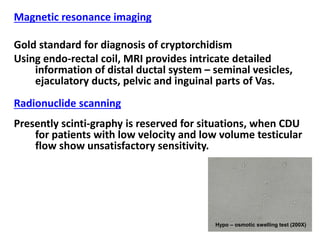
Hypo – osmotic swelling test (200X)
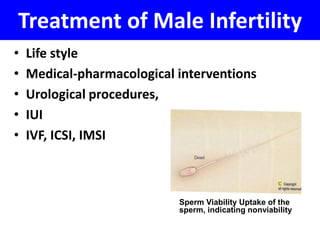
Treatment of Male Infertility 
• Life style 
• Medical-pharmacological interventions 
• Urological procedures, 
• IUI 
• IVF, ICSI, IMSI 
Sperm Viability Uptake of the 
sperm, indicating nonviability
Please 
Comment on 
Drugs treatment 
in Male Infertility ??
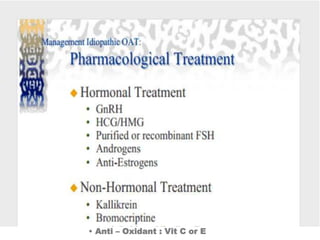
• Anti – Oxidant : Vit C or E
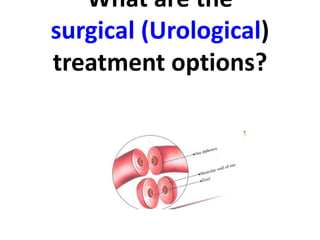
What are the 
surgical (Urological) 
treatment options?
• correction of varicocele, epididymo-and vaso-vasostomy, 
and modern approaches for 
ejaculatory disorders. 
• Varicocele is most controversial area in 
infertility
Varicocele 
in adolescent with varicocele – testicular growth is 
impaired & varicoceles are associated with smaller 
ipsilateral testes 
DIAGNOSIS 
It should be diagnosed clinically 
Scrotal doppler are not recommended for evaluation 
& diagnosis of su-clinical varicocele since there are no 
control study demonstrating improved P.R. after 
treatment of sub – clinical varicocele
Varicocele & color Doppler 
• Accuracy of color doppler ultrasound is only 
60% 
• Imaging studies should not be used to search 
for varicocele in man with normal physical 
examination
Varicocele Surgery 
Should be offered in case of “clinical varicocele , 
oligospermia ,duration of infertility at least 2 
years and otherwise unexplained infertility “ 
Guidelines on male infertility ,EAU 2012 grade B
Varicocele surgery 
Varicocele repair in adolescent with grade – II & III 
varicocele with testicular growth retardation is 
recommended. 
The present of varicocele is NOT an indication for 
varicocele repair 
As majority of man with varicocele are fertile 
Only infertile man with abnormal semen analysis is an 
indication for varicocele repair
Surgical treatment 
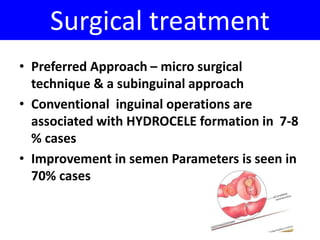
• Preferred Approach – micro surgical 
technique & a subinguinal approach 
• Conventional inguinal operations are 
associated with HYDROCELE formation in 7-8 
% cases 
• Improvement in semen Parameters is seen in 
70% cases
Semen Parameters & ART 
Few Highlights
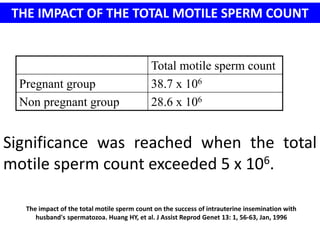
THE IMPACT OF THE TOTAL MOTILE SPERM COUNT 
Total motile sperm count 
Pregnant group 38.7 x 10⁶ 
Non pregnant group 28.6 x 10⁶ 
Significance was reached when the total 
motile sperm count exceeded 5 x 10⁶. 
The impact of the total motile sperm count on the success of intrauterine insemination with 
husband's spermatozoa. Huang HY, et al. J Assist Reprod Genet 13: 1, 56-63, Jan, 1996
THE IMPACT OF THE TOTAL MOTILE SPERM 
COUNT 
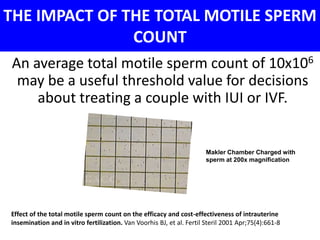
An average total motile sperm count of 10x106 
may be a useful threshold value for decisions 
about treating a couple with IUI or IVF. 
Makler Chamber Charged with 
sperm at 200x magnification 
Effect of the total motile sperm count on the efficacy and cost-effectiveness of intrauterine 
insemination and in vitro fertilization. Van Voorhis BJ, et al. Fertil Steril 2001 Apr;75(4):661-8
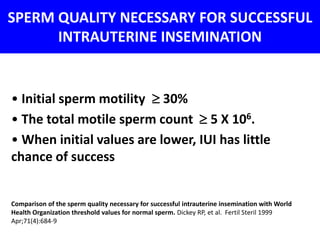
SPERM QUALITY NECESSARY FOR SUCCESSFUL 
INTRAUTERINE INSEMINATION 
• Initial sperm motility  30% 
• The total motile sperm count  5 X 10⁶. 
• When initial values are lower, IUI has little 
chance of success 
Comparison of the sperm quality necessary for successful intrauterine insemination with World 
Health Organization threshold values for normal sperm. Dickey RP, et al. Fertil Steril 1999 
Apr;71(4):684-9
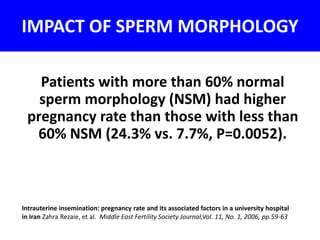
IMPACT OF SPERM MORPHOLOGY 
Patients with more than 60% normal 
sperm morphology (NSM) had higher 
pregnancy rate than those with less than 
60% NSM (24.3% vs. 7.7%, P=0.0052). 
Intrauterine insemination: pregnancy rate and its associated factors in a university hospital 
in Iran Zahra Rezaie, et al. Middle East Fertility Society Journal,Vol. 11, No. 1, 2006, pp.59-63
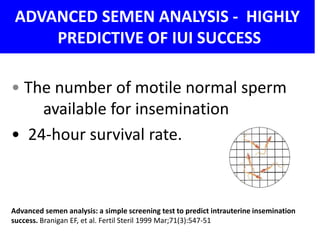
ADVANCED SEMEN ANALYSIS - HIGHLY 
PREDICTIVE OF IUI SUCCESS 
• The number of motile normal sperm 
available for insemination 
• 24-hour survival rate. 
Advanced semen analysis: a simple screening test to predict intrauterine insemination 
success. Branigan EF, et al. Fertil Steril 1999 Mar;71(3):547-51
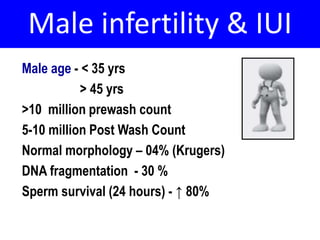
Male infertility & IUI 
Male age - < 35 yrs 
> 45 yrs 
>10 million prewash count 
5-10 million Post Wash Count 
Normal morphology – 04% (Krugers) 
DNA fragmentation - 30 % 
Sperm survival (24 hours) - ↑ 80%
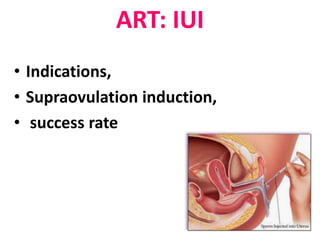
ART: IUI 
• Indications, 
• Supraovulation induction, 
• success rate
Oligo/asthenospermia -?IUI 
Intrauterine insemination with or without 
ovarian stimulation is an effective treatment 
where the man has abnormalities of semen 
quality, (A) 
NICE Guidelines : Grade B Recommendation 2004 
National guideline clearinghouse grade B 2009 
Cohlen et al., January 1999 (Cochrane Review). In: The 
Cochrane Library, Issue 2 2002. Oxford: Update Software.
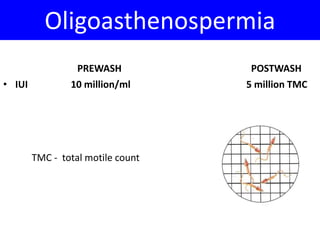
Oligoasthenospermia 
PREWASH 
• IUI 10 million/ml 
POSTWASH 
5 million TMC 
TMC - total motile count
COH AND IUI 
• Ovarian stimulation is the fundamental tool 
of subfertility treatment 
• Different options pose challenges 
• Choice depends on doctors expertise and 
patients condition, choice 
• Increases the pregnancy rate 
• Judicious monitoring to avoid complications
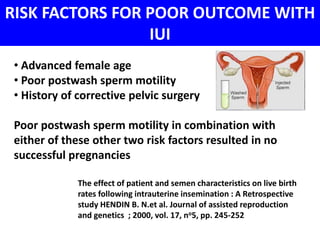
RISK FACTORS FOR POOR OUTCOME WITH 
IUI 
• Advanced female age 
• Poor postwash sperm motility 
• History of corrective pelvic surgery 
Poor postwash sperm motility in combination with 
either of these other two risk factors resulted in no 
successful pregnancies 
The effect of patient and semen characteristics on live birth 
rates following intrauterine insemination : A Retrospective 
study HENDIN B. N.et al. Journal of assisted reproduction 
and genetics ; 2000, vol. 17, no5, pp. 245-252
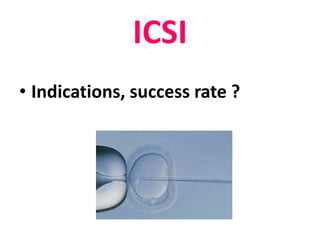
ICSI 
• Indications, success rate ?
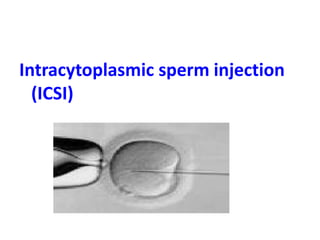
Intracytoplasmic sperm injection 
(ICSI)
Intracytoplasmic sperm 
injection (ICSI) is indicated in 
• Severe deficits in semen quality 
• Obstructive azoospermia 
• Non obstructive azoospermia 
• Previous IVF cycle with failed or very poor 
fertilisation. 
RCOG 2012
Role of genetic testing 
and counseling ?
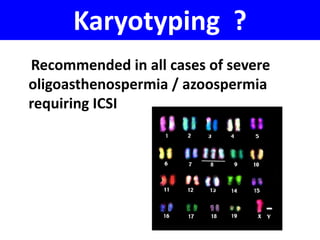
Karyotyping ? 
Recommended in all cases of severe 
oligoasthenospermia / azoospermia 
requiring ICSI
• 47 XXY (klinefelter’s syndrome) - =10% of men with 
azoospermia 
• Chromosomal translocations and deletions may be 
found which may be hereditary and can cause 
habitual abortions and congenital malformations in 
the child 
• Deletions in azoospermic factor region (AZF) of Y 
chromosome -5% incidence in pts with azoospermia 
or OAT 
• CBAVD - 85% cases – cystic fibrosis gene positive
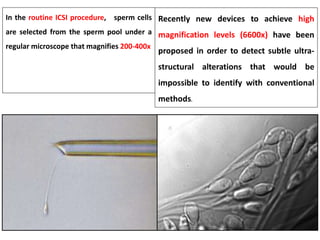
Recently new devices to achieve high 
magnification levels (6600x) have been 
proposed in order to detect subtle ultra-structural 
alterations that would be 
impossible to identify with conventional 
methods. 
In the routine ICSI procedure, sperm cells 
are selected from the sperm pool under a 
regular microscope that magnifies 200-400x
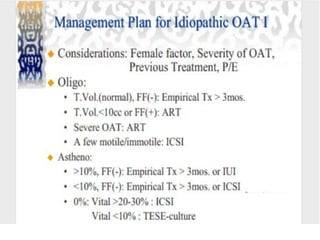
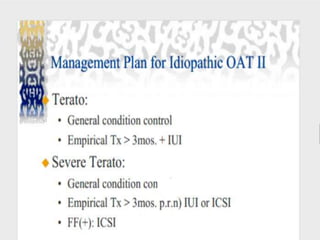
What is the 
management of 
idiopathic OAT ?
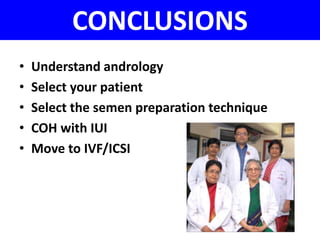
CONCLUSIONS 
• Understand andrology 
• Select your patient 
• Select the semen preparation technique 
• COH with IUI 
• Move to IVF/ICSI
P0INT TO REMEMBER 
ONE SATISFIED PATIENT IS 
WORTH THOUSANDS OF 
GUIDELINES AND PROTOCALS
ADDRESS 
11 Gagan Vihar, Near Karkari 
Morh Flyover, Delhi - 51 
CONTACT US 
9650588339, 011-22414049, 
WEBSITE : 
www.lifecarecentre.in 
www.drshardajain.com 
www.lifecareivf.com 
E-MAIL ID 
Sharda.lifecare@gmail.com 
Lifecarecentre21@gmail.com 
info@lifecareivf.com 
&
THANK YOU

Panel Discussion Problems of MALE INFERTILITY & Management of Oligo Astheno Teratospermia (OAT) , Dr.Sharda Jan, Dr. Jyoti Agarewal , Dr. Jyoti Bhaskar, Dr. Abhishek parihar

  • 1.
    Panel Discussion Problemsof MALE INFERTILITY & Management of Oligo Astheno Teratospermia (OAT) Dr. Sharda Jain Dr. Abhishek Parihar Dr. Jyoti Agarwal Dr. Jyoti Bhaskar
  • 2.
    MODERATOR Brig. R.K.Sharma Dr. Sharda Jain PANELIST • Dr Shilpi Tiwari ,(Urologist) • Dr Aruna Saxena , ( IVF Expert ) • Dr Anita Sabharwal, (Gynaecologist) • Dr Sangeeta jain, ( IVF Expert ) • Dr Shweta Lochan, ( IVF Expert ) • Dr Abhishek S Parihar ( IVF Expert )
  • 3.
    Causes of infertility Male factor Female factor Combined Unexplained 40% 40% 10% 10% •Life style
  • 4.
    MALE INFERTILITY Malefactor is solely responsible in about 20% of infertility couples & contributing in another 30 to 40% of infertility Human Reproduction 1991,6,811 Another study suggested spermatozoal defect accounting for 30-50% cases of infertility Hull MG et al BMJ 1992,306,465
  • 5.
    Causes of MaleInfertility
  • 6.
    Causes of MaleInfertility 15% 5% 50% 30% Disorders of Spermatogenesis Obstruction of VAS Disorders Sperm Motility Physiological
  • 7.
    WHAT IS RECENTWHOCRITERIA FOR SEMEN ANALYSIS AND ITS LIMITATIONS??
  • 8.
    Normal Values ofSemen Variables: WHO Guidelines 1999 2010 Volume 2.0 mL or more 1.5 ml (1.4–1.7); pH 7.2 to 8.0 Sperm concentration 20 million or more 15 million per ml (12–16); Total sperm count : 40 million or more 39 million per ejaculate (33–46); Motility : 50% or more with forward progression or 25% or more with rapid progression progressive motility, 32% (31–34); total (progressive + non-progressive) motility, 40% (38–42 Morphology 30% or more with normal forms 4.0% (3.0–4.0). White blood cells Less than 1 million Immunobead MAR<50% bound/adherent 8
  • 9.
    VARIABILITY IN SEMEN PARAMETERS is universal • Day to Day variation – More than 50 % variation in two analyses • 2 semen reports at two different times • 2 evaluation are recommended to establish profile of seminal parameters. • Period of Abstinence – Counts increase with days of Abstinence – Quality declines with more than 7 days of Abstinence 9
  • 10.
    CAUTION • Semenanalysis is guide to fertility but not absolute proof of fertility of an individual. • Pregnancy is the only irrefutable proof of the sperm's capability to fertilize. 10
  • 11.
    ROUTINE SEMEN ANALYSIS Provides useful information concerning sperm production by the testis, sperm motility and viability, the patency of the male genital tract, the secretions of the accessory organs, as well as ejaculation and emission
  • 12.
    ROUTINE SEMEN ANALYSIS It is not a test of fertility, and it provides no insights into the functional potential of the spermatozoon to fertilize an ovum or to undergo the subsequent maturation processes that are required to achieve fertilization
  • 13.
    What is Oligo-Astheno- Teratospermia?
  • 14.
    OAT IS ADIAGNOSIS? Just Like a FEVER
  • 16.
  • 17.
    OAT- CAUSES •Specific Causes * Secondry Hypogonadism * Varicocele * Retrograde Ejaculation * Infection * Immunologic Infertility • Idiopathic Causes • All Unknown Causes
  • 19.
    SPECIFIC COMMON CAUSES Oligospermia :- Androgen deficiency : Varicocele : idiopathic Astheno :- Structural Defect Teretospermia Prolonged Abstinence Genital Tract Infection anti sperm anti body Partial ductal obstructional varicoceles idiopathic
  • 20.
    HOW DOES SMOKING AFFECTS MALE FERTILITY??
  • 21.
    SMOKING: MEN •Smoking, alcohol and street drugs • ♦ Increase Reactive Oxygen Species (ROS) • ♦Decrease fertilization • ♦ Decrease sperm production • ♦Decrease sperm motility • ♦ Decrease sperm morphology (DNA damage) – Sharnowski, S. Serono Conference San Diego 2004 – Zenzes Fertility & Sterility 1999; Kunzle Fertility & Sterility
  • 22.
    WHAT ARE THE STEPS OF WORK-UP ?
  • 23.
    Male WORK-UP •History & examination • Andrological diagnostic methods used in the clinical setting • “basic" semen analysis • ? analysis of sperm function/biochemical tests (second tier level)
  • 24.
    HISTORY • Age Volume Decreases by 3-30% from age 30 to 50 Concentration No change Motility Decrease 3-37% from age 30 to 50 Morphology Decrease 4-22% from age 30 to 50 Pregnancy rates Confounded by age but a trend for a 38% decrease from age 30 to 50 Kidd et al. Fertil Steril 2001
  • 25.
    • ETHNIC ORIGIN • MARRIED LIFE (together since / cohabit) • TRYING SINCE • PREVIOUS MARRIAGE • PRIMARY / SECONDARY • COITAL FREQUENCY& SEXUAL DYSFUNCTION (use of spermicidal agents) • RESULT OF ANY PREVIOUS EVALUATION OR TREATMENT FOR INFERTILITY Sperm Viability by Staining
  • 26.
    • OCCUPATION •WEIGHT (OBESITY) • HABITS smoking, alcohol, drug abuse. • H/O EXPOSURE TO ENVIRONMENTAL TOXINS
  • 27.
    MEDICAL HISTORY •1. DIABETES MELLITUS • 2. HTN • 3. PITUITARY DYSFUNCTION • 4. TUBERCULOSIS • 5. INFL. BOWEL DIS • 6. THYROID DISORDER • 7. HYPERPROLCATINEMIA • 8.RESPIRATORY DIS (chronic RTI / Bronchiectasis) • 9. PARASITIC DISORDER • 10. CYSTIC FIBROSIS • 11. A recent history of fever is important since semen quality can be suppressed for up to 3 months after fever or illness
  • 28.
    H/O INFECTIONS /PAST H/O • UTI • STI • MUMPS • TUBERCULOSIS • LEPROSY A B A Eosin – nigrosin stained smear showing sperm with defective mid – piece B Sperm with abnormalities
  • 29.
    HISTORY OF MEDICATIONS& ALLERGIES A) IMPAIRED SPERMATOGENESIS Sulfasalazine, Mtx, Nitrofurautoin, CT B) PITUITARY SUPPRESSION-Testosterone injections, GnRH analogues C) ANTIANDROGENS- cimetidine, spironolactone D) EJACULATION FAILURE- alpha blockers, antidepressants, phenothiazines E) ERECTILE DYSFUNCTION- beta blockers, thiazides, metoclopramide F) DRUGS OF MISUSE- cannabis, heroin, cocaine
  • 30.
    H/O PREVIOUS SURGERY *vasectomy / reversal *orchidectomy *orchidopexy *varicocelectomy *torsion *trauma *tumour *hernia *hydrocele *Appendecectomy
  • 31.
    FAMILY HISTORY OFINFERTILITY • GENETIC CAUSE (CF) Personal history - Sauna / steam / tight underwear - Stress / irregular diet / Cig. > 10 per day / excess alcohol - Marijuana / recreational drugs
  • 32.
    Examination • Generalexamination Built Weight (Obesity) *Abnormalities of the secondary sex characteristics May indicate whether there is a congenital endocrine disorder - eunuchoid appearance associated with Klinefelter's syndrome.
  • 33.
    Examination Gynaecomastia issuggestive of either an estrogen/androgen imbalance or an excess of Prolactin. Situs inversus raises the possibility of Kartagener's syndrome associated with immotile cilia and thus immotile sperm.
  • 34.
    LOCAL EXAMINATION Penis– look for hypospadias Scrotum – Hypo – Osmotic swelling test (400x) examine with the patient standing in a warm room to allow for relaxation of the cremaster muscle. Testes – determine consistency and rule out the presence of an intratesticular mass. The dimensions of the testes should be measured, using calipers, an orchidometer, or sonography ( Takihara et al, 1983 ).
  • 35.
    Testes – Decreasedtesticular size, whether unilateral or bilateral, correlates with impaired spermatogenesis ( Lipshultz and Corriere, 1977 ). Epididymis – Careful palpation of the head, body, and tail. - possibility of epididymal obstruction suggested by the presence of induration or cystic dilation of the epididymis. Vas Deferens – To rule out CBAVD
  • 36.
    INVESTIGATIONS • BLOODTESTS Complete blood count Tests for sexually transmitted disease PCR for tuberculosis in Semen Kidney function tests SGOT /SGPT / Glycoselated HB/ FBS Tests for antisperm antibodies. ( Not of much significance as Treatment with IUI can bypass the effect of antisperm antibodies )
  • 37.
    Normal semen parameters(WHO 2010) PARAMETERS LOWER REFERENCE LIMIT SEMEN VOLUME (ml) 1.5(1.4 - 1.7) TOTAL SPERM NO. 39 (33 - 46) SPERM CONC. 15 (12 - 16) TOTAL MOTILTY (PR+NP) 40 ( 38 - 42) PROGRESSIVE MOTILITY (PR%) 32 (31 - 34) NORMAL FORMS (%) 4(3 - 4)
  • 38.
    Hormone Assays Fewerthan 10% cases of male infertility are caused by primary endocrine defects Serum FSH and LH Useful for assessing testicular function If testicular failure is the cause of azoospermia or severe oligospermia, it is reflected by a raised FSH levels In a patient with azoospermia or severe oligospermia, biopsy is indicated. The anti-estrogen receptor clomiphene, often used for male infertility can also raise FSH levels.
  • 39.
    Testosterone Indicates whethertestes are normally functioning or not Low in cases of hormone related hypogonadism and abnormal Leydig's cell function in testes. Most infertile men have normal testosterone levels as physiological component of hormone production separate from the site of production of sperms.
  • 40.
    Serum Prolactin Measurementis must in infertile men with c/o sexual dysfunction and show any signs of pituitary disease. Causes of high Prolactin levels in blood – • Drugs – metoclopromide, chlorpromazine, antidepressants • Hypothyroid state • Prolactinoma
  • 41.
    Ultrasound and ColorDoppler USG (CDU) Routinely used to evaluate testes and ductal system. TRUS with CDU is specially useful in patients with obstructive azoospermia, when a block at the level of ejaculatory duct or seminal vesicle is suspected. TRUS enables an accurate diagnosis of congenital and acquired anomalies of lower Urogenital tract. CDU is singularly the most important tool to detect sub clinical varicocele.
  • 42.
    Testicular Biopsy Performedmainly to differentiate primary testicular failure from obstructive ductal lesions in azoospermic patients. As the testicular tissues are being examined directly, it remains the gold standard for judging testicular function. If there are indications of ductal obstruction or testicular failure, both testes should be biopsied as both have different degrees of dysfunction. The argument in favor of unilateral biopsy is that the opposite testes is completely untouched to obviate adhesions or fibrosis. Can be performed by open method using window technique or by FNAC.
  • 43.
    Vasography invasive techniquerequires exploration of vas in scrotum. Mainly indicated in men with azoospermia with testicular biopsy showing normal spermatogenesis. CDU has now replaced it as the primary imaging technique for imaging distal ductal system. Chromosome studies Considered in patients with severe oligospermia or azoospermia to look for autosomal and sex chromosomal abnormalities. About 13% cases of non-obstructive azoospermia are caused by deletion of azoospermia factor ( AZF ).
  • 44.
    Magnetic resonance imaging Gold standard for diagnosis of cryptorchidism Using endo-rectal coil, MRI provides intricate detailed information of distal ductal system – seminal vesicles, ejaculatory ducts, pelvic and inguinal parts of Vas. Radionuclide scanning Presently scinti-graphy is reserved for situations, when CDU for patients with low velocity and low volume testicular flow show unsatisfactory sensitivity. Hypo – osmotic swelling test (200X)
  • 45.
    Treatment of MaleInfertility • Life style • Medical-pharmacological interventions • Urological procedures, • IUI • IVF, ICSI, IMSI Sperm Viability Uptake of the sperm, indicating nonviability
  • 46.
    Please Comment on Drugs treatment in Male Infertility ??
  • 47.
    • Anti –Oxidant : Vit C or E
  • 48.
    What are the surgical (Urological) treatment options?
  • 49.
    • correction ofvaricocele, epididymo-and vaso-vasostomy, and modern approaches for ejaculatory disorders. • Varicocele is most controversial area in infertility
  • 50.
    Varicocele in adolescentwith varicocele – testicular growth is impaired & varicoceles are associated with smaller ipsilateral testes DIAGNOSIS It should be diagnosed clinically Scrotal doppler are not recommended for evaluation & diagnosis of su-clinical varicocele since there are no control study demonstrating improved P.R. after treatment of sub – clinical varicocele
  • 51.
    Varicocele & colorDoppler • Accuracy of color doppler ultrasound is only 60% • Imaging studies should not be used to search for varicocele in man with normal physical examination
  • 52.
    Varicocele Surgery Shouldbe offered in case of “clinical varicocele , oligospermia ,duration of infertility at least 2 years and otherwise unexplained infertility “ Guidelines on male infertility ,EAU 2012 grade B
  • 53.
    Varicocele surgery Varicocelerepair in adolescent with grade – II & III varicocele with testicular growth retardation is recommended. The present of varicocele is NOT an indication for varicocele repair As majority of man with varicocele are fertile Only infertile man with abnormal semen analysis is an indication for varicocele repair
  • 54.
    Surgical treatment •Preferred Approach – micro surgical technique & a subinguinal approach • Conventional inguinal operations are associated with HYDROCELE formation in 7-8 % cases • Improvement in semen Parameters is seen in 70% cases
  • 55.
    Semen Parameters &ART Few Highlights
  • 56.
    THE IMPACT OFTHE TOTAL MOTILE SPERM COUNT Total motile sperm count Pregnant group 38.7 x 10⁶ Non pregnant group 28.6 x 10⁶ Significance was reached when the total motile sperm count exceeded 5 x 10⁶. The impact of the total motile sperm count on the success of intrauterine insemination with husband's spermatozoa. Huang HY, et al. J Assist Reprod Genet 13: 1, 56-63, Jan, 1996
  • 57.
    THE IMPACT OFTHE TOTAL MOTILE SPERM COUNT An average total motile sperm count of 10x106 may be a useful threshold value for decisions about treating a couple with IUI or IVF. Makler Chamber Charged with sperm at 200x magnification Effect of the total motile sperm count on the efficacy and cost-effectiveness of intrauterine insemination and in vitro fertilization. Van Voorhis BJ, et al. Fertil Steril 2001 Apr;75(4):661-8
  • 58.
    SPERM QUALITY NECESSARYFOR SUCCESSFUL INTRAUTERINE INSEMINATION • Initial sperm motility  30% • The total motile sperm count  5 X 10⁶. • When initial values are lower, IUI has little chance of success Comparison of the sperm quality necessary for successful intrauterine insemination with World Health Organization threshold values for normal sperm. Dickey RP, et al. Fertil Steril 1999 Apr;71(4):684-9
  • 59.
    IMPACT OF SPERMMORPHOLOGY Patients with more than 60% normal sperm morphology (NSM) had higher pregnancy rate than those with less than 60% NSM (24.3% vs. 7.7%, P=0.0052). Intrauterine insemination: pregnancy rate and its associated factors in a university hospital in Iran Zahra Rezaie, et al. Middle East Fertility Society Journal,Vol. 11, No. 1, 2006, pp.59-63
  • 60.
    ADVANCED SEMEN ANALYSIS- HIGHLY PREDICTIVE OF IUI SUCCESS • The number of motile normal sperm available for insemination • 24-hour survival rate. Advanced semen analysis: a simple screening test to predict intrauterine insemination success. Branigan EF, et al. Fertil Steril 1999 Mar;71(3):547-51
  • 61.
    Male infertility &IUI Male age - < 35 yrs > 45 yrs >10 million prewash count 5-10 million Post Wash Count Normal morphology – 04% (Krugers) DNA fragmentation - 30 % Sperm survival (24 hours) - ↑ 80%
  • 62.
    ART: IUI •Indications, • Supraovulation induction, • success rate
  • 63.
    Oligo/asthenospermia -?IUI Intrauterineinsemination with or without ovarian stimulation is an effective treatment where the man has abnormalities of semen quality, (A) NICE Guidelines : Grade B Recommendation 2004 National guideline clearinghouse grade B 2009 Cohlen et al., January 1999 (Cochrane Review). In: The Cochrane Library, Issue 2 2002. Oxford: Update Software.
  • 64.
    Oligoasthenospermia PREWASH •IUI 10 million/ml POSTWASH 5 million TMC TMC - total motile count
  • 65.
    COH AND IUI • Ovarian stimulation is the fundamental tool of subfertility treatment • Different options pose challenges • Choice depends on doctors expertise and patients condition, choice • Increases the pregnancy rate • Judicious monitoring to avoid complications
  • 66.
    RISK FACTORS FORPOOR OUTCOME WITH IUI • Advanced female age • Poor postwash sperm motility • History of corrective pelvic surgery Poor postwash sperm motility in combination with either of these other two risk factors resulted in no successful pregnancies The effect of patient and semen characteristics on live birth rates following intrauterine insemination : A Retrospective study HENDIN B. N.et al. Journal of assisted reproduction and genetics ; 2000, vol. 17, no5, pp. 245-252
  • 67.
    ICSI • Indications,success rate ?
  • 68.
  • 69.
    Intracytoplasmic sperm injection(ICSI) is indicated in • Severe deficits in semen quality • Obstructive azoospermia • Non obstructive azoospermia • Previous IVF cycle with failed or very poor fertilisation. RCOG 2012
  • 70.
    Role of genetictesting and counseling ?
  • 71.
    Karyotyping ? Recommendedin all cases of severe oligoasthenospermia / azoospermia requiring ICSI
  • 72.
    • 47 XXY(klinefelter’s syndrome) - =10% of men with azoospermia • Chromosomal translocations and deletions may be found which may be hereditary and can cause habitual abortions and congenital malformations in the child • Deletions in azoospermic factor region (AZF) of Y chromosome -5% incidence in pts with azoospermia or OAT • CBAVD - 85% cases – cystic fibrosis gene positive
  • 73.
    Recently new devicesto achieve high magnification levels (6600x) have been proposed in order to detect subtle ultra-structural alterations that would be impossible to identify with conventional methods. In the routine ICSI procedure, sperm cells are selected from the sperm pool under a regular microscope that magnifies 200-400x
  • 75.
    What is the management of idiopathic OAT ?
  • 78.
    CONCLUSIONS • Understandandrology • Select your patient • Select the semen preparation technique • COH with IUI • Move to IVF/ICSI
  • 79.
    P0INT TO REMEMBER ONE SATISFIED PATIENT IS WORTH THOUSANDS OF GUIDELINES AND PROTOCALS
  • 80.
    ADDRESS 11 GaganVihar, Near Karkari Morh Flyover, Delhi - 51 CONTACT US 9650588339, 011-22414049, WEBSITE : www.lifecarecentre.in www.drshardajain.com www.lifecareivf.com E-MAIL ID Sharda.lifecare@gmail.com Lifecarecentre21@gmail.com info@lifecareivf.com &
  • 81.

Editor's Notes

  • #53 Dr Leena
  • #65 Dr sushma ved
  • #69 Dr sushma
  • #72 Important – as fertility disorder and possibly the corresponding genetic defect may be transferred to the offspring . most common abnormality – 47 XXY (klinefelter’s syndrome) - =10% of men with azoospermia Chromosomal translocations and deletions may be found which may be hereditary and can cause habitual abortions and congenital malformations in the child Deletions in azoospermic factor region (AZF) of Y chromosome can occur (around 5% incidence in pts with azoospermia or OAT)than the defect would be passed on to the sons who would than be infertile CBAVD - 85% cases – cystic fibrosis gene positive
  • #74 Since it’s introduction, ICSI has consented the selection of a good looking spermatozoon under a magnification of maximum 400 times. This limit was recently overcome by the introduction of new devices that have been proposed in order to detect subtle ultra-structural alterations undetectable with conventional methods.