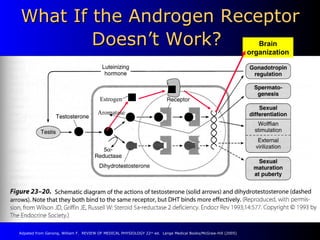
What If the Androgen Receptor Doesn’t Work?   Estrogen Brain organization Aromatase Adpated from Ganong, William F.  REVIEW OF MEDICAL PHYSIOLOGY 22 nd  ed.  Lange Medical Books/McGraw-Hill (2005)
Androgen Insensitivity Syndrome AIS aka testicular feminization syndrome Caused by mutations in the gene for the androgen receptor X-linked recessive disorder Male (46 XY) karyotype Testes (abdominal or inguinal) Male internal genitalia undeveloped No uterus or other internal female genitalia
 
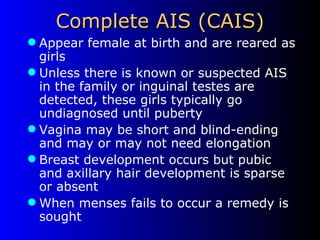
Complete AIS (CAIS) Appear female at birth and are reared as girls Unless there is known or suspected AIS in the family or inguinal testes are detected, these girls typically go undiagnosed until puberty Vagina may be short and blind-ending and may or may not need elongation Breast development occurs but pubic and axillary hair development is sparse or absent When menses fails to occur a remedy is sought
Complete Androgen Insensitivity Syndrome Luria, Z., Friedman, S., and Rose, M.D.  HUMAN SEXUALITY.  New York:  John Wiley & Sons, 1987. Forbes, C.D. and Jackson, W.F.  A COLOUR ATLAS AND TEXT OF CLINICAL MEDICINE.  England:  Mosby-Wolfe (1993)
Partial Androgen Insensitivity Syndrome (PAIS) Usually noticed at, or soon after, birth Depending upon the degree of masculinization of the genitals, the child may be raised as a boy or a girl AIS is an inherited condition Recessive X-linked single gene syndrome Manifests differently in children of the same parents; one child can be raised as a boy, another as a girl 59% PAIS were assigned as males (United Kingdom study, 16 years or younger) Most published cases of clinical-psychiatric involvement seem to be related to subjects who were raised as females
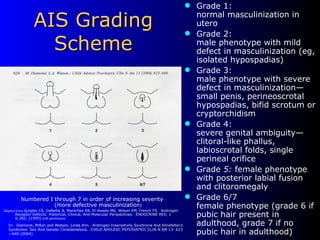
AIS Grading Scheme Grade 1:  normal masculinization in utero Grade 2: male phenotype with mild defect in masculinization (eg, isolated hypospadias) Grade 3: male phenotype with severe defect in masculinization—small penis, perineoscrotal hypospadias, bifid scrotum or cryptorchidism Grade 4: severe genital ambiguity— clitoral-like phallus, labioscrotal folds, single perineal orifice Grade  5:  female phenotype with posterior labial fusion and clitoromegaly Grade 6/7 female phenotype (grade 6 if pubic hair present in adulthood, grade 7 if no pubic hair in adulthood) Numbered I through 7 in order of increasing severity (more defective masculinization ) Adapted from  Quigley CA, DeBellis A, Marschke KB, El-Awady MK, Wilson EM, French FS.  Androgen Receptor Defects: Historical, Clinical, And Molecular Perspectives.  ENDOCRINE REV, 1 6:282; (1995)  with permission. In:  Diamond, Milton and Watson, Linda Ann.  Androgen Insensitivity Syndrome And Klinefelter’s Syndrome: Sex And Gender Considerations.  CHILD ADOLESC PSYCHIATRIC CLIN N AM 13: 623—640 (2004)
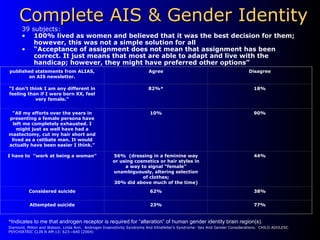
Complete AIS & Gender Identity 39 subjects: 100% lived as women and believed that it was the best decision for them; however, this was not a simple solution for all “ Acceptance of assignment does not mean that assignment has been correct. It just means that most are able to adapt and live with the handicap; however, they might have preferred other options” * Indicates to me that androgen receptor is required for “alteration” of human gender identity brain region(s). Diamond, Milton and Watson, Linda Ann.  Androgen Insensitivity Syndrome And Klinefelter’s Syndrome: Sex And Gender Considerations.  CHILD ADOLESC PSYCHIATRIC CLIN N AM 13: 623—640 (2004) published statements from ALIAS, an AIS newsletter. Agree Disagree “ I don’t think I am any different in feeling than if I were born XX, feel very female.” 82%* 18% “ All my efforts over the years in presenting a female persona have left me completely exhausted. I might just as well have had a mastectomy, cut my hair short and lived as a celibate man. It would actually have been easier I think.” 10% 90% I have to  “work at being a woman” 56%  (dressing in a feminine way or using cosmetics or hair styles in a way to signal “female” unambiguously, altering selection of clothes; 30% did above much of the time) 44% Considered suicide 62% 38% Attempted suicide 23% 77%
Partial AIS & Gender Identity 18 subjects: Often ambivalent about assigned gender 67% believed that the gender in which they were raised was best for them, whereas the others voiced reservations “ Gender switch” occurred at mean age of 33, range 18-46) * Now angry about castration, vaginal reconstruction surgery, and somatic feminization by estrogen treatment since puberty **Attempted before switching Diamond, Milton and Watson, Linda Ann.  Androgen Insensitivity Syndrome And Klinefelter’s Syndrome: Sex And Gender Considerations.  CHILD ADOLESC PSYCHIATRIC CLIN N AM 13: 623—640 (2004) PARTIAL AIS 8 raised as boys 4 live as women 10 raised as girls 2 live as men* Considered suicide 61% **Attempted suicide 17%
Milton Diamond Admonished Germaine Greer for Ignoring Brain/Mind “ A portion of your current book "The Whole Woman" dealing with androgen insensitivity (AIS) has been brought to my attention. While you write with conviction, you unfortunately also write with ignorance…” “ While you might readily admit that feminists can differ in their views toward their own femininity or identification with their woman-ness (whatever that might mean) you deny that right to others and see it as some sort of charade. You see it as a weakness that other women accept AIS individuals (and male to female transsexuals) as bone fide women.” “ Indeed individuals with AIS are biologically male. That derives from the anatomical consideration of their chromosomes and gonads.  Male or female refer to biological sexual characteristics. Gender is a social-psychological-cultural characteristic. Sex and gender might or might not coincide.  Yes, for the majority of persons the similarity exists. For intersexuals -- and AIS individuals are intersexed-- their biological variant sexuality disturbs your view of the conventional.   Educated to think in binary terms, you are slow to recognize that there are common medical conditions that move human beings away from the typical male and female.  AIS is just one such condition. CAH (congenital adrenal hyperplasia), hermaphroditism and many orders of pseudohermaphroditism are other such.” “ AIS women are doing the best they can to follow their hearts and head in the face of a natural, although relatively rare, medical condition.  It is a pity that you miss the forest for the trees when all you look at is an individual's chromosomes and gonads and ignore the most central part of a person which makes them human, their brain and mind.”

5 Androgen Insensitivity

  • 1.
    What If theAndrogen Receptor Doesn’t Work? Estrogen Brain organization Aromatase Adpated from Ganong, William F. REVIEW OF MEDICAL PHYSIOLOGY 22 nd ed. Lange Medical Books/McGraw-Hill (2005)
  • 2.
    Androgen Insensitivity SyndromeAIS aka testicular feminization syndrome Caused by mutations in the gene for the androgen receptor X-linked recessive disorder Male (46 XY) karyotype Testes (abdominal or inguinal) Male internal genitalia undeveloped No uterus or other internal female genitalia
  • 3.
  • 4.
    Complete AIS (CAIS)Appear female at birth and are reared as girls Unless there is known or suspected AIS in the family or inguinal testes are detected, these girls typically go undiagnosed until puberty Vagina may be short and blind-ending and may or may not need elongation Breast development occurs but pubic and axillary hair development is sparse or absent When menses fails to occur a remedy is sought
  • 5.
    Complete Androgen InsensitivitySyndrome Luria, Z., Friedman, S., and Rose, M.D. HUMAN SEXUALITY. New York: John Wiley & Sons, 1987. Forbes, C.D. and Jackson, W.F. A COLOUR ATLAS AND TEXT OF CLINICAL MEDICINE. England: Mosby-Wolfe (1993)
  • 6.
    Partial Androgen InsensitivitySyndrome (PAIS) Usually noticed at, or soon after, birth Depending upon the degree of masculinization of the genitals, the child may be raised as a boy or a girl AIS is an inherited condition Recessive X-linked single gene syndrome Manifests differently in children of the same parents; one child can be raised as a boy, another as a girl 59% PAIS were assigned as males (United Kingdom study, 16 years or younger) Most published cases of clinical-psychiatric involvement seem to be related to subjects who were raised as females
  • 7.
    AIS Grading SchemeGrade 1: normal masculinization in utero Grade 2: male phenotype with mild defect in masculinization (eg, isolated hypospadias) Grade 3: male phenotype with severe defect in masculinization—small penis, perineoscrotal hypospadias, bifid scrotum or cryptorchidism Grade 4: severe genital ambiguity— clitoral-like phallus, labioscrotal folds, single perineal orifice Grade 5: female phenotype with posterior labial fusion and clitoromegaly Grade 6/7 female phenotype (grade 6 if pubic hair present in adulthood, grade 7 if no pubic hair in adulthood) Numbered I through 7 in order of increasing severity (more defective masculinization ) Adapted from Quigley CA, DeBellis A, Marschke KB, El-Awady MK, Wilson EM, French FS. Androgen Receptor Defects: Historical, Clinical, And Molecular Perspectives. ENDOCRINE REV, 1 6:282; (1995) with permission. In: Diamond, Milton and Watson, Linda Ann. Androgen Insensitivity Syndrome And Klinefelter’s Syndrome: Sex And Gender Considerations. CHILD ADOLESC PSYCHIATRIC CLIN N AM 13: 623—640 (2004)
  • 8.
    Complete AIS &Gender Identity 39 subjects: 100% lived as women and believed that it was the best decision for them; however, this was not a simple solution for all “ Acceptance of assignment does not mean that assignment has been correct. It just means that most are able to adapt and live with the handicap; however, they might have preferred other options” * Indicates to me that androgen receptor is required for “alteration” of human gender identity brain region(s). Diamond, Milton and Watson, Linda Ann. Androgen Insensitivity Syndrome And Klinefelter’s Syndrome: Sex And Gender Considerations. CHILD ADOLESC PSYCHIATRIC CLIN N AM 13: 623—640 (2004) published statements from ALIAS, an AIS newsletter. Agree Disagree “ I don’t think I am any different in feeling than if I were born XX, feel very female.” 82%* 18% “ All my efforts over the years in presenting a female persona have left me completely exhausted. I might just as well have had a mastectomy, cut my hair short and lived as a celibate man. It would actually have been easier I think.” 10% 90% I have to “work at being a woman” 56% (dressing in a feminine way or using cosmetics or hair styles in a way to signal “female” unambiguously, altering selection of clothes; 30% did above much of the time) 44% Considered suicide 62% 38% Attempted suicide 23% 77%
  • 9.
    Partial AIS &Gender Identity 18 subjects: Often ambivalent about assigned gender 67% believed that the gender in which they were raised was best for them, whereas the others voiced reservations “ Gender switch” occurred at mean age of 33, range 18-46) * Now angry about castration, vaginal reconstruction surgery, and somatic feminization by estrogen treatment since puberty **Attempted before switching Diamond, Milton and Watson, Linda Ann. Androgen Insensitivity Syndrome And Klinefelter’s Syndrome: Sex And Gender Considerations. CHILD ADOLESC PSYCHIATRIC CLIN N AM 13: 623—640 (2004) PARTIAL AIS 8 raised as boys 4 live as women 10 raised as girls 2 live as men* Considered suicide 61% **Attempted suicide 17%
  • 10.
    Milton Diamond AdmonishedGermaine Greer for Ignoring Brain/Mind “ A portion of your current book "The Whole Woman" dealing with androgen insensitivity (AIS) has been brought to my attention. While you write with conviction, you unfortunately also write with ignorance…” “ While you might readily admit that feminists can differ in their views toward their own femininity or identification with their woman-ness (whatever that might mean) you deny that right to others and see it as some sort of charade. You see it as a weakness that other women accept AIS individuals (and male to female transsexuals) as bone fide women.” “ Indeed individuals with AIS are biologically male. That derives from the anatomical consideration of their chromosomes and gonads. Male or female refer to biological sexual characteristics. Gender is a social-psychological-cultural characteristic. Sex and gender might or might not coincide. Yes, for the majority of persons the similarity exists. For intersexuals -- and AIS individuals are intersexed-- their biological variant sexuality disturbs your view of the conventional. Educated to think in binary terms, you are slow to recognize that there are common medical conditions that move human beings away from the typical male and female. AIS is just one such condition. CAH (congenital adrenal hyperplasia), hermaphroditism and many orders of pseudohermaphroditism are other such.” “ AIS women are doing the best they can to follow their hearts and head in the face of a natural, although relatively rare, medical condition. It is a pity that you miss the forest for the trees when all you look at is an individual's chromosomes and gonads and ignore the most central part of a person which makes them human, their brain and mind.”