Prolactin:
A Unique
Hormone
Dr/ Mahmoud Abdel-Aleem
Professor of Obstetrics and Gynaecology,
Assiut university.
Nothingto declare !!!!
Agenda
• Introduction
• Why prolactin is a unique
hormone?
• The unique functions of prolactin
• The unique Assay.
• Abnormal levels: Unique
classification.
• Unique in neoplastic Behaviour.
• Prolactin and Infertility.
• Unique in treatment options.
Introduction
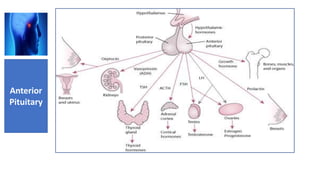
Anterior
Pituitary
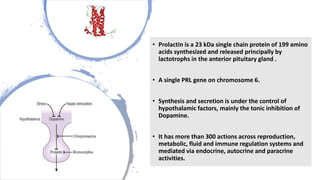
• Prolactin is a 23 kDa single chain protein of 199 amino
acids synthesized and released principally by
lactotrophs in the anterior pituitary gland .
• A single PRL gene on chromosome 6.
• Synthesis and secretion is under the control of
hypothalamic factors, mainly the tonic inhibition of
Dopamine.
• It has more than 300 actions across reproduction,
metabolic, fluid and immune regulation systems and
mediated via endocrine, autocrine and paracrine
activities.
Geoffrey Harris
• The oldest hormone: 1928 in a cow´s
hypophysis These French scientists injected
a bovine pituitary extract into pseudo
pregnant rabbit.
• Its luteotrophic activity: 1945.
• In human: 1965 – 1971. Its isolation was
difficult due to its structure, which is
similar (in a 16%) to the growth hormone
(GH) structure.
Unique Hormone
Human PRL (hRPL), growth hormone
(hGH), and placental lactogen (hPL),
commonly referred to as lactogens,
are members of the cytokine
superfamily
Source
Control of secretion
Circadian rhythm
Forms
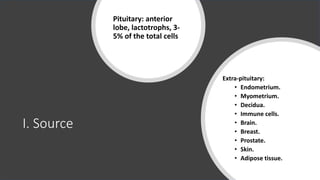
I. Source
Pituitary: anterior
lobe, lactotrophs, 3-
5% of the total cells
Extra-pituitary:
• Endometrium.
• Myometrium.
• Decidua.
• Immune cells.
• Brain.
• Breast.
• Prostate.
• Skin.
• Adipose tissue.
II. Control
of
secretion
neurotransmitter
Releasing Factor
The incomplete blood
brain barrier at the region
of arcuate nucleus
allowing for direct action
on dopamine neurons
Lactotrophs are the only pituitary cells that display spontaneous electrical
activity in the absence of hypothalamic stimulation
III. True
Circadian
Rhythm of
Prolactin
Secretion
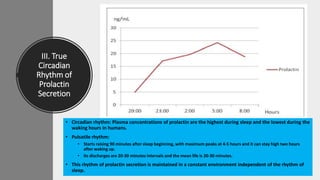
• Circadian rhythm: Plasma concentrations of prolactin are the highest during sleep and the lowest during the
waking hours in humans.
• Pulsatile rhythm:
• Starts raising 90 minutes after sleep beginning, with maximum peaks at 4-5 hours and it can stay high two hours
after waking up.
• Its discharges are 20-30 minutes intervals and the mean life is 20-30 minutes.
• This rhythm of prolactin secretion is maintained in a constant environment independent of the rhythm of
sleep.
IV. Forms
Extensive microheterogeneity
• Diverse modification:
polymerization;
proteolytic cleavage;
glycosylation and
phosphorylation
• Diverse impact: on
stability, half-life, receptor
binding, bioactivity.
Unique Function
Pleiotrophic
Classical:
LH suppression: During breastfeeding.
Preparation of mammary gland for lactation.
Non classic: 300 function
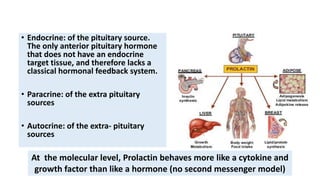
• Endocrine: of the pituitary source.
The only anterior pituitary hormone
that does not have an endocrine
target tissue, and therefore lacks a
classical hormonal feedback system.
• Paracrine: of the extra pituitary
sources
• Autocrine: of the extra- pituitary
sources
At the molecular level, Prolactin behaves more like a cytokine and
growth factor than like a hormone (no second messenger model)
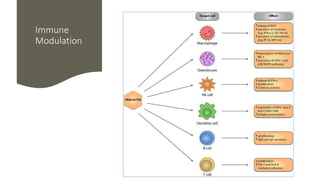
Immune
Modulation
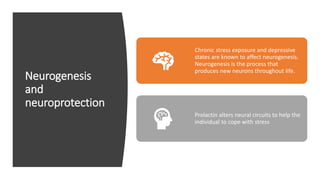
Neurogenesis
and
neuroprotection
Chronic stress exposure and depressive
states are known to affect neurogenesis.
Neurogenesis is the process that
produces new neurons throughout life.
Prolactin alters neural circuits to help the
individual to cope with stress
Metabolic
functions
Prolactin receptors are expressed on multiple tissues
involved in metabolic regulation, including adipose tissue,
liver, pancreas and the brain.
It appears to play a broad role in both pancreatic and
adipose development. In adipose tissue, prolactin is
essential in adipogenesis and adipocyte differentiation, as
well as modulating lipid metabolism.
It also regulates the secretion is several adipokines,
including stimulation of leptin and inhibition of
adiponectin production
Degradation generates smaller prolactin variants of 14 kDa,
16 kDa and 22 kDa prolactin with antiangiogenic properties
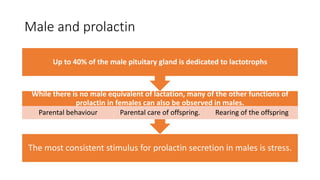
Male and prolactin
The most consistent stimulus for prolactin secretion in males is stress.
While there is no male equivalent of lactation, many of the other functions of
prolactin in females can also be observed in males.
Parental behaviour Parental care of offspring. Rearing of the offspring
Up to 40% of the male pituitary gland is dedicated to lactotrophs
PRL and Pregnancy
Serum PRL rises in a progressive way during gestation
(mean value 200 ng/mL)
Amniotic fluid PRL
• 15th -20th week: 1000 ng/ml. Highest concentration than any other
organic fluid
• At term: 450 ng/mL
• Production: fetal and the mother´s hypophysis
• Function:
• Osmoregulation to survive in the intrauterine liquid environment.
• Pulmonary maturing raising the content of phospholipids and
changes in the lecithin/sphingomyelin.
Peripartum cardiomyopathy
• The 16 kDa isoform of prolactin could also be a major factor
• The initiation and progression of peripartum cardiomyopathy
• The onset of preeclampsia.
• Lab evidence.
• Increased generation of the 16 kDa isoform
• Treatment with DA ameliorates it
• Augmentation of deterioration of the cardiac capillary network and its function.
PRL and breast feeding
• The nipple suction during breastfeeding favors a
bigger amount of hormone synthesis.
• Nipple and areola´s terminal nerves are
stimulated when suction occurs.
• This stimulus travels via afferent nerve pathways
to the hypothalamus, proving the prolactin
release, by inhibition of the release of dopamine.
Unique Assay
Physiological considerations
• Response to stress,
breast stimulation,
intercourse.
• Circadian rhythm.
• Relationship to
ovarian cycle.
Measurement of prolactin
• A simple blood test drawn
• First thing in the morning: be awake 2 hours before the test.
• Early in the menstrual cycle – before ovulation. This is because prolactin levels are
naturally higher after ovulation.
• Be 8-10 hours of fasting prior to extraction.
• Be relaxed and rested for at least 30 min before extraction.
• Avoids:
• High-protein or fat diet: 24 hours
• Intercourse: 24 hours
• Stimulation of the breast and nipples: 24 hours
• Stress: physical examination: 24 hours.
Values
• 5-20 ng/mL is considered normal in both sexes.
• 20 ng/mL males
• 25 ng/mL females.
• During pregnancy and lactation: upto 200-400 ng/mL
• > 20 ng/mL in two successive measurements is defined as
hyperprolactinemia
• > 250 ng/mL usually indication for prolactinoma.
• > 500 ng/mL it is considered as diagnosis for macroprolactinoma
Conversion factor: mU/l × 0,0472 =ng/ml; ng/ml × 21,2 = mU/l.)
Abnormal levels: Unique classification
Pathological
Hyperprolactinemia
Drugs
Polycystic ovary
syndrome
Prolactinoma
Primary hypothyroidism
Macroprolactinemia
• Asymptomatic patients
with intact gonadal and
reproductive function
and moderately elevated
prolactin levels.
• Higher molecular mass
prolactin forms (big-big
prolactin, MW > 150
kDa).
Physiological
Hyperprolactinemia
Stress
Pregnancy
Lactation
Sex
Stress
• Examples:
• Physical stress.
• Drawing blood sample.
• Pyschological reasons.
• Anxiety and irritability may be due to hyperprolactinemia.
Drugs
• First generation Anti-psychotic
medications.
• Serotonin reuptake inhibitors
• fluvoxamine; fluoxetine;
paroxetine, duloxetine
• Some types of sedatives
• Catecholamine depletory
• Dopamine synthesis inhibitor
• Neuropeptides
• Anticonvulsants
• Opiates and opiate antagonists
• Estrogen Oral contraceptives
(birth control pills)
• Anti HT: methyldopa, verapamil.
• GIT drugs: metoclopramide and
cimetidine.
Hypoprolactinemia
• A medical condition characterized by a deficiency in the serum levels of the
hypothalamic-pituitary hormone prolactin.
• Prolactin levels below 3 μg/L in women, 5 μg/L in men.
• Causes:
• Autoimmune disease.
• Hypopituitarism.
• Growth hormone deficiency.
• Hypothyroidism.
• Excessive dopamine action (drug-induced)
• Menstrual disorders, delayed puberty, infertility, and subfertility
Unique in neoplastic Behaviour
Prolactinomas
• Pituitary adenomas are the most common tumour type in the
pituitary gland.
• 1/3 About one-third of all pituitary tumours are not associated with
hypersecretory syndromes but, rather, present with symptoms of an
intracranial mass.
• Classification based on size:
• Microadenoma: < 1 cm
• Macroadenoma: > 1 cm
Microadenoma
• Less than one centimetre in diameter.
• Can be present in healthy people who do
not have high prolactin levels.
• Microadenomas can be treated with
medication.
• They do not grow large
• Do not need to be treated if hormone
levels are normal.
• Microprolactinomas usually follow a
benign course and rarely progress to
macroprolactinomas.
• Rare transformarion to other tumours
Macroadenoma
• Adenomas larger than 1 centimeter.
• If untreated, macroadenomas can
grow further and start to compress
the nearby tissues and structures.
• It is important to treat
macroadenomas whether or not a
woman is interested in getting
pregnant.
• Medication can be used to treat them
but if that fails, surgery may be
necessary.
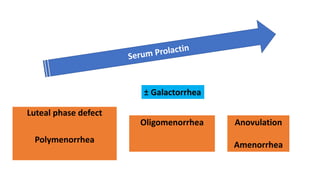
Prolactin and Infertility
Variable effects.
Males and females
Luteal phase defect
Polymenorrhea
Anovulation
Amenorrhea
Oligomenorrhea
± Galactorrhea
Prolactin and Male reproduction
• Decreased libido
• Impotence.
• Inefficient sperm production and infertility.
Unique Treatment
Medical even with tumours.
A more recent drug dislodges an older one !!!
Dopamine agonists
• To lower PRL levels
• To decrease tumor size.
• To restore gonadal function for patients.
Bromocriptine QuinagolideLisuride Pergolide Cabergoline
Bromocriptine
• It is an effective and inexpensive medication for high prolactin levels.
• The prolactin levels can be rechecked in 3 weeks. If the levels are still
elevated the dose can be increased or a different medication can be
tried.
• Due to the side effects, some women can not tolerate it:
• Vaginal bioadhesive suppositories
• Vaginal use of the pill
Cabergoline
• It is a longer acting medication.
• It is usually given once/ twice a week instead of every day.
Systematic reviews: Cabergoline is more
effective than bromocriptine in achieving
normoprolactinemia and resolving
amenorrhea/ oligomenorrhea and
galactorrhea.
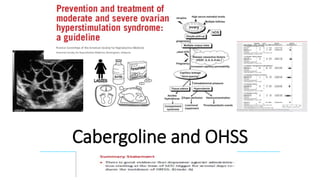
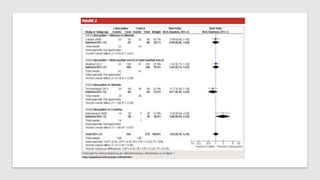
Cabergoline and OHSS
Cabergoline and heart
• Cabergoline binds to the serotonin receptor subtype 2B (5-HT2B) located on heart valves. Activation of these receptors induces valvular interstitial cell mitogenesis and
proliferation, which in turn modifies the quantity and quality of the valvular extracellular matrix through actions on proteoglycans, collagen types I, III and IV, and matrix
metalloproteinases. As a result, valve leaflets and chords become thickened, retracted and stiff, leading most commonly to valvular regurgitation
Recommendations
All patients should undergo echocardiography before
commencing DA therapy.
Patients taking a dose of cabergoline of ≤2 mg/week
should undergo surveillance echocardiography at 5 years.
Patients taking a dose of cabergoline of >2 mg/week
should undergo annual echocardiography.
Patients taking a dose of ≤2 mg/week who develop a
change in valve function should undergo annual
echocardiography if treatment is to continue.
Decisions regarding discontinuation of medication should
only be made after review of serial imaging by an
echocardiographer experienced in analysing drug-induced
valvulopathy or carcinoid heart disease.
Cabergoline and
lung
Cabergoline binds to the serotonin receptor subtype on
fibrous tissues. Activation of these receptors induces
valvular interstitial cell mitogenesis and proliferation,
which in turn modifies the quantity and quality of the
valvular extracellular matrix through actions on
proteoglycans, collagen types I, III and IV, and matrix
metalloproteinases.
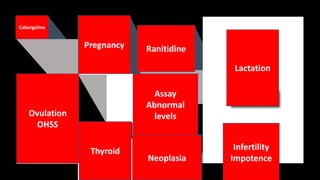
To Sum Up
Omnipotin
Versatilin
PROMOTE LACTATION
Pregnancy
Infertility
Impotence
Lactation
Thyroid
Assay
Abnormal
levelsOvulation
OHSS
Cabergoline
Ranitidine
Neoplasia
Prolactin: A unique hormone

Prolactin: A unique hormone

  • 1.
    Prolactin: A Unique Hormone Dr/ MahmoudAbdel-Aleem Professor of Obstetrics and Gynaecology, Assiut university.
  • 2.
  • 4.
    Agenda • Introduction • Whyprolactin is a unique hormone? • The unique functions of prolactin • The unique Assay. • Abnormal levels: Unique classification. • Unique in neoplastic Behaviour. • Prolactin and Infertility. • Unique in treatment options.
  • 5.
  • 6.
  • 7.
    • Prolactin isa 23 kDa single chain protein of 199 amino acids synthesized and released principally by lactotrophs in the anterior pituitary gland . • A single PRL gene on chromosome 6. • Synthesis and secretion is under the control of hypothalamic factors, mainly the tonic inhibition of Dopamine. • It has more than 300 actions across reproduction, metabolic, fluid and immune regulation systems and mediated via endocrine, autocrine and paracrine activities.
  • 8.
    Geoffrey Harris • Theoldest hormone: 1928 in a cow´s hypophysis These French scientists injected a bovine pituitary extract into pseudo pregnant rabbit. • Its luteotrophic activity: 1945. • In human: 1965 – 1971. Its isolation was difficult due to its structure, which is similar (in a 16%) to the growth hormone (GH) structure.
  • 9.
    Unique Hormone Human PRL(hRPL), growth hormone (hGH), and placental lactogen (hPL), commonly referred to as lactogens, are members of the cytokine superfamily Source Control of secretion Circadian rhythm Forms
  • 10.
    I. Source Pituitary: anterior lobe,lactotrophs, 3- 5% of the total cells Extra-pituitary: • Endometrium. • Myometrium. • Decidua. • Immune cells. • Brain. • Breast. • Prostate. • Skin. • Adipose tissue.
  • 11.
    II. Control of secretion neurotransmitter Releasing Factor Theincomplete blood brain barrier at the region of arcuate nucleus allowing for direct action on dopamine neurons Lactotrophs are the only pituitary cells that display spontaneous electrical activity in the absence of hypothalamic stimulation
  • 12.
    III. True Circadian Rhythm of Prolactin Secretion •Circadian rhythm: Plasma concentrations of prolactin are the highest during sleep and the lowest during the waking hours in humans. • Pulsatile rhythm: • Starts raising 90 minutes after sleep beginning, with maximum peaks at 4-5 hours and it can stay high two hours after waking up. • Its discharges are 20-30 minutes intervals and the mean life is 20-30 minutes. • This rhythm of prolactin secretion is maintained in a constant environment independent of the rhythm of sleep.
  • 13.
    IV. Forms Extensive microheterogeneity •Diverse modification: polymerization; proteolytic cleavage; glycosylation and phosphorylation • Diverse impact: on stability, half-life, receptor binding, bioactivity.
  • 14.
    Unique Function Pleiotrophic Classical: LH suppression:During breastfeeding. Preparation of mammary gland for lactation. Non classic: 300 function
  • 15.
    • Endocrine: ofthe pituitary source. The only anterior pituitary hormone that does not have an endocrine target tissue, and therefore lacks a classical hormonal feedback system. • Paracrine: of the extra pituitary sources • Autocrine: of the extra- pituitary sources At the molecular level, Prolactin behaves more like a cytokine and growth factor than like a hormone (no second messenger model)
  • 16.
  • 17.
    Neurogenesis and neuroprotection Chronic stress exposureand depressive states are known to affect neurogenesis. Neurogenesis is the process that produces new neurons throughout life. Prolactin alters neural circuits to help the individual to cope with stress
  • 18.
    Metabolic functions Prolactin receptors areexpressed on multiple tissues involved in metabolic regulation, including adipose tissue, liver, pancreas and the brain. It appears to play a broad role in both pancreatic and adipose development. In adipose tissue, prolactin is essential in adipogenesis and adipocyte differentiation, as well as modulating lipid metabolism. It also regulates the secretion is several adipokines, including stimulation of leptin and inhibition of adiponectin production Degradation generates smaller prolactin variants of 14 kDa, 16 kDa and 22 kDa prolactin with antiangiogenic properties
  • 19.
    Male and prolactin Themost consistent stimulus for prolactin secretion in males is stress. While there is no male equivalent of lactation, many of the other functions of prolactin in females can also be observed in males. Parental behaviour Parental care of offspring. Rearing of the offspring Up to 40% of the male pituitary gland is dedicated to lactotrophs
  • 20.
    PRL and Pregnancy SerumPRL rises in a progressive way during gestation (mean value 200 ng/mL) Amniotic fluid PRL • 15th -20th week: 1000 ng/ml. Highest concentration than any other organic fluid • At term: 450 ng/mL • Production: fetal and the mother´s hypophysis • Function: • Osmoregulation to survive in the intrauterine liquid environment. • Pulmonary maturing raising the content of phospholipids and changes in the lecithin/sphingomyelin.
  • 21.
    Peripartum cardiomyopathy • The16 kDa isoform of prolactin could also be a major factor • The initiation and progression of peripartum cardiomyopathy • The onset of preeclampsia. • Lab evidence. • Increased generation of the 16 kDa isoform • Treatment with DA ameliorates it • Augmentation of deterioration of the cardiac capillary network and its function.
  • 22.
    PRL and breastfeeding • The nipple suction during breastfeeding favors a bigger amount of hormone synthesis. • Nipple and areola´s terminal nerves are stimulated when suction occurs. • This stimulus travels via afferent nerve pathways to the hypothalamus, proving the prolactin release, by inhibition of the release of dopamine.
  • 23.
  • 24.
    Physiological considerations • Responseto stress, breast stimulation, intercourse. • Circadian rhythm. • Relationship to ovarian cycle.
  • 25.
    Measurement of prolactin •A simple blood test drawn • First thing in the morning: be awake 2 hours before the test. • Early in the menstrual cycle – before ovulation. This is because prolactin levels are naturally higher after ovulation. • Be 8-10 hours of fasting prior to extraction. • Be relaxed and rested for at least 30 min before extraction. • Avoids: • High-protein or fat diet: 24 hours • Intercourse: 24 hours • Stimulation of the breast and nipples: 24 hours • Stress: physical examination: 24 hours.
  • 26.
    Values • 5-20 ng/mLis considered normal in both sexes. • 20 ng/mL males • 25 ng/mL females. • During pregnancy and lactation: upto 200-400 ng/mL • > 20 ng/mL in two successive measurements is defined as hyperprolactinemia • > 250 ng/mL usually indication for prolactinoma. • > 500 ng/mL it is considered as diagnosis for macroprolactinoma Conversion factor: mU/l × 0,0472 =ng/ml; ng/ml × 21,2 = mU/l.)
  • 27.
  • 28.
    Pathological Hyperprolactinemia Drugs Polycystic ovary syndrome Prolactinoma Primary hypothyroidism Macroprolactinemia •Asymptomatic patients with intact gonadal and reproductive function and moderately elevated prolactin levels. • Higher molecular mass prolactin forms (big-big prolactin, MW > 150 kDa). Physiological Hyperprolactinemia Stress Pregnancy Lactation Sex
  • 29.
    Stress • Examples: • Physicalstress. • Drawing blood sample. • Pyschological reasons. • Anxiety and irritability may be due to hyperprolactinemia.
  • 30.
    Drugs • First generationAnti-psychotic medications. • Serotonin reuptake inhibitors • fluvoxamine; fluoxetine; paroxetine, duloxetine • Some types of sedatives • Catecholamine depletory • Dopamine synthesis inhibitor • Neuropeptides • Anticonvulsants • Opiates and opiate antagonists • Estrogen Oral contraceptives (birth control pills) • Anti HT: methyldopa, verapamil. • GIT drugs: metoclopramide and cimetidine.
  • 31.
    Hypoprolactinemia • A medicalcondition characterized by a deficiency in the serum levels of the hypothalamic-pituitary hormone prolactin. • Prolactin levels below 3 μg/L in women, 5 μg/L in men. • Causes: • Autoimmune disease. • Hypopituitarism. • Growth hormone deficiency. • Hypothyroidism. • Excessive dopamine action (drug-induced) • Menstrual disorders, delayed puberty, infertility, and subfertility
  • 32.
    Unique in neoplasticBehaviour Prolactinomas
  • 33.
    • Pituitary adenomasare the most common tumour type in the pituitary gland. • 1/3 About one-third of all pituitary tumours are not associated with hypersecretory syndromes but, rather, present with symptoms of an intracranial mass. • Classification based on size: • Microadenoma: < 1 cm • Macroadenoma: > 1 cm
  • 34.
    Microadenoma • Less thanone centimetre in diameter. • Can be present in healthy people who do not have high prolactin levels. • Microadenomas can be treated with medication. • They do not grow large • Do not need to be treated if hormone levels are normal. • Microprolactinomas usually follow a benign course and rarely progress to macroprolactinomas. • Rare transformarion to other tumours Macroadenoma • Adenomas larger than 1 centimeter. • If untreated, macroadenomas can grow further and start to compress the nearby tissues and structures. • It is important to treat macroadenomas whether or not a woman is interested in getting pregnant. • Medication can be used to treat them but if that fails, surgery may be necessary.
  • 35.
    Prolactin and Infertility Variableeffects. Males and females
  • 36.
  • 38.
    Prolactin and Malereproduction • Decreased libido • Impotence. • Inefficient sperm production and infertility.
  • 39.
    Unique Treatment Medical evenwith tumours. A more recent drug dislodges an older one !!!
  • 40.
    Dopamine agonists • Tolower PRL levels • To decrease tumor size. • To restore gonadal function for patients. Bromocriptine QuinagolideLisuride Pergolide Cabergoline
  • 41.
    Bromocriptine • It isan effective and inexpensive medication for high prolactin levels. • The prolactin levels can be rechecked in 3 weeks. If the levels are still elevated the dose can be increased or a different medication can be tried. • Due to the side effects, some women can not tolerate it: • Vaginal bioadhesive suppositories • Vaginal use of the pill
  • 42.
    Cabergoline • It isa longer acting medication. • It is usually given once/ twice a week instead of every day. Systematic reviews: Cabergoline is more effective than bromocriptine in achieving normoprolactinemia and resolving amenorrhea/ oligomenorrhea and galactorrhea.
  • 43.
  • 46.
    Cabergoline and heart •Cabergoline binds to the serotonin receptor subtype 2B (5-HT2B) located on heart valves. Activation of these receptors induces valvular interstitial cell mitogenesis and proliferation, which in turn modifies the quantity and quality of the valvular extracellular matrix through actions on proteoglycans, collagen types I, III and IV, and matrix metalloproteinases. As a result, valve leaflets and chords become thickened, retracted and stiff, leading most commonly to valvular regurgitation Recommendations All patients should undergo echocardiography before commencing DA therapy. Patients taking a dose of cabergoline of ≤2 mg/week should undergo surveillance echocardiography at 5 years. Patients taking a dose of cabergoline of >2 mg/week should undergo annual echocardiography. Patients taking a dose of ≤2 mg/week who develop a change in valve function should undergo annual echocardiography if treatment is to continue. Decisions regarding discontinuation of medication should only be made after review of serial imaging by an echocardiographer experienced in analysing drug-induced valvulopathy or carcinoid heart disease.
  • 47.
    Cabergoline and lung Cabergoline bindsto the serotonin receptor subtype on fibrous tissues. Activation of these receptors induces valvular interstitial cell mitogenesis and proliferation, which in turn modifies the quantity and quality of the valvular extracellular matrix through actions on proteoglycans, collagen types I, III and IV, and matrix metalloproteinases.
  • 48.
  • 49.
  • 50.