Hyperprolactinemia

충북의대 전현정
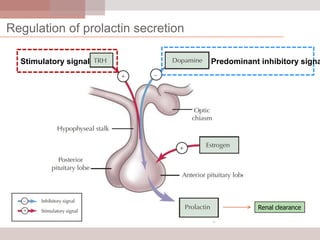
Regulation of prolactin secretion
Stimulatory signal

Predominant inhibitory signa

Renal clearance
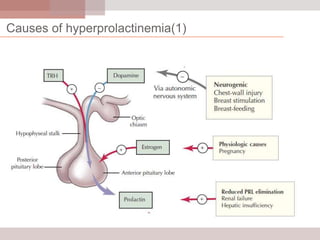
Causes of hyperprolactinemia(1)
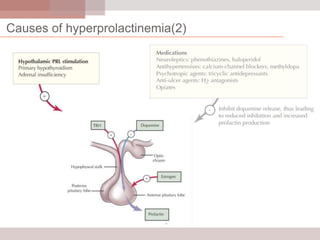
Causes of hyperprolactinemia(2)
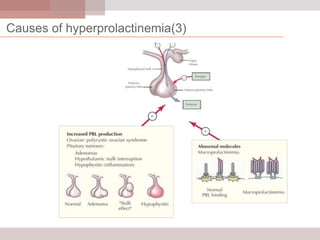
Causes of hyperprolactinemia(3)
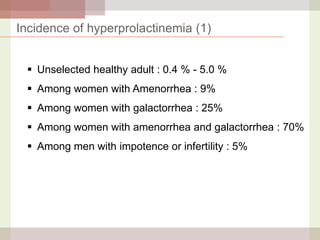
Incidence of hyperprolactinemia (1)
 Unselected healthy adult : 0.4 % - 5.0 %
 Among women with Amenorrhea : 9%
 Among women with galactorrhea : 25%
 Among women with amenorrhea and galactorrhea : 70%

 Among men with impotence or infertility : 5%
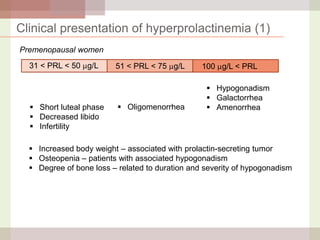
Clinical presentation of hyperprolactinemia (1)
Premenopausal women
31 < PRL < 50 g/L

 Short luteal phase
 Decreased libido
 Infertility

51 < PRL < 75 g/L

 Oligomenorrhea

100 g/L < PRL
 Hypogonadism
 Galactorrhea
 Amenorrhea

 Increased body weight – associated with prolactin-secreting tumor
 Osteopenia – patients with associated hypogonadism
 Degree of bone loss – related to duration and severity of hypogonadism
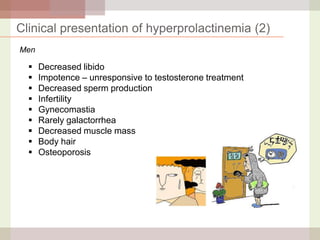
Clinical presentation of hyperprolactinemia (2)
Men











Decreased libido
Impotence – unresponsive to testosterone treatment
Decreased sperm production
Infertility
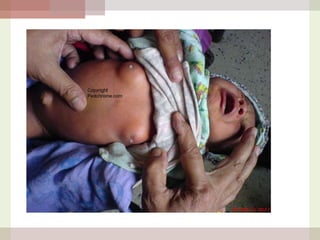
Gynecomastia
Rarely galactorrhea
Decreased muscle mass
Body hair
Osteoporosis
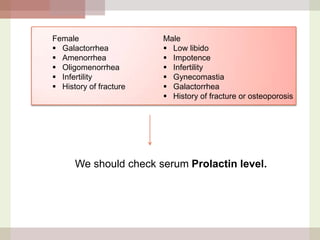
Female
 Galactorrhea
 Amenorrhea
 Oligomenorrhea
 Infertility
 History of fracture

Male
 Low libido
 Impotence
 Infertility
 Gynecomastia
 Galactorrhea
 History of fracture or osteoporosis

We should check serum Prolactin level.
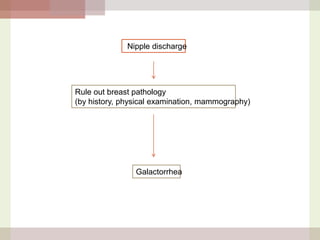
Nipple discharge

Rule out breast pathology
(by history, physical examination, mammography)

Galactorrhea
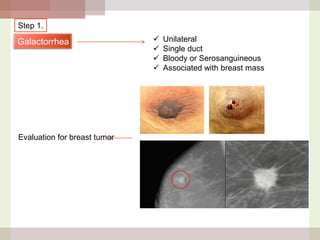
Step 1.

Galactorrhea

Evaluation for breast tumor






Unilateral
Single duct
Bloody or Serosanguineous
Associated with breast mass
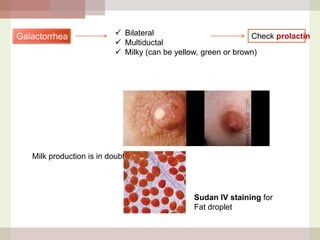
Galactorrhea

 Bilateral
Check prolactin
 Multiductal
 Milky (can be yellow, green or brown)

Milk production is in doubt

Sudan IV staining for
Fat droplet
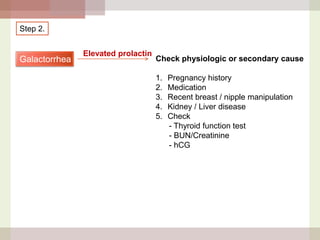
Step 2.

Galactorrhea

Elevated prolactin

Check physiologic or secondary cause
1.
2.
3.
4.
5.

Pregnancy history
Medication
Recent breast / nipple manipulation
Kidney / Liver disease
Check
- Thyroid function test
- BUN/Creatinine
- hCG
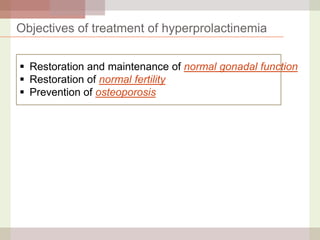
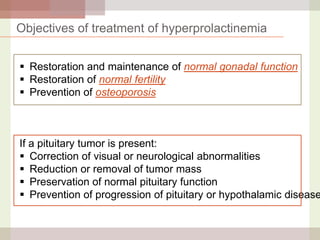
Objectives of treatment of hyperprolactinemia
 Restoration and maintenance of normal gonadal function
 Restoration of normal fertility
 Prevention of osteoporosis
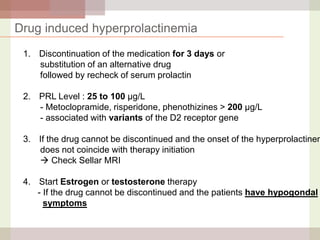
Drug induced hyperprolactinemia
1. Discontinuation of the medication for 3 days or
substitution of an alternative drug
followed by recheck of serum prolactin
2. PRL Level : 25 to 100 μg/L
- Metoclopramide, risperidone, phenothizines > 200 μg/L
- associated with variants of the D2 receptor gene

3. If the drug cannot be discontinued and the onset of the hyperprolactinem
does not coincide with therapy initiation
 Check Sellar MRI
4. Start Estrogen or testosterone therapy
- If the drug cannot be discontinued and the patients have hypogondal
symptoms
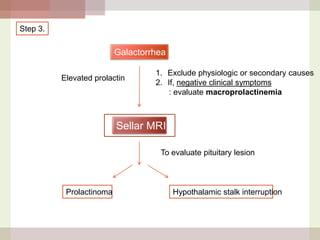
Step 3.

Galactorrhea
Elevated prolactin

1. Exclude physiologic or secondary causes
2. If, negative clinical symptoms
: evaluate macroprolactinemia

Sellar MRI
To evaluate pituitary lesion

Prolactinoma

Hypothalamic stalk interruption
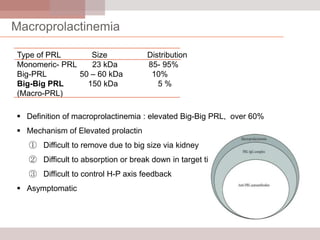
Macroprolactinemia
Type of PRL
Size
Monomeric- PRL
23 kDa
Big-PRL
50 – 60 kDa
Big-Big PRL
150 kDa
(Macro-PRL)

Distribution
85- 95%
10%
5%

 Definition of macroprolactinemia : elevated Big-Big PRL, over 60%
 Mechanism of Elevated prolactin
① Difficult to remove due to big size via kidney
② Difficult to absorption or break down in target tissue
③ Difficult to control H-P axis feedback
 Asymptomatic
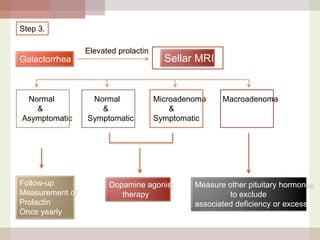
Step 3.
Elevated prolactin

Galactorrhea

Normal
&
Asymptomatic

Follow-up
Measurement of
Prolactin
Once yearly

Normal
&
Symptomatic

Sellar MRI

Microadenoma
&
Symptomatic

Dopamine agonist
therapy

Macroadenoma

Measure other pituitary hormones
to exclude
associated deficiency or excess
Objectives of treatment of hyperprolactinemia
 Restoration and maintenance of normal gonadal function
 Restoration of normal fertility
 Prevention of osteoporosis

If a pituitary tumor is present:
 Correction of visual or neurological abnormalities
 Reduction or removal of tumor mass
 Preservation of normal pituitary function
 Prevention of progression of pituitary or hypothalamic disease
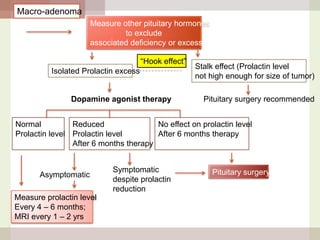
Macro-adenoma
Measure other pituitary hormones
to exclude
associated deficiency or excess
“Hook effect”
Isolated Prolactin excess

Dopamine agonist therapy

Stalk effect (Prolactin level
not high enough for size of tumor)
Pituitary surgery recommended

Normal
Reduced
No effect on prolactin level
Prolactin level Prolactin level
After 6 months therapy

Asymptomatic

Measure prolactin level
Every 4 – 6 months;
MRI every 1 – 2 yrs

Symptomatic
despite prolactin
reduction

Pituitary surgery
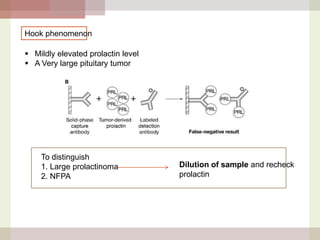
Hook phenomenon
 Mildly elevated prolactin level
 A Very large pituitary tumor

To distinguish
1. Large prolactinoma
2. NFPA

Dilution of sample and recheck
prolactin
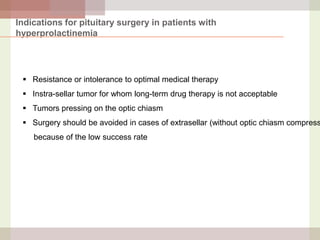
Indications for pituitary surgery in patients with
hyperprolactinemia

 Resistance or intolerance to optimal medical therapy
 Instra-sellar tumor for whom long-term drug therapy is not acceptable
 Tumors pressing on the optic chiasm

 Surgery should be avoided in cases of extrasellar (without optic chiasm compress

because of the low success rate
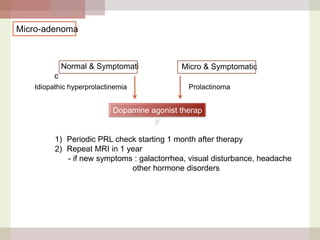
Micro-adenoma

Normal & Symptomati

Micro & Symptomatic

c
Idiopathic hyperprolactinemia

Prolactinoma

Dopamine agonist therap
y
1) Periodic PRL check starting 1 month after therapy
2) Repeat MRI in 1 year
- if new symptoms : galactorrhea, visual disturbance, headache
other hormone disorders
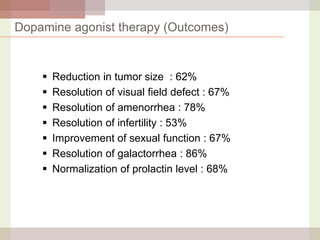
Dopamine agonist therapy (Outcomes)









Reduction in tumor size : 62%
Resolution of visual field defect : 67%
Resolution of amenorrhea : 78%
Resolution of infertility : 53%
Improvement of sexual function : 67%
Resolution of galactorrhea : 86%
Normalization of prolactin level : 68%
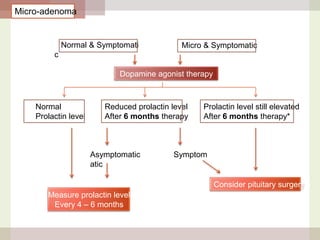
Micro-adenoma

Normal & Symptomati

Micro & Symptomatic

c
Dopamine agonist therapy

Normal
Prolactin level

Reduced prolactin level
After 6 months therapy

Asymptomatic
atic

Prolactin level still elevated
After 6 months therapy*

Symptom

Consider pituitary surgery
Measure prolactin level
Every 4 – 6 months
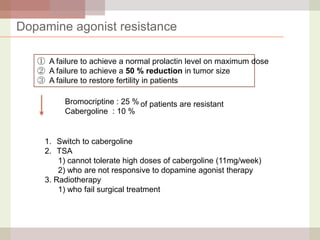
Dopamine agonist resistance
① A failure to achieve a normal prolactin level on maximum dose
② A failure to achieve a 50 % reduction in tumor size
③ A failure to restore fertility in patients
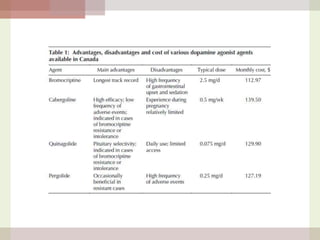
Bromocriptine : 25 % of patients are resistant
Cabergoline : 10 %

1. Switch to cabergoline
2. TSA
1) cannot tolerate high doses of cabergoline (11mg/week)
2) who are not responsive to dopamine agonist therapy
3. Radiotherapy
1) who fail surgical treatment
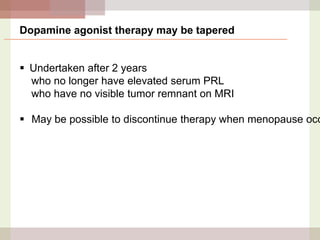
Dopamine agonist therapy may be tapered
 Undertaken after 2 years
who no longer have elevated serum PRL
who have no visible tumor remnant on MRI

 May be possible to discontinue therapy when menopause occ
Hyperprolactinemia work up

Hyperprolactinemia work up

  • 1.
  • 2.
    Regulation of prolactinsecretion Stimulatory signal Predominant inhibitory signa Renal clearance
  • 3.
  • 5.
  • 6.
  • 7.
    Incidence of hyperprolactinemia(1)  Unselected healthy adult : 0.4 % - 5.0 %  Among women with Amenorrhea : 9%  Among women with galactorrhea : 25%  Among women with amenorrhea and galactorrhea : 70%  Among men with impotence or infertility : 5%
  • 8.
    Clinical presentation ofhyperprolactinemia (1) Premenopausal women 31 < PRL < 50 g/L  Short luteal phase  Decreased libido  Infertility 51 < PRL < 75 g/L  Oligomenorrhea 100 g/L < PRL  Hypogonadism  Galactorrhea  Amenorrhea  Increased body weight – associated with prolactin-secreting tumor  Osteopenia – patients with associated hypogonadism  Degree of bone loss – related to duration and severity of hypogonadism
  • 9.
    Clinical presentation ofhyperprolactinemia (2) Men          Decreased libido Impotence – unresponsive to testosterone treatment Decreased sperm production Infertility Gynecomastia Rarely galactorrhea Decreased muscle mass Body hair Osteoporosis
  • 10.
    Female  Galactorrhea  Amenorrhea Oligomenorrhea  Infertility  History of fracture Male  Low libido  Impotence  Infertility  Gynecomastia  Galactorrhea  History of fracture or osteoporosis We should check serum Prolactin level.
  • 11.
    Nipple discharge Rule outbreast pathology (by history, physical examination, mammography) Galactorrhea
  • 12.
    Step 1. Galactorrhea Evaluation forbreast tumor     Unilateral Single duct Bloody or Serosanguineous Associated with breast mass
  • 13.
    Galactorrhea  Bilateral Check prolactin Multiductal  Milky (can be yellow, green or brown) Milk production is in doubt Sudan IV staining for Fat droplet
  • 14.
    Step 2. Galactorrhea Elevated prolactin Checkphysiologic or secondary cause 1. 2. 3. 4. 5. Pregnancy history Medication Recent breast / nipple manipulation Kidney / Liver disease Check - Thyroid function test - BUN/Creatinine - hCG
  • 15.
    Objectives of treatmentof hyperprolactinemia  Restoration and maintenance of normal gonadal function  Restoration of normal fertility  Prevention of osteoporosis
  • 16.
    Drug induced hyperprolactinemia 1.Discontinuation of the medication for 3 days or substitution of an alternative drug followed by recheck of serum prolactin 2. PRL Level : 25 to 100 μg/L - Metoclopramide, risperidone, phenothizines > 200 μg/L - associated with variants of the D2 receptor gene 3. If the drug cannot be discontinued and the onset of the hyperprolactinem does not coincide with therapy initiation  Check Sellar MRI 4. Start Estrogen or testosterone therapy - If the drug cannot be discontinued and the patients have hypogondal symptoms
  • 17.
    Step 3. Galactorrhea Elevated prolactin 1.Exclude physiologic or secondary causes 2. If, negative clinical symptoms : evaluate macroprolactinemia Sellar MRI To evaluate pituitary lesion Prolactinoma Hypothalamic stalk interruption
  • 18.
    Macroprolactinemia Type of PRL Size Monomeric-PRL 23 kDa Big-PRL 50 – 60 kDa Big-Big PRL 150 kDa (Macro-PRL) Distribution 85- 95% 10% 5%  Definition of macroprolactinemia : elevated Big-Big PRL, over 60%  Mechanism of Elevated prolactin ① Difficult to remove due to big size via kidney ② Difficult to absorption or break down in target tissue ③ Difficult to control H-P axis feedback  Asymptomatic
  • 19.
    Step 3. Elevated prolactin Galactorrhea Normal & Asymptomatic Follow-up Measurementof Prolactin Once yearly Normal & Symptomatic Sellar MRI Microadenoma & Symptomatic Dopamine agonist therapy Macroadenoma Measure other pituitary hormones to exclude associated deficiency or excess
  • 20.
    Objectives of treatmentof hyperprolactinemia  Restoration and maintenance of normal gonadal function  Restoration of normal fertility  Prevention of osteoporosis If a pituitary tumor is present:  Correction of visual or neurological abnormalities  Reduction or removal of tumor mass  Preservation of normal pituitary function  Prevention of progression of pituitary or hypothalamic disease
  • 21.
    Macro-adenoma Measure other pituitaryhormones to exclude associated deficiency or excess “Hook effect” Isolated Prolactin excess Dopamine agonist therapy Stalk effect (Prolactin level not high enough for size of tumor) Pituitary surgery recommended Normal Reduced No effect on prolactin level Prolactin level Prolactin level After 6 months therapy After 6 months therapy Asymptomatic Measure prolactin level Every 4 – 6 months; MRI every 1 – 2 yrs Symptomatic despite prolactin reduction Pituitary surgery
  • 22.
    Hook phenomenon  Mildlyelevated prolactin level  A Very large pituitary tumor To distinguish 1. Large prolactinoma 2. NFPA Dilution of sample and recheck prolactin
  • 23.
    Indications for pituitarysurgery in patients with hyperprolactinemia  Resistance or intolerance to optimal medical therapy  Instra-sellar tumor for whom long-term drug therapy is not acceptable  Tumors pressing on the optic chiasm  Surgery should be avoided in cases of extrasellar (without optic chiasm compress because of the low success rate
  • 24.
    Micro-adenoma Normal & Symptomati Micro& Symptomatic c Idiopathic hyperprolactinemia Prolactinoma Dopamine agonist therap y 1) Periodic PRL check starting 1 month after therapy 2) Repeat MRI in 1 year - if new symptoms : galactorrhea, visual disturbance, headache other hormone disorders
  • 26.
    Dopamine agonist therapy(Outcomes)        Reduction in tumor size : 62% Resolution of visual field defect : 67% Resolution of amenorrhea : 78% Resolution of infertility : 53% Improvement of sexual function : 67% Resolution of galactorrhea : 86% Normalization of prolactin level : 68%
  • 27.
    Micro-adenoma Normal & Symptomati Micro& Symptomatic c Dopamine agonist therapy Normal Prolactin level Reduced prolactin level After 6 months therapy Asymptomatic atic Prolactin level still elevated After 6 months therapy* Symptom Consider pituitary surgery Measure prolactin level Every 4 – 6 months
  • 28.
    Dopamine agonist resistance ①A failure to achieve a normal prolactin level on maximum dose ② A failure to achieve a 50 % reduction in tumor size ③ A failure to restore fertility in patients Bromocriptine : 25 % of patients are resistant Cabergoline : 10 % 1. Switch to cabergoline 2. TSA 1) cannot tolerate high doses of cabergoline (11mg/week) 2) who are not responsive to dopamine agonist therapy 3. Radiotherapy 1) who fail surgical treatment
  • 29.
    Dopamine agonist therapymay be tapered  Undertaken after 2 years who no longer have elevated serum PRL who have no visible tumor remnant on MRI  May be possible to discontinue therapy when menopause occ