WELCOME
 C.C.E
THIS IS ME
IDOARRT
Intention To practice and learn
Desired Outcome gain knowledge within the
field of communication, coaching, evaluation
Agenda ....
Roles Facilitator & active process participants
Rules Be attentive & help to create a positive
learning space
Time 10.30 a.m - 5 p.m
AGENDA
Evaluation         Coaching       Communication
2-5 p.m            1.15 - 2 p.m   10.30- 12.15
                                  p.m
Evaluate groups    What is it
                                  What
Evaluation         How to apply
design                            Rhetorical
                   Practical
Work around it     exercises      Bring something
                                  with you
COMMUNICATION
    Become aware and practice


               What
             Rhetorical
     Bring something with you
EXPECTATIONS
   What is going to happen today
EXPECTATIONS
        What is going to happen today


COMMUNICATION
EXPECTATIONS
        What is going to happen today


COMMUNICATION

COACHING
EXPECTATIONS
        What is going to happen today


COMMUNICATION

COACHING

EVALUATION
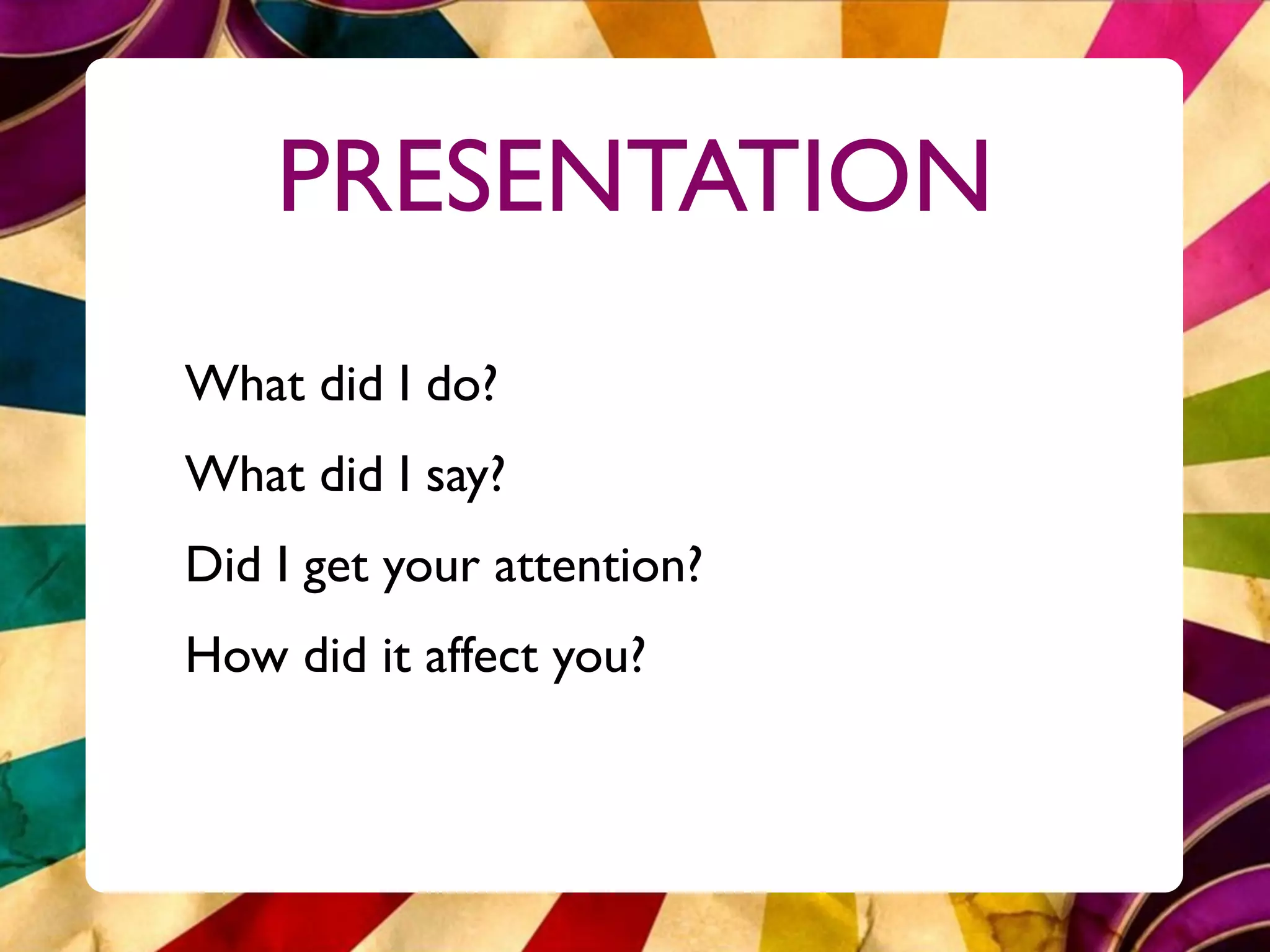
PRESENTATION
What did I do?
What did I say?
Did I get your attention?
How did it affect you?
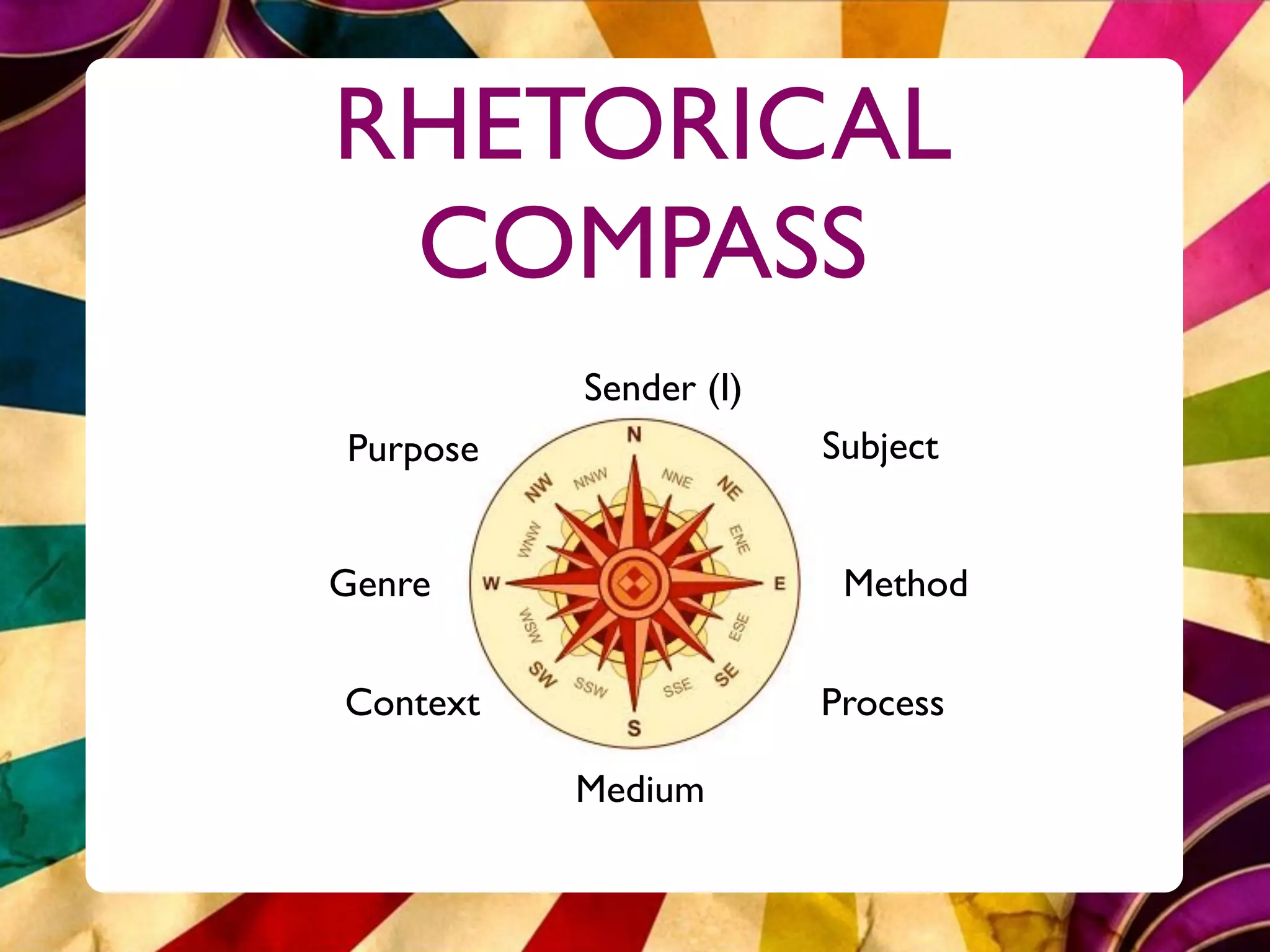
RHETORICAL
 COMPASS
          Sender (I)
Purpose                Subject


Genre                   Method


Context                Process

          Medium
PURPOSE, SUBJECT, MEDIUM,
    GENRE & PROCESS
 PURPOSE : my & yours


 GENRE: Roles and target group


 SUBJECT: clear or unstructured, read line


 PROCESS: disposition, beginning, end


 MEDIUM: which one do you use, how does the medium affect
EXERCISE
EXERCISE

Write down a short introduction about yourself


Think about the purpose, the subject, genre and process.


Choose your audience. Not more than an A4.

20 minutes.
EXERCISE
EXERCISE

Present it to the other. 5 minutes each


Give each other feedback!

Name one thing about the presentation that was really good and one that could
be better?
SENDER, METHOD &
            CONTEXT
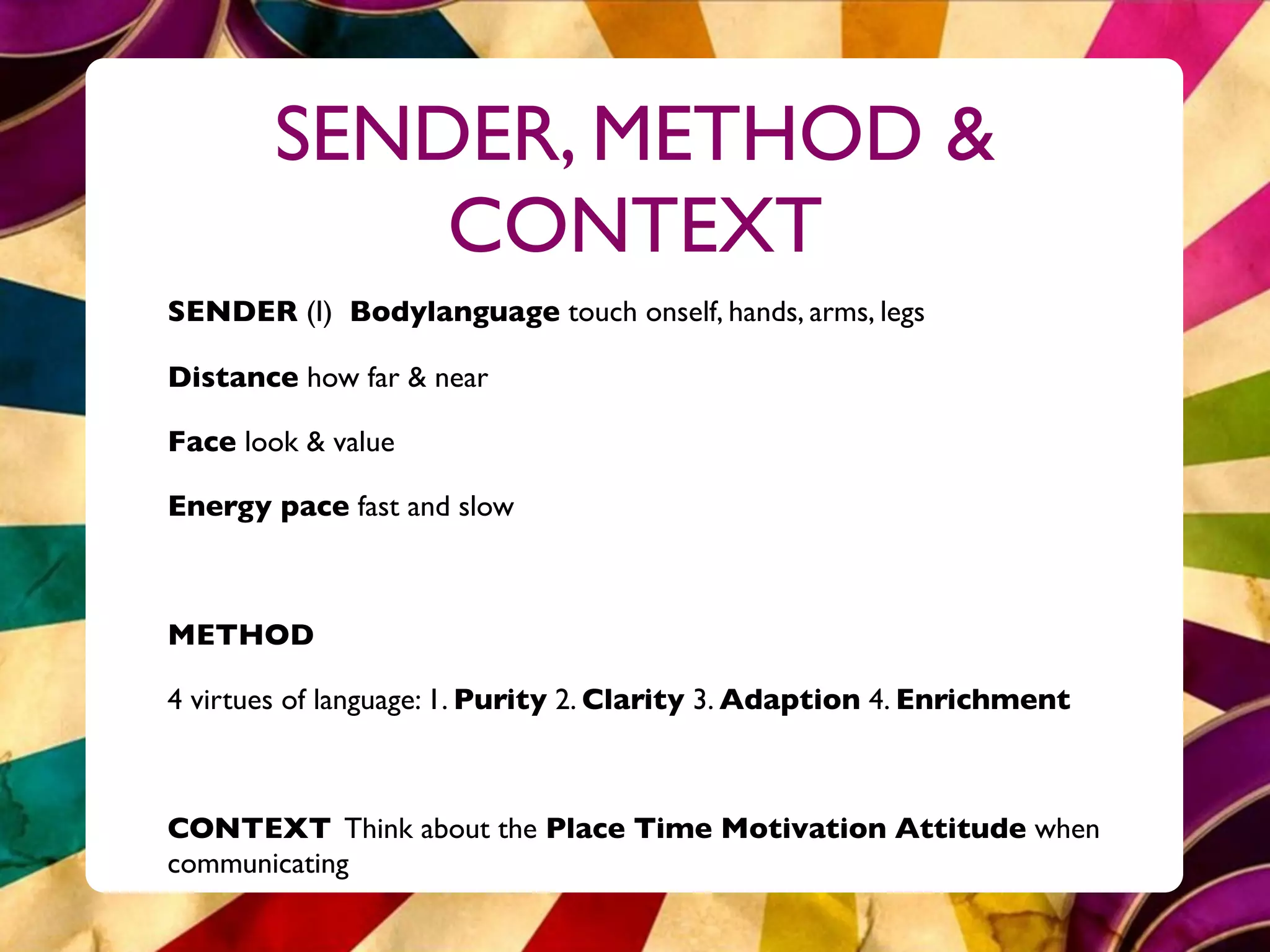
SENDER (I) Bodylanguage touch onself, hands, arms, legs

Distance how far & near

Face look & value

Energy pace fast and slow


METHOD

4 virtues of language: 1. Purity 2. Clarity 3. Adaption 4. Enrichment


CONTEXT Think about the Place Time Motivation Attitude when
communicating
EXERCISE
EXERCISE

Go through your text again, consider the feedback you got! Consider the
Sender, Method and context,

Repeat it to yourself.


15 min
EXERCISE
EXERCISE
Find someone new. Present it! Give feedback - Try again.


Consider: Sender, Method and context, purpose, subject, genre
and process.


Feedback: what caught your attention, what was less interesting, why was it
less interesting (your interest, the voice etc)


10 minutes for each person
COACHING
Learn some foundations about coaching and get some tools.


                         What is it
                       How to apply
                    Practical exercises
COACHING
Coaching is done to make it easier for someone else performance, learning & development.
COACHING
Coaching is done to make it easier for someone else performance, learning & development.


     Combination of psychology, organizational psychology, sports
                psychology, development of one self
COACHING
Coaching is done to make it easier for someone else performance, learning & development.


     Combination of psychology, organizational psychology, sports
                psychology, development of one self


Now & the future                           Unrevealed potential

Self realization                           Definition of goal

Find out how (not why)                      Listening

Focus on opportunities now & in the future
COACHING
                                 4 skills and tools


Active Listening: on different levels, conclude, break in


Intuition: stillness, dance in the moment, visualization


Curiosity: reflection, impactful questions


Focus on Action & Learning: keep agenda, conclude
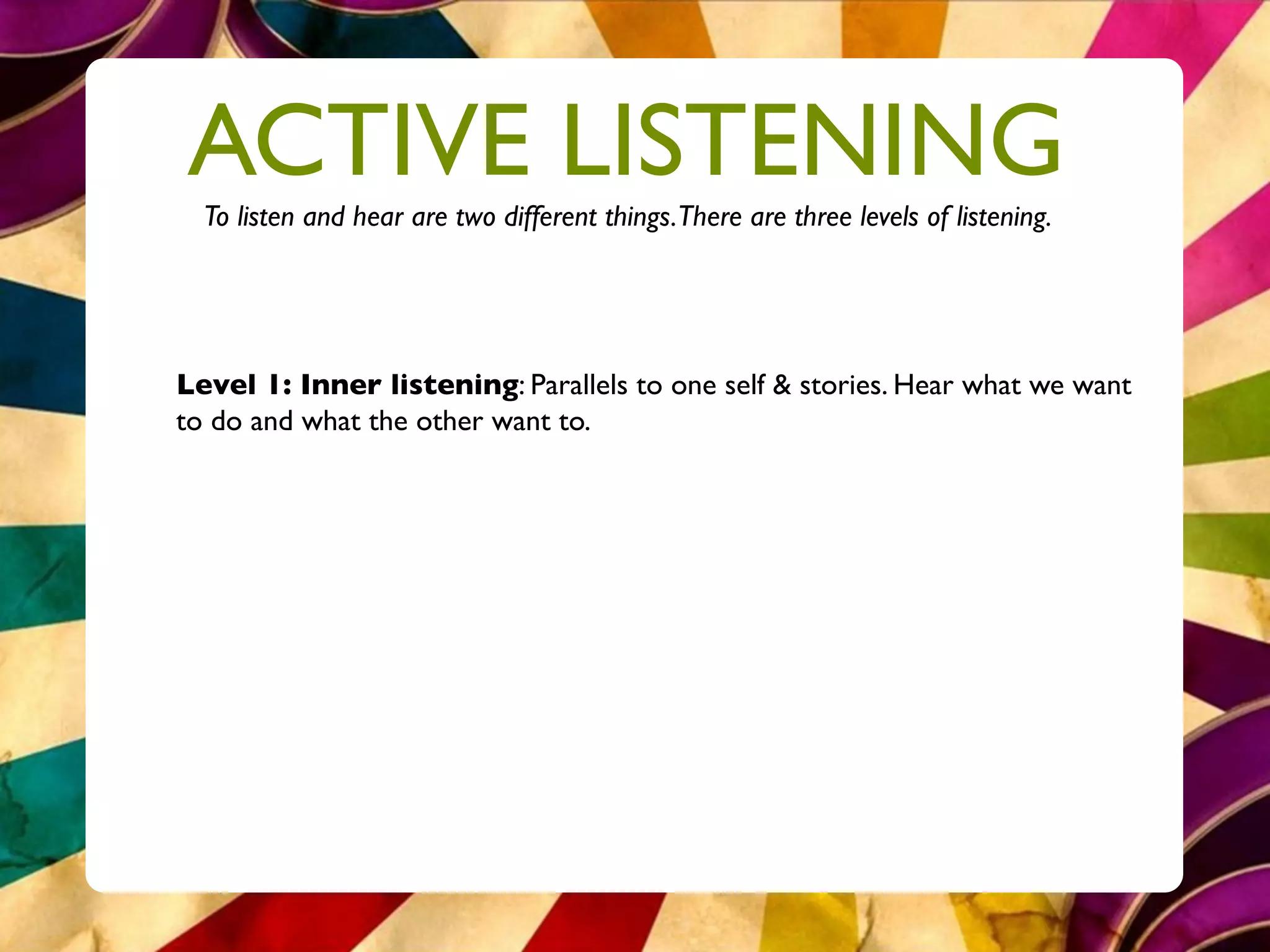
ACTIVE LISTENING
To listen and hear are two different things.There are three levels of listening.
ACTIVE LISTENING
  To listen and hear are two different things.There are three levels of listening.


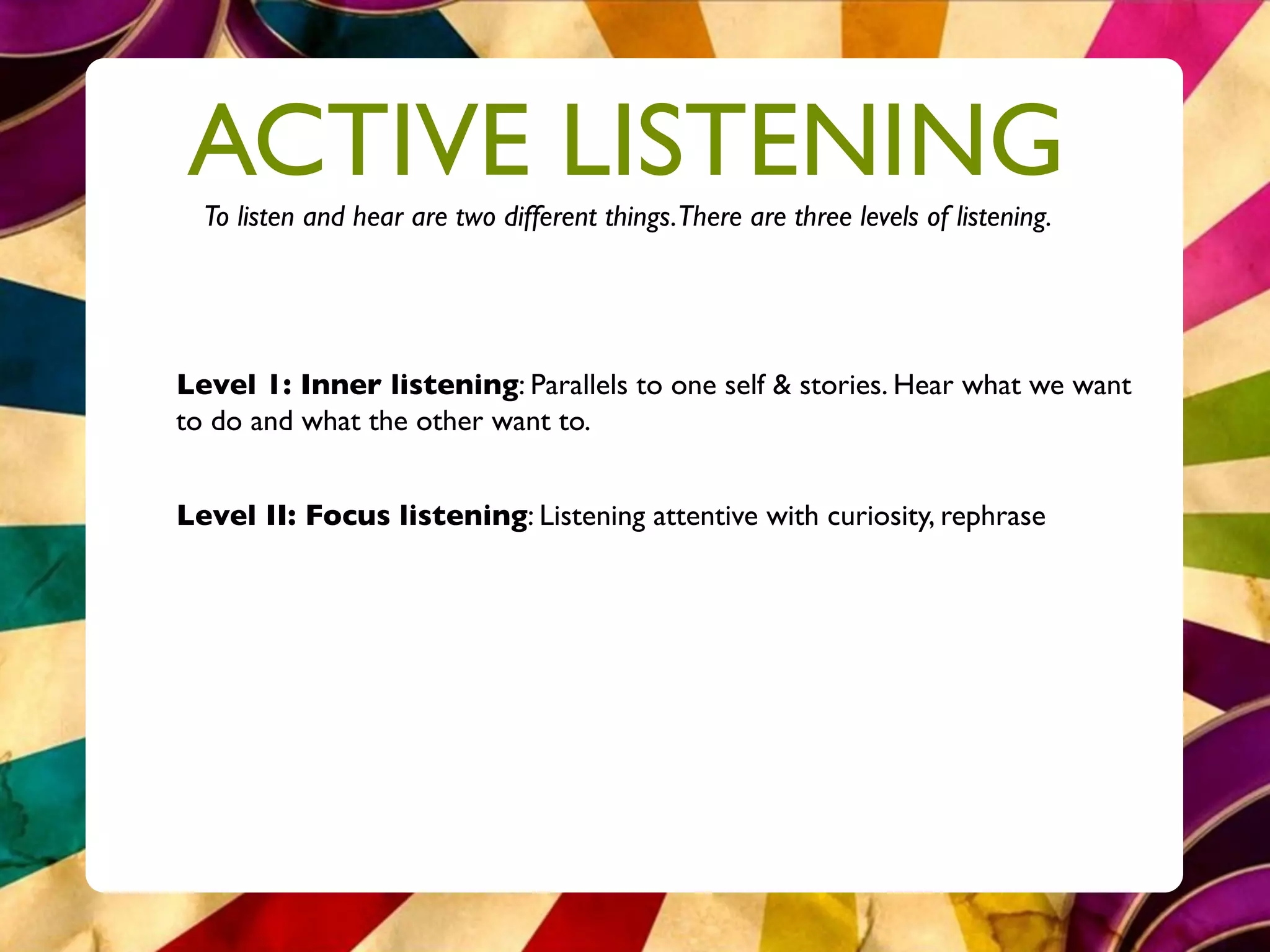
Level 1: Inner listening: Parallels to one self & stories. Hear what we want
to do and what the other want to.
ACTIVE LISTENING
  To listen and hear are two different things.There are three levels of listening.


Level 1: Inner listening: Parallels to one self & stories. Hear what we want
to do and what the other want to.


Level II: Focus listening: Listening attentive with curiosity, rephrase
ACTIVE LISTENING
  To listen and hear are two different things.There are three levels of listening.


Level 1: Inner listening: Parallels to one self & stories. Hear what we want
to do and what the other want to.


Level II: Focus listening: Listening attentive with curiosity, rephrase


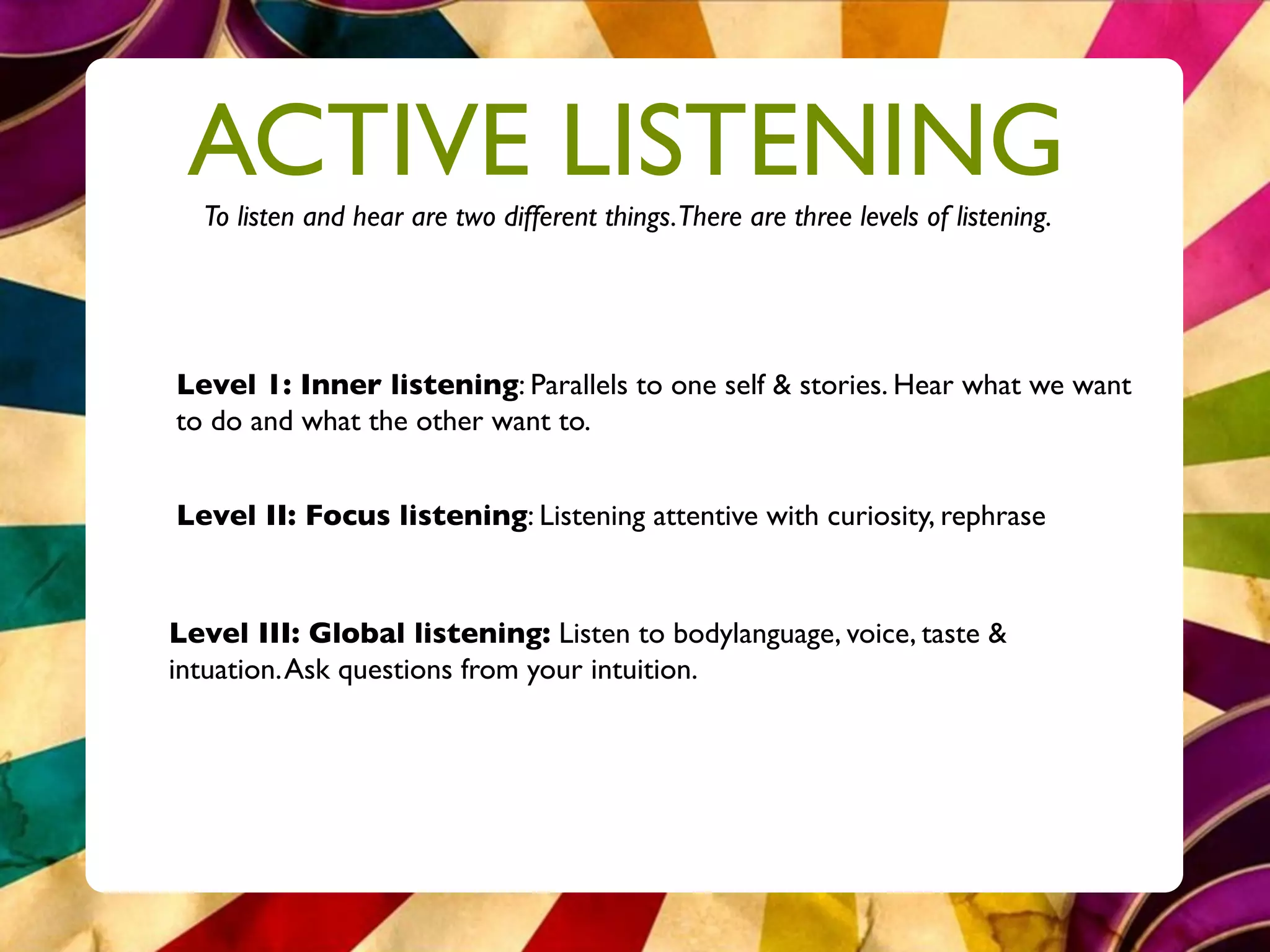
Level III: Global listening: Listen to bodylanguage, voice, taste &
intuation. Ask questions from your intuition.
EVALUATION
   Why, how and what


     Evaluate groups
    Evaluation design
      Work around it
EVALUATION
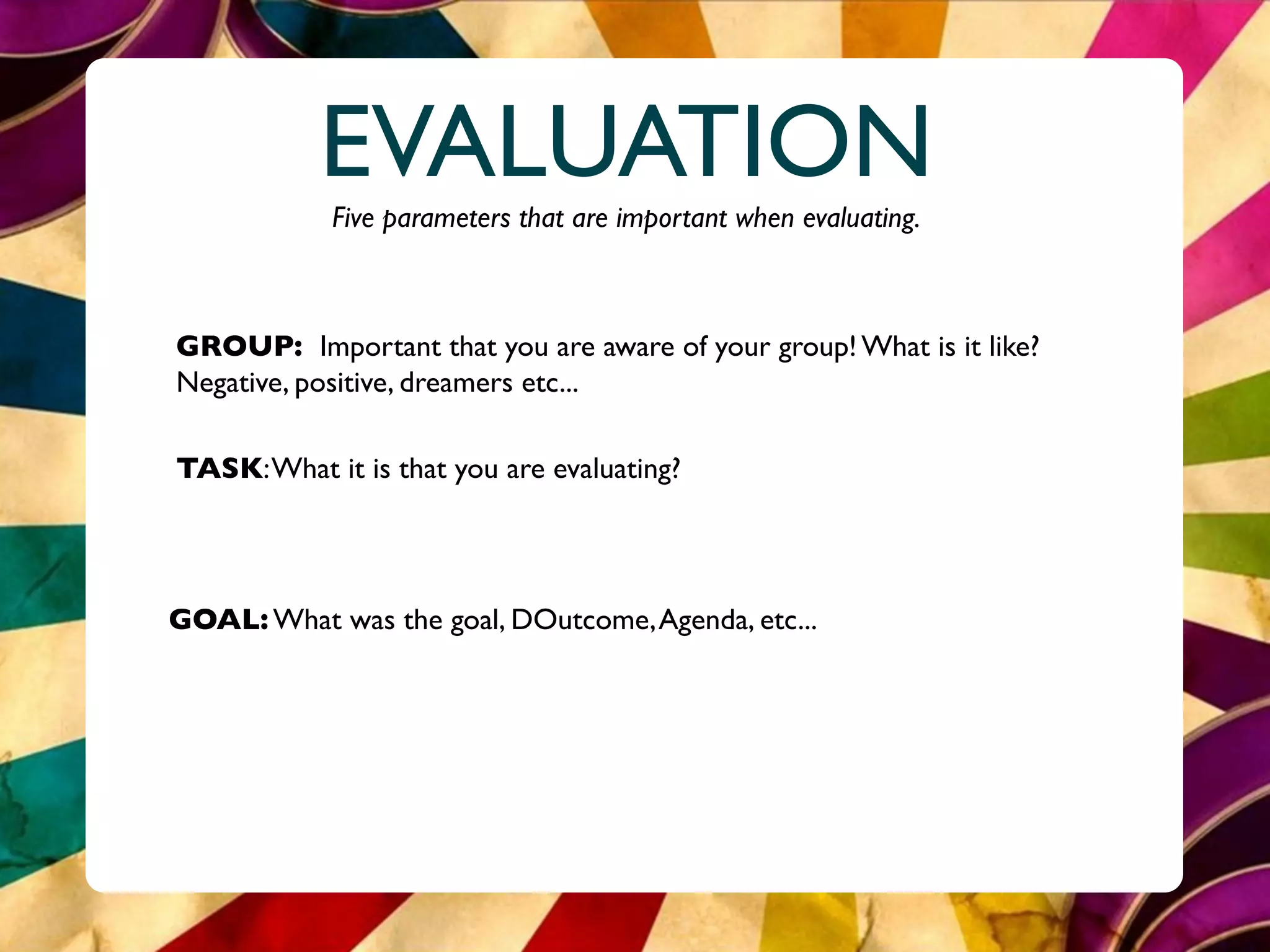
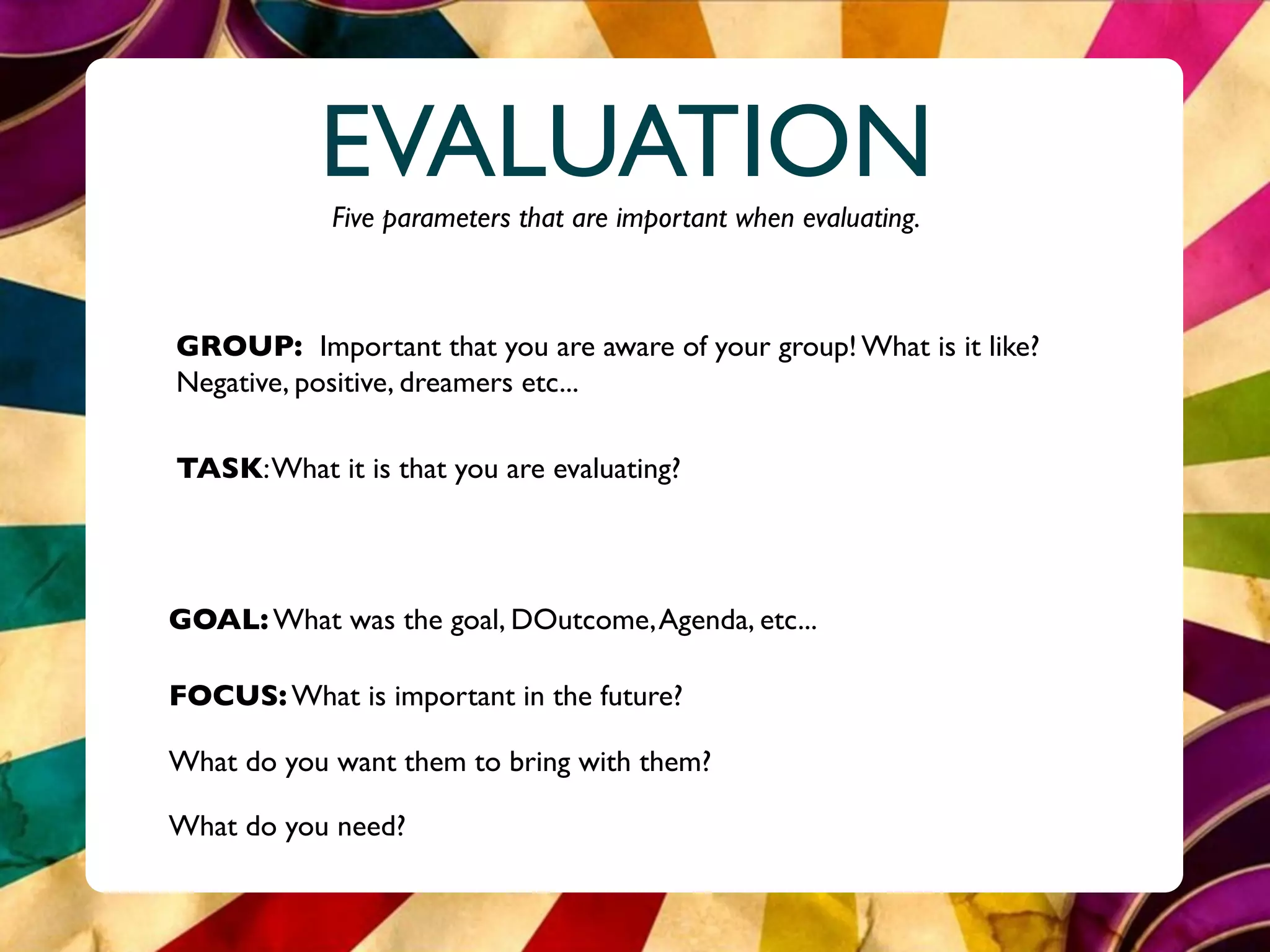
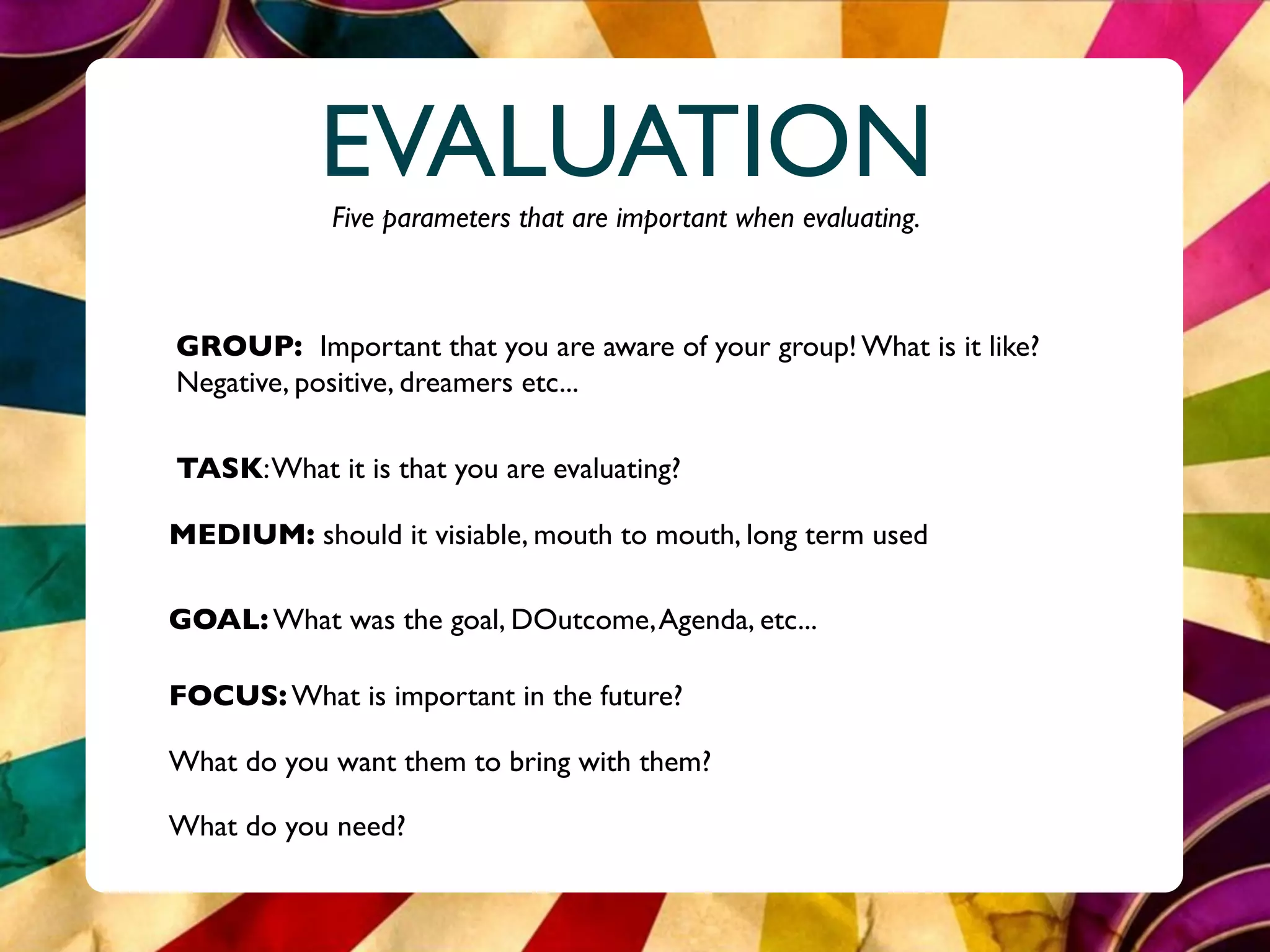
Five parameters that are important when evaluating.
EVALUATION
            Five parameters that are important when evaluating.


GROUP: Important that you are aware of your group! What is it like?
Negative, positive, dreamers etc...
EVALUATION
            Five parameters that are important when evaluating.


GROUP: Important that you are aware of your group! What is it like?
Negative, positive, dreamers etc...

TASK: What it is that you are evaluating?
EVALUATION
            Five parameters that are important when evaluating.


GROUP: Important that you are aware of your group! What is it like?
Negative, positive, dreamers etc...

TASK: What it is that you are evaluating?


GOAL: What was the goal, DOutcome, Agenda, etc...
EVALUATION
            Five parameters that are important when evaluating.


GROUP: Important that you are aware of your group! What is it like?
Negative, positive, dreamers etc...

TASK: What it is that you are evaluating?


GOAL: What was the goal, DOutcome, Agenda, etc...

FOCUS: What is important in the future?

What do you want them to bring with them?

What do you need?
EVALUATION
            Five parameters that are important when evaluating.


GROUP: Important that you are aware of your group! What is it like?
Negative, positive, dreamers etc...

TASK: What it is that you are evaluating?

MEDIUM: should it visiable, mouth to mouth, long term used

GOAL: What was the goal, DOutcome, Agenda, etc...

FOCUS: What is important in the future?

What do you want them to bring with them?

What do you need?
EXERCISE
To learn by doing, by evaluating and trying
EXERCISE
                   To learn by doing, by evaluating and trying

If you where to evaluate today. What would it be like?


Divide into 3 groups. Make an evaluation that would take 15 minutes.You have
20 minutes to prepare.

Each group focus on

1. coaching

2. communication

3. Overall

4. Evaluation
EVALUATION
                   EXAMPLES
                         To learn by doing, by evaluating and trying

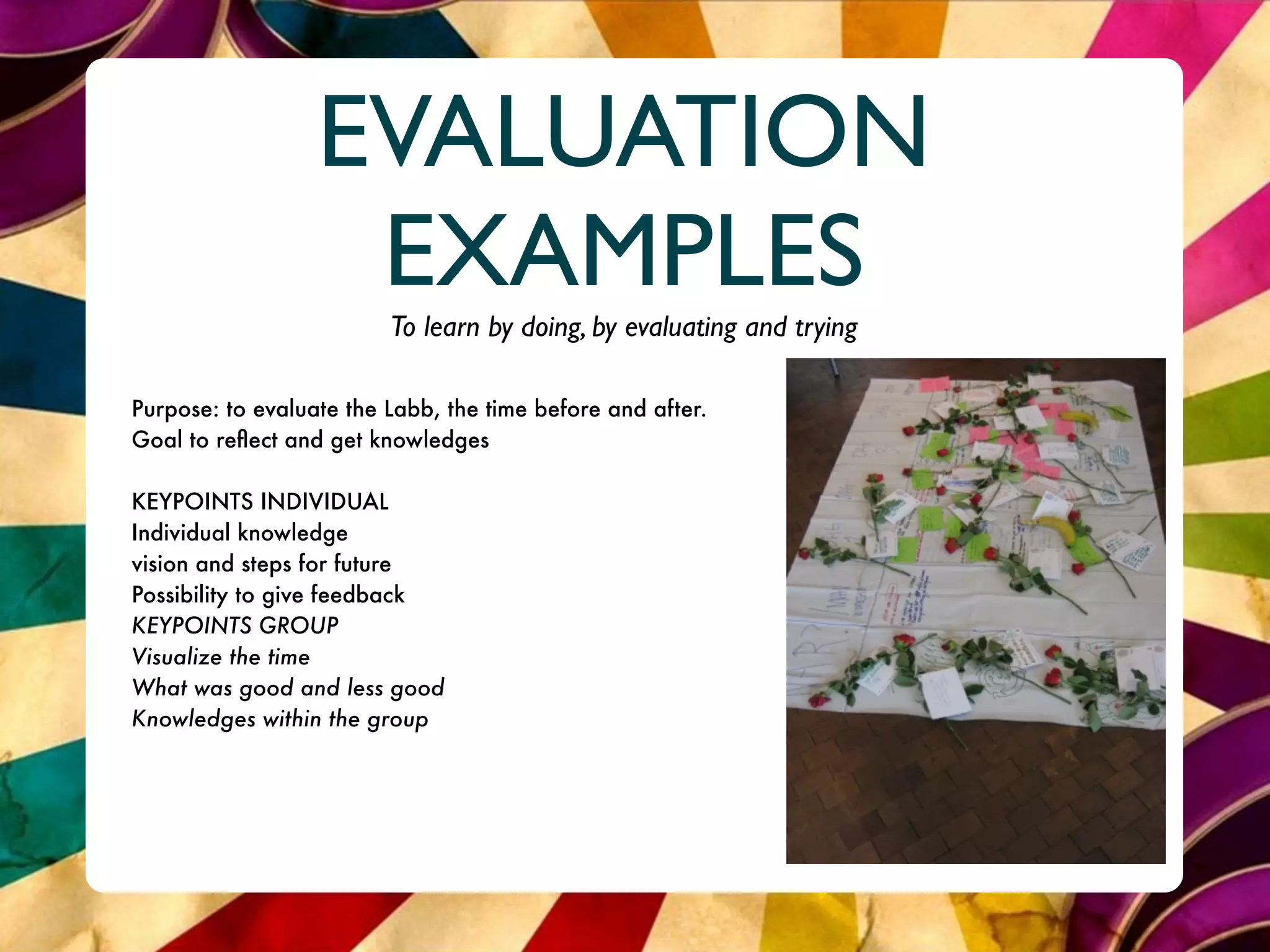
Purpose: to evaluate the Labb, the time before and after.
Goal to reflect and get knowledges

KEYPOINTS INDIVIDUAL
Individual knowledge
vision and steps for future
Possibility to give feedback
KEYPOINTS GROUP
Visualize the time
What was good and less good
Knowledges within the group
EVALUATION
                EXAMPLES
                     To learn by doing, by evaluating and trying

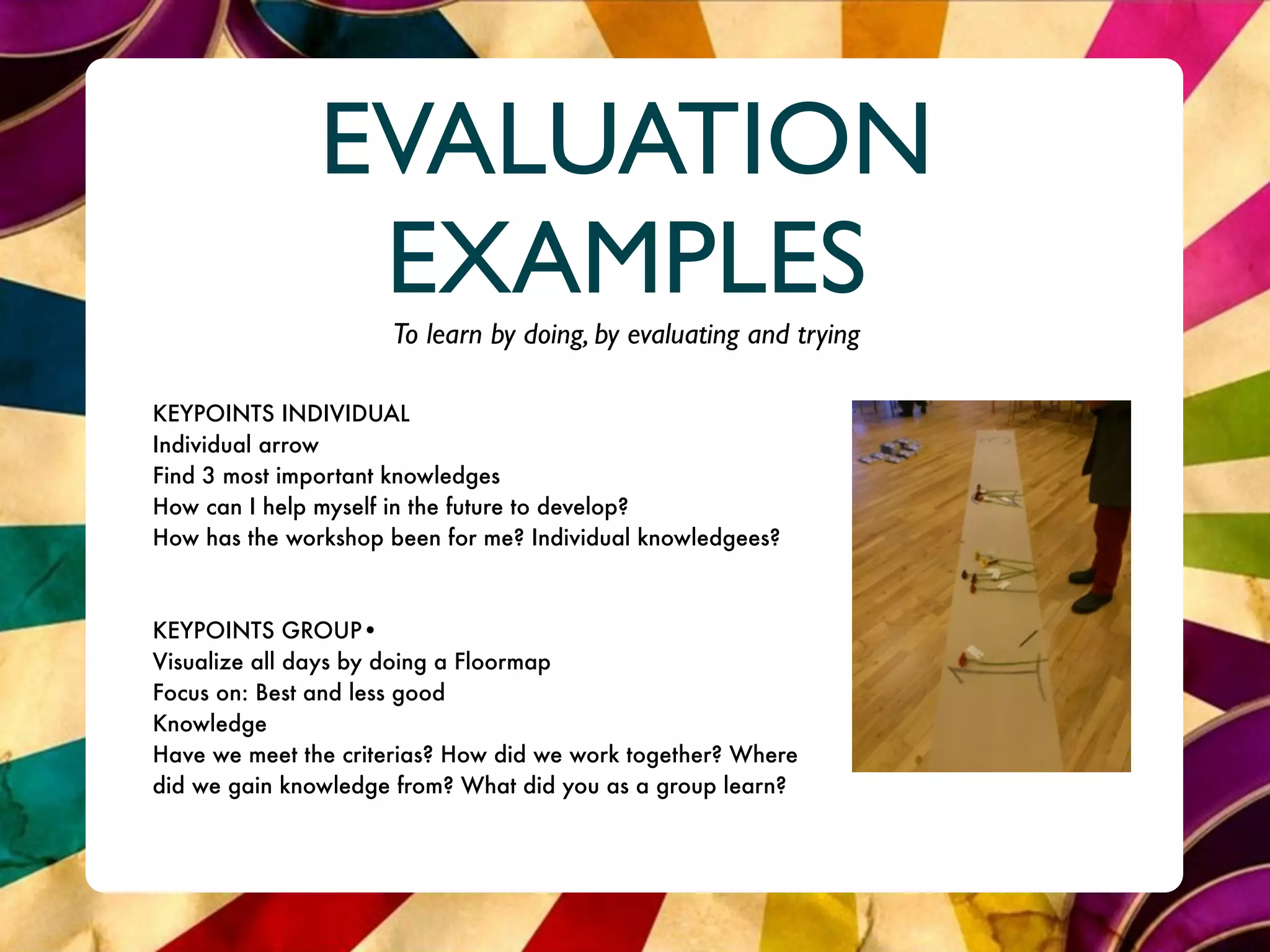
KEYPOINTS INDIVIDUAL
Individual arrow
Find 3 most important knowledges
How can I help myself in the future to develop?
How has the workshop been for me? Individual knowledgees?


KEYPOINTS GROUP•
Visualize all days by doing a Floormap
Focus on: Best and less good
Knowledge
Have we meet the criterias? How did we work together? Where
did we gain knowledge from? What did you as a group learn?
GOAL
To learn by doing, by evaluating and trying
GOAL
        To learn by doing, by evaluating and trying


                    Communication
               Become aware and practice

                        Coaching
Learn some foundations about coaching and get some tools.

                      Evaluation
                   Why, how and what
CHECK OUT
 Nice way for rounding off together and to
  make everyone share their experience.

Hyper

  • 1.
  • 2.
  • 3.
    IDOARRT Intention To practiceand learn Desired Outcome gain knowledge within the field of communication, coaching, evaluation Agenda .... Roles Facilitator & active process participants Rules Be attentive & help to create a positive learning space Time 10.30 a.m - 5 p.m
  • 4.
    AGENDA Evaluation Coaching Communication 2-5 p.m 1.15 - 2 p.m 10.30- 12.15 p.m Evaluate groups What is it What Evaluation How to apply design Rhetorical Practical Work around it exercises Bring something with you
  • 5.
    COMMUNICATION Become aware and practice What Rhetorical Bring something with you
  • 6.
    EXPECTATIONS What is going to happen today
  • 7.
    EXPECTATIONS What is going to happen today COMMUNICATION
  • 8.
    EXPECTATIONS What is going to happen today COMMUNICATION COACHING
  • 9.
    EXPECTATIONS What is going to happen today COMMUNICATION COACHING EVALUATION
  • 10.
    PRESENTATION What did Ido? What did I say? Did I get your attention? How did it affect you?
  • 11.
    RHETORICAL COMPASS Sender (I) Purpose Subject Genre Method Context Process Medium
  • 12.
    PURPOSE, SUBJECT, MEDIUM, GENRE & PROCESS PURPOSE : my & yours GENRE: Roles and target group SUBJECT: clear or unstructured, read line PROCESS: disposition, beginning, end MEDIUM: which one do you use, how does the medium affect
  • 13.
  • 14.
    EXERCISE Write down ashort introduction about yourself Think about the purpose, the subject, genre and process. Choose your audience. Not more than an A4. 20 minutes.
  • 15.
  • 16.
    EXERCISE Present it tothe other. 5 minutes each Give each other feedback! Name one thing about the presentation that was really good and one that could be better?
  • 17.
    SENDER, METHOD & CONTEXT SENDER (I) Bodylanguage touch onself, hands, arms, legs Distance how far & near Face look & value Energy pace fast and slow METHOD 4 virtues of language: 1. Purity 2. Clarity 3. Adaption 4. Enrichment CONTEXT Think about the Place Time Motivation Attitude when communicating
  • 18.
  • 19.
    EXERCISE Go through yourtext again, consider the feedback you got! Consider the Sender, Method and context, Repeat it to yourself. 15 min
  • 20.
  • 21.
    EXERCISE Find someone new.Present it! Give feedback - Try again. Consider: Sender, Method and context, purpose, subject, genre and process. Feedback: what caught your attention, what was less interesting, why was it less interesting (your interest, the voice etc) 10 minutes for each person
  • 22.
    COACHING Learn some foundationsabout coaching and get some tools. What is it How to apply Practical exercises
  • 24.
    COACHING Coaching is doneto make it easier for someone else performance, learning & development.
  • 25.
    COACHING Coaching is doneto make it easier for someone else performance, learning & development. Combination of psychology, organizational psychology, sports psychology, development of one self
  • 26.
    COACHING Coaching is doneto make it easier for someone else performance, learning & development. Combination of psychology, organizational psychology, sports psychology, development of one self Now & the future Unrevealed potential Self realization Definition of goal Find out how (not why) Listening Focus on opportunities now & in the future
  • 27.
    COACHING 4 skills and tools Active Listening: on different levels, conclude, break in Intuition: stillness, dance in the moment, visualization Curiosity: reflection, impactful questions Focus on Action & Learning: keep agenda, conclude
  • 28.
    ACTIVE LISTENING To listenand hear are two different things.There are three levels of listening.
  • 29.
    ACTIVE LISTENING To listen and hear are two different things.There are three levels of listening. Level 1: Inner listening: Parallels to one self & stories. Hear what we want to do and what the other want to.
  • 30.
    ACTIVE LISTENING To listen and hear are two different things.There are three levels of listening. Level 1: Inner listening: Parallels to one self & stories. Hear what we want to do and what the other want to. Level II: Focus listening: Listening attentive with curiosity, rephrase
  • 31.
    ACTIVE LISTENING To listen and hear are two different things.There are three levels of listening. Level 1: Inner listening: Parallels to one self & stories. Hear what we want to do and what the other want to. Level II: Focus listening: Listening attentive with curiosity, rephrase Level III: Global listening: Listen to bodylanguage, voice, taste & intuation. Ask questions from your intuition.
  • 32.
    EVALUATION Why, how and what Evaluate groups Evaluation design Work around it
  • 33.
    EVALUATION Five parameters thatare important when evaluating.
  • 34.
    EVALUATION Five parameters that are important when evaluating. GROUP: Important that you are aware of your group! What is it like? Negative, positive, dreamers etc...
  • 35.
    EVALUATION Five parameters that are important when evaluating. GROUP: Important that you are aware of your group! What is it like? Negative, positive, dreamers etc... TASK: What it is that you are evaluating?
  • 36.
    EVALUATION Five parameters that are important when evaluating. GROUP: Important that you are aware of your group! What is it like? Negative, positive, dreamers etc... TASK: What it is that you are evaluating? GOAL: What was the goal, DOutcome, Agenda, etc...
  • 37.
    EVALUATION Five parameters that are important when evaluating. GROUP: Important that you are aware of your group! What is it like? Negative, positive, dreamers etc... TASK: What it is that you are evaluating? GOAL: What was the goal, DOutcome, Agenda, etc... FOCUS: What is important in the future? What do you want them to bring with them? What do you need?
  • 38.
    EVALUATION Five parameters that are important when evaluating. GROUP: Important that you are aware of your group! What is it like? Negative, positive, dreamers etc... TASK: What it is that you are evaluating? MEDIUM: should it visiable, mouth to mouth, long term used GOAL: What was the goal, DOutcome, Agenda, etc... FOCUS: What is important in the future? What do you want them to bring with them? What do you need?
  • 39.
    EXERCISE To learn bydoing, by evaluating and trying
  • 40.
    EXERCISE To learn by doing, by evaluating and trying If you where to evaluate today. What would it be like? Divide into 3 groups. Make an evaluation that would take 15 minutes.You have 20 minutes to prepare. Each group focus on 1. coaching 2. communication 3. Overall 4. Evaluation
  • 41.
    EVALUATION EXAMPLES To learn by doing, by evaluating and trying Purpose: to evaluate the Labb, the time before and after. Goal to reflect and get knowledges KEYPOINTS INDIVIDUAL Individual knowledge vision and steps for future Possibility to give feedback KEYPOINTS GROUP Visualize the time What was good and less good Knowledges within the group
  • 42.
    EVALUATION EXAMPLES To learn by doing, by evaluating and trying KEYPOINTS INDIVIDUAL Individual arrow Find 3 most important knowledges How can I help myself in the future to develop? How has the workshop been for me? Individual knowledgees? KEYPOINTS GROUP• Visualize all days by doing a Floormap Focus on: Best and less good Knowledge Have we meet the criterias? How did we work together? Where did we gain knowledge from? What did you as a group learn?
  • 43.
    GOAL To learn bydoing, by evaluating and trying
  • 44.
    GOAL To learn by doing, by evaluating and trying Communication Become aware and practice Coaching Learn some foundations about coaching and get some tools. Evaluation Why, how and what
  • 45.
    CHECK OUT Niceway for rounding off together and to make everyone share their experience.

Editor's Notes

  • #2 \n
  • #3 10.30-10.35\n
  • #4 10.35-10.40\n
  • #5 10.35- 10.40\n
  • #6 10.40\n
  • #7 10.40-10.50\nA. 1 minute on each\nB. Do you have the same expectations on all? why, why not? (questions loud to everybody)\nC. What is the difference? (questions loud to everybody) if yes on B. take a minute to think about question C\n\n\n
  • #8 10.40-10.50\nA. 1 minute on each\nB. Do you have the same expectations on all? why, why not? (questions loud to everybody)\nC. What is the difference? (questions loud to everybody) if yes on B. take a minute to think about question C\n\n\n
  • #9 10.40-10.50\nA. 1 minute on each\nB. Do you have the same expectations on all? why, why not? (questions loud to everybody)\nC. What is the difference? (questions loud to everybody) if yes on B. take a minute to think about question C\n\n\n
  • #10 10.50- 11.\nTake 5 minutes to discuss this\n
  • #11 11.00\nA rhetocial compass is a way to navigate in your presentations on your way of being. Becoming aware of your affect & how you can / have the possibility to affect people around you. \n
  • #12 11.00-11.10\n
  • #13 11.10 - 11.40\n
  • #14 11.10 - 11.40\n
  • #15 \n
  • #16 11.40 - 11.55\n
  • #17 11.50-12.15\n
  • #18 Time 13.15 pm\nThere is another part of communication & that is the coaching approach very good at. Im get someone here on stage. \n\n
  • #19 10 min\n\n
  • #20 10 min\n\n
  • #21 10 min\n\n
  • #22 10 min\n\n
  • #23 Time 1.30 pm - 2.30 pm\nLevel 1: show with one other 5 MIN\nLevel II: let them try. 5 minutes to try on each other. Tell them about yourself. What is going on in your life right now. What is your goal. But first make sure to ask them what the goal of the converssation is. Repeat it. 15 MIN\n\n\nLevel III: explain and include. let them try again Now I want you to try on level 3. \n30 MIN\n\nCoach each other during 5 minutes.Change. 5 min then ask. what is happenng? what is it like? What are the challenges. \nChange partner. 10 min each. \n\n
  • #24 Time 1.30 pm - 2.30 pm\nLevel 1: show with one other 5 MIN\nLevel II: let them try. 5 minutes to try on each other. Tell them about yourself. What is going on in your life right now. What is your goal. But first make sure to ask them what the goal of the converssation is. Repeat it. 15 MIN\n\n\nLevel III: explain and include. let them try again Now I want you to try on level 3. \n30 MIN\n\nCoach each other during 5 minutes.Change. 5 min then ask. what is happenng? what is it like? What are the challenges. \nChange partner. 10 min each. \n\n
  • #25 Time 1.30 pm - 2.30 pm\nLevel 1: show with one other 5 MIN\nLevel II: let them try. 5 minutes to try on each other. Tell them about yourself. What is going on in your life right now. What is your goal. But first make sure to ask them what the goal of the converssation is. Repeat it. 15 MIN\n\n\nLevel III: explain and include. let them try again Now I want you to try on level 3. \n30 MIN\n\nCoach each other during 5 minutes.Change. 5 min then ask. what is happenng? what is it like? What are the challenges. \nChange partner. 10 min each. \n\n
  • #26 10 min\n\n
  • #27 When they get back the continue coaching\n\n
  • #28 10 min\n\n
  • #29 3.0 PM \n10 MIN\nTo evaluate I use a couple of different parameters. These I normally use to form the evaluation. Of course it is always hard to design the right for the right group, therefor it is good to decide what you prioritize? \nFolk schools negative \n
  • #30 3.0 PM \n10 MIN\nTo evaluate I use a couple of different parameters. These I normally use to form the evaluation. Of course it is always hard to design the right for the right group, therefor it is good to decide what you prioritize? \nFolk schools negative \n
  • #31 3.0 PM \n10 MIN\nTo evaluate I use a couple of different parameters. These I normally use to form the evaluation. Of course it is always hard to design the right for the right group, therefor it is good to decide what you prioritize? \nFolk schools negative \n
  • #32 3.0 PM \n10 MIN\nTo evaluate I use a couple of different parameters. These I normally use to form the evaluation. Of course it is always hard to design the right for the right group, therefor it is good to decide what you prioritize? \nFolk schools negative \n
  • #33 3.0 PM \n10 MIN\nTo evaluate I use a couple of different parameters. These I normally use to form the evaluation. Of course it is always hard to design the right for the right group, therefor it is good to decide what you prioritize? \nFolk schools negative \n
  • #34 Design the evaluation together. You have 20 minutes for this. Divide yourself into one or the other group. \nNow I want one representant from each group. Now I want you to do the evaluation w another group. \n\n\nWhat was it like? What was good? \nWhat was less good?\n\n\n
  • #35 \n
  • #36 \n
  • #37 Design the evaluation together. You have 20 minutes for this. Divide yourself into one or the other group. \nNow I want one representant from each group. Now I want you to do the evaluation w another group. \n\n\nWhat was it like? What was good? \nWhat was less good?\n\n\n
  • #38 Time: 20 min\nHow did the day meet your expectations? \n
  • #39 2.10 PM\n5 MIN. \nPAGE 15 IN BOOk\n\nAI5 What has been good so far today? , What would you like to evaluate more? The goal for communication & coaching where... have we done that?\n
  • #40 15.10\nTime: 10 min\nHow did the day meet your expectations? \n
  • #41 Time for exercise: 20 min\nSun 5 min, Circle, 3, Cloud, 3, grass, 3 arrow, 5. \nSyfte: För att sätt upp tydliga mål och ge individerna ett verktyg för att använda det de har lärt sig och ta med sig det framåt. Ge den tiden att tänka hur de ska nå målen. Detta är också ett tillfälle som visar på vart de är på väg i förhållande till vart de var innan.\n
  • #42 2.10 PM\n5 MIN. \nPAGE 15 IN BOOk\n\nAI5 What has been good so far today? , What would you like to evaluate more? The goal for communication & coaching where... have we done that?\n
  • #43 10 min\n
  • #44 \n