Creative &
Reflective
Writing
Prepared by Ronuel L del Rosario
The word creative is defined in various
ways. The following are just some of the
definitions:
“The ability to create”
“Imaginative”
“Productive and imaginative”
“Characterised by expressiveness and
originality”
What is
‘Creative Writing’?
Is creative writing different from other kinds of
writing?
All writing involves creativity since it is selective and is
written from the writer’s perspective.
Like informative writing, expositions (detailed
statements or explanations) or instructions, creative
writing does convey information, even when we define
it so broadly; indeed, information is the basic
component of all communication, no matter what kind.
What is
‘Creative Writing’?
The point is that almost any genre or
category of writing can be written to
engage the reader emotionally as well as
intellectually.
What makes a work more creative than
informative is its emphasis.
Informative writing is primarily about
imparting knowledge.
Creative writing is primarily about creating
emotional effect and significance.
What is
‘Creative Writing’?
Good creative writing uses the same kinds
of writing that make for good informative
writing, or good argument, or good
exposition.
It is the writer’s skill at using these forms
of writing that can turn any piece of
writing into creative piece of writing.
J Remember! J
For this term,
We are going to focus on. . .
Creatively Writing
a Reflective Paper
Reflection offers the opportunity to
consider how your personal experiences
and observations shape your thinking and
acceptance of new ideas.
Reflections encourage you to explore your
own ideas and express your opinion.
Reflective writing can help improve your
analytical skills because it requires you to
express what you think, and how and why
you think that way.
Why Write a
Reflective Paper?
Reflection is. . .
* a form of personal response to
experiences, situations, events or new
information.
* a 'processing' phase where thinking and
learning take place.
There is neither a right nor wrong way of
reflective thinking, there are just
questions to explore.
What is a
“Reflection”?
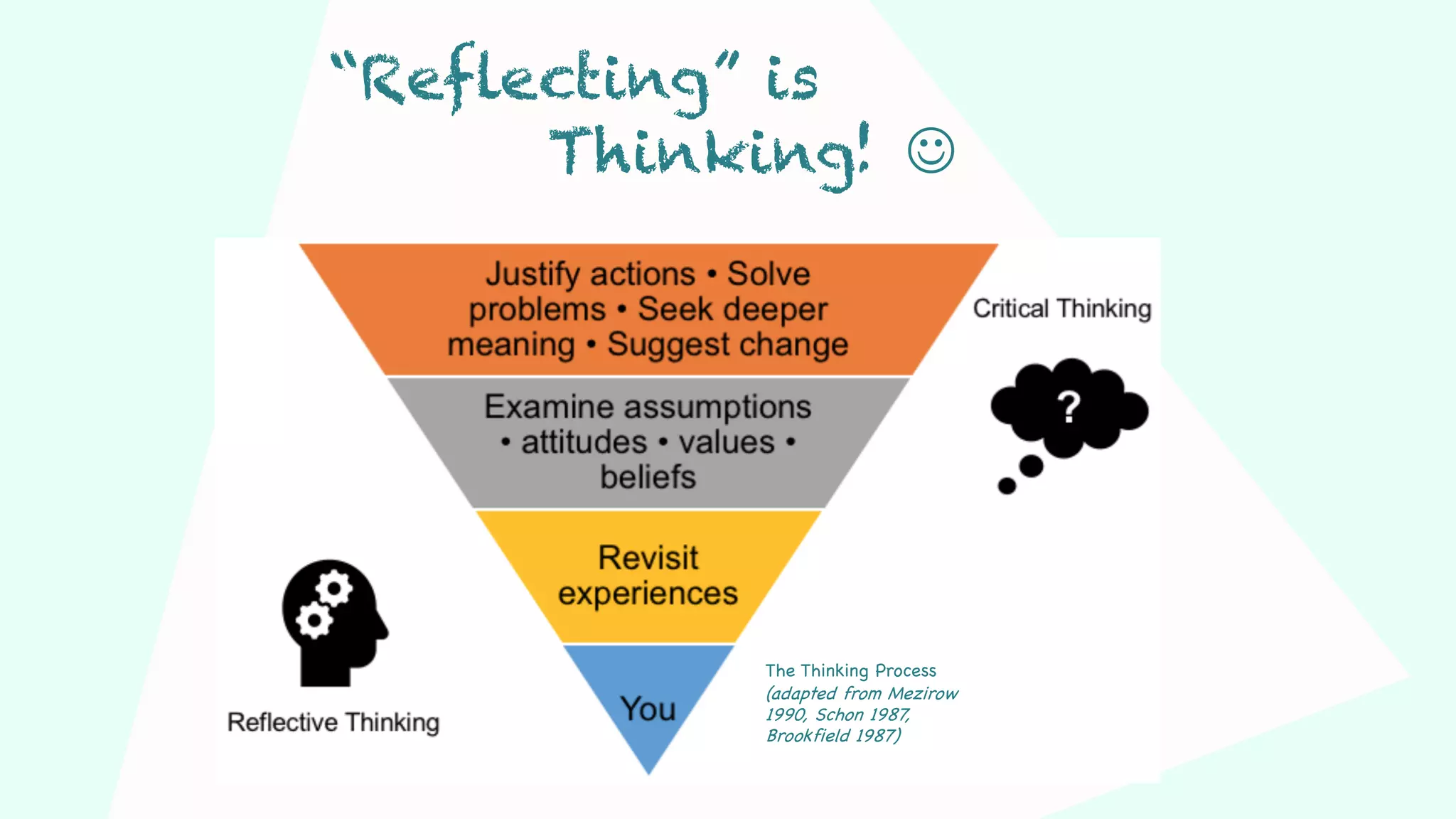
“Reflecting” is
Thinking! J
The Thinking Process
(adapted from Mezirow
1990, Schon 1987,
Brookfield 1987)
The Thinking Process (adapted from
Mezirow 1990, Schon 1987,
Brookfield 1987)
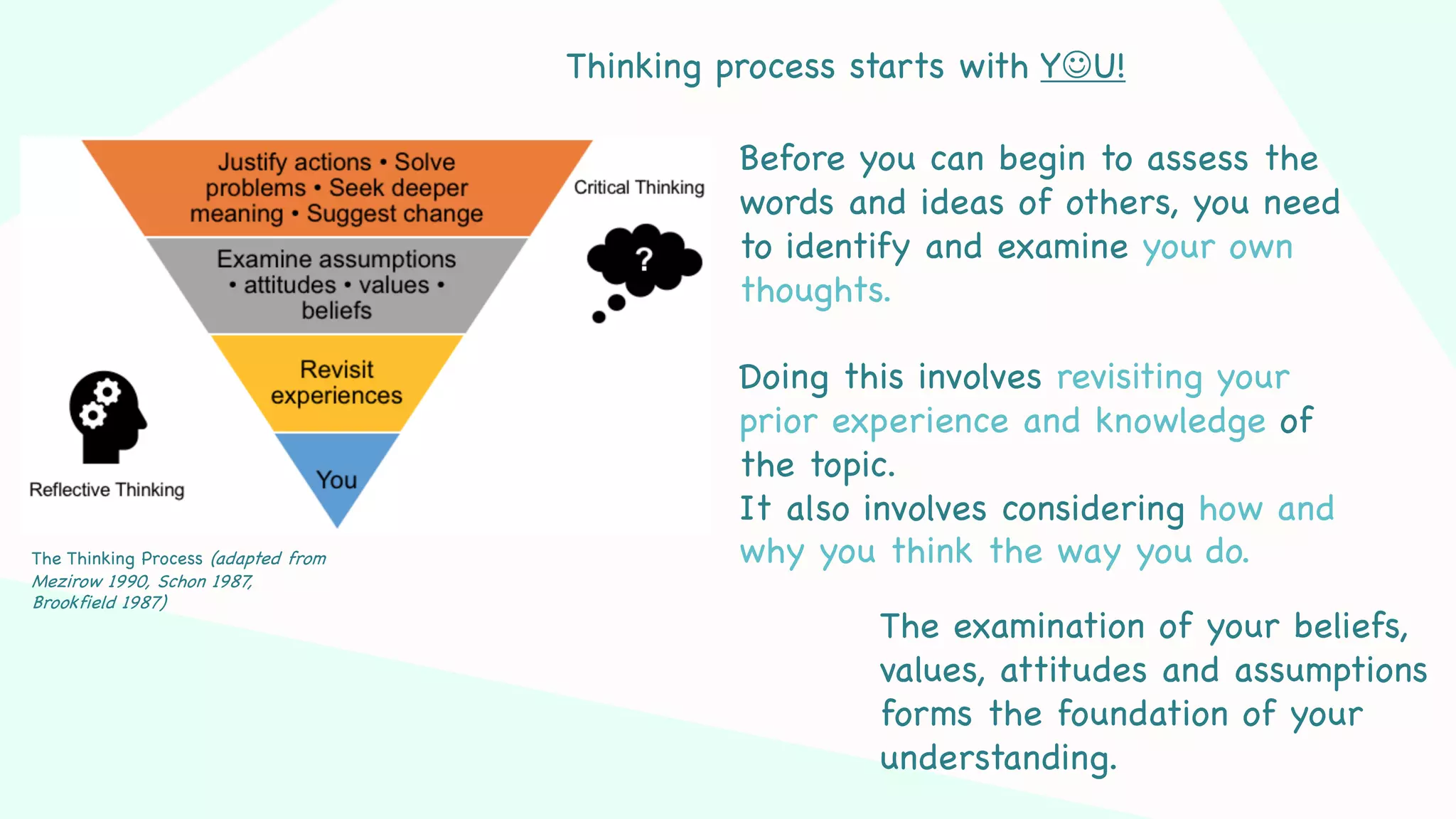
Before you can begin to assess the
words and ideas of others, you need
to identify and examine your own
thoughts.
Doing this involves revisiting your
prior experience and knowledge of
the topic.
It also involves considering how and
why you think the way you do.
Thinking process starts with YJU!
The examination of your beliefs,
values, attitudes and assumptions
forms the foundation of your
understanding.
* documenting your response to experiences, opinions,
events or new information
* communicating your response to thoughts and
feelings
* a way of exploring your learning
* an opportunity to gain self-knowledge
What is
“Reflective
Writing”?
* a way to achieve clarity and better understanding
of what you are learning
* chance to develop and reinforce writing skills
* a way of making meaning out of what you study
What is
“Reflective
Writing”?
* just conveying information, instruction or argument
pure description
* straightforward decision or judgement, e.g. about
whether something is right or wrong, good or bad
simple problem-solving
* a summary of course notes
* a standard university essay.
What is NOT
“Reflective
Writing”?
* Introduction - (the topic of an essay, the main
focus of the paper, the significance of the topic, the
way to develop it).
* Body - paragraphs with the detailed description of
the subject, assessment of the topic, and deep
analysis of the selected theme.
* Conclusion.
Parts of a
Reflective Paper
Step 03Step 01 Step 02
Step-by-Step Reflective Writing
Part 1: How to Start
Step 03Step 01 Step 02
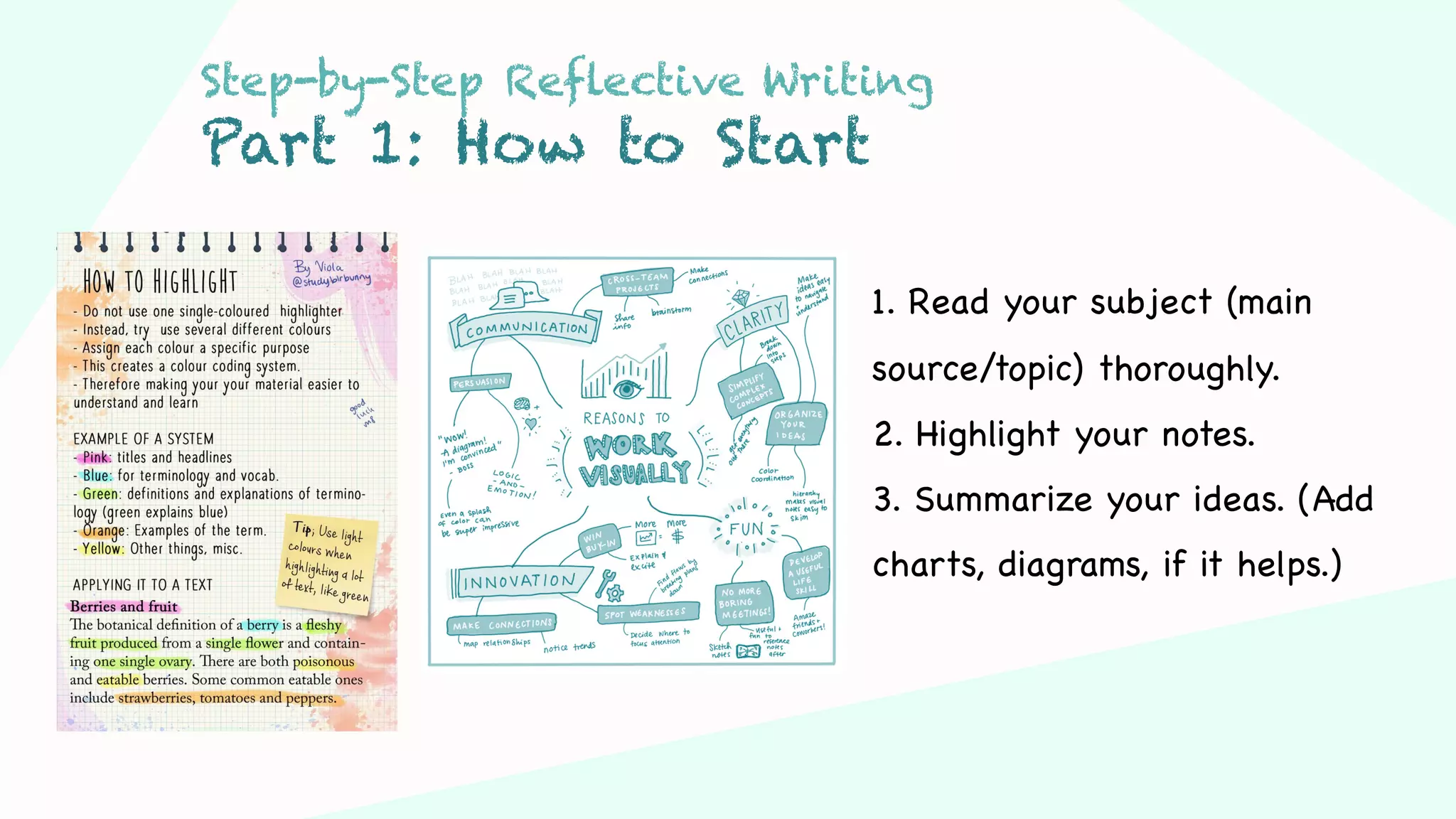
1. Read your subject (main
source/topic) thoroughly.
2. Highlight your notes.
3. Summarize your ideas. (Add
charts, diagrams, if it helps.)
Step-by-Step Reflective Writing
Part 1: How to Start
Step 03Step 01 Step 02
4. Consider the questions below
- How did the subject affect you?
- Has the subject changed your
mind about something? If so,
explain how.
- Has the subject left you with any
questions?
- Were there any unaddressed
critical issues that didn’t appear
in the subject?
- Does the subject relate to
anything from yourpast reading
experiences?
- Does the subject agree with any
of your past reading experiences?
Step-by-Step Reflective Writing
Part 1: How to Start
Step 03Step 01 Step 02
Step-by-Step Reflective Writing
Part 2: Formatting an Outline
Step 03Step 01 Step 02
1. Compose your introduction that specifies what you’re reflecting upon.
2. Compose your thesis that informs the reader of your general
position/opinion toward the subject.
3. Compose your body paragraphs. These examine ideas and experiences
you’ve had in context of your topic. Make sure each paragraph contains
a topic sentence.
Step-by-Step Reflective Writing
Part 2: Formatting an Outline
Step 03Step 01 Step 02
4. Feel free to describe what you encountered and how you felt about it.
5. Compose your conclusion. Summarize what you learned from the
subject.
6. Tell the reader how the new knowledge has affected your
understanding of the subject in general.
7. Connect your conclusion to points you’ve made in the body paragraph/s.
8. Restate your thesis and summarize the content
Step-by-Step Reflective Writing
Part 2: Formatting an Outline
Step 03Step 01 Step 02
Step-by-Step Reflective Writing
Part 3: Writing your Paper
Step 03Step 01 Step 02
1. Create a Main Theme
Write a short summary about what you have learned and your
experience with that topic.
Let readers know how you feel —and be honest.
Your readers will likely be able to relate to your opinion or at least the
way you form your perspective, and that will give them a better
understanding of your reflection.
Step-by-Step Reflective Writing
Part 3: Writing your Paper
Step 03Step 01 Step 02
1. Create a Main Theme
Example:
After watching a TEDx episode on Wim Hof, I was able to reevaluate my
preconceived notions about the negative effects of cold exposure.
Step-by-Step Reflective Writing
Part 3: Writing your Paper
Step 03Step 01 Step 02
2. Brainstorm Ideas and Experiences You’ve Had (Related to Your Topic)
You can write down specific quotes, predispositions you have, things that
influenced you, or anything memorable.
Be personal and explain, in simple words, how you felt.
Step-by-Step Reflective Writing
Part 3: Writing your Paper
Step 03Step 01 Step 02
2. Brainstorm Ideas and Experiences
You’ve Had (Related to Your Topic)
Example:
• A specific moment when I struggled with an
excess weight where I avoided carbohydrates
entirely.
• The consequences of my actions that gave rise to
my research
• The evidence and studies of nutritional science
that claim carbohydrates alone are to blame for
making people obese.
Step-by-Step Reflective Writing
Part 3: Writing your Paper
• My new experience with having a healthy diet
with a well-balanced intake of nutrients.
• The influence of other people’s perceptions on the
harm of carbohydrates, and the role their influence
has had on me.
• New ideas I’ve created as a result of my shift in
perspective.
Step 03Step 01 Step 02
3. Analyze How and Why These Ideas and Experiences Have Affected Your
Interpretation of Theme
Pick an idea or experience you had from the last step, and analyze it
further. Write your reasoning for agreeing or disagreeing with it.
Step-by-Step Reflective Writing
Part 3: Writing your Paper
Step 03Step 01 Step 02
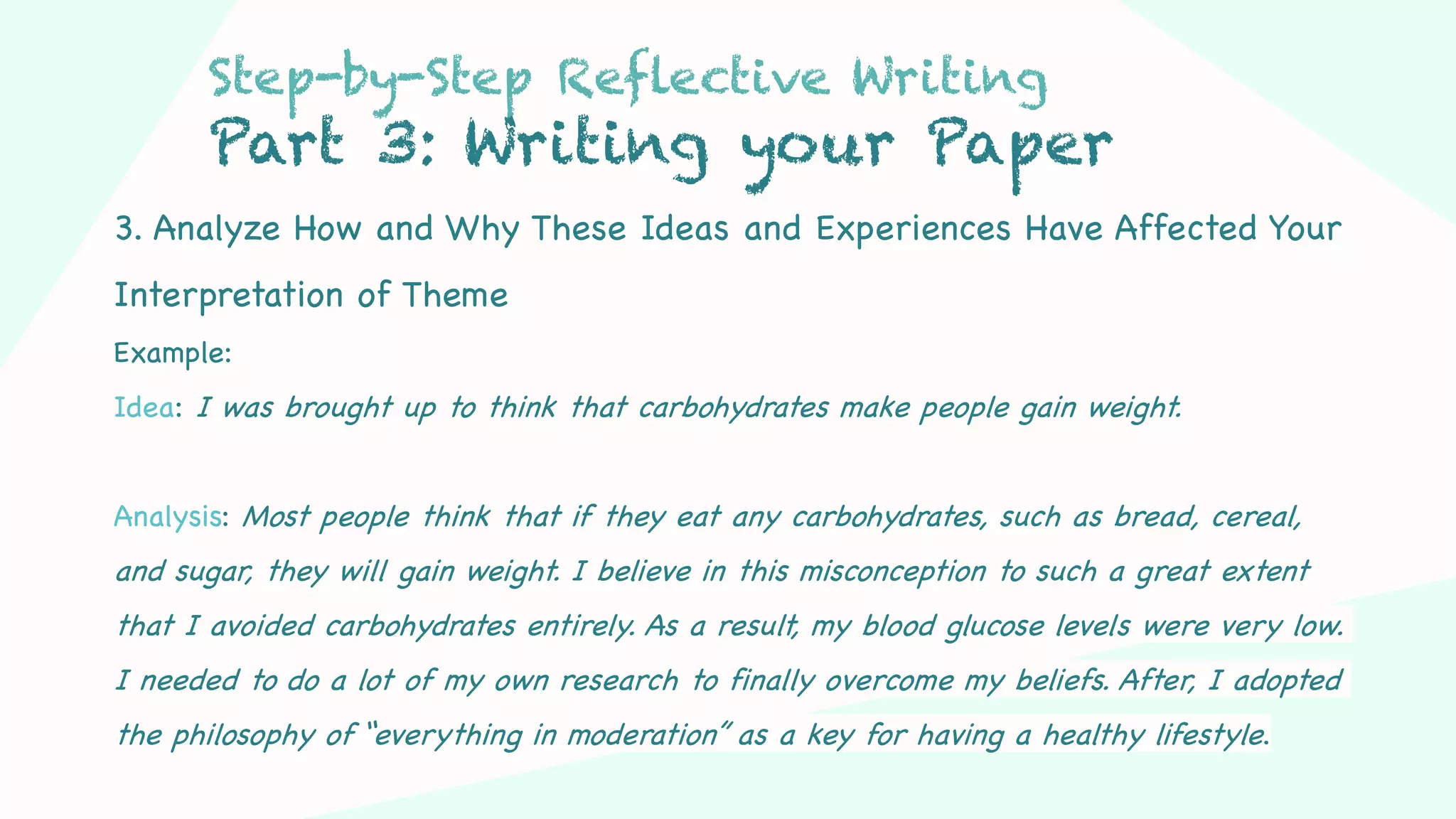
3. Analyze How and Why These Ideas and Experiences Have Affected Your
Interpretation of Theme
Example:
Idea: I was brought up to think that carbohydrates make people gain weight.
Analysis: Most people think that if they eat any carbohydrates, such as bread, cereal,
and sugar, they will gain weight. I believe in this misconception to such a great extent
that I avoided carbohydrates entirely. As a result, my blood glucose levels were very low.
I needed to do a lot of my own research to finally overcome my beliefs. After, I adopted
the philosophy of “everything in moderation” as a key for having a healthy lifestyle.
Step-by-Step Reflective Writing
Part 3: Writing your Paper
Step 03Step 01 Step 02
4. Make Connections Between Your Observations, Experiences, and
Opinions
Try to connect your ideas and insights to form a cohesive picture for
your theme.
You can also try to recognize and break down your assumptions, which
you may challenge in the future.
Step-by-Step Reflective Writing
Part 3: Writing your Paper
J Writing Tips! J
J Writing Tips! J
J Before you start your paper, read some
examples of other papers, they will likely
help you get a better understanding of
what they are and how to approach yours.
J Writing Tips! J
J When picking your subject, try to write
about something unusual and memorable —
it is more likely to capture your readers’
attention.
Your paper
should be. . .
Short and Sweet – Most reflection papers are
between 250 and 750 words. Only include
relevant information.
Clear and Concise – Make your paper as clear
and concise as possible. Use a strong thesis so
that your essay can follow it with the same
strength.
Also,
you should. . .
Maintain the Right Tone – Use a professional and academic
tone—even though the writing is personal.
Cite Your Sources – Try to cite authoritative sources and
experts to back up your personal opinions.
Proofread – Not only should you proofread for spelling and
grammatical errors, but you should proofread to focus on
your organization as well.
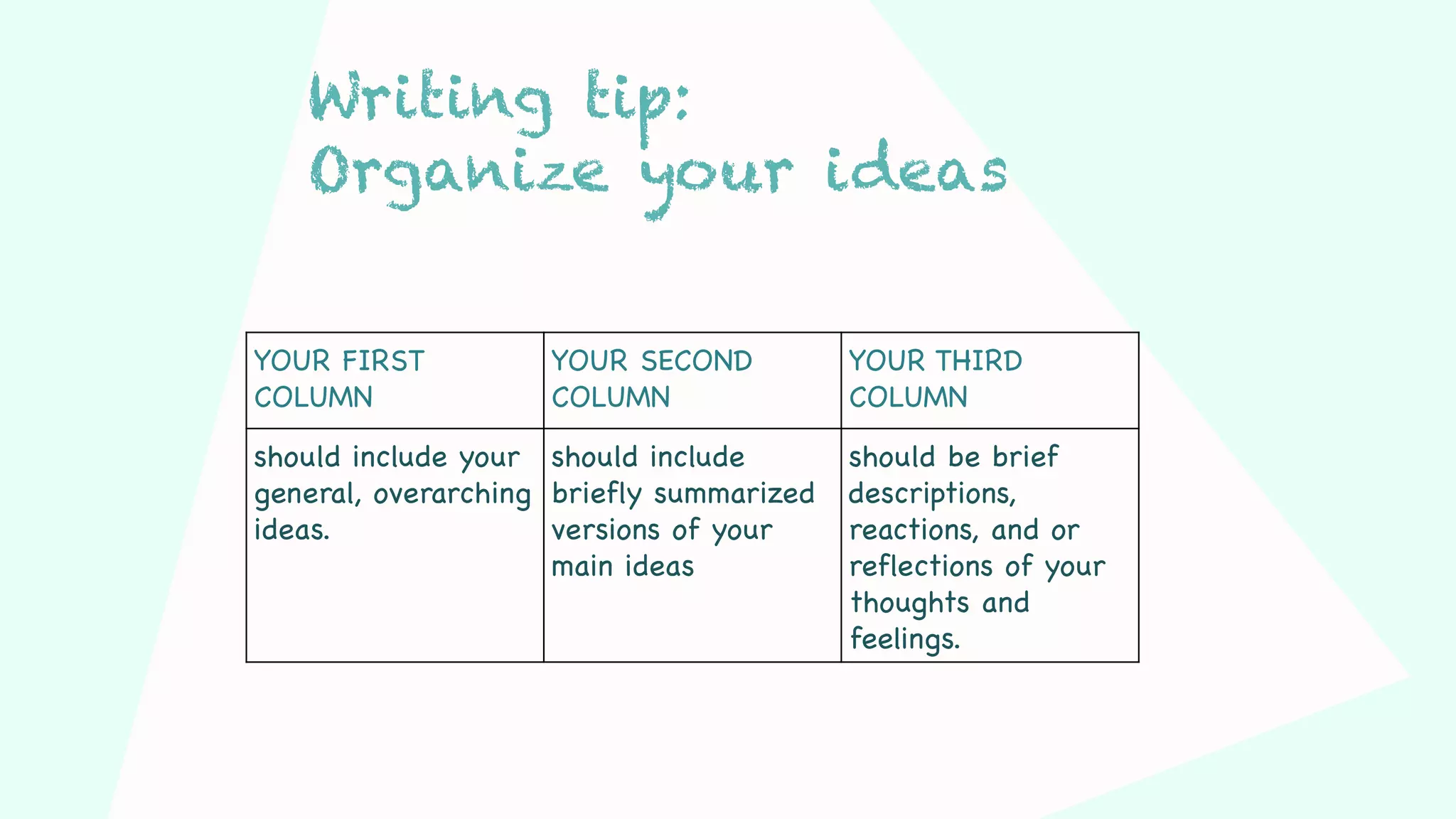
Writing tip:
Organize your ideas
YOUR FIRST
COLUMN
YOUR SECOND
COLUMN
YOUR THIRD
COLUMN
should include your
general, overarching
ideas.
should include
briefly summarized
versions of your
main ideas
should be brief
descriptions,
reactions, and or
reflections of your
thoughts and
feelings.
References
References
EssayPro. How to Write a Reflection Paper. June 24, 2020 from
https://student.unsw.edu.au/reflective-writing
Trent University. How to Write a Reflective Paper. Retrieved June 24, 2020
from https://www.trentu.ca/academicskills/how-guides/how-write-
university/how-approach-any-assignment/how-write-reflection-paper
UNSW Sydney. Reflective Writing. Retrieved June 24, 2020 from
https://student.unsw.edu.au/reflective-writing

Writing - Reflective Paper

  • 1.
  • 2.
    The word creativeis defined in various ways. The following are just some of the definitions: “The ability to create” “Imaginative” “Productive and imaginative” “Characterised by expressiveness and originality” What is ‘Creative Writing’?
  • 3.
    Is creative writingdifferent from other kinds of writing? All writing involves creativity since it is selective and is written from the writer’s perspective. Like informative writing, expositions (detailed statements or explanations) or instructions, creative writing does convey information, even when we define it so broadly; indeed, information is the basic component of all communication, no matter what kind. What is ‘Creative Writing’?
  • 4.
    The point isthat almost any genre or category of writing can be written to engage the reader emotionally as well as intellectually. What makes a work more creative than informative is its emphasis. Informative writing is primarily about imparting knowledge. Creative writing is primarily about creating emotional effect and significance. What is ‘Creative Writing’?
  • 5.
    Good creative writinguses the same kinds of writing that make for good informative writing, or good argument, or good exposition. It is the writer’s skill at using these forms of writing that can turn any piece of writing into creative piece of writing. J Remember! J
  • 6.
    For this term, Weare going to focus on. . . Creatively Writing a Reflective Paper
  • 7.
    Reflection offers theopportunity to consider how your personal experiences and observations shape your thinking and acceptance of new ideas. Reflections encourage you to explore your own ideas and express your opinion. Reflective writing can help improve your analytical skills because it requires you to express what you think, and how and why you think that way. Why Write a Reflective Paper?
  • 8.
    Reflection is. .. * a form of personal response to experiences, situations, events or new information. * a 'processing' phase where thinking and learning take place. There is neither a right nor wrong way of reflective thinking, there are just questions to explore. What is a “Reflection”?
  • 9.
    “Reflecting” is Thinking! J TheThinking Process (adapted from Mezirow 1990, Schon 1987, Brookfield 1987)
  • 10.
    The Thinking Process(adapted from Mezirow 1990, Schon 1987, Brookfield 1987) Before you can begin to assess the words and ideas of others, you need to identify and examine your own thoughts. Doing this involves revisiting your prior experience and knowledge of the topic. It also involves considering how and why you think the way you do. Thinking process starts with YJU! The examination of your beliefs, values, attitudes and assumptions forms the foundation of your understanding.
  • 11.
    * documenting yourresponse to experiences, opinions, events or new information * communicating your response to thoughts and feelings * a way of exploring your learning * an opportunity to gain self-knowledge What is “Reflective Writing”?
  • 12.
    * a wayto achieve clarity and better understanding of what you are learning * chance to develop and reinforce writing skills * a way of making meaning out of what you study What is “Reflective Writing”?
  • 13.
    * just conveyinginformation, instruction or argument pure description * straightforward decision or judgement, e.g. about whether something is right or wrong, good or bad simple problem-solving * a summary of course notes * a standard university essay. What is NOT “Reflective Writing”?
  • 14.
    * Introduction -(the topic of an essay, the main focus of the paper, the significance of the topic, the way to develop it). * Body - paragraphs with the detailed description of the subject, assessment of the topic, and deep analysis of the selected theme. * Conclusion. Parts of a Reflective Paper
  • 15.
    Step 03Step 01Step 02 Step-by-Step Reflective Writing Part 1: How to Start
  • 16.
    Step 03Step 01Step 02 1. Read your subject (main source/topic) thoroughly. 2. Highlight your notes. 3. Summarize your ideas. (Add charts, diagrams, if it helps.) Step-by-Step Reflective Writing Part 1: How to Start
  • 17.
    Step 03Step 01Step 02 4. Consider the questions below - How did the subject affect you? - Has the subject changed your mind about something? If so, explain how. - Has the subject left you with any questions? - Were there any unaddressed critical issues that didn’t appear in the subject? - Does the subject relate to anything from yourpast reading experiences? - Does the subject agree with any of your past reading experiences? Step-by-Step Reflective Writing Part 1: How to Start
  • 18.
    Step 03Step 01Step 02 Step-by-Step Reflective Writing Part 2: Formatting an Outline
  • 19.
    Step 03Step 01Step 02 1. Compose your introduction that specifies what you’re reflecting upon. 2. Compose your thesis that informs the reader of your general position/opinion toward the subject. 3. Compose your body paragraphs. These examine ideas and experiences you’ve had in context of your topic. Make sure each paragraph contains a topic sentence. Step-by-Step Reflective Writing Part 2: Formatting an Outline
  • 20.
    Step 03Step 01Step 02 4. Feel free to describe what you encountered and how you felt about it. 5. Compose your conclusion. Summarize what you learned from the subject. 6. Tell the reader how the new knowledge has affected your understanding of the subject in general. 7. Connect your conclusion to points you’ve made in the body paragraph/s. 8. Restate your thesis and summarize the content Step-by-Step Reflective Writing Part 2: Formatting an Outline
  • 21.
    Step 03Step 01Step 02 Step-by-Step Reflective Writing Part 3: Writing your Paper
  • 22.
    Step 03Step 01Step 02 1. Create a Main Theme Write a short summary about what you have learned and your experience with that topic. Let readers know how you feel —and be honest. Your readers will likely be able to relate to your opinion or at least the way you form your perspective, and that will give them a better understanding of your reflection. Step-by-Step Reflective Writing Part 3: Writing your Paper
  • 23.
    Step 03Step 01Step 02 1. Create a Main Theme Example: After watching a TEDx episode on Wim Hof, I was able to reevaluate my preconceived notions about the negative effects of cold exposure. Step-by-Step Reflective Writing Part 3: Writing your Paper
  • 24.
    Step 03Step 01Step 02 2. Brainstorm Ideas and Experiences You’ve Had (Related to Your Topic) You can write down specific quotes, predispositions you have, things that influenced you, or anything memorable. Be personal and explain, in simple words, how you felt. Step-by-Step Reflective Writing Part 3: Writing your Paper
  • 25.
    Step 03Step 01Step 02 2. Brainstorm Ideas and Experiences You’ve Had (Related to Your Topic) Example: • A specific moment when I struggled with an excess weight where I avoided carbohydrates entirely. • The consequences of my actions that gave rise to my research • The evidence and studies of nutritional science that claim carbohydrates alone are to blame for making people obese. Step-by-Step Reflective Writing Part 3: Writing your Paper • My new experience with having a healthy diet with a well-balanced intake of nutrients. • The influence of other people’s perceptions on the harm of carbohydrates, and the role their influence has had on me. • New ideas I’ve created as a result of my shift in perspective.
  • 26.
    Step 03Step 01Step 02 3. Analyze How and Why These Ideas and Experiences Have Affected Your Interpretation of Theme Pick an idea or experience you had from the last step, and analyze it further. Write your reasoning for agreeing or disagreeing with it. Step-by-Step Reflective Writing Part 3: Writing your Paper
  • 27.
    Step 03Step 01Step 02 3. Analyze How and Why These Ideas and Experiences Have Affected Your Interpretation of Theme Example: Idea: I was brought up to think that carbohydrates make people gain weight. Analysis: Most people think that if they eat any carbohydrates, such as bread, cereal, and sugar, they will gain weight. I believe in this misconception to such a great extent that I avoided carbohydrates entirely. As a result, my blood glucose levels were very low. I needed to do a lot of my own research to finally overcome my beliefs. After, I adopted the philosophy of “everything in moderation” as a key for having a healthy lifestyle. Step-by-Step Reflective Writing Part 3: Writing your Paper
  • 28.
    Step 03Step 01Step 02 4. Make Connections Between Your Observations, Experiences, and Opinions Try to connect your ideas and insights to form a cohesive picture for your theme. You can also try to recognize and break down your assumptions, which you may challenge in the future. Step-by-Step Reflective Writing Part 3: Writing your Paper
  • 29.
  • 30.
    J Writing Tips!J J Before you start your paper, read some examples of other papers, they will likely help you get a better understanding of what they are and how to approach yours.
  • 31.
    J Writing Tips!J J When picking your subject, try to write about something unusual and memorable — it is more likely to capture your readers’ attention.
  • 32.
    Your paper should be.. . Short and Sweet – Most reflection papers are between 250 and 750 words. Only include relevant information. Clear and Concise – Make your paper as clear and concise as possible. Use a strong thesis so that your essay can follow it with the same strength.
  • 33.
    Also, you should. .. Maintain the Right Tone – Use a professional and academic tone—even though the writing is personal. Cite Your Sources – Try to cite authoritative sources and experts to back up your personal opinions. Proofread – Not only should you proofread for spelling and grammatical errors, but you should proofread to focus on your organization as well.
  • 34.
    Writing tip: Organize yourideas YOUR FIRST COLUMN YOUR SECOND COLUMN YOUR THIRD COLUMN should include your general, overarching ideas. should include briefly summarized versions of your main ideas should be brief descriptions, reactions, and or reflections of your thoughts and feelings.
  • 35.
    References References EssayPro. How toWrite a Reflection Paper. June 24, 2020 from https://student.unsw.edu.au/reflective-writing Trent University. How to Write a Reflective Paper. Retrieved June 24, 2020 from https://www.trentu.ca/academicskills/how-guides/how-write- university/how-approach-any-assignment/how-write-reflection-paper UNSW Sydney. Reflective Writing. Retrieved June 24, 2020 from https://student.unsw.edu.au/reflective-writing