

Considerations & Components
for Building a World-Class
Absence Management Program
EVERYTHING YOU NEED TO KNOW
ABOUT CREATING A COMPANY-WIDE ATTENDANCE POLICY
BY GINA DUKE
Introduction
The considerations and components of this slide show are made up of a virtual team’s findings
and experiences while implementing a new attendance program in 2005 for a tier one
automotive supplier.
It was implemented in approximately 28 plants, both union and non-union across North
America.
The virtual team was made up of several Human Resources Manager.
Within the first year of implementation, it brought every plant’s absenteeism rate below 2%,
which qualified it as a World-Class Absence Management Program.
In the slides that follow, are the details of the considerations and components of this project.
Consider Best Practices
Benchmark:
• Internally
• What aspects of your sister plant’s absenteeism programs work well?
• Externally
• What is working well for your competitors and similarly-situated manufacturers?
• What worthy findings can you ascertain from other industries?
• What are other organizations who depend upon high attendance doing well?
Our Findings
Internal Findings
 One of our facilities had stopped writing employees up for absences. WHAT? Yes! And it works! (I’ll share more specifics at end of slide)
Findings from the Competitors/Similarly-Situated Companies
 Most adhered to point systems where termination point was between 5-7
 Some used percentages (98% presenteeism expected), but difficult for employees to calculate
Findings from other Industries
 Call Centers seemed to have the worst absenteeism problems of any other industry – noted that they often REQUIRED all
PTO/Vacation/Personal Days be exhausted for unplanned absences to help deter unplanned absences.
Findings from Other Organizations Who Desire High Attendance
 School Systems Rely on Positive Reinforcement Initiatives to Encourage High Attendance.
Findings from the Experts
 Review the statistics. In 2004, most employees called off at least 4 days per year for various reasons without advanced warning.
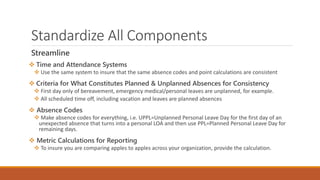
Standardize All Components
Streamline
 Time and Attendance Systems
 Use the same system to insure that the same absence codes and point calculations are consistent
 Criteria for What Constitutes Planned & Unplanned Absences for Consistency
 First day only of bereavement, emergency medical/personal leaves are unplanned, for example.
 All scheduled time off, including vacation and leaves are planned absences
 Absence Codes
 Make absence codes for everything, i.e. UPPL=Unplanned Personal Leave Day for the first day of an
unexpected absence that turns into a personal LOA and then use PPL=Planned Personal Leave Day for
remaining days.
 Metric Calculations for Reporting
 To insure you are comparing apples to apples across your organization, provide the calculation.
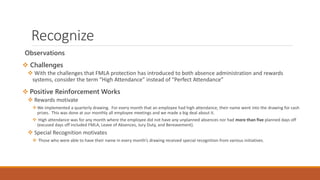
Recognize
Observations
 Challenges
 With the challenges that FMLA protection has introduced to both absence administration and rewards
systems, consider the term “High Attendance” instead of “Perfect Attendance”
 Positive Reinforcement Works
 Rewards motivate
We implemented a quarterly drawing. For every month that an employee had high attendance, their name went into the drawing for cash
prizes. This was done at our monthly all employee meetings and we made a big deal about it.
 High attendance was for any month where the employee did not have any unplanned absences nor had more than five planned days off
(excused days off included FMLA, Leave of Absences, Jury Duty, and Bereavement).
 Special Recognition motivates
 Those who were able to have their name in every month’s drawing received special recognition from various initiatives.
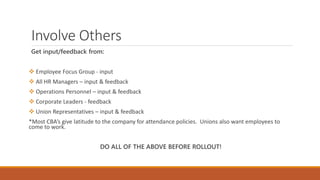
Involve Others
Get input/feedback from:
 Employee Focus Group - input
 All HR Managers – input & feedback
 Operations Personnel – input & feedback
 Corporate Leaders - feedback
 Union Representatives – input & feedback
*Most CBA’s give latitude to the company for attendance policies. Unions also want employees to
come to work.
DO ALL OF THE ABOVE BEFORE ROLLOUT!
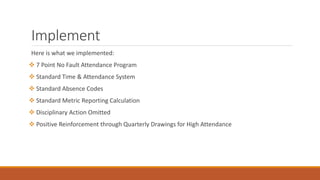
Implement
Here is what we implemented:
 7 Point No Fault Attendance Program
 Standard Time & Attendance System
 Standard Absence Codes
 Standard Metric Reporting Calculation
 Disciplinary Action Omitted
 Positive Reinforcement through Quarterly Drawings for High Attendance
Special Note for Removing Disciplinary
Action from Attendance Policies
 Goal is for the company is to move from a parental role on attendance, which is much more respectful to the employee
 Must add new verbiage to orientation / company handbook, advising employees that they will no longer be written up
for attendance and should sign an acknowledgement form.
 At the point of “excessive absenteeism” send a complimentary notice informing them of their standing in the point
system with a reminder of what point they will be terminated. Include a printout of their absences from the time and
attendance system for their review.
 Must communicate the various ways an employee can check their attendance
 Information printed on payroll stubs
 Kiosk in break area or other accessible areas to give employees unrushed times to review
 Ability to check on key pad of time and attendance system
 Request information directly from Supervisor or Human Resources who can check the T&A System
 At Termination Point, review absences with the employee.
If there is a discrepancy, remove employee from workforce with termination pending. Give employee 3 days to prove themselves; aid
in investigation with due diligence and document, document, document!
 If employee proves their absences were covered under program, pay them for time missed & excuse absences (have a code for this)
 If employee fails to respond or prove absences were legit to program, terminate on the original termination date.
Note: Unions cannot file grievance where there is no discipline.
Other Notes
 We chose a point system for its ease in administration and understanding by employees
 We chose 7 as point of termination based upon the national average of absenteeism being 4.
Anything above that would be what we considered excessive. 5 to 6 points is the trigger point for
issuing the complimentary notice. This can be mailed to the employee’s home or hand-delivered.
 We did away with “Grace Periods”
 “No Call/No Show” is any absence greater than 2 hours after start of shift without calling in. An
employee is terminated after the second day of a consecutive “No Call/No Show”
 Personal Time was approved in 2, 4 and half-day increments. We required that they be pre-
approved to encourage scheduling/discouraging unplanned absences.
 For excusing absences due to weather & other special circumstances
 33% absenteeism of workforce – excuse
 State of Emergency is issued for area – excuse
Since Then
This policy was implanted in 2004. Since then, other preferred practices learned:
 Instead of granting personal days, shift to a system where employees earn personal time off. This
encourages high attendance, and continues to separate those with excessive absenteeism.
 Awareness can get you half-way to your goal. The more leadership and supervisors reiterate how
important attendance is and how much each person is counted on, the harder it is for employees to
lay out of work because they know their team is counting on them.
 If your company has high turnover, do not use a low point system. Consider using a 10 or 12 point
system, that can be adjusted later.
 When changing systems, convert employees present standing to new policy. For those who would
be at the point of termination, move them to the point of excessive absenteeism, which is a 5 on this
scale.
 Should you decide to wipe everyone’s slate clean and start with new program, do not give advance
notice, otherwise, your employees may take advantage of the time in between to be absent.
About the Author
This PowerPoint is part of a presentation of the
Chronicles of the Corporate Mom by Gina Duke.
Gina is an award-winning author and Human Resources
professional.
For the back story and more details of the development
of this Absence Management Program, or to check out
encouraging and humorous stories, along with other HR
programs of the Corporate Mom, go to
http://ginaduke.com/the-chronicles-of-the-corp-mom/
The title of this edition is “Absenteeism Will Always Cost
You Something.”
Gina’s Book
If you are a person of faith, I recommend my
award-winning book, Organizing Your Prayer
Closet: A New and Life-Changing Way to Pray.
It won 2014’s BEST Book on Prayer by Christian
Retailing.
Not only does it teach on prayer, but it also
facilitates it for you with a 60-week structured
prayer journal called, The Prayer Closet
Organizer.
You can read more about it at:
http://ginaduke.com/my-book/
Coming Soon
Do you dream of publishing a book one day?
If so, I can guide you through your journey to
making your publishing dream come true.
I will tell you everything you should be doing
right now to get your book published without
an agent, and give you a free downloadable
RIGHT NOW workbook.
This eBook will be available in late spring of
2015 on Amazon, so watch for it.
*Even though I currently do not have affiliate links, that
may change in the near future. This is my disclosure.
Follow Gina
@TheGinaDuke
Inst @TheGinaDuke
/Churchtownministries
/gduke

How to Build a World-Class Absence Management Program

  • 1.
    Considerations & Components forBuilding a World-Class Absence Management Program EVERYTHING YOU NEED TO KNOW ABOUT CREATING A COMPANY-WIDE ATTENDANCE POLICY BY GINA DUKE
  • 2.
    Introduction The considerations andcomponents of this slide show are made up of a virtual team’s findings and experiences while implementing a new attendance program in 2005 for a tier one automotive supplier. It was implemented in approximately 28 plants, both union and non-union across North America. The virtual team was made up of several Human Resources Manager. Within the first year of implementation, it brought every plant’s absenteeism rate below 2%, which qualified it as a World-Class Absence Management Program. In the slides that follow, are the details of the considerations and components of this project.
  • 3.
    Consider Best Practices Benchmark: •Internally • What aspects of your sister plant’s absenteeism programs work well? • Externally • What is working well for your competitors and similarly-situated manufacturers? • What worthy findings can you ascertain from other industries? • What are other organizations who depend upon high attendance doing well?
  • 4.
    Our Findings Internal Findings One of our facilities had stopped writing employees up for absences. WHAT? Yes! And it works! (I’ll share more specifics at end of slide) Findings from the Competitors/Similarly-Situated Companies  Most adhered to point systems where termination point was between 5-7  Some used percentages (98% presenteeism expected), but difficult for employees to calculate Findings from other Industries  Call Centers seemed to have the worst absenteeism problems of any other industry – noted that they often REQUIRED all PTO/Vacation/Personal Days be exhausted for unplanned absences to help deter unplanned absences. Findings from Other Organizations Who Desire High Attendance  School Systems Rely on Positive Reinforcement Initiatives to Encourage High Attendance. Findings from the Experts  Review the statistics. In 2004, most employees called off at least 4 days per year for various reasons without advanced warning.
  • 5.
    Standardize All Components Streamline Time and Attendance Systems  Use the same system to insure that the same absence codes and point calculations are consistent  Criteria for What Constitutes Planned & Unplanned Absences for Consistency  First day only of bereavement, emergency medical/personal leaves are unplanned, for example.  All scheduled time off, including vacation and leaves are planned absences  Absence Codes  Make absence codes for everything, i.e. UPPL=Unplanned Personal Leave Day for the first day of an unexpected absence that turns into a personal LOA and then use PPL=Planned Personal Leave Day for remaining days.  Metric Calculations for Reporting  To insure you are comparing apples to apples across your organization, provide the calculation.
  • 6.
    Recognize Observations  Challenges  Withthe challenges that FMLA protection has introduced to both absence administration and rewards systems, consider the term “High Attendance” instead of “Perfect Attendance”  Positive Reinforcement Works  Rewards motivate We implemented a quarterly drawing. For every month that an employee had high attendance, their name went into the drawing for cash prizes. This was done at our monthly all employee meetings and we made a big deal about it.  High attendance was for any month where the employee did not have any unplanned absences nor had more than five planned days off (excused days off included FMLA, Leave of Absences, Jury Duty, and Bereavement).  Special Recognition motivates  Those who were able to have their name in every month’s drawing received special recognition from various initiatives.
  • 7.
    Involve Others Get input/feedbackfrom:  Employee Focus Group - input  All HR Managers – input & feedback  Operations Personnel – input & feedback  Corporate Leaders - feedback  Union Representatives – input & feedback *Most CBA’s give latitude to the company for attendance policies. Unions also want employees to come to work. DO ALL OF THE ABOVE BEFORE ROLLOUT!
  • 8.
    Implement Here is whatwe implemented:  7 Point No Fault Attendance Program  Standard Time & Attendance System  Standard Absence Codes  Standard Metric Reporting Calculation  Disciplinary Action Omitted  Positive Reinforcement through Quarterly Drawings for High Attendance
  • 9.
    Special Note forRemoving Disciplinary Action from Attendance Policies  Goal is for the company is to move from a parental role on attendance, which is much more respectful to the employee  Must add new verbiage to orientation / company handbook, advising employees that they will no longer be written up for attendance and should sign an acknowledgement form.  At the point of “excessive absenteeism” send a complimentary notice informing them of their standing in the point system with a reminder of what point they will be terminated. Include a printout of their absences from the time and attendance system for their review.  Must communicate the various ways an employee can check their attendance  Information printed on payroll stubs  Kiosk in break area or other accessible areas to give employees unrushed times to review  Ability to check on key pad of time and attendance system  Request information directly from Supervisor or Human Resources who can check the T&A System  At Termination Point, review absences with the employee. If there is a discrepancy, remove employee from workforce with termination pending. Give employee 3 days to prove themselves; aid in investigation with due diligence and document, document, document!  If employee proves their absences were covered under program, pay them for time missed & excuse absences (have a code for this)  If employee fails to respond or prove absences were legit to program, terminate on the original termination date. Note: Unions cannot file grievance where there is no discipline.
  • 10.
    Other Notes  Wechose a point system for its ease in administration and understanding by employees  We chose 7 as point of termination based upon the national average of absenteeism being 4. Anything above that would be what we considered excessive. 5 to 6 points is the trigger point for issuing the complimentary notice. This can be mailed to the employee’s home or hand-delivered.  We did away with “Grace Periods”  “No Call/No Show” is any absence greater than 2 hours after start of shift without calling in. An employee is terminated after the second day of a consecutive “No Call/No Show”  Personal Time was approved in 2, 4 and half-day increments. We required that they be pre- approved to encourage scheduling/discouraging unplanned absences.  For excusing absences due to weather & other special circumstances  33% absenteeism of workforce – excuse  State of Emergency is issued for area – excuse
  • 11.
    Since Then This policywas implanted in 2004. Since then, other preferred practices learned:  Instead of granting personal days, shift to a system where employees earn personal time off. This encourages high attendance, and continues to separate those with excessive absenteeism.  Awareness can get you half-way to your goal. The more leadership and supervisors reiterate how important attendance is and how much each person is counted on, the harder it is for employees to lay out of work because they know their team is counting on them.  If your company has high turnover, do not use a low point system. Consider using a 10 or 12 point system, that can be adjusted later.  When changing systems, convert employees present standing to new policy. For those who would be at the point of termination, move them to the point of excessive absenteeism, which is a 5 on this scale.  Should you decide to wipe everyone’s slate clean and start with new program, do not give advance notice, otherwise, your employees may take advantage of the time in between to be absent.
  • 12.
    About the Author ThisPowerPoint is part of a presentation of the Chronicles of the Corporate Mom by Gina Duke. Gina is an award-winning author and Human Resources professional. For the back story and more details of the development of this Absence Management Program, or to check out encouraging and humorous stories, along with other HR programs of the Corporate Mom, go to http://ginaduke.com/the-chronicles-of-the-corp-mom/ The title of this edition is “Absenteeism Will Always Cost You Something.”
  • 13.
    Gina’s Book If youare a person of faith, I recommend my award-winning book, Organizing Your Prayer Closet: A New and Life-Changing Way to Pray. It won 2014’s BEST Book on Prayer by Christian Retailing. Not only does it teach on prayer, but it also facilitates it for you with a 60-week structured prayer journal called, The Prayer Closet Organizer. You can read more about it at: http://ginaduke.com/my-book/
  • 14.
    Coming Soon Do youdream of publishing a book one day? If so, I can guide you through your journey to making your publishing dream come true. I will tell you everything you should be doing right now to get your book published without an agent, and give you a free downloadable RIGHT NOW workbook. This eBook will be available in late spring of 2015 on Amazon, so watch for it. *Even though I currently do not have affiliate links, that may change in the near future. This is my disclosure.
  • 15.