NOVEMBER 18 & 19, 2014
OCCUPATIONAL HEALTH AND SAFETY
CONFERENCE
CHRIS HYLTON, MA
ACKNOWLEDGEMENT:
ADRIANE WHITNEY
Impact of the Aging Workforce
on OHS Practices
Disclaimer
2
The information presented to you today is considered
to be general best practices for organizations across
Canada. The information is not intended to provide
legal counsel or legal advice.
Learning Objectives
 Understanding age trends in the workplace
 The needs of mature workers
 Helping mature workers stay safe and healthy in the
workplace
 Companies that are getting it right!
3
4
Age Trends in the Workplace
Changing Workplaces
5
 More people are living longer
 People are able to work
with medical conditions
and disabilities that
precluded them from
work in the past
 Many retirees are
coming back to work
full time, part time, and
as consultants
6
Aging in Canada
Source: Statistics Canada.
* Projected population.
US Aging Trends Age 65 + Age 85+
7
Insufficient Retirement Income
8
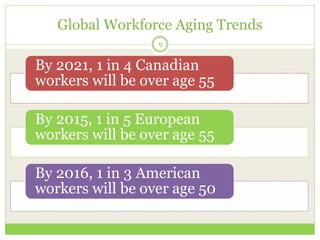
Global Workforce Aging Trends
By 2021, 1 in 4 Canadian
workers will be over age 55
By 2015, 1 in 5 European
workers will be over age 55
By 2016, 1 in 3 American
workers will be over age 50
9
Consider This
10
 Peak physical performance
 Age 25
 Peak muscle strength
 Between age 19 and 30
 Manual dexterity, joint mobility,
vision, hearing
 Decrease with age
Why It Matters
11
 Workforces are now starting to feel the full impact of
the aging workforce
 Employers need talent, skills, knowledge, and
experience on their teams
 Mature workers need engagement, income,
flexibility, and value
It’s Happening Today
12
Needs of Mature Workers
13
Basic Needs For All Generations
 Respectful and inclusive workplace
 Health and Safety strategies
 Clearly defined performance expectations
 Access to tools, resources, feedback, and coaching to
encourage success
14
Mature Worker Needs
Flexibility
More
Growth
Know they add
value
Workplace
Modifications
Needs
15
Give Them What They Want!
16
Engagement
Flexibility
Safety Growth
Value
Income
Dispelling the Myths about Mature Workers
17
Myth
 Mature workers don’t fit into an energetic and fast
paced workplace
Reality
 Older workers are motivated to exceed
expectations
 Older workers have a high retention rate for
learning new skills
Dispelling the Myths about Mature Workers
18
Myth
 Mature workers are not willing to share job
information and skills; they want to prevent younger
workers from advancing
Reality
 Mature workers can be effective mentors
Dispelling the Myths about Mature Workers
19
Myth
 The cost of employing mature workers is higher than
the cost of employing younger workers
Reality
 Mature workers have higher productivity
 Mature workers have fewer absences
 Benefit coverage is less expensive as it does
not typically include multiple dependents
Aging Advantage
Life
experience
Wisdom
Strategic Rational
Responsible
Productive Communication
Confident
Mentor
20
Understanding Age Management
European Agency for Health and Safety at Work
defines age management as emphasizing that “age
related factors should be taken into consideration in
daily management, including work arrangements and
individual work tasks, so that everybody, regardless of
age, feels empowered in reaching their own and
corporate goals.”
21
Successful Age Management
Awareness
Fair attitudes
Core
management
task
HR policies
Promoting
productivity
Lifelong
learning
Age friendly
Dignified
retirement
SUCCESS!
22
23
Safety for Mature Workers
Simple Solutions
24
Physical Risks
25
 Accumulation injuries
 Repetitive strain injuries, wear and tear resulting from years of
performing similar activities
 Hearing and vision loss
 Strains and sprains
 Common due to loss of strength, flexibility, and endurance which
occurs as our bodies age
 Cardiopulmonary changes
 Increased risk of overexertion; changes to tolerance for heat and cold
 Falls
 Caused by decreased balance, vision changes, slower reaction times
Physical Risks
26
 Heart disease
 Diabetes
 Musculoskeletal diseases
 Osteoporosis
 Arthritis
 Cancer
 Mental illness
Health and Safety
Ergonomics
• Minimizing
hazards
• Setting up
for success
Job Demands
• Changing
bodies,
changing
demands
Training
• Maintaining
safe work
skills
27
Ergonomics and Universal Design
28
An approach to the design of products, services, and
environments to be as usable as possible by as many
people as possible regardless of age, ability, or
situation.
Source: Wikipedia
Principles of Universal Design
29
 Equitable use
 Flexibility in use
 Simple and intuitive
 Noticeable information
 Tolerance for error
 Low physical effort
 Size and space for approach
and use
Fairness in Use
30
Flexibility in Use
31
Simple and Intuitive
32
Simple and Intuitive
33
Noticeable Information
34
Tolerance for Error
35
Low Physical Effort
36
Communications is Key
37
Size and Space for Approach and Use
38
Incorporating Universal Design Principles
39
 Prevention through Universal Design
 When creating a new office space or making changes,
incorporate these design principles into the process
 Pre-task planning
 Consider these principles when adding new tasks or
determining best way to have a task completed
 Tool selection
 When purchasing tools and equipment, select based on
meeting these principles of design
Prevention Through Design
40
 Design to reduce risk of injury and illness by
integrating decisions affecting safety and health
during stages of the design process
 Hazard: Power lines suspended above a construction site are
an electrical hazard
 Solution: Design to allow adequate clearance between the
structure and the power lines; bury, disconnect, or reroute
existing power lines around the site BEFORE construction
begins
Fall Prevention via Design
41
 Locate mechanical equipment on the ground or away
from edge of heights
 Specify fixed stairways and ladders
 Specify 39-45 inch high windowsills
 Specify permanent anchorage points for personal fall
arrest systems
Time to Participate!
42
Principles of Universal Design
43
 Fairness in use
 Flexibility in use
 Simple and intuitive
 Noticeable information
 Tolerance for error
 Low physical effort
 Size and space for approach
and use
Job Demands
44
 Most jobs can be modified or rearranged in order to
maximize efficiency and minimize risk for injury
Schedule
45
 Part time
 Contract
 Flex time
 Modified start
and end times
Work Location
46
 Telecommute
 Alternate office location closer to home
 Office close to parking or public transportation
 Main floor
Physical Demands
47
 Ergonomic workstations
 Desk and chair
 Assembly line
Physical Demands
48
 Modified lifting and carrying
Physical Demands
49
 Auditory requirements
 Work in an area with less background noise
 Increase communication via written instructions
 Telephone work with adjustable volumes for the ringer and the
handset and speaker
 Work in smaller area, closer to other coworkers
Physical Demands
50
 Visual demands
 Modify workstation to ensure reduced peripheral visual field is
not an issue
 Increase font size on monitors
 Reduce screen glare
 Ensure adequate light transmission
 Modify documents to a simpler layout that is easy to read
Training
51
 Regular training opportunities
 Practically based training
 Fit training into what they already know
 Provide the justification and logic behind the
training and procedures
Special Considerations for Training
52
 Provide short, clearly written instructions
 Ensure training material is easily legible and that the
information is not overwhelmed by a busy design
and graphics
 Allow additional practice time
 Minimize distractions during
training
Getting it right!
Deloitte
BMW Group
National Institutes
of Health
53
Deloitte
 Career Lattice program
 Employees can dial up or dial down during their career with
Deloitte
 Flexibility in ways to work
 Customize the when, where, and how
54
BMW Group
 Work environment
 Designed an age friendly workspace with input from
architects, automotive engineers, physical therapists, and
doctors
 Incorporated over 70 employee recommended changes
 Slowed production line
55
National Institutes of Health
 Recruitment
 Workplace culture
 Recognizing the caregiver
 Flexible work arrangements
56
THANK YOU!
57
Thank you for the opportunity to
present to you today!
About us
58
Our services
 Employer benefit plans
 Travel insurance
 Health spending
accounts
 Salary grids
 Policy review and writing
 Pension plans
 Employee wellness
 Employer of choice
 Charitable giving
 Charitable tax
information
 Employee mental health
Contact us
59
#517-7620 Elbow Drive SW
Calgary, AB T2V 1K2
403-264-5288 www.hylton.ca
800-449-5866 chris@hylton.ca
https://www.facebook.com/cghylton
twitter.com/HyltonYYC

OH&S Aging Workplace Nov 2014

  • 1.
    NOVEMBER 18 &19, 2014 OCCUPATIONAL HEALTH AND SAFETY CONFERENCE CHRIS HYLTON, MA ACKNOWLEDGEMENT: ADRIANE WHITNEY Impact of the Aging Workforce on OHS Practices
  • 2.
    Disclaimer 2 The information presentedto you today is considered to be general best practices for organizations across Canada. The information is not intended to provide legal counsel or legal advice.
  • 3.
    Learning Objectives  Understandingage trends in the workplace  The needs of mature workers  Helping mature workers stay safe and healthy in the workplace  Companies that are getting it right! 3
  • 4.
    4 Age Trends inthe Workplace
  • 5.
    Changing Workplaces 5  Morepeople are living longer  People are able to work with medical conditions and disabilities that precluded them from work in the past  Many retirees are coming back to work full time, part time, and as consultants
  • 6.
    6 Aging in Canada Source:Statistics Canada. * Projected population.
  • 7.
    US Aging TrendsAge 65 + Age 85+ 7
  • 8.
  • 9.
    Global Workforce AgingTrends By 2021, 1 in 4 Canadian workers will be over age 55 By 2015, 1 in 5 European workers will be over age 55 By 2016, 1 in 3 American workers will be over age 50 9
  • 10.
    Consider This 10  Peakphysical performance  Age 25  Peak muscle strength  Between age 19 and 30  Manual dexterity, joint mobility, vision, hearing  Decrease with age
  • 11.
    Why It Matters 11 Workforces are now starting to feel the full impact of the aging workforce  Employers need talent, skills, knowledge, and experience on their teams  Mature workers need engagement, income, flexibility, and value
  • 12.
  • 13.
    Needs of MatureWorkers 13
  • 14.
    Basic Needs ForAll Generations  Respectful and inclusive workplace  Health and Safety strategies  Clearly defined performance expectations  Access to tools, resources, feedback, and coaching to encourage success 14
  • 15.
    Mature Worker Needs Flexibility More Growth Knowthey add value Workplace Modifications Needs 15
  • 16.
    Give Them WhatThey Want! 16 Engagement Flexibility Safety Growth Value Income
  • 17.
    Dispelling the Mythsabout Mature Workers 17 Myth  Mature workers don’t fit into an energetic and fast paced workplace Reality  Older workers are motivated to exceed expectations  Older workers have a high retention rate for learning new skills
  • 18.
    Dispelling the Mythsabout Mature Workers 18 Myth  Mature workers are not willing to share job information and skills; they want to prevent younger workers from advancing Reality  Mature workers can be effective mentors
  • 19.
    Dispelling the Mythsabout Mature Workers 19 Myth  The cost of employing mature workers is higher than the cost of employing younger workers Reality  Mature workers have higher productivity  Mature workers have fewer absences  Benefit coverage is less expensive as it does not typically include multiple dependents
  • 20.
  • 21.
    Understanding Age Management EuropeanAgency for Health and Safety at Work defines age management as emphasizing that “age related factors should be taken into consideration in daily management, including work arrangements and individual work tasks, so that everybody, regardless of age, feels empowered in reaching their own and corporate goals.” 21
  • 22.
    Successful Age Management Awareness Fairattitudes Core management task HR policies Promoting productivity Lifelong learning Age friendly Dignified retirement SUCCESS! 22
  • 23.
  • 24.
  • 25.
    Physical Risks 25  Accumulationinjuries  Repetitive strain injuries, wear and tear resulting from years of performing similar activities  Hearing and vision loss  Strains and sprains  Common due to loss of strength, flexibility, and endurance which occurs as our bodies age  Cardiopulmonary changes  Increased risk of overexertion; changes to tolerance for heat and cold  Falls  Caused by decreased balance, vision changes, slower reaction times
  • 26.
    Physical Risks 26  Heartdisease  Diabetes  Musculoskeletal diseases  Osteoporosis  Arthritis  Cancer  Mental illness
  • 27.
    Health and Safety Ergonomics •Minimizing hazards • Setting up for success Job Demands • Changing bodies, changing demands Training • Maintaining safe work skills 27
  • 28.
    Ergonomics and UniversalDesign 28 An approach to the design of products, services, and environments to be as usable as possible by as many people as possible regardless of age, ability, or situation. Source: Wikipedia
  • 29.
    Principles of UniversalDesign 29  Equitable use  Flexibility in use  Simple and intuitive  Noticeable information  Tolerance for error  Low physical effort  Size and space for approach and use
  • 30.
  • 31.
  • 32.
  • 33.
  • 34.
  • 35.
  • 36.
  • 37.
  • 38.
    Size and Spacefor Approach and Use 38
  • 39.
    Incorporating Universal DesignPrinciples 39  Prevention through Universal Design  When creating a new office space or making changes, incorporate these design principles into the process  Pre-task planning  Consider these principles when adding new tasks or determining best way to have a task completed  Tool selection  When purchasing tools and equipment, select based on meeting these principles of design
  • 40.
    Prevention Through Design 40 Design to reduce risk of injury and illness by integrating decisions affecting safety and health during stages of the design process  Hazard: Power lines suspended above a construction site are an electrical hazard  Solution: Design to allow adequate clearance between the structure and the power lines; bury, disconnect, or reroute existing power lines around the site BEFORE construction begins
  • 41.
    Fall Prevention viaDesign 41  Locate mechanical equipment on the ground or away from edge of heights  Specify fixed stairways and ladders  Specify 39-45 inch high windowsills  Specify permanent anchorage points for personal fall arrest systems
  • 42.
  • 43.
    Principles of UniversalDesign 43  Fairness in use  Flexibility in use  Simple and intuitive  Noticeable information  Tolerance for error  Low physical effort  Size and space for approach and use
  • 44.
    Job Demands 44  Mostjobs can be modified or rearranged in order to maximize efficiency and minimize risk for injury
  • 45.
    Schedule 45  Part time Contract  Flex time  Modified start and end times
  • 46.
    Work Location 46  Telecommute Alternate office location closer to home  Office close to parking or public transportation  Main floor
  • 47.
    Physical Demands 47  Ergonomicworkstations  Desk and chair  Assembly line
  • 48.
  • 49.
    Physical Demands 49  Auditoryrequirements  Work in an area with less background noise  Increase communication via written instructions  Telephone work with adjustable volumes for the ringer and the handset and speaker  Work in smaller area, closer to other coworkers
  • 50.
    Physical Demands 50  Visualdemands  Modify workstation to ensure reduced peripheral visual field is not an issue  Increase font size on monitors  Reduce screen glare  Ensure adequate light transmission  Modify documents to a simpler layout that is easy to read
  • 51.
    Training 51  Regular trainingopportunities  Practically based training  Fit training into what they already know  Provide the justification and logic behind the training and procedures
  • 52.
    Special Considerations forTraining 52  Provide short, clearly written instructions  Ensure training material is easily legible and that the information is not overwhelmed by a busy design and graphics  Allow additional practice time  Minimize distractions during training
  • 53.
    Getting it right! Deloitte BMWGroup National Institutes of Health 53
  • 54.
    Deloitte  Career Latticeprogram  Employees can dial up or dial down during their career with Deloitte  Flexibility in ways to work  Customize the when, where, and how 54
  • 55.
    BMW Group  Workenvironment  Designed an age friendly workspace with input from architects, automotive engineers, physical therapists, and doctors  Incorporated over 70 employee recommended changes  Slowed production line 55
  • 56.
    National Institutes ofHealth  Recruitment  Workplace culture  Recognizing the caregiver  Flexible work arrangements 56
  • 57.
    THANK YOU! 57 Thank youfor the opportunity to present to you today!
  • 58.
    About us 58 Our services Employer benefit plans  Travel insurance  Health spending accounts  Salary grids  Policy review and writing  Pension plans  Employee wellness  Employer of choice  Charitable giving  Charitable tax information  Employee mental health
  • 59.
    Contact us 59 #517-7620 ElbowDrive SW Calgary, AB T2V 1K2 403-264-5288 www.hylton.ca 800-449-5866 chris@hylton.ca https://www.facebook.com/cghylton twitter.com/HyltonYYC