 HYDROSTATIC DEVICES
BY
TARIQ SHAH
ID=CU-611-2015
 Introduction
Device used to measure the pressure at any point in a fluid is called hydrostatic
device . There are two types of hydrostatic device.
1) Manometer
2) Mechanical gauges
 Manometer
Manometry refers to the measurement of pressure by comparison to the hydraulic
pressure produced by a column of liquid.
With the help of manometer , we can measure comparatively high pressure and
negative pressure also.
Common types are
1) U tube manometer
2) Well type manometer
3) Barometer
4) Inclined tube manometer
 U tube manometer
simplest manometer.
used in the measurement of liquid or
gas pressure.
both legs have same area.
Mercury is generally is used.
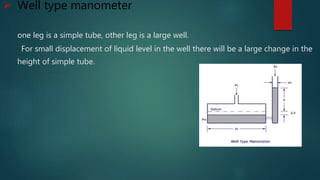
 Well type manometer
one leg is a simple tube, other leg is a large well.
For small displacement of liquid level in the well there will be a large change in the
height of simple tube.
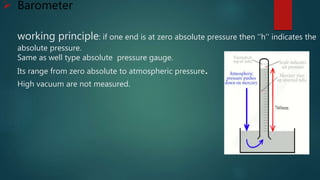
 Barometer
working principle: if one end is at zero absolute pressure then ‘’h’’ indicates the
absolute pressure.
Same as well type absolute pressure gauge.
Its range from zero absolute to atmospheric pressure.
High vacuum are not measured.
 Inclined tube manometer
It is similar to a well type manometer in construction. The only
difference being that the vertical column limb is inclined at an
angle θ. Inclined manometers are used for accurate measurement
of small pressure.
The angle of measuring leg is about 10 degree
 Mechanical pressure gauge measurement
Mechanical Pressure Measurement Devices do not read pressure of any system by
deflection of liquid level in some sort of tube. Instead they use some solid object,
such as, tube, plate, or diaphragm to measure pressure. The system whose
pressure is to be measured is connected to the deflecting object. Any change in
pressure causes the object to deflect and this deflection is mechanically amplified,
by using a suitable gear and linkage mechanism, and indicated on the calibrated
dial.
Commonly types are:
1) Bourdon gauge
2) Diaphragm gauge
3) Bellows gauge
4) Pressure transducer
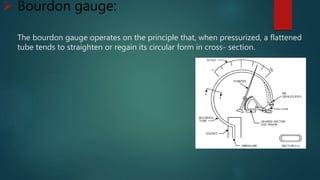
 Bourdon gauge:
The bourdon gauge operates on the principle that, when pressurized, a flattened
tube tends to straighten or regain its circular form in cross- section.
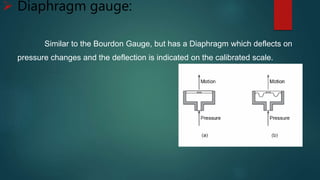
 Diaphragm gauge:
Similar to the Bourdon Gauge, but has a Diaphragm which deflects on
pressure changes and the deflection is indicated on the calibrated scale.
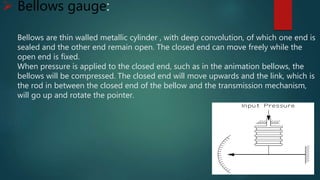
 Bellows gauge:
Bellows are thin walled metallic cylinder , with deep convolution, of which one end is
sealed and the other end remain open. The closed end can move freely while the
open end is fixed.
When pressure is applied to the closed end, such as in the animation bellows, the
bellows will be compressed. The closed end will move upwards and the link, which is
the rod in between the closed end of the bellow and the transmission mechanism,
will go up and rotate the pointer.
 Pressure transducer:
Pressure Transducers use an electrical system in conjunction with mechanical
gauges to convert the deflection due to pressure changes into electrical signals.
Pressure Transducers are useful to measure pressures continuously such that the
electrical signal supplied to some control system can be used to monitor the
pressure variations.
Some typical types of pressure transducers can be capacitive, magnetic, resistive, or
piezoelectric.
Thanks

hydro static device

  • 1.
  • 2.
     Introduction Device usedto measure the pressure at any point in a fluid is called hydrostatic device . There are two types of hydrostatic device. 1) Manometer 2) Mechanical gauges
  • 3.
     Manometer Manometry refersto the measurement of pressure by comparison to the hydraulic pressure produced by a column of liquid. With the help of manometer , we can measure comparatively high pressure and negative pressure also. Common types are 1) U tube manometer 2) Well type manometer 3) Barometer 4) Inclined tube manometer
  • 4.
     U tubemanometer simplest manometer. used in the measurement of liquid or gas pressure. both legs have same area. Mercury is generally is used.
  • 5.
     Well typemanometer one leg is a simple tube, other leg is a large well. For small displacement of liquid level in the well there will be a large change in the height of simple tube.
  • 6.
     Barometer working principle:if one end is at zero absolute pressure then ‘’h’’ indicates the absolute pressure. Same as well type absolute pressure gauge. Its range from zero absolute to atmospheric pressure. High vacuum are not measured.
  • 7.
     Inclined tubemanometer It is similar to a well type manometer in construction. The only difference being that the vertical column limb is inclined at an angle θ. Inclined manometers are used for accurate measurement of small pressure. The angle of measuring leg is about 10 degree
  • 8.
     Mechanical pressuregauge measurement Mechanical Pressure Measurement Devices do not read pressure of any system by deflection of liquid level in some sort of tube. Instead they use some solid object, such as, tube, plate, or diaphragm to measure pressure. The system whose pressure is to be measured is connected to the deflecting object. Any change in pressure causes the object to deflect and this deflection is mechanically amplified, by using a suitable gear and linkage mechanism, and indicated on the calibrated dial. Commonly types are: 1) Bourdon gauge 2) Diaphragm gauge 3) Bellows gauge 4) Pressure transducer
  • 9.
     Bourdon gauge: Thebourdon gauge operates on the principle that, when pressurized, a flattened tube tends to straighten or regain its circular form in cross- section.
  • 10.
     Diaphragm gauge: Similarto the Bourdon Gauge, but has a Diaphragm which deflects on pressure changes and the deflection is indicated on the calibrated scale.
  • 11.
     Bellows gauge: Bellowsare thin walled metallic cylinder , with deep convolution, of which one end is sealed and the other end remain open. The closed end can move freely while the open end is fixed. When pressure is applied to the closed end, such as in the animation bellows, the bellows will be compressed. The closed end will move upwards and the link, which is the rod in between the closed end of the bellow and the transmission mechanism, will go up and rotate the pointer.
  • 12.
     Pressure transducer: PressureTransducers use an electrical system in conjunction with mechanical gauges to convert the deflection due to pressure changes into electrical signals. Pressure Transducers are useful to measure pressures continuously such that the electrical signal supplied to some control system can be used to monitor the pressure variations. Some typical types of pressure transducers can be capacitive, magnetic, resistive, or piezoelectric.
  • 13.