1
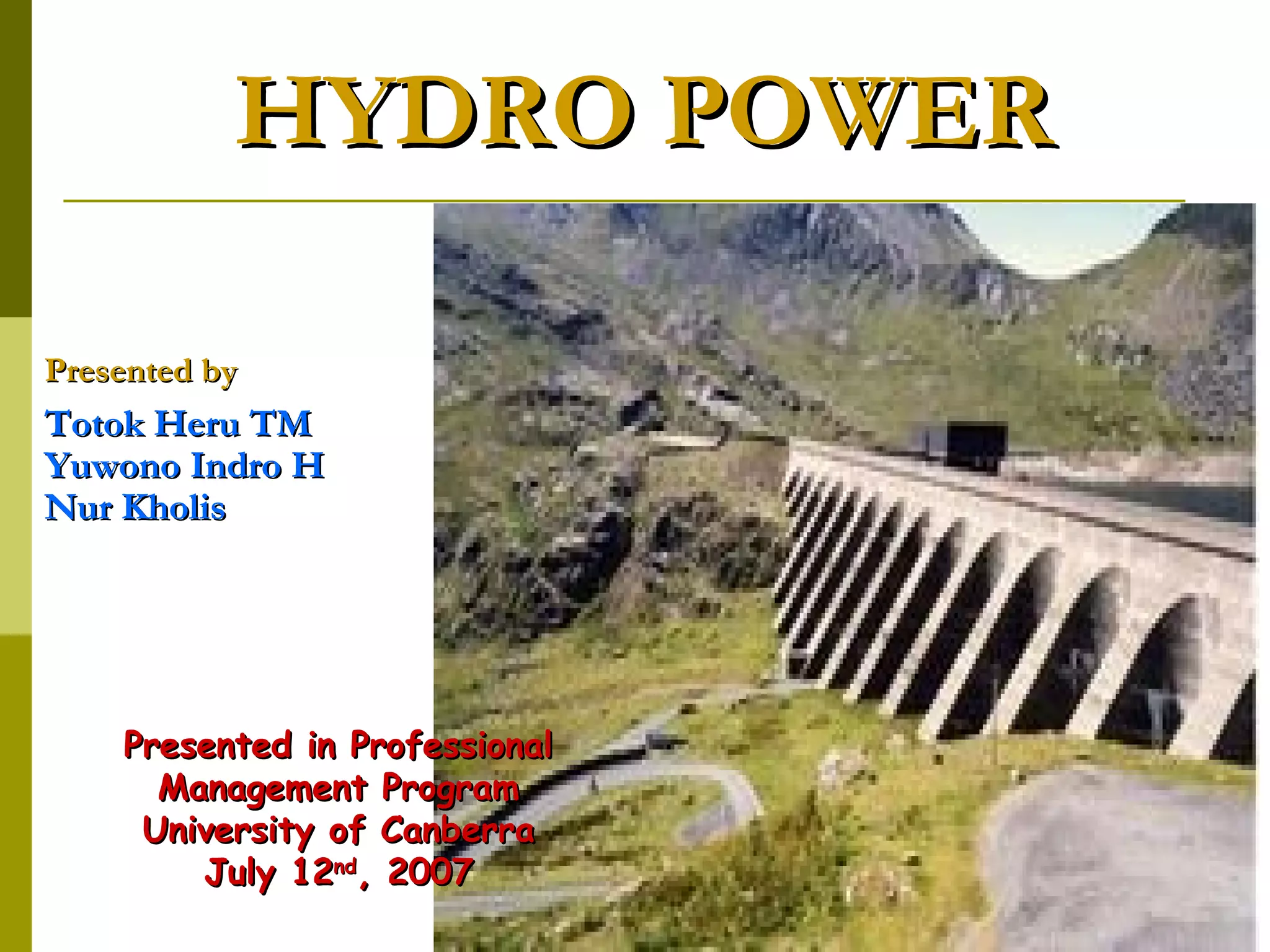
HYDRO POWERHYDRO POWER
Presented byPresented by
Totok Heru TMTotok Heru TM
Yuwono Indro HYuwono Indro H
Nur KholisNur Kholis
Presented in ProfessionalPresented in Professional
Management ProgramManagement Program
University of CanberraUniversity of Canberra
July 12July 12ndnd
, 2007, 2007
2
HYDRO POWERHYDRO POWER
Adopted fromAdopted from
Professor Stephen LawrenceProfessor Stephen Lawrence
Leeds School of BusinessLeeds School of Business
University of ColoradoUniversity of Colorado
Boulder, COBoulder, CO
3
Description ofDescription of
Hydro PowerHydro Power
4
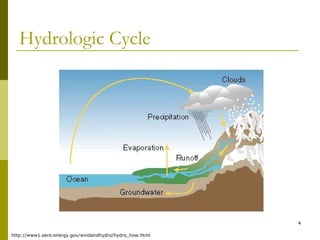
Hydrologic Cycle
http://www1.eere.energy.gov/windandhydro/hydro_how.html
5
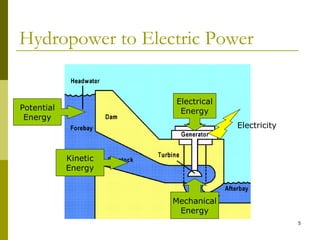
Hydropower to Electric Power
Potential
Energy
Kinetic
Energy
Electrical
Energy
Mechanical
Energy
Electricity
6
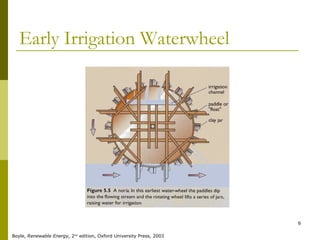
Early Irrigation Waterwheel
Boyle, Renewable Energy, 2nd
edition, Oxford University Press, 2003
7
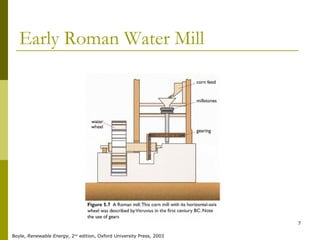
Early Roman Water Mill
Boyle, Renewable Energy, 2nd
edition, Oxford University Press, 2003
8
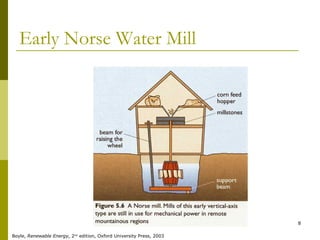
Early Norse Water Mill
Boyle, Renewable Energy, 2nd
edition, Oxford University Press, 2003
9
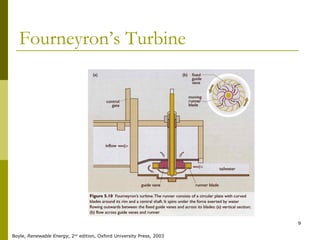
Fourneyron’s Turbine
Boyle, Renewable Energy, 2nd
edition, Oxford University Press, 2003
10
Hydropower DesignHydropower Design
11
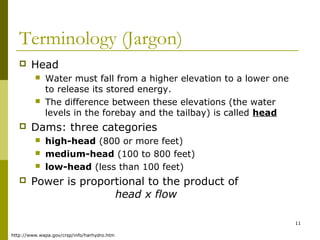
Terminology (Jargon)
 Head
 Water must fall from a higher elevation to a lower one
to release its stored energy.
 The difference between these elevations (the water
levels in the forebay and the tailbay) is called head
 Dams: three categories
 high-head (800 or more feet)
 medium-head (100 to 800 feet)
 low-head (less than 100 feet)
 Power is proportional to the product of
head x flow
http://www.wapa.gov/crsp/info/harhydro.htm
12
Scale of Hydropower Projects
 Large-hydro
 More than 100 MW feeding into a large electricity grid
 Medium-hydro
 15 - 100 MW usually feeding a grid
 Small-hydro
 1 - 15 MW - usually feeding into a grid
 Mini-hydro
 Above 100 kW, but below 1 MW
 Either stand alone schemes or more often feeding into the grid
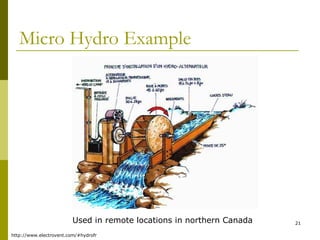
 Micro-hydro
 From 5kW up to 100 kW
 Usually provided power for a small community or rural industry
in remote areas away from the grid.
 Pico-hydro
 From a few hundred watts up to 5kW
 Remote areas away from the grid.
www.itdg.org/docs/technical_information_service/micro_hydro_power.pdf
13
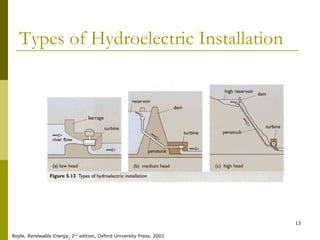
Types of Hydroelectric Installation
Boyle, Renewable Energy, 2nd
edition, Oxford University Press, 2003
14
Meeting Peak Demands
 Hydroelectric plants:
 Start easily and quickly and change power
output rapidly
 Complement large thermal plants (coal and
nuclear), which are most efficient in serving
base power loads.
 Save millions of barrels of oil
15
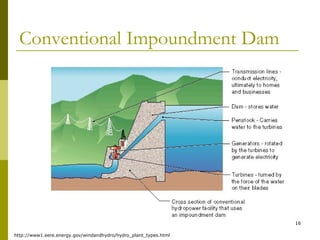
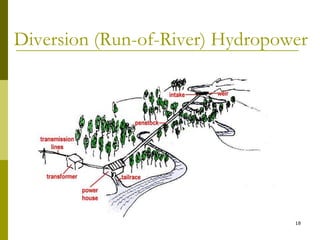
Types of Systems
 Impoundment
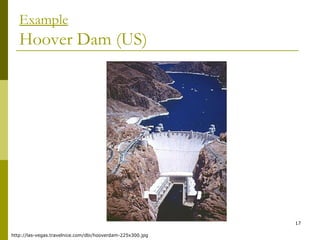
 Hoover Dam, Grand Coulee
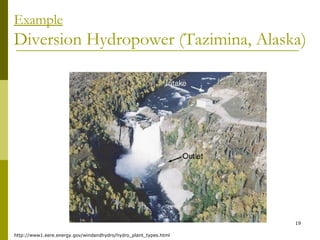
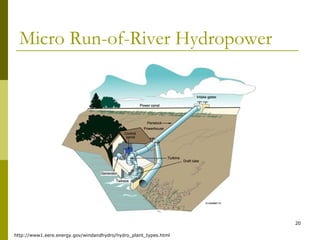
 Diversion or run-of-river systems
 Niagara Falls
 Most significantly smaller
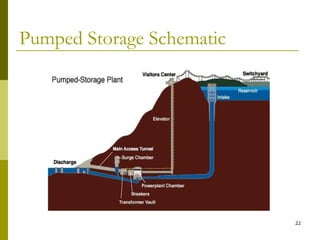
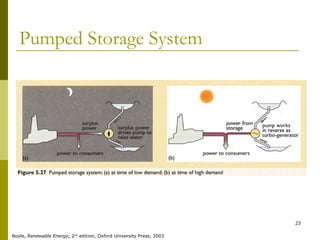
 Pumped Storage
 Two way flow
 Pumped up to a storage reservoir and returned
to a lower elevation for power generation
 A mechanism for energy storage, not net energy
production
16
Conventional Impoundment Dam
http://www1.eere.energy.gov/windandhydro/hydro_plant_types.html
17
Example
Hoover Dam (US)
http://las-vegas.travelnice.com/dbi/hooverdam-225x300.jpg
18
Diversion (Run-of-River) Hydropower
19
Example
Diversion Hydropower (Tazimina, Alaska)
http://www1.eere.energy.gov/windandhydro/hydro_plant_types.html
20
Micro Run-of-River Hydropower
http://www1.eere.energy.gov/windandhydro/hydro_plant_types.html
21
Micro Hydro Example
http://www.electrovent.com/#hydrofr
Used in remote locations in northern Canada
22
Pumped Storage Schematic
23
Pumped Storage System
Boyle, Renewable Energy, 2nd
edition, Oxford University Press, 2003
24
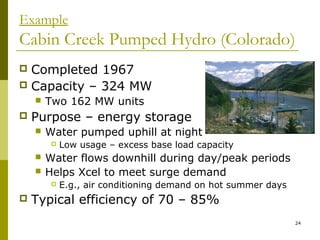
Example
Cabin Creek Pumped Hydro (Colorado)
 Completed 1967
 Capacity – 324 MW
 Two 162 MW units
 Purpose – energy storage
 Water pumped uphill at night
 Low usage – excess base load capacity
 Water flows downhill during day/peak periods
 Helps Xcel to meet surge demand
 E.g., air conditioning demand on hot summer days
 Typical efficiency of 70 – 85%
25
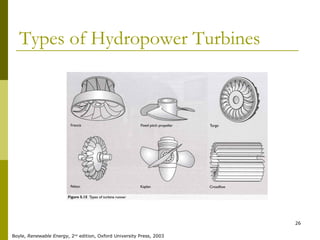
Turbine DesignTurbine Design
Francis TurbineFrancis Turbine
Kaplan TurbineKaplan Turbine
Pelton TurbinePelton Turbine
Turgo TurbineTurgo Turbine
26
Types of Hydropower Turbines
Boyle, Renewable Energy, 2nd
edition, Oxford University Press, 2003
27
Classification of Hydro Turbines
 Reaction Turbines
 Derive power from pressure drop across turbine
 Totally immersed in water
 Angular & linear motion converted to shaft power
 Propeller, Francis, and Kaplan turbines
 Impulse Turbines
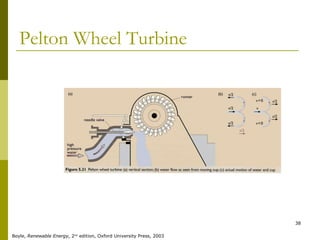
 Convert kinetic energy of water jet hitting buckets
 No pressure drop across turbines
 Pelton, Turgo, and crossflow turbines
28
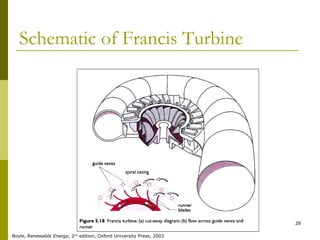
Schematic of Francis Turbine
Boyle, Renewable Energy, 2nd
edition, Oxford University Press, 2003
29
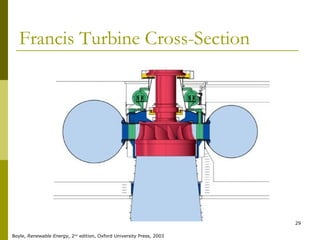
Francis Turbine Cross-Section
Boyle, Renewable Energy, 2nd
edition, Oxford University Press, 2003
30
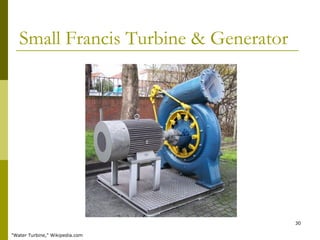
Small Francis Turbine & Generator
"Water Turbine," Wikipedia.com
31
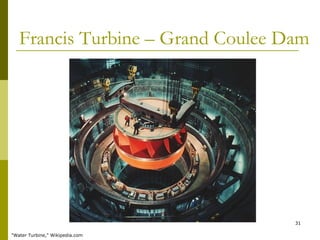
Francis Turbine – Grand Coulee Dam
"Water Turbine," Wikipedia.com
32
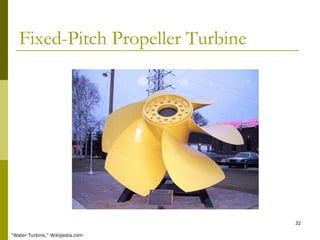
Fixed-Pitch Propeller Turbine
"Water Turbine," Wikipedia.com
33
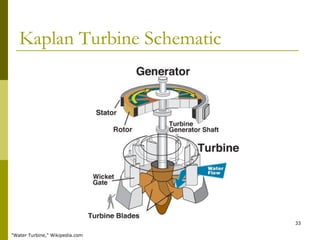
Kaplan Turbine Schematic
"Water Turbine," Wikipedia.com
34
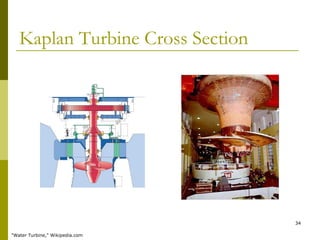
Kaplan Turbine Cross Section
"Water Turbine," Wikipedia.com
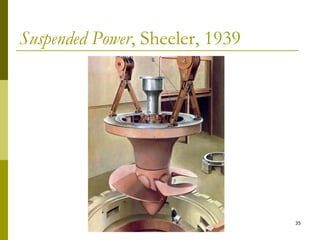
35
Suspended Power, Sheeler, 1939
36
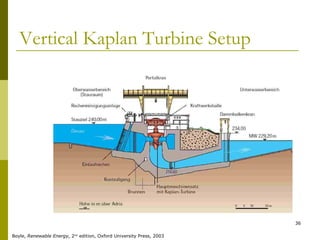
Vertical Kaplan Turbine Setup
Boyle, Renewable Energy, 2nd
edition, Oxford University Press, 2003
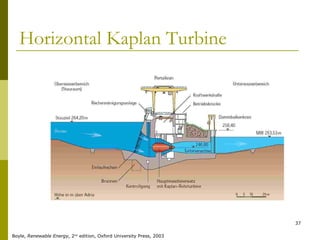
37
Horizontal Kaplan Turbine
Boyle, Renewable Energy, 2nd
edition, Oxford University Press, 2003
38
Pelton Wheel Turbine
Boyle, Renewable Energy, 2nd
edition, Oxford University Press, 2003
39
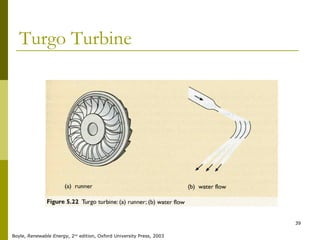
Turgo Turbine
Boyle, Renewable Energy, 2nd
edition, Oxford University Press, 2003
40
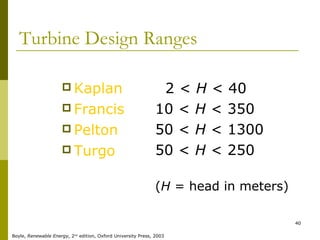
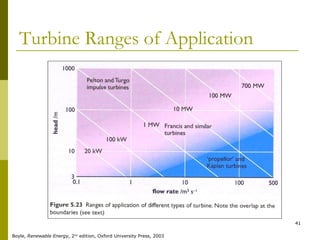
Turbine Design Ranges
 Kaplan
 Francis
 Pelton
 Turgo
2 < H < 40
10 < H < 350
50 < H < 1300
50 < H < 250
(H = head in meters)
Boyle, Renewable Energy, 2nd
edition, Oxford University Press, 2003
41
Turbine Ranges of Application
Boyle, Renewable Energy, 2nd
edition, Oxford University Press, 2003
42
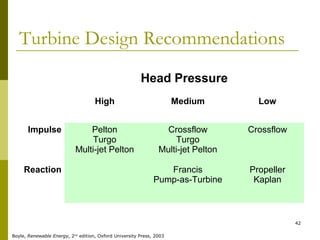
Turbine Design Recommendations
Head Pressure
High Medium Low
Impulse Pelton
Turgo
Multi-jet Pelton
Crossflow
Turgo
Multi-jet Pelton
Crossflow
Reaction Francis
Pump-as-Turbine
Propeller
Kaplan
Boyle, Renewable Energy, 2nd
edition, Oxford University Press, 2003
43
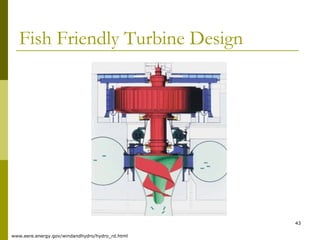
Fish Friendly Turbine Design
www.eere.energy.gov/windandhydro/hydro_rd.html
44
Hydro Power CalculationsHydro Power Calculations
YIH
45
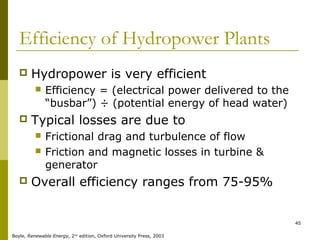
Efficiency of Hydropower Plants
 Hydropower is very efficient
 Efficiency = (electrical power delivered to the
“busbar”) ÷ (potential energy of head water)
 Typical losses are due to
 Frictional drag and turbulence of flow
 Friction and magnetic losses in turbine &
generator
 Overall efficiency ranges from 75-95%
Boyle, Renewable Energy, 2nd
edition, Oxford University Press, 2003
46
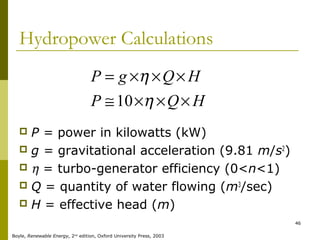
Hydropower Calculations
 P = power in kilowatts (kW)
 g = gravitational acceleration (9.81 m/s2
)
 η = turbo-generator efficiency (0<n<1)
 Q = quantity of water flowing (m3
/sec)
 H = effective head (m)
HQP
HQgP
×××≅
×××=
η
η
10
Boyle, Renewable Energy, 2nd
edition, Oxford University Press, 2003
47
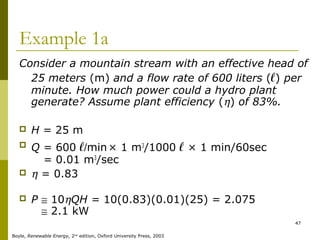
Example 1a
Consider a mountain stream with an effective head of
25 meters (m) and a flow rate of 600 liters (ℓ) per
minute. How much power could a hydro plant
generate? Assume plant efficiency (η) of 83%.
 H = 25 m
 Q = 600 ℓ/min× 1 m3
/1000 ℓ × 1 min/60sec
Q = 0.01 m3
/sec
 η = 0.83
 P ≅ 10ηQH = 10(0.83)(0.01)(25) = 2.075
P ≅ 2.1 kW
Boyle, Renewable Energy, 2nd
edition, Oxford University Press, 2003
48
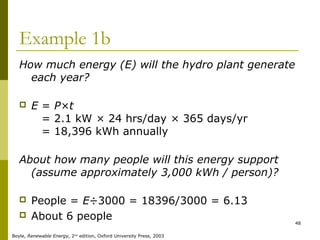
Example 1b
How much energy (E) will the hydro plant generate
each year?
 E = P×t
E = 2.1 kW × 24 hrs/day × 365 days/yr
E = 18,396 kWh annually
About how many people will this energy support
(assume approximately 3,000 kWh / person)?
 People = E÷3000 = 18396/3000 = 6.13
 About 6 people
Boyle, Renewable Energy, 2nd
edition, Oxford University Press, 2003
49
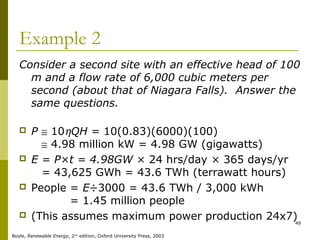
Example 2
Consider a second site with an effective head of 100
m and a flow rate of 6,000 cubic meters per
second (about that of Niagara Falls). Answer the
same questions.
 P ≅ 10ηQH = 10(0.83)(6000)(100)
P ≅ 4.98 million kW = 4.98 GW (gigawatts)
 E = P×t = 4.98GW × 24 hrs/day × 365 days/yr
E = 43,625 GWh = 43.6 TWh (terrawatt hours)
 People = E÷3000 = 43.6 TWh / 3,000 kWh
People = 1.45 million people
 (This assumes maximum power production 24x7)
Boyle, Renewable Energy, 2nd
edition, Oxford University Press, 2003
50
Hydropower in ContextHydropower in Context
51
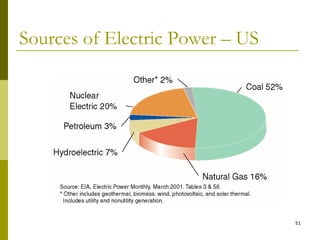
Sources of Electric Power – US
52
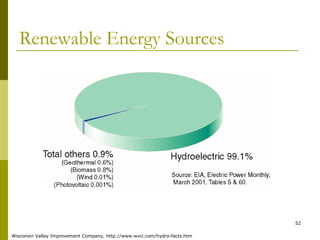
Renewable Energy Sources
Wisconsin Valley Improvement Company, http://www.wvic.com/hydro-facts.htm
53
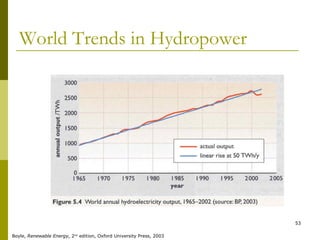
World Trends in Hydropower
Boyle, Renewable Energy, 2nd
edition, Oxford University Press, 2003
54
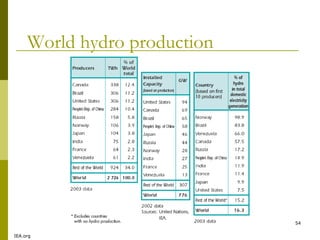
World hydro production
IEA.org
55
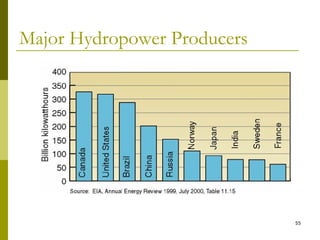
Major Hydropower Producers
56
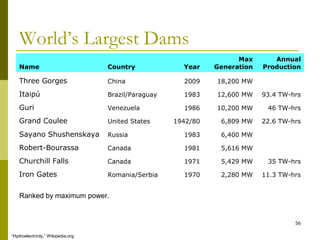
World’s Largest Dams
Ranked by maximum power.
Name Country Year
Max
Generation
Annual
Production
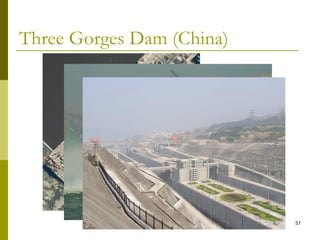
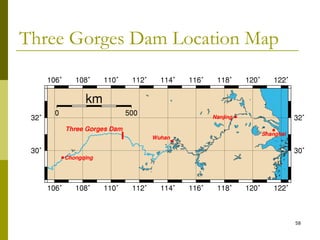
Three Gorges China 2009 18,200 MW
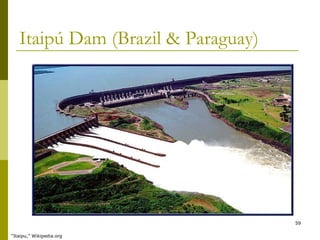
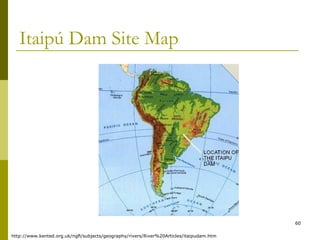
Itaipú Brazil/Paraguay 1983 12,600 MW 93.4 TW-hrs
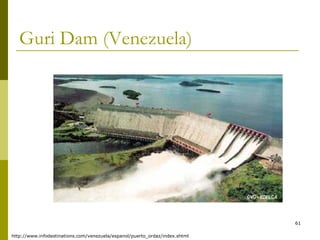
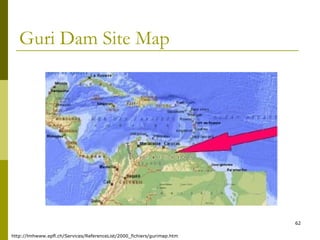
Guri Venezuela 1986 10,200 MW 46 TW-hrs
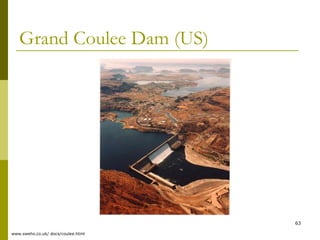
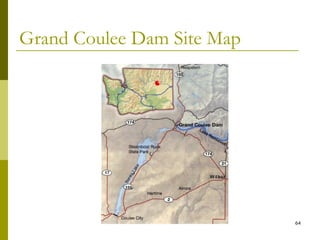
Grand Coulee United States 1942/80 6,809 MW 22.6 TW-hrs
Sayano Shushenskaya Russia 1983 6,400 MW
Robert-Bourassa Canada 1981 5,616 MW
Churchill Falls Canada 1971 5,429 MW 35 TW-hrs
Iron Gates Romania/Serbia 1970 2,280 MW 11.3 TW-hrs
“Hydroelectricity,” Wikipedia.org
57
Three Gorges Dam (China)
58
Three Gorges Dam Location Map
59
Itaipú Dam (Brazil & Paraguay)
“Itaipu,” Wikipedia.org
60
Itaipú Dam Site Map
http://www.kented.org.uk/ngfl/subjects/geography/rivers/River%20Articles/itaipudam.htm
61
Guri Dam (Venezuela)
http://www.infodestinations.com/venezuela/espanol/puerto_ordaz/index.shtml
62
Guri Dam Site Map
http://lmhwww.epfl.ch/Services/ReferenceList/2000_fichiers/gurimap.htm
63
Grand Coulee Dam (US)
www.swehs.co.uk/ docs/coulee.html
64
Grand Coulee Dam Site Map
65
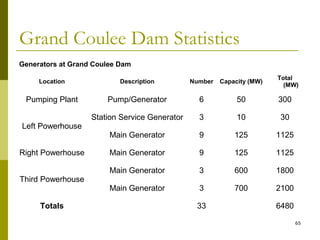
Grand Coulee Dam Statistics
Generators at Grand Coulee Dam
Location Description Number Capacity (MW)
Total
(MW)
Pumping Plant Pump/Generator 6 50 300
Left Powerhouse
Station Service Generator 3 10 30
Main Generator 9 125 1125
Right Powerhouse Main Generator 9 125 1125
Third Powerhouse
Main Generator 3 600 1800
Main Generator 3 700 2100
Totals 33 6480
66
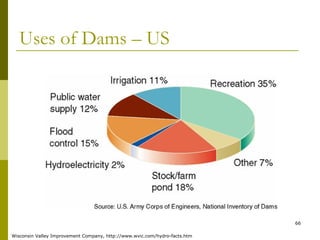
Uses of Dams – US
Wisconsin Valley Improvement Company, http://www.wvic.com/hydro-facts.htm
67
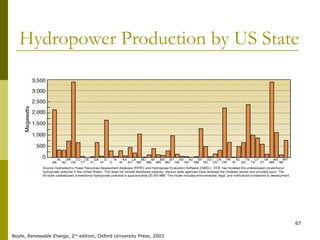
Hydropower Production by US State
Boyle, Renewable Energy, 2nd
edition, Oxford University Press, 2003
68
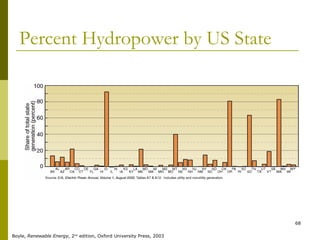
Percent Hydropower by US State
Boyle, Renewable Energy, 2nd
edition, Oxford University Press, 2003
69
Economics of HydropowerEconomics of Hydropower
70
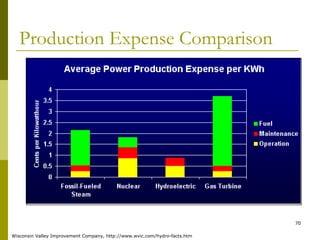
Production Expense Comparison
Wisconsin Valley Improvement Company, http://www.wvic.com/hydro-facts.htm
71
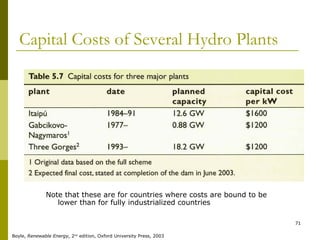
Capital Costs of Several Hydro Plants
Note that these are for countries where costs are bound to be
lower than for fully industrialized countries
Boyle, Renewable Energy, 2nd
edition, Oxford University Press, 2003
72
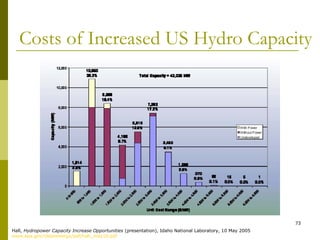
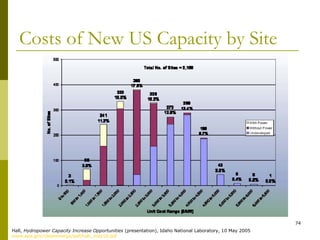
Estimates for US Hydro Construction
 Study of 2000 potential US hydro sites
 Potential capacities from 1-1300 MW
 Estimated development costs
 $2,000-4,000 per kW
 Civil engineering 65-75% of total
 Environmental studies & licensing 15-25%
 Turbo-generator & control systems ~10%
 Ongoing costs add ~1-2% to project NPV (!)
Hall et al. (2003), Estimation of Economic Parameters of US Hydropower Resources, Idaho National Laboratory
hydropower.id.doe.gov/resourceassessment/ pdfs/project_report-final_with_disclaimer-3jul03.pdf
73
Costs of Increased US Hydro Capacity
Hall, Hydropower Capacity Increase Opportunities (presentation), Idaho National Laboratory, 10 May 2005
www.epa.gov/cleanenergy/pdf/hall_may10.pdf
74
Costs of New US Capacity by Site
Hall, Hydropower Capacity Increase Opportunities (presentation), Idaho National Laboratory, 10 May 2005
www.epa.gov/cleanenergy/pdf/hall_may10.pdf
75
High Upfront Capital Expenses
 5 MW hydro plant with 25 m low head
 Construction cost of ~$20 million
 Negligible ongoing costs
 Ancillary benefits from dam
 flood control, recreation, irrigation, etc.
 50 MW combined-cycle gas turbine
 ~$20 million purchase cost of equipment
 Significant ongoing fuel costs
 Short-term pressures may favor fossil fuel
energy production
Boyle, Renewable Energy, 2nd
edition, Oxford University Press, 2003
76
Environmental ImpactsEnvironmental Impacts
NKH
77
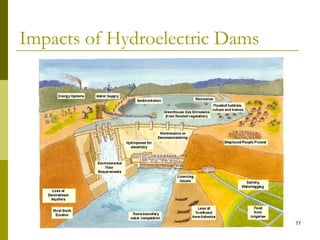
Impacts of Hydroelectric Dams
78
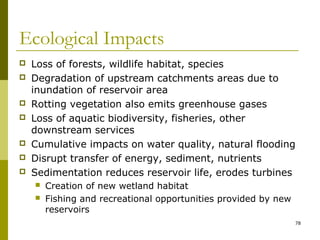
Ecological Impacts
 Loss of forests, wildlife habitat, species
 Degradation of upstream catchments areas due to
inundation of reservoir area
 Rotting vegetation also emits greenhouse gases
 Loss of aquatic biodiversity, fisheries, other
downstream services
 Cumulative impacts on water quality, natural flooding
 Disrupt transfer of energy, sediment, nutrients
 Sedimentation reduces reservoir life, erodes turbines
 Creation of new wetland habitat
 Fishing and recreational opportunities provided by new
reservoirs
79
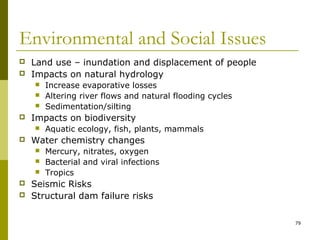
Environmental and Social Issues
 Land use – inundation and displacement of people
 Impacts on natural hydrology
 Increase evaporative losses
 Altering river flows and natural flooding cycles
 Sedimentation/silting
 Impacts on biodiversity
 Aquatic ecology, fish, plants, mammals
 Water chemistry changes
 Mercury, nitrates, oxygen
 Bacterial and viral infections
 Tropics
 Seismic Risks
 Structural dam failure risks
80
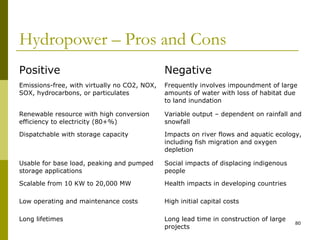
Hydropower – Pros and Cons
Positive Negative
Emissions-free, with virtually no CO2, NOX,
SOX, hydrocarbons, or particulates
Frequently involves impoundment of large
amounts of water with loss of habitat due
to land inundation
Renewable resource with high conversion
efficiency to electricity (80+%)
Variable output – dependent on rainfall and
snowfall
Dispatchable with storage capacity Impacts on river flows and aquatic ecology,
including fish migration and oxygen
depletion
Usable for base load, peaking and pumped
storage applications
Social impacts of displacing indigenous
people
Scalable from 10 KW to 20,000 MW Health impacts in developing countries
Low operating and maintenance costs High initial capital costs
Long lifetimes Long lead time in construction of large
projects
81
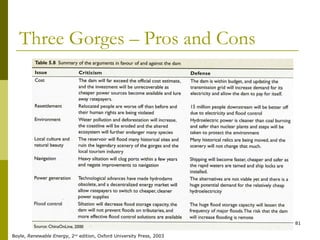
Three Gorges – Pros and Cons
Boyle, Renewable Energy, 2nd
edition, Oxford University Press, 2003
82
Future of HydropowerFuture of Hydropower
83
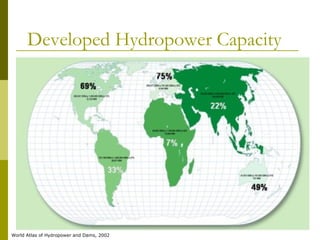
Developed Hydropower Capacity
World Atlas of Hydropower and Dams, 2002
84
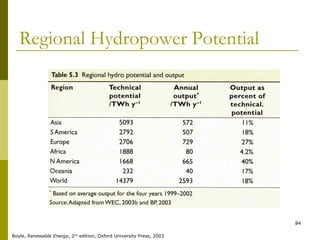
Regional Hydropower Potential
Boyle, Renewable Energy, 2nd
edition, Oxford University Press, 2003
85
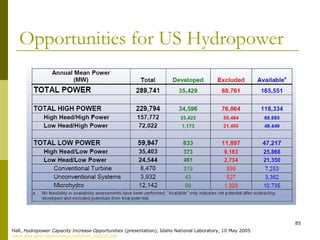
Opportunities for US Hydropower
Hall, Hydropower Capacity Increase Opportunities (presentation), Idaho National Laboratory, 10 May 2005
www.epa.gov/cleanenergy/pdf/hall_may10.pdf
86
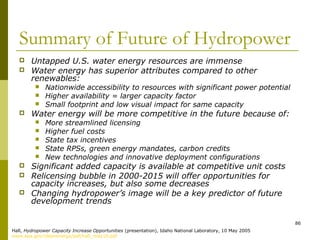
Summary of Future of Hydropower
 Untapped U.S. water energy resources are immense
 Water energy has superior attributes compared to other
renewables:
 Nationwide accessibility to resources with significant power potential
 Higher availability = larger capacity factor
 Small footprint and low visual impact for same capacity
 Water energy will be more competitive in the future because of:
 More streamlined licensing
 Higher fuel costs
 State tax incentives
 State RPSs, green energy mandates, carbon credits
 New technologies and innovative deployment configurations
 Significant added capacity is available at competitive unit costs
 Relicensing bubble in 2000-2015 will offer opportunities for
capacity increases, but also some decreases
 Changing hydropower’s image will be a key predictor of future
development trends
Hall, Hydropower Capacity Increase Opportunities (presentation), Idaho National Laboratory, 10 May 2005
www.epa.gov/cleanenergy/pdf/hall_may10.pdf
87
Thank you for your attentionThank you for your attention
Constructive criticsConstructive critics
needed …needed …

HYDRO POWER

  • 1.
    1 HYDRO POWERHYDRO POWER PresentedbyPresented by Totok Heru TMTotok Heru TM Yuwono Indro HYuwono Indro H Nur KholisNur Kholis Presented in ProfessionalPresented in Professional Management ProgramManagement Program University of CanberraUniversity of Canberra July 12July 12ndnd , 2007, 2007
  • 2.
    2 HYDRO POWERHYDRO POWER AdoptedfromAdopted from Professor Stephen LawrenceProfessor Stephen Lawrence Leeds School of BusinessLeeds School of Business University of ColoradoUniversity of Colorado Boulder, COBoulder, CO
  • 3.
  • 4.
  • 5.
    5 Hydropower to ElectricPower Potential Energy Kinetic Energy Electrical Energy Mechanical Energy Electricity
  • 6.
    6 Early Irrigation Waterwheel Boyle,Renewable Energy, 2nd edition, Oxford University Press, 2003
  • 7.
    7 Early Roman WaterMill Boyle, Renewable Energy, 2nd edition, Oxford University Press, 2003
  • 8.
    8 Early Norse WaterMill Boyle, Renewable Energy, 2nd edition, Oxford University Press, 2003
  • 9.
    9 Fourneyron’s Turbine Boyle, RenewableEnergy, 2nd edition, Oxford University Press, 2003
  • 10.
  • 11.
    11 Terminology (Jargon)  Head Water must fall from a higher elevation to a lower one to release its stored energy.  The difference between these elevations (the water levels in the forebay and the tailbay) is called head  Dams: three categories  high-head (800 or more feet)  medium-head (100 to 800 feet)  low-head (less than 100 feet)  Power is proportional to the product of head x flow http://www.wapa.gov/crsp/info/harhydro.htm
  • 12.
    12 Scale of HydropowerProjects  Large-hydro  More than 100 MW feeding into a large electricity grid  Medium-hydro  15 - 100 MW usually feeding a grid  Small-hydro  1 - 15 MW - usually feeding into a grid  Mini-hydro  Above 100 kW, but below 1 MW  Either stand alone schemes or more often feeding into the grid  Micro-hydro  From 5kW up to 100 kW  Usually provided power for a small community or rural industry in remote areas away from the grid.  Pico-hydro  From a few hundred watts up to 5kW  Remote areas away from the grid. www.itdg.org/docs/technical_information_service/micro_hydro_power.pdf
  • 13.
    13 Types of HydroelectricInstallation Boyle, Renewable Energy, 2nd edition, Oxford University Press, 2003
  • 14.
    14 Meeting Peak Demands Hydroelectric plants:  Start easily and quickly and change power output rapidly  Complement large thermal plants (coal and nuclear), which are most efficient in serving base power loads.  Save millions of barrels of oil
  • 15.
    15 Types of Systems Impoundment  Hoover Dam, Grand Coulee  Diversion or run-of-river systems  Niagara Falls  Most significantly smaller  Pumped Storage  Two way flow  Pumped up to a storage reservoir and returned to a lower elevation for power generation  A mechanism for energy storage, not net energy production
  • 16.
  • 17.
  • 18.
  • 19.
    19 Example Diversion Hydropower (Tazimina,Alaska) http://www1.eere.energy.gov/windandhydro/hydro_plant_types.html
  • 20.
  • 21.
  • 22.
  • 23.
    23 Pumped Storage System Boyle,Renewable Energy, 2nd edition, Oxford University Press, 2003
  • 24.
    24 Example Cabin Creek PumpedHydro (Colorado)  Completed 1967  Capacity – 324 MW  Two 162 MW units  Purpose – energy storage  Water pumped uphill at night  Low usage – excess base load capacity  Water flows downhill during day/peak periods  Helps Xcel to meet surge demand  E.g., air conditioning demand on hot summer days  Typical efficiency of 70 – 85%
  • 25.
    25 Turbine DesignTurbine Design FrancisTurbineFrancis Turbine Kaplan TurbineKaplan Turbine Pelton TurbinePelton Turbine Turgo TurbineTurgo Turbine
  • 26.
    26 Types of HydropowerTurbines Boyle, Renewable Energy, 2nd edition, Oxford University Press, 2003
  • 27.
    27 Classification of HydroTurbines  Reaction Turbines  Derive power from pressure drop across turbine  Totally immersed in water  Angular & linear motion converted to shaft power  Propeller, Francis, and Kaplan turbines  Impulse Turbines  Convert kinetic energy of water jet hitting buckets  No pressure drop across turbines  Pelton, Turgo, and crossflow turbines
  • 28.
    28 Schematic of FrancisTurbine Boyle, Renewable Energy, 2nd edition, Oxford University Press, 2003
  • 29.
    29 Francis Turbine Cross-Section Boyle,Renewable Energy, 2nd edition, Oxford University Press, 2003
  • 30.
    30 Small Francis Turbine& Generator "Water Turbine," Wikipedia.com
  • 31.
    31 Francis Turbine –Grand Coulee Dam "Water Turbine," Wikipedia.com
  • 32.
  • 33.
    33 Kaplan Turbine Schematic "WaterTurbine," Wikipedia.com
  • 34.
    34 Kaplan Turbine CrossSection "Water Turbine," Wikipedia.com
  • 35.
  • 36.
    36 Vertical Kaplan TurbineSetup Boyle, Renewable Energy, 2nd edition, Oxford University Press, 2003
  • 37.
    37 Horizontal Kaplan Turbine Boyle,Renewable Energy, 2nd edition, Oxford University Press, 2003
  • 38.
    38 Pelton Wheel Turbine Boyle,Renewable Energy, 2nd edition, Oxford University Press, 2003
  • 39.
    39 Turgo Turbine Boyle, RenewableEnergy, 2nd edition, Oxford University Press, 2003
  • 40.
    40 Turbine Design Ranges Kaplan  Francis  Pelton  Turgo 2 < H < 40 10 < H < 350 50 < H < 1300 50 < H < 250 (H = head in meters) Boyle, Renewable Energy, 2nd edition, Oxford University Press, 2003
  • 41.
    41 Turbine Ranges ofApplication Boyle, Renewable Energy, 2nd edition, Oxford University Press, 2003
  • 42.
    42 Turbine Design Recommendations HeadPressure High Medium Low Impulse Pelton Turgo Multi-jet Pelton Crossflow Turgo Multi-jet Pelton Crossflow Reaction Francis Pump-as-Turbine Propeller Kaplan Boyle, Renewable Energy, 2nd edition, Oxford University Press, 2003
  • 43.
    43 Fish Friendly TurbineDesign www.eere.energy.gov/windandhydro/hydro_rd.html
  • 44.
    44 Hydro Power CalculationsHydroPower Calculations YIH
  • 45.
    45 Efficiency of HydropowerPlants  Hydropower is very efficient  Efficiency = (electrical power delivered to the “busbar”) ÷ (potential energy of head water)  Typical losses are due to  Frictional drag and turbulence of flow  Friction and magnetic losses in turbine & generator  Overall efficiency ranges from 75-95% Boyle, Renewable Energy, 2nd edition, Oxford University Press, 2003
  • 46.
    46 Hydropower Calculations  P= power in kilowatts (kW)  g = gravitational acceleration (9.81 m/s2 )  η = turbo-generator efficiency (0<n<1)  Q = quantity of water flowing (m3 /sec)  H = effective head (m) HQP HQgP ×××≅ ×××= η η 10 Boyle, Renewable Energy, 2nd edition, Oxford University Press, 2003
  • 47.
    47 Example 1a Consider amountain stream with an effective head of 25 meters (m) and a flow rate of 600 liters (ℓ) per minute. How much power could a hydro plant generate? Assume plant efficiency (η) of 83%.  H = 25 m  Q = 600 ℓ/min× 1 m3 /1000 ℓ × 1 min/60sec Q = 0.01 m3 /sec  η = 0.83  P ≅ 10ηQH = 10(0.83)(0.01)(25) = 2.075 P ≅ 2.1 kW Boyle, Renewable Energy, 2nd edition, Oxford University Press, 2003
  • 48.
    48 Example 1b How muchenergy (E) will the hydro plant generate each year?  E = P×t E = 2.1 kW × 24 hrs/day × 365 days/yr E = 18,396 kWh annually About how many people will this energy support (assume approximately 3,000 kWh / person)?  People = E÷3000 = 18396/3000 = 6.13  About 6 people Boyle, Renewable Energy, 2nd edition, Oxford University Press, 2003
  • 49.
    49 Example 2 Consider asecond site with an effective head of 100 m and a flow rate of 6,000 cubic meters per second (about that of Niagara Falls). Answer the same questions.  P ≅ 10ηQH = 10(0.83)(6000)(100) P ≅ 4.98 million kW = 4.98 GW (gigawatts)  E = P×t = 4.98GW × 24 hrs/day × 365 days/yr E = 43,625 GWh = 43.6 TWh (terrawatt hours)  People = E÷3000 = 43.6 TWh / 3,000 kWh People = 1.45 million people  (This assumes maximum power production 24x7) Boyle, Renewable Energy, 2nd edition, Oxford University Press, 2003
  • 50.
  • 51.
  • 52.
    52 Renewable Energy Sources WisconsinValley Improvement Company, http://www.wvic.com/hydro-facts.htm
  • 53.
    53 World Trends inHydropower Boyle, Renewable Energy, 2nd edition, Oxford University Press, 2003
  • 54.
  • 55.
  • 56.
    56 World’s Largest Dams Rankedby maximum power. Name Country Year Max Generation Annual Production Three Gorges China 2009 18,200 MW Itaipú Brazil/Paraguay 1983 12,600 MW 93.4 TW-hrs Guri Venezuela 1986 10,200 MW 46 TW-hrs Grand Coulee United States 1942/80 6,809 MW 22.6 TW-hrs Sayano Shushenskaya Russia 1983 6,400 MW Robert-Bourassa Canada 1981 5,616 MW Churchill Falls Canada 1971 5,429 MW 35 TW-hrs Iron Gates Romania/Serbia 1970 2,280 MW 11.3 TW-hrs “Hydroelectricity,” Wikipedia.org
  • 57.
  • 58.
    58 Three Gorges DamLocation Map
  • 59.
    59 Itaipú Dam (Brazil& Paraguay) “Itaipu,” Wikipedia.org
  • 60.
    60 Itaipú Dam SiteMap http://www.kented.org.uk/ngfl/subjects/geography/rivers/River%20Articles/itaipudam.htm
  • 61.
  • 62.
    62 Guri Dam SiteMap http://lmhwww.epfl.ch/Services/ReferenceList/2000_fichiers/gurimap.htm
  • 63.
    63 Grand Coulee Dam(US) www.swehs.co.uk/ docs/coulee.html
  • 64.
  • 65.
    65 Grand Coulee DamStatistics Generators at Grand Coulee Dam Location Description Number Capacity (MW) Total (MW) Pumping Plant Pump/Generator 6 50 300 Left Powerhouse Station Service Generator 3 10 30 Main Generator 9 125 1125 Right Powerhouse Main Generator 9 125 1125 Third Powerhouse Main Generator 3 600 1800 Main Generator 3 700 2100 Totals 33 6480
  • 66.
    66 Uses of Dams– US Wisconsin Valley Improvement Company, http://www.wvic.com/hydro-facts.htm
  • 67.
    67 Hydropower Production byUS State Boyle, Renewable Energy, 2nd edition, Oxford University Press, 2003
  • 68.
    68 Percent Hydropower byUS State Boyle, Renewable Energy, 2nd edition, Oxford University Press, 2003
  • 69.
  • 70.
    70 Production Expense Comparison WisconsinValley Improvement Company, http://www.wvic.com/hydro-facts.htm
  • 71.
    71 Capital Costs ofSeveral Hydro Plants Note that these are for countries where costs are bound to be lower than for fully industrialized countries Boyle, Renewable Energy, 2nd edition, Oxford University Press, 2003
  • 72.
    72 Estimates for USHydro Construction  Study of 2000 potential US hydro sites  Potential capacities from 1-1300 MW  Estimated development costs  $2,000-4,000 per kW  Civil engineering 65-75% of total  Environmental studies & licensing 15-25%  Turbo-generator & control systems ~10%  Ongoing costs add ~1-2% to project NPV (!) Hall et al. (2003), Estimation of Economic Parameters of US Hydropower Resources, Idaho National Laboratory hydropower.id.doe.gov/resourceassessment/ pdfs/project_report-final_with_disclaimer-3jul03.pdf
  • 73.
    73 Costs of IncreasedUS Hydro Capacity Hall, Hydropower Capacity Increase Opportunities (presentation), Idaho National Laboratory, 10 May 2005 www.epa.gov/cleanenergy/pdf/hall_may10.pdf
  • 74.
    74 Costs of NewUS Capacity by Site Hall, Hydropower Capacity Increase Opportunities (presentation), Idaho National Laboratory, 10 May 2005 www.epa.gov/cleanenergy/pdf/hall_may10.pdf
  • 75.
    75 High Upfront CapitalExpenses  5 MW hydro plant with 25 m low head  Construction cost of ~$20 million  Negligible ongoing costs  Ancillary benefits from dam  flood control, recreation, irrigation, etc.  50 MW combined-cycle gas turbine  ~$20 million purchase cost of equipment  Significant ongoing fuel costs  Short-term pressures may favor fossil fuel energy production Boyle, Renewable Energy, 2nd edition, Oxford University Press, 2003
  • 76.
  • 77.
  • 78.
    78 Ecological Impacts  Lossof forests, wildlife habitat, species  Degradation of upstream catchments areas due to inundation of reservoir area  Rotting vegetation also emits greenhouse gases  Loss of aquatic biodiversity, fisheries, other downstream services  Cumulative impacts on water quality, natural flooding  Disrupt transfer of energy, sediment, nutrients  Sedimentation reduces reservoir life, erodes turbines  Creation of new wetland habitat  Fishing and recreational opportunities provided by new reservoirs
  • 79.
    79 Environmental and SocialIssues  Land use – inundation and displacement of people  Impacts on natural hydrology  Increase evaporative losses  Altering river flows and natural flooding cycles  Sedimentation/silting  Impacts on biodiversity  Aquatic ecology, fish, plants, mammals  Water chemistry changes  Mercury, nitrates, oxygen  Bacterial and viral infections  Tropics  Seismic Risks  Structural dam failure risks
  • 80.
    80 Hydropower – Prosand Cons Positive Negative Emissions-free, with virtually no CO2, NOX, SOX, hydrocarbons, or particulates Frequently involves impoundment of large amounts of water with loss of habitat due to land inundation Renewable resource with high conversion efficiency to electricity (80+%) Variable output – dependent on rainfall and snowfall Dispatchable with storage capacity Impacts on river flows and aquatic ecology, including fish migration and oxygen depletion Usable for base load, peaking and pumped storage applications Social impacts of displacing indigenous people Scalable from 10 KW to 20,000 MW Health impacts in developing countries Low operating and maintenance costs High initial capital costs Long lifetimes Long lead time in construction of large projects
  • 81.
    81 Three Gorges –Pros and Cons Boyle, Renewable Energy, 2nd edition, Oxford University Press, 2003
  • 82.
  • 83.
    83 Developed Hydropower Capacity WorldAtlas of Hydropower and Dams, 2002
  • 84.
    84 Regional Hydropower Potential Boyle,Renewable Energy, 2nd edition, Oxford University Press, 2003
  • 85.
    85 Opportunities for USHydropower Hall, Hydropower Capacity Increase Opportunities (presentation), Idaho National Laboratory, 10 May 2005 www.epa.gov/cleanenergy/pdf/hall_may10.pdf
  • 86.
    86 Summary of Futureof Hydropower  Untapped U.S. water energy resources are immense  Water energy has superior attributes compared to other renewables:  Nationwide accessibility to resources with significant power potential  Higher availability = larger capacity factor  Small footprint and low visual impact for same capacity  Water energy will be more competitive in the future because of:  More streamlined licensing  Higher fuel costs  State tax incentives  State RPSs, green energy mandates, carbon credits  New technologies and innovative deployment configurations  Significant added capacity is available at competitive unit costs  Relicensing bubble in 2000-2015 will offer opportunities for capacity increases, but also some decreases  Changing hydropower’s image will be a key predictor of future development trends Hall, Hydropower Capacity Increase Opportunities (presentation), Idaho National Laboratory, 10 May 2005 www.epa.gov/cleanenergy/pdf/hall_may10.pdf
  • 87.
    87 Thank you foryour attentionThank you for your attention Constructive criticsConstructive critics needed …needed …

Editor's Notes

  • #25 Efficiency losses from water evaporation at upper reservoir and usual mechanical efficiency losses http://www.xcelenergy.com/XLWEB/CDA/0,3080,1-1-1_1875_4797_4010-3663-2_209_376-0,00.html http://en.wikipedia.org/wiki/Pumped-storage_hydroelectricity
  • #80 Proposed projects from: http://www.eia.doe.gov/cneaf/electricity/page/capacity/proposedunits.xls
  • #81 Proposed projects from: http://www.eia.doe.gov/cneaf/electricity/page/capacity/proposedunits.xls