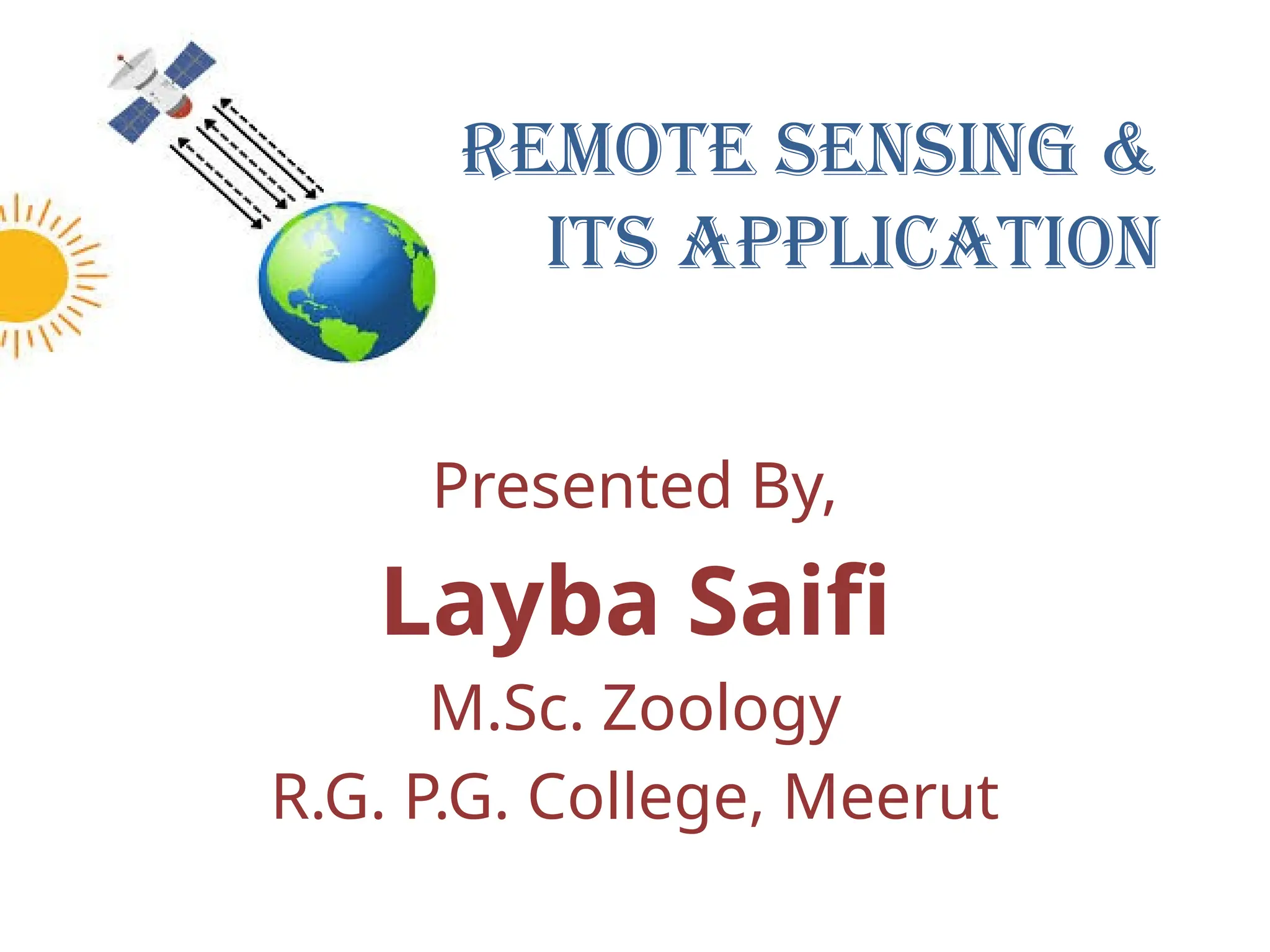
REMOTE SENSING &
ITS APPLICATION
Presented By,
Layba Saifi
M.Sc. Zoology
R.G. P.G. College, Meerut
INTRODUCTION
“Remote” means “far away” and
“Sensing” means “Believing or
observing or acquiring some
information”.
Remote Sensing means acquiring
information of things from a
distance with sensors. (without
touching the things )
Sensors are like simple cameras
except that they not only use
visible light but also other
bands of the electromagnetic
spectrum such as infrared ,
microwaves and ultraviolet
regions.
Distance of remote sensing
• Remote sensing occurs at a
distance from the object or area of
interest . It could be 1m , 1000m or
greater than 1 million metres .
• Nowadays , remote sensing is
mainly done from space using
satellites.
Definition of remote sensing
Remote sensing is :
“ The art and science of obtaining information
about an object without being in direct
contact with the object”. ( Jensen 2000)
• India’s National Remote Sensing Agency
(NRSA) defines as : “Remote sensing is the
technique of deriving information about
objects on the surface of the earth without
physically coming into contact with them”.
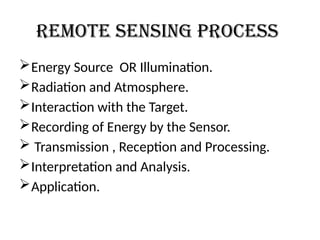
REMOTE SENSING PROCESS
Energy Source OR Illumination.
Radiation and Atmosphere.
Interaction with the Target.
Recording of Energy by the Sensor.
 Transmission , Reception and Processing.
Interpretation and Analysis.
Application.
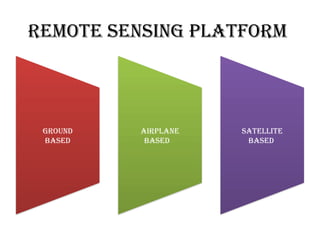
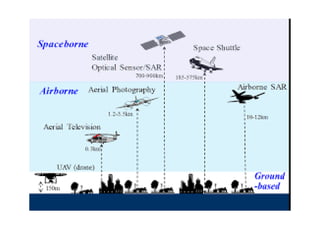
Remote sensing platform
Ground
Based
Airplane
Based
Satellite
Based
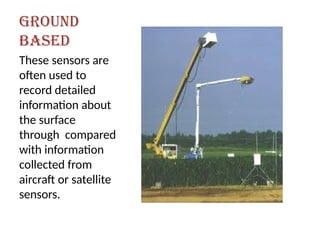
GROUND
BASED
These sensors are
often used to
record detailed
information about
the surface
through compared
with information
collected from
aircraft or satellite
sensors.
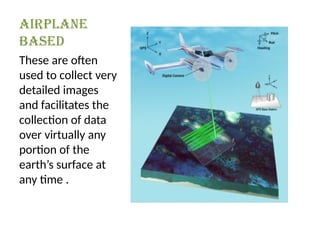
Airplane
Based
These are often
used to collect very
detailed images
and facilitates the
collection of data
over virtually any
portion of the
earth’s surface at
any time .
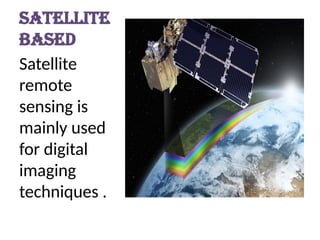
Satellite
Based
Satellite
remote
sensing is
mainly used
for digital
imaging
techniques .
Application of
remote sensing
In geology
 Remote sensing is used as a tool to extract information
about the land surface , composition or subsurface .
 Radar provides an expression of surface topography and
roughness .
 Geological applications of remote sensing include the
following:
1. Lithological mapping
2. Structural mapping
3. Mineral exploration
4. Bedrock mapping
In mapping
Remote sensing data helps in create detailed
maps of earth’s surface.
Satellite and aerial vehicles capture image that
reveal land cover , elevation and even the
presence of buildings and roads.
 this information is vital for urban planning ,
infrastructure development and resource
management.
In environmental monitoring
Remote sensing is crucial for tracking changes
in the environment.
It allows scientists to monitor deforestation,
track pollution level, assess the health of
forests and oceans, and the impact of climate
changes on various ecosystems.
In disaster management
During natural disasters like floods, wildfires
and earthquakes remote sensing plays a vital
role in damage assessment and rescue efforts.
Satellites can quickly provides images of
affected areas, helping emergency responders
to identify the extent of damage and prioritize
relief efforts.
In Agriculture
Farmers use remote sensors to monitor crops
health , tracks irrigation needs and identify
areas with nutrient deficiencies.
This information helps them optimize farming
practices, improve crop yields and reduce
environmental impact.
REMOTE SENSING AND ITS APPLICATIONS.pptx

REMOTE SENSING AND ITS APPLICATIONS.pptx

  • 1.
    REMOTE SENSING & ITSAPPLICATION Presented By, Layba Saifi M.Sc. Zoology R.G. P.G. College, Meerut
  • 3.
    INTRODUCTION “Remote” means “faraway” and “Sensing” means “Believing or observing or acquiring some information”. Remote Sensing means acquiring information of things from a distance with sensors. (without touching the things )
  • 4.
    Sensors are likesimple cameras except that they not only use visible light but also other bands of the electromagnetic spectrum such as infrared , microwaves and ultraviolet regions.
  • 5.
    Distance of remotesensing • Remote sensing occurs at a distance from the object or area of interest . It could be 1m , 1000m or greater than 1 million metres . • Nowadays , remote sensing is mainly done from space using satellites.
  • 6.
    Definition of remotesensing Remote sensing is : “ The art and science of obtaining information about an object without being in direct contact with the object”. ( Jensen 2000) • India’s National Remote Sensing Agency (NRSA) defines as : “Remote sensing is the technique of deriving information about objects on the surface of the earth without physically coming into contact with them”.
  • 7.
    REMOTE SENSING PROCESS EnergySource OR Illumination. Radiation and Atmosphere. Interaction with the Target. Recording of Energy by the Sensor.  Transmission , Reception and Processing. Interpretation and Analysis. Application.
  • 8.
  • 10.
    GROUND BASED These sensors are oftenused to record detailed information about the surface through compared with information collected from aircraft or satellite sensors.
  • 11.
    Airplane Based These are often usedto collect very detailed images and facilitates the collection of data over virtually any portion of the earth’s surface at any time .
  • 12.
  • 13.
  • 14.
    In geology  Remotesensing is used as a tool to extract information about the land surface , composition or subsurface .  Radar provides an expression of surface topography and roughness .  Geological applications of remote sensing include the following: 1. Lithological mapping 2. Structural mapping 3. Mineral exploration 4. Bedrock mapping
  • 15.
    In mapping Remote sensingdata helps in create detailed maps of earth’s surface. Satellite and aerial vehicles capture image that reveal land cover , elevation and even the presence of buildings and roads.  this information is vital for urban planning , infrastructure development and resource management.
  • 16.
    In environmental monitoring Remotesensing is crucial for tracking changes in the environment. It allows scientists to monitor deforestation, track pollution level, assess the health of forests and oceans, and the impact of climate changes on various ecosystems.
  • 17.
    In disaster management Duringnatural disasters like floods, wildfires and earthquakes remote sensing plays a vital role in damage assessment and rescue efforts. Satellites can quickly provides images of affected areas, helping emergency responders to identify the extent of damage and prioritize relief efforts.
  • 18.
    In Agriculture Farmers useremote sensors to monitor crops health , tracks irrigation needs and identify areas with nutrient deficiencies. This information helps them optimize farming practices, improve crop yields and reduce environmental impact.