1
MALNAD COLLEGE OF ENGINEERING,
HASSAN – 573 202, KARNATAKA
(An Autonomous Institution under VTU, Belgaum)
A SEMINAR REPORT
On
“GREEN HYDROGEN FUEL CELL TECHNOLOGY”
In partial Fulfillment for the award of B.E degree in Mechanical Engineering
By
CHIRANTH H P
4MC21ME410
VIII SEMESTER
20ME801
DEPARTMENT OF MECHANICAL ENGINEERING
MALNAD COLLEGE OF ENGINEERING
Hassan – 573 201
2023 -2024
TABLE OF CONTENT
1. Introduction
2. What is fuel cell
3. Major components of fuel cell
4. Types of fuel cell
5. How does green hydrogen works
6. Advantages
7. Disadvantages
8. Application
9. Conclusion
10. Reference
INTRODUCTION
 The ever-increasing energy demand, depleting fossil fuel reserves, and rising
temperatures due to greenhouse gas emissions have necessitated the transition towards
the generation of green and clean energy through renewable energy sources.
 Solar energy is one such example for renewable energy source. However, solar energy
alone cannot replace fossil fuels in the energy portfolio.
 Hydrogen proves to be an ideal candidate in this domain and can be sustainably
generated by water electrolysis by powering the electrolyzer using solar energy.
 Hydrogen is currently produced from a variety of sources, including fossil fuels , natural
gas , water electrolysis , and even biological processes, such as biomass.
 The electrolysis process and the half-cell reactions - Hydrogen evolution reaction (HER)
at the cathode and Oxygen evolution reaction (OER) at the anode - are powered by
electricity obtained from renewable energy sources such as solar , wind , and so on, and
have a zero-carbon footprint, making this process environmentally friendly. Green
hydrogen is hydrogen that is created by the electrolysis of water, powered by a
sustainable renewable energy source.
INTRODUCTION
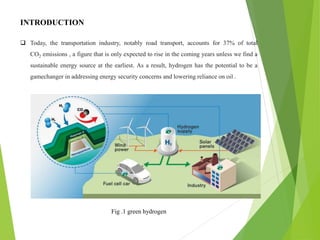
 Today, the transportation industry, notably road transport, accounts for 37% of total
CO2 emissions , a figure that is only expected to rise in the coming years unless we find a
sustainable energy source at the earliest. As a result, hydrogen has the potential to be a
gamechanger in addressing energy security concerns and lowering reliance on oil .
Fig .1 green hydrogen
What is Fuel Cell ?
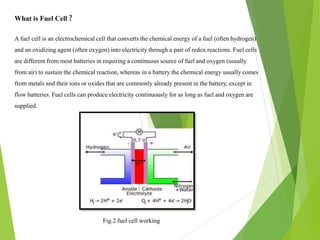
A fuel cell is an electrochemical cell that converts the chemical energy of a fuel (often hydrogen)
and an oxidizing agent (often oxygen) into electricity through a pair of redox reactions. Fuel cells
are different from most batteries in requiring a continuous source of fuel and oxygen (usually
from air) to sustain the chemical reaction, whereas in a battery the chemical energy usually comes
from metals and their ions or oxides that are commonly already present in the battery, except in
flow batteries. Fuel cells can produce electricity continuously for as long as fuel and oxygen are
supplied.
Fig.2 fuel cell working
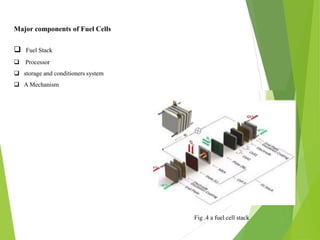
Major components of Fuel Cells
 Fuel Stack
 Processor
 storage and conditioners system
 A Mechanism
Fig .4 a fuel cell stack
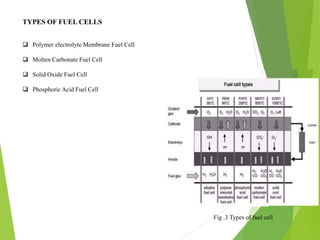
TYPES OF FUEL CELLS
 Polymer electrolyte Membrane Fuel Cell
 Molten Carbonate Fuel Cell
 Solid Oxide Fuel Cell
 Phosphoric Acid Fuel Cell
Fig .3 Types of fuel cell
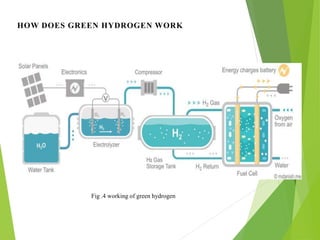
HOW DOES GREEN HYDROGEN WORK
Fig .4 working of green hydrogen
Green hydrogen is achieved through a process of electrolysis powered by renewable energies such as
wind or solar. Electrolysis involves using an electrical current to break down the water molecule into
oxygen and hydrogen by electrodes. When we need to turn it into energy, hydrogen stored in specific tanks
is channelled into a fuel cell. There it binds again with oxygen from the air and electricity is obtained.
Thus, the only by-product of the process is water, resulting in a clean, sustainable system in which zero
CO₂ is emitted to produce energy.
When we need to turn it into energy, hydrogen stored in specific tanks is channelled into a fuel cell. There
it binds again with oxygen from the air and electricity is obtained. Thus, the only by-product of the
process is water, resulting in a clean, sustainable system in which zero CO₂ is emitted to produce energy.
HOW DOES GREEN HYDROGEN WORK
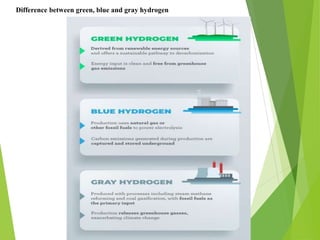
Difference between green, blue and gray hydrogen
ADVANTAGES
 It offers an effective method of energy storage.
 This technology offers a high level of energy efficiency.
 The emissions from a hydrogen fuel cell are virtually zero. Vehicles using a hydrogen
fuel cell achieve a better fuel economy rating.
 We receive a greater level of consistency with hydrogen fuel cells.
 You can reduce the risk of chemical exposure by using hydrogen fuel cells.
 Most fuel cell components are recyclable and reusable.
DISADVANTAGES
 You must regulate the temperature of a hydrogen fuel cell to
maximize its use.
 The cost to store hydrogen is expensive enough that it is prohibitive
for most people.
 It costs more to transport hydrogen than it does most other fuels.
 This technology is not widely available right now.
 It is not currently a complete renewable energy resource.
APPLICATIONS
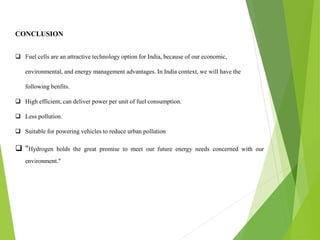
 Fuel cell technology has a wide range of applications. Currently, heavy research
is being conducted in order to manufacture a cost-efficient automobile which is
powered by a fuel cell. A few applications of this technology are listed below.
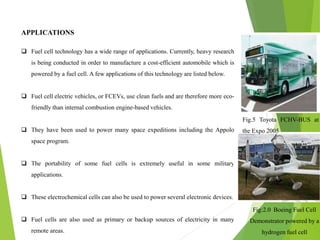
 Fuel cell electric vehicles, or FCEVs, use clean fuels and are therefore more eco-
friendly than internal combustion engine-based vehicles.
 They have been used to power many space expeditions including the Appolo
space program.
 The portability of some fuel cells is extremely useful in some military
applications.
 These electrochemical cells can also be used to power several electronic devices.
 Fuel cells are also used as primary or backup sources of electricity in many
remote areas.
Fig.5 Toyota FCHV-BUS at
the Expo 2005
Fig:2.0 Boeing Fuel Cell
Demonstrator powered by a
hydrogen fuel cell
CONCLUSION
 Fuel cells are an attractive technology option for India, because of our economic,
environmental, and energy management advantages. In India context, we will have the
following benfits.
 High efficient, can deliver power per unit of fuel consumption.
 Less pollution.
 Suitable for powering vehicles to reduce urban pollution
 "Hydrogen holds the great promise to meet our future energy needs concerned with our
environment."
REFRENCE:
 Li, Yanfei, and Farhad Taghizadeh-Hesary. "The economic feasibility of green hydrogen and fuel cell electric
vehicles for road transport in China." Energy Policy 160 (2022): 112703.
 Li, Y., & Taghizadeh-Hesary, F. (2022). The economic feasibility of green hydrogen and fuel cell electric
vehicles for road transport in China. Energy Policy, 160, 112703.
 Meda, Ujwal Shreenag, Yashesh Vijay Rajyaguru, and Aditi Pandey. "Generation of green hydrogen using self-
sustained regenerative fuel cells: Opportunities and challenges." International Journal of Hydrogen
Energy (2023).
 Meda, U. S., Rajyaguru, Y. V., & Pandey, A. (2023). Generation of green hydrogen using self-sustained
regenerative fuel cells: Opportunities and challenges. International Journal of Hydrogen Energy.
 Clark II, Woodrow W., and Jeremy Rifkin. "A green hydrogen economy." Energy Policy 34.17 (2006): 2630-
2639.
Thank You

green hydrogen fuel cell ppt by chiranth

  • 1.
    1 MALNAD COLLEGE OFENGINEERING, HASSAN – 573 202, KARNATAKA (An Autonomous Institution under VTU, Belgaum) A SEMINAR REPORT On “GREEN HYDROGEN FUEL CELL TECHNOLOGY” In partial Fulfillment for the award of B.E degree in Mechanical Engineering By CHIRANTH H P 4MC21ME410 VIII SEMESTER 20ME801 DEPARTMENT OF MECHANICAL ENGINEERING MALNAD COLLEGE OF ENGINEERING Hassan – 573 201 2023 -2024
  • 2.
    TABLE OF CONTENT 1.Introduction 2. What is fuel cell 3. Major components of fuel cell 4. Types of fuel cell 5. How does green hydrogen works 6. Advantages 7. Disadvantages 8. Application 9. Conclusion 10. Reference
  • 3.
    INTRODUCTION  The ever-increasingenergy demand, depleting fossil fuel reserves, and rising temperatures due to greenhouse gas emissions have necessitated the transition towards the generation of green and clean energy through renewable energy sources.  Solar energy is one such example for renewable energy source. However, solar energy alone cannot replace fossil fuels in the energy portfolio.  Hydrogen proves to be an ideal candidate in this domain and can be sustainably generated by water electrolysis by powering the electrolyzer using solar energy.  Hydrogen is currently produced from a variety of sources, including fossil fuels , natural gas , water electrolysis , and even biological processes, such as biomass.  The electrolysis process and the half-cell reactions - Hydrogen evolution reaction (HER) at the cathode and Oxygen evolution reaction (OER) at the anode - are powered by electricity obtained from renewable energy sources such as solar , wind , and so on, and have a zero-carbon footprint, making this process environmentally friendly. Green hydrogen is hydrogen that is created by the electrolysis of water, powered by a sustainable renewable energy source.
  • 4.
    INTRODUCTION  Today, thetransportation industry, notably road transport, accounts for 37% of total CO2 emissions , a figure that is only expected to rise in the coming years unless we find a sustainable energy source at the earliest. As a result, hydrogen has the potential to be a gamechanger in addressing energy security concerns and lowering reliance on oil . Fig .1 green hydrogen
  • 5.
    What is FuelCell ? A fuel cell is an electrochemical cell that converts the chemical energy of a fuel (often hydrogen) and an oxidizing agent (often oxygen) into electricity through a pair of redox reactions. Fuel cells are different from most batteries in requiring a continuous source of fuel and oxygen (usually from air) to sustain the chemical reaction, whereas in a battery the chemical energy usually comes from metals and their ions or oxides that are commonly already present in the battery, except in flow batteries. Fuel cells can produce electricity continuously for as long as fuel and oxygen are supplied. Fig.2 fuel cell working
  • 6.
    Major components ofFuel Cells  Fuel Stack  Processor  storage and conditioners system  A Mechanism Fig .4 a fuel cell stack
  • 7.
    TYPES OF FUELCELLS  Polymer electrolyte Membrane Fuel Cell  Molten Carbonate Fuel Cell  Solid Oxide Fuel Cell  Phosphoric Acid Fuel Cell Fig .3 Types of fuel cell
  • 8.
    HOW DOES GREENHYDROGEN WORK Fig .4 working of green hydrogen
  • 9.
    Green hydrogen isachieved through a process of electrolysis powered by renewable energies such as wind or solar. Electrolysis involves using an electrical current to break down the water molecule into oxygen and hydrogen by electrodes. When we need to turn it into energy, hydrogen stored in specific tanks is channelled into a fuel cell. There it binds again with oxygen from the air and electricity is obtained. Thus, the only by-product of the process is water, resulting in a clean, sustainable system in which zero CO₂ is emitted to produce energy. When we need to turn it into energy, hydrogen stored in specific tanks is channelled into a fuel cell. There it binds again with oxygen from the air and electricity is obtained. Thus, the only by-product of the process is water, resulting in a clean, sustainable system in which zero CO₂ is emitted to produce energy. HOW DOES GREEN HYDROGEN WORK
  • 10.
    Difference between green,blue and gray hydrogen
  • 11.
    ADVANTAGES  It offersan effective method of energy storage.  This technology offers a high level of energy efficiency.  The emissions from a hydrogen fuel cell are virtually zero. Vehicles using a hydrogen fuel cell achieve a better fuel economy rating.  We receive a greater level of consistency with hydrogen fuel cells.  You can reduce the risk of chemical exposure by using hydrogen fuel cells.  Most fuel cell components are recyclable and reusable.
  • 12.
    DISADVANTAGES  You mustregulate the temperature of a hydrogen fuel cell to maximize its use.  The cost to store hydrogen is expensive enough that it is prohibitive for most people.  It costs more to transport hydrogen than it does most other fuels.  This technology is not widely available right now.  It is not currently a complete renewable energy resource.
  • 13.
    APPLICATIONS  Fuel celltechnology has a wide range of applications. Currently, heavy research is being conducted in order to manufacture a cost-efficient automobile which is powered by a fuel cell. A few applications of this technology are listed below.  Fuel cell electric vehicles, or FCEVs, use clean fuels and are therefore more eco- friendly than internal combustion engine-based vehicles.  They have been used to power many space expeditions including the Appolo space program.  The portability of some fuel cells is extremely useful in some military applications.  These electrochemical cells can also be used to power several electronic devices.  Fuel cells are also used as primary or backup sources of electricity in many remote areas. Fig.5 Toyota FCHV-BUS at the Expo 2005 Fig:2.0 Boeing Fuel Cell Demonstrator powered by a hydrogen fuel cell
  • 14.
    CONCLUSION  Fuel cellsare an attractive technology option for India, because of our economic, environmental, and energy management advantages. In India context, we will have the following benfits.  High efficient, can deliver power per unit of fuel consumption.  Less pollution.  Suitable for powering vehicles to reduce urban pollution  "Hydrogen holds the great promise to meet our future energy needs concerned with our environment."
  • 15.
    REFRENCE:  Li, Yanfei,and Farhad Taghizadeh-Hesary. "The economic feasibility of green hydrogen and fuel cell electric vehicles for road transport in China." Energy Policy 160 (2022): 112703.  Li, Y., & Taghizadeh-Hesary, F. (2022). The economic feasibility of green hydrogen and fuel cell electric vehicles for road transport in China. Energy Policy, 160, 112703.  Meda, Ujwal Shreenag, Yashesh Vijay Rajyaguru, and Aditi Pandey. "Generation of green hydrogen using self- sustained regenerative fuel cells: Opportunities and challenges." International Journal of Hydrogen Energy (2023).  Meda, U. S., Rajyaguru, Y. V., & Pandey, A. (2023). Generation of green hydrogen using self-sustained regenerative fuel cells: Opportunities and challenges. International Journal of Hydrogen Energy.  Clark II, Woodrow W., and Jeremy Rifkin. "A green hydrogen economy." Energy Policy 34.17 (2006): 2630- 2639.
  • 16.