-SUSHANT VIMALKUMAR SHETE
(T Y B PHARM ,RCP KASEGAON)
(sushantshete1998@gmail.com)
•Learning objective-
 Mechanism of urine formation
 Definition and classification of diuretics
 MOA and SAR of each class
 Their dose and adverse effects
 Pharmacologicaol uses
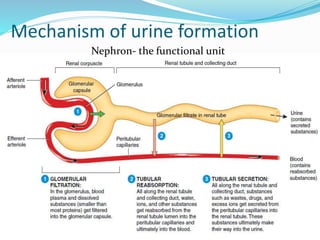
Mechanism of urine formation
Nephron- the functional unit
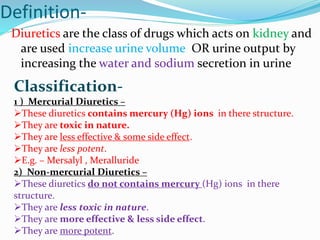
Definition-
Diuretics are the class of drugs which acts on kidney and
are used increase urine volume OR urine output by
increasing the water and sodium secretion in urine
Classification-
1 ) Mercurial Diuretics –
These diuretics contains mercury (Hg) ions in there structure.
They are toxic in nature.
They are less effective & some side effect.
They are less potent.
E.g. – Mersalyl , Meralluride
2) Non-mercurial Diuretics –
These diuretics do not contains mercury (Hg) ions in there
structure.
They are less toxic in nature.
They are more effective & less side effect.
They are more potent.
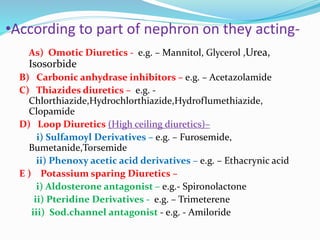
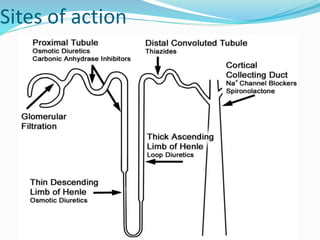
•According to part of nephron on they acting-
As) Omotic Diuretics - e.g. – Mannitol, Glycerol ,Urea,
Isosorbide
B) Carbonic anhydrase inhibitors – e.g. – Acetazolamide
C) Thiazides diuretics – e.g. -
Chlorthiazide,Hydrochlorthiazide,Hydroflumethiazide,
Clopamide
D) Loop Diuretics (High ceiling diuretics)–
i) Sulfamoyl Derivatives – e.g. – Furosemide,
Bumetanide,Torsemide
ii) Phenoxy acetic acid derivatives – e.g. – Ethacrynic acid
E ) Potassium sparing Diuretics –
i) Aldosterone antagonist – e.g.- Spironolactone
ii) Pteridine Derivatives - e.g. – Trimeterene
iii) Sod.channel antagonist - e.g. - Amiloride
Sites of action
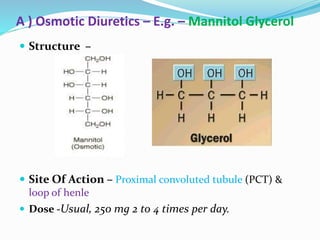
A ) Osmotic Diuretics – E.g. – Mannitol Glycerol
 Structure –
 Site Of Action – Proximal convoluted tubule (PCT) &
loop of henle
 Dose -Usual, 250 mg 2 to 4 times per day.
MOA-
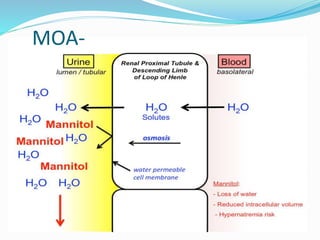
1. Retains water isoosmotically in PT-dilutes luminal
fluid which opposes NaCl reabsorption.
2. Inhibits transport processes in the thick AscLH by an
unknown mechanism. Quantitatively this appears to
be the most important cause of diuresis.
 3. Expands extracellular fluid volume (because it does
not enter cells, draws water from the intracellular
compartment)—increases g.f.r. and inhibits renin
release.
MOA-
Uses-
 drug of choice: non-toxic, freely filtered, non-reabsorbable and non-
metabolized
 administered prophylatically for acute renal failure secondary to trauma,
CVS disease, surgery or nephrotoxic drugs
 short-term treatment of acute glaucoma
 infused to lower intracranial pressure
Side effects-
•increased extracellular fluid volume
•cardiac failure
•pulmonary edema
•Hypernatremia
•hyperkalemia secondary to diabetes or impaired renal function
•headache, nausea, vomiting
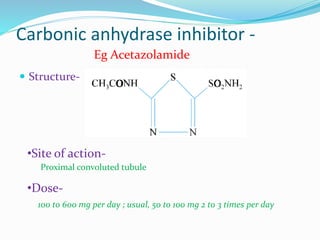
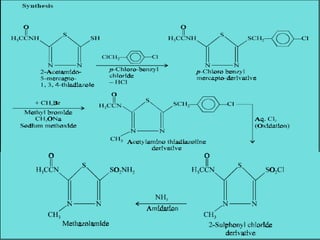
Carbonic anhydrase inhibitor -
 Structure-
Eg Acetazolamide
•Site of action-
Proximal convoluted tubule
•Dose-
100 to 600 mg per day ; usual, 50 to 100 mg 2 to 3 times per day
MOA
 carbonic anhydrase catalyzes formation of HCO3- and H+ from
H2O and CO2
 inhibition of carbonic anhydrase decreases [H+] in tubule lumen
 less H+ for for Na+/H+ exchange increased lumen Na+,
increased H2O retention
USES-
 used to treat chronic open-angle glaucoma aqueous humor
has high [HCO3-]
 acute mountain sickness prevention and treatment
 metabolic alkalosis
 mostly used in combination with other diuretics in
resistant patients
SIDE EFFECTS-
 rapid tolerance
 increased HCO3- excretion causes metabolic acidosis
 Drowsiness,fatigue,CNS depression
 paresthesia (pins and needles under skin)
 nephrolithiasis (renal stones)
 K+ wasting
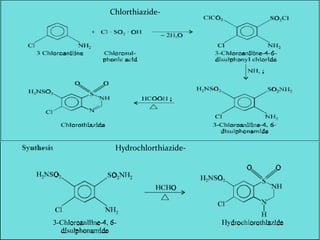
Thiazide Diuretics-Chlorothiazide, Hydrochlorothiazide
 Structure-
Chlorthiazide Hydrochlorothiazide
•Site of action-distal convoluted tubule
•Dose-
25 to 200 mg per day ; usual, 50 mg 1 or 2 times daily.
Chlorthiazide-
Hydrochlorthiazide-
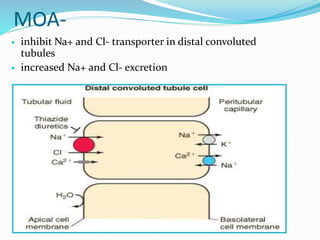
MOA-
 inhibit Na+ and Cl- transporter in distal convoluted
tubules
 increased Na+ and Cl- excretion
Uses-
 Hypertension,congestive heart failure
 hypercalciuria: prevent excess Ca2+ excretion to form
stones in ducts
 nephrogenic diabetes insipidus
 treatment of Li+ toxicity
 hypokalemia
 hyponatremia
 hyperglycemia
 hyperuricemia
 hypercalcemia
Side effects-
Potassium-sparing diuretics
 Diuretics that increase sodium and chloride
excretion, without increasing excretion rate of
potassium in the urine. These agents are known as
potassium-sparing diuretics.
 Site of action – Collecting duct
 Classification:
 Aldosterone antagonist – Spironolactone
 Pteridine Derivative – Triameterene
 Pyrazine Derivative - Amiloride
N
NN
N
H2N NH2
NH2
1
2
3
4
5
6
7
8
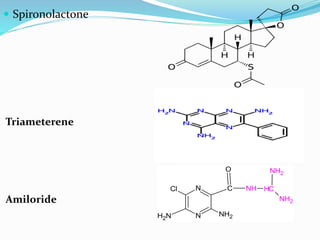
Triameterene
Amiloride
N
NNH2
NH2
Cl C NH
O
HC
NH2
NH2
 Spironolactone
Mechanism of Action
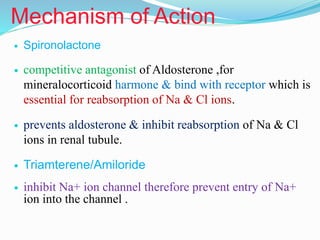
 Spironolactone
 competitive antagonist of Aldosterone ,for
mineralocorticoid harmone & bind with receptor which is
essential for reabsorption of Na & Cl ions.
 prevents aldosterone & inhibit reabsorption of Na & Cl
ions in renal tubule.
 Triamterene/Amiloride
 inhibit Na+ ion channel therefore prevent entry of Na+
ion into the channel .
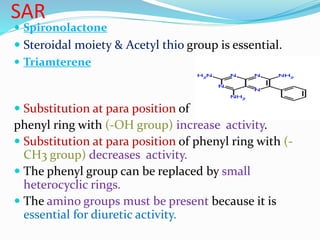
SAR
 Spironolactone
 Steroidal moiety & Acetyl thio group is essential.
 Triamterene
 Substitution at para position of
phenyl ring with (-OH group) increase activity.
 Substitution at para position of phenyl ring with (-
CH3 group) decreases activity.
 The phenyl group can be replaced by small
heterocyclic rings.
 The amino groups must be present because it is
essential for diuretic activity.
N
NN
N
H2N NH2
NH2
1
2
3
4
5
6
7
8
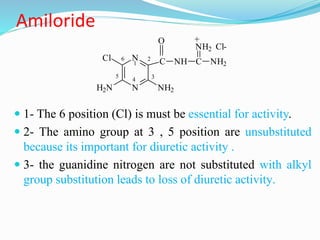
Amiloride
 1- The 6 position (Cl) is must be essential for activity.
 2- The amino group at 3 , 5 position are unsubstituted
because its important for diuretic activity .
 3- the guanidine nitrogen are not substituted with alkyl
group substitution leads to loss of diuretic activity.
N
N
Cl
H2N
C
NH2
NH C
NH2
NH2
O
1
4
2
Cl-
+
35
6
Uses-
•primary hyperaldosteronism (adrenal adenoma, bilateral
adrenal hyperplasia)
•congestive heart failure
•cirrhosis
•nephrotic syndrome
•in conjunction with K+ wasting diuretics
Side Effects
•hyperkalemia: monitor plasma [K+]
•spironolactone: gynecomastia
•triamterene: megaloblastic anemia in cirrhosis patients
•amiloride: increase in blood urea nitrogen, glucose intolerance in
diabetes mellitus
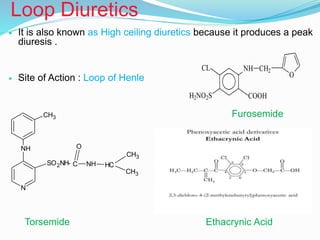
Loop Diuretics
 It is also known as High ceiling diuretics because it produces a peak
diuresis .
 Site of Action : Loop of Henle
Furosemide
Torsemide Ethacrynic Acid
H2NO2S
NH CH2
COOH
CL
O
N
CH3
NH
SO2NH- C
O
NH HC
CH3
CH3
C O CH2 COOH
Cl
O
Cl
H H
CH3CH2
1
23
4
Mechanism of Action
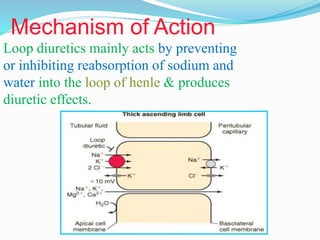
Loop diuretics mainly acts by preventing
or inhibiting reabsorption of sodium and
water into the loop of henle & produces
diuretic effects.
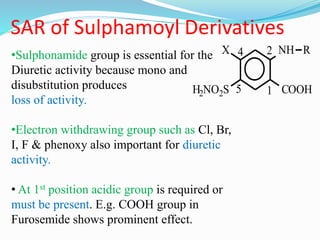
SAR of Sulphamoyl Derivatives
H2NO2S
NH
COOH
X R
5
2
1
4•Sulphonamide group is essential for the
Diuretic activity because mono and
disubstitution produces
loss of activity.
•Electron withdrawing group such as Cl, Br,
I, F & phenoxy also important for diuretic
activity.
• At 1st position acidic group is required or
must be present. E.g. COOH group in
Furosemide shows prominent effect.
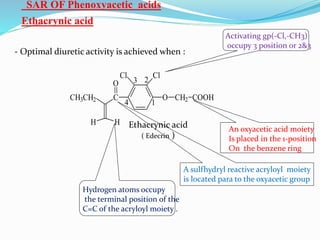
SAR OF Phenoxyacetic acids
Ethacrynic acid
C O CH2 COOH
Cl
O
Cl
H H
CH3CH2
1
23
4
Ethacrynic acid
( Edecrin )
- Optimal diuretic activity is achieved when :
An oxyacetic acid moiety
Is placed in the 1-position
On the benzene ring
A sulfhydryl reactive acryloyl moiety
is located para to the oxyacetic group
Activating gp(-Cl,-CH3)
occupy 3 position or 2&3
Hydrogen atoms occupy
the terminal position of the
C=C of the acryloyl moiety .
Uses-
 Edema: cardiac, pulmonary or renal
 Chronic renal failure
 Hypertension & hypercalcemia
 Acute and chronic hyperkalemia
Side effects-
 hypokalemia
 hyperuricemia
 metabolic alkalosis
 hyponatremia
 ototoxicity
 Mg2+ depletion
Send your suggestions to sushsantshete1998@gmail.com

Diuretics

  • 1.
    -SUSHANT VIMALKUMAR SHETE (TY B PHARM ,RCP KASEGAON) (sushantshete1998@gmail.com)
  • 2.
    •Learning objective-  Mechanismof urine formation  Definition and classification of diuretics  MOA and SAR of each class  Their dose and adverse effects  Pharmacologicaol uses
  • 3.
    Mechanism of urineformation Nephron- the functional unit
  • 4.
    Definition- Diuretics are theclass of drugs which acts on kidney and are used increase urine volume OR urine output by increasing the water and sodium secretion in urine Classification- 1 ) Mercurial Diuretics – These diuretics contains mercury (Hg) ions in there structure. They are toxic in nature. They are less effective & some side effect. They are less potent. E.g. – Mersalyl , Meralluride 2) Non-mercurial Diuretics – These diuretics do not contains mercury (Hg) ions in there structure. They are less toxic in nature. They are more effective & less side effect. They are more potent.
  • 5.
    •According to partof nephron on they acting- As) Omotic Diuretics - e.g. – Mannitol, Glycerol ,Urea, Isosorbide B) Carbonic anhydrase inhibitors – e.g. – Acetazolamide C) Thiazides diuretics – e.g. - Chlorthiazide,Hydrochlorthiazide,Hydroflumethiazide, Clopamide D) Loop Diuretics (High ceiling diuretics)– i) Sulfamoyl Derivatives – e.g. – Furosemide, Bumetanide,Torsemide ii) Phenoxy acetic acid derivatives – e.g. – Ethacrynic acid E ) Potassium sparing Diuretics – i) Aldosterone antagonist – e.g.- Spironolactone ii) Pteridine Derivatives - e.g. – Trimeterene iii) Sod.channel antagonist - e.g. - Amiloride
  • 6.
  • 7.
    A ) OsmoticDiuretics – E.g. – Mannitol Glycerol  Structure –  Site Of Action – Proximal convoluted tubule (PCT) & loop of henle  Dose -Usual, 250 mg 2 to 4 times per day.
  • 8.
    MOA- 1. Retains waterisoosmotically in PT-dilutes luminal fluid which opposes NaCl reabsorption. 2. Inhibits transport processes in the thick AscLH by an unknown mechanism. Quantitatively this appears to be the most important cause of diuresis.  3. Expands extracellular fluid volume (because it does not enter cells, draws water from the intracellular compartment)—increases g.f.r. and inhibits renin release.
  • 9.
  • 10.
    Uses-  drug ofchoice: non-toxic, freely filtered, non-reabsorbable and non- metabolized  administered prophylatically for acute renal failure secondary to trauma, CVS disease, surgery or nephrotoxic drugs  short-term treatment of acute glaucoma  infused to lower intracranial pressure Side effects- •increased extracellular fluid volume •cardiac failure •pulmonary edema •Hypernatremia •hyperkalemia secondary to diabetes or impaired renal function •headache, nausea, vomiting
  • 11.
    Carbonic anhydrase inhibitor-  Structure- Eg Acetazolamide •Site of action- Proximal convoluted tubule •Dose- 100 to 600 mg per day ; usual, 50 to 100 mg 2 to 3 times per day
  • 13.
    MOA  carbonic anhydrasecatalyzes formation of HCO3- and H+ from H2O and CO2  inhibition of carbonic anhydrase decreases [H+] in tubule lumen  less H+ for for Na+/H+ exchange increased lumen Na+, increased H2O retention
  • 14.
    USES-  used totreat chronic open-angle glaucoma aqueous humor has high [HCO3-]  acute mountain sickness prevention and treatment  metabolic alkalosis  mostly used in combination with other diuretics in resistant patients SIDE EFFECTS-  rapid tolerance  increased HCO3- excretion causes metabolic acidosis  Drowsiness,fatigue,CNS depression  paresthesia (pins and needles under skin)  nephrolithiasis (renal stones)  K+ wasting
  • 15.
    Thiazide Diuretics-Chlorothiazide, Hydrochlorothiazide Structure- Chlorthiazide Hydrochlorothiazide •Site of action-distal convoluted tubule •Dose- 25 to 200 mg per day ; usual, 50 mg 1 or 2 times daily.
  • 16.
  • 17.
    MOA-  inhibit Na+and Cl- transporter in distal convoluted tubules  increased Na+ and Cl- excretion
  • 18.
    Uses-  Hypertension,congestive heartfailure  hypercalciuria: prevent excess Ca2+ excretion to form stones in ducts  nephrogenic diabetes insipidus  treatment of Li+ toxicity  hypokalemia  hyponatremia  hyperglycemia  hyperuricemia  hypercalcemia Side effects-
  • 19.
    Potassium-sparing diuretics  Diureticsthat increase sodium and chloride excretion, without increasing excretion rate of potassium in the urine. These agents are known as potassium-sparing diuretics.  Site of action – Collecting duct  Classification:  Aldosterone antagonist – Spironolactone  Pteridine Derivative – Triameterene  Pyrazine Derivative - Amiloride
  • 20.
  • 21.
    Mechanism of Action Spironolactone  competitive antagonist of Aldosterone ,for mineralocorticoid harmone & bind with receptor which is essential for reabsorption of Na & Cl ions.  prevents aldosterone & inhibit reabsorption of Na & Cl ions in renal tubule.  Triamterene/Amiloride  inhibit Na+ ion channel therefore prevent entry of Na+ ion into the channel .
  • 22.
    SAR  Spironolactone  Steroidalmoiety & Acetyl thio group is essential.  Triamterene  Substitution at para position of phenyl ring with (-OH group) increase activity.  Substitution at para position of phenyl ring with (- CH3 group) decreases activity.  The phenyl group can be replaced by small heterocyclic rings.  The amino groups must be present because it is essential for diuretic activity. N NN N H2N NH2 NH2 1 2 3 4 5 6 7 8
  • 23.
    Amiloride  1- The6 position (Cl) is must be essential for activity.  2- The amino group at 3 , 5 position are unsubstituted because its important for diuretic activity .  3- the guanidine nitrogen are not substituted with alkyl group substitution leads to loss of diuretic activity. N N Cl H2N C NH2 NH C NH2 NH2 O 1 4 2 Cl- + 35 6
  • 24.
    Uses- •primary hyperaldosteronism (adrenaladenoma, bilateral adrenal hyperplasia) •congestive heart failure •cirrhosis •nephrotic syndrome •in conjunction with K+ wasting diuretics Side Effects •hyperkalemia: monitor plasma [K+] •spironolactone: gynecomastia •triamterene: megaloblastic anemia in cirrhosis patients •amiloride: increase in blood urea nitrogen, glucose intolerance in diabetes mellitus
  • 25.
    Loop Diuretics  Itis also known as High ceiling diuretics because it produces a peak diuresis .  Site of Action : Loop of Henle Furosemide Torsemide Ethacrynic Acid H2NO2S NH CH2 COOH CL O N CH3 NH SO2NH- C O NH HC CH3 CH3 C O CH2 COOH Cl O Cl H H CH3CH2 1 23 4
  • 26.
    Mechanism of Action Loopdiuretics mainly acts by preventing or inhibiting reabsorption of sodium and water into the loop of henle & produces diuretic effects.
  • 27.
    SAR of SulphamoylDerivatives H2NO2S NH COOH X R 5 2 1 4•Sulphonamide group is essential for the Diuretic activity because mono and disubstitution produces loss of activity. •Electron withdrawing group such as Cl, Br, I, F & phenoxy also important for diuretic activity. • At 1st position acidic group is required or must be present. E.g. COOH group in Furosemide shows prominent effect.
  • 28.
    SAR OF Phenoxyaceticacids Ethacrynic acid C O CH2 COOH Cl O Cl H H CH3CH2 1 23 4 Ethacrynic acid ( Edecrin ) - Optimal diuretic activity is achieved when : An oxyacetic acid moiety Is placed in the 1-position On the benzene ring A sulfhydryl reactive acryloyl moiety is located para to the oxyacetic group Activating gp(-Cl,-CH3) occupy 3 position or 2&3 Hydrogen atoms occupy the terminal position of the C=C of the acryloyl moiety .
  • 29.
    Uses-  Edema: cardiac,pulmonary or renal  Chronic renal failure  Hypertension & hypercalcemia  Acute and chronic hyperkalemia Side effects-  hypokalemia  hyperuricemia  metabolic alkalosis  hyponatremia  ototoxicity  Mg2+ depletion
  • 30.
    Send your suggestionsto sushsantshete1998@gmail.com