POTASSIUMSPARING DIURETICS
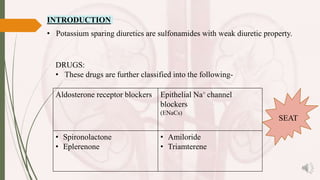
• Potassium sparing diuretics are sulfonamides with weak diuretic property.
DRUGS:
• These drugs are further classified into the following-
Aldosterone receptor blockers Epithelial Na+ channel
blockers
(ENaCs)
• Spironolactone
• Eplerenone
• Amiloride
• Triamterene
SEAT
INTRODUCTION
LOOP
OF HENLE
GLOMERULUS
PCT
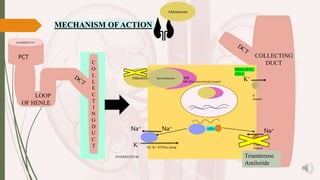
MECHANISM OFACTION
C
O
L
L
E
C
T
I
N
G
D
U
C
T
PRINCIPAL
CELL
Na+-K+-ATPase pump
ENaC-
channel
COLLECTING
DUCT
Na+
Na+
Na+
INTERSTITIUM
K+
K+
K+
channel
Aldosterone
Aldosterone MR
MR-Mineralocorticoid receptor
AIPs
Spironolactone
Triamterene
Amiloride
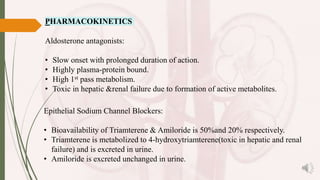
PHARMACOKINETICS
Aldosterone antagonists:
• Slow onset with prolonged duration of action.
• Highly plasma-protein bound.
• High 1st pass metabolism.
• Toxic in hepatic &renal failure due to formation of active metabolites.
Epithelial Sodium Channel Blockers:
• Bioavailability of Triamterene & Amiloride is 50%and 20% respectively.
• Triamterene is metabolized to 4-hydroxytriamterene(toxic in hepatic and renal
failure) and is excreted in urine.
• Amiloride is excreted unchanged in urine.
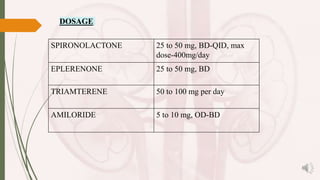
DOSAGE
SPIRONOLACTONE 25 to 50 mg, BD-QID, max
dose-400mg/day
EPLERENONE 25 to 50 mg, BD
TRIAMTERENE 50 to 100 mg per day
AMILORIDE 5 to 10 mg, OD-BD
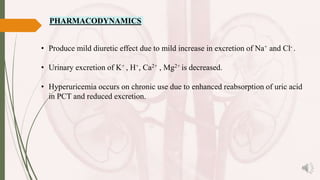
PHARMACODYNAMICS
• Produce mild diuretic effect due to mild increase in excretion of Na+ and Cl- .
• Urinary excretion of K+ , H+, Ca2+ , Mg2+ is decreased.
• Hyperuricemia occurs on chronic use due to enhanced reabsorption of uric acid
in PCT and reduced excretion.
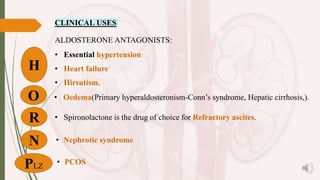
CLINICAL USES
ALDOSTERONE ANTAGONISTS:
• Essential hypertension
• Heart failure
• Hirsutism.
• Oedema(Primary hyperaldosteronism-Conn’s syndrome, Hepatic cirrhosis,).
• Spironolactone is the drug of choice for Refractory ascites.
• Nephrotic syndrome
• PCOS
H
O
PLZ
R
N
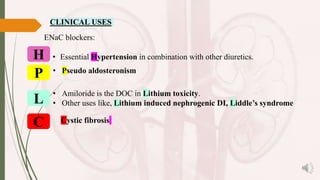
CLINICAL USES
ENaC blockers:
• Amiloride is the DOC in Lithium toxicity.
• Other uses like, Lithium induced nephrogenic DI, Liddle’s syndrome
• Essential Hypertension in combination with other diuretics.
• Pseudo aldosteronism
H
P
L
C Cystic fibrosis
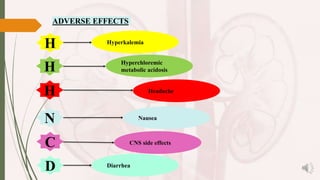
ADVERSE EFFECTS
H
H
H
N
C
D
Hyperkalemia
Hyperchloremic
metabolic acidosis
Headache
Nausea
CNS side effects
Diarrhea
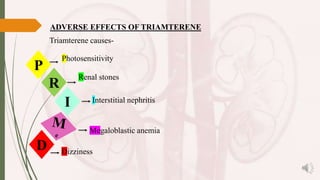
ADVERSE EFFECTS OF TRIAMTERENE
Triamterene causes-
Dizziness
Megaloblastic anemia
Photosensitivity
Renal stones
Interstitial nephritis
P
R
I
D
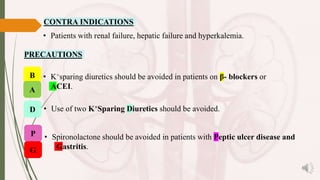
CONTRA INDICATIONS
• Patients with renal failure, hepatic failure and hyperkalemia.
• Spironolactone should be avoided in patients with Peptic ulcer disease and
Gastritis.
• Use of two K+Sparing Diuretics should be avoided.
• K+sparing diuretics should be avoided in patients on β- blockers or
ACEI.
PRECAUTIONS
B
A
D
P
G
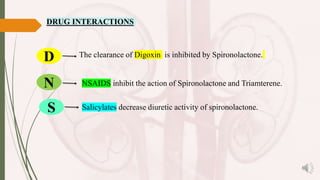
NSAIDS inhibit the action of Spironolactone and Triamterene.
The clearance of Digoxin is inhibited by Spironolactone.
Salicylates decrease diuretic activity of spironolactone.
DRUG INTERACTIONS
D
N
S

Potassium sparing diuretics

  • 1.
  • 2.
    • Potassium sparingdiuretics are sulfonamides with weak diuretic property. DRUGS: • These drugs are further classified into the following- Aldosterone receptor blockers Epithelial Na+ channel blockers (ENaCs) • Spironolactone • Eplerenone • Amiloride • Triamterene SEAT INTRODUCTION
  • 3.
    LOOP OF HENLE GLOMERULUS PCT MECHANISM OFACTION C O L L E C T I N G D U C T PRINCIPAL CELL Na+-K+-ATPasepump ENaC- channel COLLECTING DUCT Na+ Na+ Na+ INTERSTITIUM K+ K+ K+ channel Aldosterone Aldosterone MR MR-Mineralocorticoid receptor AIPs Spironolactone Triamterene Amiloride
  • 4.
    PHARMACOKINETICS Aldosterone antagonists: • Slowonset with prolonged duration of action. • Highly plasma-protein bound. • High 1st pass metabolism. • Toxic in hepatic &renal failure due to formation of active metabolites. Epithelial Sodium Channel Blockers: • Bioavailability of Triamterene & Amiloride is 50%and 20% respectively. • Triamterene is metabolized to 4-hydroxytriamterene(toxic in hepatic and renal failure) and is excreted in urine. • Amiloride is excreted unchanged in urine.
  • 5.
    DOSAGE SPIRONOLACTONE 25 to50 mg, BD-QID, max dose-400mg/day EPLERENONE 25 to 50 mg, BD TRIAMTERENE 50 to 100 mg per day AMILORIDE 5 to 10 mg, OD-BD
  • 6.
    PHARMACODYNAMICS • Produce milddiuretic effect due to mild increase in excretion of Na+ and Cl- . • Urinary excretion of K+ , H+, Ca2+ , Mg2+ is decreased. • Hyperuricemia occurs on chronic use due to enhanced reabsorption of uric acid in PCT and reduced excretion.
  • 7.
    CLINICAL USES ALDOSTERONE ANTAGONISTS: •Essential hypertension • Heart failure • Hirsutism. • Oedema(Primary hyperaldosteronism-Conn’s syndrome, Hepatic cirrhosis,). • Spironolactone is the drug of choice for Refractory ascites. • Nephrotic syndrome • PCOS H O PLZ R N
  • 8.
    CLINICAL USES ENaC blockers: •Amiloride is the DOC in Lithium toxicity. • Other uses like, Lithium induced nephrogenic DI, Liddle’s syndrome • Essential Hypertension in combination with other diuretics. • Pseudo aldosteronism H P L C Cystic fibrosis
  • 9.
  • 10.
    ADVERSE EFFECTS OFTRIAMTERENE Triamterene causes- Dizziness Megaloblastic anemia Photosensitivity Renal stones Interstitial nephritis P R I D
  • 11.
    CONTRA INDICATIONS • Patientswith renal failure, hepatic failure and hyperkalemia. • Spironolactone should be avoided in patients with Peptic ulcer disease and Gastritis. • Use of two K+Sparing Diuretics should be avoided. • K+sparing diuretics should be avoided in patients on β- blockers or ACEI. PRECAUTIONS B A D P G
  • 12.
    NSAIDS inhibit theaction of Spironolactone and Triamterene. The clearance of Digoxin is inhibited by Spironolactone. Salicylates decrease diuretic activity of spironolactone. DRUG INTERACTIONS D N S