Seal Rock
FUNDAMENTALS
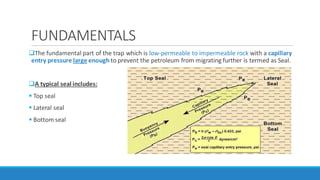
The fundamental part of the trap which is low-permeable to impermeable rock with a capillary
entry pressure large enough to prevent the petroleum from migrating further is termed as Seal.
A typical seal includes:
 Top seal
 Lateral seal
 Bottom seal
Cont.
Any lithology can be a seal or flow barrier the requirementis that the minimum capillary entry
pressure of the seal or flow-barrier material be greater than the buoyancy pressure of the
hydrocarbons in the accumulation.
The most common seal rocks are
 shale,
 anhydriteand
 salt.
CHARACTERISTICS OF A SOURCE ROCK
Attributes that favor a rock as a seal include
small pore size;
seals tend to be formed in fine grained rocks,
high ductility,
large thickness,
high capillary entry pressure
and wide lateral extent.
TYPES OF SEALS
The most common subdivision of seals are:
1. MEMBRANESEALS: Those seals in which petroleum is unable to force its way through the
smallest pores is referred to as membrane seals.
2. HYDRAULIC SEALS: Those seals in which petroleum can escape only by creating fractures are
referred to as hydraulic seals.
SEAL EVALUATION
1. Fault Seal Analysis
2. Fold Seal Analysis
1. FAULT SEAL ANALYSIS:
If a fault cuts across a reservoir zone, the question arises whether or not the fault is ‘sealing’
Faults may be sealing or non-sealing they can act as both conduits when creating migration
pathways and seals.
To evaluate the sealing character of a fault we have different methods, common of which are
as under:
1. Juxtaposition
2. Fault Gouge/Shale Gouge Ratio
??
Cont.
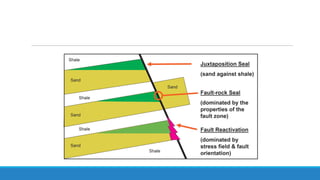
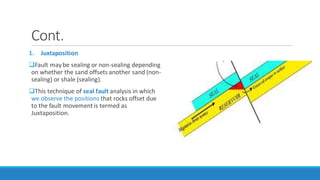
1. Juxtaposition
Fault maybe sealing or non-sealing depending
on whether the sand offsets another sand (non-
sealing) or shale (sealing).
This technique of seal fault analysis in which
we observe the positions that rocks offset due
to the fault movementis termed as
Juxtaposition.
Cont.
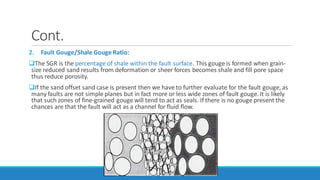
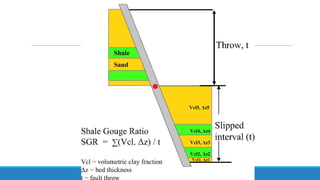
2. Fault Gouge/Shale Gouge Ratio:
The SGR is the percentage of shale within the fault surface. This gouge is formed when grain-
size reduced sand results from deformation or sheer forces becomes shale and fill pore space
thus reduce porosity.
If the sand offset sand case is present then we have to further evaluate for the fault gouge, as
many faults are not simple planes but in fact more or less wide zones of fault gouge. It is likely
that such zones of fine-grained gouge will tend to act as seals. If there is no gouge present the
chances are that the fault will act as a channel for fluid flow.
Cont.
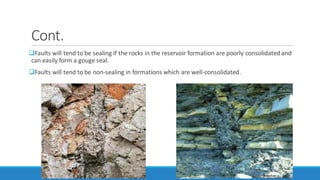
Faults will tend to be sealing if the rocks in the reservoir formation are poorly consolidated and
can easily form a gouge seal.
Faults will tend to be non-sealing in formations which are well-consolidated.
2. FOLD SEAL ANALYSIS
1. Seal Breach Analysis
2. Vertical Height of a Petroleum Column
3. Seal Thickness
Cont.
1. Seal Breach Analysis
Seal breach is a process in which seal is become ineffective and starts fluid to flow through
small fractures created in the seal.
We can derive fracture pressures and gradients by analyzing Leak-Off Test data.
This data is compared to fluid pressure to define seal capacity, which can be related to seal
breach risk and hydrocarbon column heights.
Seal breach is depends upon hydrocarbon column height and seal thickness, these processes
are dynamic that is, rate dependent and depends upon one another.
Cont.
2. Vertical Height of a PetroleumColumn:
The vertical height of the petroleum column is important in the seal evaluation because the
petroleum fluids tend to apply buoyancy force up to the overlying seal which mustn’texceed the
capillary pressure of the Seal.
If the buoyancy force exerting the petroleum column is less than that of the capillary entry
force of seal the seal acts as effective seal.
If the buoyancy force exerting the petroleum column is greater than that of the capillary entry
force of seal the seal becomes ineffective seal.
 Good shales can trap thousands of feet of hydrocarbon column.
 Poor sands and siltstones can trap 50–400 ft of oil column.
 Most good sands can trap only 50 ft or less of oil column.
Cont.
3. Seal Thickness:
If the seal quality is not appropriate to bear the buoyancy of the hydrocarbon column then the
great thickness of seal is important to bear the pressure.
If there is thick seal which prevents petroleum loss petroleum traps can be filled to capacity. It
is said to be effective seal.
The vertical height can be then up to the spill point. An under-filled trap can occur when the
seal is thin and leaks before the structure is filled to capacity then the seal is said to be
ineffective.

Seal rock

  • 1.
  • 2.
    FUNDAMENTALS The fundamental partof the trap which is low-permeable to impermeable rock with a capillary entry pressure large enough to prevent the petroleum from migrating further is termed as Seal. A typical seal includes:  Top seal  Lateral seal  Bottom seal
  • 3.
    Cont. Any lithology canbe a seal or flow barrier the requirementis that the minimum capillary entry pressure of the seal or flow-barrier material be greater than the buoyancy pressure of the hydrocarbons in the accumulation. The most common seal rocks are  shale,  anhydriteand  salt.
  • 4.
    CHARACTERISTICS OF ASOURCE ROCK Attributes that favor a rock as a seal include small pore size; seals tend to be formed in fine grained rocks, high ductility, large thickness, high capillary entry pressure and wide lateral extent.
  • 5.
    TYPES OF SEALS Themost common subdivision of seals are: 1. MEMBRANESEALS: Those seals in which petroleum is unable to force its way through the smallest pores is referred to as membrane seals. 2. HYDRAULIC SEALS: Those seals in which petroleum can escape only by creating fractures are referred to as hydraulic seals.
  • 6.
    SEAL EVALUATION 1. FaultSeal Analysis 2. Fold Seal Analysis
  • 8.
    1. FAULT SEALANALYSIS: If a fault cuts across a reservoir zone, the question arises whether or not the fault is ‘sealing’ Faults may be sealing or non-sealing they can act as both conduits when creating migration pathways and seals. To evaluate the sealing character of a fault we have different methods, common of which are as under: 1. Juxtaposition 2. Fault Gouge/Shale Gouge Ratio ??
  • 9.
    Cont. 1. Juxtaposition Fault maybesealing or non-sealing depending on whether the sand offsets another sand (non- sealing) or shale (sealing). This technique of seal fault analysis in which we observe the positions that rocks offset due to the fault movementis termed as Juxtaposition.
  • 10.
    Cont. 2. Fault Gouge/ShaleGouge Ratio: The SGR is the percentage of shale within the fault surface. This gouge is formed when grain- size reduced sand results from deformation or sheer forces becomes shale and fill pore space thus reduce porosity. If the sand offset sand case is present then we have to further evaluate for the fault gouge, as many faults are not simple planes but in fact more or less wide zones of fault gouge. It is likely that such zones of fine-grained gouge will tend to act as seals. If there is no gouge present the chances are that the fault will act as a channel for fluid flow.
  • 12.
    Cont. Faults will tendto be sealing if the rocks in the reservoir formation are poorly consolidated and can easily form a gouge seal. Faults will tend to be non-sealing in formations which are well-consolidated.
  • 13.
    2. FOLD SEALANALYSIS 1. Seal Breach Analysis 2. Vertical Height of a Petroleum Column 3. Seal Thickness
  • 14.
    Cont. 1. Seal BreachAnalysis Seal breach is a process in which seal is become ineffective and starts fluid to flow through small fractures created in the seal. We can derive fracture pressures and gradients by analyzing Leak-Off Test data. This data is compared to fluid pressure to define seal capacity, which can be related to seal breach risk and hydrocarbon column heights. Seal breach is depends upon hydrocarbon column height and seal thickness, these processes are dynamic that is, rate dependent and depends upon one another.
  • 15.
    Cont. 2. Vertical Heightof a PetroleumColumn: The vertical height of the petroleum column is important in the seal evaluation because the petroleum fluids tend to apply buoyancy force up to the overlying seal which mustn’texceed the capillary pressure of the Seal. If the buoyancy force exerting the petroleum column is less than that of the capillary entry force of seal the seal acts as effective seal. If the buoyancy force exerting the petroleum column is greater than that of the capillary entry force of seal the seal becomes ineffective seal.  Good shales can trap thousands of feet of hydrocarbon column.  Poor sands and siltstones can trap 50–400 ft of oil column.  Most good sands can trap only 50 ft or less of oil column.
  • 16.
    Cont. 3. Seal Thickness: Ifthe seal quality is not appropriate to bear the buoyancy of the hydrocarbon column then the great thickness of seal is important to bear the pressure. If there is thick seal which prevents petroleum loss petroleum traps can be filled to capacity. It is said to be effective seal. The vertical height can be then up to the spill point. An under-filled trap can occur when the seal is thin and leaks before the structure is filled to capacity then the seal is said to be ineffective.