RESERVOIR MODELING WITH PETREL
2009.1.1 AND SIMULATION RUN WITH
FRONTSIM
Presented by
Adeeba Rahman Setu
1007006
Supervised by
Mr. Tareq-Uz-Zaman
Assistant Professor
Department of Petroleum & Mining Engineering
SELECTED FIELD
Saldanadi Gas Field, Bangladesh
INTRODUCTION
Importance of Reservoir Modeling
o For new fields, 3D models may help development of the
wells by identifying
 the number of wells required,
 the optimal completion of wells,
 the present and future needs for artificial lift and
 the expected production of oil, water and gas.
o For already developed fields
 to locate new well to increase oil and gas production
 Modeling a reservoir with Petrel
 Interpretation of seismic data for pick horizons for
delineating seismic horizon
 Identifying faults in the area of study
 Delineating structure for the purpose of reservoir
modeling
 To correlate wire-line log and seismic data
 To create simulation of a reservoir model
 Simulation run with FrontSim
 History matching
OBJECTIVES OF STUDY
WHY SOFTWARE IS USED IN THE THESIS?
 Analytical methods generally cannot capture all the
details of the given reservoir or process.
 In modern reservoir engineering, they are generally
used as screening or preliminary evaluation.
 Reservoir simulation models are used by oil and
gas companies in the development of new fields.
 Models are used in developed fields where
production forecasts are needed to help make
investment decisions.
 Improvements in simulation software have lowered
the time to develop a model.
PREVIOUS MODELS DONE BY PETREL
 Hugoton field (Hugoton and Panoma in Kansan and
Guymon-Hugoton in Oklahoma)
 Norne offshore Field
 Sand bodies in reservoir in the Mumbai Offshore Basin
 Beani Bazar Gas Field (Bangladesh)
 Saldanadi Gas field etc. (Bangladesh)
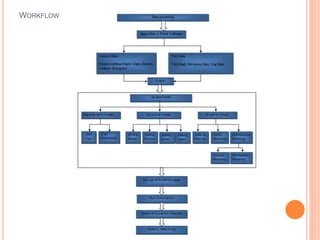
WORKFLOW
COLLECTED DATA
 Seismic Data
 Well Head Data
 Deviation Data
 Wireline Log Data
 Petrophysical Data
 Production Data
RESERVOIR MODELING
PROCESS
GEOPHYSICS
 Seismic Interpretation
 Seismic lines Interpretation
 Horizon Interpretation
 Fault interpretation
 Domain conversion
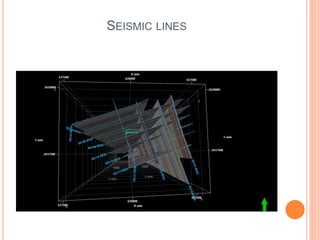
SEISMIC LINES
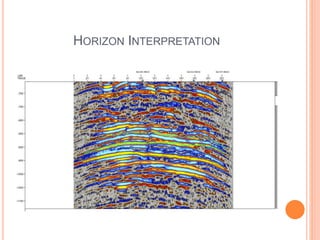
HORIZON INTERPRETATION
FAULT INTERPRETATION
 In the structure of this study there is no fault
identified but as a requirement of Petrel software a
fault has been interpreted.
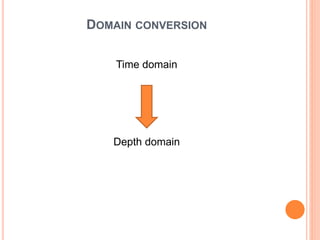
DOMAIN CONVERSION
Time domain
Depth domain
STRATIGRAPHIC MODELING
 Well Correlation
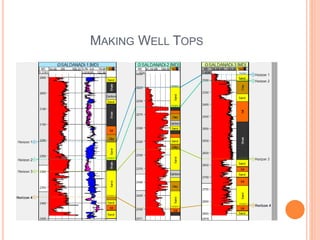
 Making Well Tops
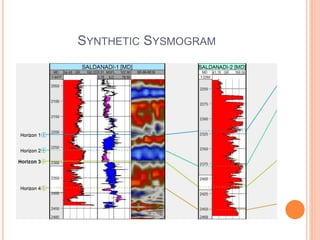
 Synthetic Seismogram
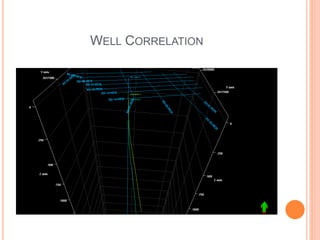
WELL CORRELATION
MAKING WELL TOPS
SYNTHETIC SYSMOGRAM
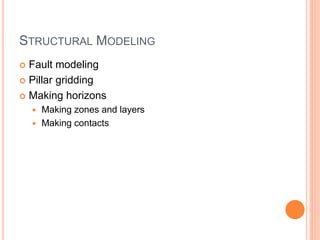
STRUCTURAL MODELING
 Fault modeling
 Pillar gridding
 Making horizons
 Making zones and layers
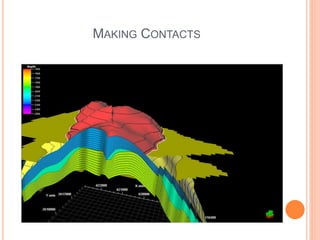
 Making contacts
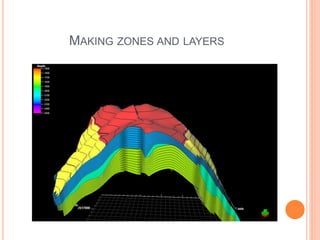
MAKING ZONES AND LAYERS
MAKING CONTACTS
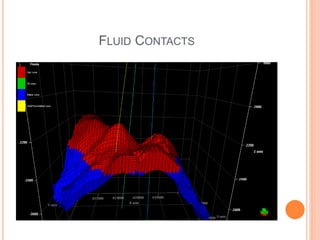
FLUID CONTACTS
PROPERTY MODELING
 Scale up well logs
 Data analysis
 Discrete data analysis
 Continuous data analysis
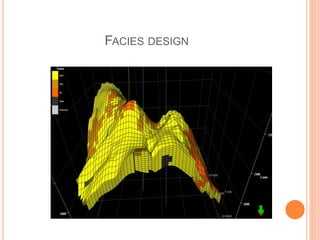
 Facies modeling
 Petrophysical modeling
FACIES DESIGN
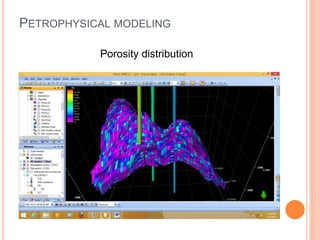
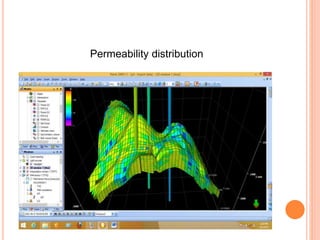
PETROPHYSICAL MODELING
Porosity distribution
Permeability distribution
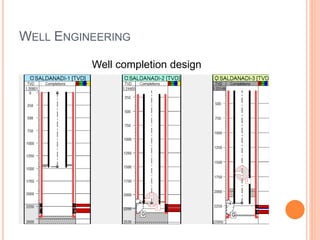
WELL ENGINEERING
Well completion design
SIMULATION
 Simulation results
 Initial condition of different properties
 Saturation function
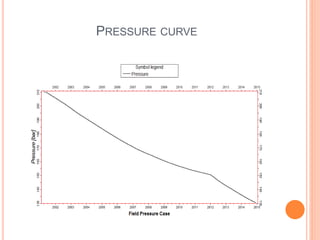
 Pressure decline curve
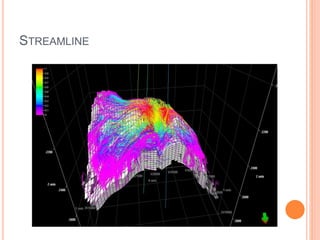
 Streamline
SIMULATION RESULTS
Initial condition of different properties
PRESSURE CURVE
STREAMLINE
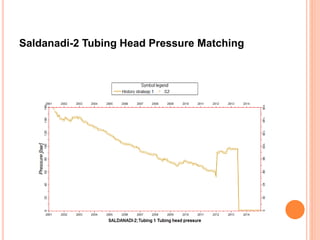
HISTORY MATCHING
Field Gas Production Rate Matching
Saldanadi-2 Gas Production Rate Matching
Saldanadi-2 Tubing Head Pressure Matching
CONCLUSION
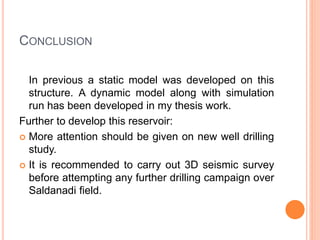
In previous a static model was developed on this
structure. A dynamic model along with simulation
run has been developed in my thesis work.
Further to develop this reservoir:
 More attention should be given on new well drilling
study.
 It is recommended to carry out 3D seismic survey
before attempting any further drilling campaign over
Saldanadi field.
THANK YOU ALL…

Reservoir Modeling with Petrel