IMPULSE TURBINE 
 SUBMITTED TO- SUBMITTED BY-Mr. 
ABHISHEK CHAUHAN KANWALDEEP SINGH 
SG12927 
MECHANICAL 5THSEM
IIMMPPUULLSSEE TTUURRBBIINNEE 
Impulse turbine is the one in which the available 
hydraulic energy is first converted into kinetic energy by 
means of efficient nozzle. 
High velocity jet issuing from the nozzle then strikes a 
series of buckets fixed around the rim of wheel(runner). 
The buckets change the direction of jet without changing 
its pressure. 
The resulting change in momentum sets bucket and 
wheel into rotary motion and thus mechanical energy is 
made available at the turbine shaft.
PPEELLTTOONN WWHHEEEELL TTUURRBBIINNEE 
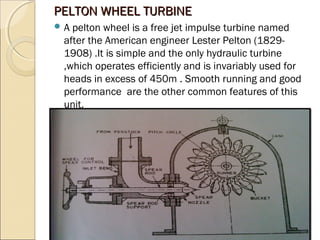
A pelton wheel is a free jet impulse turbine named 
after the American engineer Lester Pelton (1829- 
1908) .It is simple and the only hydraulic turbine 
,which operates efficiently and is invariably used for 
heads in excess of 450m . Smooth running and good 
performance are the other common features of this 
unit.
DDEESSCCRRIIPPTTIIOONN OOFF PPEELLTTOONN IIMMPPUULLSSEE 
TTUURRBBIINNEE 
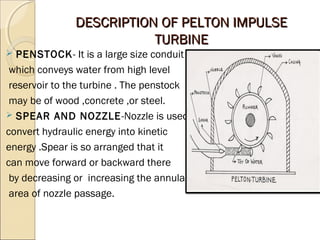
 PENSTOCK- It is a large size conduit 
which conveys water from high level 
reservoir to the turbine . The penstock 
may be of wood ,concrete ,or steel. 
 SPEAR AND NOZZLE-Nozzle is used to 
convert hydraulic energy into kinetic 
energy .Spear is so arranged that it 
can move forward or backward there 
by decreasing or increasing the annular 
area of nozzle passage.
CASING-Casing is provided to prevent strong splash 
of water ,which scatter in all directions and to guide 
the water to the tail race. 
This casing also acts as a safeguard against accidents. 
RUNNER WITH BUCKET- The turbine rotor, 
called the runner , is a circular disk carrying a number 
of cup shaped buckets which are arranged 
equidistantly around the periphery of the disk . 
For low heads the buckets are made of cast iron ,but for 
higher heads they are made of bronze ,cast steel,or 
stainless steel.
BREAKING JET-when the nozzle is completely 
closed ,the amount of water striking the runner 
reduces to zero. But the runner due to inertia goes on 
revolving for long time . To stop the runner in short 
time , a small nozzle is provided which directs the jet 
of water on the back of vanes . This jet of water is 
called breaking jet.
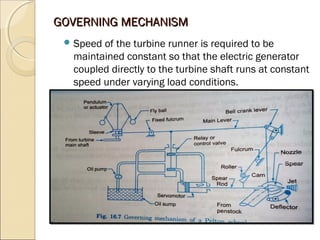
GGOOVVEERRNNIINNGG MMEECCHHAANNIISSMM 
Speed of the turbine runner is required to be 
maintained constant so that the electric generator 
coupled directly to the turbine shaft runs at constant 
speed under varying load conditions.
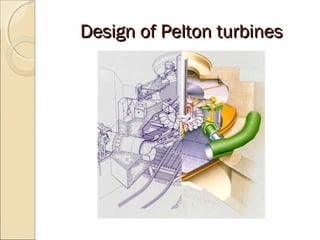
DDeessiiggnn ooff PPeellttoonn ttuurrbbiinneess
NNUUMMBBEERR OOFF JJEETTSS 
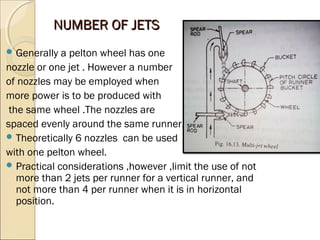
Generally a pelton wheel has one 
nozzle or one jet . However a number 
of nozzles may be employed when 
more power is to be produced with 
the same wheel .The nozzles are 
spaced evenly around the same runner. 
Theoretically 6 nozzles can be used 
with one pelton wheel. 
Practical considerations ,however ,limit the use of not 
more than 2 jets per runner for a vertical runner, and 
not more than 4 per runner when it is in horizontal 
position.
NNUUMMBBEERR OOFF BBUUCCKKEETTSS 
 The number of buckets should be few as possible so that 
there is little loss due to friction. 
 The jet of water must be fully utilized so that no water from 
the jet goes waste i.e no water escapes without striking the 
buckets . 
 Z=15+D/2d 
DEPTH AND WIDTH OF BUCKETS 
Width of bucket =5d 
Depth of bucket =1.2d
JJEETT RRAATTIIOO 
m represents the ratio of the pitch circle 
diameter to the jet diameter. (m=D/d) 
For maximum hydraulic efficiency ,the jet ratio 
lies between 11 and 15 and normally a jet 
ratio of 12 is adopted. 
A bulky installation results when a larger value 
of jet ratio is adopted. 
Its value is nearly equal to 12.
VVEELLOOCCIITTYY TTRRIIAANNGGLLEESS 
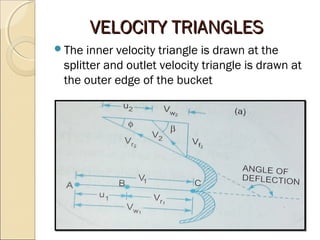
The inner velocity triangle is drawn at the 
splitter and outlet velocity triangle is drawn at 
the outer edge of the bucket
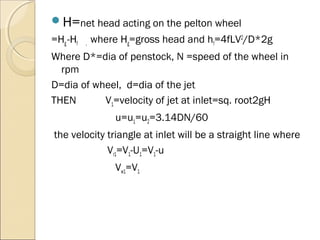
H=net head acting on the pelton wheel 
=Hg -Hf , where Hg=gross head and hf=4fLV2/D*2g 
Where D*=dia of penstock, N =speed of the wheel in 
rpm 
D=dia of wheel, d=dia of the jet 
THEN V1=velocity of jet at inlet=sq. root2gH 
u=u1=u2=3.14DN/60 
the velocity triangle at inlet will be a straight line where 
Vr1=V1-U1=V1-u 
Vw1=V1
PPOOWWEERR 
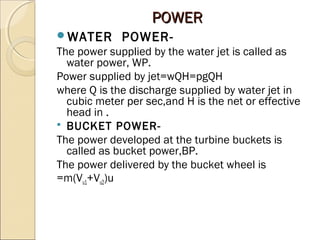
WATER POWER-The 
power supplied by the water jet is called as 
water power, WP. 
Power supplied by jet=wQH=pgQH 
where Q is the discharge supplied by water jet in 
cubic meter per sec,and H is the net or effective 
head in . 
 BUCKET POWER-The 
power developed at the turbine buckets is 
called as bucket power,BP. 
The power delivered by the bucket wheel is 
=m(Vu1+Vu2)u
EEFFFFIICCIIEENNCCYY 
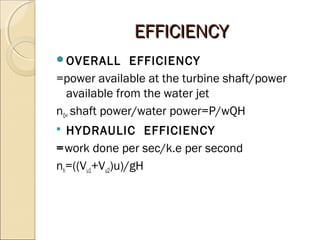
OVERALL EFFICIENCY 
=power available at the turbine shaft/power 
available from the water jet 
n0= shaft power/water power=P/wQH 
 HYDRAULIC EFFICIENCY 
=work done per sec/k.e per second 
nh=((Vu1+Vu2)u)/gH
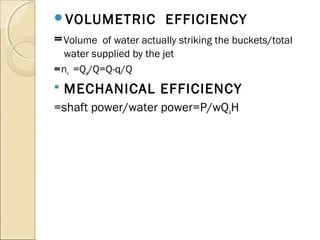
VOLUMETRIC EFFICIENCY 
=Volume of water actually striking the buckets/total 
water supplied by the jet 
=nv =Qa/Q=Q-q/Q 
 MECHANICAL EFFICIENCY 
=shaft power/water power=P/wQaH

Impulse turbine fluid mechanics

  • 1.
    IMPULSE TURBINE SUBMITTED TO- SUBMITTED BY-Mr. ABHISHEK CHAUHAN KANWALDEEP SINGH SG12927 MECHANICAL 5THSEM
  • 2.
    IIMMPPUULLSSEE TTUURRBBIINNEE Impulseturbine is the one in which the available hydraulic energy is first converted into kinetic energy by means of efficient nozzle. High velocity jet issuing from the nozzle then strikes a series of buckets fixed around the rim of wheel(runner). The buckets change the direction of jet without changing its pressure. The resulting change in momentum sets bucket and wheel into rotary motion and thus mechanical energy is made available at the turbine shaft.
  • 3.
    PPEELLTTOONN WWHHEEEELL TTUURRBBIINNEE A pelton wheel is a free jet impulse turbine named after the American engineer Lester Pelton (1829- 1908) .It is simple and the only hydraulic turbine ,which operates efficiently and is invariably used for heads in excess of 450m . Smooth running and good performance are the other common features of this unit.
  • 4.
    DDEESSCCRRIIPPTTIIOONN OOFF PPEELLTTOONNIIMMPPUULLSSEE TTUURRBBIINNEE  PENSTOCK- It is a large size conduit which conveys water from high level reservoir to the turbine . The penstock may be of wood ,concrete ,or steel.  SPEAR AND NOZZLE-Nozzle is used to convert hydraulic energy into kinetic energy .Spear is so arranged that it can move forward or backward there by decreasing or increasing the annular area of nozzle passage.
  • 5.
    CASING-Casing is providedto prevent strong splash of water ,which scatter in all directions and to guide the water to the tail race. This casing also acts as a safeguard against accidents. RUNNER WITH BUCKET- The turbine rotor, called the runner , is a circular disk carrying a number of cup shaped buckets which are arranged equidistantly around the periphery of the disk . For low heads the buckets are made of cast iron ,but for higher heads they are made of bronze ,cast steel,or stainless steel.
  • 6.
    BREAKING JET-when thenozzle is completely closed ,the amount of water striking the runner reduces to zero. But the runner due to inertia goes on revolving for long time . To stop the runner in short time , a small nozzle is provided which directs the jet of water on the back of vanes . This jet of water is called breaking jet.
  • 7.
    GGOOVVEERRNNIINNGG MMEECCHHAANNIISSMM Speedof the turbine runner is required to be maintained constant so that the electric generator coupled directly to the turbine shaft runs at constant speed under varying load conditions.
  • 8.
  • 9.
    NNUUMMBBEERR OOFF JJEETTSS Generally a pelton wheel has one nozzle or one jet . However a number of nozzles may be employed when more power is to be produced with the same wheel .The nozzles are spaced evenly around the same runner. Theoretically 6 nozzles can be used with one pelton wheel. Practical considerations ,however ,limit the use of not more than 2 jets per runner for a vertical runner, and not more than 4 per runner when it is in horizontal position.
  • 10.
    NNUUMMBBEERR OOFF BBUUCCKKEETTSS  The number of buckets should be few as possible so that there is little loss due to friction.  The jet of water must be fully utilized so that no water from the jet goes waste i.e no water escapes without striking the buckets .  Z=15+D/2d DEPTH AND WIDTH OF BUCKETS Width of bucket =5d Depth of bucket =1.2d
  • 11.
    JJEETT RRAATTIIOO mrepresents the ratio of the pitch circle diameter to the jet diameter. (m=D/d) For maximum hydraulic efficiency ,the jet ratio lies between 11 and 15 and normally a jet ratio of 12 is adopted. A bulky installation results when a larger value of jet ratio is adopted. Its value is nearly equal to 12.
  • 12.
    VVEELLOOCCIITTYY TTRRIIAANNGGLLEESS Theinner velocity triangle is drawn at the splitter and outlet velocity triangle is drawn at the outer edge of the bucket
  • 13.
    H=net head actingon the pelton wheel =Hg -Hf , where Hg=gross head and hf=4fLV2/D*2g Where D*=dia of penstock, N =speed of the wheel in rpm D=dia of wheel, d=dia of the jet THEN V1=velocity of jet at inlet=sq. root2gH u=u1=u2=3.14DN/60 the velocity triangle at inlet will be a straight line where Vr1=V1-U1=V1-u Vw1=V1
  • 14.
    PPOOWWEERR WATER POWER-The power supplied by the water jet is called as water power, WP. Power supplied by jet=wQH=pgQH where Q is the discharge supplied by water jet in cubic meter per sec,and H is the net or effective head in .  BUCKET POWER-The power developed at the turbine buckets is called as bucket power,BP. The power delivered by the bucket wheel is =m(Vu1+Vu2)u
  • 15.
    EEFFFFIICCIIEENNCCYY OVERALL EFFICIENCY =power available at the turbine shaft/power available from the water jet n0= shaft power/water power=P/wQH  HYDRAULIC EFFICIENCY =work done per sec/k.e per second nh=((Vu1+Vu2)u)/gH
  • 16.
    VOLUMETRIC EFFICIENCY =Volumeof water actually striking the buckets/total water supplied by the jet =nv =Qa/Q=Q-q/Q  MECHANICAL EFFICIENCY =shaft power/water power=P/wQaH