Unit-5 Hydraulic Turbines
A hydraulic turbine is a machine which converts hydraulic
energy into mechanical energy. The mechanical energy is
converted into electrical energy with the help of a generator
coupled to the shaft of a hydraulic turbine.
The electrical energy (power) so obtained with the help of
hydraulic energy is called hydro electrical power or hydal
power.
Hydroelectric
Power Plant
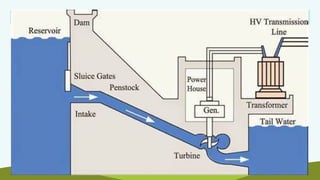
Components of hydroelectric power plant
1. A dam: A solid structure constructed across a stream or river to store the
water
2. Penstock: These are pipes of large diameter provided to convey water
under pressure form the headrace to the turbine station. These are
generally made of steel or RCC.
3. Turbine: These are the machine which are used to convert hydraulic
energy to mechanical energy.
4. Tailrace: A channel which is constructed to carry water away after the
work has done on the turbine.
5. Surge tank: These are the structures provided to absorb rising pressure
due to close of valves and to avoid possibilities of bursting of penstock.
6. Forebay: A temporary storage structure provided to store the water when
it is not required by the power station.
1. Gross head(Hg) or static head or total head:
It is defined as difference between the head raise
level and tail raise level when no water is flowing or
total head, denoted by Hg.
2. Net head or effective head (HN): It is the head
available at the inlet of the turbine. It is obtained by
deducting the losses form the gross head.
Sometimes it is also called as effective head,
denoted by HN.
CLASSIFICATION OF TURBINE
The turbines are classified based on the following
1. The type of energy available at inlet
i) Impulse turbine (Entire energy is kinetic energy) Eg Pelton wheel turbine
ii) Reaction turbine (Partly Kinetic enrgy and Partly pressure energy) Eg.
Kaplan turbine, Francis turbine.
2. The head available at the inlet
i) High head turbine (Hn>250m) Eg: Pelton wheel turbine
ii) Medium head turbine (Hn is 60m to 250m) Eg: Francis turbine
iii) Low head turbine (Hn<60m) Eg: Kaplan turbine
3. The direction of flow through the runner
i) Tangential flow turbine Eg: Pelton wheel turbine
ii) Radial flow turbine
a) Inward radial flow turbine Eg: Tomson turbine
b) Outward radial flow Eg: Foreneyron turbine
c) Axial flow turbine Eg: Kaplan turbine
d) Mixed flow turbine Eg: Modern Francis turbine
4. The specific speed of turbine
a) Low specific speed turbine (Ns<50rmp) Eg: Pelton wheel turbine
b) Medium specific turbine (Ns 50- 250rpm) Eg: Modern Francis Turbine
c) High specific turbine (Ns>250rpm) Eg: Kaplan turbine.
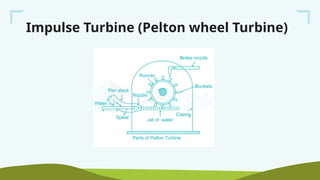
Impulse Turbine (Pelton wheel Turbine)
Pelton wheel turbine is a horizontal tangential flow
impulse turbine in which the strikes the buckets along
the tangent of the runner.
The energy available at the inlet of turbine is only kinetic
energy this turbine is used for high heels the important
components of Pelton wheel turbine are as follows.
1. Nozzle with regulating arrangement.
2. Runner with buckets.
3. Casing
4. Breaking jets
1.Nozzle and Flow Regulating Arrangement.
The water from source is transferred through
penstock to which end a nozzle is provided. Using
this nozzle the high speed water jet can be formed.
To control the water jet from nozzle, a movable
needle spear is arranged inside the nozzle.
The spear will move backward and forward in axial
direction. When it is moved forward the flow will
reduce or stopped and when it is moved backward
the flow will increase.
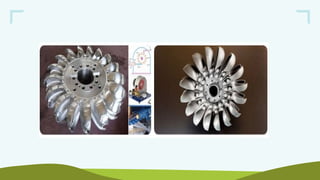
2.Runner and Buckets.
A Pelton turbine consists of a runner, which is a circular disc on
the periphery of which a number of buckets are mounted with
equal spacing between them. The buckets mounted are either
double hemispherical or double ellipsoidal shaped.
A dividing wall called splitter is provided for each bucket which
separates the bucket into two equal parts. The buckets are
generally made of cast iron or stainless steel or bronze
depending upon the head of inlet of Pelton turbine.
3. Casing: The whole arrangement of runner and buckets, inlet and
braking jets are covered by the Casing. Casing of Pelton turbine does not
perform any hydraulic actions but prevents the splashing of water while
working and also helps the water to discharge to the tail race.
4.Breaking Jet: Breaking jet is used to stop the running wheel when it is
not working. This situation arises when the nozzle inlet is closed with the
help of spear then the water jet is stopped on the buckets. But Due to
inertia, the runner will not stop revolving even after complete closure of
inlet nozzle. To stop this, a brake nozzle is provided.
The brake nozzle directs the jet of water on the back of buckets to stop
the wheel. The jet directed by brake nozzle is called breaking jet.
The working of Pelton turbine is as follows:
• The water is transferred from the high head source through a long
conduit called Penstock.
• Nozzle arrangement at the end of penstock helps the water to
accelerate and it flows out as a high speed jet with high velocity and
discharge at atmospheric pressure.
• The jet will hit the splitter of the buckets which will distribute the jet
into two halves of bucket and the wheel starts revolving.
• The kinetic energy of the jet is reduced when it hits the bucket and
also due to spherical shape of buckets the directed jet will change its
direction and takes U-turn and falls into tail race.
• In general, the inlet angle of jet is in between 1degree to
3degree, after hitting the buckets the deflected jet angle is in
between 165 degree to 170 degree.
• The water collected in tail race should not submerge the Pelton
wheel in any case.
• To generate more power, two Pelton wheels can be arranged to
a single shaft or two water jets can be directed at a time to a
single Pelton wheel.
FRANCIS TURBINE
Francis turbine is a hydraulic and reaction turbine
and it is the most preferable hydraulic turbine.
Francis Turbine contributes more than 60 percent
of hydraulic energy capacity to the world. The
Francis turbine was developed by James B. Francis
around 1855.
Francis Turbine is an inward flow reaction turbine and
has a purely radial flow runner, the pressurized water
will enter the vanes in the radial direction and
discharge out of the runner axially.
The Francis turbine operates under medium heads
(45-400 meters) and also which are guiding types and
it is employed to have medium discharge (10-700 cube
meters per second).
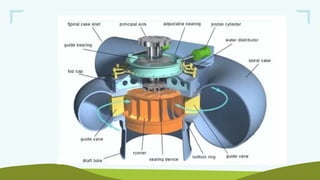
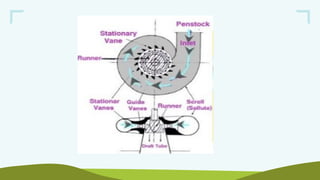
The following main parts or Construction of
Francis turbine are:
1. Penstock
2. Casing
3. Guide Vanes
4. Governing Mechanism
5. Runner and Runner Blades
6. Draft tube
Penstock:
The penstock is also known as the Input pipe.
The diameter lies between 1 to 10 meters.
The penstock is a large size conduit that conveys
water from the upstream of the dam or reservoir to
the turbine runner.
Casing:
The casing has a passage that is the closed type and
has a cross-sectional area gradually
decreasing along the direction of the flow area and
it becomes maximum at the inlet and zeroes at the exit.
Guide Vanes:
These vanes direct the water onto the runner at an angle appropriate to
the design.
The motion to them is given by means of a hand wheel or automatically
by a governor.
Governing Mechanism:
It changes the position of the guide blades/vanes to affect a
variation in water flow rate when the load conditions on the turbine
changes.
Runner and Runner blades:
• The driving force on the runner is both due to impulsive and reaction effects.
• The number of runner blades will be around 16 to 24.
• The modern Francis turbine is an inward mixed Flow reaction turbine.
• Water comes to the turbine via penstock and it will hit on no. of stationary
blades.
• These stationary orifices are commonly called as guide vanes or wicket gates.
• The head acting on the turbine is partly transformed into kinetic energy and the
rest remains as pressure head. Due to this pressure difference.
• it is called a reaction turbine and is responsible for the motion of the runner that
is why a Francis turbine is also known as a reaction turbine.
• The Francis turbine the pressure at the inlet is more than at the outlet.
• After doing the work the water is discharged to the tailrace through a closed of
gradually enlarging section like a tube.
• This is known as the draft tube.
Draft Tube:
It is an expanding tube used to discharge water through the
runner and to the tail race.
The main function of the tube is to reduce the velocity
of (water flowing)
at the time of discharge.
There are 3 types of draft tube:
• Conical Draft tube
• Elbow Draft Tube
• Moody Spreading Draft Tube
CENTRIFUGAL PUMPS
What is Centrifugal Pump?
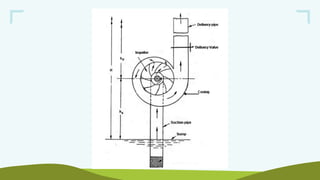
The centrifugal pump defines as a hydraulic machine that converts
mechanical energy into hydraulic energy by means of a centrifugal force acting on the fluid.
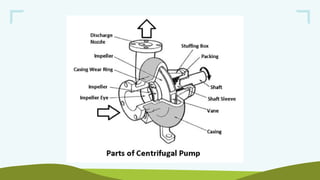
Parts of Centrifugal Pump
The different parts of the centrifugal pump are listed below.
• Shaft and shaft sleeve
• Impeller
• Casing
• Suction Pipe
• Delivery Pipe
1. Shaft and shaft sleeve
The shaft is a central part of the pump, which
rotates with the connected impeller. It is
coupled with the prime mover to get the power.
The shaft fits with the ball bearing.
A shaft sleeve is also employed, which prevents
the shaft of the pump from leakage and
corrosion. One end of the sleeve should be
sealed.
2. Impeller
The impeller consists of a series of backward-curved vanes. It is mounted to
the shaft of an electric motor. An impeller is a rotating part of the centrifugal
pump. It is enclosed in a watertight casing. The centrifugal pump impeller is
divided into three types.
a) Open Impeller
An open impeller consists of vanes attached to a central hub and mounted
directly on the shaft. The vanes have no walls or cover around them, making
open impellers weaker than closed valves. Still, these are generally quick and
easy to clean and repair.
b) Closed Impeller
The closed impeller has both front and back cover plates. In this, the
impeller vanes are sandwiched between two cover plates. These are installed
in radial flow centrifugal pumps and can be either single or double inlets.
Also, it uses to obtain pure water.
c) Semi-open impeller
Semi-open impellers have a back-wall cover plate that gives
mechanical power to the van, while the other side remains
open. Semi-open impellers are used in medium-sized
pumps. This impeller is designed for debris-loading fluid.
3. Casing
The casing is an airtight passage surrounding the
impeller. It is designed in such a way that the kinetic
energy of the water discharged at the outlet is
converted into pressure energy before the water leaves
the casing and enters the delivery pipe.
The casing works as a cover to protect the system. The
casing of the centrifugal pump is further classified into
three types.
a) Volute casing (Spiral casing)
It is surrounded by the impeller. Such a casing provides a
gradual increase in the area of a flow, thus decreasing the
velocity of water and correspondingly increasing the
pressure.
b) Vortex casing
A vortex casing is a circular chamber introduced between
the impeller and casing. here the fluid from the impeller
has to first pass through the vortex chamber and then
through the volute casing. In such a case, there is a
better conversion done that is velocity energy into
pressure, and it has good efficiency than the volute
casing.
c) Casing with Guide Blades
In a casing with guide blades, the blades surround the
impeller. These blades are designed and arranged in such
a way that the water from the impeller enters the guide
vane without shock and creates a passage of increasing
area, through which the water passes and reaches the
delivery to leave with pressure.
4. Suction Pipe with a Foot Valve and Strainer
The suction pipe has two ends. One end is connected to the inlet of the
pump and the other dips into the water in a sump.
A foot valve fits at the lower end of the suction pipe. The foot valve
is a one-way type of valve that only opens in an upward direction. A
strainer is also fitted at the end of the suction pipe to prevent the
entry of foreign bodies into the suction pipe.
5. Delivery valve
The delivery valve also has two ends. One end is
connected to the outlet of the pump, and the other
end delivers the water at the required height.
The delivery valve is kept closed after the pump has been
primed while the electric motor is turned on to rotate the
impeller.
When the delivery valve is opened, the liquid flows outward in
a radial direction by impeller vanes at the outer circumference
with high velocity, creating a vacuum. The delivery valve is
kept closed to minimize this effect.
This causes the sump’s liquid to move quickly through the suction
pipe to the impeller’s eye, replacing the long discharge from the
impeller’s center circumference, which is used to lift the liquid to
the necessary height through the delivery pipe.
Priming In A Centrifugal Pump
Priming is the operation in which the
suction pipe, casing of the pump, and a
portion of the pipe up to the delivery
valve are filled up from an outside
source with the liquid to be raised by
the pump before starting the pump.
Types of Centrifugal Pumps
Different types of centrifugal pumps are
widely used in various industries
worldwide. These pumps are classified
based on the number of impellers, type
of casing, orientation, and position.
1.Based on the number of impellers
1. Single stage impeller
2. Multistage impeller
2.Based on the type of casing
1. Turbine pump
2. Volute pump
3.Based on the orientation of the fluid
1. Radial flow pump
2. Axial flow pump
3. Mixed flow pump
4.Based on the position of the pump
1. Horizontal pump
2. Vertical pump
3. Submersible pump
1. Single-Stage Centrifugal Pump
It consists only of an impeller that rotates on a shaft within a pump
casing. It is designed to produce fluid flow by using a motor. Single-
stage centrifugal pump is one of the simplest types of pumps
available in many variations in design.
2. Multistage Centrifugal Pump
The multistage centrifugal pump consists of more than one impeller
connected in series in the pump casing. In this, the fluid enters from the
first impeller under the pressure of the suction line and leaves at some
high pressure.
While leaving the first stage, the fluid enters the second stage, where the
pressure increases further. These pumps provide better efficiency due to
tighter impeller clearance and smaller impeller diameters.
Advantages of Centrifugal Pump
1. The most significant advantage of centrifugal pumps is their
simplicity.
2. They are suitable for large discharge and smaller heads.
3. They don’t require any valves or many moving parts.
4. This pump allows them to run at high speeds with minimal
maintenance.
5. Their output is very steady and consistent.
Centrifugal pumps provide a lot of flexibility, are easy to move, and
don’t take up a lot of space.
Disadvantages of Centrifugal Pump
1.The pump uses rotation rather than suction to move
the water. Therefore, it has no suction power.
2.Centrifugal pumps always face cavitation problems.
3.During pump operation, there may be a possibility of
misalignment of the shaft.
4.These pumps are not built to operate with highly
viscous liquids as well as high heads.
5.It also damages the seal ring, worn ring, and impeller.
Application of Centrifugal Pump
1.These pumps are popularly used in domestic applications like
pumping water from one place to another.
2.They are also used in refrigerant and coolant recirculation.
3.This pump is also used for drainage, irrigation, and sprinkling.
4.Centrifugal pumps are widely used in gas and oil industries for
pumping slurry, mud, and oil.
5.These pumps are also valuable for sewage systems.
6.These are employed by the industrial and fire protection
sectors, including sprinkler systems for fire protection, heating
and ventilation, boiler feed applications, air conditioning, and
pressure boosting.

Hydroelectric Power Plant Project Proposal

  • 1.
    Unit-5 Hydraulic Turbines Ahydraulic turbine is a machine which converts hydraulic energy into mechanical energy. The mechanical energy is converted into electrical energy with the help of a generator coupled to the shaft of a hydraulic turbine. The electrical energy (power) so obtained with the help of hydraulic energy is called hydro electrical power or hydal power.
  • 2.
  • 4.
    Components of hydroelectricpower plant 1. A dam: A solid structure constructed across a stream or river to store the water 2. Penstock: These are pipes of large diameter provided to convey water under pressure form the headrace to the turbine station. These are generally made of steel or RCC. 3. Turbine: These are the machine which are used to convert hydraulic energy to mechanical energy. 4. Tailrace: A channel which is constructed to carry water away after the work has done on the turbine. 5. Surge tank: These are the structures provided to absorb rising pressure due to close of valves and to avoid possibilities of bursting of penstock. 6. Forebay: A temporary storage structure provided to store the water when it is not required by the power station.
  • 5.
    1. Gross head(Hg)or static head or total head: It is defined as difference between the head raise level and tail raise level when no water is flowing or total head, denoted by Hg. 2. Net head or effective head (HN): It is the head available at the inlet of the turbine. It is obtained by deducting the losses form the gross head. Sometimes it is also called as effective head, denoted by HN.
  • 6.
    CLASSIFICATION OF TURBINE Theturbines are classified based on the following 1. The type of energy available at inlet i) Impulse turbine (Entire energy is kinetic energy) Eg Pelton wheel turbine ii) Reaction turbine (Partly Kinetic enrgy and Partly pressure energy) Eg. Kaplan turbine, Francis turbine. 2. The head available at the inlet i) High head turbine (Hn>250m) Eg: Pelton wheel turbine ii) Medium head turbine (Hn is 60m to 250m) Eg: Francis turbine iii) Low head turbine (Hn<60m) Eg: Kaplan turbine
  • 7.
    3. The directionof flow through the runner i) Tangential flow turbine Eg: Pelton wheel turbine ii) Radial flow turbine a) Inward radial flow turbine Eg: Tomson turbine b) Outward radial flow Eg: Foreneyron turbine c) Axial flow turbine Eg: Kaplan turbine d) Mixed flow turbine Eg: Modern Francis turbine 4. The specific speed of turbine a) Low specific speed turbine (Ns<50rmp) Eg: Pelton wheel turbine b) Medium specific turbine (Ns 50- 250rpm) Eg: Modern Francis Turbine c) High specific turbine (Ns>250rpm) Eg: Kaplan turbine.
  • 8.
  • 10.
    Pelton wheel turbineis a horizontal tangential flow impulse turbine in which the strikes the buckets along the tangent of the runner. The energy available at the inlet of turbine is only kinetic energy this turbine is used for high heels the important components of Pelton wheel turbine are as follows. 1. Nozzle with regulating arrangement. 2. Runner with buckets. 3. Casing 4. Breaking jets
  • 11.
    1.Nozzle and FlowRegulating Arrangement. The water from source is transferred through penstock to which end a nozzle is provided. Using this nozzle the high speed water jet can be formed. To control the water jet from nozzle, a movable needle spear is arranged inside the nozzle. The spear will move backward and forward in axial direction. When it is moved forward the flow will reduce or stopped and when it is moved backward the flow will increase.
  • 12.
    2.Runner and Buckets. APelton turbine consists of a runner, which is a circular disc on the periphery of which a number of buckets are mounted with equal spacing between them. The buckets mounted are either double hemispherical or double ellipsoidal shaped. A dividing wall called splitter is provided for each bucket which separates the bucket into two equal parts. The buckets are generally made of cast iron or stainless steel or bronze depending upon the head of inlet of Pelton turbine.
  • 13.
    3. Casing: Thewhole arrangement of runner and buckets, inlet and braking jets are covered by the Casing. Casing of Pelton turbine does not perform any hydraulic actions but prevents the splashing of water while working and also helps the water to discharge to the tail race. 4.Breaking Jet: Breaking jet is used to stop the running wheel when it is not working. This situation arises when the nozzle inlet is closed with the help of spear then the water jet is stopped on the buckets. But Due to inertia, the runner will not stop revolving even after complete closure of inlet nozzle. To stop this, a brake nozzle is provided. The brake nozzle directs the jet of water on the back of buckets to stop the wheel. The jet directed by brake nozzle is called breaking jet.
  • 14.
    The working ofPelton turbine is as follows: • The water is transferred from the high head source through a long conduit called Penstock. • Nozzle arrangement at the end of penstock helps the water to accelerate and it flows out as a high speed jet with high velocity and discharge at atmospheric pressure. • The jet will hit the splitter of the buckets which will distribute the jet into two halves of bucket and the wheel starts revolving. • The kinetic energy of the jet is reduced when it hits the bucket and also due to spherical shape of buckets the directed jet will change its direction and takes U-turn and falls into tail race.
  • 15.
    • In general,the inlet angle of jet is in between 1degree to 3degree, after hitting the buckets the deflected jet angle is in between 165 degree to 170 degree. • The water collected in tail race should not submerge the Pelton wheel in any case. • To generate more power, two Pelton wheels can be arranged to a single shaft or two water jets can be directed at a time to a single Pelton wheel.
  • 16.
    FRANCIS TURBINE Francis turbineis a hydraulic and reaction turbine and it is the most preferable hydraulic turbine. Francis Turbine contributes more than 60 percent of hydraulic energy capacity to the world. The Francis turbine was developed by James B. Francis around 1855.
  • 18.
    Francis Turbine isan inward flow reaction turbine and has a purely radial flow runner, the pressurized water will enter the vanes in the radial direction and discharge out of the runner axially. The Francis turbine operates under medium heads (45-400 meters) and also which are guiding types and it is employed to have medium discharge (10-700 cube meters per second).
  • 19.
    The following mainparts or Construction of Francis turbine are: 1. Penstock 2. Casing 3. Guide Vanes 4. Governing Mechanism 5. Runner and Runner Blades 6. Draft tube
  • 21.
    Penstock: The penstock isalso known as the Input pipe. The diameter lies between 1 to 10 meters. The penstock is a large size conduit that conveys water from the upstream of the dam or reservoir to the turbine runner. Casing: The casing has a passage that is the closed type and has a cross-sectional area gradually decreasing along the direction of the flow area and it becomes maximum at the inlet and zeroes at the exit.
  • 22.
    Guide Vanes: These vanesdirect the water onto the runner at an angle appropriate to the design. The motion to them is given by means of a hand wheel or automatically by a governor. Governing Mechanism: It changes the position of the guide blades/vanes to affect a variation in water flow rate when the load conditions on the turbine changes.
  • 23.
    Runner and Runnerblades: • The driving force on the runner is both due to impulsive and reaction effects. • The number of runner blades will be around 16 to 24. • The modern Francis turbine is an inward mixed Flow reaction turbine. • Water comes to the turbine via penstock and it will hit on no. of stationary blades. • These stationary orifices are commonly called as guide vanes or wicket gates. • The head acting on the turbine is partly transformed into kinetic energy and the rest remains as pressure head. Due to this pressure difference. • it is called a reaction turbine and is responsible for the motion of the runner that is why a Francis turbine is also known as a reaction turbine. • The Francis turbine the pressure at the inlet is more than at the outlet. • After doing the work the water is discharged to the tailrace through a closed of gradually enlarging section like a tube. • This is known as the draft tube.
  • 24.
    Draft Tube: It isan expanding tube used to discharge water through the runner and to the tail race. The main function of the tube is to reduce the velocity of (water flowing) at the time of discharge. There are 3 types of draft tube: • Conical Draft tube • Elbow Draft Tube • Moody Spreading Draft Tube
  • 25.
    CENTRIFUGAL PUMPS What isCentrifugal Pump? The centrifugal pump defines as a hydraulic machine that converts mechanical energy into hydraulic energy by means of a centrifugal force acting on the fluid. Parts of Centrifugal Pump The different parts of the centrifugal pump are listed below. • Shaft and shaft sleeve • Impeller • Casing • Suction Pipe • Delivery Pipe
  • 27.
    1. Shaft andshaft sleeve The shaft is a central part of the pump, which rotates with the connected impeller. It is coupled with the prime mover to get the power. The shaft fits with the ball bearing. A shaft sleeve is also employed, which prevents the shaft of the pump from leakage and corrosion. One end of the sleeve should be sealed.
  • 28.
    2. Impeller The impellerconsists of a series of backward-curved vanes. It is mounted to the shaft of an electric motor. An impeller is a rotating part of the centrifugal pump. It is enclosed in a watertight casing. The centrifugal pump impeller is divided into three types. a) Open Impeller An open impeller consists of vanes attached to a central hub and mounted directly on the shaft. The vanes have no walls or cover around them, making open impellers weaker than closed valves. Still, these are generally quick and easy to clean and repair. b) Closed Impeller The closed impeller has both front and back cover plates. In this, the impeller vanes are sandwiched between two cover plates. These are installed in radial flow centrifugal pumps and can be either single or double inlets. Also, it uses to obtain pure water.
  • 29.
    c) Semi-open impeller Semi-openimpellers have a back-wall cover plate that gives mechanical power to the van, while the other side remains open. Semi-open impellers are used in medium-sized pumps. This impeller is designed for debris-loading fluid.
  • 30.
    3. Casing The casingis an airtight passage surrounding the impeller. It is designed in such a way that the kinetic energy of the water discharged at the outlet is converted into pressure energy before the water leaves the casing and enters the delivery pipe. The casing works as a cover to protect the system. The casing of the centrifugal pump is further classified into three types.
  • 31.
    a) Volute casing(Spiral casing) It is surrounded by the impeller. Such a casing provides a gradual increase in the area of a flow, thus decreasing the velocity of water and correspondingly increasing the pressure. b) Vortex casing A vortex casing is a circular chamber introduced between the impeller and casing. here the fluid from the impeller has to first pass through the vortex chamber and then through the volute casing. In such a case, there is a better conversion done that is velocity energy into pressure, and it has good efficiency than the volute casing.
  • 32.
    c) Casing withGuide Blades In a casing with guide blades, the blades surround the impeller. These blades are designed and arranged in such a way that the water from the impeller enters the guide vane without shock and creates a passage of increasing area, through which the water passes and reaches the delivery to leave with pressure.
  • 33.
    4. Suction Pipewith a Foot Valve and Strainer The suction pipe has two ends. One end is connected to the inlet of the pump and the other dips into the water in a sump. A foot valve fits at the lower end of the suction pipe. The foot valve is a one-way type of valve that only opens in an upward direction. A strainer is also fitted at the end of the suction pipe to prevent the entry of foreign bodies into the suction pipe.
  • 34.
    5. Delivery valve Thedelivery valve also has two ends. One end is connected to the outlet of the pump, and the other end delivers the water at the required height.
  • 36.
    The delivery valveis kept closed after the pump has been primed while the electric motor is turned on to rotate the impeller. When the delivery valve is opened, the liquid flows outward in a radial direction by impeller vanes at the outer circumference with high velocity, creating a vacuum. The delivery valve is kept closed to minimize this effect. This causes the sump’s liquid to move quickly through the suction pipe to the impeller’s eye, replacing the long discharge from the impeller’s center circumference, which is used to lift the liquid to the necessary height through the delivery pipe.
  • 37.
    Priming In ACentrifugal Pump Priming is the operation in which the suction pipe, casing of the pump, and a portion of the pipe up to the delivery valve are filled up from an outside source with the liquid to be raised by the pump before starting the pump.
  • 38.
    Types of CentrifugalPumps Different types of centrifugal pumps are widely used in various industries worldwide. These pumps are classified based on the number of impellers, type of casing, orientation, and position.
  • 39.
    1.Based on thenumber of impellers 1. Single stage impeller 2. Multistage impeller 2.Based on the type of casing 1. Turbine pump 2. Volute pump 3.Based on the orientation of the fluid 1. Radial flow pump 2. Axial flow pump 3. Mixed flow pump 4.Based on the position of the pump 1. Horizontal pump 2. Vertical pump 3. Submersible pump
  • 40.
    1. Single-Stage CentrifugalPump It consists only of an impeller that rotates on a shaft within a pump casing. It is designed to produce fluid flow by using a motor. Single- stage centrifugal pump is one of the simplest types of pumps available in many variations in design. 2. Multistage Centrifugal Pump The multistage centrifugal pump consists of more than one impeller connected in series in the pump casing. In this, the fluid enters from the first impeller under the pressure of the suction line and leaves at some high pressure. While leaving the first stage, the fluid enters the second stage, where the pressure increases further. These pumps provide better efficiency due to tighter impeller clearance and smaller impeller diameters.
  • 41.
    Advantages of CentrifugalPump 1. The most significant advantage of centrifugal pumps is their simplicity. 2. They are suitable for large discharge and smaller heads. 3. They don’t require any valves or many moving parts. 4. This pump allows them to run at high speeds with minimal maintenance. 5. Their output is very steady and consistent. Centrifugal pumps provide a lot of flexibility, are easy to move, and don’t take up a lot of space.
  • 42.
    Disadvantages of CentrifugalPump 1.The pump uses rotation rather than suction to move the water. Therefore, it has no suction power. 2.Centrifugal pumps always face cavitation problems. 3.During pump operation, there may be a possibility of misalignment of the shaft. 4.These pumps are not built to operate with highly viscous liquids as well as high heads. 5.It also damages the seal ring, worn ring, and impeller.
  • 43.
    Application of CentrifugalPump 1.These pumps are popularly used in domestic applications like pumping water from one place to another. 2.They are also used in refrigerant and coolant recirculation. 3.This pump is also used for drainage, irrigation, and sprinkling. 4.Centrifugal pumps are widely used in gas and oil industries for pumping slurry, mud, and oil. 5.These pumps are also valuable for sewage systems. 6.These are employed by the industrial and fire protection sectors, including sprinkler systems for fire protection, heating and ventilation, boiler feed applications, air conditioning, and pressure boosting.