ACCESSORIES USED
IN HYDRAULIC
SYSTEM
CONTENTS
Power Units
Reservoir
Accumulator
Intensifier
POWER UNIT
oThe Power unit:
oProvides energy for the operation of the hydraulic
oMoves fluid through the system
oProvides a safe maximum system operating pressure
oAssisting in maintaining correct system operating
temperature and fluid cleanliness
POWER UNITS
A basic power unit consist of :
oPrime mover to power the system
oPump to move the fluid
oReservoir to store the fluid
oRelief valve or pump compensator to control maximum
system pressure
oFilter to clean the fluid
oPlumbing to transport fluid to components
POWER UNITS
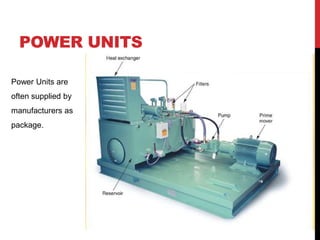
Power Units are
often supplied by
manufacturers as
package.
CLASSIFICATION
1. Vertical power units
2. Horizontal power units
3. Portable power units
RESERVOIR
The function of a fluid reservoir in a power hydraulic system is:
 To provide a chamber in which any volume of fluid can be
accommodated.
 To provide a filling point for the system
 To serve as a storage space for the hydraulic fluid
 To provide a volume of fluid which is relatively stationary to allow
entrained air to separate and heavy contaminants to settle.
 To accomplish the dissipation of heat by its proper design and to
provide a radiating and convective surface to allow the fluid to cool.
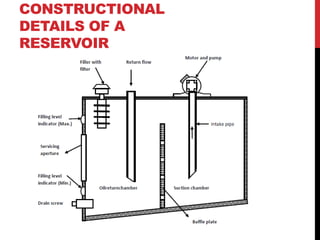
CONSTRUCTIONAL
DETAILS OF A
RESERVOIR
FEATURES OF
HYDRAULIC RESERVOIR
1. Filler Cap (breather cap):
It should be air tight when closed but may contain the air
vent that filters air entering the reservoir to provide gravity
push for proper oil flow
2. Oil level gauge:
It shows the level of oil in the reservoir without having to
open the reservoir.
3. Intake filter:
It is usually a screen that is attached to the suction pipe to
filter the hydraulic oil.
4. Baffle Plate:
The purpose of baffle plate is to separate the pump inlet line
from the return line to prevent the same fluid from
recirculating continuously within the tank.
1. To permit the foreign substance to settle down to the
bottom
2. To allow entrained air to escape the oil
3. To prevent localized turbulence in the reservoir.
4. To promote heat dissipation through the reservoir wall.
5. Suction & Return line:
1. They are designed to enter the reservoir at the points
where the air turbulence is least.
2. They can enter from top or sides but their ends should
always be at bottom
3. If return line is above the oil, the return oil can foam and
draw in some air.
6. Strainers and Filters:
They are designed to remove foreign particles from the
hydraulic fluid.
7. Drain Plug:
It allows oil to be drained from the reservoir. Some drain
plugs are magnetic to help remove metal chips from the oil.
TYPES OF RESERVOIR
1. Non- pressurized:
 These reservoir operates at the Atmospheric pressure.
 They are vented to atmosphere using an air filter or a
separating diaphragm.
 Most commonly used type in Industrial system, machine
tools.
 Since they are open to atmosphere, as such they are
prone to atmosphere. Hence they are not commonly used.
2. Pressurized:
 These reservoirs are pressurised inside between 0.35-1.4
bar and has to be provided with some methods of
pressure control.
 There may be a small air compressor to maintain set
charge pressure.
 Pressurising improves suction characteristic of pump by
providing additional suction head.
 It also helps in preventing contaminants from entering into
the reservoir.
 So it avoids a boost pressure to the main pump and
prevents the ingress of dirt.
SIZING OF RESERVOIR
The reservoir capacity should be adequate enough to cater for changes in
fluid volume within the system and sufficient area to provide system
cooling.
CRITERIA:
1. The minimum reservoir capacity should be twice the pump delivery per
minute.
2. The reservoir capacity should be three-four times the pump delivery per
minute for a high volume mobile application.
3. It must make allowance for dirt and chips to settle at the bottom and air
to escape.
4. It must be able to hold the oil.
5. It must maintain the oil level high enough to prevent the whirlpool
effect.
6. It should have large surface area to dissipate heat generated in the
system.
7. It should have an adequate air space to allow for the thermal expansion
oil.
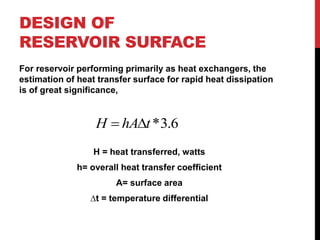
DESIGN OF
RESERVOIR SURFACE
For reservoir performing primarily as heat exchangers, the
estimation of heat transfer surface for rapid heat dissipation
is of great significance,
H = heat transferred, watts
h= overall heat transfer coefficient
A= surface area
∆t = temperature differential
6.3*thAH 
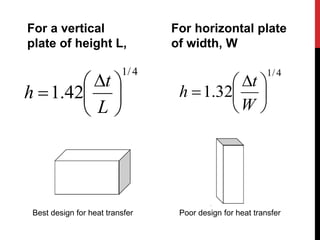
For a vertical
plate of height L,
4/1
42.1 




 

L
t
h
For horizontal plate
of width, W
4/1
32.1 




 

W
t
h
Best design for heat transfer Poor design for heat transfer
ACCUMULATOR
A hydraulic accumulator is a device in which the potential
energy of an incompressible fluid is held under pressure by
an external source against some dynamic force from sources
like gravity, mechanical spring and compressed gas.
- The potential energy is stored when the demand of energy
by the system is less than that available from the prime
mover and is released to the system during its period of
peak demand of energy which the prime mover alone
cannot meet.
- Its function is analogous to that of the flywheel in a
mechanical system and a capacitor in an electrical circuit
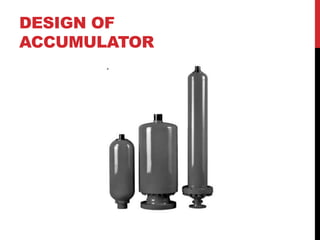
DESIGN OF
ACCUMULATOR
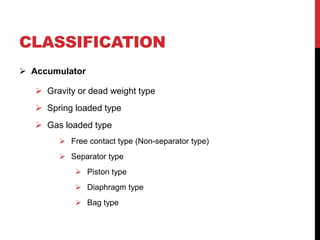
CLASSIFICATION
 Accumulator
 Gravity or dead weight type
 Spring loaded type
 Gas loaded type
 Free contact type (Non-separator type)
 Separator type
 Piston type
 Diaphragm type
 Bag type
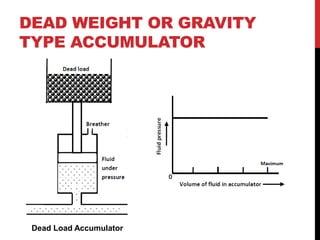
DEAD WEIGHT OR GRAVITY
TYPE ACCUMULATOR
Dead Load Accumulator
DEAD WEIGHT OR GRAVITY
TYPE ACCUMULATOR
 It consist of a vertical thick-walled steel cylinder housing a
piston.
 The piston rod extending out of cylinder supports the dead
weight by raising the piston on admitting high pressure.
 The force of gravity of the dead weight is used to store the
potential energy.
 This accumulator generates a constant pressure of fluid
through full volume output of fluid independent of rate and
quantity of energy supplied from prime mover.
 Whereas for other types, the fluid output pressure decreases
as a function of the flow rate output of the accumulator.
 The main drawback being is its very large size and heavy
weight which renders it unsuitable for portable applications.
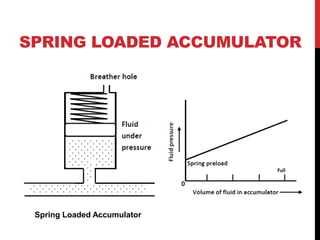
SPRING LOADED ACCUMULATOR
Spring Loaded Accumulator
SPRING LOADED ACCUMULATOR
It is similar to a dead weight type except that piston is
preloaded with a spring compression.
The spring is a source of energy acting against the piston.
The pressure created by this type of accumulator depends
upon the stiffness and pre-loading of spring.
The pressure exerted on the fluid is not constant.
It typically delivers a low flow rate of oil at low pressures,
so for high pressure situations, these type of accumulator
are somewhat heavy.
This are not suitable for application demanding high cycle
rates as the spring may fail in fatigue and lose its elasticity.
GAS LOADED/CHARGED
ACCUMULATORS
These are also known as hydro-pneumatic accumulators
because in this type the force is applied to the oil using
compressed air.
The gas loaded accumulators works on the principle of
Boyle’s law of ideal gas. The storage of potential energy is
due to the compressibility nature of the gas.
The expansion of the gas forces the oil out of the
accumulator.
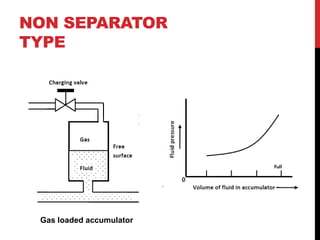
NON SEPARATOR OR
FREE CONTACT TYPE:
The non separator type consist of an enclosed cylindrical
shell having oil part at bottom and a gas charging part at the
top.
The oil below is in free contact with the gas above without
any separator.
It is always in a vertical position, so that the oil and gas
always remain separated.
It can handle large volumes of oil, which is in advantage.
While the disadvantage is the ingress of gas into oil by
absorption.
This is not suitable for high speed pumps as the entrapped
gas in the oil promotes cavitation.
NON SEPARATOR
TYPE
Gas loaded accumulator
GOVERNING
RELATIONS
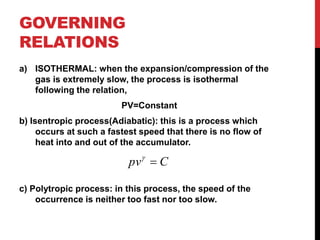
a) ISOTHERMAL: when the expansion/compression of the
gas is extremely slow, the process is isothermal
following the relation,
PV=Constant
b) Isentropic process(Adiabatic): this is a process which
occurs at such a fastest speed that there is no flow of
heat into and out of the accumulator.
c) Polytropic process: in this process, the speed of the
occurrence is neither too fast nor too slow.
Cpv 
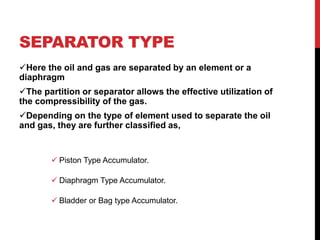
SEPARATOR TYPE
Here the oil and gas are separated by an element or a
diaphragm
The partition or separator allows the effective utilization of
the compressibility of the gas.
Depending on the type of element used to separate the oil
and gas, they are further classified as,
 Piston Type Accumulator.
 Diaphragm Type Accumulator.
 Bladder or Bag type Accumulator.
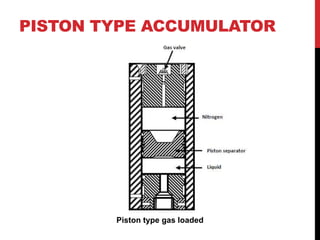
PISTON TYPE ACCUMULATOR
Piston type gas loaded
PISTON TYPE ACCUMULATOR
It consist of a cylinder housing a freely floating piston.
The piston separates the gas and oil.
The friction between the piston and seals may adversely
affect the working of particularly low pressures system.
Leakage past the piston is yet another problem requiring
frequent pre-charging.
Due to greater inertia and seal friction, these accumulators
are not suitable for damping, pressure pulsation or shock
absorption.
DIAPHRAGM TYPE
ACCUMULATOR
DIAPHRAGM TYPE
ACCUMULATOR
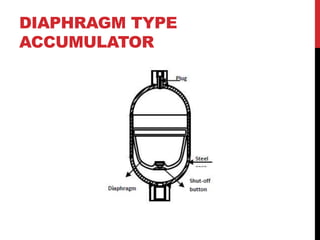
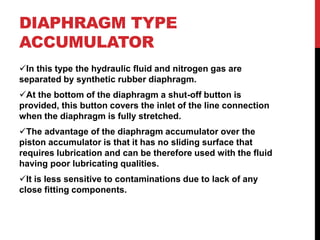
In this type the hydraulic fluid and nitrogen gas are
separated by synthetic rubber diaphragm.
At the bottom of the diaphragm a shut-off button is
provided, this button covers the inlet of the line connection
when the diaphragm is fully stretched.
The advantage of the diaphragm accumulator over the
piston accumulator is that it has no sliding surface that
requires lubrication and can be therefore used with the fluid
having poor lubricating qualities.
It is less sensitive to contaminations due to lack of any
close fitting components.
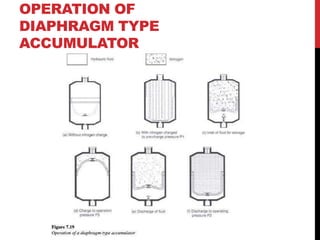
OPERATION OF
DIAPHRAGM TYPE
ACCUMULATOR
BLADDER TYPE
ACCUMULATOR
BLADDER TYPE
ACCUMULATOR
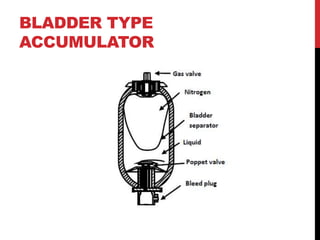
it functions in the same way as the other two accumulators.
Here the gas and the hydraulic fluid are being separated by
synthetic rubber bladder.
The bladder is filled with the nitrogen gas until the designed
pre-charged pressure is achieved.
The hydraulic fluid is then pumped into the accumulator
The poppet valve closes the inlet when the bladder is fully
expanded, thus the pressing of the bladder into the opening is
prevented.
SIGNIFICANCE OF
NITROGEN GAS FILLED
ACCUMULATOR
Only nitrogen gas is used to charge a gas filled with
accumulator.
Nitrogen is chemically inert, non-flammable and does not
combine easily with other elements.
The ingress of nitrogen in to the oil is detectable in the form
of foaming in the reservoir.
Reduction of nitrogen volume also causes narrow limits of
pump operation and overheating, thus reducing the speed of
the cylinders and motors.
The effectiveness can be compensated by using gas back-
up bottle.

Accessories used in fluid power system

  • 1.
  • 2.
  • 3.
    POWER UNIT oThe Powerunit: oProvides energy for the operation of the hydraulic oMoves fluid through the system oProvides a safe maximum system operating pressure oAssisting in maintaining correct system operating temperature and fluid cleanliness
  • 4.
    POWER UNITS A basicpower unit consist of : oPrime mover to power the system oPump to move the fluid oReservoir to store the fluid oRelief valve or pump compensator to control maximum system pressure oFilter to clean the fluid oPlumbing to transport fluid to components
  • 5.
    POWER UNITS Power Unitsare often supplied by manufacturers as package.
  • 6.
    CLASSIFICATION 1. Vertical powerunits 2. Horizontal power units 3. Portable power units
  • 7.
    RESERVOIR The function ofa fluid reservoir in a power hydraulic system is:  To provide a chamber in which any volume of fluid can be accommodated.  To provide a filling point for the system  To serve as a storage space for the hydraulic fluid  To provide a volume of fluid which is relatively stationary to allow entrained air to separate and heavy contaminants to settle.  To accomplish the dissipation of heat by its proper design and to provide a radiating and convective surface to allow the fluid to cool.
  • 8.
  • 9.
    FEATURES OF HYDRAULIC RESERVOIR 1.Filler Cap (breather cap): It should be air tight when closed but may contain the air vent that filters air entering the reservoir to provide gravity push for proper oil flow 2. Oil level gauge: It shows the level of oil in the reservoir without having to open the reservoir. 3. Intake filter: It is usually a screen that is attached to the suction pipe to filter the hydraulic oil.
  • 10.
    4. Baffle Plate: Thepurpose of baffle plate is to separate the pump inlet line from the return line to prevent the same fluid from recirculating continuously within the tank. 1. To permit the foreign substance to settle down to the bottom 2. To allow entrained air to escape the oil 3. To prevent localized turbulence in the reservoir. 4. To promote heat dissipation through the reservoir wall.
  • 11.
    5. Suction &Return line: 1. They are designed to enter the reservoir at the points where the air turbulence is least. 2. They can enter from top or sides but their ends should always be at bottom 3. If return line is above the oil, the return oil can foam and draw in some air. 6. Strainers and Filters: They are designed to remove foreign particles from the hydraulic fluid. 7. Drain Plug: It allows oil to be drained from the reservoir. Some drain plugs are magnetic to help remove metal chips from the oil.
  • 12.
    TYPES OF RESERVOIR 1.Non- pressurized:  These reservoir operates at the Atmospheric pressure.  They are vented to atmosphere using an air filter or a separating diaphragm.  Most commonly used type in Industrial system, machine tools.  Since they are open to atmosphere, as such they are prone to atmosphere. Hence they are not commonly used.
  • 13.
    2. Pressurized:  Thesereservoirs are pressurised inside between 0.35-1.4 bar and has to be provided with some methods of pressure control.  There may be a small air compressor to maintain set charge pressure.  Pressurising improves suction characteristic of pump by providing additional suction head.  It also helps in preventing contaminants from entering into the reservoir.  So it avoids a boost pressure to the main pump and prevents the ingress of dirt.
  • 14.
    SIZING OF RESERVOIR Thereservoir capacity should be adequate enough to cater for changes in fluid volume within the system and sufficient area to provide system cooling. CRITERIA: 1. The minimum reservoir capacity should be twice the pump delivery per minute. 2. The reservoir capacity should be three-four times the pump delivery per minute for a high volume mobile application. 3. It must make allowance for dirt and chips to settle at the bottom and air to escape. 4. It must be able to hold the oil. 5. It must maintain the oil level high enough to prevent the whirlpool effect. 6. It should have large surface area to dissipate heat generated in the system. 7. It should have an adequate air space to allow for the thermal expansion oil.
  • 15.
    DESIGN OF RESERVOIR SURFACE Forreservoir performing primarily as heat exchangers, the estimation of heat transfer surface for rapid heat dissipation is of great significance, H = heat transferred, watts h= overall heat transfer coefficient A= surface area ∆t = temperature differential 6.3*thAH 
  • 16.
    For a vertical plateof height L, 4/1 42.1         L t h For horizontal plate of width, W 4/1 32.1         W t h Best design for heat transfer Poor design for heat transfer
  • 17.
    ACCUMULATOR A hydraulic accumulatoris a device in which the potential energy of an incompressible fluid is held under pressure by an external source against some dynamic force from sources like gravity, mechanical spring and compressed gas. - The potential energy is stored when the demand of energy by the system is less than that available from the prime mover and is released to the system during its period of peak demand of energy which the prime mover alone cannot meet. - Its function is analogous to that of the flywheel in a mechanical system and a capacitor in an electrical circuit
  • 18.
  • 19.
    CLASSIFICATION  Accumulator  Gravityor dead weight type  Spring loaded type  Gas loaded type  Free contact type (Non-separator type)  Separator type  Piston type  Diaphragm type  Bag type
  • 20.
    DEAD WEIGHT ORGRAVITY TYPE ACCUMULATOR Dead Load Accumulator
  • 21.
    DEAD WEIGHT ORGRAVITY TYPE ACCUMULATOR  It consist of a vertical thick-walled steel cylinder housing a piston.  The piston rod extending out of cylinder supports the dead weight by raising the piston on admitting high pressure.  The force of gravity of the dead weight is used to store the potential energy.  This accumulator generates a constant pressure of fluid through full volume output of fluid independent of rate and quantity of energy supplied from prime mover.  Whereas for other types, the fluid output pressure decreases as a function of the flow rate output of the accumulator.  The main drawback being is its very large size and heavy weight which renders it unsuitable for portable applications.
  • 22.
  • 23.
    SPRING LOADED ACCUMULATOR Itis similar to a dead weight type except that piston is preloaded with a spring compression. The spring is a source of energy acting against the piston. The pressure created by this type of accumulator depends upon the stiffness and pre-loading of spring. The pressure exerted on the fluid is not constant. It typically delivers a low flow rate of oil at low pressures, so for high pressure situations, these type of accumulator are somewhat heavy. This are not suitable for application demanding high cycle rates as the spring may fail in fatigue and lose its elasticity.
  • 24.
    GAS LOADED/CHARGED ACCUMULATORS These arealso known as hydro-pneumatic accumulators because in this type the force is applied to the oil using compressed air. The gas loaded accumulators works on the principle of Boyle’s law of ideal gas. The storage of potential energy is due to the compressibility nature of the gas. The expansion of the gas forces the oil out of the accumulator.
  • 25.
    NON SEPARATOR OR FREECONTACT TYPE: The non separator type consist of an enclosed cylindrical shell having oil part at bottom and a gas charging part at the top. The oil below is in free contact with the gas above without any separator. It is always in a vertical position, so that the oil and gas always remain separated. It can handle large volumes of oil, which is in advantage. While the disadvantage is the ingress of gas into oil by absorption. This is not suitable for high speed pumps as the entrapped gas in the oil promotes cavitation.
  • 26.
  • 27.
    GOVERNING RELATIONS a) ISOTHERMAL: whenthe expansion/compression of the gas is extremely slow, the process is isothermal following the relation, PV=Constant b) Isentropic process(Adiabatic): this is a process which occurs at such a fastest speed that there is no flow of heat into and out of the accumulator. c) Polytropic process: in this process, the speed of the occurrence is neither too fast nor too slow. Cpv 
  • 28.
    SEPARATOR TYPE Here theoil and gas are separated by an element or a diaphragm The partition or separator allows the effective utilization of the compressibility of the gas. Depending on the type of element used to separate the oil and gas, they are further classified as,  Piston Type Accumulator.  Diaphragm Type Accumulator.  Bladder or Bag type Accumulator.
  • 29.
  • 30.
    PISTON TYPE ACCUMULATOR Itconsist of a cylinder housing a freely floating piston. The piston separates the gas and oil. The friction between the piston and seals may adversely affect the working of particularly low pressures system. Leakage past the piston is yet another problem requiring frequent pre-charging. Due to greater inertia and seal friction, these accumulators are not suitable for damping, pressure pulsation or shock absorption.
  • 31.
  • 32.
    DIAPHRAGM TYPE ACCUMULATOR In thistype the hydraulic fluid and nitrogen gas are separated by synthetic rubber diaphragm. At the bottom of the diaphragm a shut-off button is provided, this button covers the inlet of the line connection when the diaphragm is fully stretched. The advantage of the diaphragm accumulator over the piston accumulator is that it has no sliding surface that requires lubrication and can be therefore used with the fluid having poor lubricating qualities. It is less sensitive to contaminations due to lack of any close fitting components.
  • 33.
  • 34.
  • 35.
    BLADDER TYPE ACCUMULATOR it functionsin the same way as the other two accumulators. Here the gas and the hydraulic fluid are being separated by synthetic rubber bladder. The bladder is filled with the nitrogen gas until the designed pre-charged pressure is achieved. The hydraulic fluid is then pumped into the accumulator The poppet valve closes the inlet when the bladder is fully expanded, thus the pressing of the bladder into the opening is prevented.
  • 36.
    SIGNIFICANCE OF NITROGEN GASFILLED ACCUMULATOR Only nitrogen gas is used to charge a gas filled with accumulator. Nitrogen is chemically inert, non-flammable and does not combine easily with other elements. The ingress of nitrogen in to the oil is detectable in the form of foaming in the reservoir. Reduction of nitrogen volume also causes narrow limits of pump operation and overheating, thus reducing the speed of the cylinders and motors. The effectiveness can be compensated by using gas back- up bottle.