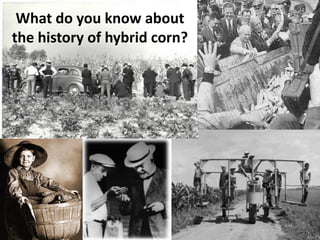
What do you know about the history of hybrid corn?
Geneticists, economists, sociologists, and historians have all discussed hybrid corn 
as a case study of rapid technology adoption with transformative effects.
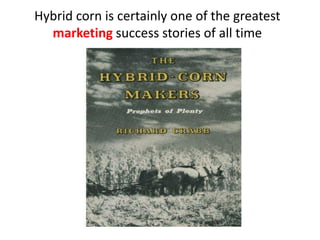
Hybrid corn is certainly one of the greatest marketing success stories of all time
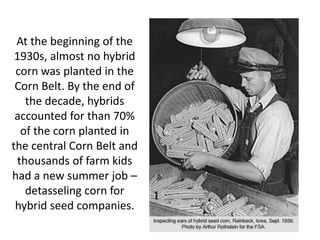
At the beginning of the 1930s, almost no hybrid corn was planted in the Corn Belt. By the end of the decade, hybrids accounted for than 70% of the corn planted in the central Corn Belt and thousands of farm kids had a new summer job – detasseling corn for hybrid seed companies.
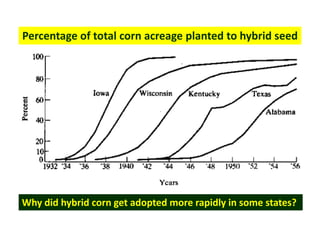
Percentage of total corn acreage planted to hybrid seed 
Why did hybrid corn get adopted more rapidly in some states?
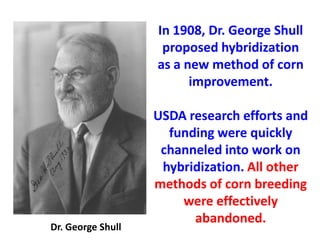
In 1908, Dr. George Shull proposed hybridization as a new method of corn improvement. 
USDA research efforts and funding were quickly channeled into work on hybridization. All other methods of corn breeding were effectively abandoned. 
Dr. George Shull
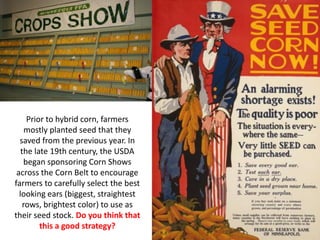
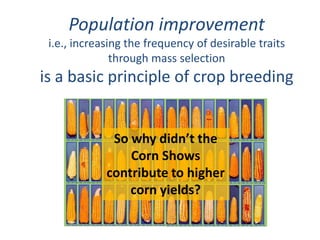
Prior to hybrid corn, farmers mostly planted seed that they saved from the previous year. In the late 19th century, the USDA began sponsoring Corn Shows across the Corn Belt to encourage farmers to carefully select the best looking ears (biggest, straightest rows, brightest color) to use as their seed stock. Do you think that this a good strategy?
Population improvement i.e., increasing the frequency of desirable traits 
through mass selection 
is a basic principle of crop breeding 
So why didn’t the Corn Shows contribute to higher corn yields?
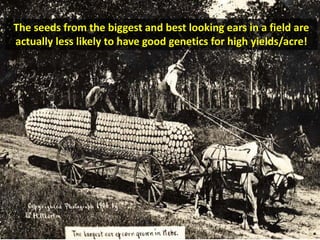
The seeds from the biggest and best looking ears in a field are actually less likely to have good genetics for high yields/acre!
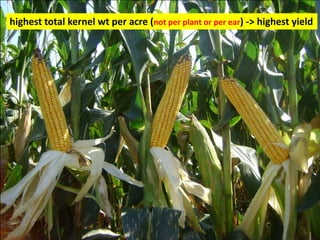
highest total kernel wt per acre (not per plant or per ear) -> highest yield
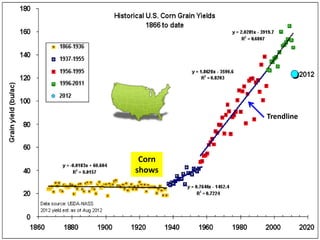
Corn shows 
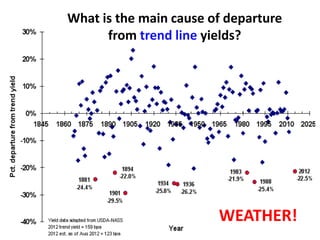
Trendline
What is the main cause of departure 
from trend line yields? 
WEATHER!
Why did corn yield begin increasing dramatically in the 1930s? 
(1)The introduction of planned breeding programs. The confusion of breeding, in general, with hybridization as a particular method is common. 
(1)The introduction of more efficient experimental and statistical test procedures. 
(2) An unprecedented effort by government agencies to develop improved inbred lines in support of the hybrid-seed strategy. 
(3)Major changes in agronomic practices, such as mechanization of field work and increased use of fertilizers.
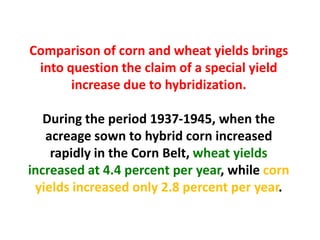
Comparison of corn and wheat yields brings into question the claim of a special yield increase due to hybridization. 
During the period 1937-1945, when the acreage sown to hybrid corn increased rapidly in the Corn Belt, wheat yields increased at 4.4 percent per year, while corn yields increased only 2.8 percent per year.
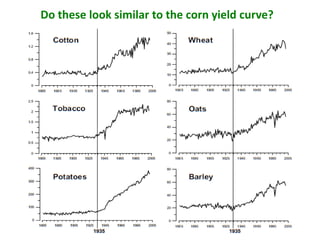
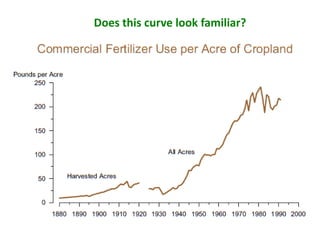
Do these look similar to the corn yield curve?
Does this curve look familiar?
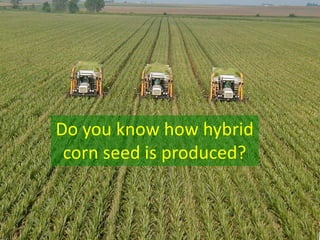
Do you know how hybrid corn seed is produced?
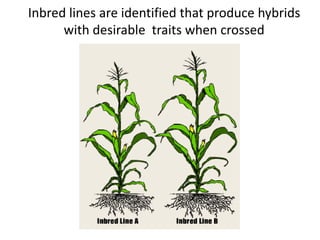
Inbred lines are identified that produce hybrids with desirable traits when crossed
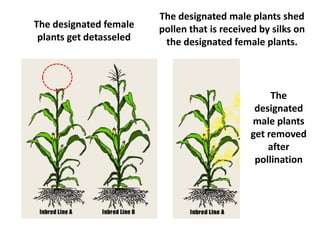
The designated female plants get detasseled 
The designated male plants shed pollen that is received by silks on the designated female plants. 
The designated male plants get removed after pollination
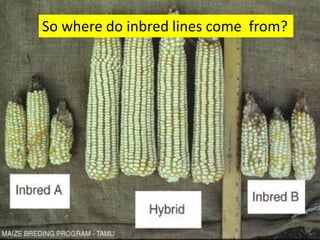
So where do inbred lines come from?
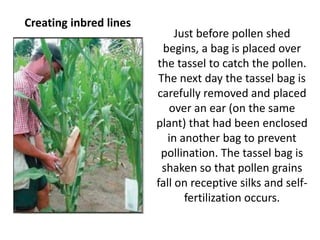
Just before pollen shed begins, a bag is placed over the tassel to catch the pollen. The next day the tassel bag is carefully removed and placed over an ear (on the same plant) that had been enclosed in another bag to prevent pollination. The tassel bag is shaken so that pollen grains fall on receptive silks and self- fertilization occurs. 

Creating inbred lines
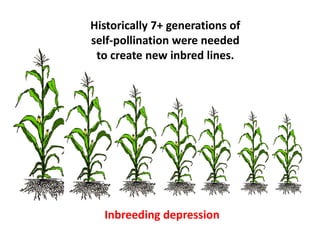
Historically 7+ generations of self-pollination were needed to create new inbred lines. 
Inbreeding depression
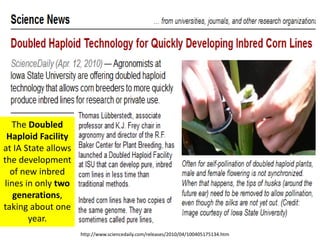
The Doubled Haploid Facility at IA State allows the development of new inbred lines in only two generations, taking about one year. 
http://www.sciencedaily.com/releases/2010/04/100405175134.htm
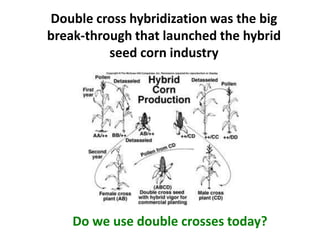
Double cross hybridization was the big break-through that launched the hybrid seed corn industry 
Do we use double crosses today?
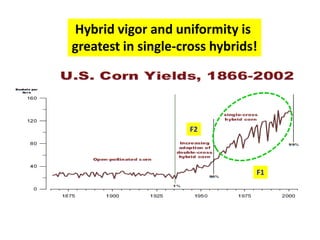
Hybrid vigor and uniformity is 
greatest in single-cross hybrids! 
F2 
F1
The hybridization of corn transformed corn seed into a commodity. 
WHY? 
Seed corn companies knew that once farmers decided to plant hybrid corn they were committing to purchasing seed every year.
As the use of hybrid seed spread, the production of hybrid seed became a highly profitable industry. 
The combination of commercial interest and substantial government support quickly led to a new type of 
public-private partnership with 
lots of investment from both sectors 
in hybrid seed corn R&D.
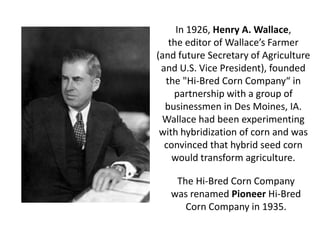
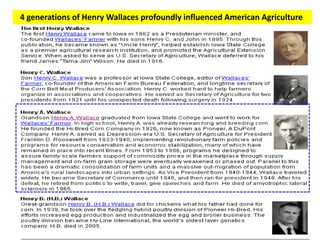
In 1926, Henry A. Wallace, 
the editor of Wallace’s Farmer 
(and future Secretary of Agriculture and U.S. Vice President), founded the "Hi-Bred Corn Company“ in partnership with a group of businessmen in Des Moines, IA. Wallace had been experimenting with hybridization of corn and was convinced that hybrid seed corn would transform agriculture. 
The Hi-Bred Corn Company was renamed Pioneer Hi-Bred Corn Company in 1935.
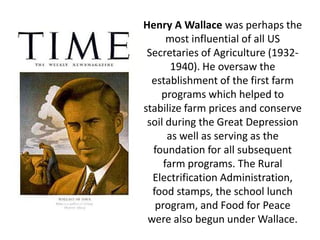
Henry A Wallace was perhaps the most influential of all US Secretaries of Agriculture (1932- 1940). He oversaw the establishment of the first farm programs which helped to stabilize farm prices and conserve soil during the Great Depression as well as serving as the foundation for all subsequent farm programs. The Rural Electrification Administration, food stamps, the school lunch program, and Food for Peace were also begun under Wallace.
“In 1934 alone, Secretary of Agriculture Wallace traveled more than 40,000 miles by car, train, boat, and plane. He made public appearances in all 48 states, delivered 88 speeches, wrote 20 articles for magazines and journals, published two books and a lengthy pamphlet, received two honorary degrees, and met with reporters by the score." American Dreamer: A Life of Henry A. Wallace
4 generations of Henry Wallaces profoundly influenced American Agriculture
Henry A Wallace and Hybrid Hype It is important to consider why so many farmers were willing to purchase hybrid corn seed BEFORE hybrids offered them a clear economic advantage. (1) Pioneer Hi-Bred and other seed companies launched very aggressive marketing campaigns directed at potential adopters, and (2) Henry A. Wallace, founder of Pioneer Hi-Bred, former editor of Wallace’s Agriculture and US Secretary of Agriculture (1932-1940) put the full weight of the USDA behind the advancement of hybrid corn. 
2 important factors
By today’s standards, the glaring conflict of interest between Henry A Wallace’s financial interest in the Pioneer Hi-Bred Company and his use of the government agency he controlled to advertise and advocate for hybrid corn would be considered outrageous. 
All the promotion by the USDA and private industry might not have been able to overcome farmer reservations about hybrids without 
2 other factors. 
Conflict of interest????????
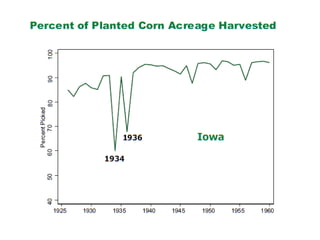
Factor 1 – Extreme weather The key factor which convinced large #s of farmers of the value of hybrids was their performance during catastrophic droughts in 1934 and 1936. The superior drought tolerance of a few specific hybrids relative to open pollinated corn in 1934 and 1936 was a tipping point for many farmers.
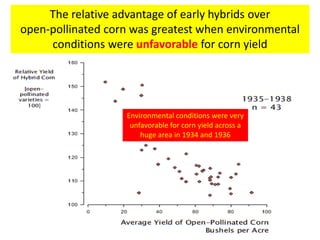
The relative advantage of early hybrids over open-pollinated corn was greatest when environmental conditions were unfavorable for corn yield 
Environmental conditions were very unfavorable for corn yield across a huge area in 1934 and 1936
Factor 2 - Technological Reinforcement 
As hybrid seed corn became a profitable industry, R&D by industry and public scientists rapidly increased corn yield potential creating a self-reinforcing momentum away from open pollinated breeding efforts. 
The profitability of hybrid corn attracted private capital that helped to advance seed production and distribution technologies/infrastructure. 
In addition, the uniformity of hybrid corn enabled early mechanical harvesting equipment to work much more effectively.
Z. Griliches an economist at IA State used the adoption of hybrid corn in the United States as the main example for his well-known model of 
technological diffusion. 
Griliches presented the adoption of hybrid corn as the perfect illustration of how farmers respond to the availability of superior technology. 
As just discussed, the real story is more complex.
Experiments clearly demonstrate that yield gains in hybrid corn are primarily due to improvements in abiotic and biotic stress tolerance (healthier plants that tolerate higher populations) and that these improvements have occurred in both inbred parents and hybrid progeny. 
Modern inbreds are higher yielding than early hybrids and the relative yield advantage of hybrids over inbred parents has decreased over time.
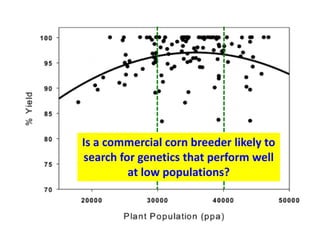
I include three of the top OPVs for Iowa (from the 1920s and 1930s) in my trials and find that although they differ from each other in yielding ability, all three of them are consistently on the bottom for yield and stress tolerance at modern planting rates, but are equal in yield to modern hybrids at super-low populations 
(e.g, 1 plant/square meter). 
Don Duvick – legendary corn breeder 
OPV = open pollinated varieties
Is a commercial corn breeder likely to search for genetics that perform well at low populations?
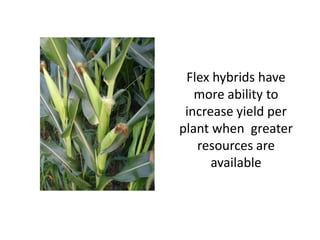
Flex hybrids have more ability to increase yield per plant when greater resources are available
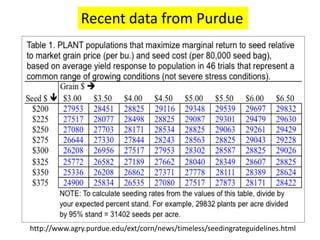
Plant populations in Ohio have increased 56% since the early 1970’s, 280 plants/A/yr on average according to NASS Average final populations in 2010 IA – 29,950 plants/A MN - 29,900 plants/A IL – 29,650 plants/A IN - 28,350 plants/A OH - 28,200 plants/A 
http://corn.osu.edu/newsletters/2011/2001- 06/plant-population-trends-for-corn-in-ohio
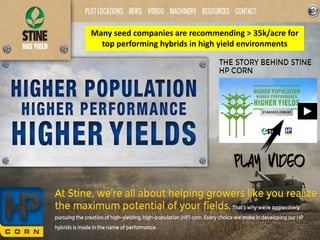
Many seed companies are recommending > 35k/acre for top performing hybrids in high yield environments
http://www.agry.purdue.edu/ext/corn/news/timeless/seedingrateguidelines.html 
Recent data from Purdue
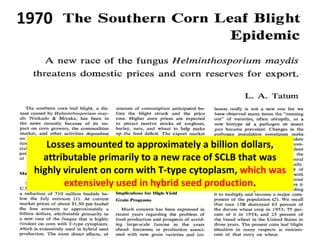
Losses amounted to approximately a billion dollars, attributable primarily to a new race of SCLB that was highly virulent on corn with T-type cytoplasm, which was extensively used in hybrid seed production. 

1970
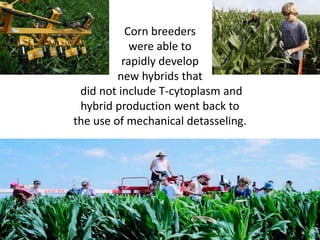
Corn breeders 
were able to 
rapidly develop 
new hybrids that 
did not include T-cytoplasm and hybrid production went back to the use of mechanical detasseling.
(1) Precise genotype identification and multiplication. Instead of a random collection of hybrid and/or inbred plants in an OPV, the most superior hybrid combinations can be identified and reproduced in unlimited quantity. 
Hybridization is a process that fits very well with the industrialization of agriculture
(2) Breeders of hybrid crops can react faster and with more options to meet changing times and changing demands, as compared to breeders of either inbred crops or OPVs. New hybrids with needed new traits can be made and put out to test within one or two seasons, given a broad-based pool of inbred lines. 
Hybridization is a process that fits very well with the industrialization of agriculture
(3) Hybrids facilitate combination of multiple traits into one cultivar, e.g., one hybrid can carry several dominant genes for disease resistance, some coming from one parent, some from the other, or one hybrid may derive its drought tolerance from one parent and its lodging resistance from the other parent. 
Hybridization is a process that fits very well with the industrialization of agriculture
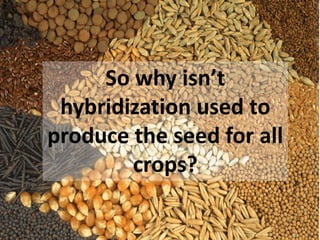
So why isn’t hybridization used to produce the seed for all crops?
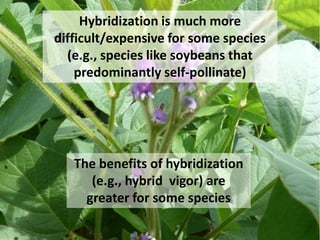
Hybridization is much more difficult/expensive for some species 
(e.g., species like soybeans that predominantly self-pollinate) 
The benefits of hybridization (e.g., hybrid vigor) are greater for some species
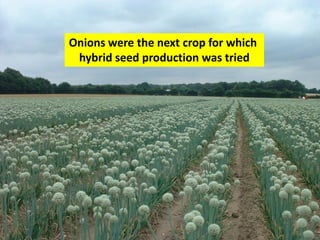
Onions were the next crop for which 
hybrid seed production was tried
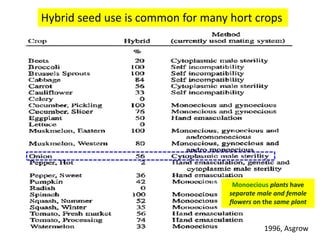
1996, Asgrow 
Hybrid seed use is common for many hort crops 
Monoecious plants have separate male and female flowers on the same plant
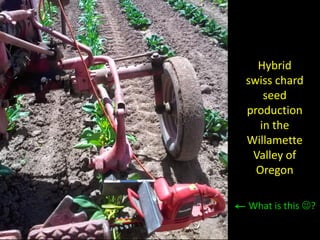
Hybrid 
swiss chard seed production 
in the Willamette Valley of Oregon 
What is this ?
http://ucanr.edu/blogs/blogcore/postdetail.cfm?postnum=12389 
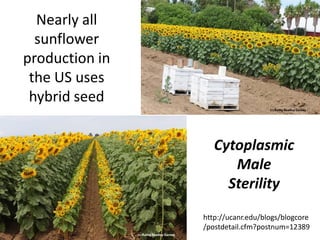
Nearly all sunflower production in the US uses hybrid seed 
Cytoplasmic 
Male 
Sterility
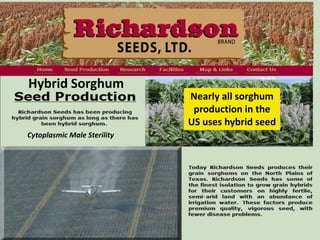
Hybrid Sorghum 
Nearly all sorghum production in the US uses hybrid seed 
Cytoplasmic Male Sterility
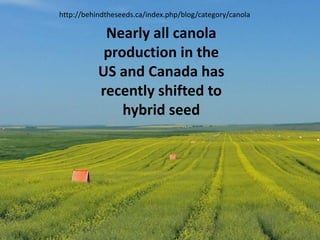
http://behindtheseeds.ca/index.php/blog/category/canola 
Nearly all canola production in the US and Canada has recently shifted to hybrid seed
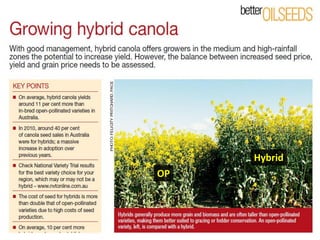
Hybrid 
OP
“I planted a demo bag of hybrid cotton several years ago. It wasn't anything special, and never heard from the company again.” 
TX farmer
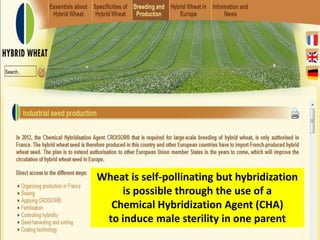
Wheat is self-pollinating but hybridization is possible through the use of a Chemical Hybridization Agent (CHA) to induce male sterility in one parent
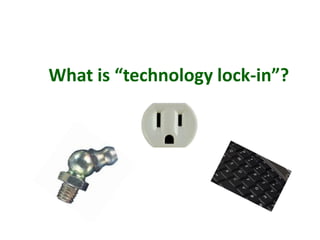
What is “technology lock-in”?
Although the quality and technical advantages provided by a technology undoubtedly influence its fate, other factors unrelated to technical superiority or inferiority may also have major impact. 
Early technology offerings may become so entrenched that superior but subsequent technologies may be unable to gain a foothold in the market. 
Technologies brought to market by large/well- positioned companies may gain a controlling share of the market locking out alternative technologies.
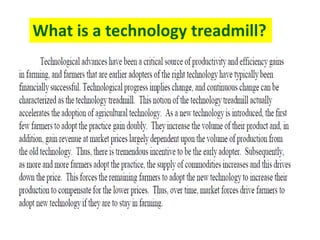
What is a technology treadmill?
Most farmers are using methods which do not allow production flexibility. American agriculture of the conventional type "works" only when the throttle governing energy and input flows is pulled all the way out. Farmers lack the option of switching-either permanently or temporarily-to an alternate system that performs well when conventional production is not profitable. 
Paraphrased Robert Rodale quote that caught my attention back in the 80s

Hybrid corn2014new

  • 2.
    What do youknow about the history of hybrid corn?
  • 3.
    Geneticists, economists, sociologists,and historians have all discussed hybrid corn as a case study of rapid technology adoption with transformative effects.
  • 4.
    Hybrid corn iscertainly one of the greatest marketing success stories of all time
  • 5.
    At the beginningof the 1930s, almost no hybrid corn was planted in the Corn Belt. By the end of the decade, hybrids accounted for than 70% of the corn planted in the central Corn Belt and thousands of farm kids had a new summer job – detasseling corn for hybrid seed companies.
  • 6.
    Percentage of totalcorn acreage planted to hybrid seed Why did hybrid corn get adopted more rapidly in some states?
  • 7.
    In 1908, Dr.George Shull proposed hybridization as a new method of corn improvement. USDA research efforts and funding were quickly channeled into work on hybridization. All other methods of corn breeding were effectively abandoned. Dr. George Shull
  • 8.
    Prior to hybridcorn, farmers mostly planted seed that they saved from the previous year. In the late 19th century, the USDA began sponsoring Corn Shows across the Corn Belt to encourage farmers to carefully select the best looking ears (biggest, straightest rows, brightest color) to use as their seed stock. Do you think that this a good strategy?
  • 9.
    Population improvement i.e.,increasing the frequency of desirable traits through mass selection is a basic principle of crop breeding So why didn’t the Corn Shows contribute to higher corn yields?
  • 10.
    The seeds fromthe biggest and best looking ears in a field are actually less likely to have good genetics for high yields/acre!
  • 11.
    highest total kernelwt per acre (not per plant or per ear) -> highest yield
  • 12.
  • 13.
    What is themain cause of departure from trend line yields? WEATHER!
  • 14.
    Why did cornyield begin increasing dramatically in the 1930s? (1)The introduction of planned breeding programs. The confusion of breeding, in general, with hybridization as a particular method is common. (1)The introduction of more efficient experimental and statistical test procedures. (2) An unprecedented effort by government agencies to develop improved inbred lines in support of the hybrid-seed strategy. (3)Major changes in agronomic practices, such as mechanization of field work and increased use of fertilizers.
  • 15.
    Comparison of cornand wheat yields brings into question the claim of a special yield increase due to hybridization. During the period 1937-1945, when the acreage sown to hybrid corn increased rapidly in the Corn Belt, wheat yields increased at 4.4 percent per year, while corn yields increased only 2.8 percent per year.
  • 16.
    Do these looksimilar to the corn yield curve?
  • 17.
    Does this curvelook familiar?
  • 18.
    Do you knowhow hybrid corn seed is produced?
  • 19.
    Inbred lines areidentified that produce hybrids with desirable traits when crossed
  • 20.
    The designated femaleplants get detasseled The designated male plants shed pollen that is received by silks on the designated female plants. The designated male plants get removed after pollination
  • 21.
    So where doinbred lines come from?
  • 22.
    Just before pollenshed begins, a bag is placed over the tassel to catch the pollen. The next day the tassel bag is carefully removed and placed over an ear (on the same plant) that had been enclosed in another bag to prevent pollination. The tassel bag is shaken so that pollen grains fall on receptive silks and self- fertilization occurs. Creating inbred lines
  • 23.
    Historically 7+ generationsof self-pollination were needed to create new inbred lines. Inbreeding depression
  • 24.
    The Doubled HaploidFacility at IA State allows the development of new inbred lines in only two generations, taking about one year. http://www.sciencedaily.com/releases/2010/04/100405175134.htm
  • 25.
    Double cross hybridizationwas the big break-through that launched the hybrid seed corn industry Do we use double crosses today?
  • 26.
    Hybrid vigor anduniformity is greatest in single-cross hybrids! F2 F1
  • 27.
    The hybridization ofcorn transformed corn seed into a commodity. WHY? Seed corn companies knew that once farmers decided to plant hybrid corn they were committing to purchasing seed every year.
  • 28.
    As the useof hybrid seed spread, the production of hybrid seed became a highly profitable industry. The combination of commercial interest and substantial government support quickly led to a new type of public-private partnership with lots of investment from both sectors in hybrid seed corn R&D.
  • 29.
    In 1926, HenryA. Wallace, the editor of Wallace’s Farmer (and future Secretary of Agriculture and U.S. Vice President), founded the "Hi-Bred Corn Company“ in partnership with a group of businessmen in Des Moines, IA. Wallace had been experimenting with hybridization of corn and was convinced that hybrid seed corn would transform agriculture. The Hi-Bred Corn Company was renamed Pioneer Hi-Bred Corn Company in 1935.
  • 30.
    Henry A Wallacewas perhaps the most influential of all US Secretaries of Agriculture (1932- 1940). He oversaw the establishment of the first farm programs which helped to stabilize farm prices and conserve soil during the Great Depression as well as serving as the foundation for all subsequent farm programs. The Rural Electrification Administration, food stamps, the school lunch program, and Food for Peace were also begun under Wallace.
  • 31.
    “In 1934 alone,Secretary of Agriculture Wallace traveled more than 40,000 miles by car, train, boat, and plane. He made public appearances in all 48 states, delivered 88 speeches, wrote 20 articles for magazines and journals, published two books and a lengthy pamphlet, received two honorary degrees, and met with reporters by the score." American Dreamer: A Life of Henry A. Wallace
  • 32.
    4 generations ofHenry Wallaces profoundly influenced American Agriculture
  • 36.
    Henry A Wallaceand Hybrid Hype It is important to consider why so many farmers were willing to purchase hybrid corn seed BEFORE hybrids offered them a clear economic advantage. (1) Pioneer Hi-Bred and other seed companies launched very aggressive marketing campaigns directed at potential adopters, and (2) Henry A. Wallace, founder of Pioneer Hi-Bred, former editor of Wallace’s Agriculture and US Secretary of Agriculture (1932-1940) put the full weight of the USDA behind the advancement of hybrid corn. 2 important factors
  • 37.
    By today’s standards,the glaring conflict of interest between Henry A Wallace’s financial interest in the Pioneer Hi-Bred Company and his use of the government agency he controlled to advertise and advocate for hybrid corn would be considered outrageous. All the promotion by the USDA and private industry might not have been able to overcome farmer reservations about hybrids without 2 other factors. Conflict of interest????????
  • 38.
    Factor 1 –Extreme weather The key factor which convinced large #s of farmers of the value of hybrids was their performance during catastrophic droughts in 1934 and 1936. The superior drought tolerance of a few specific hybrids relative to open pollinated corn in 1934 and 1936 was a tipping point for many farmers.
  • 40.
    The relative advantageof early hybrids over open-pollinated corn was greatest when environmental conditions were unfavorable for corn yield Environmental conditions were very unfavorable for corn yield across a huge area in 1934 and 1936
  • 41.
    Factor 2 -Technological Reinforcement As hybrid seed corn became a profitable industry, R&D by industry and public scientists rapidly increased corn yield potential creating a self-reinforcing momentum away from open pollinated breeding efforts. The profitability of hybrid corn attracted private capital that helped to advance seed production and distribution technologies/infrastructure. In addition, the uniformity of hybrid corn enabled early mechanical harvesting equipment to work much more effectively.
  • 42.
    Z. Griliches aneconomist at IA State used the adoption of hybrid corn in the United States as the main example for his well-known model of technological diffusion. Griliches presented the adoption of hybrid corn as the perfect illustration of how farmers respond to the availability of superior technology. As just discussed, the real story is more complex.
  • 43.
    Experiments clearly demonstratethat yield gains in hybrid corn are primarily due to improvements in abiotic and biotic stress tolerance (healthier plants that tolerate higher populations) and that these improvements have occurred in both inbred parents and hybrid progeny. Modern inbreds are higher yielding than early hybrids and the relative yield advantage of hybrids over inbred parents has decreased over time.
  • 44.
    I include threeof the top OPVs for Iowa (from the 1920s and 1930s) in my trials and find that although they differ from each other in yielding ability, all three of them are consistently on the bottom for yield and stress tolerance at modern planting rates, but are equal in yield to modern hybrids at super-low populations (e.g, 1 plant/square meter). Don Duvick – legendary corn breeder OPV = open pollinated varieties
  • 45.
    Is a commercialcorn breeder likely to search for genetics that perform well at low populations?
  • 46.
    Flex hybrids havemore ability to increase yield per plant when greater resources are available
  • 47.
    Plant populations inOhio have increased 56% since the early 1970’s, 280 plants/A/yr on average according to NASS Average final populations in 2010 IA – 29,950 plants/A MN - 29,900 plants/A IL – 29,650 plants/A IN - 28,350 plants/A OH - 28,200 plants/A http://corn.osu.edu/newsletters/2011/2001- 06/plant-population-trends-for-corn-in-ohio
  • 48.
    Many seed companiesare recommending > 35k/acre for top performing hybrids in high yield environments
  • 49.
  • 50.
    Losses amounted toapproximately a billion dollars, attributable primarily to a new race of SCLB that was highly virulent on corn with T-type cytoplasm, which was extensively used in hybrid seed production. 1970
  • 51.
    Corn breeders wereable to rapidly develop new hybrids that did not include T-cytoplasm and hybrid production went back to the use of mechanical detasseling.
  • 52.
    (1) Precise genotypeidentification and multiplication. Instead of a random collection of hybrid and/or inbred plants in an OPV, the most superior hybrid combinations can be identified and reproduced in unlimited quantity. Hybridization is a process that fits very well with the industrialization of agriculture
  • 53.
    (2) Breeders ofhybrid crops can react faster and with more options to meet changing times and changing demands, as compared to breeders of either inbred crops or OPVs. New hybrids with needed new traits can be made and put out to test within one or two seasons, given a broad-based pool of inbred lines. Hybridization is a process that fits very well with the industrialization of agriculture
  • 54.
    (3) Hybrids facilitatecombination of multiple traits into one cultivar, e.g., one hybrid can carry several dominant genes for disease resistance, some coming from one parent, some from the other, or one hybrid may derive its drought tolerance from one parent and its lodging resistance from the other parent. Hybridization is a process that fits very well with the industrialization of agriculture
  • 55.
    So why isn’thybridization used to produce the seed for all crops?
  • 56.
    Hybridization is muchmore difficult/expensive for some species (e.g., species like soybeans that predominantly self-pollinate) The benefits of hybridization (e.g., hybrid vigor) are greater for some species
  • 57.
    Onions were thenext crop for which hybrid seed production was tried
  • 58.
    1996, Asgrow Hybridseed use is common for many hort crops Monoecious plants have separate male and female flowers on the same plant
  • 59.
    Hybrid swiss chardseed production in the Willamette Valley of Oregon What is this ?
  • 60.
    http://ucanr.edu/blogs/blogcore/postdetail.cfm?postnum=12389 Nearly allsunflower production in the US uses hybrid seed Cytoplasmic Male Sterility
  • 61.
    Hybrid Sorghum Nearlyall sorghum production in the US uses hybrid seed Cytoplasmic Male Sterility
  • 62.
    http://behindtheseeds.ca/index.php/blog/category/canola Nearly allcanola production in the US and Canada has recently shifted to hybrid seed
  • 63.
  • 64.
    “I planted ademo bag of hybrid cotton several years ago. It wasn't anything special, and never heard from the company again.” TX farmer
  • 65.
    Wheat is self-pollinatingbut hybridization is possible through the use of a Chemical Hybridization Agent (CHA) to induce male sterility in one parent
  • 68.
  • 70.
    Although the qualityand technical advantages provided by a technology undoubtedly influence its fate, other factors unrelated to technical superiority or inferiority may also have major impact. Early technology offerings may become so entrenched that superior but subsequent technologies may be unable to gain a foothold in the market. Technologies brought to market by large/well- positioned companies may gain a controlling share of the market locking out alternative technologies.
  • 71.
    What is atechnology treadmill?
  • 72.
    Most farmers areusing methods which do not allow production flexibility. American agriculture of the conventional type "works" only when the throttle governing energy and input flows is pulled all the way out. Farmers lack the option of switching-either permanently or temporarily-to an alternate system that performs well when conventional production is not profitable. Paraphrased Robert Rodale quote that caught my attention back in the 80s