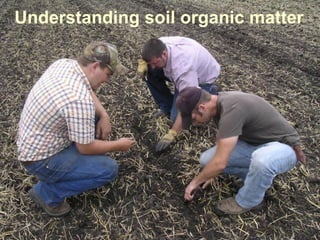
Understanding soil organic matter
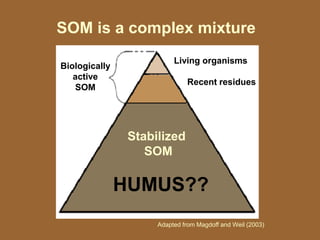
Biologically
active
SOM
SOM is a complex mixture
Living organisms
Recent residues
Stabilized
SOM
Adapted from Magdoff and Weil (2003)
HUMUS??
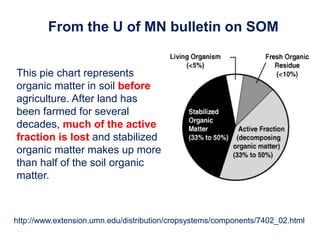
http://www.extension.umn.edu/distribution/cropsystems/components/7402_02.html
This pie chart represents
organic matter in soil before
agriculture. After land has
been farmed for several
decades, much of the active
fraction is lost and stabilized
organic matter makes up more
than half of the soil organic
matter.
From the U of MN bulletin on SOM
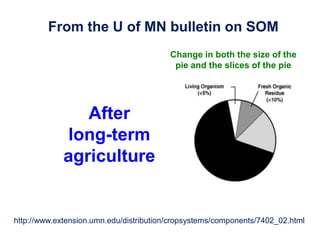
http://www.extension.umn.edu/distribution/cropsystems/components/7402_02.html
From the U of MN bulletin on SOM
After
long-term
agriculture
Change in both the size of the
pie and the slices of the pie
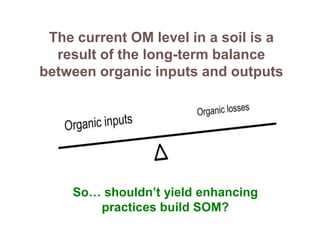
The current OM level in a soil is a
result of the long-term balance
between organic inputs and outputs
So… shouldn’t yield enhancing
practices build SOM?
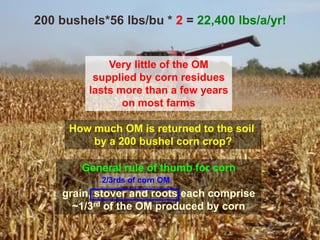
General rule of thumb for corn
grain, stover and roots each comprise
~1/3rd of the OM produced by corn
How much OM is returned to the soil
by a 200 bushel corn crop?
200 bushels*56 lbs/bu * 2 = 22,400 lbs/a/yr!
2/3rds of corn OM
Very little of the OM
supplied by corn residues
lasts more than a few years
on most farms
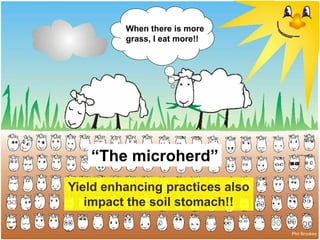
“The microherd”
Phil Brookes
Yield enhancing practices also
impact the soil stomach!!
When there is more
grass, I eat more!!
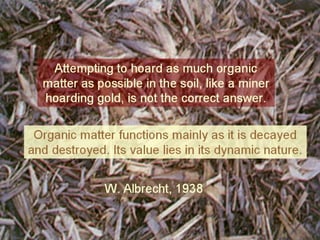
”But with the removal of water through furrows, ditches,
and tiles, and the aeration of the soil by cultivation, what
the pioneers did in effect was to fan the former simmering
fires… into a blaze of bacterial oxidation and more
complete combustion. The combustion of the accumulated
organic matter began to take place at a rate far greater
than its annual accumulation. Along with the increased rate
of destruction of the supply accumulated from the past, the
removal of crops lessened the chance for annual additions.
The age-old process was reversed and the supply of
organic matter in the soil began to decrease instead of
accumulating.”
William Albrecht – 1938 Yearbook of Agriculture
Tillage + Lime + Drainage + N fertilizer =>
higher yields & higher decomposition rates
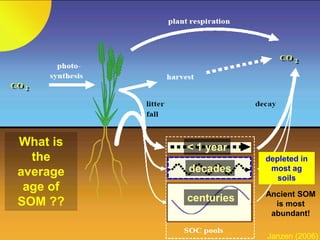
< 1 year
decades
centuries
What is
the
average
age of
SOM ??
Janzen (2006)
Ancient SOM
is most
abundant!
depleted in
most ag
soils
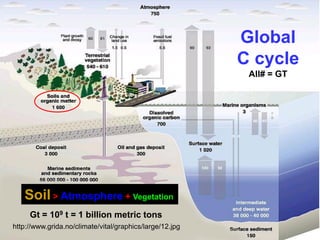
http://www.grida.no/climate/vital/graphics/large/12.jpg
Global
C cycle
All# = GT
Gt = 109 t = 1 billion metric tons
Soil > Atmosphere + Vegetation
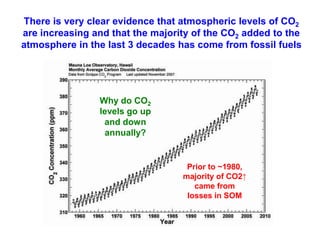
There is very clear evidence that atmospheric levels of CO2
are increasing and that the majority of the CO2 added to the
atmosphere in the last 3 decades has come from fossil fuels
Why do CO2
levels go up
and down
annually?
Prior to ~1980,
majority of CO2↑
came from
losses in SOM
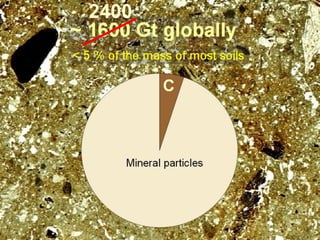
2400
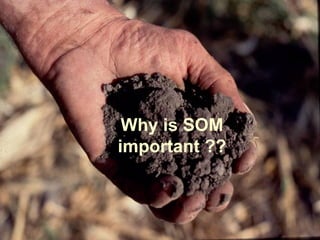
Why is SOM
important ??
What Does Organic Matter Do (for you)?
Nutrient cycling
Increases the nutrient holding capacity of soil (CEC).
Serves as a slow release form of nutrients for plants.
Chelates nutrients increasing their availability to plants.
Feeds soil organisms from bacteria to worms that excrete available nutrients
Water dynamics
Improves water infiltration.
Decreases evaporation.
Increases water holding capacity, especially in sandy soils.
Structure
Reduces crusting, especially in fine-textured soils.
Encourages root development.
Improves aggregation, preventing erosion and reducing compaction.
From the U of MN bulletin:
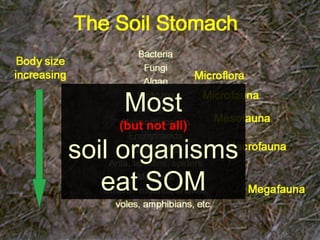
Most
(but not all)
soil organisms
eat SOM
Some bacteria are CHEMOAUTOTROPHS
Chemoautotrophic bacteria obtain energy
through the oxidation of electron donors
other than C.
For example, the bacteria that oxidize ammonia
into nitrate, a important process called nitrification,
do NOT eat SOM
Many bacteria and all fungi
(as well as all other soil organisms)
are HETEROTROPHS
(which means that they eat organic matter).
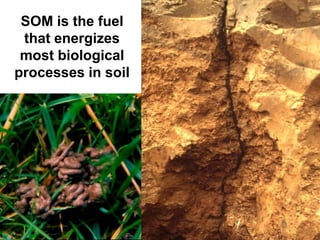
SOM is the fuel
that energizes
most biological
processes in soil
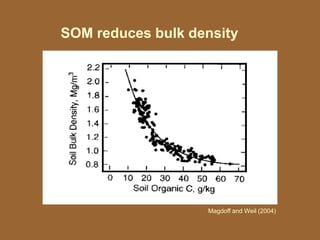
SOM reduces bulk density
Magdoff and Weil (2004)
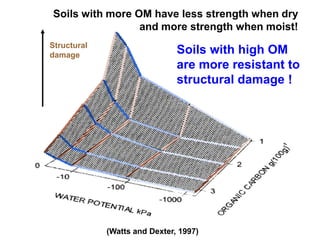
(Watts and Dexter, 1997)
Structural
damage Soils with high OM
are more resistant to
structural damage !
Soils with more OM have less strength when dry
and more strength when moist!
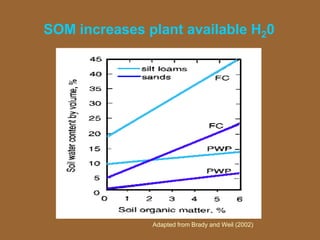
SOM increases plant available H20
Adapted from Brady and Weil (2002)
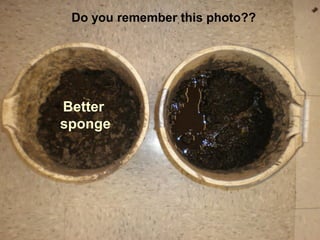
Do you remember this photo??
Better
sponge
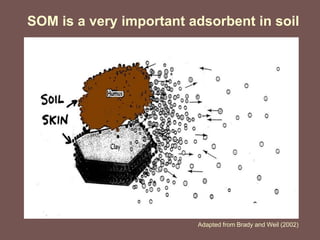
SOM is a very important adsorbent in soil
Adapted from Brady and Weil (2002)
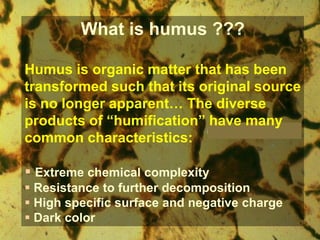
What is humus ???
Humus is organic matter that has been
transformed such that its original source
is no longer apparent… The diverse
products of “humification” have many
common characteristics:
 Extreme chemical complexity
 Resistance to further decomposition
 High specific surface and negative charge
 Dark color
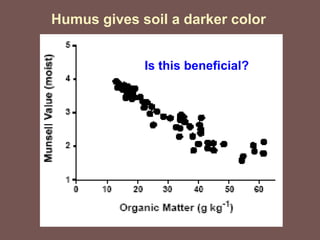
Humus gives soil a darker color
Is this beneficial?
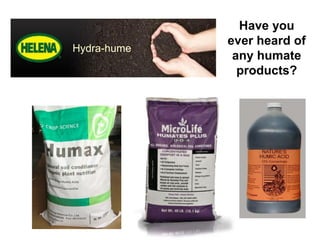
Have you
ever heard of
any humate
products?
Hydra-hume
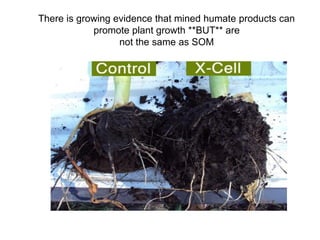
There is growing evidence that mined humate products can
promote plant growth **BUT** are
not the same as SOM
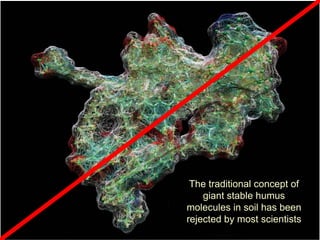
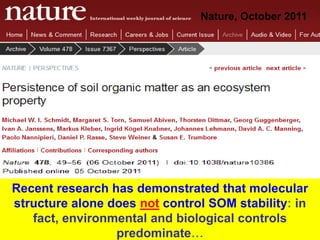
Recent research has demonstrated that molecular
structure alone does not control SOM stability: in
fact, environmental and biological controls
predominate…
Nature, October 2011
The traditional concept of
giant stable humus
molecules in soil has been
rejected by most scientists
accumulate in
soil?
why does
matorganic ter
So…
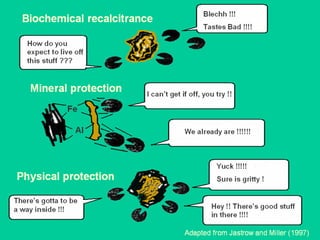
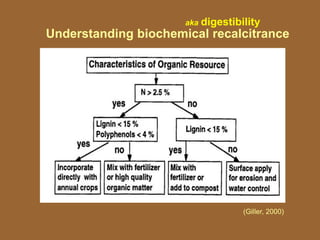
Understanding biochemical recalcitrance
(Giller, 2000)
aka digestibility
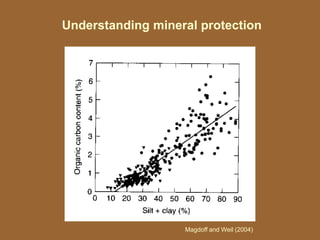
Understanding mineral protection
Magdoff and Weil (2004)
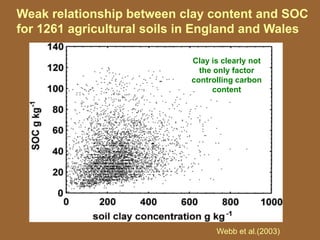
Weak relationship between clay content and SOC
for 1261 agricultural soils in England and Wales
Webb et al.(2003)
Clay is clearly not
the only factor
controlling carbon
content
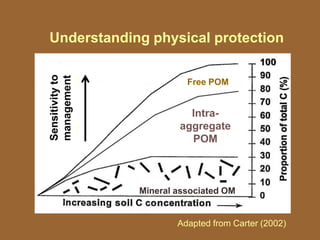
Understanding physical protection
Adapted from Carter (2002)
Mineral associated OM
Intra-
aggregate
POM
Free POM
Sensitivityto
management
↑
↑
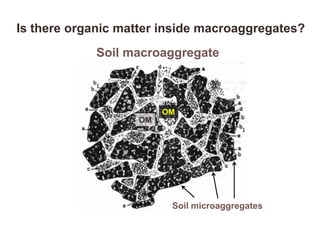
Soil microaggregates
Soil macroaggregate
OM
OM
Is there organic matter inside macroaggregates?
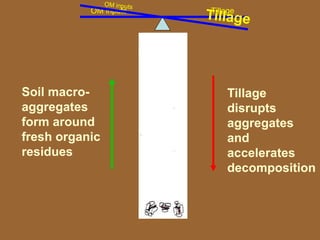
Soil macro-
aggregates
form around
fresh organic
residues
Tillage
disrupts
aggregates
and
accelerates
decomposition
TillageOM inputs
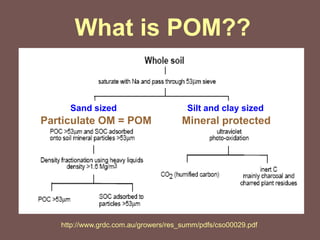
What is POM??
Mineral protected
Sand sized Silt and clay sized
http://www.grdc.com.au/growers/res_summ/pdfs/cso00029.pdf
Particulate OM = POM
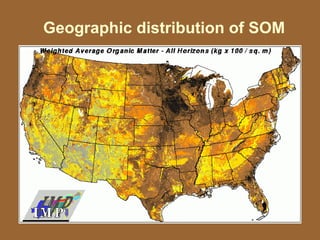
Geographic distribution of SOM
What Determines Soil Organic Matter Levels?
The amount of organic matter in soil is the result of two processes: the addition of
organic matter (roots, surface residue, manure, etc.), and the loss of organic
matter through decomposition. Five factors affect both additions and losses.
Soil texture - Fine-textured soils can hold much more organic matter than sandy
soils for two reasons. First, clay particles form electrochemical bonds that hold
organic compounds. Second, decomposition occurs faster in well-aerated sandy
soils. A sandy loam rarely holds more than 2% organic matter.
Historical vegetation - In prairies, much of the organic matter that dies and is
added to the soil each year comes from grass roots that extend deep into the soil.
In forests, the organic matter comes from leaves that are dropped on the surface
of the soil. Thus, farmland that was once prairie will have higher amounts of
organic matter deep in the soil than lands that were previously forest.
Climate - High temperatures speed up the degradation of organic matter. In
areas of high precipitation (or irrigation) there is more plant growth and therefore
more roots and residues entering the soil.
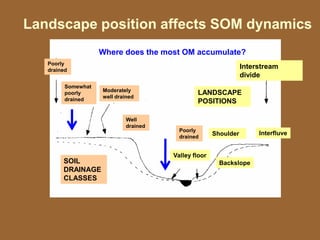
Landscape position - Low, poorly-drained areas have higher organic matter
levels, because less oxygen is available in the soil for decomposition. Low spots
also accumulate organic matter that erodes off hill tops and steep slopes.
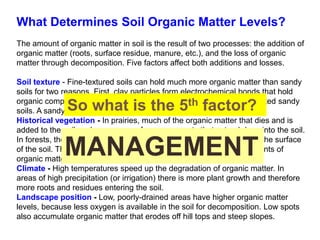
So what is the 5th factor?
MANAGEMENT
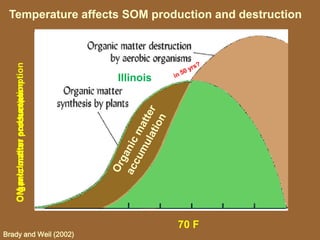
Temperature affects SOM production and destruction
Brady and Weil (2002)
70 F
Organic matter destruction
by aerobic organisms
Organic matter
synthesis by plants
OrganicmatterproductionOrganicmatterconsumptionOMproductionandconsumption
Illinois
Interstream
divide
SOIL
DRAINAGE
CLASSES
Poorly
drained
Somewhat
poorly
drained
Moderately
well drained
Poorly
drained
Well
drained
Interfluve
Valley floor
Backslope
Shoulder
LANDSCAPE
POSITIONS
Landscape position affects SOM dynamics
Where does the most OM accumulate?
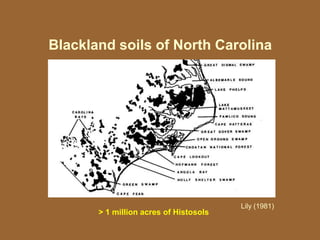
Blackland soils of North Carolina
Lily (1981)
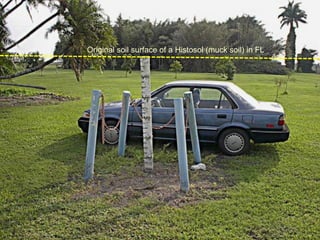
> 1 million acres of Histosols
How
much
is
enough
??
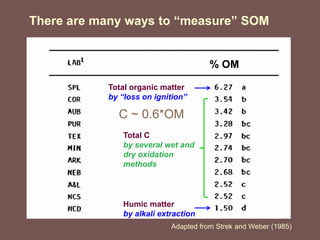
There are many ways to “measure” SOM
Adapted from Strek and Weber (1985)
Total organic matter
by “loss on ignition”
Total C
by several wet and
dry oxidation
methods
Humic matter
by alkali extraction
C ~ 0.6*OM
% OM
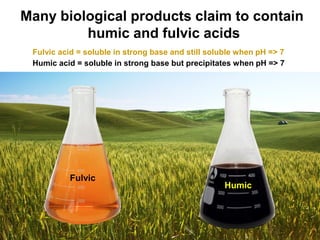
Many biological products claim to contain
humic and fulvic acids
Fulvic
Humic
Fulvic acid = soluble in strong base and still soluble when pH => 7
Humic acid = soluble in strong base but precipitates when pH => 7
TIDIC acid production system ☺
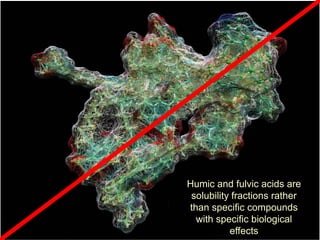
Humic and fulvic acids are
solubility fractions rather
than specific compounds
with specific biological
effects
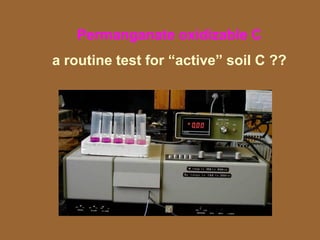
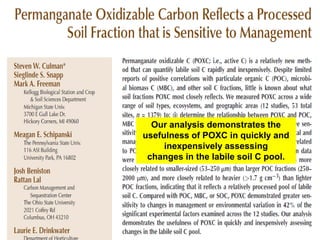
Permanganate oxidizable C
a routine test for “active” soil C ??
Our analysis demonstrates the
usefulness of POXC in quickly and
inexpensively assessing
changes in the labile soil C pool.
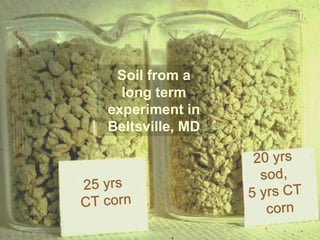
Soil from a
long term
experiment in
Beltsville, MD
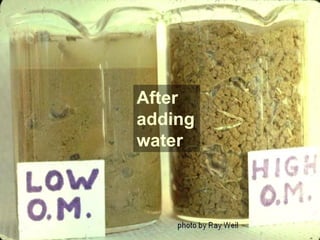
After
adding
water
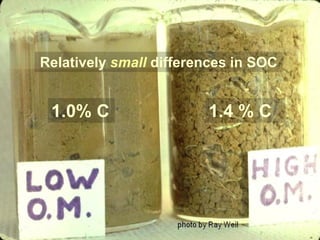
1.4 % C1.0% C
Relatively small differences in SOC
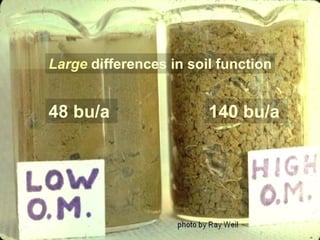
48 bu/a 140 bu/a
Large differences in soil function
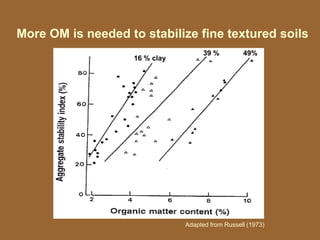
16 % clay 39 % 49%
More OM is needed to stabilize fine textured soils
Adapted from Russell (1973)
16 % clay
39 % 49%
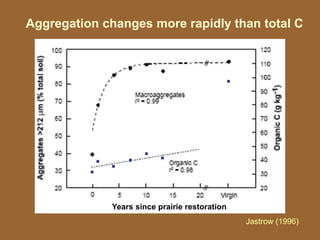
Aggregation changes more rapidly than total C
Jastrow (1996)
Years since prairie restoration
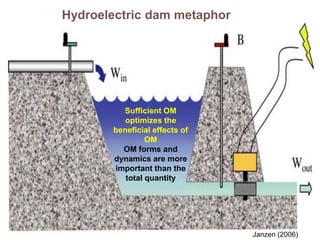
Janzen (2006)
Hydroelectric dam metaphor
Sufficient OM
optimizes the
beneficial effects of
OM
OM forms and
dynamics are more
important than the
total quantity
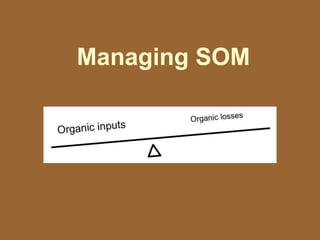
Managing SOM
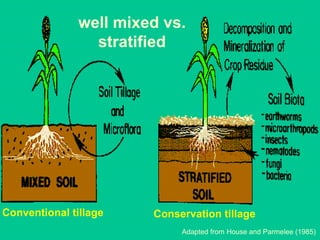
well mixed vs.
stratified
Conventional tillage Conservation tillage
Adapted from House and Parmelee (1985)
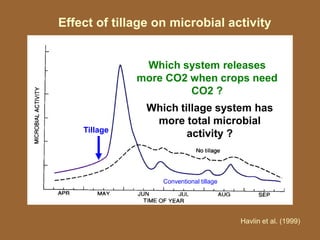
Effect of tillage on microbial activity
Havlin et al. (1999)
Tillage
Which tillage system has
more total microbial
activity ?
Conventional tillage
Which system releases
more CO2 when crops need
CO2 ?
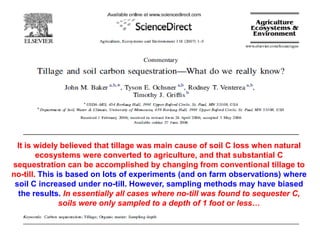
It is widely believed that tillage was main cause of soil C loss when natural
ecosystems were converted to agriculture, and that substantial C
sequestration can be accomplished by changing from conventional tillage to
no-till. This is based on lots of experiments (and on farm observations) where
soil C increased under no-till. However, sampling methods may have biased
the results. In essentially all cases where no-till was found to sequester C,
soils were only sampled to a depth of 1 foot or less…
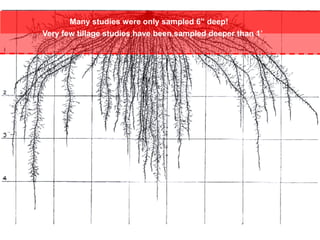
Very few tillage studies have been sampled deeper than 1’
Many studies were only sampled 6” deep!
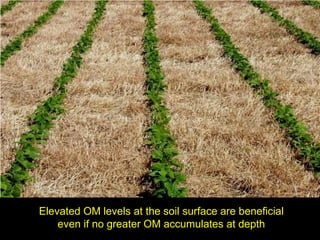
Elevated OM levels at the soil surface are beneficial
even if no greater OM accumulates at depth
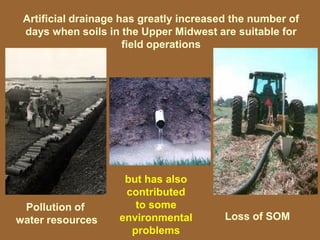
Artificial drainage has greatly increased the number of
days when soils in the Upper Midwest are suitable for
field operations
but has also
contributed
to some
environmental
problems
Pollution of
water resources Loss of SOM
Original soil surface of a Histosol (muck soil) in FL
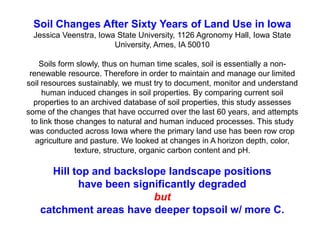
Soil Changes After Sixty Years of Land Use in Iowa
Jessica Veenstra, Iowa State University, 1126 Agronomy Hall, Iowa State
University, Ames, IA 50010
Soils form slowly, thus on human time scales, soil is essentially a non-
renewable resource. Therefore in order to maintain and manage our limited
soil resources sustainably, we must try to document, monitor and understand
human induced changes in soil properties. By comparing current soil
properties to an archived database of soil properties, this study assesses
some of the changes that have occurred over the last 60 years, and attempts
to link those changes to natural and human induced processes. This study
was conducted across Iowa where the primary land use has been row crop
agriculture and pasture. We looked at changes in A horizon depth, color,
texture, structure, organic carbon content and pH.
Hill top and backslope landscape positions
have been significantly degraded
but
catchment areas have deeper topsoil w/ more C.
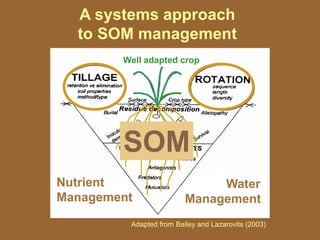
Adapted from Bailey and Lazarovits (2003)
A systems approach
to SOM management
Well adapted crop
Nutrient
Management
Water
Management
SOM
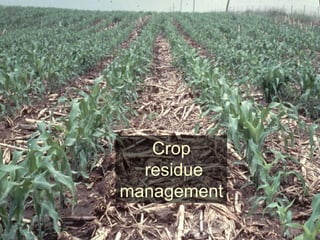
Crop
residue
management
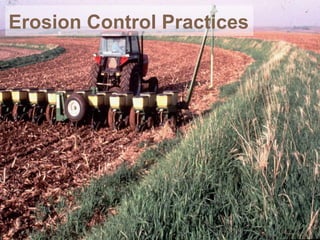
Erosion Control Practices
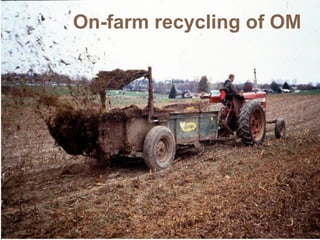
On-farm recycling of OM
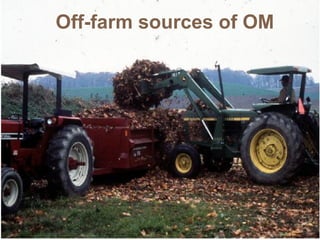
Off-farm sources of OM
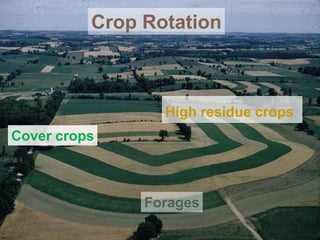
Crop Rotation
High residue crops
Cover crops
Forages
Innovative cover cropping
Actual C
Practically
attainable C
Potential C
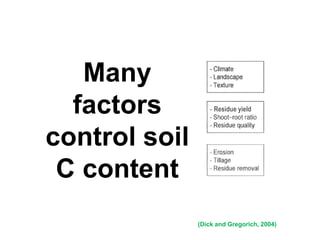
(Dick and Gregorich, 2004)
Input factors
Many
factors
control soil
C content
Residue yield
Saturation deficit
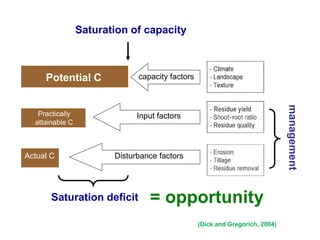
Saturation of capacity
Actual C
Practically
attainable C
Potential C
(Dick and Gregorich, 2004)
Disturbance factors
Input factors
capacity factors
management
= opportunity
Residue yield
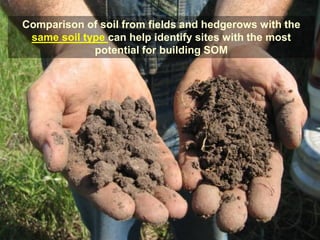
Comparison of soil from fields and hedgerows with the
same soil type can help identify sites with the most
potential for building SOM

Understanding Soil Organic Matter

  • 1.
  • 2.
    Biologically active SOM SOM is acomplex mixture Living organisms Recent residues Stabilized SOM Adapted from Magdoff and Weil (2003) HUMUS??
  • 3.
    http://www.extension.umn.edu/distribution/cropsystems/components/7402_02.html This pie chartrepresents organic matter in soil before agriculture. After land has been farmed for several decades, much of the active fraction is lost and stabilized organic matter makes up more than half of the soil organic matter. From the U of MN bulletin on SOM
  • 4.
    http://www.extension.umn.edu/distribution/cropsystems/components/7402_02.html From the Uof MN bulletin on SOM After long-term agriculture Change in both the size of the pie and the slices of the pie
  • 5.
    The current OMlevel in a soil is a result of the long-term balance between organic inputs and outputs So… shouldn’t yield enhancing practices build SOM?
  • 6.
    General rule ofthumb for corn grain, stover and roots each comprise ~1/3rd of the OM produced by corn How much OM is returned to the soil by a 200 bushel corn crop? 200 bushels*56 lbs/bu * 2 = 22,400 lbs/a/yr! 2/3rds of corn OM Very little of the OM supplied by corn residues lasts more than a few years on most farms
  • 7.
    “The microherd” Phil Brookes Yieldenhancing practices also impact the soil stomach!! When there is more grass, I eat more!!
  • 8.
    ”But with theremoval of water through furrows, ditches, and tiles, and the aeration of the soil by cultivation, what the pioneers did in effect was to fan the former simmering fires… into a blaze of bacterial oxidation and more complete combustion. The combustion of the accumulated organic matter began to take place at a rate far greater than its annual accumulation. Along with the increased rate of destruction of the supply accumulated from the past, the removal of crops lessened the chance for annual additions. The age-old process was reversed and the supply of organic matter in the soil began to decrease instead of accumulating.” William Albrecht – 1938 Yearbook of Agriculture Tillage + Lime + Drainage + N fertilizer => higher yields & higher decomposition rates
  • 9.
    < 1 year decades centuries Whatis the average age of SOM ?? Janzen (2006) Ancient SOM is most abundant! depleted in most ag soils
  • 10.
    http://www.grida.no/climate/vital/graphics/large/12.jpg Global C cycle All# =GT Gt = 109 t = 1 billion metric tons Soil > Atmosphere + Vegetation
  • 11.
    There is veryclear evidence that atmospheric levels of CO2 are increasing and that the majority of the CO2 added to the atmosphere in the last 3 decades has come from fossil fuels Why do CO2 levels go up and down annually? Prior to ~1980, majority of CO2↑ came from losses in SOM
  • 12.
  • 13.
  • 14.
    What Does OrganicMatter Do (for you)? Nutrient cycling Increases the nutrient holding capacity of soil (CEC). Serves as a slow release form of nutrients for plants. Chelates nutrients increasing their availability to plants. Feeds soil organisms from bacteria to worms that excrete available nutrients Water dynamics Improves water infiltration. Decreases evaporation. Increases water holding capacity, especially in sandy soils. Structure Reduces crusting, especially in fine-textured soils. Encourages root development. Improves aggregation, preventing erosion and reducing compaction. From the U of MN bulletin:
  • 15.
    Most (but not all) soilorganisms eat SOM
  • 16.
    Some bacteria areCHEMOAUTOTROPHS Chemoautotrophic bacteria obtain energy through the oxidation of electron donors other than C. For example, the bacteria that oxidize ammonia into nitrate, a important process called nitrification, do NOT eat SOM Many bacteria and all fungi (as well as all other soil organisms) are HETEROTROPHS (which means that they eat organic matter).
  • 17.
    SOM is thefuel that energizes most biological processes in soil
  • 18.
    SOM reduces bulkdensity Magdoff and Weil (2004)
  • 19.
    (Watts and Dexter,1997) Structural damage Soils with high OM are more resistant to structural damage ! Soils with more OM have less strength when dry and more strength when moist!
  • 20.
    SOM increases plantavailable H20 Adapted from Brady and Weil (2002)
  • 21.
    Do you rememberthis photo?? Better sponge
  • 22.
    SOM is avery important adsorbent in soil Adapted from Brady and Weil (2002)
  • 23.
    What is humus??? Humus is organic matter that has been transformed such that its original source is no longer apparent… The diverse products of “humification” have many common characteristics:  Extreme chemical complexity  Resistance to further decomposition  High specific surface and negative charge  Dark color
  • 24.
    Humus gives soila darker color Is this beneficial?
  • 25.
    Have you ever heardof any humate products? Hydra-hume
  • 26.
    There is growingevidence that mined humate products can promote plant growth **BUT** are not the same as SOM
  • 27.
    Recent research hasdemonstrated that molecular structure alone does not control SOM stability: in fact, environmental and biological controls predominate… Nature, October 2011
  • 28.
    The traditional conceptof giant stable humus molecules in soil has been rejected by most scientists
  • 29.
  • 31.
  • 32.
  • 33.
    Weak relationship betweenclay content and SOC for 1261 agricultural soils in England and Wales Webb et al.(2003) Clay is clearly not the only factor controlling carbon content
  • 34.
    Understanding physical protection Adaptedfrom Carter (2002) Mineral associated OM Intra- aggregate POM Free POM Sensitivityto management ↑ ↑
  • 35.
    Soil microaggregates Soil macroaggregate OM OM Isthere organic matter inside macroaggregates?
  • 36.
    Soil macro- aggregates form around freshorganic residues Tillage disrupts aggregates and accelerates decomposition TillageOM inputs
  • 37.
    What is POM?? Mineralprotected Sand sized Silt and clay sized http://www.grdc.com.au/growers/res_summ/pdfs/cso00029.pdf Particulate OM = POM
  • 38.
  • 39.
    What Determines SoilOrganic Matter Levels? The amount of organic matter in soil is the result of two processes: the addition of organic matter (roots, surface residue, manure, etc.), and the loss of organic matter through decomposition. Five factors affect both additions and losses. Soil texture - Fine-textured soils can hold much more organic matter than sandy soils for two reasons. First, clay particles form electrochemical bonds that hold organic compounds. Second, decomposition occurs faster in well-aerated sandy soils. A sandy loam rarely holds more than 2% organic matter. Historical vegetation - In prairies, much of the organic matter that dies and is added to the soil each year comes from grass roots that extend deep into the soil. In forests, the organic matter comes from leaves that are dropped on the surface of the soil. Thus, farmland that was once prairie will have higher amounts of organic matter deep in the soil than lands that were previously forest. Climate - High temperatures speed up the degradation of organic matter. In areas of high precipitation (or irrigation) there is more plant growth and therefore more roots and residues entering the soil. Landscape position - Low, poorly-drained areas have higher organic matter levels, because less oxygen is available in the soil for decomposition. Low spots also accumulate organic matter that erodes off hill tops and steep slopes. So what is the 5th factor? MANAGEMENT
  • 40.
    Temperature affects SOMproduction and destruction Brady and Weil (2002) 70 F Organic matter destruction by aerobic organisms Organic matter synthesis by plants OrganicmatterproductionOrganicmatterconsumptionOMproductionandconsumption Illinois
  • 41.
  • 42.
    Blackland soils ofNorth Carolina Lily (1981) > 1 million acres of Histosols
  • 43.
  • 44.
    There are manyways to “measure” SOM Adapted from Strek and Weber (1985) Total organic matter by “loss on ignition” Total C by several wet and dry oxidation methods Humic matter by alkali extraction C ~ 0.6*OM % OM
  • 45.
    Many biological productsclaim to contain humic and fulvic acids Fulvic Humic Fulvic acid = soluble in strong base and still soluble when pH => 7 Humic acid = soluble in strong base but precipitates when pH => 7
  • 46.
  • 47.
    Humic and fulvicacids are solubility fractions rather than specific compounds with specific biological effects
  • 48.
    Permanganate oxidizable C aroutine test for “active” soil C ??
  • 49.
    Our analysis demonstratesthe usefulness of POXC in quickly and inexpensively assessing changes in the labile soil C pool.
  • 50.
    Soil from a longterm experiment in Beltsville, MD
  • 51.
  • 52.
    1.4 % C1.0%C Relatively small differences in SOC
  • 53.
    48 bu/a 140bu/a Large differences in soil function
  • 54.
    16 % clay39 % 49% More OM is needed to stabilize fine textured soils Adapted from Russell (1973) 16 % clay 39 % 49%
  • 55.
    Aggregation changes morerapidly than total C Jastrow (1996) Years since prairie restoration
  • 57.
    Janzen (2006) Hydroelectric dammetaphor Sufficient OM optimizes the beneficial effects of OM OM forms and dynamics are more important than the total quantity
  • 58.
  • 59.
    well mixed vs. stratified Conventionaltillage Conservation tillage Adapted from House and Parmelee (1985)
  • 60.
    Effect of tillageon microbial activity Havlin et al. (1999) Tillage Which tillage system has more total microbial activity ? Conventional tillage Which system releases more CO2 when crops need CO2 ?
  • 61.
    It is widelybelieved that tillage was main cause of soil C loss when natural ecosystems were converted to agriculture, and that substantial C sequestration can be accomplished by changing from conventional tillage to no-till. This is based on lots of experiments (and on farm observations) where soil C increased under no-till. However, sampling methods may have biased the results. In essentially all cases where no-till was found to sequester C, soils were only sampled to a depth of 1 foot or less…
  • 62.
    Very few tillagestudies have been sampled deeper than 1’ Many studies were only sampled 6” deep!
  • 63.
    Elevated OM levelsat the soil surface are beneficial even if no greater OM accumulates at depth
  • 64.
    Artificial drainage hasgreatly increased the number of days when soils in the Upper Midwest are suitable for field operations but has also contributed to some environmental problems Pollution of water resources Loss of SOM
  • 65.
    Original soil surfaceof a Histosol (muck soil) in FL
  • 66.
    Soil Changes AfterSixty Years of Land Use in Iowa Jessica Veenstra, Iowa State University, 1126 Agronomy Hall, Iowa State University, Ames, IA 50010 Soils form slowly, thus on human time scales, soil is essentially a non- renewable resource. Therefore in order to maintain and manage our limited soil resources sustainably, we must try to document, monitor and understand human induced changes in soil properties. By comparing current soil properties to an archived database of soil properties, this study assesses some of the changes that have occurred over the last 60 years, and attempts to link those changes to natural and human induced processes. This study was conducted across Iowa where the primary land use has been row crop agriculture and pasture. We looked at changes in A horizon depth, color, texture, structure, organic carbon content and pH. Hill top and backslope landscape positions have been significantly degraded but catchment areas have deeper topsoil w/ more C.
  • 67.
    Adapted from Baileyand Lazarovits (2003) A systems approach to SOM management Well adapted crop Nutrient Management Water Management SOM
  • 68.
  • 69.
  • 70.
  • 71.
  • 72.
    Crop Rotation High residuecrops Cover crops Forages
  • 73.
  • 74.
    Actual C Practically attainable C PotentialC (Dick and Gregorich, 2004) Input factors Many factors control soil C content Residue yield
  • 75.
    Saturation deficit Saturation ofcapacity Actual C Practically attainable C Potential C (Dick and Gregorich, 2004) Disturbance factors Input factors capacity factors management = opportunity Residue yield
  • 76.
    Comparison of soilfrom fields and hedgerows with the same soil type can help identify sites with the most potential for building SOM