High-Yield Corn Production
This presentation summarizes management practices
used by NCGA national contest winners, many of
which can be applied to all corn production fields.
Corn Yield Trends

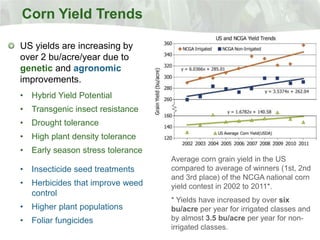
US yields are increasing by
over 2 bu/acre/year due to
genetic and agronomic
improvements.
•   Hybrid Yield Potential
•   Transgenic insect resistance
•   Drought tolerance
•   High plant density tolerance
•   Early season stress tolerance
                                    Average corn grain yield in the US
•   Insecticide seed treatments     compared to average of winners (1st, 2nd
                                    and 3rd place) of the NCGA national corn
•   Herbicides that improve weed    yield contest in 2002 to 2011*.
    control
                                    * Yields have increased by over six
•   Higher plant populations        bu/acre per year for irrigated classes and
•   Foliar fungicides               by almost 3.5 bu/acre per year for non-
                                    irrigated classes.
Hybrid Selection
To achieve highest possible
yields, growers should select a
hybrid with:
 • Top-end yield potential
 • Full maturity for the field
 • Good emergence under
   stress
 • Drought tolerance
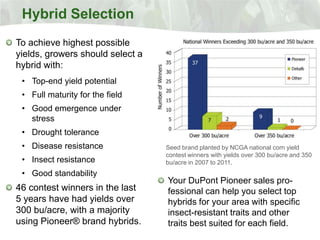
 • Disease resistance             Seed brand planted by NCGA national corn yield
                                  contest winners with yields over 300 bu/acre and 350
 • Insect resistance              bu/acre in 2007 to 2011.
 • Good standability
                                  Your DuPont Pioneer sales pro-
46 contest winners in the last    fessional can help you select top
5 years have had yields over      hybrids for your area with specific
300 bu/acre, with a majority      insect-resistant traits and other
using Pioneer® brand hybrids.     traits best suited for each field.
Crop Rotation & Soil Fertility

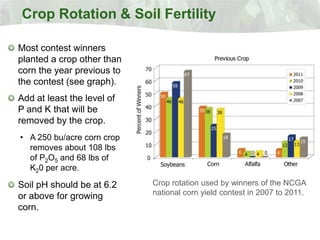
Most contest winners
planted a crop other than
corn the year previous to
the contest (see graph).
Add at least the level of
P and K that will be
removed by the crop.
• A 250 bu/acre corn crop
  removes about 108 lbs
  of P2O5 and 68 lbs of
  K20 per acre.

Soil pH should be at 6.2    Crop rotation used by winners of the NCGA
or above for growing        national corn yield contest in 2007 to 2011.
corn.
Nitrogen (N) Rates & Application Timing
Corn grain removes approximately
one pound of N per bu harvested,
and stover production requires a
half-pound for each bu of grain
produced.
• Fertilizer does not need to be the only
  source of N, take credit for previous
  legume crop, manure, soil organic
  matter, and N in irrigation water.

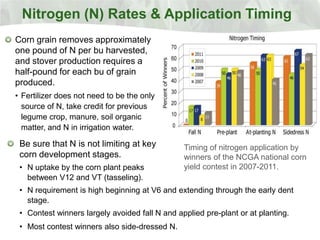
 Be sure that N is not limiting at key          Timing of nitrogen application by
 corn development stages.                       winners of the NCGA national corn
 • N uptake by the corn plant peaks             yield contest in 2007-2011.
   between V12 and VT (tasseling).
 • N requirement is high beginning at V6 and extending through the early dent
   stage.
 • Contest winners largely avoided fall N and applied pre-plant or at planting.
 • Most contest winners also side-dressed N.
Starter, Micronutrients and Manure

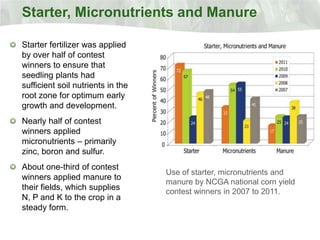
Starter fertilizer was applied
by over half of contest
winners to ensure that
seedling plants had
sufficient soil nutrients in the
root zone for optimum early
growth and development.
Nearly half of contest
winners applied
micronutrients – primarily
zinc, boron and sulfur.
About one-third of contest
                                   Use of starter, micronutrients and
winners applied manure to
                                   manure by NCGA national corn yield
their fields, which supplies       contest winners in 2007 to 2011.
N, P and K to the crop in a
steady form.
Planting Date
Winning contest plots are usually
planted as early as practical
for their geography.
 • Lengthens the growing season.
 • Moves pollination and initial ear-fill
   earlier. When pollination is
   completed in June or early July,
   heat and moisture stress effects
   may be reduced.
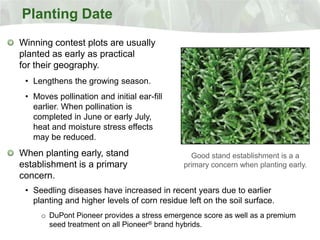
When planting early, stand                     Good stand establishment is a a
establishment is a primary                   primary concern when planting early.
concern.
 • Seedling diseases have increased in recent years due to earlier
   planting and higher levels of corn residue left on the soil surface.
     o DuPont Pioneer provides a stress emergence score as well as a premium
       seed treatment on all Pioneer® brand hybrids.
Planting Rate & Row Width
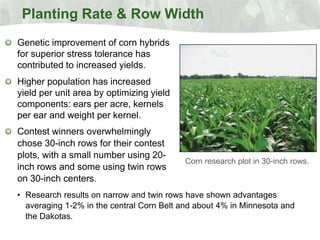
Genetic improvement of corn hybrids
for superior stress tolerance has
contributed to increased yields.
Higher population has increased
yield per unit area by optimizing yield
components: ears per acre, kernels
per ear and weight per kernel.
Contest winners overwhelmingly
chose 30-inch rows for their contest
plots, with a small number using 20-
                                          Corn research plot in 30-inch rows.
inch rows and some using twin rows
on 30-inch centers.
• Research results on narrow and twin rows have shown advantages
  averaging 1-2% in the central Corn Belt and about 4% in Minnesota and
  the Dakotas.
Foliar Fungicide Use

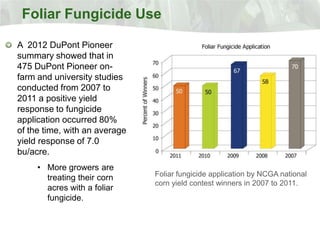
A 2012 DuPont Pioneer
summary showed that in
475 DuPont Pioneer on-
farm and university studies
conducted from 2007 to
2011 a positive yield
response to fungicide
application occurred 80%
of the time, with an average
yield response of 7.0
bu/acre.
     • More growers are
                               Foliar fungicide application by NCGA national
       treating their corn
                               corn yield contest winners in 2007 to 2011.
       acres with a foliar
       fungicide.
Weed Control
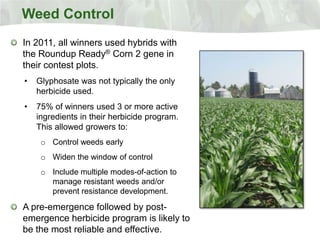
In 2011, all winners used hybrids with
the Roundup Ready® Corn 2 gene in
their contest plots.
•   Glyphosate was not typically the only
    herbicide used.
•   75% of winners used 3 or more active
    ingredients in their herbicide program.
    This allowed growers to:
     o Control weeds early
     o Widen the window of control
     o Include multiple modes-of-action to
       manage resistant weeds and/or
       prevent resistance development.

A pre-emergence followed by post-
emergence herbicide program is likely to
be the most reliable and effective.
Other Practices and Conclusions

In the last 5 contest years, insecticide seed treatments were used
by the vast majority of contest winners.
 • Some used other practices such as multiple deep tillage trips; planter
   calibration; soil and plant-applied insecticides; and “non-traditional”
   products such as root enhancers, growth regulators, and growth
   promoters.

 • It may be difficult to evaluate the effect of individual treatments when
   several are applied to a single plot. This complicates identifying useful
   products for the future, even if improved yields are obtained in the plot.

Hybrid selection, crop rotation, nitrogen fertility, plant population,
planting date and foliar fungicides are critical
factors in achieving highest corn yields.
 • Growers using these practices are rapidly accelerating corn yields in
   contest plots as well as on production acres.

High-Yield Corn Production

  • 1.
    High-Yield Corn Production Thispresentation summarizes management practices used by NCGA national contest winners, many of which can be applied to all corn production fields.
  • 2.
    Corn Yield Trends USyields are increasing by over 2 bu/acre/year due to genetic and agronomic improvements. • Hybrid Yield Potential • Transgenic insect resistance • Drought tolerance • High plant density tolerance • Early season stress tolerance Average corn grain yield in the US • Insecticide seed treatments compared to average of winners (1st, 2nd and 3rd place) of the NCGA national corn • Herbicides that improve weed yield contest in 2002 to 2011*. control * Yields have increased by over six • Higher plant populations bu/acre per year for irrigated classes and • Foliar fungicides by almost 3.5 bu/acre per year for non- irrigated classes.
  • 3.
    Hybrid Selection To achievehighest possible yields, growers should select a hybrid with: • Top-end yield potential • Full maturity for the field • Good emergence under stress • Drought tolerance • Disease resistance Seed brand planted by NCGA national corn yield contest winners with yields over 300 bu/acre and 350 • Insect resistance bu/acre in 2007 to 2011. • Good standability Your DuPont Pioneer sales pro- 46 contest winners in the last fessional can help you select top 5 years have had yields over hybrids for your area with specific 300 bu/acre, with a majority insect-resistant traits and other using Pioneer® brand hybrids. traits best suited for each field.
  • 4.
    Crop Rotation &Soil Fertility Most contest winners planted a crop other than corn the year previous to the contest (see graph). Add at least the level of P and K that will be removed by the crop. • A 250 bu/acre corn crop removes about 108 lbs of P2O5 and 68 lbs of K20 per acre. Soil pH should be at 6.2 Crop rotation used by winners of the NCGA or above for growing national corn yield contest in 2007 to 2011. corn.
  • 5.
    Nitrogen (N) Rates& Application Timing Corn grain removes approximately one pound of N per bu harvested, and stover production requires a half-pound for each bu of grain produced. • Fertilizer does not need to be the only source of N, take credit for previous legume crop, manure, soil organic matter, and N in irrigation water. Be sure that N is not limiting at key Timing of nitrogen application by corn development stages. winners of the NCGA national corn • N uptake by the corn plant peaks yield contest in 2007-2011. between V12 and VT (tasseling). • N requirement is high beginning at V6 and extending through the early dent stage. • Contest winners largely avoided fall N and applied pre-plant or at planting. • Most contest winners also side-dressed N.
  • 6.
    Starter, Micronutrients andManure Starter fertilizer was applied by over half of contest winners to ensure that seedling plants had sufficient soil nutrients in the root zone for optimum early growth and development. Nearly half of contest winners applied micronutrients – primarily zinc, boron and sulfur. About one-third of contest Use of starter, micronutrients and winners applied manure to manure by NCGA national corn yield their fields, which supplies contest winners in 2007 to 2011. N, P and K to the crop in a steady form.
  • 7.
    Planting Date Winning contestplots are usually planted as early as practical for their geography. • Lengthens the growing season. • Moves pollination and initial ear-fill earlier. When pollination is completed in June or early July, heat and moisture stress effects may be reduced. When planting early, stand Good stand establishment is a a establishment is a primary primary concern when planting early. concern. • Seedling diseases have increased in recent years due to earlier planting and higher levels of corn residue left on the soil surface. o DuPont Pioneer provides a stress emergence score as well as a premium seed treatment on all Pioneer® brand hybrids.
  • 8.
    Planting Rate &Row Width Genetic improvement of corn hybrids for superior stress tolerance has contributed to increased yields. Higher population has increased yield per unit area by optimizing yield components: ears per acre, kernels per ear and weight per kernel. Contest winners overwhelmingly chose 30-inch rows for their contest plots, with a small number using 20- Corn research plot in 30-inch rows. inch rows and some using twin rows on 30-inch centers. • Research results on narrow and twin rows have shown advantages averaging 1-2% in the central Corn Belt and about 4% in Minnesota and the Dakotas.
  • 9.
    Foliar Fungicide Use A2012 DuPont Pioneer summary showed that in 475 DuPont Pioneer on- farm and university studies conducted from 2007 to 2011 a positive yield response to fungicide application occurred 80% of the time, with an average yield response of 7.0 bu/acre. • More growers are Foliar fungicide application by NCGA national treating their corn corn yield contest winners in 2007 to 2011. acres with a foliar fungicide.
  • 10.
    Weed Control In 2011,all winners used hybrids with the Roundup Ready® Corn 2 gene in their contest plots. • Glyphosate was not typically the only herbicide used. • 75% of winners used 3 or more active ingredients in their herbicide program. This allowed growers to: o Control weeds early o Widen the window of control o Include multiple modes-of-action to manage resistant weeds and/or prevent resistance development. A pre-emergence followed by post- emergence herbicide program is likely to be the most reliable and effective.
  • 11.
    Other Practices andConclusions In the last 5 contest years, insecticide seed treatments were used by the vast majority of contest winners. • Some used other practices such as multiple deep tillage trips; planter calibration; soil and plant-applied insecticides; and “non-traditional” products such as root enhancers, growth regulators, and growth promoters. • It may be difficult to evaluate the effect of individual treatments when several are applied to a single plot. This complicates identifying useful products for the future, even if improved yields are obtained in the plot. Hybrid selection, crop rotation, nitrogen fertility, plant population, planting date and foliar fungicides are critical factors in achieving highest corn yields. • Growers using these practices are rapidly accelerating corn yields in contest plots as well as on production acres.