GRADE IV- SCIENCE & HEALTH 
HOW SELF POLLINATION 
DIFFERS FROM CROSS 
POLLINATION 
Rosalie Q. Castillo 
Lazareto Elementary School
Pollination Song
Stinking Plant 
• A blow-fly was looking for an ideal place to lay eggs. Like rotting meat. So that 
when her little maggots were born, they could feed on the meat. 
• As she turned a corner in the grassland, she smelt something stinking in the air. 
The smell of rotten meat! With great joy she perched on it and laid her eggs. She was 
happy that her children would have enough food to eat. 
• The blow-fly did not know she had made a great mistake. What she had sat upon 
was not meat but a flower, which stinks. It is called a carrion flower. So, when the 
blow-fly's eggs hatched and the little maggots came out, they had nothing to eat. 
They died of starvation.
• The carrion flower is one of the many flowers which give out dirty smells to 
attract flies. The Rafflesia stinks like rotting meat, while the tropical Lords and 
Ladies flower gives out a smell like rotting fish. 
• They do it for a special reason. Unlike mating birds, these plants cannot 
move from their place. But it is important for the male cell of one plant to get 
in touch with the female cell of another plant. Once that is done, the seed of the 
plant will bloom and give birth to another plant. 
• The plant uses its stink to attract flies. As soon as the blow-fly sits on the 
flower, it is captured by the flower with strong hair. When the hair falls, the fly 
is free to fly - but it takes some pollen with it. And goes and sits on another 
plant. The male cell of one plant meets the female cell of the other. The seed 
gets new life.
Guessing Game… 
Guessing Game… 
• Here I am. I am slow, I am 
fast. You can feel me but 
you can’t see me. 
• Here I am. I am slow, I am 
fast. You can feel me but 
you can’t see me…
wwinindd
• When I come, plants welcome 
me with open arms and when 
I do not come, farmers pray 
When I come, plants 
welcome me with open 
arms and when I do not 
come, farmers pray that 
that I may come soon. 
I may come soon…
rraaiinn
• I come zooming like an 
airplane into red, yellow, pink 
flowers in the garden… 
• I come zooming like an 
airplane into red, yellow, pink 
flowers in the garden…
bbeeeess
• I am always a welcome in the 
garden by visitor, because of 
my colorful velvet dress… 
garden by visitor, because of 
my colorful velvet dress…
bbuutttteerrffllyy
• I touch, I smell, I pick these 
beautiful flowers , who am I? 
• I touch, I smell, I pick 
these beautiful flowers , 
who am I?
mmaann
ACTIVITY 1 
ACTIVITY 
1. Observe the flowers in the garden. 
2. What insects are found in the garden? 
3. Explain why insects are attracted to 
some flowers? 
3. Explain why insects are attracted to 
some flowers?
Let’s Observe and Draw 
Do the following: 
1. Observe a flower from afar wait until an 
Do the following: 
1. Observe a flower from afar wait until an 
insect stay on it. Then draw what you 
see. 
insect stay on it. Then draw what you 
see. 
2. Observe the insect. Does the insect 
transfer from one flower to another 
flower? Draw what you see. 
transfer from one flower to another 
flower? Draw what you see.
ACTIVITY 
ACTIVITY 
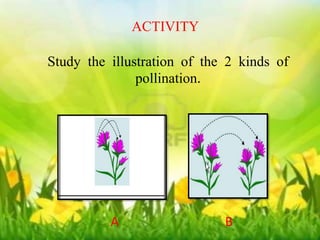
Study the illustration of the 2 kinds of 
pollination. 
pollination. 
A B 
A B
Answer the questions. 
1. Which illustration involves flower from 
the same plant? 
the same plant? 
2. Which involves flowers from 2 plants? 
3. Which illustration can be called self-pollination? 
2. Which involves flowers from 2 plants? 
3. Which illustration can be called self-pollination? 
Why? 
Why? 
4. Which illustration can be called cross-pollination? 
Why? 
Why?
Video Viewing 
Video Viewing 
Cross pollination and Self Pollination 
Cross pollination and Self Pollination
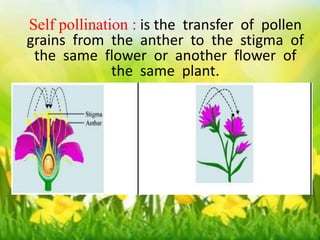
Self pollination : is the transfer of 
pollen grains from the anther to 
Self pollination : is the transfer of pollen 
grains from the anther to the stigma of 
the same flower or another flower of 
the stigma. 
the same plant.
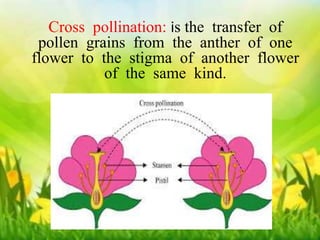
Cross pollination: is the transfer of 
pollen grains from the anther of one 
flower to the stigma of another of the 
Cross pollination: is the transfer of 
pollen grains from the anther of one 
flower to the stigma of another flower 
of the same kind. 
same kind.
Answer the questions: 
• What are the two kinds of 
pollination? 
• What are the two kinds of 
pollination? 
• Differentiate one from the 
other. 
• Differentiate one from the 
other.
Unscramble the letters of the 
correct answer. 
correct answer. 
SRCOS PLINOLONATI transfer of pollen 
grains from the anther to the stigma of 
the same flower. 
FSEL IONLINAPOLT 
transfer of pollen grains from the anther 
to the stigma of the same flower. 
FSEL IONLINAPOLT transfer of pollen 
grains from the anther to the stigma of 
another of the same kind. 
SRCOS PLINOLONATI 
transfer of pollen grains from the anther 
to the stigma of another of the same 
kind.
• How does self- pollination 
differ from cross pollination? 
• How does self- pollination 
differ from cross pollination?
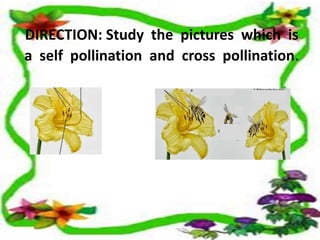
DIRECTION: Study the pictures which is 
a self pollination and cross pollination.
• Make a list of flowering plants. 
Opposite each, write how they 
are pollinated. 
• Make a list of flowering plants. 
Opposite each, write how they 
are pollinated.
TThhaannkk yyoouu……

Self pollination & cross pollination

  • 1.
    GRADE IV- SCIENCE& HEALTH HOW SELF POLLINATION DIFFERS FROM CROSS POLLINATION Rosalie Q. Castillo Lazareto Elementary School
  • 2.
  • 3.
    Stinking Plant •A blow-fly was looking for an ideal place to lay eggs. Like rotting meat. So that when her little maggots were born, they could feed on the meat. • As she turned a corner in the grassland, she smelt something stinking in the air. The smell of rotten meat! With great joy she perched on it and laid her eggs. She was happy that her children would have enough food to eat. • The blow-fly did not know she had made a great mistake. What she had sat upon was not meat but a flower, which stinks. It is called a carrion flower. So, when the blow-fly's eggs hatched and the little maggots came out, they had nothing to eat. They died of starvation.
  • 4.
    • The carrionflower is one of the many flowers which give out dirty smells to attract flies. The Rafflesia stinks like rotting meat, while the tropical Lords and Ladies flower gives out a smell like rotting fish. • They do it for a special reason. Unlike mating birds, these plants cannot move from their place. But it is important for the male cell of one plant to get in touch with the female cell of another plant. Once that is done, the seed of the plant will bloom and give birth to another plant. • The plant uses its stink to attract flies. As soon as the blow-fly sits on the flower, it is captured by the flower with strong hair. When the hair falls, the fly is free to fly - but it takes some pollen with it. And goes and sits on another plant. The male cell of one plant meets the female cell of the other. The seed gets new life.
  • 5.
    Guessing Game… GuessingGame… • Here I am. I am slow, I am fast. You can feel me but you can’t see me. • Here I am. I am slow, I am fast. You can feel me but you can’t see me…
  • 6.
  • 7.
    • When Icome, plants welcome me with open arms and when I do not come, farmers pray When I come, plants welcome me with open arms and when I do not come, farmers pray that that I may come soon. I may come soon…
  • 8.
  • 9.
    • I comezooming like an airplane into red, yellow, pink flowers in the garden… • I come zooming like an airplane into red, yellow, pink flowers in the garden…
  • 10.
  • 11.
    • I amalways a welcome in the • I am always a welcome in the garden by visitor, because of my colorful velvet dress… garden by visitor, because of my colorful velvet dress…
  • 12.
  • 13.
    • I touch,I smell, I pick these beautiful flowers , who am I? • I touch, I smell, I pick these beautiful flowers , who am I?
  • 14.
  • 15.
    ACTIVITY 1 ACTIVITY 1. Observe the flowers in the garden. 1. Observe the flowers in the garden. 2. What insects are found in the garden? 2. What insects are found in the garden? 3. Explain why insects are attracted to some flowers? 3. Explain why insects are attracted to some flowers?
  • 16.
    Let’s Observe andDraw Let’s Observe and Draw Do the following: 1. Observe a flower from afar wait until an Do the following: 1. Observe a flower from afar wait until an insect stay on it. Then draw what you see. insect stay on it. Then draw what you see. 2. Observe the insect. Does the insect 2. Observe the insect. Does the insect transfer from one flower to another flower? Draw what you see. transfer from one flower to another flower? Draw what you see.
  • 17.
    ACTIVITY ACTIVITY Studythe illustration of the 2 kinds of Study the illustration of the 2 kinds of pollination. pollination. A B A B
  • 18.
    Answer the questions. Answer the questions. 1. Which illustration involves flower from 1. Which illustration involves flower from the same plant? the same plant? 2. Which involves flowers from 2 plants? 3. Which illustration can be called self-pollination? 2. Which involves flowers from 2 plants? 3. Which illustration can be called self-pollination? Why? Why? 4. Which illustration can be called cross-pollination? 4. Which illustration can be called cross-pollination? Why? Why?
  • 19.
    Video Viewing VideoViewing Cross pollination and Self Pollination Cross pollination and Self Pollination
  • 20.
    Self pollination :is the transfer of pollen grains from the anther to Self pollination : is the transfer of pollen grains from the anther to the stigma of the same flower or another flower of the stigma. the same plant.
  • 21.
    Cross pollination: isthe transfer of pollen grains from the anther of one flower to the stigma of another of the Cross pollination: is the transfer of pollen grains from the anther of one flower to the stigma of another flower of the same kind. same kind.
  • 22.
    Answer the questions: Answer the questions: • What are the two kinds of pollination? • What are the two kinds of pollination? • Differentiate one from the other. • Differentiate one from the other.
  • 23.
    Unscramble the lettersof the Unscramble the letters of the correct answer. correct answer. SRCOS PLINOLONATI transfer of pollen grains from the anther to the stigma of the same flower. FSEL IONLINAPOLT transfer of pollen grains from the anther to the stigma of the same flower. FSEL IONLINAPOLT transfer of pollen grains from the anther to the stigma of another of the same kind. SRCOS PLINOLONATI transfer of pollen grains from the anther to the stigma of another of the same kind.
  • 24.
    • How doesself- pollination differ from cross pollination? • How does self- pollination differ from cross pollination?
  • 25.
    DIRECTION: Study thepictures which is a self pollination and cross pollination.
  • 26.
    • Make alist of flowering plants. Opposite each, write how they are pollinated. • Make a list of flowering plants. Opposite each, write how they are pollinated.
  • 27.