Joel Gruver
WIU Agriculture
J-gruver@wiu.edu
Using Cover Crops
in a Corn/Soybean Rotation
1922
Cover crops are not new
but we are managing
them in new ways
Sciota, IL
40’ wide x 10 mph  > 40 acres per hour
Radish on 30” rows
with twin rows of ARG
in the inter-row
Ever seen anything like this?
Champaign Cty, IL
Rothermel Farm
1 week
Current hot topic
of discussion
Talk to your crop insurance agent about CCs
Talk to a CCA
about CCs
Well… what do you
want your cover
crop to do for you?
What needs to be adjusted
to find the best fit?
Where are the best places for
cover crops on your farm?
When is the best time for
establishment and termination?
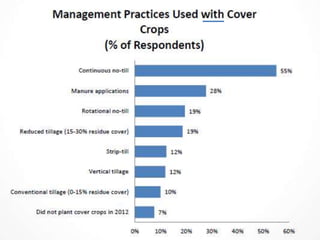
2012 – SARE Survey
Results
Are IL farmers taking
erosion control less
seriously?
Results of IL Conservation Transect
Which are most important to you?
? ?
Increase
management
Host
pests
Become a
weed
Prevent
soil drying
Dry out soil
excessively
Interfere w/
equipment
performance
Suppress crop
growth
Tie up N
Add cost
Cover
Crops
Adapted from Magdoff and Weil (2004)
Not all CC effects are positive
+30
http://www.greencoverseed.com/
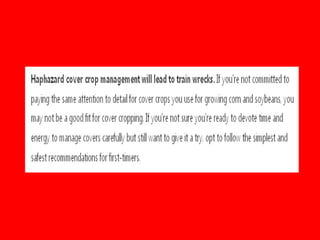
Cover crops require and reward management
more than broadly adapted technologies
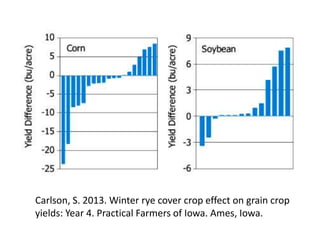
Wow...cover crops
are not idiot-proof!
IA Soybean Association’s On-Farm Network®
Replicated Strip Trial Database
Carlson, S. 2013. Winter rye cover crop effect on grain crop
yields: Year 4. Practical Farmers of Iowa. Ames, Iowa.
Miguez, F.E. and G.A. Bollero. 2005. Review of corn yield
response under winter cover cropping systems using meta-
analytic methods. Crop Science. 45:2318-2329.
#1 way to make
cover crops pay!!!
EQIP CSP
Field operation IA* IL IN* MO*
Fertilizer buggy 4.15 (1.50-
7.50)
4.72 (3.07-6.37) 4.97 (3-15) fert
6.02 (3.50-15)
fert+seed
Harrowing 8.10 (4-
12.50)
6.78 (3-12)
Cultipacking 6.55 (3-10) 8.50 (5-15)
Broadcast w/ ATV 10.35 (8-12) 7.44 (3-12.50)
Conv. grain drill 13 (7.50-20) 11.40 15.89 (13.63-
18.15) s
13 (8-24) sg
14.09 (10-24) gc
No-Till grain drill 15.35 (12-25) 14.60 14.47 (10.80-
18.14)
14.80 (10-24) s
14.25 (5-25) sg
Air seeder 16.40
Per acre costs of cover crop planting operations
based on custom rate surveys
Costs Program 1 Program 2 Program 3 Program 4
Seed 11.25 7.50 11.25 9.00
Seeding operation 4.15 15.00 10.00 10.00
Seed incorporation 6.50
Herbicide 2.00 2.00
Termination
operation
6.50 6.50
Total 30.40 31.00 21.25 19.00
Examples of total cover crop management programs ($/ac)
Program 1
Seed: 90 lbs/ac cereal rye
Seeding operation: spread w/fertilizer buggy
Seed incorporation: rolling stalk chopper
Herbicide: 24 oz. glyphosate
Termination operation: 90’ boom spray rig
Program 3
Seed: 90 lbs of cereal rye
Seed bed preparation: none
Seeding operation: aerial seeding
Herbicide: no added cost, burn-down standard
Termination operation: no added cost, burn-down standard
Program 2
Seed: 60 lbs/ac cereal rye
Seed bed preparation: none
Seeding operation: no-till drill
Herbicide: 24 oz. glyphosate
Termination operation: 90’ boom spray rig
Program 4
Seed: 3 bushels of bin-run oats
Seed bed preparation: none
Seeding operation: aerial seeding
Herbicide: none – winter-kill
Termination operation: none – winter-kill
Strong demand has
increased the price
of CC seed
IA and IL Aerial Applicator Survey (May-June 2010)
Name Location Experience w/CC Cost
Cady Aerial Spray Rock Falls, IL
no exp., no customer
interest $8.00/a norm app $8.50/a cc
Benoit Aerial
Spraying Kankakee, IL turnips and rye $8.00/a norm app $10.00/a cc
Franks Flying
Service Morrison, IL ryegrass and c. rye $8.00/a norm app $10.00/a cc
Reeds Fly-on
Farming Mattoon, IL
yes, c. rye, small part
of business $8.00/a norm app $12.00/a cc
Killiam Flying
Service Carlinville, IL
rye, wheat on beans,
rye on corn
$8.00/a norm app $10.00/ac
or 10/lb
Curless Flying
Service Astoria, IL ryegrass and turnips $8-15.00/a all app.
Klein Flying
Service
St. Francisville,
IL annual rye and turnips
~$12.50/a cc, $9.00/a liquid
app
Agriflite Services Wakarusa, IN rye, wheat, ryegrass ave $15.00/a for cc app.
Al's Aerial
Spraying Ovid, MI rye and wheat
$10-15.00/a cc $10.00/a
liquid
IL CC Business Directory
Where will
you be on
2/18?
Opportunities for planting cover crops
• Dormant seeding early or late winter
• Frost seeding
• In the spring
• When planting summer crops
• Prevent plant scenarios
• Before canopy closure
• After small grains
• After vegetables
• After seed corn or silage corn
• Aerial or high clearance seeding into standing crops in late
summer/early fall as canopy opens
• After early corn/bean grain harvest
• After full season corn/bean grain harvest
Interseeders
PSU
interseeder
crimson
clover and
annual
ryegrass are
very shade
tolerant
West Union, IA
“I run a delayed burn down..... Usually mid to late May.
I have switched back to older chems..... I miss the Callisto, we’re supposed to
only get a few weeks residual, but 2yrs ago I seeded some clover every week til
August..... In August, still fried clover after emergence. With that said, I did
have a bunch of clover pop the next spring, just doubt I got much benefit from
it..... Since it showed up about the week I sprayed.” L. Steinlage, West Union, IA
In 2014, we interseeded different mixes of cover crops into both corn and soybeans
with a Hagie high-clearance sprayer equipped with a Gandy dry box with boom hosing
on August 26.
10 most shade tolerant species out of 45 ground covers
Species Shade rating
Crownvetch 83
Kura clover 56
Strawberry clover 47
Crimson clover 39
Arrowleaf clover 39
Berseem clover 38
White clover 38
Sub. clover 31
Red clover 30
Birdsfoot trefoil 25
Alsike clover 22
Alfalfa 20
Species Shade rating
River oats 83
Cluster fescue 76
Reed canary grass 69
Orchard grass 66
Smooth brome grass 66
Kentucky bluegrass 60
Tall fescue 49
Annual ryegrass 47
Perennial ryegrass 44
Redtop 41
Timothy 36
Cool season legumes Cool season grasses
Some of these species
may be the future of early interseeding!
Soybean herbicides like fomesafen, chlorimuron (in products such as Classic)
and imazethapyr (Pursuit) create significant risk for legumes and brassicas but
are generally not an issue for small grains.
Corn herbicides like atrazine and simazine should be used at less than 1 pound
per acre when cereal grains are used for covers, and less than 0.75 pounds per
acre for most legume cover crops, mustards and annual ryegrass.
1) Persistence of herbicide activity in soil
2) Cover crop sensitivity to herbicide
Herbicides with short half-lives (time it takes for 50% of the active
ingredient to dissipate) are less of a concern.
Factors influencing the rate of dissipation include rainfall, soil texture
and soil pH, etc.
In general, products with a 4 month or less rotation restriction for the
species of interest, close relative, or sensitive species should pose
little problem.
2 main factors impact potential
for herbicide injury to cover crops
Partial list of corn herbicides
Partial list of soybean herbicides
(Corzatt & Bernards, 2014)
Corvus Atrazine
Flexstar
Lexar Halex
WIU student
project in 2012
Perform a bioassay
if you have concerns
Have you
looked at
this
document?
IN FIELD
EDGE OF FIELD
Cover crops
reduce nutrient
losses
…while also
improving soil
health
Do you scout your fields in the rain?
If not, you are missing a great
opportunity to see soil health in action!
Wow! That was cool!
RAINFALL
SIMULATION
Low risk cover crop system for a CORN-SOY rotation:
1. No-till drill cereal rye into corn stalks. You can drill (or
broadcast/harrow) in Nov. and still establish a good stand.
2. No-till soybeans into terminated cereal rye. Plant an
earlier group soybean and harvest in September.
3. No-till drill a low C:N cover crop mix (e.g., oats and
radish) that will reliably winter kill.
4. No-till or strip-till corn into the CC residues.
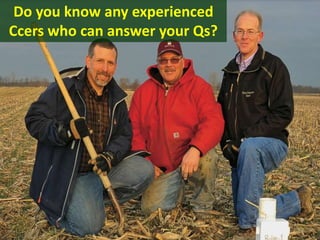
Do you know any experienced
Ccers who can answer your Qs?
Each Q is answered by multiple IL CC specialists
Q. Which cover crops collect/remove nitrogen (N) the quickest or most efficiently?
Q: How do I determine which cover crops are best suited for my soils and typography?
Q. What is the carbon-nitrogen penalty, meaning how many units of carbon to how
many units of nitrogen? How do I account for that?
Q. I am just starting to grow cover crops. Which ones are easier to start with? Which
ones should I stay away from?
Q. Can I plant cover crops on fields in continuous corn?
Q: Which cover crops are better for weed control?
Q. We’ve had trouble getting a good stand of cover crops the last two years. Last year,
we planted cereal rye and radishes on the corn ground going into soybeans. We
planted cereal rye, radish and crimson clover with a plane on ground going into corn.
Our fields are in northeast St. Clair County.
Q. A Monmouth farmer asks, “Is there a better product and/or faster working product
than what I’m doing if the rye has any size to it? Burndown of annual rye is frustrating
and slow. I was told to always use Roundup 32-44 oz., 1 pt. 24-D, A.M.S. on the first
trip. Then the second trip put down my residual. Sometimes with the wet and busy
spring, it is tough to fit in. I want to keep a cover crop on in the winter.”
Q: When cover crops decompose, what amounts of nitrogen do they contribute back
into the soil?
Q: What should I consider about reliability of cover crop seed sources? What about
seed mixes?
Cover crop FAQ on FARMWEEKNOW.COM

Quincy2015pptx

  • 1.
    Joel Gruver WIU Agriculture J-gruver@wiu.edu UsingCover Crops in a Corn/Soybean Rotation
  • 2.
    1922 Cover crops arenot new but we are managing them in new ways
  • 4.
    Sciota, IL 40’ widex 10 mph  > 40 acres per hour
  • 5.
    Radish on 30”rows with twin rows of ARG in the inter-row Ever seen anything like this?
  • 6.
  • 8.
  • 9.
  • 11.
    Talk to yourcrop insurance agent about CCs
  • 12.
    Talk to aCCA about CCs
  • 14.
    Well… what doyou want your cover crop to do for you?
  • 15.
    What needs tobe adjusted to find the best fit? Where are the best places for cover crops on your farm? When is the best time for establishment and termination?
  • 16.
    2012 – SARESurvey Results
  • 17.
    Are IL farmerstaking erosion control less seriously? Results of IL Conservation Transect
  • 18.
    Which are mostimportant to you?
  • 19.
    ? ? Increase management Host pests Become a weed Prevent soildrying Dry out soil excessively Interfere w/ equipment performance Suppress crop growth Tie up N Add cost Cover Crops Adapted from Magdoff and Weil (2004) Not all CC effects are positive
  • 22.
  • 27.
  • 28.
    Cover crops requireand reward management more than broadly adapted technologies Wow...cover crops are not idiot-proof!
  • 30.
    IA Soybean Association’sOn-Farm Network® Replicated Strip Trial Database
  • 32.
    Carlson, S. 2013.Winter rye cover crop effect on grain crop yields: Year 4. Practical Farmers of Iowa. Ames, Iowa.
  • 33.
    Miguez, F.E. andG.A. Bollero. 2005. Review of corn yield response under winter cover cropping systems using meta- analytic methods. Crop Science. 45:2318-2329.
  • 34.
    #1 way tomake cover crops pay!!!
  • 35.
  • 36.
    Field operation IA*IL IN* MO* Fertilizer buggy 4.15 (1.50- 7.50) 4.72 (3.07-6.37) 4.97 (3-15) fert 6.02 (3.50-15) fert+seed Harrowing 8.10 (4- 12.50) 6.78 (3-12) Cultipacking 6.55 (3-10) 8.50 (5-15) Broadcast w/ ATV 10.35 (8-12) 7.44 (3-12.50) Conv. grain drill 13 (7.50-20) 11.40 15.89 (13.63- 18.15) s 13 (8-24) sg 14.09 (10-24) gc No-Till grain drill 15.35 (12-25) 14.60 14.47 (10.80- 18.14) 14.80 (10-24) s 14.25 (5-25) sg Air seeder 16.40 Per acre costs of cover crop planting operations based on custom rate surveys
  • 37.
    Costs Program 1Program 2 Program 3 Program 4 Seed 11.25 7.50 11.25 9.00 Seeding operation 4.15 15.00 10.00 10.00 Seed incorporation 6.50 Herbicide 2.00 2.00 Termination operation 6.50 6.50 Total 30.40 31.00 21.25 19.00 Examples of total cover crop management programs ($/ac) Program 1 Seed: 90 lbs/ac cereal rye Seeding operation: spread w/fertilizer buggy Seed incorporation: rolling stalk chopper Herbicide: 24 oz. glyphosate Termination operation: 90’ boom spray rig Program 3 Seed: 90 lbs of cereal rye Seed bed preparation: none Seeding operation: aerial seeding Herbicide: no added cost, burn-down standard Termination operation: no added cost, burn-down standard Program 2 Seed: 60 lbs/ac cereal rye Seed bed preparation: none Seeding operation: no-till drill Herbicide: 24 oz. glyphosate Termination operation: 90’ boom spray rig Program 4 Seed: 3 bushels of bin-run oats Seed bed preparation: none Seeding operation: aerial seeding Herbicide: none – winter-kill Termination operation: none – winter-kill Strong demand has increased the price of CC seed
  • 38.
    IA and ILAerial Applicator Survey (May-June 2010) Name Location Experience w/CC Cost Cady Aerial Spray Rock Falls, IL no exp., no customer interest $8.00/a norm app $8.50/a cc Benoit Aerial Spraying Kankakee, IL turnips and rye $8.00/a norm app $10.00/a cc Franks Flying Service Morrison, IL ryegrass and c. rye $8.00/a norm app $10.00/a cc Reeds Fly-on Farming Mattoon, IL yes, c. rye, small part of business $8.00/a norm app $12.00/a cc Killiam Flying Service Carlinville, IL rye, wheat on beans, rye on corn $8.00/a norm app $10.00/ac or 10/lb Curless Flying Service Astoria, IL ryegrass and turnips $8-15.00/a all app. Klein Flying Service St. Francisville, IL annual rye and turnips ~$12.50/a cc, $9.00/a liquid app Agriflite Services Wakarusa, IN rye, wheat, ryegrass ave $15.00/a for cc app. Al's Aerial Spraying Ovid, MI rye and wheat $10-15.00/a cc $10.00/a liquid
  • 39.
    IL CC BusinessDirectory
  • 40.
  • 41.
    Opportunities for plantingcover crops • Dormant seeding early or late winter • Frost seeding • In the spring • When planting summer crops • Prevent plant scenarios • Before canopy closure • After small grains • After vegetables • After seed corn or silage corn • Aerial or high clearance seeding into standing crops in late summer/early fall as canopy opens • After early corn/bean grain harvest • After full season corn/bean grain harvest
  • 42.
  • 43.
  • 44.
  • 46.
    “I run adelayed burn down..... Usually mid to late May. I have switched back to older chems..... I miss the Callisto, we’re supposed to only get a few weeks residual, but 2yrs ago I seeded some clover every week til August..... In August, still fried clover after emergence. With that said, I did have a bunch of clover pop the next spring, just doubt I got much benefit from it..... Since it showed up about the week I sprayed.” L. Steinlage, West Union, IA
  • 48.
    In 2014, weinterseeded different mixes of cover crops into both corn and soybeans with a Hagie high-clearance sprayer equipped with a Gandy dry box with boom hosing on August 26.
  • 49.
    10 most shadetolerant species out of 45 ground covers
  • 50.
    Species Shade rating Crownvetch83 Kura clover 56 Strawberry clover 47 Crimson clover 39 Arrowleaf clover 39 Berseem clover 38 White clover 38 Sub. clover 31 Red clover 30 Birdsfoot trefoil 25 Alsike clover 22 Alfalfa 20 Species Shade rating River oats 83 Cluster fescue 76 Reed canary grass 69 Orchard grass 66 Smooth brome grass 66 Kentucky bluegrass 60 Tall fescue 49 Annual ryegrass 47 Perennial ryegrass 44 Redtop 41 Timothy 36 Cool season legumes Cool season grasses Some of these species may be the future of early interseeding!
  • 52.
    Soybean herbicides likefomesafen, chlorimuron (in products such as Classic) and imazethapyr (Pursuit) create significant risk for legumes and brassicas but are generally not an issue for small grains. Corn herbicides like atrazine and simazine should be used at less than 1 pound per acre when cereal grains are used for covers, and less than 0.75 pounds per acre for most legume cover crops, mustards and annual ryegrass.
  • 54.
    1) Persistence ofherbicide activity in soil 2) Cover crop sensitivity to herbicide Herbicides with short half-lives (time it takes for 50% of the active ingredient to dissipate) are less of a concern. Factors influencing the rate of dissipation include rainfall, soil texture and soil pH, etc. In general, products with a 4 month or less rotation restriction for the species of interest, close relative, or sensitive species should pose little problem. 2 main factors impact potential for herbicide injury to cover crops
  • 55.
    Partial list ofcorn herbicides
  • 56.
    Partial list ofsoybean herbicides
  • 59.
  • 60.
    Corvus Atrazine Flexstar Lexar Halex WIUstudent project in 2012 Perform a bioassay if you have concerns
  • 61.
  • 63.
    IN FIELD EDGE OFFIELD Cover crops reduce nutrient losses
  • 64.
  • 65.
    Do you scoutyour fields in the rain? If not, you are missing a great opportunity to see soil health in action!
  • 66.
    Wow! That wascool! RAINFALL SIMULATION
  • 69.
    Low risk covercrop system for a CORN-SOY rotation: 1. No-till drill cereal rye into corn stalks. You can drill (or broadcast/harrow) in Nov. and still establish a good stand. 2. No-till soybeans into terminated cereal rye. Plant an earlier group soybean and harvest in September. 3. No-till drill a low C:N cover crop mix (e.g., oats and radish) that will reliably winter kill. 4. No-till or strip-till corn into the CC residues.
  • 70.
    Do you knowany experienced Ccers who can answer your Qs?
  • 71.
    Each Q isanswered by multiple IL CC specialists
  • 72.
    Q. Which covercrops collect/remove nitrogen (N) the quickest or most efficiently? Q: How do I determine which cover crops are best suited for my soils and typography? Q. What is the carbon-nitrogen penalty, meaning how many units of carbon to how many units of nitrogen? How do I account for that? Q. I am just starting to grow cover crops. Which ones are easier to start with? Which ones should I stay away from? Q. Can I plant cover crops on fields in continuous corn? Q: Which cover crops are better for weed control? Q. We’ve had trouble getting a good stand of cover crops the last two years. Last year, we planted cereal rye and radishes on the corn ground going into soybeans. We planted cereal rye, radish and crimson clover with a plane on ground going into corn. Our fields are in northeast St. Clair County. Q. A Monmouth farmer asks, “Is there a better product and/or faster working product than what I’m doing if the rye has any size to it? Burndown of annual rye is frustrating and slow. I was told to always use Roundup 32-44 oz., 1 pt. 24-D, A.M.S. on the first trip. Then the second trip put down my residual. Sometimes with the wet and busy spring, it is tough to fit in. I want to keep a cover crop on in the winter.” Q: When cover crops decompose, what amounts of nitrogen do they contribute back into the soil? Q: What should I consider about reliability of cover crop seed sources? What about seed mixes? Cover crop FAQ on FARMWEEKNOW.COM