Principles of PlantBreeding
PSCI 4833
Somashekhar Punnuri
Fort Valley State University
Fort Valley, GA
punnuris@fvsu.edu
2.
Etiquettes & codesfor class
Come prepared for the class and Do the readings
Refer to the course outline and syllabus for
textbooks and other informations
Show curiosity in Science through questions
Be prepared to answer and interact
Everyone’s opinion will be heard and respected
Develop greater insights from this course by the end
of semester
Use of cellphone in the class is strictly prohibited
Have fun and enjoy the lectures
3.
Objective
To introduce thegeneral principles of plant breeding.
Provide knowledge base of world, USA and Georgia
crops breeding production methods.
Overview the impacts of world and local agricultural.
Provide a basic knowledge of the processes by which
our major food and nonfood agricultural crops are
produced.
4.
Agriculture and itsimportance
◼ Agricultural products used in everyday life- Food, Fiber and energy-
nutrition is a key determinant of human health, , Fiber for
construction material, provider of energy-fuel-wood and medicinal
plants
• Agriculture is key to a healthy biosphere and economic driver. It is
central to:
– Nation’s economic growth-US is major exporter
• Individual livelihoods
5.
What is PlantBreeding?
a systematic process using scientific methods in
order to improve plant traits also collectively
known as plant phenotype by crossing and
selection and manipulation at the genotype
composition with the favorable genes
selection: the process of breeding for a specific
trait
Deliberate and intentional
– selective breeding is a form of genetic engineering
6.
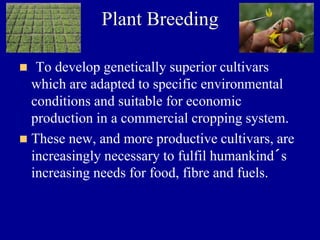
Plant Breeding
◼ Todevelop genetically superior cultivars
which are adapted to specific environmental
conditions and suitable for economic
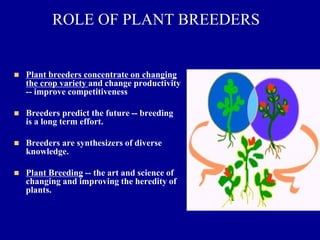
production in a commercial cropping system.
◼ These new, and more productive cultivars, are
increasingly necessary to fulfil humankind´s
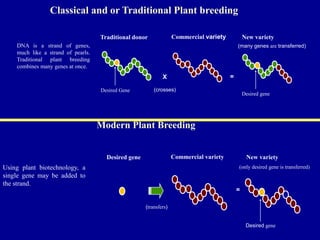
increasing needs for food, fibre and fuels.
7.
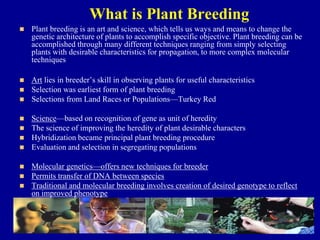
What is PlantBreeding
◼ Plant breeding is an art and science, which tells us ways and means to change the
genetic architecture of plants to accomplish specific objective. Plant breeding can be
accomplished through many different techniques ranging from simply selecting
plants with desirable characteristics for propagation, to more complex molecular
techniques
◼ Art lies in breeder’s skill in observing plants for useful characteristics
◼ Selection was earliest form of plant breeding
◼ Selections from Land Races or Populations—Turkey Red
◼ Science—based on recognition of gene as unit of heredity
◼ The science of improving the heredity of plant desirable characters
◼ Hybridization became principal plant breeding procedure
◼ Evaluation and selection in segregating populations
◼ Molecular genetics—offers new techniques for breeder
◼ Permits transfer of DNA between species
◼ Traditional and molecular breeding involves creation of desired genotype to reflect
on improved phenotype
8.
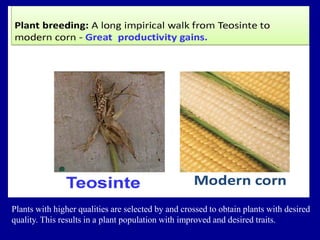
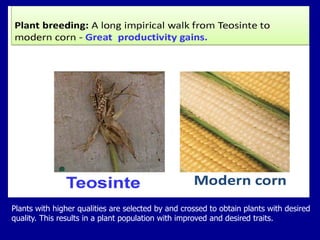
Plants with higherqualities are selected by and crossed to obtain plants with desired
quality. This results in a plant population with improved and desired traits.
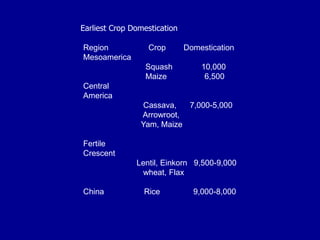
Region Crop Domestication
Mesoamerica
Squash10,000
Maize 6,500
Central
America
Cassava, 7,000-5,000
Arrowroot,
Yam, Maize
Fertile
Crescent
Lentil, Einkorn 9,500-9,000
wheat, Flax
China Rice 9,000-8,000
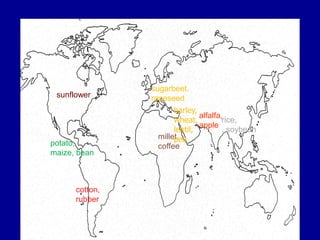
Earliest Crop Domestication
14.
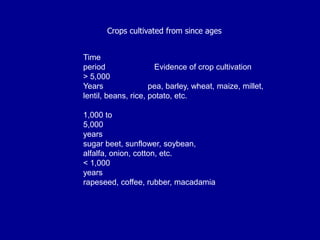
Time
period Evidence ofcrop cultivation
> 5,000
Years pea, barley, wheat, maize, millet,
lentil, beans, rice, potato, etc.
1,000 to
5,000
years
sugar beet, sunflower, soybean,
alfalfa, onion, cotton, etc.
< 1,000
years
rapeseed, coffee, rubber, macadamia
Crops cultivated from since ages
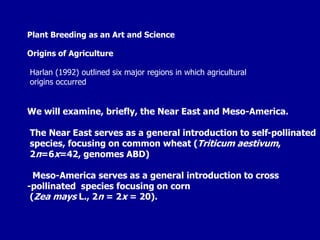
Plant Breeding asan Art and Science
Origins of Agriculture
Harlan (1992) outlined six major regions in which agricultural
origins occurred
We will examine, briefly, the Near East and Meso-America.
The Near East serves as a general introduction to self-pollinated
species, focusing on common wheat (Triticum aestivum,
2n=6x=42, genomes ABD)
Meso-America serves as a general introduction to cross
-pollinated species focusing on corn
(Zea mays L., 2n = 2x = 20).
Plants with higherqualities are selected by and crossed to obtain plants with desired
quality. This results in a plant population with improved and desired traits.
19.
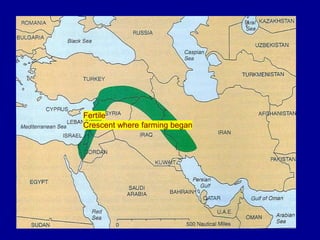
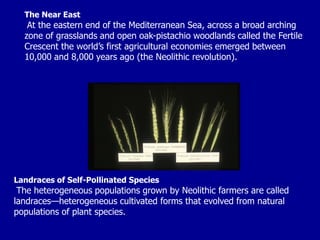
The Near East
Atthe eastern end of the Mediterranean Sea, across a broad arching
zone of grasslands and open oak-pistachio woodlands called the Fertile
Crescent the world’s first agricultural economies emerged between
10,000 and 8,000 years ago (the Neolithic revolution).
Landraces of Self-Pollinated Species
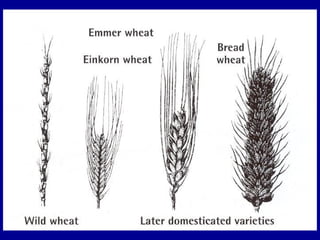
The heterogeneous populations grown by Neolithic farmers are called
landraces—heterogeneous cultivated forms that evolved from natural
populations of plant species.
20.
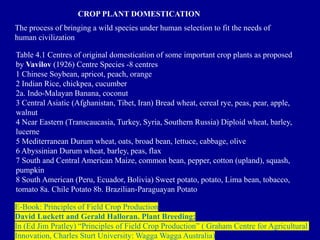
CROP PLANT DOMESTICATION
Theprocess of bringing a wild species under human selection to fit the needs of
human civilization
Table 4.1 Centres of original domestication of some important crop plants as proposed
by Vavilov (1926) Centre Species -8 centres
1 Chinese Soybean, apricot, peach, orange
2 Indian Rice, chickpea, cucumber
2a. Indo-Malayan Banana, coconut
3 Central Asiatic (Afghanistan, Tibet, Iran) Bread wheat, cereal rye, peas, pear, apple,
walnut
4 Near Eastern (Transcaucasia, Turkey, Syria, Southern Russia) Diploid wheat, barley,
lucerne
5 Mediterranean Durum wheat, oats, broad bean, lettuce, cabbage, olive
6 Abyssinian Durum wheat, barley, peas, flax
7 South and Central American Maize, common bean, pepper, cotton (upland), squash,
pumpkin
8 South American (Peru, Ecuador, Bolivia) Sweet potato, potato, Lima bean, tobacco,
tomato 8a. Chile Potato 8b. Brazilian-Paraguayan Potato
E-Book: Principles of Field Crop Production
David Luckett and Gerald Halloran. Plant Breeding;
In (Ed Jim Pratley) “Principles of Field Crop Production” ( Graham Centre for Agricultural
Innovation, Charles Sturt University: Wagga Wagga Australia)
21.
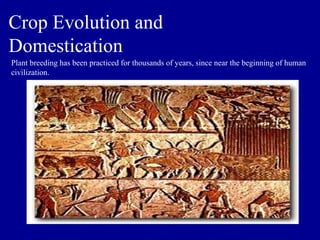
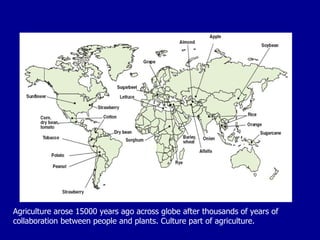
Agriculture arose 15000years ago across globe after thousands of years of
collaboration between people and plants. Culture part of agriculture.
23.
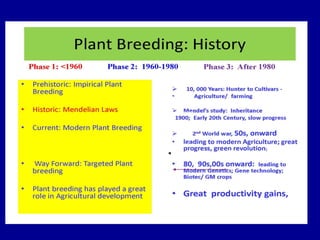
History of PlantBreeding
It started when man first chose certain plants for cultivation. There is no recorded history
when the plant breeding started.
➢ As early as 700 BC Babylonians and Assyrians artificially pollinated the date palm.
➢ In 1717 Thomas Fairchild produced the first artificial hybrid.
➢ Joseph Kolreuter, a German made extensive crosses in Tobacco and Solanum between
1760 and 1866 and studied the progenies in detail.
➢ Thomas Andrew Knight (1759-1835) was the first man to produce several new fruit
varieties by using artificial hybridization.
➢ Le Coutier, a farmer published his results on selection in wheat in the year 1843. He
concluded that progenies from single plants were more uniform.
➢ Patrick Shireff a Scotsman practiced individual plant selection in wheat and oats and
developed some valuable varieties.
➢ Vilmorin (1857) proposed individual plant selection based on progeny testing. This was
known as “Vilmorins principle of progeny testing’. He proposed this progeny testing in
sugar content in sugar beets (Beta vulgaris). But this method was ineffective in wheat.
➢ This clearly demonstrated the difference between effect of selection in cross and self pollinated
crops.
➢ Nilsson and his associates in Sweedish Seed Association, Svalof Sweeden (1890) refined
the single plant selection.
Principles of Plant Breeding
4 www.AgriMoon.Com
24.
In 1903 Johansenproposed the famous ‘pure line theory’ which states that a pure line is
progeny of a single self fertilized homozygous plant. He proposed this theory based on
his studies in Phaseolus vulgaris.
G.H. Shull work in maize is the forerunner for the present day hybrid maize program.
He described in detail about the effect of inbreeding.
During 1960’s Norman Borlaug, the Nobel laureate developed Mexican semi dwarf
wheat varieties, which paved the way for green revolution in wheat. The dwarfing gene
was isolated from wheat variety Norin 10.
In rice the identification of dwarf Dee Gee Woo Gen from a tall rice variety by a Taiwan
farmer revolutionized rice breeding. Using this DGWG at IRRI during 1965 the wonder
rice IR 8 was released.
Golden rice –provitamin A was approved in July 2021 in Philippines.
History of Plant Breeding
Principles of Plant Breeding
4 www.AgriMoon.Com
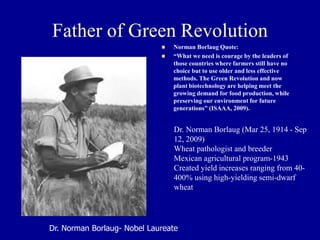
Father of GreenRevolution
◼ Norman Borlaug Quote:
◼ “What we need is courage by the leaders of
those countries where farmers still have no
choice but to use older and less effective
methods. The Green Revolution and now
plant biotechnology are helping meet the
growing demand for food production, while
preserving our environment for future
generations” (ISAAA, 2009).
Dr. Norman Borlaug- Nobel Laureate
Dr. Norman Borlaug (Mar 25, 1914 - Sep
12, 2009)
Wheat pathologist and breeder
Mexican agricultural program-1943
Created yield increases ranging from 40-
400% using high-yielding semi-dwarf
wheat
27.
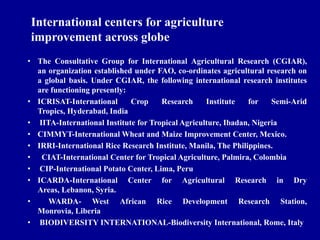
• The ConsultativeGroup for International Agricultural Research (CGIAR),
an organization established under FAO, co-ordinates agricultural research on
a global basis. Under CGIAR, the following international research institutes
are functioning presently:
• ICRISAT-International Crop Research Institute for Semi-Arid
Tropics, Hyderabad, India
• IITA-International Institute for Tropical Agriculture, Ibadan, Nigeria
• CIMMYT-International Wheat and Maize Improvement Center, Mexico.
• IRRI-International Rice Research Institute, Manila, The Philippines.
• CIAT-International Center for Tropical Agriculture, Palmira, Colombia
• CIP-International Potato Center, Lima, Peru
• ICARDA-International Center for Agricultural Research in Dry
Areas, Lebanon, Syria.
• WARDA- West African Rice Development Research Station,
Monrovia, Liberia
• BIODIVERSITY INTERNATIONAL-Biodiversity International, Rome, Italy
International centers for agriculture
improvement across globe
28.
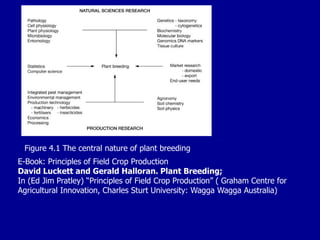
E-Book: Principles ofField Crop Production
David Luckett and Gerald Halloran. Plant Breeding;
In (Ed Jim Pratley) “Principles of Field Crop Production” ( Graham Centre for
Agricultural Innovation, Charles Sturt University: Wagga Wagga Australia)
Figure 4.1 The central nature of plant breeding
29.
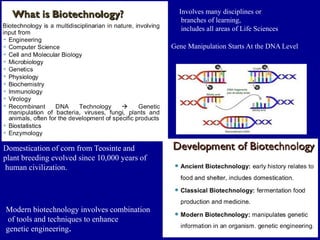
Involves many disciplinesor
branches of learning,
includes all areas of Life Sciences
Gene Manipulation Starts At the DNA Level
Domestication of corn from Teosinte and
plant breeding evolved since 10,000 years of
human civilization.
Modern biotechnology involves combination
of tools and techniques to enhance
genetic engineering.
30.
Genotype vs. Phenotype
◼trait: a genetically determined
characteristic
◼ genotype: the genetic make up of an
organism
◼ phenotype: the physical characteristics of
an organism
30
www.OneLessThing.net
31.
Objectives of PlantBreeding
◼ International development agencies believe that breeding new
crops is important for ensuring food security by developing new
varieties that are higher-yielding, resistant to pests and diseases,
drought-resistant or regionally adapted to different environments
and growing conditions.
◼ The objectives may be
◼ a) Crop improvement-Increasing the yield
◼ b) Improved agronomic characters-Elimination of toxic
substance, food processing qualities, nutrition content
◼ c) Resistance against biotic and abiotic stress- ex. drought, frost,
sugarcane aphid resistance, leaf spot diseases
32.
Examples of traitmodifications
◼ Change in maturity duration – Evolution of early maturing varieties
◼ Improved agronomic characters -Production of more tillers – E.g. Rice,
Bajra,
Reducing the plant height to prevent lodging – Rice
◼ Photoinsensitivity – Pigeon pea, sorghum
◼ Non-shattering nature – Green gram, Brassicas
◼ Synchronized maturity – Pulses
◼ Determinate Growth habit –determinate growth – Pulses
◼ Elimination or introduction of dormancy –Groundnut
33.
Cultivars
◼ Cultivar: aplant that has been bred/developed
to have specific and distinguishable
characteristics that will be passed on to its
offspring also known as a variety
www.OneLessThing.net
The basic concept of varietal development is rather simple and involves three
distinct operations:
◦ Produce or identify genetically diverse germplasm;
◦ Carry out selection procedures on phenotypes or genotypes from within this
germplasm to identify superior genotypes with specifically and improved
characteristics;
◦ Stabilize and multiply these superior genotypes and release cultivars for
commercial production.
34.
Hybrids
◼ Hybrid: offspringthat result from breeding
individual of different varieties or species
◼ hybrid vigor: when the offspring of distinctly
different individuals have traits greater than
the parents
◼ mutation: a genetic variation that occurs
naturally (can be a favorable trait)
34
www.OneLessThing.net
35.
The Influence ofDarwin and Mendel on
Plant Breeding
Darwin began the age of population thinking. It replaced the abstract or
metaphysical view of variation of the Essentialist with the materialist view of
the Darwinist by focusing on the variation among organisms as a pivotal fact of
nature. Darwin considered intraspecific variation to be the cornerstone of
evolution. The variation among members of a single species was no longer
considered an annoying distortion of the ‘ideal’ divine creation.
Darwin believed that evolution was simply the application of the plant and
animal breeder’s activities to the mechanisms of nature as a whole.
Mendel put emphasis on the variation among the offspring of his crosses rather
than on an average description of them. He divided the progeny into categories,
counted the number of offspring in each category, and then calculated ratios of
numbers of individuals in each category. Unlike his predecessors who seemed to
be satisfied to just obtain progeny from crosses, Mendel’s approach considered the
whole population and sought out the underlying mechanisms controlling the
variation in the populations.
36.
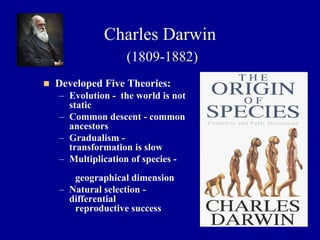
Charles Darwin
(1809-1882)
◼ DevelopedFive Theories:
– Evolution - the world is not
static
– Common descent - common
ancestors
– Gradualism -
transformation is slow
– Multiplication of species -
geographical dimension
– Natural selection -
differential
reproductive success
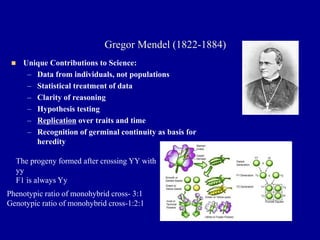
Gregor Mendel (1822-1884)
◼Unique Contributions to Science:
– Data from individuals, not populations
– Statistical treatment of data
– Clarity of reasoning
– Hypothesis testing
– Replication over traits and time
– Recognition of germinal continuity as basis for
heredity
Phenotypic ratio of monohybrid cross- 3:1
Genotypic ratio of monohybrid cross-1:2:1
The progeny formed after crossing YY with
yy
F1 is always Yy
39.
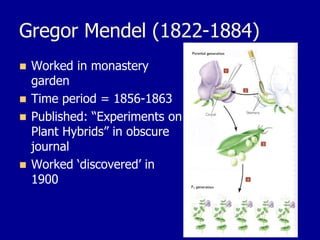
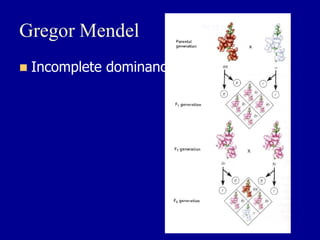
Gregor Mendel (1822-1884)
◼Worked in monastery
garden
◼ Time period = 1856-1863
◼ Published: “Experiments on
Plant Hybrids” in obscure
journal
◼ Worked ‘discovered’ in
1900
40.
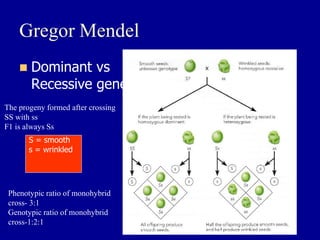
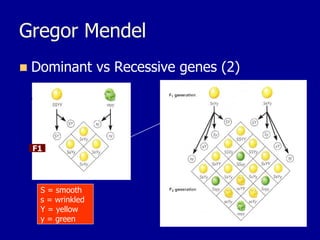
Gregor Mendel
S =smooth
s = wrinkled
◼ Dominant vs
Recessive genes
The progeny formed after crossing
SS with ss
F1 is always Ss
Phenotypic ratio of monohybrid
cross- 3:1
Genotypic ratio of monohybrid
cross-1:2:1
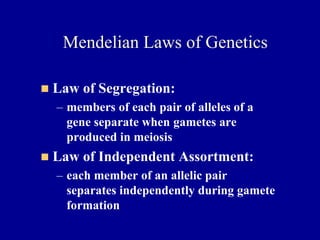
Mendelian Laws ofGenetics
◼ Law of Segregation:
– members of each pair of alleles of a
gene separate when gametes are
produced in meiosis
◼ Law of Independent Assortment:
– each member of an allelic pair
separates independently during gamete
formation
43.
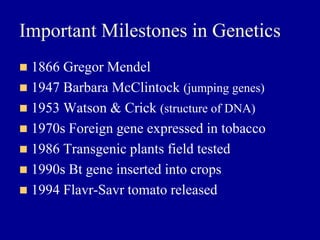
Important Milestones inGenetics
◼ 1866 Gregor Mendel
◼ 1947 Barbara McClintock (jumping genes)
◼ 1953 Watson & Crick (structure of DNA)
◼ 1970s Foreign gene expressed in tobacco
◼ 1986 Transgenic plants field tested
◼ 1990s Bt gene inserted into crops
◼ 1994 Flavr-Savr tomato released
44.
Mendelian Genetics
Mendel's Laws
1.Law of Dominance
2. Law of Segregation
3. Law of Independent
Assortment
What Mendel termed as
“factors” in his experiments
were later realized as “genes”
http://www.scienceprofonline.com/
45.
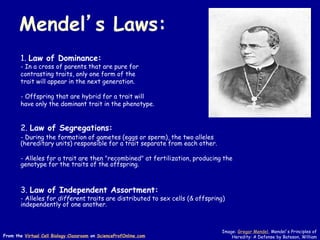
1. Law ofDominance:
- In a cross of parents that are pure for
contrasting traits, only one form of the
trait will appear in the next generation.
- Offspring that are hybrid for a trait will
have only the dominant trait in the phenotype.
2. Law of Segregations:
- During the formation of gametes (eggs or sperm), the two alleles
(hereditary units) responsible for a trait separate from each other.
- Alleles for a trait are then "recombined" at fertilization, producing the
genotype for the traits of the offspring.
3. Law of Independent Assortment:
- Alleles for different traits are distributed to sex cells (& offspring)
independently of one another.
Mendel’s Laws:
Image: Gregor Mendel, Mendel's Principles of
Heredity: A Defense by Bateson, William
From the Virtual Cell Biology Classroom on ScienceProfOnline.com
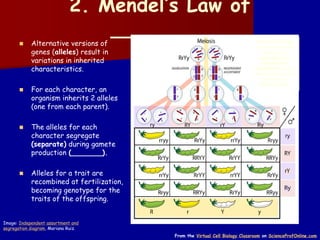
2. Mendel’s Lawof
________
Image: Independent assortment and
segregation diagram, Mariana Ruiz.
Table showing how
the genes exchange
according to
segregation or
independent
assortment during
meiosis and how this
translates into
Mendel's laws.
◼ Alternative versions of
genes (alleles) result in
variations in inherited
characteristics.
◼ For each character, an
organism inherits 2 alleles
(one from each parent).
◼ The alleles for each
character segregate
(separate) during gamete
production (_______).
◼ Alleles for a trait are
recombined at fertilization,
becoming genotype for the
traits of the offspring.
From the Virtual Cell Biology Classroom on ScienceProfOnline.com
48.
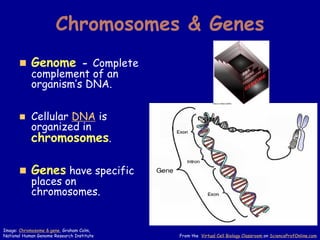
Chromosomes & Genes
◼Genome - Complete
complement of an
organism’s DNA.
◼ Cellular DNA is
organized in
chromosomes.
◼ Genes have specific
places on
chromosomes.
From the Virtual Cell Biology Classroom on ScienceProfOnline.com
Image: Chromosome & gene, Graham Colm,
National Human Genome Research Institute
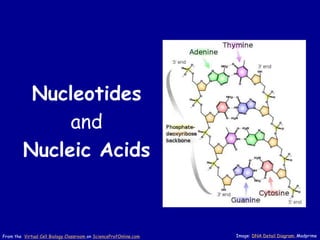
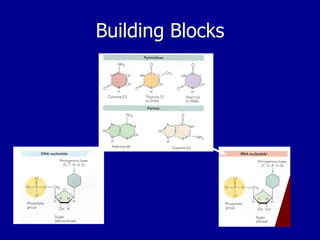
Nucleic Acids
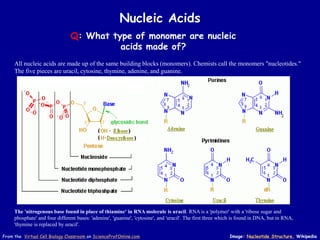
Q: Whattype of monomer are nucleic
acids made of?
Image: Nucleotide Structure, Wikipedia
From the Virtual Cell Biology Classroom on ScienceProfOnline.com
All nucleic acids are made up of the same building blocks (monomers). Chemists call the monomers "nucleotides."
The five pieces are uracil, cytosine, thymine, adenine, and guanine.
The 'nitrogenous base found in place of thiamine' in RNA molecule is uracil. RNA is a 'polymer' with a 'ribose sugar and
phosphate' and four different bases: 'adenine', 'guanine', 'cytosine', and 'uracil'. The first three which is found in DNA, but in RNA,
'thymine is replaced by uracil'.
51.
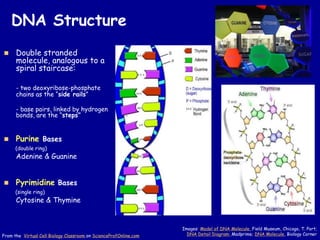
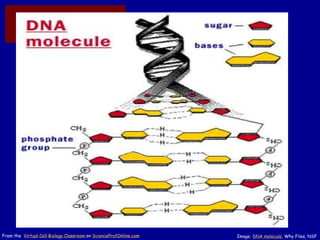
DNA Structure
◼ Doublestranded
molecule, analogous to a
spiral staircase:
- two deoxyribose-phosphate
chains as the “side rails”
- base pairs, linked by hydrogen
bonds, are the “steps”
◼ Purine Bases
(double ring)
Adenine & Guanine
◼ Pyrimidine Bases
(single ring)
Cytosine & Thymine
Images: Model of DNA Molecule, Field Museum, Chicago, T. Port;
DNA Detail Diagram: Madprime; DNA Molecule, Biology Corner
From the Virtual Cell Biology Classroom on ScienceProfOnline.com
52.
Image: DNA molecule,Why Files, NSF
From the Virtual Cell Biology Classroom on ScienceProfOnline.com
53.
ROLE OF PLANTBREEDERS
◼ Plant breeders concentrate on changing
the crop variety and change productivity
-- improve competitiveness
◼ Breeders predict the future -- breeding
is a long term effort.
◼ Breeders are synthesizers of diverse
knowledge.
◼ Plant Breeding -- the art and science of
changing and improving the heredity of
plants.
54.
Development of ModernPlant Breeding
◼ Introduction: What plant breeding is and what’s involved in
order to have a successful plant breeding program
◼ Relevant Historical Events: Great history behind plant
breeding including who withstood and over came many
political, scientific, and personal obstacles.
◼ The Green Revolution
◼ The Birth of Biotechnology: Charles Darwin and Gregor
Mendel
55.
Modern Plant Breeding
◼Influence on agricultural production
– Total productivity increased
– Production area expanded
– Hybrid cultivars developed
– Resistance to disease and insect pests
manipulated
– Food quality increased
– Crops designed for adaptability to
mechanical harvest
56.
Desired gene
Classical andor Traditional Plant breeding
DNA is a strand of genes,
much like a strand of pearls.
Traditional plant breeding
combines many genes at once.
Traditional donor Commercial variety New variety
Desired Gene
X =
(crosses)
(many genes are transferred)
Modern Plant Breeding
Using plant biotechnology, a
single gene may be added to
the strand.
Desired gene Commercial variety New variety
(transfers)
=
Desired gene
(only desired gene is transferred)
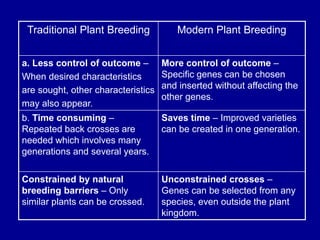
58.
Traditional Plant BreedingModern Plant Breeding
(Plant Biotechnology/ Genetic Engineering
a. Less control of outcome –
When desired characteristics
are sought, other characteristics
may also appear.
More control of outcome –
Specific genes can be chosen
and inserted without affecting the
other genes.
b. Time consuming –
Repeated back crosses are
needed which involves many
generations and several years.
Saves time – Improved varieties
can be created in one generation.
Constrained by natural
breeding barriers – Only
similar plants can be crossed.
Unconstrained crosses –
Genes can be selected from any
species, even outside the plant
kingdom.
59.
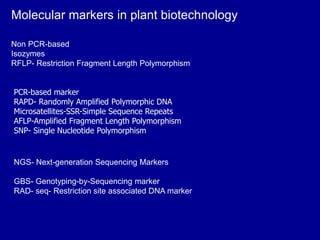
Molecular markers inplant biotechnology
Non PCR-based
Isozymes
RFLP- Restriction Fragment Length Polymorphism
NGS- Next-generation Sequencing Markers
GBS- Genotyping-by-Sequencing marker
RAD- seq- Restriction site associated DNA marker
PCR-based marker
RAPD- Randomly Amplified Polymorphic DNA
Microsatellites-SSR-Simple Sequence Repeats
AFLP-Amplified Fragment Length Polymorphism
SNP- Single Nucleotide Polymorphism
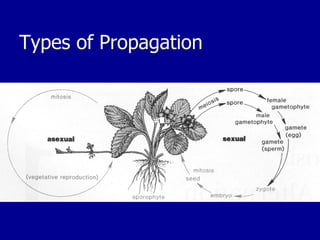
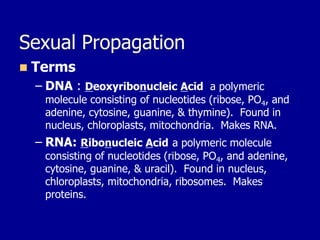
Sexual Propagation
◼ Terms
–DNA : Deoxyribonucleic Acid a polymeric
molecule consisting of nucleotides (ribose, PO4, and
adenine, cytosine, guanine, & thymine). Found in
nucleus, chloroplasts, mitochondria. Makes RNA.
– RNA: Ribonucleic Acid a polymeric molecule
consisting of nucleotides (ribose, PO4, and adenine,
cytosine, guanine, & uracil). Found in nucleus,
chloroplasts, mitochondria, ribosomes. Makes
proteins.
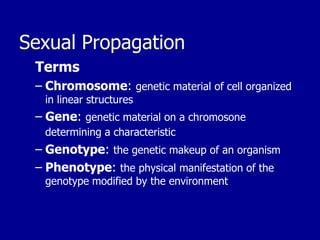
Sexual Propagation
Terms
– Chromosome:genetic material of cell organized
in linear structures
– Gene: genetic material on a chromosone
determining a characteristic
– Genotype: the genetic makeup of an organism
– Phenotype: the physical manifestation of the
genotype modified by the environment
65.
Sexual Propagation
Terms
– Diploid:a cell containing 2 sets (2n)of
chromosomes (vegetative cell)
– Haploid: a cell containing 1 (1n)set of
chromosomes (pollen or ovule)
– Sex cells contain haploid number of chromosomes-n
– Polyploid: a cell containing more than 2 sets of
chromosomes. Usually vegetatively reproduced.
▪ Banana = 3n
▪ Potato = 4n
▪ Strawberry = 8n
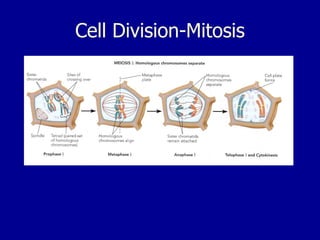
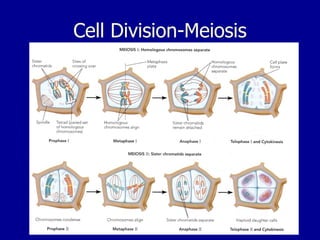
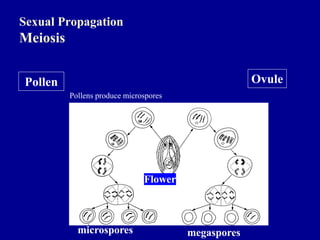
66.
Sexual Propagation
Terms
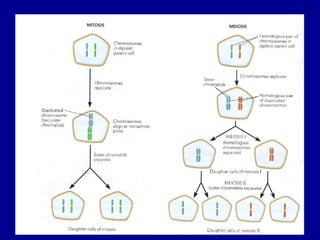
– Mitosis:cell division where nuclear complement
(1n or 2n) is maintained
– Meiosis: cell division where nuclear complement
(2n only) is reduced to 1n (gametes)
– Hybridization: controlled cross-fertilization
– Independent Assortment: each chromosome
operates independently during mitosis & meiosis
– Mutation: a heritable change in a gene
67.
Sexual Propagation
Terms
◼ Monoecious:Both sexes on same plant
(e.g. corn, pecan)
◼ Dioecious: Sexes on different plants
– Holly (female) Juniper (male or female)
– Pistachio (female) Cottonwood (male)
– Asparagus (male)]
– Ash (male)


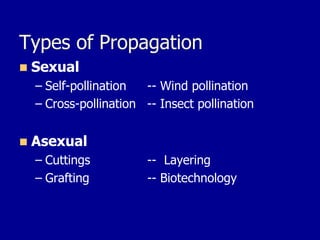
![Sexual Propagation
Terms
◼ Monoecious: Both sexes on same plant
(e.g. corn, pecan)
◼ Dioecious: Sexes on different plants
– Holly (female) Juniper (male or female)
– Pistachio (female) Cottonwood (male)
– Asparagus (male)]
– Ash (male)](https://image.slidesharecdn.com/chapter1-introductiontoplantbreeding-chapter2-reproduction-250323225934-6d9de24c/85/Chapter-1-Introduction-to-Plant-Breeding-pdf-67-320.jpg)