Meteorology
Temperature and humidity
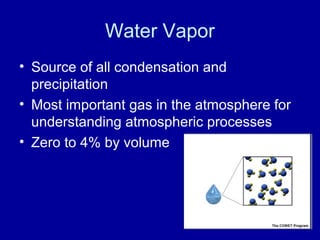
Water Vapor
• Source of all condensation and
precipitation
• Most important gas in the atmosphere for
understanding atmospheric processes
• Zero to 4% by volume
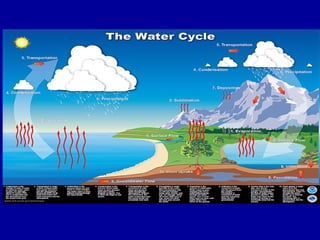
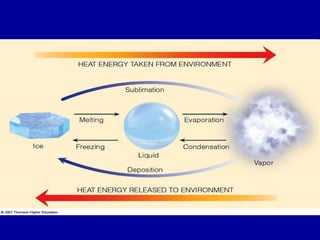
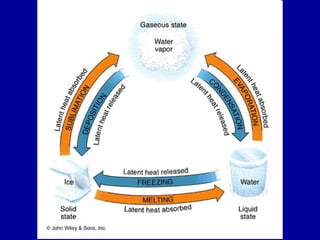
Water Changes State
• Always requires heat
• Heat is either absorbed or released
• Water must pass through the atmosphere
in the form of water vapor
• If all the water vapor was in a global layer
it would only be 2 mm deep
Solid to Liquid
• Melting
– Heat is transferred to ice water
– Temperature of the water remains a constant 0
degrees C until all ice has melted
– Heat breaks apart crystal structure of ice forming
liquid water
Liquid to Gas
• Evaporation
– Changing a liquid into a gas
– Requires 2500 joules of energy to convert 1
gram of liquid water to water vapor
Liquid to Gas
• “Evaporation as a cooling process”
– Energy is needed to evaporate water
– Cooling effect after getting out of the pool
– Energy needed comes right from your skin
• Condensation
– Water vapor changes to liquid
– Generates clouds and fog
Solid to Gas
• Sublimation
– Conversion of solid directly to a gas
– No liquid state
– Dry ice (frozen carbon dioxide)
– Generates “smoke”
• Deposition
– Conversion of vapor directly to a solid
– Frost on cold objects, grass, windows
Humidity
• Humidity – the amount of water vapor in the air
• Saturation
– Balance between liquid water and water vapor
– Closed jar: half water, half air
– Water begins to evaporate  increases pressure in
the air
– Pressure is caused by more water vapor molecules
moving into the air
– Pressure in air continues to increase
– Forces more water molecules to return to liquid
– When a balance occurs, air is said to be saturated
Saturated Air
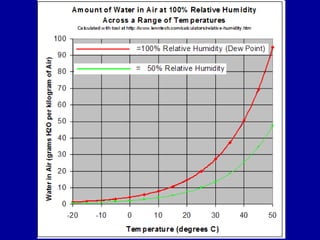
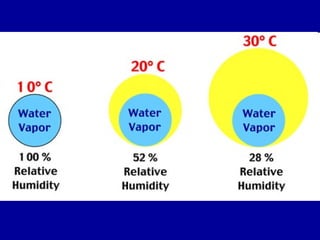
• Depends on temperature
• Warm air contains more water vapor than
cold air
Relative Humidity
• Ratio of air’s actual water vapor content
compared to the amount of water vapor
the air can hold at the time
• How much water vapor can the air hold?
– Depends on temperature and pressure
• Indicates how near the air is to saturation
Relative Humidity
• How can it be changed?
– 1 – adding or removing water vapor
• Occurs naturally
• Oceans and smaller bodies of water
– 2 – varies with temperature
• Lowering air temperatures causes INCREASE
• Raising air temperatures causes DECREASE
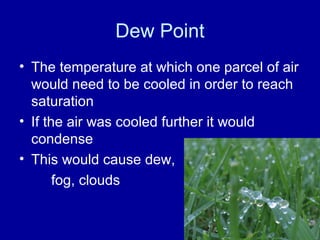
Dew Point
• The temperature at which one parcel of air
would need to be cooled in order to reach
saturation
• If the air was cooled further it would
condense
• This would cause dew,
fog, clouds
How do you measure humidity?
• Hygrometer – used to measure relative
humidity
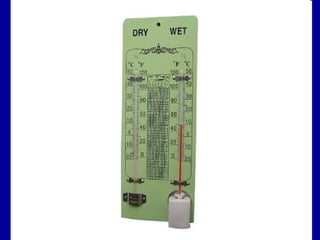
• Psychrometer
– Two thermometers side by side
– One is dry bulb, the other wet bulb
– Larger the difference on the reading the lower
the relative humidity
– If air is saturated the thermometers will have
the same reading
Humidity and temperature

Humidity and temperature

  • 1.
  • 2.
    Water Vapor • Sourceof all condensation and precipitation • Most important gas in the atmosphere for understanding atmospheric processes • Zero to 4% by volume
  • 3.
    Water Changes State •Always requires heat • Heat is either absorbed or released • Water must pass through the atmosphere in the form of water vapor • If all the water vapor was in a global layer it would only be 2 mm deep
  • 5.
    Solid to Liquid •Melting – Heat is transferred to ice water – Temperature of the water remains a constant 0 degrees C until all ice has melted – Heat breaks apart crystal structure of ice forming liquid water
  • 7.
    Liquid to Gas •Evaporation – Changing a liquid into a gas – Requires 2500 joules of energy to convert 1 gram of liquid water to water vapor
  • 8.
    Liquid to Gas •“Evaporation as a cooling process” – Energy is needed to evaporate water – Cooling effect after getting out of the pool – Energy needed comes right from your skin • Condensation – Water vapor changes to liquid – Generates clouds and fog
  • 10.
    Solid to Gas •Sublimation – Conversion of solid directly to a gas – No liquid state – Dry ice (frozen carbon dioxide) – Generates “smoke” • Deposition – Conversion of vapor directly to a solid – Frost on cold objects, grass, windows
  • 11.
    Humidity • Humidity –the amount of water vapor in the air • Saturation – Balance between liquid water and water vapor – Closed jar: half water, half air – Water begins to evaporate  increases pressure in the air – Pressure is caused by more water vapor molecules moving into the air – Pressure in air continues to increase – Forces more water molecules to return to liquid – When a balance occurs, air is said to be saturated
  • 12.
    Saturated Air • Dependson temperature • Warm air contains more water vapor than cold air
  • 13.
    Relative Humidity • Ratioof air’s actual water vapor content compared to the amount of water vapor the air can hold at the time • How much water vapor can the air hold? – Depends on temperature and pressure • Indicates how near the air is to saturation
  • 16.
    Relative Humidity • Howcan it be changed? – 1 – adding or removing water vapor • Occurs naturally • Oceans and smaller bodies of water – 2 – varies with temperature • Lowering air temperatures causes INCREASE • Raising air temperatures causes DECREASE
  • 17.
    Dew Point • Thetemperature at which one parcel of air would need to be cooled in order to reach saturation • If the air was cooled further it would condense • This would cause dew, fog, clouds
  • 18.
    How do youmeasure humidity? • Hygrometer – used to measure relative humidity • Psychrometer – Two thermometers side by side – One is dry bulb, the other wet bulb – Larger the difference on the reading the lower the relative humidity – If air is saturated the thermometers will have the same reading