Specific
humidity
Relative
humidity
Saturation
mixing ratio
Vapour
pressure
Mixing ratio
Absolute
humidity
Outline
I
• Introduction
II
• Measurement Used to Determine Atmospheric Humidity
III
• Effect of Humidity
IV
• Instruments Used to Measure Humidity
V
• Relationship of Humidity to other Meteorological
Parameters
VI
• Humidity on Land and Oceans
Introduction
Atmospheric humidity is a measurable quantity of the moisture content found in the Earth’s
atmosphere.
Humidity is the amount of water vapour in the atmosphere. The main sources of water vapour
in the lower atmosphere are evaporation and transpiration.
Atmospheric water vapour accounts for only about 1/1000th of the total amount of water in
the global hydrological cycle.
The total volume of water in the atmosphere is about 1.3 x 10¹³ m3 , the overwhelming
majority of which is the vapor phase (Air Resources Laboratory, 2008)
Oceans contain about 1.35 x 10¹⁸ m3 of water (Air Resources Laboratory, 2008)
Atmospheric water vapour is one of the most important factors in determining Earth’s
weather and climate, because of its role as greenhouse gas and because of the large amounts
of energy involved as water changes between the gaseous (vapor) phase and liquid and solid
phases
Measurements
Various ways of expressing humidity
Absolute humidity (g of vapour/m3 of air)– expresses the vapour
content of the air using the mass of water vapour contained in a given
volume of air. Absolute humidity changes when the volume changes,
even though the mass of water vapour has not changed.
Specific humidity ( g of vapour/kg. of air)– measures the water vapour
content of the air using mass of water for a given mass of air. Specific
humidity doesn’t change as the air parcel expands or is compressed.
Vapour Pressure – measures the water vapour content of the air using
partial pressure of the water vapour in the air.
Measurements
Measurements
Mixing Ratio (g of water vapour/kg. of dry air) -
refers the ratio of the mass of water vapour to the
mass of dry air in the sample. It is not affected by
changes in pressure and temperature.
Saturation mixing ratio - refers to the mass of water
vapour that can held in a kilogram of dry air at
saturation. Saturation can be generally defined as the
condition of liquid water or the deposition of ice at a
given temperature and pressure.
Relative humidity – the most commonly used to
measure humidity. It is the amount of water in the air
relative to the saturation amount the air can hold at a
given temperature multiplied by 100.
Temperature
Degrees
Celsius
Vapor (g) per
Kilogram of Dry
Air
50 88.12
40 49.81
30 27.69
20 14.85
10 7.76
0 3.84
Fig. 1 Illustration on how relative humidity changes
in a parcel of air with an increase in air temperature
Note:
The more water
vapour in the air, the
higher the relative
humidity is at a given
temperature.
Air with a relative
humidity of 50%
contains half of water
vapour it could hold
at a particular
temperature.
Measurements
Factors
 Change the amount of water vapour available –
Example: Lake – relative humidity can be increased by evaporation
from the surface of the lake.
Water vapour Humidity
 Change the temperature of the air -
Example: No water vapour is added.
Air temperature Relative humidity
Note:
Relative humidity varies considerably, tending to be the highest close to
dawn when the air temperature is at its lowest, and decreasing as the
air temperature rises. The decrease in the relative humidity towards
midday tends to be the largest in summer. In areas with high humidity
levels, the transmission of solar radiation is reduced because of
atmospheric absorption and scattering. High humidity reduces
evaporation of water and sweat. Consequently, high humidity
accompanied by high ambient temperature causes a lot of discomfort.
(http://mnre.gov.in)
Effects of Humidity
Transpiration of water vapour through leaf stomata depends on the gradient of
moisture between the leaf interior (which is saturated) and the overlying air, as
well as the availability of moisture in the soil. The lower the atmospheric humidity,
the greater the transpiration rate. The transpiration rate is determined by a balance
between the amount of energy available to convert water from the liquid to vapour
phase and the moisture gradient.
Transpiration rates also depend on the resistance to water movement between the
leaf and the air.
Atmospheric humidity affects the organisms by modifying its water content. Some
forms are hygroscopic and absorb water from moist air. Different studies showed
that specific organisms gains or lose weight depending on the humidity’s in a
certain environment.
Animals
Plants
Humans
Humans too are very sensitive to humidity because our skin relies on the air to
get rid of moisture.
So if the air is at 100% relative humidity, sweat will not evaporate into the air. As
a result, we feel much hotter than the actual temperature when the relative
humidity is high. If the relative humidity is low, we can feel much cooler than the
actual temperature because our sweat evaporates easily, cooling us off.
For example, if the air temperature is 75 degrees Fahrenheit (24 degrees Celsius)
and the relative humidity is zero percent, the air temperature feels like 69
degrees Fahrenheit (21 C) to our bodies. If the air temperature is 75 degrees
Fahrenheit (24 C) and the relative humidity is 100 percent, we feel like it's 80
degrees (27 C) out. People tend to feel most comfortable at a relative humidity of
about 45 percent (www.science.howstuffworks.com). High humidity causes
health problems such as sunstroke and heatstroke.
Instruments
Sling psychrometer- often used to determine
relative humidity. Consists of thermometers
(wet bulb and dry bulb).
The difference between the dry and wet bulb
reading will give with the aid of psychometric
table, the dew point temperature and the
relative humidity. Performed near saturation
but under read at lower humidities
Hygrothermograph – records both relative
humidity and temperature on graph paper in
the same manner as the thermograph and
barograph do.
Hair hygrometers – it works on the fact that hair changes its length when
humidity varies. This device usually consists of a number of human or horse hairs
connected to the mechanical lever system. When humidity increases the length of
the hair becomes longer. This device is less accurate than the psychrometer.
Satellites – on a global scale, humidity is being measured using remotely placed
satellites. These satellites are able to detect the concentration of water in the
troposphere at altitudes between 4 and 12 kilometers. Satellites that can measure
water vapour have sensors that are sensitive to infrared radiation.
Relationship of humidity to
other Meteorological
ParametersWeather Parameters Relationship Remarks
Air pressure Inversely proportional More humidity in the air, the lighter the air
pressure and When less humidity is in the air,
there is more air pressure. (Givoni, 1976).
Air temperature Directly related to
solar radiation
Higher the temperature, the higher is the
amount of energy in the air.
(Bharat and Sheeba, 2011)
Precipitation Directly proportional As precipitation increases, humidity also
increases.
Temperature Inversely proportional Temperature changes; relative humidity also
changes but in opposite direction.
Soil temperature Indirect and minimal Air temperature was the factor that influenced
most the soil temperature.
(Salamene et. al. 2010)
Wind Less affected Air pressure differences between different
locations will cause air pressure differences
which in turn produce air movement (wind)
Climate Variables and their
Correlation
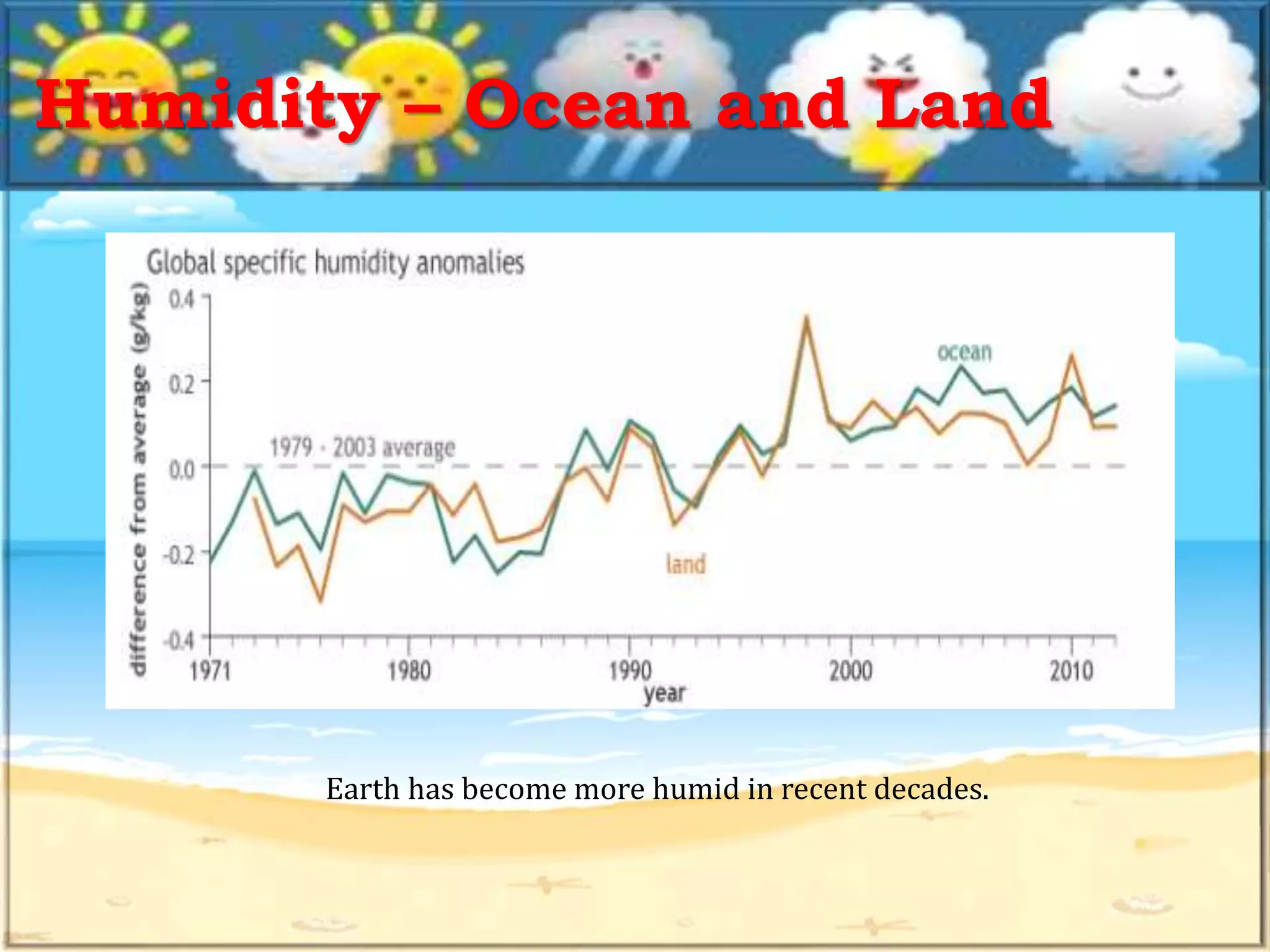
Humidity – Ocean and Land
Earth has become more humid in recent decades.
Atmospheric humidity

Atmospheric humidity

  • 1.
  • 2.
    Outline I • Introduction II • MeasurementUsed to Determine Atmospheric Humidity III • Effect of Humidity IV • Instruments Used to Measure Humidity V • Relationship of Humidity to other Meteorological Parameters VI • Humidity on Land and Oceans
  • 3.
    Introduction Atmospheric humidity isa measurable quantity of the moisture content found in the Earth’s atmosphere. Humidity is the amount of water vapour in the atmosphere. The main sources of water vapour in the lower atmosphere are evaporation and transpiration. Atmospheric water vapour accounts for only about 1/1000th of the total amount of water in the global hydrological cycle. The total volume of water in the atmosphere is about 1.3 x 10¹³ m3 , the overwhelming majority of which is the vapor phase (Air Resources Laboratory, 2008) Oceans contain about 1.35 x 10¹⁸ m3 of water (Air Resources Laboratory, 2008) Atmospheric water vapour is one of the most important factors in determining Earth’s weather and climate, because of its role as greenhouse gas and because of the large amounts of energy involved as water changes between the gaseous (vapor) phase and liquid and solid phases
  • 4.
    Measurements Various ways ofexpressing humidity
  • 5.
    Absolute humidity (gof vapour/m3 of air)– expresses the vapour content of the air using the mass of water vapour contained in a given volume of air. Absolute humidity changes when the volume changes, even though the mass of water vapour has not changed. Specific humidity ( g of vapour/kg. of air)– measures the water vapour content of the air using mass of water for a given mass of air. Specific humidity doesn’t change as the air parcel expands or is compressed. Vapour Pressure – measures the water vapour content of the air using partial pressure of the water vapour in the air. Measurements
  • 6.
    Measurements Mixing Ratio (gof water vapour/kg. of dry air) - refers the ratio of the mass of water vapour to the mass of dry air in the sample. It is not affected by changes in pressure and temperature. Saturation mixing ratio - refers to the mass of water vapour that can held in a kilogram of dry air at saturation. Saturation can be generally defined as the condition of liquid water or the deposition of ice at a given temperature and pressure. Relative humidity – the most commonly used to measure humidity. It is the amount of water in the air relative to the saturation amount the air can hold at a given temperature multiplied by 100. Temperature Degrees Celsius Vapor (g) per Kilogram of Dry Air 50 88.12 40 49.81 30 27.69 20 14.85 10 7.76 0 3.84
  • 7.
    Fig. 1 Illustrationon how relative humidity changes in a parcel of air with an increase in air temperature Note: The more water vapour in the air, the higher the relative humidity is at a given temperature. Air with a relative humidity of 50% contains half of water vapour it could hold at a particular temperature. Measurements
  • 8.
    Factors  Change theamount of water vapour available – Example: Lake – relative humidity can be increased by evaporation from the surface of the lake. Water vapour Humidity  Change the temperature of the air - Example: No water vapour is added. Air temperature Relative humidity
  • 9.
    Note: Relative humidity variesconsiderably, tending to be the highest close to dawn when the air temperature is at its lowest, and decreasing as the air temperature rises. The decrease in the relative humidity towards midday tends to be the largest in summer. In areas with high humidity levels, the transmission of solar radiation is reduced because of atmospheric absorption and scattering. High humidity reduces evaporation of water and sweat. Consequently, high humidity accompanied by high ambient temperature causes a lot of discomfort. (http://mnre.gov.in)
  • 11.
    Effects of Humidity Transpirationof water vapour through leaf stomata depends on the gradient of moisture between the leaf interior (which is saturated) and the overlying air, as well as the availability of moisture in the soil. The lower the atmospheric humidity, the greater the transpiration rate. The transpiration rate is determined by a balance between the amount of energy available to convert water from the liquid to vapour phase and the moisture gradient. Transpiration rates also depend on the resistance to water movement between the leaf and the air. Atmospheric humidity affects the organisms by modifying its water content. Some forms are hygroscopic and absorb water from moist air. Different studies showed that specific organisms gains or lose weight depending on the humidity’s in a certain environment. Animals Plants
  • 12.
    Humans Humans too arevery sensitive to humidity because our skin relies on the air to get rid of moisture. So if the air is at 100% relative humidity, sweat will not evaporate into the air. As a result, we feel much hotter than the actual temperature when the relative humidity is high. If the relative humidity is low, we can feel much cooler than the actual temperature because our sweat evaporates easily, cooling us off. For example, if the air temperature is 75 degrees Fahrenheit (24 degrees Celsius) and the relative humidity is zero percent, the air temperature feels like 69 degrees Fahrenheit (21 C) to our bodies. If the air temperature is 75 degrees Fahrenheit (24 C) and the relative humidity is 100 percent, we feel like it's 80 degrees (27 C) out. People tend to feel most comfortable at a relative humidity of about 45 percent (www.science.howstuffworks.com). High humidity causes health problems such as sunstroke and heatstroke.
  • 13.
  • 14.
    Sling psychrometer- oftenused to determine relative humidity. Consists of thermometers (wet bulb and dry bulb). The difference between the dry and wet bulb reading will give with the aid of psychometric table, the dew point temperature and the relative humidity. Performed near saturation but under read at lower humidities Hygrothermograph – records both relative humidity and temperature on graph paper in the same manner as the thermograph and barograph do.
  • 15.
    Hair hygrometers –it works on the fact that hair changes its length when humidity varies. This device usually consists of a number of human or horse hairs connected to the mechanical lever system. When humidity increases the length of the hair becomes longer. This device is less accurate than the psychrometer. Satellites – on a global scale, humidity is being measured using remotely placed satellites. These satellites are able to detect the concentration of water in the troposphere at altitudes between 4 and 12 kilometers. Satellites that can measure water vapour have sensors that are sensitive to infrared radiation.
  • 16.
    Relationship of humidityto other Meteorological ParametersWeather Parameters Relationship Remarks Air pressure Inversely proportional More humidity in the air, the lighter the air pressure and When less humidity is in the air, there is more air pressure. (Givoni, 1976). Air temperature Directly related to solar radiation Higher the temperature, the higher is the amount of energy in the air. (Bharat and Sheeba, 2011) Precipitation Directly proportional As precipitation increases, humidity also increases. Temperature Inversely proportional Temperature changes; relative humidity also changes but in opposite direction. Soil temperature Indirect and minimal Air temperature was the factor that influenced most the soil temperature. (Salamene et. al. 2010) Wind Less affected Air pressure differences between different locations will cause air pressure differences which in turn produce air movement (wind)
  • 17.
    Climate Variables andtheir Correlation
  • 18.
    Humidity – Oceanand Land Earth has become more humid in recent decades.