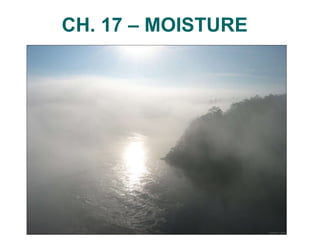
CH. 17 – MOISTURE
Changes of State of Water Heat = energy  Adding heat to an object makes atoms vibrate faster Heat  ≠  temperature! Temperature = average of all molecular motion
Change of State of Water Latent heat – energy added to or released by substance w/out changing temperature  Latent = “hidden” Ex:  Beaker w/ ice and water
Humidity Describes amount of water vapor in air - water vapor sits in spaces between dry air gases Saturation = spaces filled to capacity w/ water vapor
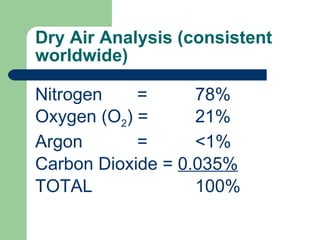
Dry Air Analysis (consistent worldwide) Nitrogen  =  78% Oxygen (O 2 ) =  21% Argon  =  <1% Carbon Dioxide =  0.035% TOTAL 100%
Water Vapor Capacity Table Temperature dependent Hotter air = molecules moving farther apart = more space for water vapor
Relative Humidity - measures how close air is to saturation w/ water vapor - expressed as a percentage - is temperature dependent!
Relative Humidity Mixing ratio  - actual amount water vapor by weight in one kg of air
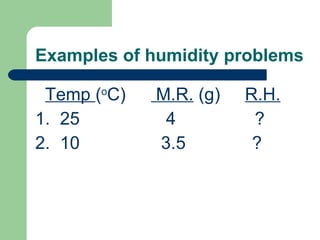
Examples of humidity problems Temp  ( o C)   M.R.  (g)  R.H. 1.  25   4    ? 2.  10   3.5    ?
True or False? Air with a higher relative humidity has more water vapor in it than air with a lower relative humidity?
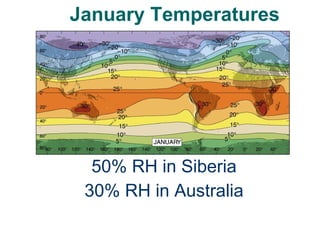
January Temperatures 50% RH in Siberia 30% RH in Australia
Relative Humidity Question: If temp. increases w/out changing the mixing ratio, what happens to relative humidity?
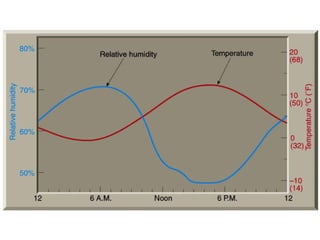
Factors that change relative humidity 1) Change in air temperature Assuming no change in mixing ratio: Increase temp. = __________ RH Decrease temp. = _________ RH
Rel. hum. vs. temp
Factors that change relative humidity 2) Change amount of water vapor a) Add water vapor through ____________ b) Remove water vapor  by ____________
Dew Point Temperature at which air is saturated without changing the mixing ratio - air has to ________to reach dew point
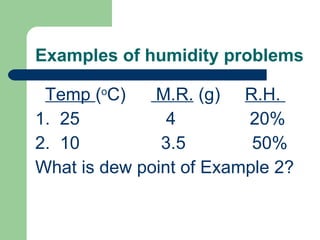
Examples of humidity problems Temp  ( o C)   M.R.  (g)  R.H.  1.  25   4    20% 2.  10   3.5    50% What is dew point of Example 2?
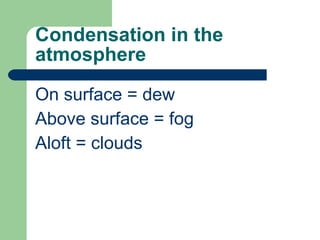
Condensation in the atmosphere On surface = dew Above surface = fog Aloft = clouds
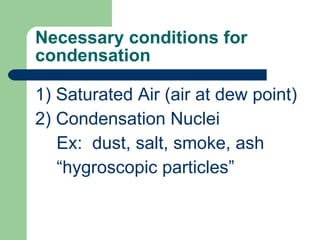
Necessary conditions for condensation 1) Saturated Air (air at dew point) 2) Condensation Nuclei Ex:  dust, salt, smoke, ash “ hygroscopic particles”
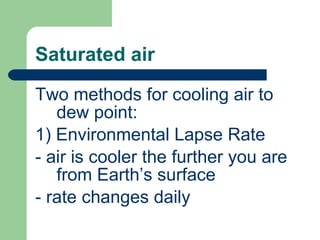
Saturated air Two methods for cooling air to dew point: 1) Environmental Lapse Rate - air is cooler the further you are from Earth’s surface - rate changes daily
Cooling to Dew Point: Method #2 2) Adiabatic Temp. Change - caused by changing air’s volume * No heat (energy) is added or removed from the air!
Adiabatic Temperature Changes Air expands = temp. decreases Ex:  aerosol spray can Air compresses = temp. increases Ex:  bicycle tire pump heating up
Cloud Formation As air rises, it expands & cools Dry adiabatic rate = cooling of unsaturated air - constant 10 o  C per km
Condensation Latent heat released by water vapor Ex:  In summer, can “sweats” - latent heat warms can
Cloud Formation Wet adiabatic rate = cooling of saturated air - always < 10 o  C   per km Varies depending on amount of condensation in cloud (latent heat warms surrounding air)
Review cloud forming process: 1.  Air rises 2. Air expands 3. Air cools adiabatically
Review cloud forming process: 4. Air reaches dew point altitude varies based on how much water vapor is in rising air 5.  Condensation begins
Review cloud forming process: * Key to cloud formation is to get large amounts of air to rise!
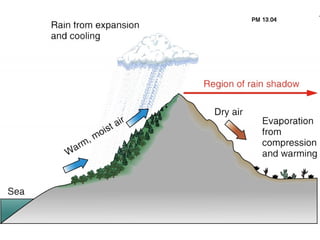
Mechanisms forcing air to rise: 1) Orographic Lifting - physical barrier to wind Clouds form on windward side of mountain As air descends, it compresses & heats up adiabatically
Orographic Lifting “ Rain shadow” deserts on leeward side of mountains Ex:  Basin & Range in Nevada
 
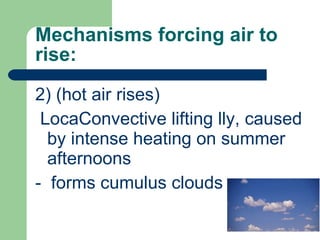
Mechanisms forcing air to rise: 2) (hot air rises) LocaConvective lifting lly, caused by intense heating on summer afternoons  -  forms cumulus clouds
Mechanisms forcing air to rise: 3) Convergence Surface air moves from high pressure to low pressure (wind)
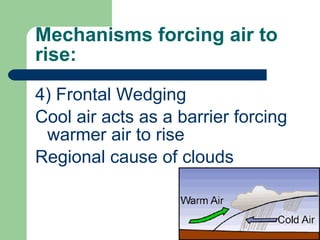
Mechanisms forcing air to rise: 4) Frontal Wedging Cool air acts as a barrier forcing warmer air to rise Regional cause of clouds
Frontal Wedging Major factor in Midwest - warm moist air (Gulf of Mexico) - cold dry air (Canada)
Fog Cloud with its base at or very near the ground Ex:  Radiation fog (ground fog) - fairly clear nights w/ high relative humidity
Radiation Fog Air above ground cools rapidly to dew point  - after sunrise, fog evaporates from ground up (“lifts”)
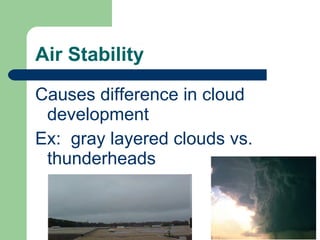
Air Stability Causes difference in cloud development Ex:  gray layered clouds vs. thunderheads
Stable Air Air resists vertical displacement - air at surface is colder than temp. of surrounding air - Force air to rise Ex:  Orographic lifting
Unstable Air Air that does not resist vertical displacement - air at surface is warmer than surrounding air - begins and continues to rise on its own (ex: “convective lifting”)
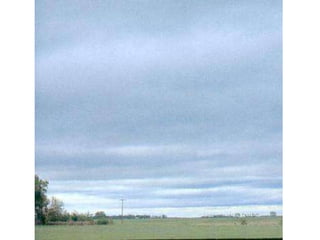
Weather Conditions  Stable Air: a) Characteristically sheet-like layered clouds (stratus) Ppt.- producing = nimbostratus b) light to moderate ppt. of long duration
Stratus clouds
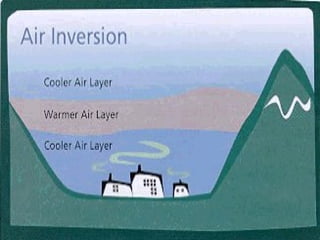
Weather with stable air: c) Other phenomena: - poor visibility & haze - fog, sleet, glaze - inversions (smog alerts)
Inversions
Weather Conditions Unstable Air: a) Clouds w/ considerable vertical development b) Short episodes of heavy ppt.  (cumulonimbus clouds)
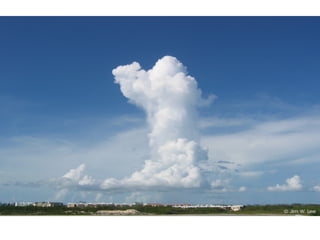
Cloud of vertical development
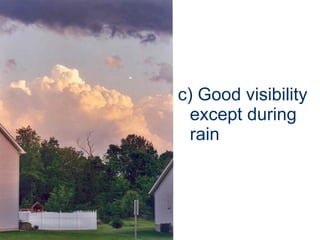
c) Good visibility except during rain
Weather w/unstable air d) Extreme weather phenomena: - lightning & thunder - hail - tornadoes - hurricanes

Ch17_Moisture_students

  • 1.
    CH. 17 –MOISTURE
  • 2.
    Changes of Stateof Water Heat = energy Adding heat to an object makes atoms vibrate faster Heat ≠ temperature! Temperature = average of all molecular motion
  • 3.
    Change of Stateof Water Latent heat – energy added to or released by substance w/out changing temperature Latent = “hidden” Ex: Beaker w/ ice and water
  • 4.
    Humidity Describes amountof water vapor in air - water vapor sits in spaces between dry air gases Saturation = spaces filled to capacity w/ water vapor
  • 5.
    Dry Air Analysis(consistent worldwide) Nitrogen = 78% Oxygen (O 2 ) = 21% Argon = <1% Carbon Dioxide = 0.035% TOTAL 100%
  • 6.
    Water Vapor CapacityTable Temperature dependent Hotter air = molecules moving farther apart = more space for water vapor
  • 7.
    Relative Humidity -measures how close air is to saturation w/ water vapor - expressed as a percentage - is temperature dependent!
  • 8.
    Relative Humidity Mixingratio - actual amount water vapor by weight in one kg of air
  • 9.
    Examples of humidityproblems Temp ( o C) M.R. (g) R.H. 1. 25 4 ? 2. 10 3.5 ?
  • 10.
    True or False?Air with a higher relative humidity has more water vapor in it than air with a lower relative humidity?
  • 11.
    January Temperatures 50%RH in Siberia 30% RH in Australia
  • 12.
    Relative Humidity Question:If temp. increases w/out changing the mixing ratio, what happens to relative humidity?
  • 13.
    Factors that changerelative humidity 1) Change in air temperature Assuming no change in mixing ratio: Increase temp. = __________ RH Decrease temp. = _________ RH
  • 14.
  • 15.
    Factors that changerelative humidity 2) Change amount of water vapor a) Add water vapor through ____________ b) Remove water vapor by ____________
  • 16.
    Dew Point Temperatureat which air is saturated without changing the mixing ratio - air has to ________to reach dew point
  • 17.
    Examples of humidityproblems Temp ( o C) M.R. (g) R.H. 1. 25 4 20% 2. 10 3.5 50% What is dew point of Example 2?
  • 18.
    Condensation in theatmosphere On surface = dew Above surface = fog Aloft = clouds
  • 19.
    Necessary conditions forcondensation 1) Saturated Air (air at dew point) 2) Condensation Nuclei Ex: dust, salt, smoke, ash “ hygroscopic particles”
  • 20.
    Saturated air Twomethods for cooling air to dew point: 1) Environmental Lapse Rate - air is cooler the further you are from Earth’s surface - rate changes daily
  • 21.
    Cooling to DewPoint: Method #2 2) Adiabatic Temp. Change - caused by changing air’s volume * No heat (energy) is added or removed from the air!
  • 22.
    Adiabatic Temperature ChangesAir expands = temp. decreases Ex: aerosol spray can Air compresses = temp. increases Ex: bicycle tire pump heating up
  • 23.
    Cloud Formation Asair rises, it expands & cools Dry adiabatic rate = cooling of unsaturated air - constant 10 o C per km
  • 24.
    Condensation Latent heatreleased by water vapor Ex: In summer, can “sweats” - latent heat warms can
  • 25.
    Cloud Formation Wetadiabatic rate = cooling of saturated air - always < 10 o C per km Varies depending on amount of condensation in cloud (latent heat warms surrounding air)
  • 26.
    Review cloud formingprocess: 1. Air rises 2. Air expands 3. Air cools adiabatically
  • 27.
    Review cloud formingprocess: 4. Air reaches dew point altitude varies based on how much water vapor is in rising air 5. Condensation begins
  • 28.
    Review cloud formingprocess: * Key to cloud formation is to get large amounts of air to rise!
  • 29.
    Mechanisms forcing airto rise: 1) Orographic Lifting - physical barrier to wind Clouds form on windward side of mountain As air descends, it compresses & heats up adiabatically
  • 30.
    Orographic Lifting “Rain shadow” deserts on leeward side of mountains Ex: Basin & Range in Nevada
  • 31.
  • 32.
    Mechanisms forcing airto rise: 2) (hot air rises) LocaConvective lifting lly, caused by intense heating on summer afternoons - forms cumulus clouds
  • 33.
    Mechanisms forcing airto rise: 3) Convergence Surface air moves from high pressure to low pressure (wind)
  • 34.
    Mechanisms forcing airto rise: 4) Frontal Wedging Cool air acts as a barrier forcing warmer air to rise Regional cause of clouds
  • 35.
    Frontal Wedging Majorfactor in Midwest - warm moist air (Gulf of Mexico) - cold dry air (Canada)
  • 36.
    Fog Cloud withits base at or very near the ground Ex: Radiation fog (ground fog) - fairly clear nights w/ high relative humidity
  • 37.
    Radiation Fog Airabove ground cools rapidly to dew point - after sunrise, fog evaporates from ground up (“lifts”)
  • 38.
    Air Stability Causesdifference in cloud development Ex: gray layered clouds vs. thunderheads
  • 39.
    Stable Air Airresists vertical displacement - air at surface is colder than temp. of surrounding air - Force air to rise Ex: Orographic lifting
  • 40.
    Unstable Air Airthat does not resist vertical displacement - air at surface is warmer than surrounding air - begins and continues to rise on its own (ex: “convective lifting”)
  • 41.
    Weather Conditions Stable Air: a) Characteristically sheet-like layered clouds (stratus) Ppt.- producing = nimbostratus b) light to moderate ppt. of long duration
  • 42.
  • 43.
    Weather with stableair: c) Other phenomena: - poor visibility & haze - fog, sleet, glaze - inversions (smog alerts)
  • 44.
  • 45.
    Weather Conditions UnstableAir: a) Clouds w/ considerable vertical development b) Short episodes of heavy ppt. (cumulonimbus clouds)
  • 46.
    Cloud of verticaldevelopment
  • 47.
    c) Good visibilityexcept during rain
  • 48.
    Weather w/unstable aird) Extreme weather phenomena: - lightning & thunder - hail - tornadoes - hurricanes