
HUMIDITY
ABSOLUTE HUMIDITY
Humidity means amount of water vapor in
the air.
There are different ways to describe the
humidity.
Suppose there is a parcel of air. It
contains water vapor and other gases.
Now by using a chemical drying agent we
removed water vapor from parcel & weigh
it and get its mass.
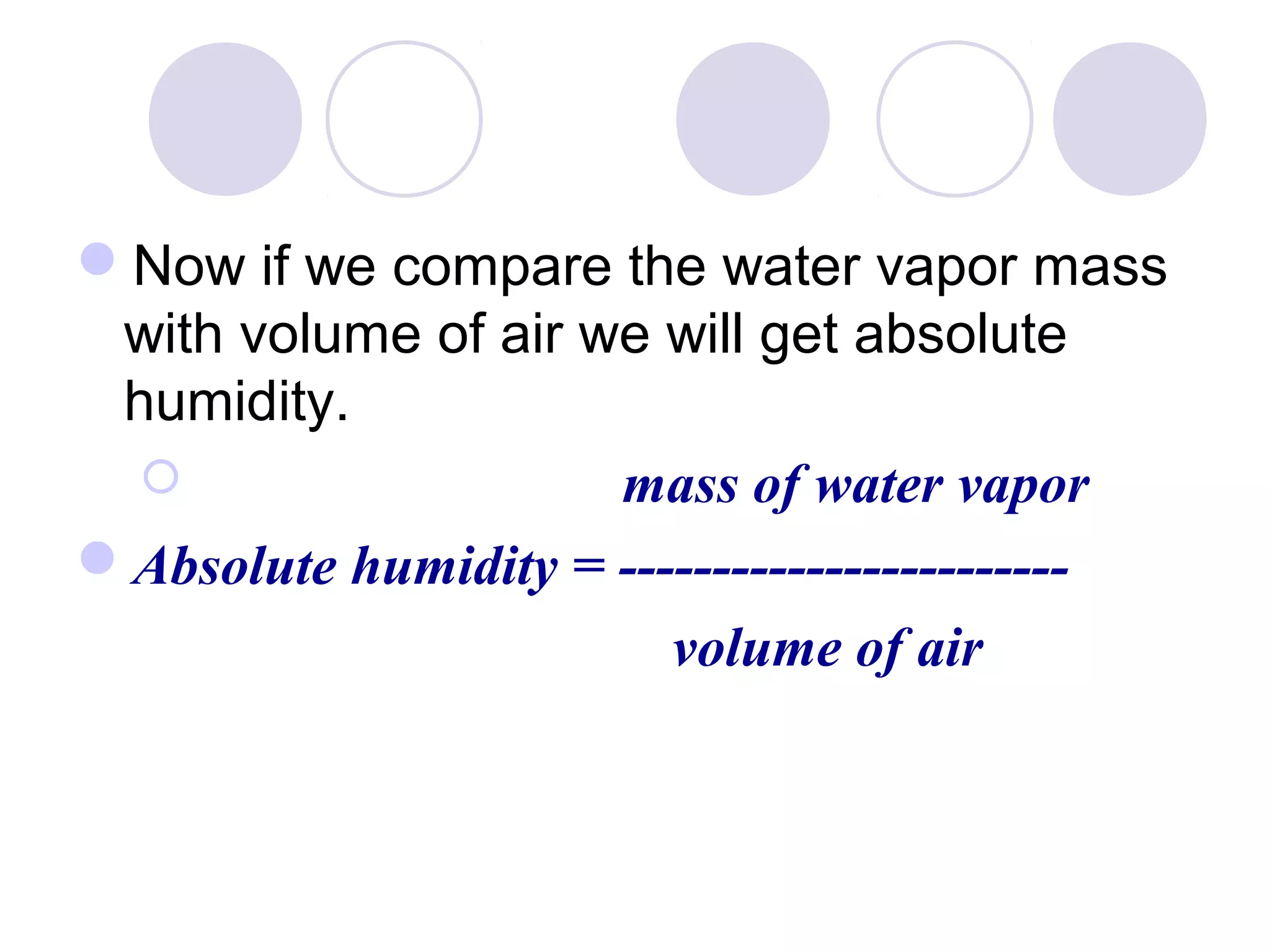
Now if we compare the water vapor mass
with volume of air we will get absolute
humidity.
 mass of water vapor
Absolute humidity = ------------------------
volume of air
It is usually expressed in grams of water
vapor in a cubic meter of air.
If there is 25 gms. of water vapor in 1
cubic meter of air the absolute humidity of
the air will be 25 gms. per cubic meter
(25 g/m3).
There will be a change in the volume of
the air parcel as it rises or descends due
to change in the surrounding air pressure.
It means that the absolute humidity will
change when volume of parcel changes.
SPECIFIC HUMIDITY & MIXING RATIO
Now if we compare
the mass of the water
vapor in the air with
the mass of all the air
in the parcel
(including water
vapor) it is called
specific humidity.
 mass of water vapor
Specific humidity = ------------------------
 total mass of air
We can also express it by comparing the
mass of water vapor in the parcel to the
mass of remaining dry air
“Mixing Ratio”.
 mass of water vapor
Mixing Ratio = ------------------------
mass of dry air
 Both specific humidity & mixing ratio are
expressed in grams of water vapor per kg. of
air (g/kg.)
Specific humidity & mixing ratio of an air
parcel remains constant as long as water
vapor is not added or removed from the
parcel.
It means total no. of air molecules (mass
of air parcel) remains constant even the
parcel contracts /expand.
The figure shows how specific humidity
varies with the latitude.
It is higher in the warm tropics and as we
move away from tropics the specific
humidity decreases and reaches its
minimum value in the polar latitudes.
VAPOR PRESSURE
The pressure of the water vapor in the air
is called vapor pressure.
Suppose the total air parcel pressure is
1000 mb.
Then partial pressure exerted by N2 will be
780 mb, O2 will be 210 mb and the partial
vapor pressure will be 10 mb.
RELATIVE HUMIDITY
It is the ratio of the amount of water vapor
in the air compared to the max. amount of
water vapor required for saturation @
temp. & pressure.
 water vapor content
Relative humidity = ------------------------
water vapor capacity
SATURATION VAPOR PRESSURE
It indicates how much water vapor is
necessary to make the air saturated at
any given temperature.
Saturation is an atmospheric condition
where the level of water vapor is
maximum @ existing temp. & pressure.
At higher air temp. it takes more water
vapor to saturate the air and more water
vapor exert more pressure.
Saturation vapor pressure depends on the
air temp. Lets have a look on the figure
and see what can you dig out from it.
It clearly shows that saturation vapor
pressure increases with increasing
temperature.
At a temp. of 10C the saturation vapor
pressure is 12 mb. and at 30 C it is 42 mb.
Also it is clear that saturation vapor pressure
of liquid is greater than of ice. WHY…….
Because liquid need less time to change
into vapors as compared to ice which
takes a longer time to convert into vapors.
Relative humidity is also expressed as:
 actual vapor pressure
R.H = ------------------------ x 100%
saturation vapor pressure
Relative humidity is given in percent.
If air has a R.H of 50% it means that 50%
is there for saturation.
If air has a R.H of 100% then air is said to
be saturated as it is full filled with water
vapor.
 Air with a R.H greater than 100 % is
known as super saturated.
 There are two ways by which a change
can be brought in R.H.
i. By changing the water vapor content in air.
ii. By changing the air temperature.
A change in the air water vapor pressure
content can change the air’s actual vapor
pressure.
If the air temp. remains constant, an
increase in the air’s water vapor pressure
will increase the air’s actual vapor
pressure and that increases the R.H.
If air temp. remains constant a decrease
in the air’s water vapor pressure will
decrease the air’s actual vapor pressure
and that lowers the R.H.
So we can say that if water vapor is
added to air (with no change in the air
temp.) the R.H increases and as vapor
content is removed from air R.H
decreases.
If there is no change in the water vapor
content an increase in the air temp. will
lower the R.H while….
 A decrease in the air temp. will raise the
R.H as shown in the figure.
As the air cools
during the night R.H
increases.
When the air is
coolest (morning)
R.H is high. At noon
R.H is low.
RELATIVE HUMIDITY & DEW POINT
Lets suppose it is morning and air is
saturated outside.
The air temp. is 10 C & R.H =100%
 actual vapor pressure
R.H = ------------------------ x 100%
saturation vapor pressure
From the figure it is clear that saturation
vapor pressure for 10C is 12 mb.
Now as the air is saturated and & R.H is
100
actual vapor pressure = saturation vapor
pressure
 12 mb
R.H = ----------- x 100% = 100%
12 mb
Suppose during the day the air gets warm &
air temp. is 30C with no change in water
vapor content.
Now calculate R.H in this case?
Now
12 mb
R.H = ----------- x 100% = 29%(approx)
42 mb
Dew point temp. is the temp. to which air
should be cooled for saturation to occur if
there is no change in water vapor content.
Dew point temp. is measured w.r.t the
surface of water and if dew point temp. is
measured w.r.t surface of ice it is called
frost point.
High dew point means ????? value of
water vapor.
HIGH
Addition of water vapor to the air
increases the dew point temp. & removing
it will lower the dew point temp.
The difference between the air temp. &
dew point temp. tells how high or low the
R.H is.
If there is a wide difference between air
temp. & dew point R.H is low & when they
are near to each other R.H is high.
When air temp. & dew point are equal
then what happens?????
Air is saturated and R.H is 100%
Air temp=-2C, Dew point= -2C
The figure shows that air temp. and dew
point temp. is same in the polar region,
then R.H will be 100%.
The other figure shows there is a
difference between air temp. & dew point.
Can u calculate the R.H in that case???
Air temp.=35C, Dew point= 5C
Desert air temp. = 35 C
Saturation vapor pressure =
Desert air dew point temp. = 5C
Actual vapor pressure =
R.H = ?????
Desert air temp. = 35 C
Saturation vapor pressure = 56mb
Desert air dew point temp. = 5C
Actual vapor pressure = 9 mb
9 mb
R.H = ----------- x 100% = 16%(approx)
56 mb
R.H & HUMAN DISCOMFORT
Suppose there is a humid day, we might
say that although its is not that much heat
but even then there is a lot humidity.
In warm weather the main source of our
body cooling is evaporation.
Now if air temp. is high and R.H is low
skin perspiration evaporates quickly and
we feel relaxed.
If both air temp. and humidity is high, air is
saturated with water vapor, then skin
perspiration do not evaporate quickly and
we will discomfort.

Humidity

  • 1.
  • 2.
    ABSOLUTE HUMIDITY Humidity meansamount of water vapor in the air. There are different ways to describe the humidity. Suppose there is a parcel of air. It contains water vapor and other gases. Now by using a chemical drying agent we removed water vapor from parcel & weigh it and get its mass.
  • 4.
    Now if wecompare the water vapor mass with volume of air we will get absolute humidity.  mass of water vapor Absolute humidity = ------------------------ volume of air
  • 5.
    It is usuallyexpressed in grams of water vapor in a cubic meter of air. If there is 25 gms. of water vapor in 1 cubic meter of air the absolute humidity of the air will be 25 gms. per cubic meter (25 g/m3).
  • 6.
    There will bea change in the volume of the air parcel as it rises or descends due to change in the surrounding air pressure. It means that the absolute humidity will change when volume of parcel changes.
  • 8.
    SPECIFIC HUMIDITY &MIXING RATIO Now if we compare the mass of the water vapor in the air with the mass of all the air in the parcel (including water vapor) it is called specific humidity.
  • 9.
     mass ofwater vapor Specific humidity = ------------------------  total mass of air We can also express it by comparing the mass of water vapor in the parcel to the mass of remaining dry air “Mixing Ratio”.
  • 10.
     mass ofwater vapor Mixing Ratio = ------------------------ mass of dry air  Both specific humidity & mixing ratio are expressed in grams of water vapor per kg. of air (g/kg.)
  • 11.
    Specific humidity &mixing ratio of an air parcel remains constant as long as water vapor is not added or removed from the parcel. It means total no. of air molecules (mass of air parcel) remains constant even the parcel contracts /expand.
  • 14.
    The figure showshow specific humidity varies with the latitude. It is higher in the warm tropics and as we move away from tropics the specific humidity decreases and reaches its minimum value in the polar latitudes.
  • 15.
    VAPOR PRESSURE The pressureof the water vapor in the air is called vapor pressure. Suppose the total air parcel pressure is 1000 mb. Then partial pressure exerted by N2 will be 780 mb, O2 will be 210 mb and the partial vapor pressure will be 10 mb.
  • 16.
    RELATIVE HUMIDITY It isthe ratio of the amount of water vapor in the air compared to the max. amount of water vapor required for saturation @ temp. & pressure.  water vapor content Relative humidity = ------------------------ water vapor capacity
  • 17.
    SATURATION VAPOR PRESSURE Itindicates how much water vapor is necessary to make the air saturated at any given temperature. Saturation is an atmospheric condition where the level of water vapor is maximum @ existing temp. & pressure.
  • 18.
    At higher airtemp. it takes more water vapor to saturate the air and more water vapor exert more pressure. Saturation vapor pressure depends on the air temp. Lets have a look on the figure and see what can you dig out from it.
  • 20.
    It clearly showsthat saturation vapor pressure increases with increasing temperature. At a temp. of 10C the saturation vapor pressure is 12 mb. and at 30 C it is 42 mb. Also it is clear that saturation vapor pressure of liquid is greater than of ice. WHY…….
  • 21.
    Because liquid needless time to change into vapors as compared to ice which takes a longer time to convert into vapors.
  • 22.
    Relative humidity isalso expressed as:  actual vapor pressure R.H = ------------------------ x 100% saturation vapor pressure
  • 23.
    Relative humidity isgiven in percent. If air has a R.H of 50% it means that 50% is there for saturation. If air has a R.H of 100% then air is said to be saturated as it is full filled with water vapor.
  • 24.
     Air witha R.H greater than 100 % is known as super saturated.  There are two ways by which a change can be brought in R.H. i. By changing the water vapor content in air. ii. By changing the air temperature.
  • 25.
    A change inthe air water vapor pressure content can change the air’s actual vapor pressure. If the air temp. remains constant, an increase in the air’s water vapor pressure will increase the air’s actual vapor pressure and that increases the R.H.
  • 26.
    If air temp.remains constant a decrease in the air’s water vapor pressure will decrease the air’s actual vapor pressure and that lowers the R.H. So we can say that if water vapor is added to air (with no change in the air temp.) the R.H increases and as vapor content is removed from air R.H decreases.
  • 27.
    If there isno change in the water vapor content an increase in the air temp. will lower the R.H while….  A decrease in the air temp. will raise the R.H as shown in the figure.
  • 29.
    As the aircools during the night R.H increases. When the air is coolest (morning) R.H is high. At noon R.H is low.
  • 30.
    RELATIVE HUMIDITY &DEW POINT Lets suppose it is morning and air is saturated outside. The air temp. is 10 C & R.H =100%  actual vapor pressure R.H = ------------------------ x 100% saturation vapor pressure
  • 31.
    From the figureit is clear that saturation vapor pressure for 10C is 12 mb. Now as the air is saturated and & R.H is 100 actual vapor pressure = saturation vapor pressure
  • 32.
     12 mb R.H= ----------- x 100% = 100% 12 mb Suppose during the day the air gets warm & air temp. is 30C with no change in water vapor content. Now calculate R.H in this case?
  • 33.
    Now 12 mb R.H =----------- x 100% = 29%(approx) 42 mb Dew point temp. is the temp. to which air should be cooled for saturation to occur if there is no change in water vapor content.
  • 34.
    Dew point temp.is measured w.r.t the surface of water and if dew point temp. is measured w.r.t surface of ice it is called frost point. High dew point means ????? value of water vapor. HIGH
  • 35.
    Addition of watervapor to the air increases the dew point temp. & removing it will lower the dew point temp. The difference between the air temp. & dew point temp. tells how high or low the R.H is.
  • 36.
    If there isa wide difference between air temp. & dew point R.H is low & when they are near to each other R.H is high. When air temp. & dew point are equal then what happens????? Air is saturated and R.H is 100%
  • 37.
  • 38.
    The figure showsthat air temp. and dew point temp. is same in the polar region, then R.H will be 100%. The other figure shows there is a difference between air temp. & dew point. Can u calculate the R.H in that case???
  • 39.
  • 40.
    Desert air temp.= 35 C Saturation vapor pressure = Desert air dew point temp. = 5C Actual vapor pressure = R.H = ?????
  • 41.
    Desert air temp.= 35 C Saturation vapor pressure = 56mb Desert air dew point temp. = 5C Actual vapor pressure = 9 mb 9 mb R.H = ----------- x 100% = 16%(approx) 56 mb
  • 42.
    R.H & HUMANDISCOMFORT Suppose there is a humid day, we might say that although its is not that much heat but even then there is a lot humidity. In warm weather the main source of our body cooling is evaporation.
  • 43.
    Now if airtemp. is high and R.H is low skin perspiration evaporates quickly and we feel relaxed. If both air temp. and humidity is high, air is saturated with water vapor, then skin perspiration do not evaporate quickly and we will discomfort.