High Flow Therapy (HFT)
in the Neonatal Population
Agenda
• HFT Clinical Review
• Precision Flow® Overview
• Precision Flow® Demonstration
• Q & A
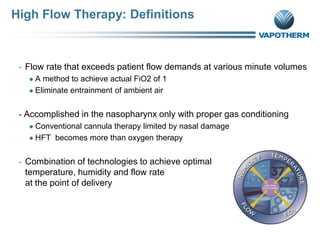
High Flow Therapy: Definitions
- Flow rate that exceeds patient flow demands at various minute volumes
● A method to achieve actual FiO2 of 1
● Eliminate entrainment of ambient air
- Accomplished in the nasopharynx only with proper gas conditioning
● Conventional cannula therapy limited by nasal damage
● HFT becomes more than oxygen therapy
- Combination of technologies to achieve optimal
temperature, humidity and flow rate
at the point of delivery
Flow First™
1-8Lpm
4
HFT Clinical Review
5
5
Continuum of Care: Old Model
5
General 02
Therapy
Acuity
Choice of Therapy
General 02
Therapy
Bi-Level
Mechanical
Ventilation
CPAP
Rescue Weaning
Bi-Level
CPAP
Continuum of Care: New Model
General 02
Therapy
Acuity
Choice of Therapy
General 02
Therapy
Bi-Level
Mechanical
Ventilation
CPAP
High Flow
Therapy
Rescue Weaning
Bi-Level
CPAP
Control the Factors that Matter…
Combination of
proprietary technology to
achieve optimal:
 Flow
 Fi02
 Temperature
 Humidity
at the point of delivery.
8
8
High Flow Therapy: Mechanisms of Action
Humidify / Warm Airways
Supports Inspiration
Flush Dead Space
● CO2 Elimination
● Oxygen Efficiency
● Cannula Flow > inspiratory
● Work of Breathing
● Mobilization of Secretions
● Nasal comfort
Humidify / Warm Airways
●Nasopharynx is highly
efficient at conditioning
inspiratory gas
●Anatomical Structure
●Mucosal Architecture
Inspiratory Gas Conditioning
Humidify / Warm Airways
Conditioning Prevents Injury
Inadequate warming and humidification can cause:
●Thickened Secretions
● Decreased mucocilliary action
●Thermal challenge
● Bloody secretions
● Lung atelectasis
Humidify / Warm Airways
Inspiratory Gas Conditioning
●Williams et al, 1996, Crit Care Med 24(11):
1920-9
Why BTPS?
Flush Dead Space & Support Inspiration
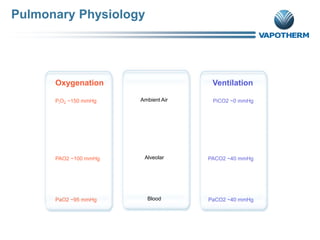
Pulmonary Physiology
Ventilation
Oxygenation
PiO2 ~150 mmHg
PAO2 ~100 mmHg
PaO2 ~95 mmHg
PiCO2 ~0 mmHg
PACO2 ~40 mmHg
PaCO2 ~40 mmHg
Ambient Air
Alveolar
Blood
Pulmonary Physiology and Dead Space
Pulmonary Pathophysiology
3
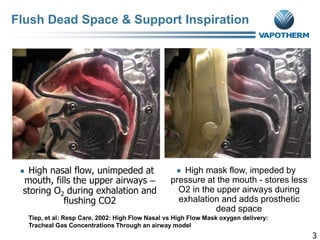
● High nasal flow, unimpeded at
mouth, fills the upper airways –
storing O2 during exhalation and
flushing CO2
Flush Dead Space & Support Inspiration
● High mask flow, impeded by
pressure at the mouth - stores less
O2 in the upper airways during
exhalation and adds prosthetic
dead space
Tiep, et al: Resp Care, 2002: High Flow Nasal vs High Flow Mask oxygen delivery:
Tracheal Gas Concentrations Through an airway model
Dead space washout
● Supports CO2 ventilation
● Enhances oxygenation
Matched inspiratory flow
● Attenuates nasopharyngeal resistance
Adequate gas conditioning
● Improves conductance and compliance
● Reduces energy cost of gas conditioning
Mechanism of Action for HFT
What About Pressure?
● Pressure determined by primarily by leak (Kahn at al, Pediatr Res 2007)
- Infant anatomical size – passage through nasopharynx
- Size ratio between nares and prongs – back flush
● Inadvertent CPAP with conventional nasal cannula (Locke et al,
Pediatrics 1993)
- Smaller (2 cm OD) prongs negate pressure
- Occluded only 50% of the nares
- Larger (3 cm OD) prongs generate pressure
● Intentional CPAP with conventional nasal cannula
(Sreenan et al, Pediatrics 2001)
- Snug prongs
- Mouth held closed
- Up to 8 cmH2O with 3 lpm
22
Mechanisms by Application
Neonataes
/Infants
Oxygen Flush Humidity Mild
Pressure
IRDS
RSV
Brochiolitis
(also seen in
Peds)
HFT DOES NOT TREAT A DISEASE, THE MECHANISMS TREAT SYMPTOMS
Here are a few general disease states and how the mechanisms of
action treat the symptoms.
Can you think of other respiratory insufficiencies where the
symptoms can be treated by HFT?
What Else About Pressure?
Platform A Platform B
Premature 1.5 2.4
Neonatal 1.5 2.4
Infant 1.9 2.7
Intermediate
Infant
1.9 2.7
Pediatric 2.7 3.7
Calculating Minimal Flow
Extrapolated from equations in Mosby’s Respiratory Care Equipment, 7th Ed.
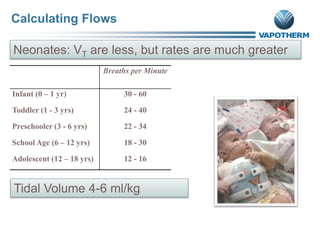
Calculating Flows
Tidal Volume 4-6 ml/kg
Neonates: VT are less, but rates are much greater
Breaths per Minute
Infant (0 – 1 yr) 30 - 60
Toddler (1 - 3 yrs) 24 - 40
Preschooler (3 - 6 yrs) 22 - 34
School Age (6 – 12 yrs) 18 - 30
Adolescent (12 – 18 yrs) 12 - 16
Flow Requirements: Infants
Inhalation:
RR = 60 - 70+
Tidal Volume = 4-6 ml/kg
Inspiratory time fraction = 0.3 – 0.5 (<0.3 sec)
< 2 LPM (in most cases)
26
Exhalation:
Expiratory time = < 0.6 sec
Extrathoracic dead space = 2.6 ml/kg
Inhalation flow is NOT sufficient
Indications for Use:
Indications:
●Spontaneously breathing patients who are requiring supplemental
oxygen therapy
●Any patient who is on an oxygen mask that is: 1. Not compliant, 2. not
improving, 3. Or has an increase in work of breathing
●Post- extubation support or weaning from NPPV
●Patients requiring supplemental heat & humidity for artificial airways
Contraindications:
●Patients not spontaneously breathing
●Patients that have a deviated septum
●Patients with severe facial trauma or disfigurement
● Dysart et al. - Respir Med 2009;103:1400-5
- The combination of flow dynamics and gas conditioning offer a number of mechanisms
that impart impressive clinical outcomes
● Woodhead et al. - J Perinatol 2006;26:481-5
- Showed that the nasal mucosa is preserved because of the Vapotherm conditioning and
this allowed these authors to avert intubation.
● Holleman-Duray et al. - J Perinatol 2007;27:776-81
- At Loyola showed they were able to extubate from greater vent setting by using
Vapotherm. There is some mild pressure, and a growing number of studies have
confirmed this.
● Saslow et al. - J Perinatol 2006;26:476-80
- were they showed the distending pressure to be not more than with a CPAP of
6. But, you can’t compare HFT directly to CPAP because there are other
mechanisms at play such as the elimination of dead space.
● Lampland et al. - J Pediatr 2009;154:177-82
- Compared to a CPAP of 6cmH20 the babies were doing just as well with high
HFT setting that generated just about half of the airway pressure.
More Clinical References
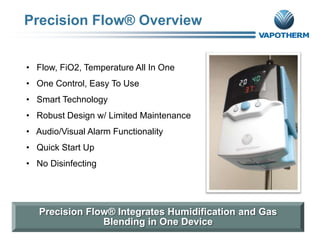
Precision Flow® Overview
Precision Flow® Integrates Humidification and Gas
Blending in One Device
• Flow, FiO2, Temperature All In One
• One Control, Easy To Use
• Smart Technology
• Robust Design w/ Limited Maintenance
• Audio/Visual Alarm Functionality
• Quick Start Up
• No Disinfecting
Main Unit - Front Panel
Run, Standby
Button
Alarm Mute and
Display Dim
Temperature
Display
Setting Control Knob
Flow Display Oxygen
Display
Safety Features
System Fault Alarm
Water Out Alarm
Blocked Tube Alarm
Gas Supply Fault
Battery Low, Charging
Cartridge Fault
Disposable Water Path
Fault or Absent
High and Low
Cartridge Indicators
Disposable Patient Circuit (DPC)
The Precision Flow™ Disposable
Patient Circuit (DPC) Consists of
Three Components:
1. Disposable Water Path (DWP)
2. Vapor Transfer Cartridge (VTC)
3. Patient Delivery Tube
30 Day on Single Patient
 Available Low or High Flow Kits
Impeller
Heater
Plate
Sensors
Filter Membrane
Delivery
Tube
Cartridge
Water
Spike
Precision Flow Overview: It All Comes Down To This
Vapor Transfer Cartridge:
● Key to efficient, high performance
humidification and gas conditioning
● Also serves as filter--pore size
much smaller than 0.05 microns
Patient Delivery Tube:
● Patented triple lumen design
● Design prevents rain-out
● Keeps gas conditioned out to
patient
● Safer than traditional heater wire
design
Indications for Use: 1-8 Lpm
Indications:
● Spontaneously breathing patients who are requiring supplemental
oxygen therapy
● Any patient who is on oxygen that is: 1. Not compliant,
2. not improving, 3. Or has an increase in work of breathing
● Post extubation support or weaning from NCPAP
● Patients requiring supplemental heat & humidity for artificial airways
Contraindications:
● Patients not spontaneously breathing
● Patients that have a deviated septum
Q & A

1.ppt

  • 1.
    High Flow Therapy(HFT) in the Neonatal Population
  • 2.
    Agenda • HFT ClinicalReview • Precision Flow® Overview • Precision Flow® Demonstration • Q & A
  • 3.
    High Flow Therapy:Definitions - Flow rate that exceeds patient flow demands at various minute volumes ● A method to achieve actual FiO2 of 1 ● Eliminate entrainment of ambient air - Accomplished in the nasopharynx only with proper gas conditioning ● Conventional cannula therapy limited by nasal damage ● HFT becomes more than oxygen therapy - Combination of technologies to achieve optimal temperature, humidity and flow rate at the point of delivery
  • 4.
  • 5.
    5 5 Continuum of Care:Old Model 5 General 02 Therapy Acuity Choice of Therapy General 02 Therapy Bi-Level Mechanical Ventilation CPAP Rescue Weaning Bi-Level CPAP
  • 6.
    Continuum of Care:New Model General 02 Therapy Acuity Choice of Therapy General 02 Therapy Bi-Level Mechanical Ventilation CPAP High Flow Therapy Rescue Weaning Bi-Level CPAP
  • 7.
    Control the Factorsthat Matter… Combination of proprietary technology to achieve optimal:  Flow  Fi02  Temperature  Humidity at the point of delivery.
  • 8.
    8 8 High Flow Therapy:Mechanisms of Action Humidify / Warm Airways Supports Inspiration Flush Dead Space ● CO2 Elimination ● Oxygen Efficiency ● Cannula Flow > inspiratory ● Work of Breathing ● Mobilization of Secretions ● Nasal comfort
  • 9.
    Humidify / WarmAirways ●Nasopharynx is highly efficient at conditioning inspiratory gas ●Anatomical Structure ●Mucosal Architecture Inspiratory Gas Conditioning
  • 10.
  • 11.
    Conditioning Prevents Injury Inadequatewarming and humidification can cause: ●Thickened Secretions ● Decreased mucocilliary action ●Thermal challenge ● Bloody secretions ● Lung atelectasis Humidify / Warm Airways
  • 12.
    Inspiratory Gas Conditioning ●Williamset al, 1996, Crit Care Med 24(11): 1920-9 Why BTPS?
  • 13.
    Flush Dead Space& Support Inspiration
  • 14.
    Pulmonary Physiology Ventilation Oxygenation PiO2 ~150mmHg PAO2 ~100 mmHg PaO2 ~95 mmHg PiCO2 ~0 mmHg PACO2 ~40 mmHg PaCO2 ~40 mmHg Ambient Air Alveolar Blood
  • 15.
  • 16.
  • 17.
  • 18.
  • 19.
    3 ● High nasalflow, unimpeded at mouth, fills the upper airways – storing O2 during exhalation and flushing CO2 Flush Dead Space & Support Inspiration ● High mask flow, impeded by pressure at the mouth - stores less O2 in the upper airways during exhalation and adds prosthetic dead space Tiep, et al: Resp Care, 2002: High Flow Nasal vs High Flow Mask oxygen delivery: Tracheal Gas Concentrations Through an airway model
  • 20.
    Dead space washout ●Supports CO2 ventilation ● Enhances oxygenation Matched inspiratory flow ● Attenuates nasopharyngeal resistance Adequate gas conditioning ● Improves conductance and compliance ● Reduces energy cost of gas conditioning Mechanism of Action for HFT
  • 21.
    What About Pressure? ●Pressure determined by primarily by leak (Kahn at al, Pediatr Res 2007) - Infant anatomical size – passage through nasopharynx - Size ratio between nares and prongs – back flush ● Inadvertent CPAP with conventional nasal cannula (Locke et al, Pediatrics 1993) - Smaller (2 cm OD) prongs negate pressure - Occluded only 50% of the nares - Larger (3 cm OD) prongs generate pressure ● Intentional CPAP with conventional nasal cannula (Sreenan et al, Pediatrics 2001) - Snug prongs - Mouth held closed - Up to 8 cmH2O with 3 lpm
  • 22.
    22 Mechanisms by Application Neonataes /Infants OxygenFlush Humidity Mild Pressure IRDS RSV Brochiolitis (also seen in Peds) HFT DOES NOT TREAT A DISEASE, THE MECHANISMS TREAT SYMPTOMS Here are a few general disease states and how the mechanisms of action treat the symptoms. Can you think of other respiratory insufficiencies where the symptoms can be treated by HFT?
  • 23.
    What Else AboutPressure? Platform A Platform B Premature 1.5 2.4 Neonatal 1.5 2.4 Infant 1.9 2.7 Intermediate Infant 1.9 2.7 Pediatric 2.7 3.7
  • 24.
    Calculating Minimal Flow Extrapolatedfrom equations in Mosby’s Respiratory Care Equipment, 7th Ed.
  • 25.
    Calculating Flows Tidal Volume4-6 ml/kg Neonates: VT are less, but rates are much greater Breaths per Minute Infant (0 – 1 yr) 30 - 60 Toddler (1 - 3 yrs) 24 - 40 Preschooler (3 - 6 yrs) 22 - 34 School Age (6 – 12 yrs) 18 - 30 Adolescent (12 – 18 yrs) 12 - 16
  • 26.
    Flow Requirements: Infants Inhalation: RR= 60 - 70+ Tidal Volume = 4-6 ml/kg Inspiratory time fraction = 0.3 – 0.5 (<0.3 sec) < 2 LPM (in most cases) 26 Exhalation: Expiratory time = < 0.6 sec Extrathoracic dead space = 2.6 ml/kg Inhalation flow is NOT sufficient
  • 27.
    Indications for Use: Indications: ●Spontaneouslybreathing patients who are requiring supplemental oxygen therapy ●Any patient who is on an oxygen mask that is: 1. Not compliant, 2. not improving, 3. Or has an increase in work of breathing ●Post- extubation support or weaning from NPPV ●Patients requiring supplemental heat & humidity for artificial airways Contraindications: ●Patients not spontaneously breathing ●Patients that have a deviated septum ●Patients with severe facial trauma or disfigurement
  • 28.
    ● Dysart etal. - Respir Med 2009;103:1400-5 - The combination of flow dynamics and gas conditioning offer a number of mechanisms that impart impressive clinical outcomes ● Woodhead et al. - J Perinatol 2006;26:481-5 - Showed that the nasal mucosa is preserved because of the Vapotherm conditioning and this allowed these authors to avert intubation. ● Holleman-Duray et al. - J Perinatol 2007;27:776-81 - At Loyola showed they were able to extubate from greater vent setting by using Vapotherm. There is some mild pressure, and a growing number of studies have confirmed this. ● Saslow et al. - J Perinatol 2006;26:476-80 - were they showed the distending pressure to be not more than with a CPAP of 6. But, you can’t compare HFT directly to CPAP because there are other mechanisms at play such as the elimination of dead space. ● Lampland et al. - J Pediatr 2009;154:177-82 - Compared to a CPAP of 6cmH20 the babies were doing just as well with high HFT setting that generated just about half of the airway pressure. More Clinical References
  • 29.
    Precision Flow® Overview PrecisionFlow® Integrates Humidification and Gas Blending in One Device • Flow, FiO2, Temperature All In One • One Control, Easy To Use • Smart Technology • Robust Design w/ Limited Maintenance • Audio/Visual Alarm Functionality • Quick Start Up • No Disinfecting
  • 30.
    Main Unit -Front Panel Run, Standby Button Alarm Mute and Display Dim Temperature Display Setting Control Knob Flow Display Oxygen Display
  • 31.
    Safety Features System FaultAlarm Water Out Alarm Blocked Tube Alarm Gas Supply Fault Battery Low, Charging Cartridge Fault Disposable Water Path Fault or Absent High and Low Cartridge Indicators
  • 32.
    Disposable Patient Circuit(DPC) The Precision Flow™ Disposable Patient Circuit (DPC) Consists of Three Components: 1. Disposable Water Path (DWP) 2. Vapor Transfer Cartridge (VTC) 3. Patient Delivery Tube 30 Day on Single Patient  Available Low or High Flow Kits Impeller Heater Plate Sensors Filter Membrane Delivery Tube Cartridge Water Spike
  • 33.
    Precision Flow Overview:It All Comes Down To This Vapor Transfer Cartridge: ● Key to efficient, high performance humidification and gas conditioning ● Also serves as filter--pore size much smaller than 0.05 microns Patient Delivery Tube: ● Patented triple lumen design ● Design prevents rain-out ● Keeps gas conditioned out to patient ● Safer than traditional heater wire design
  • 34.
    Indications for Use:1-8 Lpm Indications: ● Spontaneously breathing patients who are requiring supplemental oxygen therapy ● Any patient who is on oxygen that is: 1. Not compliant, 2. not improving, 3. Or has an increase in work of breathing ● Post extubation support or weaning from NCPAP ● Patients requiring supplemental heat & humidity for artificial airways Contraindications: ● Patients not spontaneously breathing ● Patients that have a deviated septum
  • 35.