High Flow Nasal Cannula
(HFNC)
in Bronchiolitis:
Managing Care Outside
the ICU
Wednesday, November 2, 2022
11 a.m.
Faculty
• Estevan Garcia, MD, DPH, MPA, FAAP, Chief Medical
Officer, Massachusetts Department of Public Health
• Alla Smith, MD, Attending Physician, Division of Medical
Critical Care, Boston Children's Hospital
Key Objectives
The webinar is tailored to clinicians who are managing patients with bronchiolitis
on HFNC outside the ICU – in both community hospitals and sites where there may
be a pediatric ICU that is currently at capacity.
Participants should expect to achieve the following learning objectives through
this webinar:
• Summarize the physiologic mechanism for HFNC in bronchiolitis;
• Identify patients with bronchiolitis who may benefit from HFNC;
• Discuss a weight-based approach for initiation, escalation, and weaning of
HFNC; and
• Assess how a pathway for management of HFNC in bronchiolitis might be
implemented in your health system
HFNC in Bronchiolitis:
Managing Care Outside the ICU
Alla Smith, 11/2/2022
High Flow Nasal Cannula Pathway
HFNC in Bronchiolitis Pathway guides management of
patients with bronchiolitis on HFNC using optimal flows
and incorporates aggressive weaning.
Goal:
 Bring this pathway back to your facility- adapt it to that
environment
 Improve staff comfort with this patient population
 Shorten duration of critical illness/time on HFNC
HFNC: What is it?
 Heated, humidified air with titratable FiO2 (0.21 to 1),
typically delivered at flows >4L/minute
HFNC: How does it help?
 Allows for effective dead space wash-out1
 Humidifies airways, which assists with secretion clearance1
 Provides (small) PEEP in patients with bronchiolitis1
 Improves tachypnea and dyspnea in patients with bronchiolitis2
1. Milési, C., Baleine, J., Matecki, S., Durand, S., Combes, C., Novais, A. R. B., & Combonie, G. (2013). Is treatment with a high flow
nasal cannula effective in acute viral bronchiolitis? A physiologic study. Intensive Care Medicine, 39(6), 1088–1094.
2. Rubin, S., Ghuman, A., Deakers, T., Khemani, R., Ross, P., & Newth, C. J. (2014). Effort of Breathing in Children Receiving High-
Flow Nasal Cannula. Pediatric Critical Care Medicine, 15(1), 1–6.
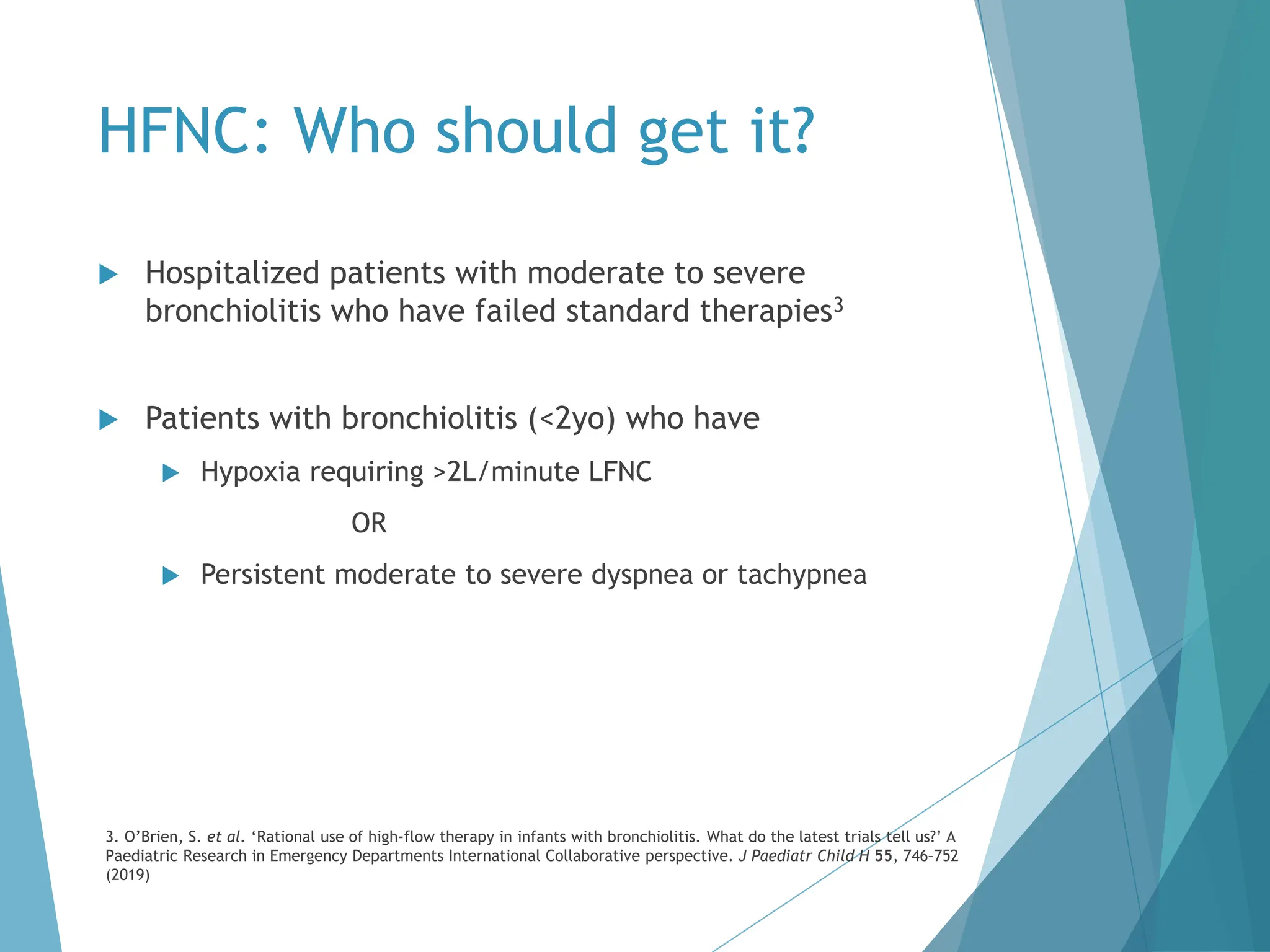
HFNC: Who should get it?
 Hospitalized patients with moderate to severe
bronchiolitis who have failed standard therapies3
 Patients with bronchiolitis (<2yo) who have
 Hypoxia requiring >2L/minute LFNC
OR
 Persistent moderate to severe dyspnea or tachypnea
3. O’Brien, S. et al. ‘Rational use of high‐flow therapy in infants with bronchiolitis. What do the latest trials tell us?’ A
Paediatric Research in Emergency Departments International Collaborative perspective. J Paediatr Child H 55, 746–752
(2019)
HFNC: What flows are best?
 Most pediatric inpatient units in US use fixed liter limit
flows that are low (<8LPM)4
 Weight-Based Flows
 2L/kg/minute are optimal5
4. Kalburgi, S. & Halley, T. High-Flow Nasal Cannula Use Outside of the ICU Setting. Pediatrics 146, e20194083 (2020)
5. Milési C, Pierre AF, Deho A, et al. A multicenter randomized controlled trial of a 3-L/kg/min versus 2-L/kg/min high-flow
nasal cannula flow rate in young infants with severe viral bronchiolitis (TRAMONTANE 2). Intens Care Med.
2018;44(11):1870-1878
HFNC: Weaning is Important
 Higher flows are associated with longer LOS5
 Aggressive weaning protocols can shorten LOS6
 Regularly turn down flows and assess how patients respond
5. Milési C, Pierre AF, Deho A, et al. A multicenter randomized controlled trial of a 3-L/kg/min versus 2-L/kg/min high-flow nasal
cannula flow rate in young infants with severe viral bronchiolitis (TRAMONTANE 2). Intens Care Med. 2018;44(11):1870-1878.
doi:10.1007/s00134-018-5343-1
6. Sokuri P, Heikkilä P, Korppi M. National high‐flow nasal cannula and bronchiolitis survey highlights need for further research and
evidence‐based guidelines. Acta Paediatr. 2017;106(12):1998-2003. doi:10.1111/apa.13964
HFNC: What to do when it fails
 Some studies suggest reduction in ICU need- but a
proportion of children on HFNC (15-50%) will require ICU
transfer7-11
 Building in institution-specific transfer criteria is key to
pathway success
 NIV with CPAP or BIPAP is a reasonable next step for most
patients
7. Franklin, D., Babl, F. E., Schlapbach, L. J., Oakley, E., Craig, S., Neutze, J., et al. (2018). A Randomized Trial of High-
Flow Oxygen Therapy in Infants with Bronchiolitis. The New England Journal of Medicine, 378(12), 1121–1131
8. Willer, R. J. et al. Implementation of a Weight-Based High-Flow Nasal Cannula Protocol for Children With
Bronchiolitis. Hosp Pediatrics 11, 891–895 (2021)
9. Kepreotes, E., Whitehead, B., Attia, J., Oldmeadow, C., Collison, A., Searles, A., et al. (2017). High-flow warm
humidified oxygen versus standard low-flow nasal cannula oxygen for moderate bronchiolitis (HFWHO RCT): an open, phase
4, randomised controlled trial. The Lancet, 389(10072), 930–939
10. Mayfield, S., Bogossian, F., O'Malley, L., & Schibler, A. (2014). High-flow nasal cannula oxygen therapy for infants with
bronchiolitis: Pilot study. Journal of Paediatrics and Child Health, 50(5), 373–378
11. Clayton, J. A., McKee, B., Slain, K. N., Rotta, A. T., & Shein, S. L. (2019). Outcomes of Children With Bronchiolitis
Treated With High-Flow Nasal Cannula or Noninvasive Positive Pressure Ventilation. Pediatric Critical Care Medicine, 20(2),
128–135.
HFNC Pathway at a Community Hospital
40.1
77.4
24.0
50.6
0
10
20
30
40
50
60
70
80
90
HFNC (hours)
p <0.001
LOS (hours)
p <0.001
Hours
Average Hours on HFNC and LOS by Arm Group
Standard HFNC Arm
Weight-Based HFNC Arm
HFNC Pathway at BCH
Compared with Standard Practice at BCH:
 Reduction in Time on HFNC
 Reduction in Hospital and Critical Care LOS
 Decrease in the percentage of patients who require
escalation to NIV or IMV*
*preliminary data
HFNC: What are the risks?
 Minimal.
 Risk of air leak is very low, even when using higher flows
 Recent large (~1500) patient RCT did not demonstrate any air
leak7
7. Franklin, D., Babl, F. E., Schlapbach, L. J., Oakley, E., Craig, S., Neutze, J., et al. (2018). A Randomized Trial of
High-Flow Oxygen Therapy in Infants with Bronchiolitis. The New England Journal of Medicine, 378(12), 1121–1131
HFNC Pathway: RN/RT Staffing
 HFNC does not obviate or reduce the need for RN and
RT support
 Patients generally staffed at 1:2 to 1:3 for nursing
 RT supports vary- but they are often involved in
assessments/flow changes
PIMCU Network
 Interested in high-acuity care outside the ICU?
 Join the PIMCU Network! Email me or the network
administrator* for an invitation to the group’s website.
Post questions/share pathways etc. Over 150 members
nationally
 Join the new AAP Sub-committee on Pediatric
Intermediate Care (under SOHM and SOCC)
* alla.smith@childrens.harvard.edu or peter.hopkins@childrens.Harvard.edu
Acknowledgements
 Network Team
 Debra Banville
 Mark Waltzman
 Karen Gruskin
 Jesslyn Lenox
And many others!
 BCH Team
 Michael Agus
 Christiana Russ
 Elyse Jones
 Daria Donelly
High Flow Nasal Cannula- trends
 Fujiogi, M. et al. Trends in Bronchiolitis Hospitalizations in the United States:
2000–2016. Pediatrics 144, e20192614 (2019).
HFNC Study: Weight Based Protocol
Initiate HFNC @ Initial 1 lpm/kg and 21% Oxygen
MAINTAIN:
Initiate 4 hours of observation
Escalation to
Moderate or Severe
Bronchiolitis @ any
time?
Wean FiO2:
Wean FiO2 to 21% over 2 hours.
(If already on 21% go directly to
wean flow.)
Wean Flow:
Cut flow in half
Monitor x2 hours.
Remove
ESCALATE:
Increase to max flow rate.
Maintain SpO2 >90%
At 4 hours,
3 of the 4 Transfer
Criteria* are met?
21%
With SpO2
>90%
YES NO
NO
YES
NO
YES
Patient
breathing
comfortably with
SpO2
>90%
Yes
NO
Return to previous
FiO2 to maintain
SpO2 >90%.
Monitor x2 hours
Return to
previous flow
Monitor x2 hours
NO
Updated: 4/27 v12
Does the patient have a BASS
score of mild bronchiolitis after
2 hours?*
CONSIDER
TRANSFER
YES
Already on max
settings?
NO
TRANSFER CRITERIA:
HR: unchanged or
increased, compared with
HR at HFNC initiation.
RR: unchanged or
increased, compared with
RR at HFNC initiation.
WOB: unchanged or
increased, compared with
WOB at HFNC initiation.
Oxygen requirement >40%
to maintain SpO2 >90%
* Consider earlier transfer in the
setting of sustained clinical
worsening on maximum flow.
Consider wean
after 4 hours.
YES
* consider escalating sooner if patient is decompensating
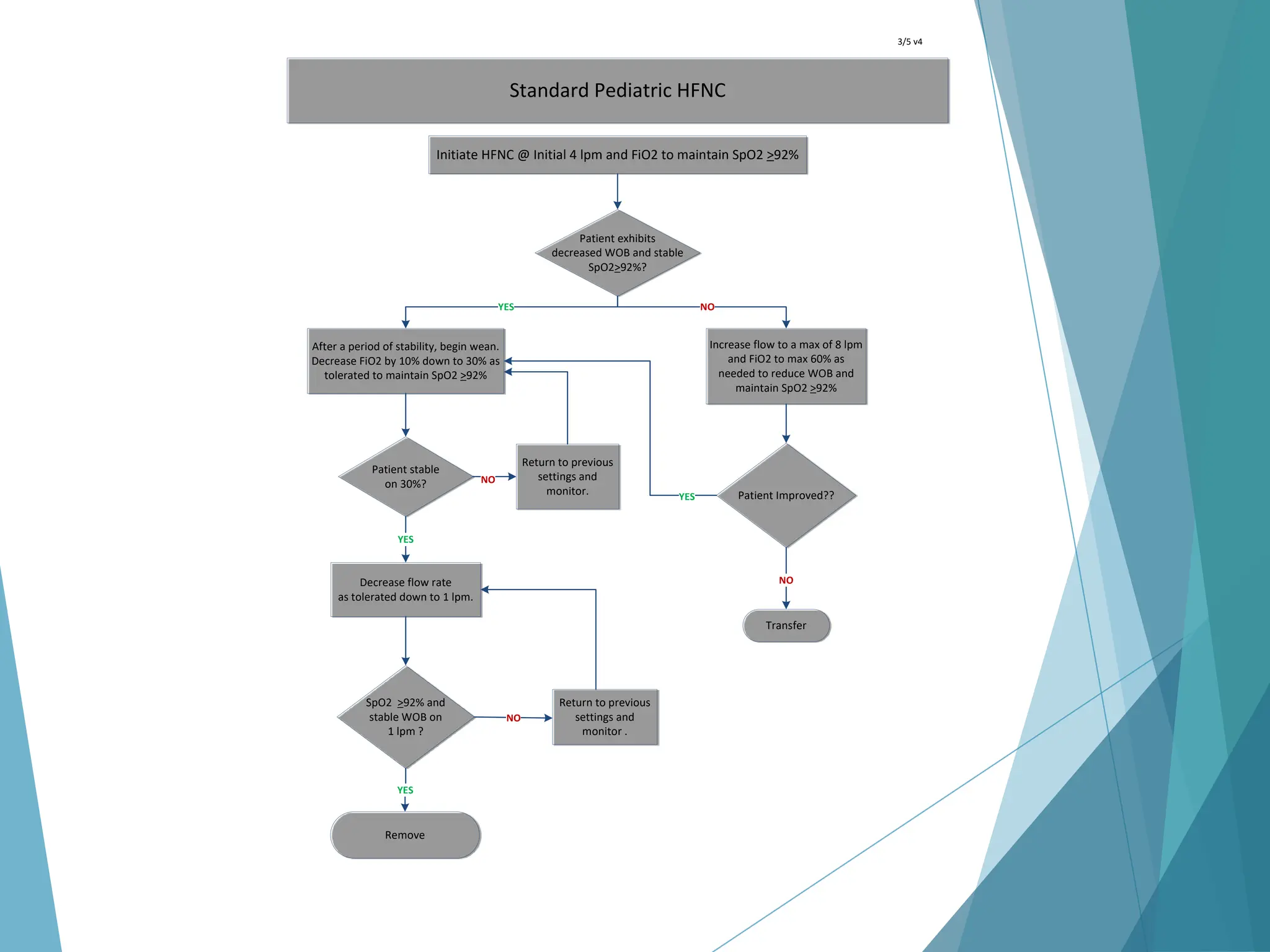
Standard Pediatric HFNC
Initiate HFNC @ Initial 4 lpm and FiO2 to maintain SpO2 >92%
Patient exhibits
decreased WOB and stable
SpO2>92%?
After a period of stability, begin wean.
Decrease FiO2 by 10% down to 30% as
tolerated to maintain SpO2 >92%
Patient stable
on 30%?
Decrease flow rate
as tolerated down to 1 lpm.
Remove
Increase flow to a max of 8 lpm
and FiO2 to max 60% as
needed to reduce WOB and
maintain SpO2 >92%
SpO2 >92% and
stable WOB on
1 lpm ?
YES NO
NO
YES
YES
NO
Patient Improved??
Transfer
YES
Return to previous
settings and
monitor .
NO
Return to previous
settings and
monitor.
3/5 v4
Follow Up & Next Steps
• Patricia Noga, PhD, RN, MBA, NEA-BC, FAAN, Vice
President, Clinical Affairs, MHA
– pnoga@mhalink.org
• Adam Delmolino, Director, Virtual Care & Clinical Affairs,
MHA
– adelmolino@mhalink.org
• Steve Defossez, MD, EMHL, CPE, Vice President, Clinical
Integration, MHA
– sdefossez@mhalink.org

High-Flow-Nasal-Cannula-PPT-11.2.2022.pdf

  • 1.
    High Flow NasalCannula (HFNC) in Bronchiolitis: Managing Care Outside the ICU Wednesday, November 2, 2022 11 a.m.
  • 2.
    Faculty • Estevan Garcia,MD, DPH, MPA, FAAP, Chief Medical Officer, Massachusetts Department of Public Health • Alla Smith, MD, Attending Physician, Division of Medical Critical Care, Boston Children's Hospital
  • 3.
    Key Objectives The webinaris tailored to clinicians who are managing patients with bronchiolitis on HFNC outside the ICU – in both community hospitals and sites where there may be a pediatric ICU that is currently at capacity. Participants should expect to achieve the following learning objectives through this webinar: • Summarize the physiologic mechanism for HFNC in bronchiolitis; • Identify patients with bronchiolitis who may benefit from HFNC; • Discuss a weight-based approach for initiation, escalation, and weaning of HFNC; and • Assess how a pathway for management of HFNC in bronchiolitis might be implemented in your health system
  • 4.
    HFNC in Bronchiolitis: ManagingCare Outside the ICU Alla Smith, 11/2/2022
  • 5.
    High Flow NasalCannula Pathway HFNC in Bronchiolitis Pathway guides management of patients with bronchiolitis on HFNC using optimal flows and incorporates aggressive weaning. Goal:  Bring this pathway back to your facility- adapt it to that environment  Improve staff comfort with this patient population  Shorten duration of critical illness/time on HFNC
  • 6.
    HFNC: What isit?  Heated, humidified air with titratable FiO2 (0.21 to 1), typically delivered at flows >4L/minute
  • 7.
    HFNC: How doesit help?  Allows for effective dead space wash-out1  Humidifies airways, which assists with secretion clearance1  Provides (small) PEEP in patients with bronchiolitis1  Improves tachypnea and dyspnea in patients with bronchiolitis2 1. Milési, C., Baleine, J., Matecki, S., Durand, S., Combes, C., Novais, A. R. B., & Combonie, G. (2013). Is treatment with a high flow nasal cannula effective in acute viral bronchiolitis? A physiologic study. Intensive Care Medicine, 39(6), 1088–1094. 2. Rubin, S., Ghuman, A., Deakers, T., Khemani, R., Ross, P., & Newth, C. J. (2014). Effort of Breathing in Children Receiving High- Flow Nasal Cannula. Pediatric Critical Care Medicine, 15(1), 1–6.
  • 8.
    HFNC: Who shouldget it?  Hospitalized patients with moderate to severe bronchiolitis who have failed standard therapies3  Patients with bronchiolitis (<2yo) who have  Hypoxia requiring >2L/minute LFNC OR  Persistent moderate to severe dyspnea or tachypnea 3. O’Brien, S. et al. ‘Rational use of high‐flow therapy in infants with bronchiolitis. What do the latest trials tell us?’ A Paediatric Research in Emergency Departments International Collaborative perspective. J Paediatr Child H 55, 746–752 (2019)
  • 9.
    HFNC: What flowsare best?  Most pediatric inpatient units in US use fixed liter limit flows that are low (<8LPM)4  Weight-Based Flows  2L/kg/minute are optimal5 4. Kalburgi, S. & Halley, T. High-Flow Nasal Cannula Use Outside of the ICU Setting. Pediatrics 146, e20194083 (2020) 5. Milési C, Pierre AF, Deho A, et al. A multicenter randomized controlled trial of a 3-L/kg/min versus 2-L/kg/min high-flow nasal cannula flow rate in young infants with severe viral bronchiolitis (TRAMONTANE 2). Intens Care Med. 2018;44(11):1870-1878
  • 10.
    HFNC: Weaning isImportant  Higher flows are associated with longer LOS5  Aggressive weaning protocols can shorten LOS6  Regularly turn down flows and assess how patients respond 5. Milési C, Pierre AF, Deho A, et al. A multicenter randomized controlled trial of a 3-L/kg/min versus 2-L/kg/min high-flow nasal cannula flow rate in young infants with severe viral bronchiolitis (TRAMONTANE 2). Intens Care Med. 2018;44(11):1870-1878. doi:10.1007/s00134-018-5343-1 6. Sokuri P, Heikkilä P, Korppi M. National high‐flow nasal cannula and bronchiolitis survey highlights need for further research and evidence‐based guidelines. Acta Paediatr. 2017;106(12):1998-2003. doi:10.1111/apa.13964
  • 11.
    HFNC: What todo when it fails  Some studies suggest reduction in ICU need- but a proportion of children on HFNC (15-50%) will require ICU transfer7-11  Building in institution-specific transfer criteria is key to pathway success  NIV with CPAP or BIPAP is a reasonable next step for most patients 7. Franklin, D., Babl, F. E., Schlapbach, L. J., Oakley, E., Craig, S., Neutze, J., et al. (2018). A Randomized Trial of High- Flow Oxygen Therapy in Infants with Bronchiolitis. The New England Journal of Medicine, 378(12), 1121–1131 8. Willer, R. J. et al. Implementation of a Weight-Based High-Flow Nasal Cannula Protocol for Children With Bronchiolitis. Hosp Pediatrics 11, 891–895 (2021) 9. Kepreotes, E., Whitehead, B., Attia, J., Oldmeadow, C., Collison, A., Searles, A., et al. (2017). High-flow warm humidified oxygen versus standard low-flow nasal cannula oxygen for moderate bronchiolitis (HFWHO RCT): an open, phase 4, randomised controlled trial. The Lancet, 389(10072), 930–939 10. Mayfield, S., Bogossian, F., O'Malley, L., & Schibler, A. (2014). High-flow nasal cannula oxygen therapy for infants with bronchiolitis: Pilot study. Journal of Paediatrics and Child Health, 50(5), 373–378 11. Clayton, J. A., McKee, B., Slain, K. N., Rotta, A. T., & Shein, S. L. (2019). Outcomes of Children With Bronchiolitis Treated With High-Flow Nasal Cannula or Noninvasive Positive Pressure Ventilation. Pediatric Critical Care Medicine, 20(2), 128–135.
  • 13.
    HFNC Pathway ata Community Hospital 40.1 77.4 24.0 50.6 0 10 20 30 40 50 60 70 80 90 HFNC (hours) p <0.001 LOS (hours) p <0.001 Hours Average Hours on HFNC and LOS by Arm Group Standard HFNC Arm Weight-Based HFNC Arm
  • 14.
    HFNC Pathway atBCH Compared with Standard Practice at BCH:  Reduction in Time on HFNC  Reduction in Hospital and Critical Care LOS  Decrease in the percentage of patients who require escalation to NIV or IMV* *preliminary data
  • 15.
    HFNC: What arethe risks?  Minimal.  Risk of air leak is very low, even when using higher flows  Recent large (~1500) patient RCT did not demonstrate any air leak7 7. Franklin, D., Babl, F. E., Schlapbach, L. J., Oakley, E., Craig, S., Neutze, J., et al. (2018). A Randomized Trial of High-Flow Oxygen Therapy in Infants with Bronchiolitis. The New England Journal of Medicine, 378(12), 1121–1131
  • 16.
    HFNC Pathway: RN/RTStaffing  HFNC does not obviate or reduce the need for RN and RT support  Patients generally staffed at 1:2 to 1:3 for nursing  RT supports vary- but they are often involved in assessments/flow changes
  • 17.
    PIMCU Network  Interestedin high-acuity care outside the ICU?  Join the PIMCU Network! Email me or the network administrator* for an invitation to the group’s website. Post questions/share pathways etc. Over 150 members nationally  Join the new AAP Sub-committee on Pediatric Intermediate Care (under SOHM and SOCC) * alla.smith@childrens.harvard.edu or peter.hopkins@childrens.Harvard.edu
  • 18.
    Acknowledgements  Network Team Debra Banville  Mark Waltzman  Karen Gruskin  Jesslyn Lenox And many others!  BCH Team  Michael Agus  Christiana Russ  Elyse Jones  Daria Donelly
  • 20.
    High Flow NasalCannula- trends  Fujiogi, M. et al. Trends in Bronchiolitis Hospitalizations in the United States: 2000–2016. Pediatrics 144, e20192614 (2019).
  • 21.
    HFNC Study: WeightBased Protocol Initiate HFNC @ Initial 1 lpm/kg and 21% Oxygen MAINTAIN: Initiate 4 hours of observation Escalation to Moderate or Severe Bronchiolitis @ any time? Wean FiO2: Wean FiO2 to 21% over 2 hours. (If already on 21% go directly to wean flow.) Wean Flow: Cut flow in half Monitor x2 hours. Remove ESCALATE: Increase to max flow rate. Maintain SpO2 >90% At 4 hours, 3 of the 4 Transfer Criteria* are met? 21% With SpO2 >90% YES NO NO YES NO YES Patient breathing comfortably with SpO2 >90% Yes NO Return to previous FiO2 to maintain SpO2 >90%. Monitor x2 hours Return to previous flow Monitor x2 hours NO Updated: 4/27 v12 Does the patient have a BASS score of mild bronchiolitis after 2 hours?* CONSIDER TRANSFER YES Already on max settings? NO TRANSFER CRITERIA: HR: unchanged or increased, compared with HR at HFNC initiation. RR: unchanged or increased, compared with RR at HFNC initiation. WOB: unchanged or increased, compared with WOB at HFNC initiation. Oxygen requirement >40% to maintain SpO2 >90% * Consider earlier transfer in the setting of sustained clinical worsening on maximum flow. Consider wean after 4 hours. YES * consider escalating sooner if patient is decompensating
  • 22.
    Standard Pediatric HFNC InitiateHFNC @ Initial 4 lpm and FiO2 to maintain SpO2 >92% Patient exhibits decreased WOB and stable SpO2>92%? After a period of stability, begin wean. Decrease FiO2 by 10% down to 30% as tolerated to maintain SpO2 >92% Patient stable on 30%? Decrease flow rate as tolerated down to 1 lpm. Remove Increase flow to a max of 8 lpm and FiO2 to max 60% as needed to reduce WOB and maintain SpO2 >92% SpO2 >92% and stable WOB on 1 lpm ? YES NO NO YES YES NO Patient Improved?? Transfer YES Return to previous settings and monitor . NO Return to previous settings and monitor. 3/5 v4
  • 23.
    Follow Up &Next Steps • Patricia Noga, PhD, RN, MBA, NEA-BC, FAAN, Vice President, Clinical Affairs, MHA – pnoga@mhalink.org • Adam Delmolino, Director, Virtual Care & Clinical Affairs, MHA – adelmolino@mhalink.org • Steve Defossez, MD, EMHL, CPE, Vice President, Clinical Integration, MHA – sdefossez@mhalink.org