5/20/2010Dr.NILESH1VENTILATOR SETTINGS AND CPAPDr. NILESH PANCHAL
OVERVIEW OF PRESENTATIONBASICS OF VENTILATORBASICS OF VENTILATOR SETTINGSCPAPBUBBLE CPAPAPPLICATION AND ADVANTAGES OF CPAPMONITORING OF CPAPCOMPLICATIONS OF CPAPIN-SUR-E5/20/2010Dr.NILESH2
PROBLEMS5/20/2010Dr.NILESH3The functional characteristics of respirators and the ventilation techniques are seldom taught to ICU personnel.
The medical literature is filled with unproven statements favoring one new mode of ventilation (usually more invasive) over another. PROBLEMSExperiments on normal healthy animals have been often used to extrapolate information for sick newborn infants.Regarding “the standard mechanical ventilation”, there is little uniformity in the selection of ventilator settings among institutions or even within the same hospital. 5/20/2010Dr.NILESH4
PROBLEMSMany infants who could have managed on their own are submitted to the ventilator risks.  Ventilator management can be worse than the disease.We need to learn who, when and why before learning how to use the ventilator.5/20/2010Dr.NILESH5
GALIRAL IN LATE 1800“AEROPHORE PULMONAIRE”    5/20/2010Dr.NILESH6Ö Galiral (late 1800’s) first mechanical device forartificial ventilation (‘aerophore pulmonaire’)
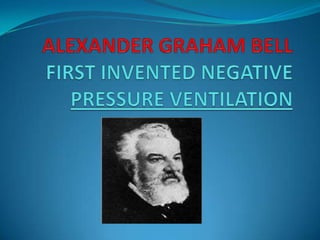
ALEXANDER GRAHAM BELL FIRST INVENTED NEGATIVE PRESSURE VENTILATION
Von Reuss (1914) FIRST described CPAP to resuscitate5/20/2010Dr.NILESH8
MECHANICAL VENTILATION STRATEGIESCPAP (1969) & NPCPAP (1975) Intermittent Mandatory Ventilation (IMV) (1970s)Patient-triggered ventilation (1980s-1990s)High frequency ventilation (1990s) Flow synchronized ventilation (2000) Hybrid (Pressure & volume targeted) (VAPS/PRVC) (2000)5/20/2010Dr.NILESH9
CONCEPTS OF “T”5/20/2010Dr.NILESH10
5/20/2010Dr.NILESH11
5/20/2010Dr.NILESH12
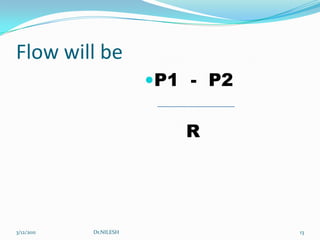
Flow will beP1  -  P2       R5/20/2010Dr.NILESH13
TYPES OF VENTILATORSConventional VentilatorsPressure-limited, time-cycledVolume-limited, time- cycledPatient-triggered ventilationHigh Frequency VentilatorsHigh frequency oscillatory ventilatorHigh frequency jet ventilators5/20/2010Dr.NILESH14
JUGGLARY OF 6 PLAYERSPIP           (peak inspiratory  pressure)  PEEP        (peak end expiratory pressure) FiO2         ( fraction of O2)R.R.         (respiratory  rate)Ti            (inspiratory time)Te           ( expiratory time)5/20/2010Dr.NILESH15
FLOW RATEThe minimal flow rate is 2.5 times infant’s minute ventilationWith high flow rate:Higher MAPHigher incidence of barotraumaWith low flow rate: Higher PCO2 form rebreathing exhaled gasMay not be high enough to reach PIP5/20/2010Dr.NILESH16
Fi O2The use of unnecessary high FiO2 increases the risk for pulmonary oxygen toxicity.The minimal adequate PaO2 is not known.  PaO2 of 50-70  mmHg is generally acceptable.Preductal oxygen saturation is a valuable and inexpensive measure to follow.5/20/2010Dr.NILESH17
Ti------TeTI, TE, I:E ratio, and rate(IMV) are all related		Example: 	TI =0.5 sec	I:E = 1:1 		means,	 	TE =0.5 sec 	IMV=60   Ideally, the choose of TI should be dependent on the time constant (Tc) of the respiratory system. 5/20/2010Dr.NILESH18
PIPDepends on Cl and RawIt should be adjusted until adequate but not excessive chest excursion is noted.If infant remains hypoxic in the face of good chest excursion, it is important to exclude CHD and PPHN.5/20/2010Dr.NILESH19
PIPIf PIP is too low: tidal volume will be low, leading to intra-pulmonary shunts and hypoxiaIf PIP is too high: the lung will be hyperinflated causing barotrauma PVR will be elevatedvenous return will be impeded5/20/2010Dr.NILESH20
PIPHypoxemia   PIP Observe chest excursion in every ventilated patientSudden deterioration of the patient with  decreased chest excursion denotes an airway or pneumothorax problems rather than compliance changes.5/20/2010Dr.NILESH21
PEEPExcessively high PEEP:will overdistend the alveoliwill decrease the compliancewill cause barotraumawill impede the venous return5/20/2010Dr.NILESH22
EFFECTS OF SETTINGS5/20/2010Dr.NILESH23
Continuous positive airway pressure   ( CPAP  )GREGORY   IN  1971 _ ENDOTRACHEAL  CPAP  IN PRE –TERM WITH RDSKATTIWINKEL _  NASAL  PRONGE  FOR  CPAP                      CPAP FORGOTTENMr. J. WUNG from columbia university  used nasal pronge cpap and shown  decreased incidence of BPD5/20/2010Dr.NILESH24
ROLE OF CPAPStart early nasal prong CPAP for any:tachypnea retractiongruntingoxygen requirementEarly use of CPAP changes the severity and duration of illness. 5/20/2010Dr.NILESH25
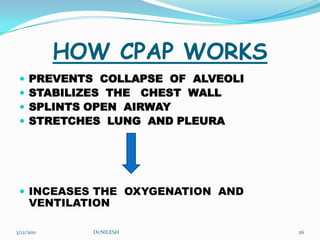
HOW CPAP WORKSPREVENTS  COLLAPSE  OF  ALVEOLISTABILIZES  THE   CHEST  WALLSPLINTS OPEN  AIRWAYSTRETCHES  LUNG  AND PLEURAINCEASES THE  OXYGENATION  AND  VENTILATION5/20/2010Dr.NILESH26
COMPONENTS  OF  CPAPGAS  SOURCEPRESSURE  GENERATORPATIENT INTERFACE  / DELIVERY SYSTEM5/20/2010Dr.NILESH27
CPAP  PRESSURE  GENERATORSCONTINUOUS FLOW DEVICES INFANT  VENTILATOR
BUBBLE CPAPVARIABLE FLOW DEVICES(assist in exhalation)INFANT FLOW  DRIVER
SiPAP5/20/2010Dr.NILESH28
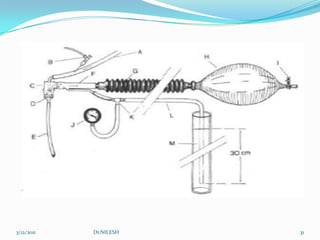
BUBBLE  CPAPFLOWMETERWATER5/20/2010Dr.NILESH29FLOW METER
5/20/2010Dr.NILESH30
5/20/2010Dr.NILESH31
ADVANTAGES OF BUBBLE CPAPSIMPLEEASY TO PRPARECOST EFFECTIVEEFFECTIVE IN PRETERM WITH  RDSDECREASED CHANCES OF BPDEASY TO IDENTIFY AIR LEAK FROM NASAL PRONGES5/20/2010Dr.NILESH32
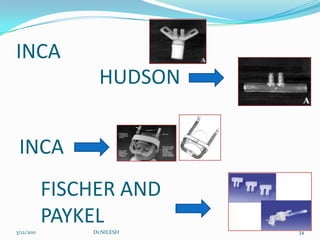
HOW TO INITIATE  NASAL  CPAPUSE CORRECT SIZE OF NASAL PRONGENASAL  PRONGE SHOULD NOT  TOUCH  NASAL SEPTUMFIX THE NASAL  PRONGE  BY  STRIP  OR  ADHESIVE  PLASTSNIFFING  POSITION  OF  THE  BABYFIX  NASAL  PRONGE  TO CIRCUIT  OF CPAP APPLY PULSE OXYMETER5/20/2010Dr.NILESH33
INCA5/20/2010Dr.NILESH34HUDSONINCAFISCHER AND PAYKEL
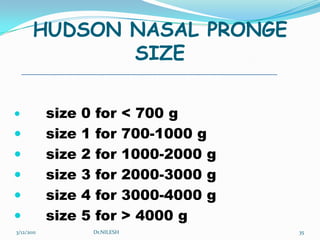
HUDSON NASAL PRONGE SIZEsize 0 for < 700 g 	size 1 for 700-1000 g 	size 2 for 1000-2000 g 	size 3 for 2000-3000 g 	size 4 for 3000-4000 g 	size 5 for > 4000 g 5/20/2010Dr.NILESH35
Attach the oxygen tubing to the flow meter, and connect the tubing to the humidifier Set the flow meter to deliver 5 – 10 liters per minute 5/20/2010Dr.NILESH36
5/20/2010Dr.NILESH37Choose appropriate size nasal prongs and attach them to the corrugated tubing Secure measuring tape to the outlet bottle containing 0.25% acetic acid or sterile water, with the 7 cm mark at the base Empty fluid to the 0 mark  Place the end of the corrugated tube   into the water to a depth of 5 cm to create 5 cm of CPAP
SUCCESS OF CPAPNCPAP is successful when meticulous attention is paid to both the infant and to the NCPAP Delivery System. This involves vigilance in: Monitoring the infant’s condition
Maintaining an optimal airway
Maintaining a patent CPAP delivery circuit
Prevention of complications which may arise from NCPAP5/20/2010Dr.NILESH38
MONITORINGOnce NCPAP is applied, the infant’s condition must be monitored frequently
Observe the infant q 1 hr over the first 4 hours of life, and then q 3-4 hr thereafter while on NCPAP.
Any infant experiencing significant respiratory distress while on NCPAP requires closer observation for change in condition5/20/2010Dr.NILESH39
5/20/2010Dr.NILESH40Recommended monitoring: Respiratory status (RR, work of breathing)
Pre ductal oxygen saturation
Cardiovascular status (HR, BP, perfusion)
GI status (abdominal distention, bowel sounds)
Neurological state (tone, activity, responsiveness)
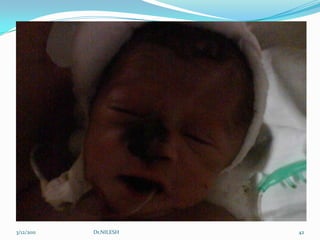
ThermoregulationCOMPLICATIONSDo not take CPAP lightly!Pulmonary air leaksExcessive pressure- compromise o2Abdominal distensionHypotensionLocal – excoriation, scarring, deformity5/20/2010Dr.NILESH41
5/20/2010Dr.NILESH42
COMPLICATION   Suction the mouth, nose and      pharynx            q 3 hr For symptomatic infants more frequent suctioning may be needed5/20/2010Dr.NILESH43
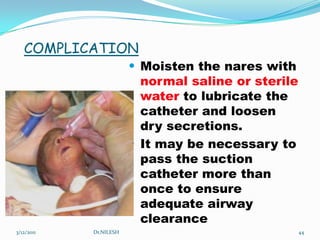
COMPLICATIONMoisten the nares with normal saline or sterile water to lubricate the catheter and loosen dry secretions.
It may be necessary to pass the suction catheter more than once to ensure adequate airway clearance5/20/2010Dr.NILESH44

iap-ahd-ventilation

  • 1.
  • 2.
    OVERVIEW OF PRESENTATIONBASICSOF VENTILATORBASICS OF VENTILATOR SETTINGSCPAPBUBBLE CPAPAPPLICATION AND ADVANTAGES OF CPAPMONITORING OF CPAPCOMPLICATIONS OF CPAPIN-SUR-E5/20/2010Dr.NILESH2
  • 3.
    PROBLEMS5/20/2010Dr.NILESH3The functional characteristicsof respirators and the ventilation techniques are seldom taught to ICU personnel.
  • 4.
    The medical literatureis filled with unproven statements favoring one new mode of ventilation (usually more invasive) over another. PROBLEMSExperiments on normal healthy animals have been often used to extrapolate information for sick newborn infants.Regarding “the standard mechanical ventilation”, there is little uniformity in the selection of ventilator settings among institutions or even within the same hospital. 5/20/2010Dr.NILESH4
  • 5.
    PROBLEMSMany infants whocould have managed on their own are submitted to the ventilator risks. Ventilator management can be worse than the disease.We need to learn who, when and why before learning how to use the ventilator.5/20/2010Dr.NILESH5
  • 6.
    GALIRAL IN LATE1800“AEROPHORE PULMONAIRE” 5/20/2010Dr.NILESH6Ö Galiral (late 1800’s) first mechanical device forartificial ventilation (‘aerophore pulmonaire’)
  • 7.
    ALEXANDER GRAHAM BELLFIRST INVENTED NEGATIVE PRESSURE VENTILATION
  • 8.
    Von Reuss (1914)FIRST described CPAP to resuscitate5/20/2010Dr.NILESH8
  • 9.
    MECHANICAL VENTILATION STRATEGIESCPAP(1969) & NPCPAP (1975) Intermittent Mandatory Ventilation (IMV) (1970s)Patient-triggered ventilation (1980s-1990s)High frequency ventilation (1990s) Flow synchronized ventilation (2000) Hybrid (Pressure & volume targeted) (VAPS/PRVC) (2000)5/20/2010Dr.NILESH9
  • 10.
  • 11.
  • 12.
  • 13.
    Flow will beP1 - P2 R5/20/2010Dr.NILESH13
  • 14.
    TYPES OF VENTILATORSConventionalVentilatorsPressure-limited, time-cycledVolume-limited, time- cycledPatient-triggered ventilationHigh Frequency VentilatorsHigh frequency oscillatory ventilatorHigh frequency jet ventilators5/20/2010Dr.NILESH14
  • 15.
    JUGGLARY OF 6PLAYERSPIP (peak inspiratory pressure) PEEP (peak end expiratory pressure) FiO2 ( fraction of O2)R.R. (respiratory rate)Ti (inspiratory time)Te ( expiratory time)5/20/2010Dr.NILESH15
  • 16.
    FLOW RATEThe minimalflow rate is 2.5 times infant’s minute ventilationWith high flow rate:Higher MAPHigher incidence of barotraumaWith low flow rate: Higher PCO2 form rebreathing exhaled gasMay not be high enough to reach PIP5/20/2010Dr.NILESH16
  • 17.
    Fi O2The useof unnecessary high FiO2 increases the risk for pulmonary oxygen toxicity.The minimal adequate PaO2 is not known. PaO2 of 50-70 mmHg is generally acceptable.Preductal oxygen saturation is a valuable and inexpensive measure to follow.5/20/2010Dr.NILESH17
  • 18.
    Ti------TeTI, TE, I:Eratio, and rate(IMV) are all related Example: TI =0.5 sec I:E = 1:1 means, TE =0.5 sec IMV=60 Ideally, the choose of TI should be dependent on the time constant (Tc) of the respiratory system. 5/20/2010Dr.NILESH18
  • 19.
    PIPDepends on Cland RawIt should be adjusted until adequate but not excessive chest excursion is noted.If infant remains hypoxic in the face of good chest excursion, it is important to exclude CHD and PPHN.5/20/2010Dr.NILESH19
  • 20.
    PIPIf PIP istoo low: tidal volume will be low, leading to intra-pulmonary shunts and hypoxiaIf PIP is too high: the lung will be hyperinflated causing barotrauma PVR will be elevatedvenous return will be impeded5/20/2010Dr.NILESH20
  • 21.
    PIPHypoxemia  PIP Observe chest excursion in every ventilated patientSudden deterioration of the patient with decreased chest excursion denotes an airway or pneumothorax problems rather than compliance changes.5/20/2010Dr.NILESH21
  • 22.
    PEEPExcessively high PEEP:willoverdistend the alveoliwill decrease the compliancewill cause barotraumawill impede the venous return5/20/2010Dr.NILESH22
  • 23.
  • 24.
    Continuous positive airwaypressure ( CPAP )GREGORY IN 1971 _ ENDOTRACHEAL CPAP IN PRE –TERM WITH RDSKATTIWINKEL _ NASAL PRONGE FOR CPAP CPAP FORGOTTENMr. J. WUNG from columbia university used nasal pronge cpap and shown decreased incidence of BPD5/20/2010Dr.NILESH24
  • 25.
    ROLE OF CPAPStartearly nasal prong CPAP for any:tachypnea retractiongruntingoxygen requirementEarly use of CPAP changes the severity and duration of illness. 5/20/2010Dr.NILESH25
  • 26.
    HOW CPAP WORKSPREVENTS COLLAPSE OF ALVEOLISTABILIZES THE CHEST WALLSPLINTS OPEN AIRWAYSTRETCHES LUNG AND PLEURAINCEASES THE OXYGENATION AND VENTILATION5/20/2010Dr.NILESH26
  • 27.
    COMPONENTS OF CPAPGAS SOURCEPRESSURE GENERATORPATIENT INTERFACE / DELIVERY SYSTEM5/20/2010Dr.NILESH27
  • 28.
    CPAP PRESSURE GENERATORSCONTINUOUS FLOW DEVICES INFANT VENTILATOR
  • 29.
    BUBBLE CPAPVARIABLE FLOWDEVICES(assist in exhalation)INFANT FLOW DRIVER
  • 30.
  • 31.
  • 32.
  • 33.
  • 34.
    ADVANTAGES OF BUBBLECPAPSIMPLEEASY TO PRPARECOST EFFECTIVEEFFECTIVE IN PRETERM WITH RDSDECREASED CHANCES OF BPDEASY TO IDENTIFY AIR LEAK FROM NASAL PRONGES5/20/2010Dr.NILESH32
  • 35.
    HOW TO INITIATE NASAL CPAPUSE CORRECT SIZE OF NASAL PRONGENASAL PRONGE SHOULD NOT TOUCH NASAL SEPTUMFIX THE NASAL PRONGE BY STRIP OR ADHESIVE PLASTSNIFFING POSITION OF THE BABYFIX NASAL PRONGE TO CIRCUIT OF CPAP APPLY PULSE OXYMETER5/20/2010Dr.NILESH33
  • 36.
  • 37.
    HUDSON NASAL PRONGESIZEsize 0 for < 700 g size 1 for 700-1000 g size 2 for 1000-2000 g size 3 for 2000-3000 g size 4 for 3000-4000 g size 5 for > 4000 g 5/20/2010Dr.NILESH35
  • 38.
    Attach the oxygentubing to the flow meter, and connect the tubing to the humidifier Set the flow meter to deliver 5 – 10 liters per minute 5/20/2010Dr.NILESH36
  • 39.
    5/20/2010Dr.NILESH37Choose appropriate sizenasal prongs and attach them to the corrugated tubing Secure measuring tape to the outlet bottle containing 0.25% acetic acid or sterile water, with the 7 cm mark at the base Empty fluid to the 0 mark Place the end of the corrugated tube into the water to a depth of 5 cm to create 5 cm of CPAP
  • 40.
    SUCCESS OF CPAPNCPAPis successful when meticulous attention is paid to both the infant and to the NCPAP Delivery System. This involves vigilance in: Monitoring the infant’s condition
  • 41.
  • 42.
    Maintaining a patentCPAP delivery circuit
  • 43.
    Prevention of complicationswhich may arise from NCPAP5/20/2010Dr.NILESH38
  • 44.
    MONITORINGOnce NCPAP isapplied, the infant’s condition must be monitored frequently
  • 45.
    Observe the infantq 1 hr over the first 4 hours of life, and then q 3-4 hr thereafter while on NCPAP.
  • 46.
    Any infant experiencingsignificant respiratory distress while on NCPAP requires closer observation for change in condition5/20/2010Dr.NILESH39
  • 47.
  • 48.
  • 49.
  • 50.
    GI status (abdominaldistention, bowel sounds)
  • 51.
    Neurological state (tone,activity, responsiveness)
  • 52.
    ThermoregulationCOMPLICATIONSDo not takeCPAP lightly!Pulmonary air leaksExcessive pressure- compromise o2Abdominal distensionHypotensionLocal – excoriation, scarring, deformity5/20/2010Dr.NILESH41
  • 53.
  • 54.
    COMPLICATION Suction the mouth, nose and pharynx q 3 hr For symptomatic infants more frequent suctioning may be needed5/20/2010Dr.NILESH43
  • 55.
    COMPLICATIONMoisten the nareswith normal saline or sterile water to lubricate the catheter and loosen dry secretions.
  • 56.
    It may benecessary to pass the suction catheter more than once to ensure adequate airway clearance5/20/2010Dr.NILESH44