
HUMAN RESOURCE
PLANNING
Presented byPresented by ::
Udita vijayvargiaUdita vijayvargia
Saumyah singhSaumyah singh
Swati khemkaSwati khemka
ANNOTATED OUTLINE
5-2
INTRODUCTION
HRP offers an accurate estimate of the number of employees
required with matching skill requirements to meet organisational
objectives. HRP is a forward looking function as human resource
estimates are made well in advance. It is, of course, subject to
revision.
Human Resource Planning
5-3
Human Resource Planning
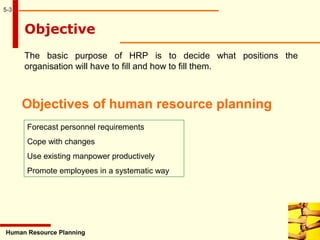
Objective
The basic purpose of HRP is to decide what positions the
organisation will have to fill and how to fill them.
Objectives of human resource planning
Forecast personnel requirements
Cope with changes
Use existing manpower productively
Promote employees in a systematic way
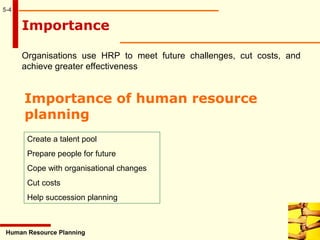
Importance
5-4
Organisations use HRP to meet future challenges, cut costs, and
achieve greater effectiveness
Human Resource Planning
Importance of human resource
planning
Create a talent pool
Prepare people for future
Cope with organisational changes
Cut costs
Help succession planning
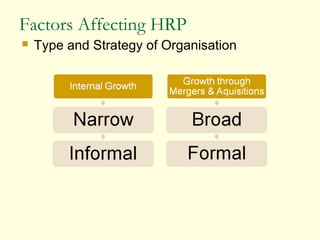
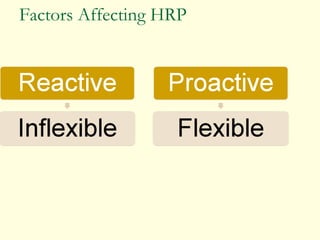
Factors Affecting HRP
 Type and Strategy of Organisation
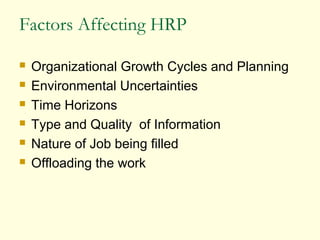
Factors Affecting HRP
 Organizational Growth Cycles and Planning
 Environmental Uncertainties
 Time Horizons
 Type and Quality of Information
 Nature of Job being filled
 Offloading the work
5-5
Human Resource Planning
The Process Of HRP
The HRP involves forecasting personnel needs,
assessing personnel supply and matching
demand supply factors through personnel –
related programmes.
Organisational Objectives and
Policies:
 Objectives of the HR Plan must be derived
from Organisational Objectives.
 In developing these objectives specific
policies need to be formalised, like:
1. Are vacancies to be filled by promotions or
hiring from outside
2.How do the training objective interface with
HRP objectives
Organisational Objectives and
Policies:
3.What union constraints are encountered in
HRP and what policies are needed to handle
this constraints?
4.How to enrich the employees job?
5.How to downsize the organisation to make
it more effective?
Organisational Objectives and
Policies:
6.To what extent production and operations be
automated and what can be done about the
displaced?
7.How to ensure continuous availability of
adaptive and flexible workforce?
HR Demand Forecast
 Demand forecasting is estimating the future
quantity and quality of people required.
 The basis of the forecast must be the annual
budget and long term corporate plan,
translated into activity level for each function
and department.
 Demand forecasting must consider external
and internal Factors
5-7
Forecasting Techniques
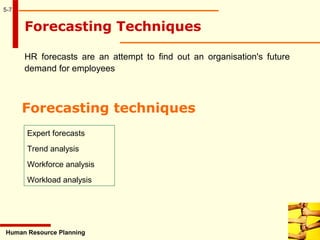
HR forecasts are an attempt to find out an organisation's future
demand for employees
Human Resource Planning
Forecasting techniques
Expert forecasts
Trend analysis
Workforce analysis
Workload analysis
5-8
Human Resource Planning
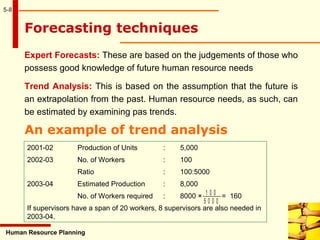
Expert Forecasts: These are based on the judgements of those who
possess good knowledge of future human resource needs
Trend Analysis: This is based on the assumption that the future is
an extrapolation from the past. Human resource needs, as such, can
be estimated by examining pas trends.
Forecasting techniques
An example of trend analysis
2001-02 Production of Units : 5,000
2002-03 No. of Workers : 100
Ratio : 100:5000
2003-04 Estimated Production : 8,000
No. of Workers required : 8000 × = 160
If supervisors have a span of 20 workers, 8 supervisors are also needed in
2003-04.
1 0 0
5 0 0 0
5-9
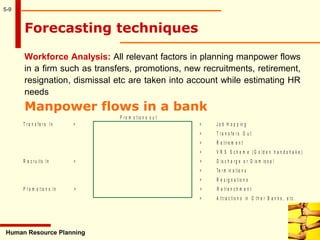
Workforce Analysis: All relevant factors in planning manpower flows
in a firm such as transfers, promotions, new recruitments, retirement,
resignation, dismissal etc are taken into account while estimating HR
needs
Human Resource Planning
Forecasting techniques
Manpower flows in a bank
P r o m o t io n s o u t
T r a n s fe r s I n > > J o b H o p p in g
> T r a n s fe r s O u t
> R e tir e m e n t
> V R S S c h e m e ( G o ld e n h a n d s h a k e )
R e c r u it s In > > D is c h a r g e o r D is m is s a l
> Te r m in a tio n s
> R e s ig n a tio n s
P r o m o tio n s In > > R e tr e n c h m e n t
> A t tr a c tio n s in O t h e r B a n k s , e tc .
5-10
Human Resource Planning
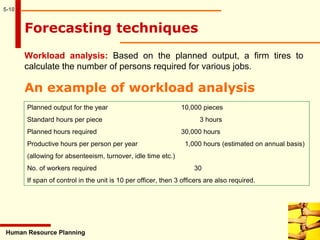
Workload analysis: Based on the planned output, a firm tires to
calculate the number of persons required for various jobs.
Forecasting techniques
An example of workload analysis
Planned output for the year 10,000 pieces
Standard hours per piece 3 hours
Planned hours required 30,000 hours
Productive hours per person per year 1,000 hours (estimated on annual basis)
(allowing for absenteeism, turnover, idle time etc.)
No. of workers required 30
If span of control in the unit is 10 per officer, then 3 officers are also required.
5-11
Human Resource Planning
Supply Forecasting
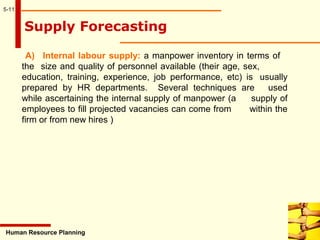
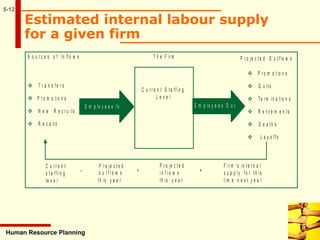
A) Internal labour supply: a manpower inventory in terms of
the size and quality of personnel available (their age, sex,
education, training, experience, job performance, etc) is usually
prepared by HR departments. Several techniques are used
while ascertaining the internal supply of manpower (a supply of
employees to fill projected vacancies can come from within the
firm or from new hires )
5-12
Human Resource Planning
Estimated internal labour supply
for a given firm
T h e F ir mS o u r c e s o f In flo w s
 T r a n s f e r s
 P r o m o tio n s
 N e w R e c r u its
 R e c a lls
 P r o m o t io n s
 Q u its
 Te r m in a tio n s
 R e tir e m e n ts
 D e a th s
 L a y o ffs
E m p lo y e e s In E m p lo y e e s O u t
C u r r e n t
s t a f f i n g
le v e l
P r o je c t e d
o u t f l o w s
th is y e a r
P r o je c t e d
i n f l o w s
th is y e a r
F ir m ’s in te r n a l
s u p p ly f o r t h is
tim e n e x t y e a r
– + =
P r o je c te d O u t f lo w s
C u r r e n t S ta ffin g
L e v e l
5-15
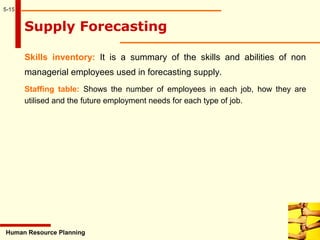
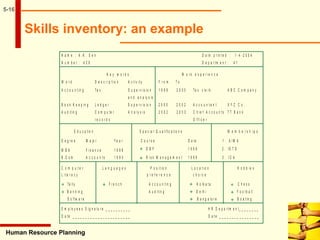
Skills inventory: It is a summary of the skills and abilities of non
managerial employees used in forecasting supply.
Staffing table: Shows the number of employees in each job, how they are
utilised and the future employment needs for each type of job.
Human Resource Planning
Supply Forecasting
5-16
Human Resource Planning
Skills inventory: an example
N a m e : A . K . S e n D a te p r in t e d : 1 - 4 - 2 0 0 4
N u m b e r : 4 2 9 D e p a r tm e n t : 4 1
K e y w o r d s W o r k e x p e r i e n c e
W o r d D e s c r i p t i o n A c t iv it y F r o m T o
A c c o u n t in g Ta x S u p e r v is io n 1 9 9 8 2 0 0 0 Ta x c le r k A B C C o m p a n y
a n d a n a ly s is
B o o k K e e p in g L e d g e r S u p e r v is io n 2 0 0 0 2 0 0 2 A c c o u n t a n t X Y Z C o .
A u d it in g C o m p u te r A n a l y s i s 2 0 0 2 2 0 0 3 C h ie f A c c o u n t s T T B a n k
r e c o r d s O f f i c e r
E d u c a tio n S p e c ia l Q u a lific a tio n s M e m b e r s h i p s
D e g r e e M a jo r Y e a r C o u r s e D a te 1 . A IM A
M B A F in a n c e 1 9 9 8 D B F 1 9 9 6 2 . I S T D
B .C o m A c c o u n t s 1 9 9 5 R is k M a n a g e m e n t 1 9 9 9 3 . I C A
C o m p u t e r L a n g u a g e s P o s i t io n L o c a t i o n H o b b ie s
L i t e r a c y p r e f e r e n c e c h o i c e
 Ta lly F r e n c h A c c o u n t in g K o lk a t a C h e s s
 B a n k in g A u d it in g D e lh i F o o t b a ll
S o f tw a r e B a n g a lo r e B o a t in g
E m p lo y e e s S ig n a tu r e _ _ _ _ _ _ _ _ _ _ H R D e p a r tm e n t_ _ _ _ _ _ _ _
D a te _ _ _ _ _ _ _ _ _ _ _ _ _ _ _ _ _ _ _ _ _ _ _ D a t e _ _ _ _ _ _ _ _ _ _ _ _ _ _ _ _
5-17
Human Resource Planning
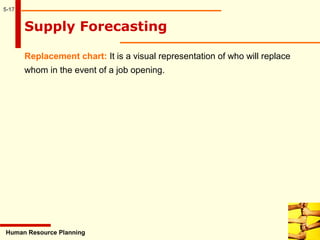
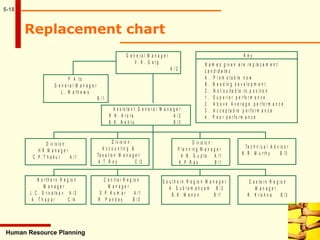
Replacement chart: It is a visual representation of who will replace
whom in the event of a job opening.
Supply Forecasting
5-18
Human Resource Planning
Replacement chart
G e n e r a l M a n a g e r
V . K . G a r g
A / 2
K e y
N a m e s g iv e n a r e r e p la c e m e n t
c a n d id a te s
A . P r o m o t a b le n o w
B . N e e d in g d e v e lo p m e n t
C . N o t s u ita b le t o p o s it io n
1 . S u p e r io r p e r fo r m a n c e
2 . A b o v e A v e r a g e p e r f o r m a n c e
3 . A c c e p ta b le p e r f o r m a n c e
4 . P o o r p e r fo r m a n c e
P A to
G e n e r a l M a n a g e r
L . M a t h e w s
B / 1
A s s is ta n t G e n e r a l M a n a g e r
R .K . A r o r a A / 2
B . K . N e h r u B / 3
D iv is io n :
H R M a n a g e r
C .P. T h a k u r A /1
D iv is io n :
A c c o u n t in g &
Ta x a t io n M a n a g e r
A .T. R o y C /2
D iv is io n :
P la n n in g M a n a g e r
A .N . G u p t a A /1
K .P. R a o B /1
Te c h n ic a l A d v is o r
N . R . M u r t h y B /3
N o r t h e r n R e g io n
M a n a g e r
L .C . S r iv a ts a v A / 2
A . T h a p a r C /4
C e n tr a l R e g io n
M a n a g e r
S .P. K u m a r A /1
R . P a n d e y B / 3
S o u t h e r n R e g io n M a n a g e r
A . S u b r a m a n y a m B / 2
B .K . M e n o n B /1
E a s te r n R e g io n
M a n a g e r
R . K r is h n a B /3
5-19
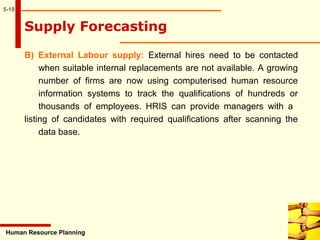
B) External Labour supply: External hires need to be contacted
when suitable internal replacements are not available. A growing
number of firms are now using computerised human resource
information systems to track the qualifications of hundreds or
thousands of employees. HRIS can provide managers with a
listing of candidates with required qualifications after scanning the
data base.
Human Resource Planning
Supply Forecasting
5-20
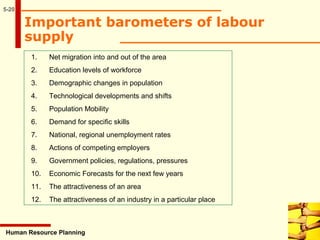
Important barometers of labour
supply
Human Resource Planning
1. Net migration into and out of the area
2. Education levels of workforce
3. Demographic changes in population
4. Technological developments and shifts
5. Population Mobility
6. Demand for specific skills
7. National, regional unemployment rates
8. Actions of competing employers
9. Government policies, regulations, pressures
10. Economic Forecasts for the next few years
11. The attractiveness of an area
12. The attractiveness of an industry in a particular place
5-22
Formulating HR Plans
Human Resource Planning
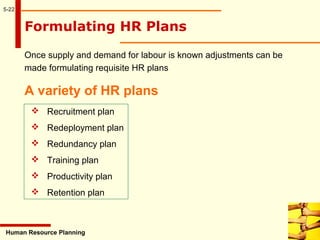
Once supply and demand for labour is known adjustments can be
made formulating requisite HR plans
A variety of HR plans
 Recruitment plan
 Redeployment plan
 Redundancy plan
 Training plan
 Productivity plan
 Retention plan
5-23
Responsibility For Human Resource
Planning
HRP is a top management job. HR plans are usually made by the
HR division in consultation with other corporate heads. Any
deviations from the formulated plans and their causes must be
looked into, from time to time in order to assess whether the plans
require revision or modification.
Human Resource Planning
5-24
Limitations Of Human Resource
Planning
HR professionals are basically confronted with three problems while
preparing and administering HR plans: accuracy, inadequate top
management support, lopsided focus on quantitative aspects.
Human Resource Planning
5-25
Effective Human Resource Planning
HR plans must fit in with overall objectives of a firm. They must get
consistent support from top management. Computerised human resource
information systems must be used for applicant tracking, succession
planning, building skills inventories etc. The whole exercise must be
carried out in coordination with operating managers.
Human Resource Planning

human resource planning

  • 1.
    HUMAN RESOURCE PLANNING Presented byPresentedby :: Udita vijayvargiaUdita vijayvargia Saumyah singhSaumyah singh Swati khemkaSwati khemka
  • 2.
    ANNOTATED OUTLINE 5-2 INTRODUCTION HRP offersan accurate estimate of the number of employees required with matching skill requirements to meet organisational objectives. HRP is a forward looking function as human resource estimates are made well in advance. It is, of course, subject to revision. Human Resource Planning
  • 3.
    5-3 Human Resource Planning Objective Thebasic purpose of HRP is to decide what positions the organisation will have to fill and how to fill them. Objectives of human resource planning Forecast personnel requirements Cope with changes Use existing manpower productively Promote employees in a systematic way
  • 4.
    Importance 5-4 Organisations use HRPto meet future challenges, cut costs, and achieve greater effectiveness Human Resource Planning Importance of human resource planning Create a talent pool Prepare people for future Cope with organisational changes Cut costs Help succession planning
  • 5.
    Factors Affecting HRP Type and Strategy of Organisation
  • 6.
  • 7.
    Factors Affecting HRP Organizational Growth Cycles and Planning  Environmental Uncertainties  Time Horizons  Type and Quality of Information  Nature of Job being filled  Offloading the work
  • 8.
    5-5 Human Resource Planning TheProcess Of HRP The HRP involves forecasting personnel needs, assessing personnel supply and matching demand supply factors through personnel – related programmes.
  • 9.
    Organisational Objectives and Policies: Objectives of the HR Plan must be derived from Organisational Objectives.  In developing these objectives specific policies need to be formalised, like: 1. Are vacancies to be filled by promotions or hiring from outside 2.How do the training objective interface with HRP objectives
  • 10.
    Organisational Objectives and Policies: 3.Whatunion constraints are encountered in HRP and what policies are needed to handle this constraints? 4.How to enrich the employees job? 5.How to downsize the organisation to make it more effective?
  • 11.
    Organisational Objectives and Policies: 6.Towhat extent production and operations be automated and what can be done about the displaced? 7.How to ensure continuous availability of adaptive and flexible workforce?
  • 12.
    HR Demand Forecast Demand forecasting is estimating the future quantity and quality of people required.  The basis of the forecast must be the annual budget and long term corporate plan, translated into activity level for each function and department.  Demand forecasting must consider external and internal Factors
  • 13.
    5-7 Forecasting Techniques HR forecastsare an attempt to find out an organisation's future demand for employees Human Resource Planning Forecasting techniques Expert forecasts Trend analysis Workforce analysis Workload analysis
  • 14.
    5-8 Human Resource Planning ExpertForecasts: These are based on the judgements of those who possess good knowledge of future human resource needs Trend Analysis: This is based on the assumption that the future is an extrapolation from the past. Human resource needs, as such, can be estimated by examining pas trends. Forecasting techniques An example of trend analysis 2001-02 Production of Units : 5,000 2002-03 No. of Workers : 100 Ratio : 100:5000 2003-04 Estimated Production : 8,000 No. of Workers required : 8000 × = 160 If supervisors have a span of 20 workers, 8 supervisors are also needed in 2003-04. 1 0 0 5 0 0 0
  • 15.
    5-9 Workforce Analysis: Allrelevant factors in planning manpower flows in a firm such as transfers, promotions, new recruitments, retirement, resignation, dismissal etc are taken into account while estimating HR needs Human Resource Planning Forecasting techniques Manpower flows in a bank P r o m o t io n s o u t T r a n s fe r s I n > > J o b H o p p in g > T r a n s fe r s O u t > R e tir e m e n t > V R S S c h e m e ( G o ld e n h a n d s h a k e ) R e c r u it s In > > D is c h a r g e o r D is m is s a l > Te r m in a tio n s > R e s ig n a tio n s P r o m o tio n s In > > R e tr e n c h m e n t > A t tr a c tio n s in O t h e r B a n k s , e tc .
  • 16.
    5-10 Human Resource Planning Workloadanalysis: Based on the planned output, a firm tires to calculate the number of persons required for various jobs. Forecasting techniques An example of workload analysis Planned output for the year 10,000 pieces Standard hours per piece 3 hours Planned hours required 30,000 hours Productive hours per person per year 1,000 hours (estimated on annual basis) (allowing for absenteeism, turnover, idle time etc.) No. of workers required 30 If span of control in the unit is 10 per officer, then 3 officers are also required.
  • 17.
    5-11 Human Resource Planning SupplyForecasting A) Internal labour supply: a manpower inventory in terms of the size and quality of personnel available (their age, sex, education, training, experience, job performance, etc) is usually prepared by HR departments. Several techniques are used while ascertaining the internal supply of manpower (a supply of employees to fill projected vacancies can come from within the firm or from new hires )
  • 18.
    5-12 Human Resource Planning Estimatedinternal labour supply for a given firm T h e F ir mS o u r c e s o f In flo w s  T r a n s f e r s  P r o m o tio n s  N e w R e c r u its  R e c a lls  P r o m o t io n s  Q u its  Te r m in a tio n s  R e tir e m e n ts  D e a th s  L a y o ffs E m p lo y e e s In E m p lo y e e s O u t C u r r e n t s t a f f i n g le v e l P r o je c t e d o u t f l o w s th is y e a r P r o je c t e d i n f l o w s th is y e a r F ir m ’s in te r n a l s u p p ly f o r t h is tim e n e x t y e a r – + = P r o je c te d O u t f lo w s C u r r e n t S ta ffin g L e v e l
  • 19.
    5-15 Skills inventory: Itis a summary of the skills and abilities of non managerial employees used in forecasting supply. Staffing table: Shows the number of employees in each job, how they are utilised and the future employment needs for each type of job. Human Resource Planning Supply Forecasting
  • 20.
    5-16 Human Resource Planning Skillsinventory: an example N a m e : A . K . S e n D a te p r in t e d : 1 - 4 - 2 0 0 4 N u m b e r : 4 2 9 D e p a r tm e n t : 4 1 K e y w o r d s W o r k e x p e r i e n c e W o r d D e s c r i p t i o n A c t iv it y F r o m T o A c c o u n t in g Ta x S u p e r v is io n 1 9 9 8 2 0 0 0 Ta x c le r k A B C C o m p a n y a n d a n a ly s is B o o k K e e p in g L e d g e r S u p e r v is io n 2 0 0 0 2 0 0 2 A c c o u n t a n t X Y Z C o . A u d it in g C o m p u te r A n a l y s i s 2 0 0 2 2 0 0 3 C h ie f A c c o u n t s T T B a n k r e c o r d s O f f i c e r E d u c a tio n S p e c ia l Q u a lific a tio n s M e m b e r s h i p s D e g r e e M a jo r Y e a r C o u r s e D a te 1 . A IM A M B A F in a n c e 1 9 9 8 D B F 1 9 9 6 2 . I S T D B .C o m A c c o u n t s 1 9 9 5 R is k M a n a g e m e n t 1 9 9 9 3 . I C A C o m p u t e r L a n g u a g e s P o s i t io n L o c a t i o n H o b b ie s L i t e r a c y p r e f e r e n c e c h o i c e  Ta lly F r e n c h A c c o u n t in g K o lk a t a C h e s s  B a n k in g A u d it in g D e lh i F o o t b a ll S o f tw a r e B a n g a lo r e B o a t in g E m p lo y e e s S ig n a tu r e _ _ _ _ _ _ _ _ _ _ H R D e p a r tm e n t_ _ _ _ _ _ _ _ D a te _ _ _ _ _ _ _ _ _ _ _ _ _ _ _ _ _ _ _ _ _ _ _ D a t e _ _ _ _ _ _ _ _ _ _ _ _ _ _ _ _
  • 21.
    5-17 Human Resource Planning Replacementchart: It is a visual representation of who will replace whom in the event of a job opening. Supply Forecasting
  • 22.
    5-18 Human Resource Planning Replacementchart G e n e r a l M a n a g e r V . K . G a r g A / 2 K e y N a m e s g iv e n a r e r e p la c e m e n t c a n d id a te s A . P r o m o t a b le n o w B . N e e d in g d e v e lo p m e n t C . N o t s u ita b le t o p o s it io n 1 . S u p e r io r p e r fo r m a n c e 2 . A b o v e A v e r a g e p e r f o r m a n c e 3 . A c c e p ta b le p e r f o r m a n c e 4 . P o o r p e r fo r m a n c e P A to G e n e r a l M a n a g e r L . M a t h e w s B / 1 A s s is ta n t G e n e r a l M a n a g e r R .K . A r o r a A / 2 B . K . N e h r u B / 3 D iv is io n : H R M a n a g e r C .P. T h a k u r A /1 D iv is io n : A c c o u n t in g & Ta x a t io n M a n a g e r A .T. R o y C /2 D iv is io n : P la n n in g M a n a g e r A .N . G u p t a A /1 K .P. R a o B /1 Te c h n ic a l A d v is o r N . R . M u r t h y B /3 N o r t h e r n R e g io n M a n a g e r L .C . S r iv a ts a v A / 2 A . T h a p a r C /4 C e n tr a l R e g io n M a n a g e r S .P. K u m a r A /1 R . P a n d e y B / 3 S o u t h e r n R e g io n M a n a g e r A . S u b r a m a n y a m B / 2 B .K . M e n o n B /1 E a s te r n R e g io n M a n a g e r R . K r is h n a B /3
  • 23.
    5-19 B) External Laboursupply: External hires need to be contacted when suitable internal replacements are not available. A growing number of firms are now using computerised human resource information systems to track the qualifications of hundreds or thousands of employees. HRIS can provide managers with a listing of candidates with required qualifications after scanning the data base. Human Resource Planning Supply Forecasting
  • 24.
    5-20 Important barometers oflabour supply Human Resource Planning 1. Net migration into and out of the area 2. Education levels of workforce 3. Demographic changes in population 4. Technological developments and shifts 5. Population Mobility 6. Demand for specific skills 7. National, regional unemployment rates 8. Actions of competing employers 9. Government policies, regulations, pressures 10. Economic Forecasts for the next few years 11. The attractiveness of an area 12. The attractiveness of an industry in a particular place
  • 25.
    5-22 Formulating HR Plans HumanResource Planning Once supply and demand for labour is known adjustments can be made formulating requisite HR plans A variety of HR plans  Recruitment plan  Redeployment plan  Redundancy plan  Training plan  Productivity plan  Retention plan
  • 26.
    5-23 Responsibility For HumanResource Planning HRP is a top management job. HR plans are usually made by the HR division in consultation with other corporate heads. Any deviations from the formulated plans and their causes must be looked into, from time to time in order to assess whether the plans require revision or modification. Human Resource Planning
  • 27.
    5-24 Limitations Of HumanResource Planning HR professionals are basically confronted with three problems while preparing and administering HR plans: accuracy, inadequate top management support, lopsided focus on quantitative aspects. Human Resource Planning
  • 28.
    5-25 Effective Human ResourcePlanning HR plans must fit in with overall objectives of a firm. They must get consistent support from top management. Computerised human resource information systems must be used for applicant tracking, succession planning, building skills inventories etc. The whole exercise must be carried out in coordination with operating managers. Human Resource Planning