Human Resource Management
   in the Defence Context
       Dr Teri McConville
Human Resource Management
• Human resource management … seeks to achieve
  competitive advantage [operational effectiveness]
  through the strategic deployment of a highly
  committed and capable workforce, using an
  integrated array of cultural, structural and personal
  techniques.
      • (John Storey, 1995)
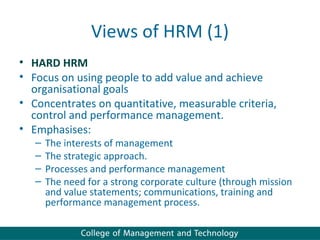
Views of HRM (1)
• HARD HRM
• Focus on using people to add value and achieve
  organisational goals
• Concentrates on quantitative, measurable criteria,
  control and performance management.
• Emphasises:
   –   The interests of management
   –   The strategic approach.
   –   Processes and performance management
   –   The need for a strong corporate culture (through mission
       and value statements; communications, training and
       performance management process.
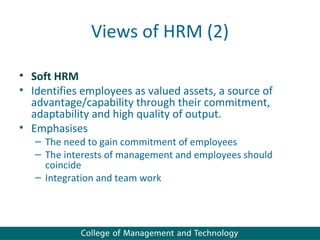
Views of HRM (2)

• Soft HRM
• Identifies employees as valued assets, a source of
  advantage/capability through their commitment,
  adaptability and high quality of output.
• Emphasises
   – The need to gain commitment of employees
   – The interests of management and employees should
     coincide
   – Integration and team work
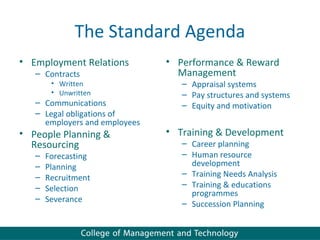
The Standard Agenda
• Employment Relations         • Performance & Reward
   – Contracts                   Management
        • Written                 – Appraisal systems
        • Unwritten               – Pay structures and systems
   – Communications               – Equity and motivation
   – Legal obligations of
     employers and employees
• People Planning &            • Training & Development
  Resourcing                      – Career planning
   –   Forecasting                – Human resource
   –   Planning                     development
   –   Recruitment                – Training Needs Analysis
   –   Selection                  – Training & educations
                                    programmes
   –   Severance                  – Succession Planning
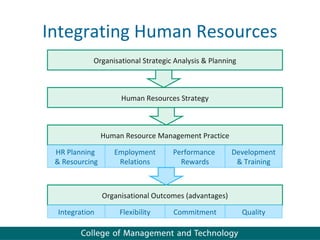
Integrating Human Resources
           Organisational Strategic Analysis & Planning


                     Human Resources Strategy


                Human Resource Management Practice

 HR Planning       Employment       Performance        Development
 & Resourcing       Relations         Rewards           & Training


                Organisational Outcomes (advantages)

 Integration         Flexibility    Commitment            Quality
Managing the Employment Relationship

EXPECTATIONS IN THE WORKPLACE
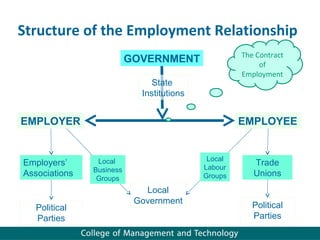
Structure of the Employment Relationship
                                                    The Contract
                          GOVERNMENT                     of
                                                    Employment
                               State
                            Institutions


EMPLOYER                                            EMPLOYEE


                Local                       Local
Employers’                                 Labour
                                                       Trade
               Business
Associations                               Groups      Unions
                Groups
                             Local
                           Government                  Political
   Political
   Parties                                             Parties
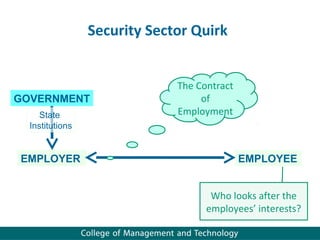
Security Sector Quirk


                              The Contract
GOVERNMENT                         of
     State                    Employment
  Institutions


EMPLOYER                                     EMPLOYEE


                                     Who looks after the
                                    employees’ interests?
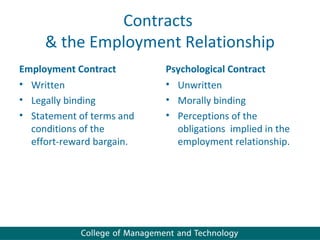
Contracts
     & the Employment Relationship
Employment Contract        Psychological Contract
• Written                  • Unwritten
• Legally binding          • Morally binding
• Statement of terms and   • Perceptions of the
  conditions of the          obligations implied in the
  effort-reward bargain.     employment relationship.
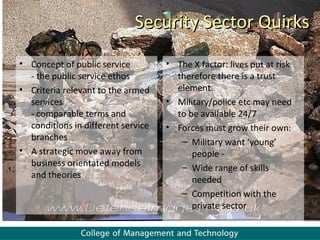
Security Sector Quirks
• Concept of public service         • The X factor: lives put at risk
  - the public service ethos          therefore there is a trust
• Criteria relevant to the armed      element.
  services                          • Military/police etc may need
  - comparable terms and              to be available 24/7
  conditions in different service   • Forces must grow their own:
  branches                             – Military want ‘young’
• A strategic move away from              people -
  business orientated models           – Wide range of skills
  and theories                            needed
                                       – Competition with the
                                          private sector
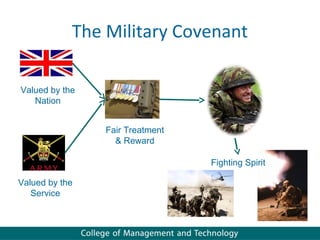
The Military Covenant

Valued by the
   Nation


                Fair Treatment
                  & Reward

                                 Fighting Spirit

Valued by the
   Service
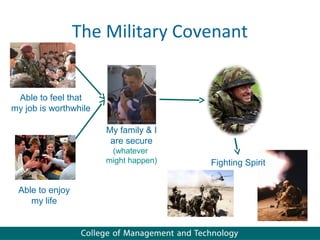
The Military Covenant


 Able to feel that
my job is worthwhile

                       My family & I
                        are secure
                        (whatever
                       might happen)   Fighting Spirit


 Able to enjoy
    my life
People Resourcing
MAINTAINING THE WORKFORCE
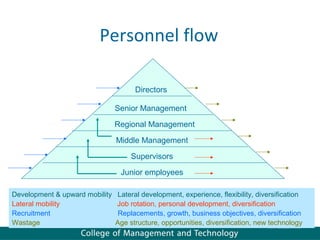
Personnel flow

                                      Directors

                                Senior Management

                                Regional Management

                                Middle Management

                                     Supervisors

                                 Junior employees

Development & upward mobility   Lateral development, experience, flexibility, diversification
Lateral mobility                Job rotation, personal development, diversification
Recruitment                      Replacements, growth, business objectives, diversification
Wastage
  15                            Age structure, opportunities, diversification, new technology
                                                                                 Teri McConville
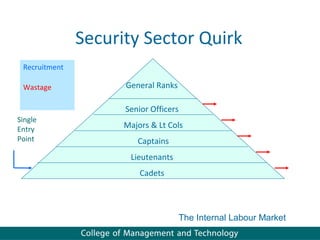
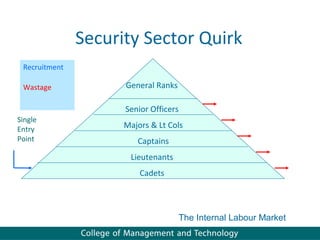
Security Sector Quirk
 Recruitment

 Wastage             General Ranks

                     Senior Officers
Single
Entry                Majors & Lt Cols
Point                   Captains
                      Lieutenants
                         Cadets


                                       The Internal Labour Market
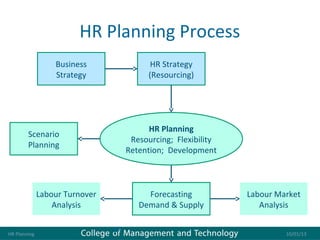
HR Planning Process
                  Business                  HR Strategy
                  Strategy                 (Resourcing)


                                           HR Planning
        Scenario
                                      Resourcing; Flexibility
        Planning
                                     Retention; Development


              Labour Turnover             Forecasting           Labour Market
                  Analysis              Demand & Supply            Analysis


HR Planning
                                17                                       10/01/13
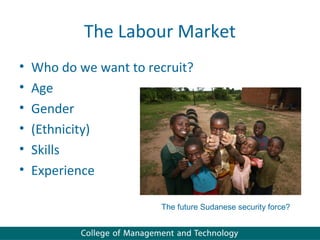
The Labour Market
•   Who do we want to recruit?
•   Age
•   Gender
•   (Ethnicity)
•   Skills
•   Experience

                        The future Sudanese security force?
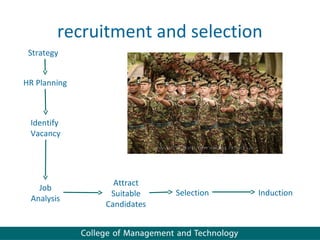
recruitment and selection
 Strategy


HR Planning


 Identify
 Vacancy


                Attract
   Job
               Suitable    Selection   Induction
 Analysis
              Candidates
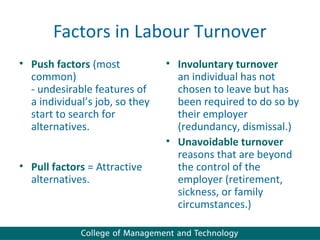
Factors in Labour Turnover
• Push factors (most            • Involuntary turnover
  common)                         an individual has not
  - undesirable features of       chosen to leave but has
  a individual’s job, so they     been required to do so by
  start to search for             their employer
  alternatives.                   (redundancy, dismissal.)
                                • Unavoidable turnover
                                  reasons that are beyond
• Pull factors = Attractive       the control of the
  alternatives.                   employer (retirement,
                                  sickness, or family
                                  circumstances.)
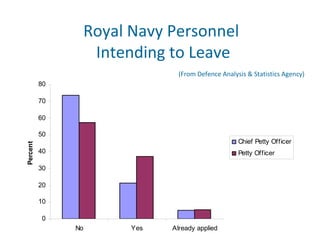
Royal Navy Personnel
                     Intending to Leave
                                    (From Defence Analysis & Statistics Agency)
          80

          70

          60

          50
                                                        Chief Petty Officer
Percent


          40                                            Petty Officer

          30

          20

          10

          0
               No      21   Yes   Already applied
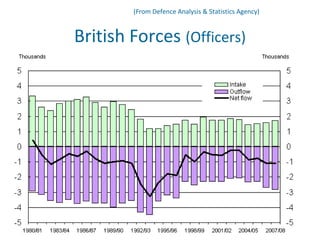
(From Defence Analysis & Statistics Agency)


British Forces (Officers)
Developing the Human Resource

DEVELOPING POTENTIAL
Security Sector Quirk
 Recruitment

 Wastage             General Ranks

                     Senior Officers
Single
Entry                Majors & Lt Cols
Point                   Captains
                      Lieutenants
                         Cadets


                                       The Internal Labour Market
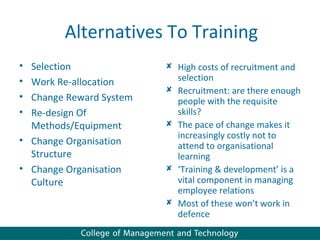
Alternatives To Training
• Selection               High costs of recruitment and
• Work Re-allocation       selection
                          Recruitment: are there enough
• Change Reward System     people with the requisite
• Re-design Of             skills?
  Methods/Equipment       The pace of change makes it
                           increasingly costly not to
• Change Organisation      attend to organisational
  Structure                learning
• Change Organisation     ‘Training & development’ is a
  Culture                  vital component in managing
                           employee relations
                          Most of these won’t work in
                           defence
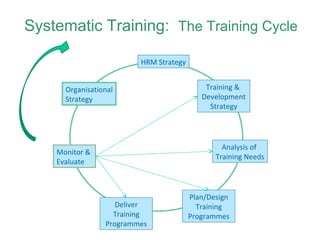
Systematic Training: The Training Cycle

                         HRM Strategy


      Organisational                        Training &
      Strategy                             Development
                                             Strategy


                                                 Analysis of
    Monitor &
                                               Training Needs
    Evaluate


                                        Plan/Design
                    Deliver               Training
                   Training             Programmes
                 Programmes
Reward Management

FOR MOTIVATION & PERFORMANCE
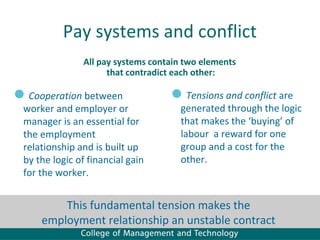
Pay systems and conflict
               All pay systems contain two elements
                     that contradict each other:

Cooperation between               Tensions and conflict are
 worker and employer or              generated through the logic
 manager is an essential for         that makes the ‘buying’ of
 the employment                      labour a reward for one
 relationship and is built up        group and a cost for the
 by the logic of financial gain      other.
 for the worker.


         This fundamental tension makes the
     employment relationship an unstable contract
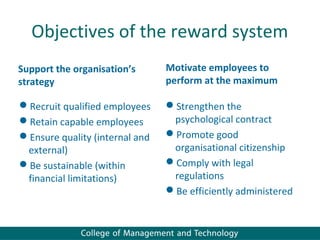
Objectives of the reward system
Support the organisation’s      Motivate employees to
strategy                        perform at the maximum

Recruit qualified employees    Strengthen the
Retain capable employees        psychological contract
Ensure quality (internal and   Promote good
 external)                       organisational citizenship
Be sustainable (within         Comply with legal
 financial limitations)          regulations
                                Be efficiently administered
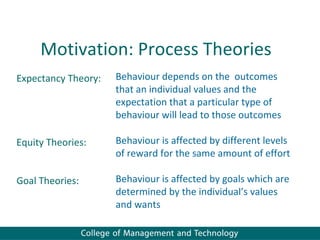
Motivation: Process Theories
Expectancy Theory:   Behaviour depends on the outcomes
                     that an individual values and the
                     expectation that a particular type of
                     behaviour will lead to those outcomes

Equity Theories:     Behaviour is affected by different levels
                     of reward for the same amount of effort

Goal Theories:       Behaviour is affected by goals which are
                     determined by the individual’s values
                     and wants
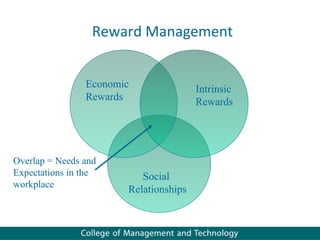
Reward Management


                Economic               Intrinsic
                Rewards                Rewards


Overlap = Needs and
Expectations in the       Social
workplace
                       Relationships
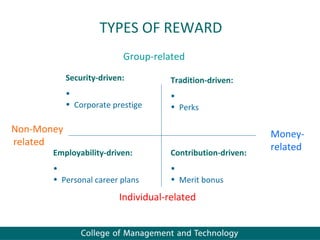
TYPES OF REWARD
                           Group-related
            Security-driven:          Tradition-driven:
            •                         •
            • Corporate prestige      • Perks

Non-Money                                                    Money-
related                                                      related
       Employability-driven:          Contribution-driven:
       •                              •
       • Personal career plans        • Merit bonus

                          Individual-related
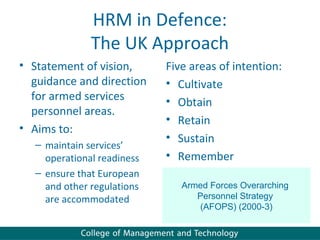
HRM in Defence:
               The UK Approach
• Statement of vision,       Five areas of intention:
  guidance and direction     • Cultivate
  for armed services         • Obtain
  personnel areas.
                             • Retain
• Aims to:
                             • Sustain
   – maintain services’
     operational readiness   • Remember
   – ensure that European
     and other regulations      Armed Forces Overarching
     are accommodated              Personnel Strategy
                                   (AFOPS) (2000-3)
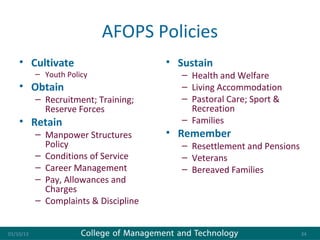
AFOPS Policies
    • Cultivate                        • Sustain
           – Youth Policy                 – Health and Welfare
    • Obtain                              – Living Accommodation
           – Recruitment; Training;       – Pastoral Care; Sport &
             Reserve Forces                 Recreation
    • Retain                              – Families
           – Manpower Structures       • Remember
             Policy                       – Resettlement and Pensions
           – Conditions of Service        – Veterans
           – Career Management            – Bereaved Families
           – Pay, Allowances and
             Charges
           – Complaints & Discipline


01/10/13                                                                34
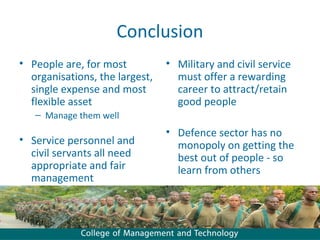
Conclusion
• People are, for most          • Military and civil service
  organisations, the largest,     must offer a rewarding
  single expense and most         career to attract/retain
  flexible asset                  good people
   – Manage them well
                                • Defence sector has no
• Service personnel and           monopoly on getting the
  civil servants all need         best out of people - so
  appropriate and fair            learn from others
  management

Human resource management 1and2

  • 1.
    Human Resource Management in the Defence Context Dr Teri McConville
  • 2.
    Human Resource Management •Human resource management … seeks to achieve competitive advantage [operational effectiveness] through the strategic deployment of a highly committed and capable workforce, using an integrated array of cultural, structural and personal techniques. • (John Storey, 1995)
  • 3.
    Views of HRM(1) • HARD HRM • Focus on using people to add value and achieve organisational goals • Concentrates on quantitative, measurable criteria, control and performance management. • Emphasises: – The interests of management – The strategic approach. – Processes and performance management – The need for a strong corporate culture (through mission and value statements; communications, training and performance management process.
  • 4.
    Views of HRM(2) • Soft HRM • Identifies employees as valued assets, a source of advantage/capability through their commitment, adaptability and high quality of output. • Emphasises – The need to gain commitment of employees – The interests of management and employees should coincide – Integration and team work
  • 5.
    The Standard Agenda •Employment Relations • Performance & Reward – Contracts Management • Written – Appraisal systems • Unwritten – Pay structures and systems – Communications – Equity and motivation – Legal obligations of employers and employees • People Planning & • Training & Development Resourcing – Career planning – Forecasting – Human resource – Planning development – Recruitment – Training Needs Analysis – Selection – Training & educations programmes – Severance – Succession Planning
  • 6.
    Integrating Human Resources Organisational Strategic Analysis & Planning Human Resources Strategy Human Resource Management Practice HR Planning Employment Performance Development & Resourcing Relations Rewards & Training Organisational Outcomes (advantages) Integration Flexibility Commitment Quality
  • 7.
    Managing the EmploymentRelationship EXPECTATIONS IN THE WORKPLACE
  • 8.
    Structure of theEmployment Relationship The Contract GOVERNMENT of Employment State Institutions EMPLOYER EMPLOYEE Local Local Employers’ Labour Trade Business Associations Groups Unions Groups Local Government Political Political Parties Parties
  • 9.
    Security Sector Quirk The Contract GOVERNMENT of State Employment Institutions EMPLOYER EMPLOYEE Who looks after the employees’ interests?
  • 10.
    Contracts & the Employment Relationship Employment Contract Psychological Contract • Written • Unwritten • Legally binding • Morally binding • Statement of terms and • Perceptions of the conditions of the obligations implied in the effort-reward bargain. employment relationship.
  • 11.
    Security Sector Quirks •Concept of public service • The X factor: lives put at risk - the public service ethos therefore there is a trust • Criteria relevant to the armed element. services • Military/police etc may need - comparable terms and to be available 24/7 conditions in different service • Forces must grow their own: branches – Military want ‘young’ • A strategic move away from people - business orientated models – Wide range of skills and theories needed – Competition with the private sector
  • 12.
    The Military Covenant Valuedby the Nation Fair Treatment & Reward Fighting Spirit Valued by the Service
  • 13.
    The Military Covenant Able to feel that my job is worthwhile My family & I are secure (whatever might happen) Fighting Spirit Able to enjoy my life
  • 14.
  • 15.
    Personnel flow Directors Senior Management Regional Management Middle Management Supervisors Junior employees Development & upward mobility Lateral development, experience, flexibility, diversification Lateral mobility Job rotation, personal development, diversification Recruitment Replacements, growth, business objectives, diversification Wastage 15 Age structure, opportunities, diversification, new technology Teri McConville
  • 16.
    Security Sector Quirk Recruitment Wastage General Ranks Senior Officers Single Entry Majors & Lt Cols Point Captains Lieutenants Cadets The Internal Labour Market
  • 17.
    HR Planning Process Business HR Strategy Strategy (Resourcing) HR Planning Scenario Resourcing; Flexibility Planning Retention; Development Labour Turnover Forecasting Labour Market Analysis Demand & Supply Analysis HR Planning 17 10/01/13
  • 18.
    The Labour Market • Who do we want to recruit? • Age • Gender • (Ethnicity) • Skills • Experience The future Sudanese security force?
  • 19.
    recruitment and selection Strategy HR Planning Identify Vacancy Attract Job Suitable Selection Induction Analysis Candidates
  • 20.
    Factors in LabourTurnover • Push factors (most • Involuntary turnover common) an individual has not - undesirable features of chosen to leave but has a individual’s job, so they been required to do so by start to search for their employer alternatives. (redundancy, dismissal.) • Unavoidable turnover reasons that are beyond • Pull factors = Attractive the control of the alternatives. employer (retirement, sickness, or family circumstances.)
  • 21.
    Royal Navy Personnel Intending to Leave (From Defence Analysis & Statistics Agency) 80 70 60 50 Chief Petty Officer Percent 40 Petty Officer 30 20 10 0 No 21 Yes Already applied
  • 22.
    (From Defence Analysis& Statistics Agency) British Forces (Officers)
  • 23.
    Developing the HumanResource DEVELOPING POTENTIAL
  • 24.
    Security Sector Quirk Recruitment Wastage General Ranks Senior Officers Single Entry Majors & Lt Cols Point Captains Lieutenants Cadets The Internal Labour Market
  • 25.
    Alternatives To Training •Selection  High costs of recruitment and • Work Re-allocation selection  Recruitment: are there enough • Change Reward System people with the requisite • Re-design Of skills? Methods/Equipment  The pace of change makes it increasingly costly not to • Change Organisation attend to organisational Structure learning • Change Organisation  ‘Training & development’ is a Culture vital component in managing employee relations  Most of these won’t work in defence
  • 26.
    Systematic Training: TheTraining Cycle HRM Strategy Organisational Training & Strategy Development Strategy Analysis of Monitor & Training Needs Evaluate Plan/Design Deliver Training Training Programmes Programmes
  • 27.
  • 28.
    Pay systems andconflict All pay systems contain two elements that contradict each other: Cooperation between Tensions and conflict are worker and employer or generated through the logic manager is an essential for that makes the ‘buying’ of the employment labour a reward for one relationship and is built up group and a cost for the by the logic of financial gain other. for the worker. This fundamental tension makes the employment relationship an unstable contract
  • 29.
    Objectives of thereward system Support the organisation’s Motivate employees to strategy perform at the maximum Recruit qualified employees Strengthen the Retain capable employees psychological contract Ensure quality (internal and Promote good external) organisational citizenship Be sustainable (within Comply with legal financial limitations) regulations Be efficiently administered
  • 30.
    Motivation: Process Theories ExpectancyTheory: Behaviour depends on the outcomes that an individual values and the expectation that a particular type of behaviour will lead to those outcomes Equity Theories: Behaviour is affected by different levels of reward for the same amount of effort Goal Theories: Behaviour is affected by goals which are determined by the individual’s values and wants
  • 31.
    Reward Management Economic Intrinsic Rewards Rewards Overlap = Needs and Expectations in the Social workplace Relationships
  • 32.
    TYPES OF REWARD Group-related Security-driven: Tradition-driven: • • • Corporate prestige • Perks Non-Money Money- related related Employability-driven: Contribution-driven: • • • Personal career plans • Merit bonus Individual-related
  • 33.
    HRM in Defence: The UK Approach • Statement of vision, Five areas of intention: guidance and direction • Cultivate for armed services • Obtain personnel areas. • Retain • Aims to: • Sustain – maintain services’ operational readiness • Remember – ensure that European and other regulations Armed Forces Overarching are accommodated Personnel Strategy (AFOPS) (2000-3)
  • 34.
    AFOPS Policies • Cultivate • Sustain – Youth Policy – Health and Welfare • Obtain – Living Accommodation – Recruitment; Training; – Pastoral Care; Sport & Reserve Forces Recreation • Retain – Families – Manpower Structures • Remember Policy – Resettlement and Pensions – Conditions of Service – Veterans – Career Management – Bereaved Families – Pay, Allowances and Charges – Complaints & Discipline 01/10/13 34
  • 35.
    Conclusion • People are,for most • Military and civil service organisations, the largest, must offer a rewarding single expense and most career to attract/retain flexible asset good people – Manage them well • Defence sector has no • Service personnel and monopoly on getting the civil servants all need best out of people - so appropriate and fair learn from others management

Editor's Notes

  • #9 Employee organisations: work group trade union organisations (needs solidarity) notions of trade union density oligarchy managers of discontent employer organisations: wage setting more private, less collective inaccurate information CBI was set up by a Labour government as an aid to national economic planning State bodies: Statutory bodies e.g. ACAS / MSC legal system DfEE Military Church of England
  • #10 Employee organisations: work group trade union organisations (needs solidarity) notions of trade union density oligarchy managers of discontent employer organisations: wage setting more private, less collective inaccurate information CBI was set up by a Labour government as an aid to national economic planning State bodies: Statutory bodies e.g. ACAS / MSC legal system DfEE Military Church of England