TESTING AND ASSESSMENT:

  A GUIDE TO GOOD PRACTICES FOR

           WORKFORCE INVESTMENT

                       PROFESSIONALS


U.S. Department of Labor
Employment and Training Administration

2006
Foreword
PURPOSE of the GUIDE

Human capital is our most valuable resource in today’s globally competitive, highly technical,
and increasingly diverse workplace. Investing in the development of our workforce is critical if
we, as a nation, are to protect our economic well-being and maintain our standard of living. We
develop our workforce in a number of ways by helping both individuals and organizations to
identify and cultivate their abilities and competencies. Tests and assessments are often key tools
in achieving this important goal.

This Guide serves to help career counselors and training and development professionals use
assessment practices in appropriate ways to support the overarching goal of workforce
development. It conveys the essential concepts of testing and assessment in easy-to-understand
terms so that counselors, trainers, and other workforce development professionals can:

   evaluate and select assessment tools/procedures that provide career counseling and guidance,
   and aid in training and career development;
   administer and score assessment tools that are the most efficient and effective for their
   particular needs;
   interpret assessment results in an accurate manner; and
   understand the professional and legal standards to be followed when using tests and
   assessments in counseling, training, and other career development programs.


FORMAT of the GUIDE

This Guide is structured around a set of assessment principles and their applications. The
information is organized so that readers from a variety of backgrounds will find the information
presented in a clear and useful manner.

   Each chapter covers a critical aspect of the assessment process. The issues involved in each
   aspect are outlined at the beginning of each chapter.
   Thirteen principles of assessment are explained in the Guide. The last chapter (Chapter 9)
   summarizes the main points of the principles, serving as a review of the material discussed in
   the Guide.
   Appendix A offers a list of resource materials for those interested in more information on a
   particular topic, and Appendix B is a glossary for quick clarification of terms and concepts.


 The Guide is designed to provide important information regarding testing as part of workforce
 development programs such as career counseling, training, and development. It gives general
 guidelines and must not be viewed as legal advice.


                                                                                                   i
Acknowledgments
Testing and Assessment: A Guide to Good Practices for Workforce Investment Professionals
(hereinafter referred to as the Guide) was produced and funded by the U.S. Department of
Labor’s Employment and Training Administration.

This Guide was prepared under Department of Labor grants with the North Carolina
Employment Security Commission, Southern Assessment Research and Development Center,
and National O*NET Consortium; the New York Department of Labor; and the Utah
Department of Employment Security. The Guide was completed under the direction of
David Rivkin and Phil Lewis. This Guide was adapted from Testing and Assessment: An
Employer’s Guide to Good Practices, written by Syed Saad, Gary W. Carter, Mark Rothenberg,
and Enid Israelson. Dianne Brown Maranto and Elizabeth McKenzie revised the Guide and
adapted it for the workforce investment system. Grateful acknowledgment is made to
Patrice Gilliam-Johnson, Jonathan Levine, Cindy Bell, and Brenda Dunn for their contributions.
 Thanks are also given to Ann Kump, Helen Tannenbaum, Don Kreger, Kristin Fiske, and
Marilyn Silver whose valuable suggestions were very much appreciated. Grateful
acknowledgment is also made to Suzan Chastain, Department of Labor, Office of the Solicitor,
Division of Civil Rights, and Hilary R. Weinerand and Cynthia Misicka of the Equal
Employment Opportunity Commission for consultant reviews and insights into the final
preparation of this Guide.

Special Notice: Intended use of information presented in
Testing and Assessment: A Guide to Good Practices for
Workforce Investment Professionals.
The Guide is designed to provide important information regarding testing and assessment as part
of workforce investment program activities such as career counseling, career training, and career
development. It summarizes relevant laws and regulations. The information presented is not
intended to be exhaustive. Additionally, the user should be aware that relevant new laws and
regulations may have been instituted since development of the Guide. The Guide is not to be
viewed as legal advice.

Copyright Information
Unless marked with a copyright notice, the materials contained in this Guide are part of the
public domain and, therefore, may be used and reproduced without restriction. Any materials in
this Guide that are copyrighted and protected under the federal Copyright Act of 1976 are
marked with a copyright notice. Permission is granted to use such copyrighted materials for
non-commercial, instructional, personal, or scholarly purposes. Any portion of this Guide
reproduced for such a purpose must include a reference citation to the publication, including the
title/date of the Guide, page number/s, and the authors. Use of the copyrighted material/s for any
other purpose, particularly commercial use, without the prior, express written permission of the
authors is prohibited.


                                                                                                ii
This project was supported by the U.S. Department of Labor-ETA, under a grant to the North
Carolina Employment Security Commission: Grant No. M-6403-7-00-96-60.


                                                                                             iii
iv
Table of Contents
Chapters                                                                                                              Page

            Foreword......................................................................................................... i
            Acknowledgments ..........................................................................................ii
            Special Notice .................................................................................................ii
            Copyright Information......................................................................................ii

  1         Assessment in Workforce Development:
                Career Counseling, Training, and Development .................................. 1-1
  2         Understanding the Professional and Legal Context of Assessment
                in Workforce Development ................................................................... 2-1
  3         Understanding Test Quality: Concepts of Reliability and Validity............... 3-1
  4         Assessment Tools and Their Uses in Workforce Development ............... 4-1
  5         How to Select Tests: Standards for Evaluating Tests ................................ 5-1
  6         Administering Assessment Instruments ...................................................... 6-1
  7         Using, Scoring, and Interpreting Assessment Instruments ......................... 7-1
  8         Issues and Concerns with Assessment ...................................................... 8-1
  9         A Review: Principles of Assessment.......................................................... 9-1

Appendices

  A        Sources of Additional Information on Assessment
               in Workforce Development ...................................................................A-1

  B        Glossary of Assessment Terms ...................................................................B-1


                                                                                                                             v
vi
CHAPTER 1               Assessment in Workforce Development:
                        Career Counseling, Training, and Development
Assessment is a systematic approach to gathering information about individuals. This
information can be used in a variety of ways to aid in workforce development.

Assessment is always conducted for a specific purpose. Career counselors may conduct
assessment to provide career guidance to clients. Tests may provide information that helps
individuals choose occupations in which they are likely to be successful and satisfied. In
training and career development programs, tests are used to help identify employees or
individuals who might benefit from either remedial or advanced training, or who are suitable for
particular career development tracks. They also can be used to find out whether employees have
mastered training materials.


Chapter Highlights

     1. Assessment in workforce development
     2. Assessment tools: tests and inventories
     3. Relationship between workforce development and tests
     4. What do tests measure?
     5. Importance of using tests in a purposeful manner
     6. Limitations of tests: fallibility of test scores

Principles of Assessment Discussed
Use assessment tools in a purposeful manner.
Use the whole-person approach to assessment.


1.    Assessment in workforce development
Assessment can be used as an aid in workforce development in the following ways:

        Career counseling. Career counseling is an interactive process by which counselors and
        clients exchange and explore information concerning clients’ backgrounds, experiences,
        interests, abilities, self-esteem, and other personal characteristics that help or inhibit their
        work readiness and career planning. Career counseling is a systematic approach to
        providing information and advice to clients in such areas as outreach programs, training,
        internships, apprenticeships, and job placement. Although the career counselor’s primary
        concern is the client’s career development, counselors also may provide screening and
        referral services to employers. Counselors use information gathered through assessment
        to understand and respond to clients’ needs and concerns; clients use this information to


                                                                                                      1
understand themselves better, clarify their goals and perspectives, and make plans for the
       future.

       Training. Training is often provided by employers to employees, usually for specific
       skills and abilities or for company procedures and rules. Training also can be provided
       by educational agencies, such as community colleges, or by private or governmental
       service providers as a means to help individuals gain skills to prepare them for
       employment. Training programs may be developed in-house or purchased off-the-shelf.

       Assessment can help identify those applicants and employees who might benefit from
       either remedial or advanced training. It also is used to monitor individual progress
       through training. Although the primary focus of this Guide is on the use of assessments
       for individuals, it is worth noting that assessment also can be used to evaluate the
       effectiveness of the training program through pre- and post-testing of participants.

       Development. Career development programs may be provided by employers or
       workforce investment agencies to help individuals pursue specific career tracks. A career
       development program may include specific training, a variety of work assignments, and
       mentoring. Assessment can be used to select candidates for career development
       programs, to monitor individual progress through programs, and to aid in individual
       guidance.

2.   Assessment tools: tests and inventories


There are many types of assessment tools that are used in the workforce investment system.
These include traditional knowledge and ability tests, personality and interest inventories, and
work samples or performance tests. In this Guide, the term test will be used as a generic term to
refer to any instrument that measures traits, abilities, or other constructs.

Workforce development assessment tools differ in:
       purpose, e.g., career counseling, referral, selection, placement, or completion of training
      and development programs;
       what they are designed to measure, e.g., knowledge, skills, abilities, personality traits,
      work styles, work values, vocational interests, managerial potential, career success, and
      job satisfaction;
       format, e.g., paper-and-pencil, work sample, or computer application; and
       level of standardization, objectivity, and quantifiability. Assessment tools and
      procedures vary greatly on these factors. For example, there are subjective evaluations of
      informal interviews, highly structured achievement tests, and personality inventories with
      no specific right or wrong answers.

In training and development programs, there are several ways tests may be used as part of a
decision-making process that affects an individual’s employment status (e.g., access to training
and, therefore, access to opportunities). All assessment tools used to make employment-related


                                                                                                   2
decisions, regardless of their format, level of standardization, or objectivity are subject to
professional and legal standards. Assessment tools used solely for career exploration or
counseling are usually not held to these same legal standards. Counselors should be aware of
these issues if they engage in referral of clients for employment and also to better understand the
proper use of assessments in workforce development efforts.


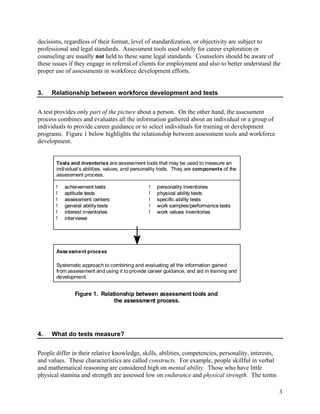
3.   Relationship between workforce development and tests


A test provides only part of the picture about a person. On the other hand, the assessment
process combines and evaluates all the information gathered about an individual or a group of
individuals to provide career guidance or to select individuals for training or development
programs. Figure 1 below highlights the relationship between assessment tools and workforce
development.


       Tests and inventories are assessment tools that may be used to measure an
       individual’s abilities, values, and personality traits. They are components of the
       assessment process.

       !   achievement tests                     !   personality inventories
       !   aptitude tests                        !   physical ability tests
       !   assessment centers                    !   specific ability tests
       !   general ability tests                 !   work samples/performance tests
       !   interest inventories                  !   work values inventories
       !   interviews


       Asse ssment process

       Systematic approach to combining and evaluating all the information gained
       from assessment and using it to provide career guidance, and aid in training and
       development.


               Figure 1. Relationship between assessment tools and
                              the assessment process.


4.   What do tests measure?


People differ in their relative knowledge, skills, abilities, competencies, personality, interests,
and values. These characteristics are called constructs. For example, people skillful in verbal
and mathematical reasoning are considered high on mental ability. Those who have little
physical stamina and strength are assessed low on endurance and physical strength. The terms

                                                                                                      3
mental ability, endurance, and physical strength are constructs. Constructs are used to identify
personal characteristics and to distinguish between people in terms of how much they possess of
such characteristics.

Constructs cannot be seen or heard, but we can observe their effects on other variables. For
example, we don’t observe physical strength, but we can observe people with great strength
lifting heavy objects and people with limited strength attempting, but failing, to lift these objects.
 Tests give us information about characteristics we may not otherwise observe that, in turn, can
be used to help individuals and organizations to develop their skill base or competencies.

Individuals vary in terms of constructs. These differences systematically affect their job and
occupational suitability, career choices, job satisfaction, training needs, and overall career
success.

These differences in characteristics are not necessarily apparent by simply observing an
individual. In career counseling, assessment tools can be used to gather accurate information
about career-relevant characteristics. For example, interest inventories are designed to measure
people’s likes and dislikes for various activities. Scores on an interest inventory summarize
interest patterns of the client that can be used to gauge his or her “fit” with different jobs or
occupations. Therefore, interest inventories can play an important role in career planning.

For training, tests can reveal skill and ability levels of individuals, indicating training needs.
For example, a keyboard or typing test might be used to measure an individual’s current abilities
and can be used to determine whether or not training is needed. Assessment tools also can be
used to predict an individual’s success in training, aiding in selection of candidates for training
programs. To give an example, an employee’s score on a mechanical test reflects his or her
mechanical aptitude as measured by the test. This score can be used to predict that person’s
likelihood of success in mechanical training. Skill or ability tests also can be used to assess an
individual’s progress in training or to evaluate the effectiveness of a training program. By pre-
and post-testing trainees, skill or ability tests can tell us how effective the training is in general,
not just for an individual.

In career development programs, tests can be used to identify and select suitable candidates for
certain career tracks. For example, an ability measure might be used to determine managerial
potential. Results of this assessment then can be used to place individuals in career tracks that
lead to managerial positions. Part of this process also may include career guidance assessment,
to help individuals determine their choices for career development programs. For example, a
skills assessment might help an individual identify strengths that he or she can link to particular
occupations. Tests also can be used to monitor an individual’s progress through a specific career
development program. They can help determine if the individual is acquiring the necessary
skills or knowledge required to move to the next step in their career.


                                                                                                      4
5.   Importance of using tests in a purposeful manner


Assessment instruments, like other tools, can be extremely helpful when used properly, but
counterproductive when used inappropriately. Often, inappropriate use stems from not having a
clear understanding of what you want to measure and why you want to measure it. Having a
clear understanding of the purpose of your assessment system is important in selecting the
appropriate assessment tools to meet that purpose. This brings us to an important principle of
assessment.

Principle of Assessment
Use assessment tools in a purposeful manner. It is critical to have a clear understanding of what
needs to be measured and for what purpose.

Assessment strategies should be developed with a clear understanding of the knowledge, skills,
abilities, characteristics, or personal traits you want to measure. It is also essential to have a
clear idea of what each assessment tool you are considering using is designed to measure.


6.   Limitations of tests: fallibility of test scores


Professionally developed tests and procedures that are used as part of a planned assessment
program may help in career guidance, training, and development. However, it is essential to
understand that all assessment tools are subject to errors, both in measuring a characteristic,
such as verbal ability, and in predicting performance, such as success in training. This is true for
all tests and procedures, regardless of how objective or standardized they might be.

      Do not expect any test or procedure to measure a personal trait or ability with perfect
      accuracy for every single person.
      Do not expect any test or procedure to be completely accurate in predicting performance
      or job satisfaction.

There will be cases when a test score or procedure will predict suitability for a particular
occupation, when in fact the person would not prove to be satisfied in that occupation. There
also will be cases in which an individual receiving a low score will be advised against a
particular occupation, when in fact the person actually would be a capable and good worker.

Similarly, there will be cases where a test score or procedure will predict success in training for
an individual who then does not succeed. Such errors in this context are called selection errors.
Selection errors cannot be completely avoided in any assessment program.

Why use testing despite these errors? The answer is that appropriate use of professionally
developed assessment tools on average enables individuals and organizations to make more
effective decisions than use of simple observations or random decision making.


                                                                                                      5
Using a single test or procedure will provide you with a limited view of a person’s career
interests or training needs. Moreover, you may reach a mistaken conclusion by giving too much
weight to a single test result. On the other hand, using a variety of assessment tools enables you
to get a more complete picture of the individual. The practice of using a variety of tests and
procedures to more fully assess people is referred to as the whole-person approach. This will
help reduce the number of selection errors made and will boost the effectiveness of your decision
making. This leads to an important principle of assessment.


Principle of Assessment
Do not rely too much on any one test to make decisions. Use the whole-person approach to
assessment.


                                                                                                6
CHAPTER 2              Understanding the Professional and Legal
                       Context of Assessment in Workforce
                       Development
This chapter introduces some of the major laws and professional guidelines that govern the use
of tests in career counseling, job placement, employment, and/or training and development. It
also describes some of the laws and identifies the testing standards adopted by major
professional organizations involved with psychology, testing, and measurement.

Chapter Highlights

   1. Overview of Pertinent Laws and Guidelines
   2. Laws and Guidelines That Apply to Vocational Counseling Programs
       2.1     Title IX of the Education Amendments of 1972, as amended
       2.2     Section 504 of the Rehabilitation Act of 1973, as amended
       2.3     Career Education Incentive Implementation Act of 1977
       2.4     Vocational Educational Programs Guidelines of 1979
       2.5     Carl D. Perkins Vocational and Training Education Act of 1990, as amended
       2.6     Workforce Investment Act of 1998
       2.7     Responsibilities of Users of Standardized Tests (RUST) - 2003
       2.8     The Program Evaluation Standards - 1994
       2.9     Title VI of the Civil Rights Act of 1964, as amended
       2.10    Age Discrimination Act of 1975, as amended
       2.11    Title II of the Americans with Disabilities Act of 1990, as amended
   3. Laws and Guidelines That Apply When Tests and Assessments Are Used in Employment
      Situations
      3.1     Title VII of the Civil Rights Act (CRA) of 1964, as amended
      3.2     Age Discrimination in Employment Act of 1967 (ADEA), as amended
      3.3     Uniform Guidelines on Employee Selection Procedures - 1978
      3.4     Title I of the Americans with Disabilities Act (ADA) of 1990
      3.5     Equal Employment Opportunity Commission (EEOC)
      3.6     Record-keeping of adverse impact and job-relatedness of tests
      3.7     Relationship between federal, state, and local employment laws
      3.8     Standards for Educational and Psychological Testing - 1999; Principles for the
              Validation and Use of Personnel Selection Procedures – 2003

Several laws protect individuals with disabilities. These laws include, but are not limited to, the
Workforce Investment Act of 1998 (WIA) and Section 504 of the Rehabilitation Act of 1973, as
amended (Section 504), and Americans with Disabilities Act of 1990 (ADA). Any reference in
this Guide to ADA should be interpreted to include pertinent provisions of WIA and Section
504.
                                                                                                2-1
Principle of Assessment Discussed
Use only assessment instruments that are unbiased and fair to all groups.


1. Overview of Pertinent Laws and Guidelines


The number of laws and guidelines governing workforce development (employment, training,
counseling) has increased over the past four decades. This increase resulted from developments
in the fields of civil rights, industrial psychology, vocational education, and career counseling.
This chapter is presented to provide workforce professionals important information that can help
them successfully utilize assessments to assist clients in career development and career
exploration.

The laws and guidelines discussed first in this chapter apply most directly to vocational
counseling programs, for example, organizations which receive federal financial assistance, such
as One-Stop Career Centers and vocational rehabilitation programs. Such programs conduct
career counseling, including career exploration, career development, or training. The laws and
guidelines discussed second in this chapter apply when employers use tests and other
assessments in the context of the employment process. For example, an employer may provide
career counseling or training or make an employment selection decision based on validated tests,
inventories, and other assessment tools.

The general purpose of the employment laws discussed in this chapter is to prohibit
discrimination in employment and provide equal employment opportunity for all.
Discrimination occurs when employment decisions are based on race, sex, religion, ethnicity,
age, or disability rather than on job-relevant knowledge, skills, abilities, and other
characteristics. Employment practices also may be discriminatory if they disproportionately
disadvantage a particular group of individuals. Employment practices that discriminate against
people are called unlawful or discriminatory employment practices. Laws and guidelines
directed towards organizations receiving federal financial assistance that provide vocational
counseling services also are geared towards prohibiting discrimination (e.g., not making
decisions based on race, sex, religion, ethnicity, age, or disability) in these types of programs
and providing equal access to services for all. The summaries of the professional standards and
guidelines in this chapter focus on their impact on workforce development programs.

Before you institute any policies based on these laws and regulations, read the specific laws
carefully and consult with your legal advisors regarding the implications for your particular
assessment program.


                                                                                                2-2
2. Laws and Guidelines That Apply to Vocational Counseling Programs

As discussed above, this first set of information applies most directly to career counseling, career
development, and career exploration programs.


   2.1   Title IX of the Education Amendments of 1972, as amended

   This legislation prohibits recipients of federal financial assistance from discriminating on the
   basis of sex in educational programs or activities. Specifically, the statute states that “no
   person in the United States shall, on the basis of sex, be excluded from participation in, be
   denied the benefits of or be subjected to discrimination under any educational program or
   activity receiving federal financial assistance.” Title IX seeks to ensure that federal financial
   assistance is not used to support sex-based discrimination and that individuals have equal
   opportunities, without regard to gender, to pursue, engage or participate in and benefit from
   academic, extracurricular, research, occupational training, employment, and other
   educational programs or activities. To comply with this legislation, your program should use
   assessments in your workforce investment activities that are fair and unbiased for both men
   and women.


   2.2   Section 504 of the Rehabilitation Act of 1973, as amended

   The purpose of this Act is to empower individuals with disabilities to maximize their
   employment, independence, and integration into society. The Act aims to provide equal
   opportunity for persons with disabilities, especially in terms of gainful employment and
   participation in federally-funded programs and activities. Section 504 of the Rehabilitation
   Act prohibits discrimination on the basis of disability in programs and activities receiving
   federal financial assistance or conducted by an executive branch agency. No otherwise
   qualified individual with a disability may be excluded from participation in, or denied the
   benefits of, or otherwise be subjected to discrimination under any service, program or
   activity receiving federal financial assistance. Such services, programs, or activities must
   provide reasonable modifications to allow otherwise qualified individuals with disabilities to
   participate or benefit unless such modifications would fundamentally alter the nature of the
   service, program, or activity.

   It is important that your program use assessments which are fair and unbiased for persons
   with disabilities. When selecting assessments for your counseling or training program, think
   about whether or not they are appropriate for clients with disabilities whom you serve. If an
   assessment tool or the administration of a test discriminates on the basis of disability, you
   may be required to provide a reasonable accommodation or modification (e.g., equipment,
   timing, administration procedures).


                                                                                                2-3
2.3   Career Education Incentive Implementation Act of 1977

This legislation further integrated the use of tests in career education, guidance, and
counseling programs in public schools. One of its primary contributions has been to extend
the use of career assessment instruments into middle and elementary schools. As a service
provider, it may be useful for your agency to be knowledgeable about the application of
career assessments in your local school district. Clients may come to your agency with
previous assessment information that can help inform their career choices.

2.4   Vocational Education Programs Guidelines of 1979

In 1979, the Office of Civil Rights of the Department of Health, Education and Welfare
(HEW) issued the Vocational Educational Programs Guidelines for Eliminating
Discrimination and Denial of Services on the Basis of Race, Color, National Origin, Sex and
Handicap. These guidelines were modeled after major civil rights legislation, including the
Civil Rights Act of 1964 and the Rehabilitation Act of 1973. They prohibit the use of tests in
ways that would deny or limit a person’s opportunity to pursue training in vocational
education programs based on his or her demographic background. For example, in
counseling clients, if you are using a verbal and quantitative abilities test that has adverse
impact, you may be limiting your recommendations, or a client’s options, for career paths.

2.5   Carl D. Perkins Vocational and Training Education Act of 1990, as amended

The Vocational and Training Education Act promotes the use of federal funds to provide
vocational-technical training programs and services to youth and adults and, in particular,
special populations. The goals of programs funded by this Act are to provide participants
with the academic and vocational skills needed to be successful contenders in a world
market. In order for a state to receive funding under the Act, it must submit a state plan. The
law states that programs must offer equal access to all participants.

The plans should cover such topics as the:
       type of career counseling and exploration services provided;
       resources and training that will be available to educators charged with carrying out
       the program;
       communication mechanisms that will be put in place to foster interaction between
       educators, students, and parents;
       academic and technical training programs that will be implemented, and the skills
       they will address; and
       programs that will be put in place to prepare participants for entry into post-
       secondary education or high skill and high wage occupations.


                                                                                              2-4
Assessments are a critical part of any plan submitted. The Act states that proper assessments
should be used to evaluate the success of the program for each special population, and
different assessments may need to be implemented for each special population. In
developing and implementing your program, assessments can be used to:
        provide information for career exploration and career counseling;
        objectively identify the education and skill building participants require;
        identify and develop students’ career goals and objectives;
        evaluate students’ success; and
        evaluate the success of the program itself for particular populations.

The Act provides very specific details of requirements for programs seeking funding under
this legislation.


2.6   Workforce Investment Act of 1998

The Workforce Investment Act of 1998 (WIA) replaced the Job Training Partnership Act
(JTPA) as the fundamental federal initiative of workforce development. The Act was
enacted on August 7, 1998, and became fully effective as of July 1, 2000. Title I builds upon
the JTPA and approves the use of federal financial assistance to provide workforce
investment activities through statewide and local workforce investment systems to increase
employment outcomes and occupational skill attainment of participants. It provides funding
for core, intensive, training and supportive services through three main areas of funding
streams: youth, adults, and dislocated workers. It creates a One-Stop Delivery System that
can be used by interested parties to explore work preparation and career development
services and to access a variety of training, employment, and adult and occupational
education programs. These One-Stop Delivery Systems offer core employment-related
services and access to the other employment and training services funded under the Act as
well as under other federal programs.
The federal government provides WIA financial assistance by formula to states. States
allocate WIA financial assistance by formula to local areas for appropriate local programs.
The level and mix of services provided to participants depends upon a determination of the
services needed to obtain or retain employment. Assessments are critical tools in making
such determinations. Assessments can assist in identifying their characteristics, including
abilities, interests, interpersonal skills, and experience of participants. Results of the
assessments should be used to determine the types of intervention, training, and experience
individuals need to perform productively in an appropriate work environment. Assessments
also can be used to determine individuals’ progress in achieving their goals and the goals of
the interventions.


                                                                                           2-5
2.7   Responsibilities of Users of Standardized Tests (RUST) - 2003

This is the joint policy statement of the Association for Assessment Counselors (AAC) and
the American Counseling Association (ACA). RUST is an excellent resource guide on the
standards by which tests should be used in counseling. It contains detailed guidelines on test
selection, administration, scoring, and interpretation. Also discussed are the necessary
qualifications of test users and the procedures for communicating test results to clients.


2.8   The Program Evaluation Standards - 1994

The Program Evaluation Standards address the development and use of assessments in
conducting evaluations of educational and training programs and are very useful for
professionals who need to monitor and report on the effectiveness of their workforce
development programs. Their development was sponsored by the American Association of
School Administrators, the American Educational Research Association, the American
Evaluation Association, the American Federation of Teachers, the American Psychological
Association, the Association for Assessment in Counseling, the Association for Supervision
and Curriculum Development, the Canadian Society for the Study of Education, the Council
of Chief State School Officers, the Council on Post-Secondary Accreditation, the National
Association of Elementary School Principals, the National Association of Secondary School
Principals, the National Council on Measurement in Education, the National Education
Association, and the National School Boards Association.


2.9   Title VI of the Civil Rights Act of 1964, as amended

Title VI of the Civil Rights Act of 1964 prohibits recipients of federal financial assistance
from discriminating on the basis of race, color, or national origin. Implementing regulations
state that the registering, counseling, testing, recruitment, selection, referral to job openings,
or referral for training opportunities, and all other activities performed by or through
government service offices financed in whole or in part from federal funds, must be
conducted without regard to race, color, or national origin. Use assessments that are fair and
unbiased for persons of different races, color, or national origin.


2.10 Age Discrimination Act of 1975, as amended

This legislation prohibits discrimination on the basis of age in programs and activities
receiving federal financial assistance. Unlike the Age Discrimination in Employment Act
(ADEA), the Age Discrimination Act applies to all age levels.

To help your program comply with this legislation, you should implement assessments that
are unbiased and fair to persons of different ages. In some cases, this might mean using
different assessments for clients of different ages. This might be necessary because many
assessments are designed for specific age groups.


                                                                                               2-6
2.11 Title II of the Americans with Disabilities Act of 1990, as amended

     This legislation prohibits state and local governments from discriminating against qualified
     individuals with disabilities from participating in or deriving benefits from their services,
     programs, or activities. The state and local governments must make reasonable
     modifications in the policies, practices, or procedures when necessary to avoid
     discrimination on the basis of disability, unless making such changes would fundamentally
     alter the nature of the service, program, or activity.

     To help your state or local workforce development program comply with this legislation, be
     sure to use assessments that are fair and unbiased for persons with disabilities that you serve.
     Choose assessments that are flexible, so reasonable modifications (equipment, set-up, timing,
     administration procedures) can be made for your clients with disabilities. For assistance in
     complying with Title II, you may contact the Department of Justice at (800) 514-0301
     (voice) or (800) 514-0383 (TDD).


3.     Laws and Guidelines That Apply When Tests and Assessments Are Used in
       Employment Situations

     3.1   Title VII of the Civil Rights Act (CRA) of 1964, as amended

     Title VII is legislation that prohibits discrimination in all terms and conditions of
     employment based on race, color, religion, sex, or national origin. The employment
     practices covered by this law include the following:

        recruitment                         hiring                         job classification
        transfer                            training                       promotion
        performance appraisal               compensation                   union or other
        disciplinary action                 termination                     membership
                                                                           fringe benefits
.
     Employers having 15 or more employees, public and private educational institutions, state
     and local governments, joint (labor-management) committees for apprenticeship and training,
     employment agencies, and labor unions are subject to this law.

     Title VII authorizes the use of professionally-developed ability tests in making employment
     decisions. However, only instruments that are not designed, intended, or used to discriminate
     against any particular group can be used. Even professionally-developed tests, however, must
     meet the requirements of the Uniform Guidelines on Employee Selection Procedures (see
     Section 3.5 of this chapter).

     Another important provision of Title VII relates to the use of group-based test score
     adjustments to maintain a representative workforce. The Act prohibits score adjustments, the
     use of different cut-off scores for different groups of test takers, or alteration of employment-
     related test results based on the demographics of the test takers. Such practices, which are

                                                                                                   2-7
referred to as race norming or within-group norming, were used in the past by some
employers and government agencies to avoid adverse impact.

3.2   Age Discrimination in Employment Act of 1967 (ADEA), as amended

This Act prohibits discrimination against employees or applicants age 40 or older in all
aspects of the employment process, including hiring, firing, promotion, demotion, transfer,
compensation, termination, and admission to training programs. Individuals in this group
must be provided equal employment opportunity; discrimination in testing and assessment is
prohibited. If an older worker charges discrimination under the ADEA, the employer may
defend the practice if it can be shown that the job requirement is a matter of business
necessity. Employers must have documented support for the argument they use as a defense.

The ADEA covers employers having 20 or more employees, labor unions, and employment
agencies. Certain groups of employees are exempt from ADEA coverage, including public
law enforcement personnel, such as police officers and firefighters. Uniformed military
personnel also are exempt from ADEA coverage.

3.3   Uniform Guidelines on Employee Selection Procedures - 1978; adverse or
      disparate impact, approaches to determine existence of adverse impact, four-fifths
      rule, job-relatedness, business necessity, biased assessment procedures

In 1978, the EEOC and three other federal agenciesCthe Civil Service Commission
(predecessor of the Office of Personnel Management) and the Labor and Justice
DepartmentsCjointly issued the Uniform Guidelines on Employee Selection Procedures. The
Guidelines incorporate a set of principles governing the use of employee selection procedures
according to applicable laws. They provide a framework for employers and other
organizations for determining the proper use of tests and other selection procedures. The
Guidelines are legally binding regulations under a number of civil rights laws, including
Executive Order 11246, the Workforce Investment Act, and the Wagner-Peyser Act. In
reviewing the testing practices of organizations under Title VII, the courts generally give
great importance to the Guidelines’ technical standards for establishing the job-relatedness of
tests. Also, federal and state agencies, including the EEOC, apply the Uniform Guidelines in
enforcing Title VII and related laws.

The Guidelines cover employers with 15 or more employees, labor organizations, and
employment agencies. They also cover contractors and subcontractors to the federal
government and some organizations receiving federal financial assistance. They apply to
tests, inventories, and procedures used to make employment decisions. Employment
decisions include hiring, promotion, referral, disciplinary action, termination, licensing, and
certification. Training may be included as an employment decision if it leads to any of the
actions listed above.

One of the basic principles of the Uniform Guidelines is that it is unlawful to use a test or
selection procedure that creates adverse impact, unless justified. Adverse impact occurs when
there is a substantially different rate of selection in hiring, promotion, or other employment
decisions that works to the disadvantage of members of a race, sex, or ethnic group.


                                                                                              2-8
Different approaches exist that can be used to determine whether adverse impact has
  occurred. Statistical techniques may provide information regarding whether or not the use of a
  test results in adverse impact. Adverse impact is normally indicated when the selection rate
  for one group is less than 80% (4/5) that of another. This measure is commonly referred to as
  the four-fifths or 80% rule. However, variations in sample size may affect the interpretation
  of the calculation. For example, the 80% rule may not be accurate in detecting substantially
  different rates of selection in very large or small samples. When determining whether there is
  adverse impact in very large or small samples, more sensitive tests of statistical significance
  should be employed.

  The Guidelines recommend the following actions when adverse impact occurs:

           Modify the assessment instrument or procedure causing adverse impact.
           Exclude the component procedure causing adverse impact from your assessment
           program.
           Use an alternative procedure that causes little or no adverse impact, assuming that the
           alternative procedure is substantially equally valid.
           Use the selection instrument that has adverse impact if the procedure is job-related
           and justified by business necessity, and there is no equally effective procedure
           available that has less adverse impact.

  Demonstrating job-relatedness of a test is the same as establishing that the test may be validly
  used as desired. Chapter 3 discusses the concept of test validity and methods for establishing
  the validity or job-relatedness of a test.

  Demonstrating the business necessity of using a particular assessment instrument involves
  showing that its use is essential to the safe and efficient operation of the business and that
  there are no alternative procedures available that are substantially equally valid to achieve the
  business objectives with a lesser adverse impact.

  Another issue of importance discussed in the Uniform Guidelines relates to test fairness. The
  Uniform Guidelines define biased or unfair assessment procedures as those assessment
  procedures on which members of one race, sex, or ethnic group characteristically obtain lower
  scores than members of another group, and the differences in the scores are not reflected in
  differences in the job performance of members of the groups.

  The meaning of scores on an unfair or biased assessment procedure will differ depending on
  the group membership of the person taking the test. Therefore, using biased tests can prevent
  employers from making equitable employment decisions. This leads to the next principle.

Principle of Assessment
Use only assessment instruments that are unbiased and fair to all groups.

  Use of biased tools may result in discrimination against members of the lower scoring groups.
  However, use of fair and unbiased tests can still result in adverse impact in some cases. If
  you are developing your own test or procedure, expert help may be advisable to make sure
  your procedure is fair to all relevant groups. If you are planning to purchase professionally-
                                                                                                2-9
developed assessment tools, first evaluate the fairness of those you are considering by reading
the test manuals and consulting independent reviews.
While the Uniform Guidelines focus on employment-related decisions, such as hiring,
promotion, termination, or certification, they also can apply to training programs, particularly
when tests are used to select individuals for training or career development programs. The
Uniform Guidelines may apply to career counseling programs when referrals are based on
assessments that may have adverse impact. Whether or not the Uniform Guidelines apply
specifically to your program, you should be well-versed in the concept of adverse impact and
the guidelines provided in this document.
3.4   Title I of the Americans with Disabilities Act (ADA) of 1990
Under the ADA, qualified individuals with disabilities must be given equal opportunity in all
aspects of employment. The law prohibits employers with 15 or more employees, labor
unions, and employment agencies from discriminating against qualified individuals with
disabilities. Prohibited discrimination includes a failure to provide reasonable
accommodation to persons with disabilities unless doing so would pose an undue hardship.
Title I of the ADA also prohibits the denial of admission to an employment-related
apprenticeship, counseling, or training program on the basis of a physical or mental
disability.

A qualified individual with a disability is one who can perform the essential functions of a
job, with or without reasonable accommodation.

        Disability is defined broadly to include any actual, perceived, or record of a physical
        or mental impairment that substantially limits one or more of an individual’s major
        life activities, such as caring for oneself, walking, talking, hearing, or seeing. Some
        common examples include visual, speech, and hearing disabilities; epilepsy; specific
        learning disabilities; cancer; serious mental illness; AIDS and HIV infection;
        alcoholism; and past drug addiction. Noteworthy among conditions not covered are
        current illegal use of drugs, sexual behavior disorders, compulsive gambling,
        kleptomania, and pyromania.
        Essential functions are the primary job duties that are fundamental, and not marginal,
        to the job. Factors relevant to determining whether a function is essential include
        written job descriptions, the amount of time spent performing the function, the
        consequences of not requiring the function, and the work experiences of employees
        who hold the same or similar jobs.
        Reasonable accommodation is defined as a change in the job application and
        selection process, a change in the work environment, or a change in the manner in
        which the work is performed, that enables a qualified person with a disability to enjoy
        equal employment opportunities. Under this Act, qualified individuals with
        disabilities must be provided reasonable accommodation so they can perform the
        essential job functions, as long as this does not create undue hardship to the
        employer.
        Undue hardship is defined as significant difficulty or additional expense and is
        determined based on a number of factors. Some factors that are considered are the
        nature and net cost of the accommodation, the financial resources of the facility, the
        number employed at the facility, the effect on resources and operations, the overall
                                                                                             2-10
financial resources of the entire organization, and the fiscal relationship of the facility
       with the organization. An accommodation that is possible for a large organization
       may pose an undue hardship for a small organization.

The ADA has major implications for your assessment practices. In training and development
programs, the ADA applies to employment opportunities. In employment counseling and
guidance, reasonable accommodations in the assessment process also are required in
providing services.

       In general, it is the responsibility of the individual with a disability to inform the
       service provider that an accommodation is needed. When an accommodation is
       requested, if necessary, the provider may ask for documentation of the applicant’s
       disability and functional limitations for which he or she needs an accommodation.
       Reasonable accommodation may involve making the test site accessible or using an
       alternative assessment procedure. Administering tests that require individuals with
       disabilities to use their impaired abilities is prohibited unless the tests are intended to
       measure one of those abilities.
       One possible alternative procedure would be to use a form of the test that does not
       require use of the impaired ability. You may be required to provide an
       accommodation for the administration of the test. Another possibility is to use a
       procedure that compensates for the impaired ability, if appropriate. For example,
       allowing extra time to complete certain types of employment tests for someone with
       dyslexia or other learning disability, or providing a test with larger print, or supplying
       a reader to a visually impaired individual where appropriate would be considered
       reasonable accommodations.
       The ADA expressly prohibits making medical inquiries or administering medical
       examinations prior to making a job offer. This applies to selection of candidates for
       training and development programs as well, especially if such programs are linked to
       future employment or promotional opportunities. Before making medical inquiries or
       requiring medical exams, employers must make an offer of employment to the
       applicant. Employers may make medical inquiries or require medical exams of an
       employee only when doing so is work-related and justified by business necessity. All
       medical information employers obtain about applicants and employees is strictly
       confidential and must be treated as such. Access to and use of this information is also
       greatly restricted. Career counselors can help job seekers to understand their rights
       under the ADA.

Your organization should develop a written policy on conducting testing and assessment of
individuals with disabilities. This will help ensure compliance with the provisions of the
ADA.

If you need assistance in complying with the ADA, there are several resources you may
contact:

       U.S. Equal Employment Opportunity Commission: (202) 663-4494, (800) 669-4000,
       TTY: (800) 669-6820
       The Job Accommodation Network: (800) 526-7234

                                                                                             2-11
National Business and Disability Council: (516) 465-1515
       The American Foundation for the Blind: (202) 408-0200, (800) 232-5463
       Office of Disability Employment Policy: (866) 633-7365, TTY: (877) 889-5627
       Disability and Business Technical Assistance Centers: (800) 949-4232
       DisabilityInfo.gov (A Web site of information and resources):
       http://www.disabilityinfor.gov.


3.5   Equal Employment Opportunity Commission (EEOC)

The EEOC is responsible for enforcing many of the federal laws prohibiting employment
discrimination, including Title VII, the Age Discrimination in Employment Act, and the
Americans with Disabilities Act. It receives, investigates, and processes charges of unlawful
employment practices of employers filed by an individual, a group of individuals, or one of
its commissioners. If the EEOC determines that there is “reasonable cause” that an unlawful
employment practice has occurred, it is also authorized to sue on behalf of the charging
individual(s) or itself.


3.6   Record-keeping of adverse impact and job-relatedness of tests

Employers are required to maintain a record of their employment-related activities, including
statistics related to testing and adverse impact. Filing and record-keeping requirements for
large employers (those with over 100 employees) are generally more extensive than those for
employers with 100 or fewer employees. To learn more about the specific requirements,
refer to EEOC regulations on record-keeping and reporting requirements under Title VII and
the ADA (29 CFR Part 1602) and the Uniform Guidelines.


3.7   Relationship between federal, state, and local employment laws

Some states and localities have issued their own fair employment practices laws, and some
have adopted the federal Uniform Guidelines. These state and local laws may be more
stringent than corresponding federal laws. If there is a direct conflict, federal laws and
regulations override any contradictory provisions of corresponding state or local laws. You
should become thoroughly familiar with your own state and local laws on employment and
testing, or consult with appropriate experts, before you initiate and operate an assessment
program.


3.8   Standards for Educational and Psychological Testing - 1999; Principles for the
      Validation and Use of Personnel Selection Procedures - 2003

There are two resource guides published by major organizations in the testing field that will
help you set up and maintain an assessment program. The principles and practices presented
in these publications set the standards for professional conduct in all aspects of assessment.


                                                                                          2-12
The Standards for Educational and Psychological Testing. This publication was
   developed jointly by the American Psychological Association (APA), the National
   Council on Measurement in Education (NCME), and the American Educational Research
   Association (AERA). The Standards are an authoritative and comprehensive source of
   information on how to develop, evaluate, and use tests and other assessment procedures
   in educational, employment, counseling, and clinical settings. Although developed as
   professional guidelines, they are consistent with applicable regulations and are frequently
   cited in litigation involving testing practices.

   The Principles for the Validation and Use of Personnel Selection Procedures. This
   publication was developed by the Society for Industrial and Organizational Psychology
   (SIOP). Like the Standards, the Principles also are an excellent guide to good practices
   in the choice, development, evaluation, and use of assessment tools. However, their main
   focus is on tools used in the personnel assessment context. The Principles explain their
   relationship to the Standards in the following way:

The Standards primarily address psychometric issues while the Principles primarily address
the problems of making decisions in employee selection, placement, promotion, etc. The
major concern of the Standards is general; the primary concern of the Principles is that
performance on a test is related to performance on a job, in training, or other measures of job
success.

Compatibility of the Standards and the Principles with the Uniform Guidelines

The Uniform Guidelines were intended to be consistent with generally accepted professional
standards for validating and evaluating standardized tests and other selection procedures. In
this regard, the Guidelines specifically refer to the Standards.

It is strongly encouraged that you become familiar with both the Standards and the
Principles in addition to the Uniform Guidelines. Together, they can help you conduct
assessment in workforce development programs in a manner consistent with legal and
professional standards.

To summarize, this chapter has introduced several laws, regulations, standards, and
guidelines that are relevant to assessment in workforce development and employment.
Understanding them will help you to conduct assessments that are fair and useful within your
workforce development program. Many of the laws cited in this chapter focus on
employment-related decisions. However, they may relate to the use of assessments in
training and development programs or in job referral. Your knowledge of such laws and
regulations can help you assist clients or employees in their development process.


                                                                                           2-13
2-14
CHAPTER 3                  Understanding Test Quality: Concepts of
                           Reliability and Validity

Test reliability and validity are two technical properties of a test that indicate the quality and
usefulness of the test. These are the two most important features of a test. You should examine
these features when evaluating the suitability of the test for your use. This chapter provides a
simplified explanation of these two complex ideas. These explanations will help you to
understand reliability and validity information reported in test manuals and independent reviews
and to use that information to evaluate the suitability of a test in your workforce development
program.


Chapter Highlights

     1. What makes a good test?
     2. Test reliability
     3. Interpretation of reliability information from test manuals and reviews
     4. Types of reliability estimates
     5. Standard error of measurement
     6. Test validity
     7. Methods for conducting validation studies
     8. Using validity evidence from outside studies
     9. How to interpret validity information from test manuals and independent reviews


Principles of Assessment Discussed
Use only reliable assessment instruments and procedures.
Use only assessment procedures and instruments that have been demonstrated to be valid for the
specific purpose for which they are being used.
Use assessment tools that are appropriate for the target population.

1.    What makes a good test?


A test used in career guidance or for training and development is considered good if the
following can be said about it:

            The test measures what it claims to measure. For example, a test of mental ability
            does in fact measure mental ability and not some other characteristic.


                                                                                                 3-1
The test measures what it claims to measure consistently or reliably. This means that
           if a person were to take the test again, the person would get a similar test score.
           The test is purpose-relevant. In other words, the test measures one or more
           characteristics that are important to specific career decisions or for predicting or
           monitoring training and development outcomes.
           By using the test, more effective decisions can be made by and about individuals. For
           example, an interest inventory helps you to guide a client toward careers in which he
           or she is more likely to be satisfied. A mechanical aptitude test may help you predict
           who would benefit from mechanical training.

The degree to which a test has these qualities is indicated by two technical properties: reliability
and validity.


2.   Test reliability


Reliability refers to how dependably or consistently a test measures a characteristic. If a person
takes the test again, will he or she get a similar test score, or a much different score? A test that
yields similar scores for a person who repeats the test is said to measure a characteristic reliably.

How do we account for an individual who does not get exactly the same test score every time he
or she takes the test? Some possible reasons are the following:

           Test taker’s temporary psychological or physical state. Test performance can be
           influenced by a person’s psychological or physical state at the time of testing. For
           example, differing levels of anxiety, fatigue, or motivation may affect an individual’s
           test results.
           Environmental factors. Differences in the testing environment, such as room
           temperature, lighting, noise, or even the test administrator, can influence an
           individual’s test performance.
           Test form. Many tests have more than one version or form. Items differ on each
           form, but each form is supposed to measure the same thing. Different forms of a test
           are known as parallel forms or alternate forms. These forms are designed to have
           similar measurement characteristics, but they contain different items. Because the
           forms are not exactly the same, a test taker might do better on one form than on
           another.
           Multiple raters. In certain tests, scoring is determined by a rater’s judgments of the
           test taker’s performance or responses. Differences in training, experience, and frame
           of reference among raters can produce different test scores for the test taker.

These factors are sources of chance or random measurement error in the assessment process. If
there were no random errors of measurement, the individual would get the same test score, the
individual’s “true” score, each time. The degree to which test scores are unaffected by
measurement errors is an indication of the reliability of the test.


                                                                                                  3-2
Reliable assessment tools produce dependable, repeatable, and consistent information about
people. In order to meaningfully interpret test scores and make useful training, development, or
career-related decisions, you need reliable tools. This brings us to the next principle of
assessment.


Principle of Assessment
Use only reliable assessment instruments and procedures. In other words, use only assessment
tools that provide dependable and consistent information.


3.    Interpretation of reliability information from test manuals and reviews


Test manuals and independent reviews of tests provide information on test reliability. The
following discussion will help you interpret the reliability information about any test.

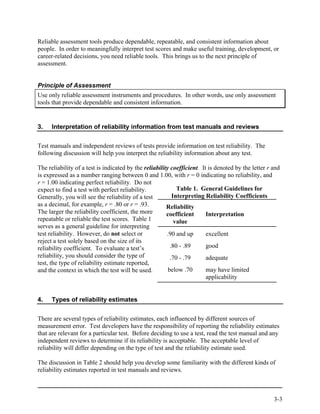
The reliability of a test is indicated by the reliability coefficient. It is denoted by the letter r and
is expressed as a number ranging between 0 and 1.00, with r = 0 indicating no reliability, and
r = 1.00 indicating perfect reliability. Do not
expect to find a test with perfect reliability.              Table 1. General Guidelines for
Generally, you will see the reliability of a test          Interpreting Reliability Coefficients
as a decimal, for example, r = .80 or r = .93.          Reliability
The larger the reliability coefficient, the more        coefficient      Interpretation
repeatable or reliable the test scores. Table 1             value
serves as a general guideline for interpreting
test reliability. However, do not select or             .90 and up       excellent
reject a test solely based on the size of its
reliability coefficient. To evaluate a test’s             .80 - .89      good
reliability, you should consider the type of              .70 - .79      adequate
test, the type of reliability estimate reported,
and the context in which the test will be used.          below .70       may have limited
                                                                         applicability


4.    Types of reliability estimates


There are several types of reliability estimates, each influenced by different sources of
measurement error. Test developers have the responsibility of reporting the reliability estimates
that are relevant for a particular test. Before deciding to use a test, read the test manual and any
independent reviews to determine if its reliability is acceptable. The acceptable level of
reliability will differ depending on the type of test and the reliability estimate used.

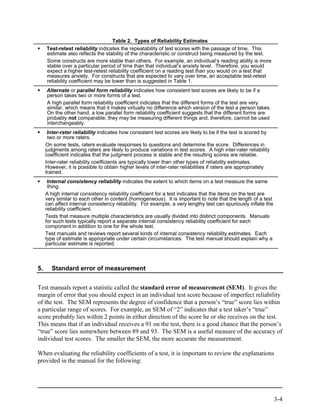
The discussion in Table 2 should help you develop some familiarity with the different kinds of
reliability estimates reported in test manuals and reviews.


                                                                                                     3-3
Table 2. Types of Reliability Estimates
     Test-retest reliability indicates the repeatability of test scores with the passage of time. This
     estimate also reflects the stability of the characteristic or construct being measured by the test.
     Some constructs are more stable than others. For example, an individual’s reading ability is more
     stable over a particular period of time than that individual’s anxiety level. Therefore, you would
     expect a higher test-retest reliability coefficient on a reading test than you would on a test that
     measures anxiety. For constructs that are expected to vary over time, an acceptable test-retest
     reliability coefficient may be lower than is suggested in Table 1.
     Alternate or parallel form reliability indicates how consistent test scores are likely to be if a
     person takes two or more forms of a test.
     A high parallel form reliability coefficient indicates that the different forms of the test are very
     similar, which means that it makes virtually no difference which version of the test a person takes.
     On the other hand, a low parallel form reliability coefficient suggests that the different forms are
     probably not comparable; they may be measuring different things and, therefore, cannot be used
     interchangeably.
      Inter-rater reliability indicates how consistent test scores are likely to be if the test is scored by
      two or more raters.
     On some tests, raters evaluate responses to questions and determine the score. Differences in
     judgments among raters are likely to produce variations in test scores. A high inter-rater reliability
     coefficient indicates that the judgment process is stable and the resulting scores are reliable.
     Inter-rater reliability coefficients are typically lower than other types of reliability estimates.
     However, it is possible to obtain higher levels of inter-rater reliabilities if raters are appropriately
     trained.
      Internal consistency reliability indicates the extent to which items on a test measure the same
      thing.
     A high internal consistency reliability coefficient for a test indicates that the items on the test are
     very similar to each other in content (homogeneous). It is important to note that the length of a test
     can affect internal consistency reliability. For example, a very lengthy test can spuriously inflate the
     reliability coefficient.
     Tests that measure multiple characteristics are usually divided into distinct components. Manuals
     for such tests typically report a separate internal consistency reliability coefficient for each
     component in addition to one for the whole test.
     Test manuals and reviews report several kinds of internal consistency reliability estimates. Each
     type of estimate is appropriate under certain circumstances. The test manual should explain why a
     particular estimate is reported.


5.      Standard error of measurement


Test manuals report a statistic called the standard error of measurement (SEM). It gives the
margin of error that you should expect in an individual test score because of imperfect reliability
of the test. The SEM represents the degree of confidence that a person’s “true” score lies within
a particular range of scores. For example, an SEM of “2” indicates that a test taker’s “true”
score probably lies within 2 points in either direction of the score he or she receives on the test.
This means that if an individual receives a 91 on the test, there is a good chance that the person’s
“true” score lies somewhere between 89 and 93. The SEM is a useful measure of the accuracy of
individual test scores. The smaller the SEM, the more accurate the measurement.

When evaluating the reliability coefficients of a test, it is important to review the explanations
provided in the manual for the following:


                                                                                                                3-4
Types of reliability used. The manual should indicate why a certain type of reliability
       coefficient was reported. The manual should also discuss sources of random
       measurement error that are relevant for the test.
       How reliability studies were conducted. The manual should indicate the conditions
       under which the data were obtained, such as the length of time that passed between
       administrations of a test in a test-retest reliability study. In general, reliabilities tend to
       drop as the time between test administrations increases.
       The characteristics of the sample group. The manual should indicate the important
       characteristics of the group used in gathering reliability information, such as educational
       level, occupation, etc. This will allow you to compare the characteristics of the people
       you want to test with the sample group. If they are sufficiently similar, then the reported
       reliability estimates will probably hold true for your population as well.

For more information on reliability, consult the Standards for Educational and Psychological
Testing (American Educational Research Association, American Psychological Association and
the National Council on Measurement in Education), the Society for Industrial and
Organizational Psychology’s Principles for the Validation and Use of Personnel Selection
Procedures, or any major textbook on psychometrics or employment testing. Appendix A lists
some possible sources.


6.   Test validity


Validity is the most important issue in selecting a test. Validity refers to the characteristic
that the test measures and how well the test measures that characteristic.

       Validity tells you, for example, if the characteristic being measured by a test is related to
       job satisfaction or training achievement.
       Validity gives meaning to the test scores. Validity evidence indicates that there is
       linkage between test performance and the construct it is intended to measure. It can tell
       you what you may conclude or predict about someone from his or her score on the test.
       Validity also describes the degree to which you can make specific conclusions or
       predictions about people based on their test scores. In other words, it indicates the
       usefulness of the test.

It is important to understand the differences between reliability and validity. Validity will tell
you how good a test is for a particular situation; reliability will tell you how trustworthy a score
on that test will be. You cannot draw valid conclusions from a test score unless you are sure that
the test is reliable. Even when a test is reliable, it may not be valid. You should be careful that
any test you select is both reliable and valid for your situation.

A test’s validity is established in reference to a specific purpose; the test may not be valid for
different purposes. For example, the test you use to make valid predictions about someone’s
career satisfaction may not be valid for predicting his or her likelihood of success in leadership
training. This leads to the next principle of assessment.


                                                                                                   3-5
Principle of Assessment
Use only assessment procedures and instruments that have been demonstrated to be valid for the
specific purpose for which they are being used.


Similarly, a test’s validity is established in reference to specific groups. These groups are called
the reference groups. The test may not be valid for different groups. For example, an
assessment tool designed to determine the work values of adults may not be suitable for use with
junior high school students. It is possible that many junior high school students are not
vocationally mature enough for the assessment to be meaningful for them, or perhaps the reading
level of the measure is not suitable for junior high school students. Similarly, a test used to
predict success of managers in leadership skills training might not be suitable for computer
technicians, even if the training program is similar. Computer technicians can be expected to
have had very different backgrounds with regard to leadership skills than managerial staff,
making the test valid for managers but not computer technicians.

Test developers have the responsibility of describing the reference groups used to develop the
test. The manual should describe the groups for whom the test is valid and the interpretation of
scores for individuals belonging to each of these groups. You must determine if the test can be
used appropriately with the particular type of people you want to test. This group of people is
called your target population or target group.


Principle of Assessment
Use assessment tools that are appropriate for the target population.

Your target group and the reference group do not have to match on all factors; they must be
sufficiently similar so that the test will yield meaningful scores for your group. For example, a
writing ability test developed for use with high school seniors may be appropriate for measuring
the writing ability of administrative assistants, even though these groups do not have identical
characteristics. In determining the appropriateness of a test for your target groups, consider
factors such as occupation, reading level, cultural differences, and language barriers.

Recall that the Uniform Guidelines require assessment tools to have adequate supporting
evidence for the conclusions you reach with them in the event adverse impact occurs. A valid
assessment tool is one that measures an important characteristic of interest to you. Use of valid
tools will, generally, enable you to make better decisions about career choices and training and
development needs. Both from business-efficiency and legal viewpoints, it is essential to use
only tests that are valid for your intended use.


                                                                                                3-6
7.   Methods for conducting validation studies


The Uniform Guidelines discusses the following three methods of conducting validation studies
and focuses mainly on the job-relatedness of a test, as pertinent to employment selection. This is
also relevant to selection for training and career development programs. The Guidelines
describes conditions under which each type of validation strategy is appropriate. It does not
express a preference for any one strategy to demonstrate the job-relatedness of a test.

       Criterion-related validation requires demonstration of a correlation or other statistical
       relationship between test performance and job performance. In other words, individuals
       who score high on the test tend to perform better on the job than those who score low on
       the test. If the criterion is obtained at the same time the test is given, it is called
       concurrent validity; if the criterion is obtained at a later time, it is called predictive
       validity.
       Content-related validation requires a demonstration that the content of the test represents
       important job-related behaviors. In other words, test items should be relevant to and
       measure directly important requirements and qualifications for the job.
       Construct-related validation requires a demonstration that the test measures the construct
       or characteristic it claims to measure, and that this characteristic is important to
       successful performance on the job.

More recently, professional standards and scientific references (Guion, 1980; Messick, 1989;
Cronbach, 1988; Camara & Brown, 1995) are discussing validity in slightly different terms.
Construct validity encompasses all other forms of validity, and validation is the cumulative and
on-going process of giving meaning to test scores. Rather than the traditional “3 Cs of Validity:
Content, Criterion, & Construct,” validity is viewed as a unitary concept which may have many
forms of evidence.

So, the overarching concept of validity is construct validity. A test must always measure some
construct(s), and the validity evidence you collect for the test demonstrates its ability to measure
the specified construct(s). This evidence may be obtained from a variety of sources, including
test content, response processes, internal structure of the test, and external criteria. You may
have more than one form of validity evidence for a single test.

As discussed in Chapter 1, a construct is any variable measured by a test: a trait, characteristic,
knowledge, skill, ability, or interest, for example. Evidence that a test is measuring the
construct(s) it is intended to measure can come from a variety of sources.

Content evidence relates the content of the test to the construct being assessed. This could be
determined through subject matter experts and often through analyzing documentation of the
development of a test, which should define the domain being assessed. For example, a test used
to measure achievement in pilot training would be developed based on a thorough identification
of the domain of knowledge, skills, and abilities necessary for being a pilot. This could be
determined using pilots’ expert judgments to identify the domain and to determine whether the
test’s items, structure, and format adequately measure the content.


                                                                                                 3-7
Evidence of validity also can be obtained from an analysis of response processes. For example,
a test of mathematical reasoning can be analyzed to determine whether examinees are
performing the mental processes the test is intended to measure. If so, this is another form of
validity evidence. The internal structure of a test can be studied to determine whether it supports
validity for a test. Item difficulty levels can be examined to see if they reflect the intended level
of difficulty of the construct being measured.

Tests also can be validated with evidence of their relationship to relevant criteria. Some
examples of criteria are success in training, success on the job, or job satisfaction. Criterion-
related evidence of validity is especially important when we are using a test to predict
something. If the test can be shown to be related to the criteria it is intended to predict, this is
evidence of the test’s validity. For example, if a test is meant to predict successful completion of
training in mechanics, it should be related to an assessment of training performance. If so, it has
evidence of validity for this use and would be appropriate to use in selecting candidates for
training.

Professionally developed tests should come with reports on validity evidence, including detailed
explanations of how validation studies were conducted. If you develop your own tests or
procedures, you will need to conduct your own validation studies. As the test user, you have the
ultimate responsibility for making sure that validity evidence exists for the conclusions you
reach using the tests. This applies to all tests and procedures you use, whether they have been
bought off-the-shelf, developed externally, or developed in-house. If you purchase a
professionally developed training program, you also must evaluate its assessment components
for validity.

Validity evidence is especially critical for tests that have adverse impact. When a test has
adverse impact, the Uniform Guidelines require that validity evidence for that specific
employment decision be provided. This is especially relevant for tests used for selection into
training and development programs. In career counseling, adverse impact rules may apply in the
use of assessments for job referral.

When training is required for a particular job, it should be highly related to performing that job,
which can be determined partly through a job analysis. Job analysis is a systematic process
used to identify the tasks, duties, responsibilities, and working conditions associated with a job
and the knowledge, skills, abilities, and other characteristics required to perform that job.

Job analysis information may be gathered by direct observation of people currently in the job,
interviews with experienced supervisors and job incumbents, questionnaires, personnel and
equipment records, and work manuals. In order to meet the requirements of the Uniform
Guidelines, it is advisable that the job analysis be conducted by a qualified professional, for
example, an industrial and organizational psychologist or other professional well trained in job
analysis techniques. Job analysis information is central in determining training objectives, what
to test for, and which tests to use.


                                                                                                 3-8
8.    Using validity evidence from outside studies


Conducting your own validation study is expensive, and, in many cases, you may not have
enough individuals or other resources to make it feasible to conduct a study. Therefore, you may
find it advantageous to use professionally developed assessment tools and procedures for which
documentation on validity already exists. However, care must be taken to make sure that
validity evidence obtained for an “outside” test study can be suitably “transported” to your
particular situation, especially for training and development purposes.

The Uniform Guidelines, the Standards, and the SIOP Principles state that evidence of
transportability is required. Consider the following when using outside tests:

            Validity evidence. The validation procedures used in the studies must be consistent
            with accepted standards.
            Job similarity. A job analysis should be performed to verify that your job or training
            program and the original job or training program are substantially similar in terms of
            ability requirements and work behavior.
            Fairness evidence. Reports of test fairness from outside studies must be considered
            for each protected group that is part of your labor market. When this information is
            not available for an otherwise qualified test, an internal study of test fairness should
            be conducted, if feasible.
            Other significant variables. These include the type of performance measures and
            standards used, the essential work activities performed, the similarity of your target
            group to the reference samples, as well as all other situational factors that might
            affect the applicability of the outside test for your use.

To ensure that the outside test you purchase or obtain meets professional and legal standards,
you should consult with testing professionals. See Chapter 5 for information on testing
consultants.


9.    How to interpret validity information from test manuals and independent
      reviews


To determine if a particular test is valid for your intended use, consult the test manual and
available independent reviews. (Chapter 5 offers sources for test reviews.) The information
below can help you interpret the validity evidence reported in these publications.

        In evaluating validity information, it is important to determine whether the test can be
        used in the specific way you intended and whether your target group is similar to the test
        reference group.

     Test manuals and reviews should describe:


                                                                                                 3-9
Available validation evidence supporting use of the test for specific purposes. The
   manual should include a thorough description of the procedures used in the validation
   studies and the results of those studies.
   The possible valid uses of the test. The purposes for which the test can legitimately be
   used should be described, as well as any performance criteria that can be validly
   predicted.
   The sample group(s) on which the test was developed. For example, was the test
   developed on a sample of high school graduates, managers, or clerical workers? What
   was the racial, ethnic, age, and gender mix of the sample?
   The group(s) for which the test may be used.

The criterion-related validity of a test is measured by the validity coefficient. It is reported
as a number between 0 and 1.00 that indicates the magnitude of the relationship r between
the test and a measure of training performance (criterion). The larger the validity coefficient,
the more confidence you can have in predictions made from the test scores. However, a
single test can never fully predict training        Table 3. General Guidelines for
performance because success in training            Interpreting Validity Coefficients
depends on so many varied factors.                   Validity
Therefore, validity coefficients, unlike                              Interpretation
                                                coefficient value
reliability coefficients, rarely exceed
r = .40.                                            above .35         very beneficial

                                                    .21 - .35        likely to be useful
As a general rule, the higher the validity
coefficient, the more beneficial it is to use      .11 - .20       depends on
the test. Validity coefficients of r = .21 to                      circumstances
r = .35 are typical for a single test and are
                                                  below .11        unlikely to be useful
considered useful. Validities for selection
systems that use multiple tests will
probably be higher because different tools are being used to measure/predict different aspects
of performance, whereas a single test is more likely to measure or predict fewer aspects of
total performance. Table 3 serves as a general guideline for interpreting test validity for a
single test.

For example, an abilities test with a reported validity coefficient of .30 is likely to be useful
and would be appropriate to use in screening candidates for training. However, the same test
with a validity coefficient of .10 is unlikely to be useful and should not be used in decision-
making. An abilities test with a validity coefficient of .18 might be useful to monitor
progress in training, but not to select candidates into development programs.

Evaluating test validity is a sophisticated task, and you might require the services of a testing
expert/consultant. In addition to the magnitude of the validity coefficient, you should also
consider at a minimum the following factors:

       Level of adverse impact associated with your assessment tool
       Selection ratio (number of applicants versus the number of openings)
       Cost of a referral error

                                                                                            3-10
Cost of the assessment tool
       Probability of referring qualified individuals based on chance alone.

Here are three scenarios illustrating why you should consider these factors, individually and
in combination with one another, when evaluating validity coefficients:

Scenario One

An employer has asked your agency to screen clients for a number of entry-level positions in
their company. They inform you that they have not been satisfied with the performance of
workers that they have hired in a number of positions. The company expects some level of
employee error, but wants to reduce errors as part of a cost saving measure they want to put
into operation. Therefore, in hiring for new openings in these positions, they would like your
agency to screen potential applicants with an assessment tool before sending them for an
interview for the job openings. Training time is relatively short for these positions since they
are not highly technical and do not require a great deal of skill.

It is determined that many of the errors made by the current employees are due to poor
clerical perception. You find two suitable clerical perception assessment tools. The first one
has high validity, however, the cost is prohibitive and the administration and scoring time for
your staff is extensive. The second assessment tool has a reasonable cost and has an
administration and scoring time that is more in line with your agency’s resources; however,
the validity is considered only “likely to be useful.” It is decided to use the second
assessment tool for several reasons: it will be used only as one part of the selection process
for this employer, it is likely to improve employee job performance, it is reasonably priced, it
is fairly quick to administer and score, and no adverse impact has been associated with it to
date.

Now, let’s change the situation.

Scenario Two

Based on requests from local employers who are looking for highly capable applicants to fill
a demanding and technical job, your agency is sponsoring a technical training course for
customers in your area. The companies with job openings have informed you that for these
particular positions, accuracy is very important; and employee errors could be both
dangerous and expensive. Therefore, using an assessment tool that will help select the most
competent trainees for the program is important. In addition, the significant expense of
training is wasted whenever trainees drop out of the training program before completion or
finish without acquiring the necessary competencies. After researching a number of
assessment tools, an assessment is identified that will be used as one part of the screening
process for potential trainees. While this assessment is a highly valid predictor of success for
this occupation, it takes quite a bit of time to administer and is expensive. Nevertheless, your
agency decides to use this assessment because its validity is considered to be “very
beneficial” and no adverse impact has been associated with it to date. An assessment with
lower validity would most likely not be acceptable considering the circumstances and the
companies’ job requirements. For persons who are not accepted into this training program, it


                                                                                           3-11
is important to provide career exploration activities and refer them to alternative
opportunities to train for occupations in demand.

Here is another scenario that shows why you need to consider multiple factors when
evaluating the validity of assessment tools.

Scenario Three

A company you are working with asks your agency to administer an assessment as part of
your referral process to their company. When reviewing the documentation on this
assessment you learn that even though it is considered to be a very effective selection system
for the occupation, it also results in fairly high levels of adverse impact. In addition, you are
concerned about the high cost of this particular assessment. Therefore, you conduct
additional research to identify other possible assessment tools that might have less adverse
impact and are less costly. In conducting your research, you carefully document your
findings. Your research concludes that the other available assessment tools with lower
adverse impact had substantially lower validity and were just as expensive. In addition, the
selection tool will be used as only one part of the screening process. Other factors of
consideration included the difficulty in hiring for this position, the “very beneficial” validity
of the assessment, and the failed attempts to find equally valid alternative instruments with
less adverse impact. As always, you consider any applicable state testing policies when
making your assessment decisions. You also consult appropriate legal counsel to assure that
your agency is in compliance with all applicable laws. Your agency decides that the
selection tool is acceptable because making mistakes in hiring decisions would represent too
great a risk for the company. Your agency plans to conduct periodic searches for new
assessment tools that have “very beneficial validity” and with less adverse impact. In the
meantime, your agency will use this assessment tool as part of the referral process.

Again, these examples demonstrate the complexity of evaluating the validity of assessments.
 Multiple factors often need to be considered. You might want to seek the assistance of a
testing expert (for example, an industrial/organizational psychologist) to evaluate the
appropriateness of particular assessments for various workforce investment customers and
their individual situations.

When properly applied, the use of valid and reliable assessment instruments will help you
and the clients you serve business and job seekers make better decisions. Additionally, by
using a variety of assessment tools as part of an assessment program, you can more fully
assess the skills and capabilities of individuals, while reducing the effects of errors
associated with any one tool.


                                                                                            3-12
CHAPTER 4              Assessment Tools and Their Uses in
                       Workforce Development
This chapter briefly describes different types of assessment tools and procedures that are used in
workforce development programs. Included are techniques used in career guidance and
counseling, training, and development programs. Results can help identify training needs,
strengths, and possible career paths. Table 4, which appears at the end of this chapter, contains a
brief description of the advantages and disadvantages of different types of assessment
instruments.

Chapter Highlights

     1. Preliminary assessment (career counseling)
     2. Mental and physical ability tests
     3. Achievement tests
     4. Interest measures
     5. Work and personal values measures
     6. Personality inventories
     7. Interviews
     8. Assessment centers
     9. Comprehensive career planning measures

It takes a good deal of knowledge and judgment to properly use assessment tools to make
effective decisions regarding career counseling, training, and development. Many assessment
tools and procedures require specialized training, education, or experience to administer and
interpret correctly. These requirements vary widely, depending on the specific instruments being
used. Check with the test publisher to determine whether you and your staff meet these
requirements. To ensure that test users have the necessary qualifications, some test publishers
and distributors require proof of qualifications before they will release certain tests.


1.    Preliminary assessment


In counseling, the process of assessment begins before the first interview when the counselor
reads the initial contact form completed by the client. This intake form often contains questions
which can guide the initial counseling interview. Typical items include the client’s name,
address, age, educational and work history, reason for referral to counseling, and whether the
client has been or is being counseled elsewhere. If the intake form is kept brief, it usually does
not present a barrier to the client.

The intake form can help direct the initial interview, guiding the discussion toward the client’s
most significant problems. The assessment process will enable the counselor to evaluate the

                                                                                                4-1
client’s needs and will help the counselor to select the most appropriate type of assessment tools
for the individual. The counselor also can learn at this time whether the client was referred by
another agency and whether any assessment was done at that agency.


2.   Mental and physical ability tests


When properly applied, ability tests are among the most useful and valid tools available for
predicting success in jobs and in training and for identifying training needs across a wide variety
of occupations. Counselors and job placement staff frequently use ability tests when the client is
considering an occupation or training program in which he or she has not had the opportunity to
demonstrate competence. For example, if a client is considering a career in bookkeeping, a
counselor might administer a quantitative abilities test to determine whether or not the individual
has the necessary abilities for that occupation. Ability tests also can be used to identify
employees or individuals who could benefit from training and to assess progress in training. A
mechanical abilities test might be used to determine whether employees need training for new
mechanical equipment or whether they have mastered training material. Mental ability tests are
generally used to measure the ability to learn and perform particular job responsibilities. Like
physical ability tests, they can be used in training and development programs. Examples of some
mental abilities are verbal, quantitative, and spatial abilities. Physical ability tests usually
encompass abilities such as strength, endurance, and flexibility.

       General ability tests typically measure one or more broad mental abilities, such as
       verbal, mathematical, and reasoning skills. These skills are fundamental to success in
       many different kinds of jobs and training, especially where cognitive activities such as
       reading, computing, analyzing, or communicating are involved.
       Specific ability tests include measures of distinct physical and mental abilities, such as
       reaction time, written comprehension, mathematical reasoning, and mechanical ability,
       which are important for many jobs and occupations. For example, good mechanical
       ability may be important for success in auto mechanic and engineering jobs; physical
       endurance may be critical for fire-fighting jobs.

Although mental ability tests are valid predictors of performance in many jobs, use of such tests
in selection or referral contexts often results in adverse impact. For example, research suggests
that mental abilities tests adversely impact some racial minority groups and, if speed is also a
component of the test, older workers may be adversely impacted. Similarly, use of physical
ability tests often results in adverse impact against women and older persons. See Chapter 7 for
strategies to minimize adverse impact in your assessment program.


3.   Achievement tests


Achievement tests, also known as proficiency tests, are frequently used to measure an
individual’s current knowledge or skills that are important to a particular job or a specific course
of study. They may be used to assess an individual’s progress in a specific training or career


                                                                                                 4-2
development program, or to assess the need for training. These tests generally fall into one of
the following formats:

       Knowledge tests typically involve specific questions to determine how much the
       individual knows about particular job tasks and responsibilities. Traditionally they have
       been administered in a paper-and-pencil format, but computer administration is becoming
       more common. Knowledge tests tend to have relatively high validity.
       Work-sample or performance tests require the individual to actually demonstrate or
       perform one or more job tasks. These tests, by their makeup, generally show a high
       degree of job-relatedness. Test takers generally view these tests as fairer than other types
       of tests. Use of these tests often results in less adverse impact than mental ability tests
       and job knowledge tests. They may be used in counseling to help a client get a realistic
       job preview, as well as to assess their achievement in a specific area. However, they can
       be expensive to develop and administer.

Achievement tests can also be important components of work readiness models. These
models/systems measure an individual’s readiness to enter into employment based on assessment
results. Persons who reach certain levels of achievement or who have mastered particular
competencies receive skill proficiency certificates which convey their level of mastery in terms
of the work readiness model.


4.   Interest measures


Interest measures usually assess a client’s career-related interests by having the client respond
positively or negatively to various activity statements or descriptions. Counselors use these
measures to help with career and academic planning, and they are often the most non-threatening
way to begin the career exploration process. They can be used to make clients aware of career
possibilities they had not previously considered, confirm tentative choices, or help clients focus
their attention on occupational areas that relate to their interests.

Two approaches are most often utilized in interest inventories - general scales and occupational
scales. General scales measure a client’s interests in broad categories (e.g., selling or physical
performing). Occupational scales assess how similar a client’s pattern of likes and dislikes is to
those of workers in various occupations.

General scales usually require less knowledge about the world of work than do occupational
scales. They often are used to assess high school students or inexperienced workers.
Occupational scales provide more occupationally-specific information than do general scales.
Therefore, occupational scales often are more appropriate instruments for the assessment of
vocationally-sophisticated clients. Many interest measures offer both scales in one instrument.

Interest measures differ in their response formats. Some ask for “like” or “dislike” responses;
others require forced choices between two or more items, and others ask for responses on a scale
of “like a lot” to “dislike a lot.”


                                                                                                  4-3
Interest inventories are attractive as counseling tools because they can be administered relatively
quickly, and their results tend to make intuitive sense to clients. Interest inventories typically do
a good job of predicting job satisfaction. They typically do not predict job or training
performance well. Therefore, interest measures are frequently used in counseling, but are rarely
used for selection or referral purposes.

It is important to be aware that interest patterns can be unstable for young or inexperienced
workers. Counselors may want to consider a new administration of an interest measure after six
months or so when working with such clients.


5.   Work and personal values measures


Interest measures ask people to consider whether they like or dislike activities performed on a
job, whereas work values instruments evaluate the relative importance of job activities and
conditions to them. Interest inventories address the question of what activities people like to
perform; work values instruments ask which conditions people consider most important and
rewarding to them.

Work values instruments typically ask clients to rate the importance of such characteristics as job
security, salary, or the opportunity to display creativity on the job. Work values instruments are
not used to make evaluative judgments. Rather, they are used to determine the relative
importance of various job characteristics to the client. When people are employed in positions
that meet their needs, they are more likely to be satisfied. Work values have been shown to be
valid predictors of job satisfaction.

Personal values instruments address broader value structures that relate to personal lives as well
as to careers. The importance of family, religion, and physical activity are examples of values
that may be measured by a personal values instrument. Exploring personal values can help
clarify work goals in the context of more general life goals.

Since they are used to explore clients’ values rather than their behavior or abilities, work values
instruments often are perceived by clients as less threatening than other assessments. They can
act as springboards to discussions of vocational characteristics and choices. They also can pave
the way for further testing. Values instruments can be used in conjunction with interest, ability,
and other measures as part of a whole-person assessment program to help clients make
vocational decisions.


6.   Personality inventories


Some employers and counselors use personality inventories to learn about an individual’s
personal, emotional, and social traits and behaviors. Personality inventories designed for use in
employment contexts are used to evaluate such characteristics as motivation, conscientiousness,
self-confidence, or how well an employee might get along with fellow workers.


                                                                                                  4-4
Research has shown that personality tests, in conjunction with other assessment instruments, can
yield helpful predictions for career guidance, and for some training and development programs.
For example, if a client is considering a career in customer service, a personality inventory that
includes a measure of introversion/extroversion can provide useful information about that
individual’s suitability for working with people. A personality inventory that assesses leadership
potential might be used to select individuals for a career development program in a managerial
track.

Personality tests fall into two general categories: vocational and clinical instruments.

       Vocationally-oriented instruments ask clients to check off or rate items that best describe
       themselves. These measures can be used to evaluate such characteristics as motivation,
       conscientiousness, self-confidence, or how well an individual might get along with
       fellow workers.
       Clinical instruments are designed to screen for psychopathology. They can be either
       general purpose measures that produce scores on a number of scales or they can be
       specific purpose measures that screen for narrower types of pathology such as depression
       or eating disorders.

If you decide to use a personality instrument, be sure that it is appropriate for your purposes, and
that you are trained to administer and interpret it. Clinical instruments usually are not
appropriate for career counseling or development because they have been devised to detect
psychopathology, not to assess job-relevant characteristics. Clinical tests are used in very
limited employment contexts, primarily for jobs in which it is critical for the employer to have
some idea about the applicant’s state of mind, such as in the selection of law enforcement
officers or nuclear power plant operators.

If a personality inventory or other assessment tool provides information that would lead to
identifying a mental disorder or impairment, the tool is considered a medical exam under the
ADA. The ADA permits medical examinations of applicants and employees only in limited
circumstances.

There are a few additional concerns about personality tests. Since there are usually no right or
wrong answers to the test items, test takers may provide socially desirable answers. However,
sophisticated personality inventories often have “lie-scales” built in, which allow such response
patterns to be detected. There is also a general perception that some of these tests ask personal
questions that are only indirectly relevant to job or training performance. This may raise concern
on the part of test takers that such tests are an invasion of privacy. Some of these concerns can
be reduced by including personality tests only as one part of a broader assessment program.


7.   Interviews


The interview is probably the most commonly used assessment tool. The interview can range
from being totally unplanned, that is, unstructured, to carefully designed beforehand, that is,
completely structured. The most structured interviews have characteristics such as standardized
questions, trained interviewers, specific question order, controlled length of time, and a

                                                                                                 4-5
standardized response evaluation format. At the other end of the spectrum, a completely
unstructured interview would probably be done “off the cuff,” with untrained interviewers,
random questions, and with no consideration of time. A structured interview will be more
reliable and valid. When interviews are used in selection for training or development programs,
reliability and validity become more important.

Counselors use interviews to help gather information about clients and clarify results of other
assessments. In counseling job-seekers, it is important to appraise their interviewing skills and
help them work on obstacles such as situational shyness, anxiety, and inappropriate body
language. Every question in a job interview is geared towards selecting applicants; clients may
need help to understand this. Counselors may need to explain how responses to seemingly
innocuous questions might help or harm clients’ chances for a job offer. Even sophisticated
clients may need a session focused on pinpointing their problem areas and anticipating the kinds
of questions that might be asked.

Regardless of the extent to which the interview is structured or unstructured, the skill of the
interviewer can make a difference in the quality of the information gathered. A skillful, trained
interviewer will be able to ask relevant follow-up questions to clarify and explore issues brought
up during the interview.

In selection, it is unlawful to ask questions about medical conditions and disabilities before a
conditional job offer. Even if the job applicant volunteers such information, employers are not
permitted to pursue inquiries about the nature of the medical condition or disability. Instead,
they should refocus the interview so that emphasis is on the ability of the applicant to perform
the job, not on the disability. Following a structured interview format can help interviewers
avoid unlawful or inappropriate inquiries where medical conditions, disability, and age are
concerned.

It is important to note that inquiries about race, ethnicity, or age generally are not expressly
prohibited under the law, but usually serve no credible purpose in an interview. These types of
questions also are closely scrutinized by organizations, including regulatory agencies interested
in protecting the civil rights of applicants. Counselors can prepare their clients by discussing
types of questions that are illegal for an employer to ask during a job interview and strategies for
responding to illegal or inappropriate questions.


8.   Assessment centers


Assessment centers are most widely used for managerial and other high level positions to assess
managerial potential, promotability, problem-solving skills, and decision-making skills. They
also may be an integral part of career development programs, for selection or for monitoring
individual progress. In the assessment center approach, candidates are generally assessed with a
wide variety of instruments and procedures. These could include interviews, ability and
personality measures, and a range of standardized management activities and problem-solving
exercises. Typical of these activities and exercises are in-basket tests, leaderless group
discussions, and role-play exercises.


                                                                                                 4-6
In-basket tests ask the candidates to sort through a manager’s “in-basket” of letters,
       memos, directives, and reports describing problems and scenarios. Candidates are asked
       to examine them, prioritize them, and respond appropriately with memos, action plans,
       and problem-solving strategies. Trained assessors then evaluate the candidates’
       responses.
       Leaderless group discussions are group exercises in which a group of candidates is asked
       to respond to various kinds of problems and scenarios without a designated group leader.
        Candidates are evaluated on their behavior in the group discussions. This might include
       their teamwork skills, their interaction with others, or their leadership skills.
       In role-play exercises, candidates are asked to pretend that they already have the job and
       must interact with another employee to solve a problem. The other employee is usually a
       trained assessor. The exercise may involve providing a solution to a problem that the
       employee presents or suggesting some course of action regarding a hypothetical situation.
       Candidates are evaluated on the behavior displayed, solutions provided, or advice given.

Assessors must be appropriately trained. Their skills and experience are essential to the quality
of the evaluations they provide.

Assessment centers apply the whole-person approach to personnel assessment. They can be very
good predictors of job performance and behavior when the tests and procedures making up the
assessment center are constructed and used appropriately.

It can be costly to set up an assessment center. Large companies may have their own assessment
centers; mid-size and smaller firms sometimes send candidates to private consulting firms for
evaluation.


9.   Comprehensive career planning measures


Comprehensive career planning measures combine several types of assessment instruments, such
as measures of abilities, interests, and values, into a single tool. In addition to traditional career
counseling, these measures may be used in career development programs. Such measures
generate a number of reports or scores, often including a report that synthesizes the findings of
the component scales into a set of vocational recommendations. A number of comprehensive
career planning measures produce computer-generated narrative reports. Some of the
comprehensive measures are based on self-estimates of levels of abilities and other
characteristics, while others are based on standardized tests or a combination of self-estimates
and standardized tests.

       Measures based on self-estimates can help clients to direct their thinking on vocational
       issues, but these measures are not designed to predict success in specific occupations. If
       clients are unable or unwilling to see a counselor, these instruments can serve as an
       alternative to counseling. Self-estimates are generally not used in selection and
       placement contexts.
       Measures incorporating standardized tests typically use several standardized measures,
       such as ability tests, interest inventories, and work values measures to provide

                                                                                                  4-7
information that clients can use to explore career possibilities. Standardized tests are
       typically validated in terms of their success in predicting job performance, job or career
       satisfaction, or tenure.

Often, career development measures can be accessed through career information delivery
systems. There are many web-based systems, and many states have developed their own local
systems. These systems coordinate a variety of assessment tools used in career development
with other client services that provide information about career options and opportunities. More
information can be obtained about career information delivery systems through the Association
of Computer-Based Systems for Career Information (ACSCI) at www.acsci.org.


            Table 4. Main Advantages and Disadvantages of Different Types of
                               Assessment Instruments

Type of assessment                   Advantages                          Disadvantages
    instrument
Ability tests             Mental ability tests
                                                                  Use of ability tests can result
                             Are among the most useful            in high levels of adverse
                             predictors of performance            impact.
                             across a wide variety of jobs.
                                                                  Physical ability tests can be
                             Are usually easy and                  costly to develop and
                             inexpensive to administer.            administer.

Achievement/                 In general, job knowledge and        Written job knowledge tests
proficiency tests             work-sample tests have              can result in adverse impact.
                              relatively high validity.
                                                                  Work-sample tests can be
                             Job knowledge tests are              expensive to develop and
                              generally easy and                  administer.
                              inexpensive to administer.
                             Work-sample tests usually
                              result in less adverse impact
                              than ability tests and written
                              knowledge tests.
Interest measures            Can be administered quickly.         May be unstable or unsuitable
                                                                  for young/inexperienced
                             Predict job satisfaction.            workers.
                             Are non-threatening to clients
                             undergoing career counseling.


Work and personal            Work values instruments can          Values instruments generally
values measures              be valid predictors of job or        do not predict job
                             career satisfaction.                 performance.
                             Values instruments are               Personal values instruments
                             generally not perceived as            may not relate directly to job
                             threatening by clients.               choice.

                                                                                                  4-8
Type of assessment           Advantages                      Disadvantages
    instrument
Personality          Usually do not result in          Need to distinguish between
inventories          adverse impact.                   clinical and employment-
                                                       oriented personality
                     Predictive validity evidence      inventories in terms of their
                      exists for some personality      purpose and use.
                      inventories in specific
                      situations.                      Possibility of faking or
                                                        providing socially desirable
                     May help to reduce adverse         answers.
                     impact when used in
                     conjunction with other tests      Concern about invasion of
                     and procedures.                    privacy (use only as part of a
                                                        broader assessment battery).
                     Easy and inexpensive to
                      administer.

Interviews           Structured interviews, based      Unstructured interviews
                      on job analyses, tend to be      typically have poor validity.
                      valid.
                                                       Skill of the interviewer is
                     May reduce adverse impact if       critical to the quality of
                     used in conjunction with other     interview (interviewer
                     tests.                             training can help).

Assessment centers   Good predictors of job and        Can be expensive to develop
                     training performance,              and administer.
                     managerial potential, and
                     leadership ability.               Specialized training required
                                                        for assessors; their skill is
                     Apply the whole-person             essential to the quality of
                     approach to personnel              assessment centers
                     assessment.
Comprehensive                                          They are only as good as the
career planning      Combine several types of           component instruments.
measures              assessment instruments into
                      one comprehensive tool.          They may be based on self-
                                                        estimates, standardized tests,
                     Reports often synthesize           or a combination of the two.
                      findings into sets of             It is important to determine
                      vocational recommendations.       whether test results are based
                                                        on self-report measures or
                     Can help clients direct their      standardized tests before
                      thinking on vocational issues.    making vocational decisions.


                                                                                     4-9
4-10
CHAPTER 5               How to Select Tests: Standards for Evaluating
                        Tests
Previous chapters described a number of test types and their use as assessment tools in
workforce development programs. Technical and legal issues that have to be considered in using
tests also were discussed. In this chapter, information and procedures for evaluating tests will be
presented.

Chapter Highlights

     1. Sources of information about tests
     2. Standards for evaluating a test: information to consider to determine suitability of a test
        for your use
     3. Checklist for evaluating a test


Principle of Assessment Discussed
Use assessment instruments for which understandable and comprehensive documentation is
available.


1.    Sources of information about tests

Many assessment instruments are available for use in workforce development programs.
Sources that can help you determine the tests that are appropriate for your situation are described
below.

        Test manual. A test manual should provide clear and complete information about how
        the test was developed; its recommended uses and possible misuses; and evidence of
        reliability, validity, and fairness. The manual also should contain full instructions for test
        administration, scoring, and interpretation. In summary, a test manual should provide
        sufficient administrative and technical information to allow you to make an informed
        judgment as to whether the test is suitable for your use. You can order specimen test sets
        and test manuals from most test publishers. Test publishers and distributors vary in the
        amount and quality of information they provide in test manuals. The quality and
        comprehensiveness of the manual often reflect the adequacy of the research base behind
        the test. Do not mistake catalogs or pamphlets provided by test publishers and
        distributors for test manuals. Catalogs and pamphlets are marketing tools aimed at
        selling products. To get a balanced picture of the test, it is important to consult
        independently published critical test reviews in addition to test manuals.

        Mental Measurements Yearbook (MMY). The MMY is a major source of information
        about assessment tools. It consists of a continuing series of volumes. Each volume
        contains reviews of tests that are new or significantly revised since the publication of the

                                                                                                  5-1
previous volume. New volumes do not replace old ones; rather, they supplement them.
   The MMY series covers nearly all commercially available psychological, educational,
   and vocational tests published for use with English-speaking people. There is a detailed
   review of each test by an expert in the field. A brief description of the test covering areas
   such as purpose, scoring, prices, and publisher also is provided. The MMY is published
   by the Buros Institute of Mental Measurements. Their web address is
   www.unl.edu/buros. The Buros Institute also makes test reviews available through a
   computer database. This database is updated monthly via an on-line computer service.
   This service is administered by the Bibliographic Retrieval Services (BRS).
   Tests in Print (TIP). TIP is another Buros Institute publication. It is published every
   few years and lists virtually every test published in English that is available for purchase
   at that time. It includes the same basic information about a test that is included in the
   MMY, but it does not contain reviews. This publication is a good starting place for
   determining the tests that are currently available.
   Test Critiques. Published by Pro-Ed, Inc., this publication provides practical and
   straightforward test reviews. It consists of several volumes, published over a period of
   years. Each volume reviews a different selection of tests. The subject index at the back
   of the most recent volume directs the reader to the correct volume for each test review.
   Finding Information About Psychological Tests. This pamphlet, available from the
   American Psychological Association (APA), is a guide for locating and using both
   published and unpublished tests. It includes the references above, as well as additional
   sources of information about tests. This and other information about testing can be found
   on the web at www. apa.org/science/testing.html.
   Assessment Resources. The Association for Assessment in Counseling and Education
   (AACE), a division of the American Counseling Association (ACA), also provides
   information on assessments and testing. Information and links to a variety of resources
   are available at http://aac.ncat.edu/resources.html.
   Professional consultants. There are many testing experts who can help you evaluate and
   select tests for your intended use. They can help you design assessment programs that
   are useful and comply with relevant laws.

If you are considering hiring a consultant, it is important to evaluate his or her qualifications
and experience beforehand. Professionals working in this field generally have a Ph.D. in
industrial/organizational psychology, counseling psychology, or a related field. Look for an
individual with hands-on experience in the areas in which you need assistance. Consultants
may be found in psychology or business departments at universities and colleges. Others
serve as full-time consultants, either working independently, or as members of consulting
organizations. Typically, professional consultants will hold memberships in organizations
such as the APA (www.apa.org), the Society for Industrial and Organizational Psychology
www.siop.org), the American Society for Training and Development (www.astd.org), the
Society for Human Resource Management (www.shrm.org), the International Personnel
Management Association - Assessment Council (www.ipmaac.org), or other related
professional organizations.

Reference libraries should contain the publications discussed above as well as others that will
provide information about personnel tests and procedures. The Standards for Educational


                                                                                              5-2
and Psychological Testing and the Principles for the Validation and Use of Personnel
     Selection Procedures also can help you evaluate a test in terms of its development and use.
     In addition, these publications indicate the kinds of information a good test manual should
     contain. Carefully evaluate the quality and the suitability of a test before deciding to use it.
     Avoid using tests for which only unclear or incomplete documentation is available and tests
     that you are unable to thoroughly evaluate. This is the next principle of assessment.

Principle of Assessment
Use assessment instruments for which understandable and comprehensive documentation is
available.

2.    Standards for evaluating a testCinformation to consider to determine
      suitability of a test for your use


The following basic descriptive and technical information should be evaluated before you select
a test for your use. In order to evaluate a test, you should obtain a copy of the test and test
manual. Consult independent reviews of the test for professional opinions on the technical
adequacy of the test and the suitability of the test for your purposes. This information applies to
evaluating assessments that are part of professionally developed training programs, as well.

General information

        Test description. As a starting point, obtain a full description of the test. You will need
        specific identifying information to order your specimen set and to look up independent
        reviews. The description of the test is the starting point for evaluating whether the test is
        suitable for your needs.
        o Name of test. Make sure you have the accurate name of the test. There are tests with
            similar names, and you will want to look up reviews of the correct instrument.
        o Publication date. What is the date of publication? Is it the latest version? If the test
            is old, it is possible that the test content and norms for scoring and interpretation have
            become outdated.
        o Publisher. Who is the test publisher? Sometimes test copyrights are transferred
            from one publisher to another. You may need to call the publisher for information or
            for determining the suitability of the test for your needs. Is the publisher cooperative
            in this regard? Does the publisher have staff available to assist you?
        o Authors. Who developed the test? Try to determine the background of the authors.
            Typically, test developers hold a doctorate in industrial/organizational psychology,
            counseling psychology, psychometrics, or a related field and are associated with
            professional organizations such as the APA. Another desirable qualification is
            proven expertise in test research and construction.
        o Forms. Is there more than one version of the test? Are they interchangeable? Are
            forms available for use with special groups, such as non-English speakers or persons
            with limited reading skills?


                                                                                                   5-3
o Format. Is the test available in paper-and-pencil and/or computer format? Is it
           meant to be administered to one person at a time, or can it be administered in a group
           setting?
       o Administration time. How long does it take to administer?
       Costs. What are the costs to administer and score the test? This may vary depending on
       the version used and whether scoring is by hand, computer, or by the test publisher.
       Staff requirements. What training and background do staff need to administer, score,
       and interpret the test? Do you have suitable staff available now or do you need to train
       and/or hire staff?
Purpose, nature, and applicability of the test
      Test purpose. What aspects of training performance or career suitability do you need to
      measure? What constructs does the test measure? Does the manual contain a coherent
      description of these constructs? Is there a match between what the developer says the
      test measures and what you intend to measure? The test you select for your assessment
      should relate directly to career exploration or to your specific training and development
      program.
      Similarity of reference group to target group. The test manual will describe the
      characteristics of the reference group that was used to develop the test. How similar are
      your test takers, the target group, to the reference group? Consider such factors as age,
      gender, racial and ethnic composition, education, occupation, and cultural background.
      Do any factors suggest that the test may not be appropriate for your group? In general,
      the closer your group matches the characteristics of the reference group, the more
      confidence you will have that the test will yield meaningful scores for your group.
      Similarity of norm group to target group. In some cases, the test manual will refer to
      a norm group. A norm group is the sample of the relevant population on whom the
      scoring procedures and score interpretation guidelines are based. In some cases, the
      norm group may be the same as the reference group. If your target group differs from the
      norm group in important ways, then the test cannot be meaningfully used in your
      situation. For further discussion of norm groups, see Chapter 7.
Technical information
      Test reliability. Examine the test manual to determine whether the test has an
      acceptable level of reliability before deciding to use it. See Chapter 3 for a discussion of
      how to interpret reliability information. A good test manual should provide detailed
      information on the types of reliabilities reported, how reliability studies were conducted,
      and the size and nature of the sample used to develop the reliability coefficients.
      Independent reviews also should be consulted.
      Test validity. Determine whether the test may be validly used in the way you intend.
      Check the validity coefficients in the relevant validity studies. Usually the higher the
      validity coefficient, the more useful the test will be in predicting job success. See
      Chapter 3 for a discussion of how to interpret validity information. A good test manual
      will contain clear and complete information on the valid uses of the test, including how
      validation studies were conducted, and the size and characteristics of the validation
      samples. Independent test reviews will let you know whether the sample size was


                                                                                               5-4
sufficient, whether statistical procedures were appropriate, and whether the test meets
       professional standards.
       Test fairness. Select tests developed to be as fair as possible to test takers of different
       racial, ethnic, gender, and age groups. Read the manual and independent reviews of the
       test to evaluate its fairness to these groups. To secure acceptance by all test takers, the
       test also should appear to be fair. The test items should not reflect racial, cultural, or
       gender stereotypes or overemphasize one culture over another. The rules for test
       administration and scoring should be clear and uniform. Does the manual indicate any
       modifications that are possible and may be needed to test individuals with disabilities?
       Potential for adverse impact. The manual and independent reviews should help you to
       evaluate whether the test you are considering has the potential for causing adverse
       impact. As discussed earlier, mental and physical ability tests have the potential for
       causing substantial adverse impact if used in selection for training and development
       programs. However, they can be an important part of your assessment program. If these
       tests are used in combination with other tests and procedures, you will be able to obtain a
       better picture of an individual’s training or career potential and reduce the effect of
       average score differences between groups on one test.
Practical evaluation
       Test tryout. It often is useful to try the test in your own organizational setting by asking
       employees of your organization to take the test and by taking the test yourself. Do not
       compute test scores for these co-workers or employees unless you take steps to ensure
       that results are anonymous. By trying the test, you will gain a better appreciation of the
       administration procedures, including the suitability of the administration manual, test
       booklet, answer sheets and scoring procedures, the actual time needed, and the adequacy
       of the planned staffing arrangements. The reactions of your co-workers or clients to the
       test may give you additional insight into the effect the test will have on examinees.
       Cost-effectiveness. Are there less costly tests or assessment procedures that can help
       you achieve your assessment goals? If possible, weigh the potential gain in diagnostic
       power or in training performance against the cost of using the test. Some test publishers
       and test reviews include an expectancy chart or table that you can consult to predict the
       expected level of performance of an individual based on his or her test score. However,
       make sure your target group is comparable to the reference group on which the
       expectancy chart was developed.
       Independent reviews. Is the information provided by the test manual consistent with
       independent reviews of the test? If there is more than one review, do they agree or
       disagree with each other? Information from independent reviews will prove most useful
       in evaluating a test.
       Overall practical evaluation. This involves evaluating the overall suitability of the test
       for your specific circumstances. Does the test appear easy to use or is it unsettling? Does
       it appear fair and appropriate for your target groups? How clear are instructions for
       administration, scoring, and interpretation? Are special equipment or facilities needed?
       Is the staff qualified to administer the test and interpret results, or would extensive
       training be required?


                                                                                                5-5
3.   Checklist for evaluating a test


It is helpful to have an organized method for choosing the right assessment tools for your
workforce development needs. A checklist can help you in this process. Your checklist should
summarize the kinds of information discussed above. For example, is the test valid for your
intended purpose? Is it reliable and fair? Is it cost-effective? Is the instrument likely to be
viewed as fair and valid by the test takers? Also consider the ease or difficulty of administration,
scoring, and interpretation given available resources. A sample checklist that you may find
useful appears on the following page. Completing a checklist for each test you are considering
will assist you in comparing them more easily.


                                                                                                5-6
CHECKLIST FOR EVALUATING A TEST

Characteristic to be measured by test (skill, ability, personality trait):

Job/training characteristic to be assessed:

Target population (education, or experience level, other background):

TEST CHARACTERISTICS

Test name:                                           Version:

  Type: (paper-and-pencil, computer)                 Alternate forms available:

  Scoring method: (hand-scored, machine-scored)

Technical considerations:

  Reliability: r =           Validity: r =        Reference/norm group:

  Test fairness evidence:

  Adverse impact evidence:

  Applicability (indicate any special group)

Administration considerations:                                               Administration time:

Materials needed (include start-up costs, operational and                    Costs:
scoring cost):


Facilities needed:

Staffing requirements:

Training requirements:

Other considerations (consider clarity, comprehensiveness, utility):

Test manual:

Supporting documents from the publisher:

Publisher assistance:

Independent reviews:

Overall evaluation:


                                                                                               5-7
5-8
CHAPTER 6               Administering Assessment Instruments
Proper administration of assessment instruments is essential to obtaining valid or meaningful
scores for your test takers. This chapter discusses how to administer assessment instruments so
that you can be certain that the results will be valid and fair.

Chapter Highlights

     1. Training and qualifications of administration staff
     2. Following instructions and guidelines stated in the test manual
     3. Ensuring suitable and uniform assessment conditions
     4. Test administrator feedback
     5. The pre-test counseling session
     6. How much help to offer test takers
     7. Test anxiety
     8. Alternative assessment methods for special cases
     9. Providing reasonable accommodation in the assessment process to people with
         disabilities
     10. Administering computer-based tests
     11. Obtaining informed consent of test takers and a waiver of liability claims
     12. Self assessment
     13. Maintaining assessment instrument security
     14. Maintaining confidentiality of assessment results
     15. Testing unionized employees


Principles of Assessment Discussed
Ensure that administration staff are properly trained.
Ensure that testing conditions are suitable for all test takers.
Provide reasonable accommodation in the assessment process for people with disabilities.
Maintain assessment instrument security.
Maintain confidentiality of assessment results.


1.    Training and qualifications of administration staff
The qualifications and training required for a test administrator will depend on the nature and
complexity of the test. The more complex the test administration procedures, the more training


                                                                                             6-1
an administrator will need. However, even simple-to-administer tests need trained staff to
ensure valid results. Administrators should be given ample time to learn their responsibilities
before they administer a test to clients. Your staff may need professional training in test
administration that is offered by some test publishers.

Only those staff who can administer the test in a professional and satisfactory manner should be
assigned test administration duties. Test administrators should be well organized and observant,
speak well, and be able to deal comfortably with people. They also should be trained to handle
special situations with sensitivity. For example, they should know how to respond to a test
taker’s request for an accommodation and be able to calm down those who may become overly
anxious about taking a test. This leads to our next principle of assessment.


Principle of Assessment
Ensure that administration staff are properly trained.


2.   Following instructions and guidelines stated in the test manual


Staff should be thoroughly familiar with the testing procedures before administering the test.
They should carefully follow all standardized administration and scoring procedures as outlined
in the test manual. Test manuals will indicate the test materials that are needed, the order of
presentation, and the instructions that must be read verbatim. They also will indicate whether
there are time limits, and, if so, what those time limits are. Any special instructions noted by the
test manual should be observed. This includes meeting the requirements for specific equipment
or facilities. Alterations can invalidate results.


3.   Ensuring suitable and uniform assessment conditions


There are various extraneous influences that may affect the reliability and validity of an
assessment procedure. To maintain the integrity of results, you and your staff should make sure
that adverse conditions are minimized.

       Choose a suitable testing location. Obtain a room that is well-lit and well-ventilated,
       with acceptable room temperature. Make sure the room is free of noise, traffic, and other
       interruptions. Chairs should be comfortable, and tables should be at an appropriate
       height, with sufficient room for test booklets and answer sheets. Furthermore, testing
       facilities and conditions must be uniform for all test takers. This means that people
       taking the test in another room or at a different time should be in a substantially similar
       testing environment. As indicated in Chapter 3, these extraneous factors can affect the
       reliability and validity of test results.


                                                                                                  6-2
Prepare the room and test materials ahead of time. Chairs and tables should be set up
       in position. Staff should check that all needed test materials and equipment are available
       and in good condition.
       Test taker readiness or suitability for testing. Be alert to problems individuals may
       have in taking the test. Before the assessment begins, give them an overview of the test
       and ask whether anyone anticipates having a problem taking the test. Some test takers
       may have forgotten to bring their eyeglasses; others may have bad colds or other
       temporary illnesses. These individuals should be rescheduled. Others may have
       disabilities that require accommodations or an alternate assessment arrangement (see
       section on ADA in Chapter 2).
       Uniform administration. The practices and precautions discussed above should become
       standard procedures in preparing testing materials, equipment, and facilities. Also, make
       sure that all test takers understand the directions before the test begins and are ready to
       follow the standard set of instructions during the test. These steps will help ensure that
       the results reflect real differences among individuals, and not differences in test
       administration. This brings us to the next principle of assessment.


Principle of Assessment
Ensure that testing conditions are suitable for all test takers.

To maintain the integrity of test results, administrators need to be alert to test takers’ activities
throughout the session. For example, some individuals may lose their place in the test booklet or
put answers in the wrong column on the answer sheet. Others may try to copy answers from
someone else. An alert administrator will be able to correct these situations quickly before they
invalidate the test takers’ responses.


4.   Test administrator feedback


Frequently, the test administrator will observe client behavior in the test session that would be of
interest to the counselor. For example, one test taker might fill in the circles of an answer sheet
for a speeded test with meticulous neatness and no regard for the clock, while another might
display signs of unusual anxiety during the session. Moreover, the test administrator might
observe behavior that a client has not demonstrated during counseling sessions. A client who
appears to be reserved and cooperative during counseling may act disruptively during the test
session.

In training and development programs using tests, it is a good practice to establish a procedure
that allows the test administrator to report any extenuating circumstances in the testing situation.
For example, if some disruption occurred during the test administration, this is relevant
information in later interpreting or applying test results. The test administrator also might want
to report questions asked by examinees. The feedback could help to clarify test instructions used
in the future.


                                                                                                 6-3
5.   The pre-test counseling session


To get the best effort and cooperation from clients in counseling settings, it is important for them
to understand the goals of assessment and how test results can benefit them. When clients take
tests given by employers as part of the selection process, motivation is strong. To get hired, they
must do as well as possible on the assessment procedures. When clients take tests suggested by
a counselor, motivation may be questionable. Counselors can take steps during the pre-test
counseling session to improve client interest and motivation.

The client should be consulted when planning a testing strategy. The counselor will have made
some decisions as to what assessment tools are most appropriate for a particular client. The
counselor then should explain to the client the benefits or usefulness of each of the assessment
instruments in question. Most clients at this point will agree to all of the counselor’s
recommendations. The counselor might work on eliciting client feelings about the assessments
to get some input and generate interest. And certainly, if the client is opposed to some or all of
the assessment tools discussed, his or her feelings must be taken into account in the decision-
making process.

Once the plan is agreed upon, the counselor should make sure that all clients are aware of what
to expect during the assessment sessions. If an orientation booklet is available from the test
developer or publisher that describes the test and gives sample questions, counselors should
arrange for clients to review the booklet. Some clients who have limited recent test-taking
experience or who have been out of school for a long time may need additional preparation.
They may not only need an orientation to the types of questions that will be asked, but also may
need to be familiarized with machine-scored answer sheets or with taking tests on a computer.
For example, some clients may get very low scores on speeded tests by spending excessive
amounts of time making sure that the boxes are filled out neatly on the answer sheet. Counselors
may want to encourage clients to work quickly on such tests and be less concerned with
neatness. The counselor’s preparation session should familiarize clients with test structure and
format. However, the counselor should not disclose any actual test items nor any other
information that would compromise the validity or security of the test.

The pre-test counseling session also should include a discussion of what the client should expect
from the results of the assessment process. Counselors should explain the type of information
that will be furnished based on the assessments and how that information will be useful to the
client. If ability or achievement tests are being scheduled, the possibility of the client obtaining
low scores exists. It is helpful to broach this subject in the pre-test counseling session. Clients
should understand that they may not do well in every area, that this is true for everyone, and that
the results still will provide very useful information. Preparing the client for this kind of
information will make it easier to talk about high and low scores in the post-test interview. It
also may lower the client’s anxiety about “failing.” These types of discussions also may increase
the likelihood that the client will show up for the test session. When they report for the post-test
session, they probably will come with a more realistic idea of what to expect from the test
results.


                                                                                                6-4
If a client is referred to an employer who uses assessment instruments as part of the selection
procedure, the counselor should prepare the client for taking these instruments. Preparation
should include a discussion of the particular test’s purposes and formats, if known. If pre-test
exercises or booklets are available, they should be discussed with the client. It is not appropriate
or ethical to give clients information about a test that would invalidate the results or give them an
unfair advantage over other applicants.


6.   How much help to offer test takers


The test manual usually indicates the kind of assistance and information that can be provided to
test takers during the test. Administration staff should be familiar with what is and is not
permissible at each stage of the assessment process.

Some instruments allow the administrator to clarify the directions and practice exercises, but
prohibit help with the actual test questions. This is generally true for ability and achievement
tests. However, other assessment tools, such as interest inventories or personality tests, may
allow for more assistance with the assessment.

In general, test takers should not be coached on how best to answer test questions.
Administrators should not offer more information than is indicated in the instructions. If they
do, some individuals will be given an unfair advantage.


7.   Test anxiety


Most people feel some anxiety about taking a test. For some otherwise qualified individuals, test
anxiety can have a paralyzing effect on their performance. There are a few things that can be
done to alleviate anxiety.

       Written orientation materials are available for many tests. These materials describe the
       test and provide sample questions. If such materials exist, they should be made available
       to all test takers well in advance of the test date.
       Before the test begins, give test takers a brief orientation explaining the purpose of the
       test, the type of questions to expect, and how long the test will last.
       Start test sessions promptly. A long wait will raise the anxiety level among test takers.
       All testing materials, equipment, and facilities should be ready well in advance of the
       scheduled session. A well-run test session helps to reduce test anxiety.


                                                                                                   6-5
8.   Alternative assessment methods for special cases


Some individuals, because of cultural differences, poor skills in English, or limited formal
education, cannot be evaluated properly using some of the available assessment instruments.
Poor test performance may not be a reflection of their job-related knowledge, skills, or abilities,
but rather may be due to the existence of a cultural or language barrier. Some of these tests may
be available in appropriate foreign language versions or in a version suitable for individuals
functioning at low literacy levels. Also, where appropriate, work samples and structured
interviews should be considered as practical alternatives to written tests. At times, individual
evaluations by outside agencies or consultants may be a suitable approach.


9.   Providing reasonable accommodation in the assessment process to people
     with disabilities


The Americans with Disabilities Act has opened up employment opportunities for a great
number of qualified persons with disabilities. These opportunities have enabled persons with
disabilities to apply their skills and be successful in the world of work. Under the ADA, you are
required to provide reasonable accommodation in the assessment process to qualified persons
with disabilities. This leads to our next principle of assessment.

Principle of Assessment
Provide reasonable accommodation in the assessment process for people with disabilities.

Accommodation in the assessment process may involve ensuring physical accessibility to the test
site, modifying test equipment or tests, or providing qualified assistance. Giving extra time on
certain kinds of tests to test takers with dyslexia or other learning disabilities and administering a
larger print version of a test to a person who is visually impaired are examples of reasonable
accommodation. However, providing a reader for a reading comprehension test could invalidate
the test results. You should become familiar with the accommodations that can be made for
different conditions or circumstances without invalidating the test. Provide all test takers with
descriptive information about the test in advance, so that they will have ample opportunity to
request needed accommodations. When the need for accommodation is not obvious, you may
ask for reasonable documentation of the disability’s functional limitations for which
accommodation is needed. The test taker, test manual, the test publisher, and several
professional associations (listed in Chapter 2 and Appendix A) can help you determine the
appropriate reasonable accommodations for particular situations. If an accommodation cannot
be made without invalidating the test, alternative assessment strategies, such as a review of past
job experience, a review of school records, or a brief job tryout, must be considered.


                                                                                                  6-6
10. Administering computer-based tests


Many tests are now computer-based. Computers can be used to administer and score tests and
print results. A number of computerized tests also provide extensive test interpretations.

Some computer-based tests are adaptive. Adaptive tests, as opposed to conventional tests,
present test questions based on the responses of the test taker to previous questions, and so adjust
for his or her level of ability. This allows for a more reliable measure of ability with fewer items
administered.

Advantages to computer-based testing include:
      Administration procedures are the same for all test takers.
      The need for test administrators is reduced.
      Results can be available immediately.
      The test can be administered without delay to walk-in applicants.

Disadvantages of computer-based testing include:
      A computer is needed for each test taker.
      Some test takers may feel uncomfortable using a computer; this could raise anxiety levels
      and adversely affect scores of these individuals.


11. Obtaining informed consent of test takers


When a test taker gives informed consent, it implies that he or she understands the nature of the
test, the reasons for it, and how the results will be used. When tests are being given for
counseling purposes, counselors or staff should make sure that clients understand why they are
being tested and what to expect of the assessment process. In some agency settings, informed
consent is not required, but the client still should be apprised of the purpose and nature of
assessments. In training and development contexts, the purpose of the assessment should be
made explicit in all cases. Obtaining informed consent may not be legally required in this
context, but it may help protect an organization from liability. Obtaining written consent does
not relieve the organization of legal liability if applicable laws are violated.


12. Self assessment

In some cases, test instruments may be self-administered, scored, and interpreted. These may
include abilities tests, interest and values inventories, and even personality inventories. Self
assessment may be used in counseling, training and development, and program evaluation.
When the focus of the assessment is to provide information to an individual about his or her
knowledge, skills, abilities, or other characteristics, self-assessment tools can be appropriate
methods.


                                                                                                   6-7
Self assessment also may be useful when a program is short on staff or other resources. They
can help clients learn self-assessment skills that may help them with their career development
now and in the future.

If you are considering using self assessment as part of your workforce development program, it
is important to ensure that the measures are appropriate for such use and have self-interpretable
reports. Counselors may assist clients in a self-assessment process, but clients should be able to
conduct the assessments independently.


13. Maintaining assessment instrument security


For tests used to make selection or referral decisions, test takers should not have an opportunity
to view the test beforehand. This will help you obtain fair and valid results for your clients. To
ensure this, keep test materials secure at all times. Store all materials relating to the test in
locked rooms or cabinets when not in use and account for all materials that are used during the
testing session. In general, test takers should not take any items from the testing room. Limit
access to testing materials to staff involved in the assessment process. This brings us to the next
principle of assessment.


Principle of Assessment
Maintain assessment instrument security.

In counseling, some instruments may not be held to the same strict standards of security that
others are. For example, interest and values measures might be suitable for a client to take at
home at their leisure. Tests that are intended to be used in self assessments also do not require
the strictest security. To the extent that an instrument is used as information for individuals
about their knowledge, skills, abilities, or other characteristics, test security may be less critical.
If a test is used to help select candidates for training or development programs, security is
paramount.

Security measures also are required when you use computer-based tests. Establish a password
procedure for accessing computerized test materials and secure all related computer disks and
manuals. Many computerized test developers encode test items and answer keys so that items
cannot easily be read if electronic files are stolen.

When tests are used over a long period of time, it becomes increasingly likely that some test
questions will leak out. To help maintain security, test developers periodically introduce new
alternate forms. If alternate forms of the test are available, you can increase security by varying
the form used.


                                                                                                     6-8
14. Maintaining confidentiality of assessment results


Test results and answer sheets should be kept in a secure location. Results should be released
only to those who have a legitimate need to know. Test results are confidential and should not
be disclosed to another individual or outside organization without the informed consent of the
test taker. This is the next principle of assessment.


Principle of Assessment
Maintain confidentiality of assessment results.


15. Testing unionized employees


Testing may be a mandatory subject of collective bargaining between management and labor
unions. Therefore, unionized employers should not institute a testing program or revise a current
program without first referring to the collective bargaining agreement.


                                                                                             6-9
6-10
CHAPTER 7               Using, Scoring, and Interpreting Assessment
                        Instruments

This chapter describes some of the most common assessment instrument scoring procedures.
It discusses how to properly interpret results and how to use them effectively. Other issues
regarding the proper use of assessment tools also are discussed.

Chapter Highlights

     1. Assessment instrument scoring procedures
     2. Test interpretation methods: norm and criterion-referenced tests
     3. Interpreting test results
     4. Using test results in counseling
     5. Using test results in training and development programs
     6. Minimizing adverse impact


Principle of Assessment Discussed
Ensure that scores are interpreted properly.


1.    Assessment instrument scoring procedures


Test publishers may offer one or more ways to score the tests you purchase. Available options
may range from hand scoring by your staff to machine scanning and scoring done by the
publisher. All options have their advantages and disadvantages. When you select the tests for
use, investigate the available scoring options. Your staff’s time, turnaround time for test results,
and cost may all play a part in your purchasing decision.

     Hand scoring. The answer sheet is scored by counting the number of correct responses or
     by categorizing responses, often with the aid of a stencil. These scores may then have to be
     converted from the raw score count to a form that is more meaningful, such as a percentile or
     standard score. Staff must be trained on proper hand scoring procedures and raw score
     conversion. This method is more prone to error than machine scoring. To improve accuracy,
     scoring should be double checked. Hand scoring a test may take more time and effort, but it
     also may be the least expensive method when there are only a small number of tests to score.
     Computer-based scoring. Tests can be scored using a computer and test scoring software
     purchased from the test publisher. When the test is administered in a paper-and-pencil
     format, raw scores and identification information must be key-entered by staff following the
     completion of the test session. Converted scores and interpretive reports can be printed


                                                                                                 7-1
immediately. When the test is administered on the computer, scores are most often generated
     automatically upon completion of the test; there is no need to key-enter raw scores or
     identifying information. This is one of the major advantages of computer-based testing.
     Optical scanning. Machine scorable answer sheets are now readily available for many
     multiple choice tests. They are quickly scanned and scored by an optical mark reader. You
     may be able to score these answer sheets in-house or send them to the test publisher for
     scoring.
        On-site. You will need a personal computer system (computer, monitor, and printer), an
        optical reader, and special test scoring software from the publisher. Some scanning
        programs not only generate test scores, but also provide test users with individual or
        group interpretive reports. Scanning systems can be costly, and the staff must learn to
        operate the scanner and the computer program that does the test scoring and reporting.
        However, using a scanner is much more efficient than hand scoring or key-entering raw
        scores when testing volume is heavy.
        Mail-in and fax scoring. In many cases the completed machine-scannable answer sheets
        can be mailed or faxed to the test publisher. The publisher scores the answer sheets and
        returns the scores and test reports to the employer. Test publishers generally charge a fee
        for each test scored and for each report generated. For mail-in service, there is a delay of
        several days between mailing answer sheets and receipt of the test results from the
        service. Overnight mail by private or public carrier will shorten the wait, but will add to
        the cost. Some publishers offer a scoring service by fax machine. This will considerably
        shorten the turn-around time, but greater care must be taken to protect the confidentiality
        of the results.


2.    Test interpretation methods: norm and criterion-referenced tests


Assessment instruments are used to make inferences about people’s knowledge, skills, abilities,
interests, traits, and values. What does the test score mean? To help answer this question,
consider what the test is designed to accomplish. Does the test compare one person’s score to
those obtained by others in an occupation, or does it measure the absolute level of skill an
individual has obtained? These two methods are described below.

     Norm-referenced test interpretation. In norm-referenced test interpretation, the scores that
     the applicant receives are compared with the test performance of a particular reference group.
     In this case, the reference group is the norm group. The norm group generally consists of
     large representative samples of individuals from specific populations, such as high school
     students, clerical workers, or electricians. It is their average test performance and the
     distribution of their scores that set the standard and become the test norms of the group.
     Interest, personality, and values inventories are norm-referenced instruments.
     The test manual usually will provide detailed descriptions of the norm groups and the test
     norms. To ensure valid scores and meaningful interpretation of norm-referenced tests, make
     sure that your target group is similar to the norm group. Compare educational levels;


                                                                                                7-2
occupational, language, and cultural backgrounds; and other demographic characteristics of
     the individuals making up the two groups to determine their similarity.
     Criterion-referenced test interpretation. In criterion-referenced tests, the test score
     indicates the amount of skill or knowledge the test taker possesses in a particular subject or
     content area. The test score is not used to indicate how well the person does compared to
     others; it relates solely to the test taker’s degree of competence in the specific area assessed.
     Criterion-referenced assessment is used in selecting for, and monitoring progress in, training
     and development programs.
     A particular test score generally is chosen as the minimum acceptable level of competence.
     How is a level of competence chosen? The test publisher may develop a mechanism that
     converts test scores into proficiency standards, or the company may use its own experience
     to relate test scores to competence standards.

It is important to ensure that all inferences you make on the basis of test results are well-founded.
Only use tests for which sufficient information is available to guide and support score
interpretation. Read the test manual for instructions in properly interpreting the test results. This
leads to the next principle of assessment.

Principle of Assessment
Ensure that scores are interpreted properly.


3.    Interpreting test results


Test results usually are presented in terms of numerical scores, such as raw scores, standard
scores, and percentile scores. In order to interpret test scores properly, you need to understand the
scoring system used.

     Types of scores
        Raw scores. These refer to the unadjusted scores on the test. Usually the raw score
        represents the number of items answered correctly, as in mental ability or achievement
        tests. Some types of assessment tools, such as work value inventories and personality
        inventories, have no “right” or “wrong” answers. In such cases, the raw score may
        represent the number of positive responses for a particular trait. Raw scores do not provide
        much useful information. Consider a test taker who gets 25 out of 50 questions correct on
        a math test. It’s hard to know whether 25 is a good score or a poor score. When you
        compare the results to all the other individuals who took the same test, you may discover
        that this was the highest score on the test. In general, for norm-referenced tests, it is
        important to see where a particular score lies within the context of the scores of other
        people. Adjusting or converting raw scores into standard scores or percentiles will provide
        you with this kind of information. For criterion-referenced tests, it is important to see what
        a particular score indicates about proficiency or competence.
        Standard scores. Standard scores are converted raw scores. They indicate where a
        person’s score lies in comparison to a reference group. For example, if the test manual


                                                                                                   7-3
indicates that the average or mean score for the group on a test is 50, then an individual
   who gets a higher score is above average, and an individual who gets a lower score is
   below average. Standard scores are discussed in more detail below in the section on
   standard score distributions.
   Percentile score. A percentile score is another type of converted score. An individual’s
   raw score is converted to a number indicating the percent of people in the norm group
   who scored below the test taker. For example, a score at the 70th percentile means that
   the individual’s score is the same as or higher than the scores of 70% of those who took
   the test. The 50th percentile is known as the median and represents the middle score of
   the distribution.
Score distribution
   Normal curve. A great many human characteristics, such as height, weight, math
   ability, and typing skill, are distributed in the population at large in a typical pattern.
   This pattern of distribution is known as the normal curve and has a symmetrical bell-
   shaped appearance. The curve is illustrated in Figure 2. As you can see, a large
   number of individual cases cluster in the middle of the curve. The farther from the
   middle or average you go, the fewer the cases. In general, distributions of test scores
   follow the same normal curve pattern. Most individuals get scores in the middle
   range. As the extremes are approached, fewer and fewer cases exist, indicating that
   progressively fewer individuals get low scores (left of center) and high scores (right
   of center).


    Figure 2. The normal curve illustrating standard score and percentile distribution.


   Standard score distribution. There are two characteristics of a standard score
   distribution that are reported in test manuals. One is the mean, a measure of central
   tendency; the other is the standard deviation, a measure of the variability of the
   distribution.
       • Mean. The most commonly used measure of central tendency is the mean or
           arithmetic average score. Test developers generally assign an arbitrary number
           to represent the mean standard score when they convert from raw scores to


                                                                                           7-4
standard scores. Look at Figure 2. Test A and Test B are two tests with
               different standard score means. Notice that Test A has a mean of 100 and Test
               B has a mean of 50. If an individual got a score of 50 on Test A, that person did
               very poorly. However, a score of 50 on Test B would be an average score.
           • Standard deviation. The standard deviation is the most commonly used
               measure of variability. It is used to describe the distribution of scores around
               the mean. Figure 2 shows the percent of cases 1, 2, and 3 standard deviations
               (sd) above the mean and 1, 2, and 3 standard deviations below the mean. As
               you can see, 34% of the cases lie between the mean and +1 sd, and 34% of the
               cases lie between the mean and -1 sd. Thus, approximately 68% of the cases lie
               between -1 and +1 standard deviations. Notice that for Test A, the standard
               deviation is 20, and 68% of the test takers score between 80 and 120. For Test
               B the standard deviation is 10, and 68% of the test takers score between 40 and
               60.
       Percentile distribution. The bottom horizontal line below the curve in Figure 2 is
       labeled “Percentiles.” It represents the distribution of scores in percentile units. Notice
       that the median is in the same position as the mean on the normal curve. By knowing
       the percentile score of an individual, you already know how that individual compares
       with others in the group. An individual at the 98th percentile scored the same or better
       than 98% of the individuals in the group. This is equivalent to getting a standard score
       of 140 on Test A or 70 on Test B.

4.   Using test results in counseling


The scoring and interpretation of test instruments have been addressed, but there are additional
issues related to using results specifically in counseling settings. These relate to how results
are given to examinees or clients and how they are reported within an agency.

     Guidelines for the test interpretation session. Before discussing results with clients, it
     is important for the counselor to review the results thoroughly and formulate a plan for the
     post-test discussion. Initially, the counselor may need to refer to the test manual to
     solidify his or her knowledge of the test itself. The test manual will discuss applications of
     the test, describe populations used to norm the instrument and suggest ways to interpret
     the results.

     Understanding the strengths and limitations of the assessment instrument will enable the
     counselor to relate assessment results to the client’s needs. The counselor should review the
     client’s pattern of results in the context of other information about the client (e.g., results
     from other assessment tools, educational background, and vocational history).

     The post-test session should aim to inform clients of the results, enlist clients' active
     participation in test interpretation, and help clients to formulate education, training, or
     career plans. It is advisable to get the client’s reactions to the testing session before
     beginning a discussion of the client’s results. This conversation might address how he or
     she felt about the assessment procedures and how the client thought he or she performed.

                                                                                                   7-5
To open the discussion of test results, the counselor should review the purposes for which
the tests were administered. It is usually better to discuss results in terms of specific goals,
rather than as scores alone. Numerical scores often have very little meaning to clients.
Clients should be provided with information about the implications of the scores. If specific
scores are discussed, their meaning should be made clear in terms of career or occupational
goals. If a battery of tests was given, it is helpful to remind the client what questions or
parts of the test are associated with each score (e.g., “your clerical score comes from the
part in which you had to decide whether the names were similar or different”). The
counselor should explain what each of the scores is intended to indicate in terms the client
can understand. For example, rather than telling a client he or she got a 70 on a work style
scale, it would be more meaningful to explain that this indicates a preference for working
with others rather than working alone.

The post-test session should leave clients with a picture of their skills, abilities, interests, or
values as indicated by the assessment results. If the scores seem to be inconsistent with a
client's vocational plans, the counselor should discuss the scores within the context of other
available information about the person and reach some conclusions, if possible. A low
score on a skills test may not indicate that the client should jettison his or her plan to pursue
a job requiring those skills, but it might call for added steps to reach the goal. For example,
the client may want to pursue more education or training to obtain the necessary skills.
Your program can help the client obtain the necessary preparation to move forward toward
the client’s goals. In some cases, the client may want to consider changing career plans, but
this should never be done on the basis of one test score alone. Results should be conveyed
in terms of probabilities, rather than as definitive predictions. It is important to suggest
options to clients rather than closing career doors. Test scores should be viewed together
with other relevant factors such as education, work history, recreational activities, and other
test scores, rather than in isolation.

If the test generates a profile, it is important to view the whole pattern as well as the
individual scores. The profile can give you a more complete picture of the client. The
individual scores may pinpoint particularly strong characteristics of the client, areas that
need improvement, or areas that are not important to the client. Some instruments also
provide scales that report the consistency of the client’s profile; if such scales indicate that
the client may be distorting the truth or failing to concentrate, it is advisable to probe the
client’s reaction to the test with particular care. It can be fruitful to look at clients’
scores on individual scales in relation to their patterns of results as well as in comparison to
the relevant population. For example, an interest scale score may reflect an average level of
interest compared to the population, but it may represent a particular client’s highest score.
In the case of flat profiles, with no particular highs or lows, the counselor might find it
useful to discuss the client’s life experiences to elicit preferences. Sometimes, the flatness
of the client’s profile may have led the client to counseling in the first place.

Poor test results. Counselors may shy away from suggesting ability or achievement tests
for clients because the counselors fear poor results. It may be a wise decision not to test,


                                                                                               7-6
especially when the available assessment tools are not appropriate given the client’s
educational level.

Often, however, useful information about clients’’ abilities and skills can best be obtained
from tests. In such cases, it can be a disservice to clients not to test them. One argument in
favor of testing is that many clients, especially if they are reserved or inarticulate, may
produce more positive test results than the counselor anticipates. In such cases, test scores
may introduce many possible career directions to discuss with the client. Another argument
for testing is that clients are best positioned for vocational choice if they show their
strengths and weaknesses. They also can seek education and training to help improve their
weaknesses and maybe even make them strengths.

When the client and counselor agree to an assessment plan, they are forming a contract of
sorts. The client agrees to take the assessment instruments with sufficient concentration to
produce valid results and to participate actively in the post-test session. In return, the
counselor agrees to review the assessment results with the client and to work with the client
in integrating the results with all other client information to help formulate a vocational
plan. Both the counselor and client should recognize that low scores are possible. Low
scores should not be given undue weight in the test interpretation session, but they also
should not be overlooked or downplayed. If recognized as a possibility before the
assessment takes place, low scores can be treated as useful information, not as barriers to
discussion.

Conveying low scores can be uncomfortable for the counselor, but it is an important part of
providing feedback to a client. The counselor’s role is to discuss the client’s scores with
objectivity and empathy, without being judgmental, moralistic, or showing pity. It is the
counselor’s responsibility to help clients understand their strengths and weaknesses. If a
score falls below the counselor’s and/or the client’s expectations, the counselor could
explore reasons for the discrepancy (e.g., poor mathematics scores might indicate the client
has “rusty” math skills), but should not necessarily downplay the validity of the score. If
the area of weakness impinges on the client’s vocational plans, those plans could either be
rethought or the counselor might discuss ways to compensate for the weakness, such as
remediation. Most importantly, the test score should not be regarded as the last word on a
client’s aptitude or motivation; the whole-person approach asserts that other test scores,
educational and vocational history, interests, and life experiences also must be considered.

Conducting group test interpretation. Group sessions allow counselors to use their time
more efficiently, while giving clients the opportunity to interact with peers. A well-run
group session can help the client to stay focused on the task. It also can generate questions
that might be of interest to clients who might not have thought to raise those questions in
individual sessions.

The major function of the group test interpretation session is to convey information about
the test results to a number of clients at one time. Self assessments are ideal for group
interpretations since results are written for the client. The counselor presents information
about the test, explains what the scores mean, and shows how to use the results in career


                                                                                           7-7
planning. Clients are given only their own scores; they do not see others’ test scores. In a
     well-run group session, the counselor does not need to speak to each member individually to
     interpret his or her scores; the general presentation permits each client to draw conclusions
     from his or her own test results. The counselor suggests to clients areas on which to focus,
     such as highest aptitudes and interests. Often counselors have resource books available at
     the session that clients can use to assist them in their planning.

     When forming a group, it is reasonable to select clients who have some similarity in
     educational or vocational background. Because test interpretation groups are often formed
     before test results are known, test score similarity usually is not a major consideration in
     group membership. However, after tests are scored, counselors should review the results to
     see whether there are clients who have unusually low scores or scores that are highly
     incompatible with the clients’ histories. These clients might be scheduled for individual test
     interpretation.

     Counselor assessment instrument write-ups. The form and content of a write-up are
     often governed by agency policy. As such, write-ups of test scores may vary as widely as
     the goals of the agency and the counseling program. Generally, the write-up is used to
     summarize the client’s situation for the counselor and for other professionals who might
     inherit the case in the future or might be consulted. The write-up may be used to document
     the client’s progress for the purpose of agency review. Frequently, the act of writing helps
     to clarify the counselor’s thinking regarding the case. Generally, the counseling write-up
     contains a brief description of the client, an overview of the present situation that brought
     the individual to counseling, a description of the evaluation procedure, observations of the
     client's behavior in counseling, a review of the test scores, client's views, counselor
     conclusions, recommendations, and a summary. The write-up should describe how test
     results have been integrated with all other information about the client.

     The principle of confidentiality and its converse, freedom of information, are important
     considerations. Write-ups of test scores should be written as if they might be seen by all
     who are entitled to access. In many agency settings, counseling write-ups can function as
     legal documents; accuracy is paramount in such cases and comprehensibility to laypersons
     can be important. As with any confidential information, only those staff members who need
     to see test write-ups should have access to them. Freedom of information laws assert
     clients' rights to see their records; keep this in mind when characterizing clients and their
     behavior.


5.   Using test results in training and development programs


In training and development programs, tests are used in several ways: to help clients identify
their training needs, for selection into training and development programs, for monitoring
individual progress through programs, and for evaluating the effectiveness of programs.


                                                                                                 7-8
Identify training needs. Test results can be used to identify training needs for clients or for
employees. Usually, some standard of performance on a test has been established to be
associated with adequate job performance and scores falling below that level indicate the
need for training. For example, we may have information that successful auto mechanics
score above the 50th percentile on a mechanical abilities test. If a client scores below this, it
may indicate the need for more training.

Selection into training and development programs. The rank-ordering of test results, the
use of cut-off scores, or some combination of these approaches is commonly used to assess
the qualifications of people and to make selection decisions about them. Many programs
may use a variety of tests and procedures in their assessment of candidates for training and
development programs. In general, you can use a “multiple hurdles” approach or a “total
assessment” approach, or a combination of the two. These are described below.

  Rank-ordering is a process of arranging candidates on a list from highest score to lowest
  score based on their test results. In rank-order selection, candidates are chosen on a top-
  down basis.
  A cut-off score is the minimum score that a candidate must have to qualify for entry into
  a training or development program. Generally the cut-off score is set at a level which is
  determined directly related to training success. Candidates who score below this cut-off
  generally are not considered for training.
  Multiple hurdles approach. In this approach, candidates must pass each test or
  procedure (usually by scoring above a cut-off score) to continue within the assessment
  process. It may be used to reduce the total cost of assessment by administering less
  costly screening devices to everyone, but having only those who do well take the more
  expensive tests or other assessment tools.
  Total assessment approach. In this approach, test takers are administered every test and
  procedure in the assessment program. The information gathered is used in a flexible or
  counterbalanced manner. This allows a high score on one test to be counterbalanced
  with a low score on another. For example, an applicant who performs poorly on a written
  test, but shows great enthusiasm for learning and is a very hard worker, may still be a
  candidate for training or development.

A key decision in using the total assessment approach is determining the relative weights to
assign to each assessment instrument in the program.

Figure 3 is a simple example of combining assessment results from several tests and
procedures to generate a weighted composite score.


                                                                                             7-9
Assessment              Assigned
Assessment instrument                                                          Weighted total
                                    score (0-100)            weight


Interview                                 80                    8                    640

Mechanical ability test                   60                    10                   600

H.S. course work                          90                    5                    450


                                                                     Total Score: 1,690


     Figure 3. Score-sheet for selection into machinist training: Candidate A.

A company is selecting employee candidates to train for entry-level machinist. The assessment
instruments consist of a structured interview, a mechanical ability test, and high school course
work. After consultation with relevant staff and experts, a weight of 8 is assigned for the
interview, 10 for the test, and 5 for course work. A sample score sheet for one candidate,
Candidate A, is shown above. As you can see, although Candidate A scored lowest on the
mechanical ability test, the weights of all of the assessment instruments as a composite allowed
him/her to continue on as a candidate for the machinist training rather than being eliminated for
consideration as a result of the one low score.


   Monitoring individual progress through training/development. Tests are an important
   part of monitoring an individual’s progress in training and development programs.
   Individuals can benefit from specific feedback about their test results. It can help them to
   identify strengths and weaknesses and help point to the need for further training, or establish
   that they have achieved mastery of relevant material. Test results should be maintained
   confidentially in appropriate personnel files, and only staff who have a need to know the
   information, and a right to it, should be allowed access.

   Evaluating program effectiveness. Tests can be used to monitor the overall effectiveness
   of training programs, usually by pre-testing and post-testing trainees to establish their
   change in knowledge, skill, or ability. This may even be accomplished using some of the
   same instruments that are used to monitor individual progress.


                                                                                             7-10
6.   Minimizing adverse impact


A well-designed assessment program will improve clients’’ ability to make effective career,
training, and development related decisions. However, some predictors of job performance may
exhibit adverse impact. As a test user, there are several good testing practices to follow to
minimize the likelihood of adverse impact in conducting assessments for selection and referral
purposes for training.

       Be clear about what needs to be measured and for what purpose. Use only assessment
       tools that are job-related and valid, and only use them in the way they were designed to
       be used.
       Use assessment tools that are appropriate for the target population.
       Do not use assessment tools that are biased or unfair to any group of people.
       Consider whether there are alternative assessment methods to use.
       Consider whether there is another way to use the test that either is free of or reduces
       adverse impact.
       To minimize the possibility of adverse impact, it is recommended that a test be used as
       only one part of a comprehensive assessment process. That is, apply the whole-person
       approach to your personnel assessment program. This approach will allow you to
       improve your assessment of the individual and reduce the effect of differences in average
       scores between groups on a single test.


                                                                                            7-11
7-12
CHAPTER 8               Issues and Concerns With Assessment
It is important to remember that an assessment instrument, like any tool, is most effective when
used properly and can be very counterproductive when used inappropriately. In previous
chapters, you have read about the advantages of using tests and procedures as part of your
workforce development program. You also have read about the limitations of tests in providing
a consistently accurate and complete picture of an individual’s career-related qualifications and
potential. This chapter highlights some important issues and concerns surrounding these
limitations. Careful attention to these issues and concerns will help you produce a fair and
effective assessment program.

Chapter Highlights

     1. Deciding whether or not to use tests
     2. Test anxiety
     3. Fallibility of test scores
     4. Appeals process and retesting
     5. Qualifications of assessment staff
     6. Misuse or overuse of tests
     7. Ethnic, linguistic, and cultural differences and biases
     8. Testing people with disabilities


1.    Deciding whether or not to use tests


How successful is your current assessment program? Is it in need of improvement? The
decision to use a test is an important one. You need to carefully consider several technical,
administrative, and practical matters.

In counseling settings, consider how much additional time and effort will be involved in
expanding your assessment program. As in every business decision, you will want to determine
whether the potential benefits outweigh the expenditure of time and effort. Be sure to factor in
all the costs, such as purchase of tests and staff time, and balance these against all the benefits,
including potential increases in the effectiveness of the assessment process.

Before expanding your assessment program or deciding to use tests in training and development
programs, it is important to have a clear picture of your organization’s needs, the benefits you
can expect, and the costs you will incur.


                                                                                                 8-1
2.   Test anxiety


Many people are intimidated at the mere thought of taking a test. Some may fear that testing will
expose their weaknesses, and some may fear that tests will not measure what they really can do
on the job. Also, some people may view certain tests as an invasion of privacy. This is
especially true of personality tests.

Fear or mistrust of tests can lower the scores of some otherwise qualified candidates or clients.
To reduce these feelings, it is important to take the time to explain a few things about the testing
program before administering a test. Any explanation should, at a minimum, cover the following
topics:

       why the test is being administered,
       confidentiality of test results, and
       how the test results will be used in the assessment process.


3.   Fallibility of test scores


All assessment tools and procedures are subject to measurement errors. This means that a test
neither measures a characteristic with perfect accuracy for all people nor fully accounts for their
knowledge, skills, abilities, or other characteristics. Thus, there will always be some errors in
selection or referral decisions that are made based on assessment results. This is true of all
assessment procedures, regardless of how objective or standardized they might be.

It is, therefore, important not to rely entirely on any one assessment instrument in making
counseling or training decisions. Using a variety of assessment tools will help you obtain a
fuller and more accurate picture of an individual. Consider such information as an evaluation of
a person’s education, work experience, and other job-relevant factors in addition to standardized
test results.


4.   Appeals process and retesting


Every test taker should have a fair chance to demonstrate his or her best performance on an
assessment procedure. However, at times this might not occur. If the results may not be valid
for an individual, consider retesting or using alternative assessment procedures before screening
the individual.

There are external circumstances or conditions that could invalidate the test results. These may
include the test taker’s state of mind or health at the time of the test, the conditions under which
the test is given, and his or her familiarity with particular questions on the test. To give some
specific examples, a person who has a child at home with the measles may not be able to
concentrate on taking a vocabulary test. Someone sitting next to a noisy air conditioner may not


                                                                                                 8-2
be able to concentrate on the test questions. On another day, under different circumstances,
these individuals might obtain a different score.

If you believe that the test was not valid for an individual, you should consider a retest. If other
versions of the test are not available, consider alternative means of assessment. Check the test
manual for advice from the publisher regarding retesting. It is advisable to develop a policy on
handling complaints regarding testing and appeals for retesting, so that these concerns can be
resolved fairly and consistently.


5.   Qualifications of assessment staff


Test results may not be accurate if the tests have not been administered and scored properly, or if
the results are not interpreted appropriately. The usefulness of test results depends on proper
administration, scoring, and interpretation. Qualified individuals must be chosen to administer
and score tests and interpret test results. These individuals must be trained appropriately. Test
manuals usually will specify the qualifications and training needed to administer and score the
tests and interpret results.


6.   Misuse or overuse of tests


A single test cannot be expected to be valid in all situations and for all groups of people. A test
generally is developed to measure specific characteristics or to predict specific performance
criteria for a particular group. For example, a test with items designed to assess the interests of
adults may not be valid for identifying interests of junior high school students.

In addition, test results usually provide specific information that is valid for a specific amount of
time. Therefore, it is unlikely to be appropriate to consider a client for entry into a career
development program based on his or her test scores on a proficiency test taken 5 years earlier.

The test manual and independent reviews of the test remain your best guides for administering,
scoring, and interpreting the test.


7.   Ethnic, linguistic, and cultural differences and biases


The American workforce is made up of a diverse array of ethnic and cultural groups, including
many persons for whom English is not the primary language. Some of these individuals may
experience difficulty on standardized tests due to cultural differences or lack of mastery of the
English language. Depending on the nature of the job for which they are applying, this could
mean that their test scores will not accurately predict their true job potential.


                                                                                                  8-3
Before selecting new tests, consider the composition of your potential client or candidate
population. Are the tests appropriate for all of them? The test manuals may provide assistance
in determining this. If you need further clarification, contact the test publisher.

There may be cases where appropriate standardized tests are not available for certain groups.
You may have to rely on other assessment techniques, such as interviews and evaluations of
education and work experience to make your assessment decisions.


8.   Testing people with disabilities


The Americans with Disabilities Act protects qualified individuals with disabilities from
discrimination in all aspects of employment and in the job-seeking process, including counseling
and testing. Your staff should be trained to evaluate requests for reasonable accommodation and
provide these accommodations if they are necessary and would not cause “undue hardship.”
These situations must be handled with professionalism and sensitivity. Properly handled, this
can be accomplished without compromising the integrity of the assessment process.

Accommodation may involve ensuring physical accessibility to the test site, modifying test
equipment or tests, or providing other forms of assistance. Giving extra time for certain kinds of
tests to test takers with dyslexia or other learning disabilities and administering a Braille version
of a test for the blind may be examples of reasonable accommodation. See Chapters 2 and 6 for
further discussions on testing people with disabilities.


                                                                                                  8-4
CHAPTER 9              A Review: Principles of Assessment
Assessment tools, when used appropriately, can improve the quality of an agency’s services by
helping clients, counselors, and job placement specialists gather valuable information that can be
used to help clients make appropriate career decisions. Employers can effectively use
assessment instruments to measure job-relevant skills and capabilities of employees in training
and development programs. To use assessment tools properly, administrators and staff must be
aware of the inherent limitations of any assessment procedure, as well as the legal and
professional issues involved when using assessment tools.

The Guide is organized around 13 important assessment principles and their applications. This
final chapter brings all the principles together. They are listed below in the order of their
appearance in the text, with the chapter number in parentheses. Together, the 13 principles
provide a comprehensive framework for conducting an effective assessment program.

     Use assessment tools in a purposeful manner (Chapter 1)

Assessment instruments, like other tools, are helpful when used properly, but can be useless,
harmful, or illegal when used inappropriately. Often, inappropriate use results from not having a
clear understanding of what you want to measure and why you want to measure it. You should
be clear about what you want to accomplish with your assessment program in order to select the
proper tools to achieve those goals.

In selecting your assessment tools, always keep in mind the knowledge, skills, abilities,
characteristics, and personal traits you want to measure, and the population to be assessed. Once
you are clear about your purpose, you will be better able to select appropriate assessment tools
and use those tools in an effective manner. Only use tests that are appropriate for your particular
purpose.

     Use the whole-person approach to assessment (Chapter 1)

An assessment instrument may provide you with important career- or training-relevant
information about an individual. However, no assessment tool is 100% reliable or valid; all are
subject to errors, both in measuring job-relevant characteristics and in predicting job
performance. Moreover, a single assessment instrument only provides you with a limited view
of a person's qualifications. Using a variety of tools to measure skills, abilities, and other job-
relevant characteristics provides you with a solid basis upon which to make important career and
development decisions and minimizes adverse impact.


                                                                                                9-1
Use only assessment instruments that are unbiased and fair to all groups
     (Chapter 2)

Using unbiased and fair tests will enable you to provide the most appropriate assessment services
to clients. You should review the fairness evidence associated with assessment instruments
before selecting tools by examining the test manual and independent test reviews.

     Use only reliable assessment instruments and procedures (Chapter 3)

If a person takes the same test again, will he or she get a similar score, or a very different score?
A reliable instrument will provide accurate and consistent scores. To meaningfully interpret test
scores and make useful career or employment-related decisions, use only reliable tools. Test
manuals usually will provide a statistic known as the reliability coefficient, giving you an
indication of a test's reliability. The higher the reliability coefficient, the more confidence you
can have that the score is accurate.

     Use only assessment procedures and instruments that have been
     demonstrated to be valid for the specific purpose for which they are being
     used (Chapter 3)

Validity is the most important issue in selecting assessment tools. It refers to (1) the
characteristic the assessment instrument measures, and (2) how well the instrument measures the
characteristic. Validity is not a property of the assessment instrument itself; it relates to how the
instrument is being used.

A test's validity is established in reference to a specific purpose; it may not be valid for different
purposes. For example, a test that may be valid for assessing someone’s job knowledge may not
be valid for predicting his or her leadership skills. You must be sure that the instrument is valid
for the purpose for which it is to be used. Selecting a commercially developed instrument does
not relieve you of this responsibility.

The test manual usually provides a statistic, the validity coefficient, which will give an
indication of the test's validity for a specific purpose under specific circumstances. It measures
the degree of relationship between test performance and job performance (i.e., job-relatedness of
the test).

     Use assessment tools that are appropriate for the target population
     (Chapter 3)

An assessment tool usually is developed for use with a specific group; it may not be valid for
other groups. For example, a test designed to predict the work values of adults may not be valid
for use with junior high school students. It is possible that many junior high school students are
not vocationally mature enough for the assessment tool to be meaningful, or perhaps the reading
level of the test is not suitable for junior high school students. Tests should be appropriate for
the individuals you want to test, that is, your target population.

                                                                                                   9-2
The manual should indicate the group or groups the test is designed to assess. Your target
population should be similar to the group on which the test was developed or normed. In
determining the appropriateness of an instrument for your target group, also consider such
factors as reading levels, cultural backgrounds, and language barriers.


     Use assessment instruments for which understandable and comprehensive
     documentation is available (Chapter 5)

Are the instructions for administration and interpretation understandable? Is the information
sufficiently comprehensive to evaluate the suitability of the instrument for your needs?
Carefully evaluate the documentation provided by the test publisher to be sure that the tools you
select do the job you want them to do and furnish you with the information you need. If the
documentation is not understandable or complete, you run the risk of selecting inappropriate
instruments.

Test manuals should provide information about both the development and psychometric
characteristics of tests. They should cover topics such as procedures for administration, scoring
and interpretation, the recommended uses of an instrument, the groups for whom the test is
appropriate, and test norms. They also should include a description of the validation procedures
used and evidence of validity, reliability, and test fairness.

     Ensure that administration staff are properly trained (Chapter 6)

Assessment instruments must be administered properly to obtain valid results. Consult the test
publisher and administration manual for guidelines on the qualifications and training required for
test administrators. These requirements will vary depending on the nature and complexity of the
test. Only suitable staff should be selected. Administrators should be given ample time to learn
their responsibilities and should practice by administering tests to other staff before
administering tests to applicants. Some test publishers may run training sessions for test
administration and interpretation.

Administration staff also should be trained to handle special situations with sensitivity. An
example would be responding to a request for accommodation based on a disability.

     Ensure that testing conditions are suitable for all test takers (Chapter 6)

There are various extraneous influences that may affect the reliability and validity of an
assessment procedure. For example, noise in the testing room, poor lighting, inaccurate timing,
and damaged test equipment may adversely affect test takers. Staff should ensure that the testing
environment is suitable and that administration procedures are uniform for all test takers.


                                                                                                9-3
Provide reasonable accommodation in the assessment process for people
     with disabilities (Chapter 6)

To ensure that qualified individuals with disabilities have an equal chance to demonstrate their
potential, accommodations in the assessment process may be necessary. Under the ADA,
reasonable accommodation may involve ensuring physical accessibility to the test site,
modifying test equipment or the testing process, or providing qualified assistance to the test
taker. For example, administering a Braille version of a test, allowing extra time to complete the
test, or supplying a reader may be appropriate. It is important to become familiar with the types
of accommodations that can be made without invalidating test results. If reasonable
accommodation involving test administration cannot be made, consider alternative assessment
strategies.

     Maintain assessment instrument security (Chapter 6)

All materials used in the assessment process, whether paper-and-pencil or computer-based, must
be kept secure. Lack of security may result in some test takers having access to test questions
beforehand, thus invalidating their scores. To prevent this, test administrators should, for
example, keep testing materials in locked rooms or cabinets and limit access to those materials to
staff involved in the assessment process.

Some instruments used in counseling and in self-assessments are not held to the same strict
standards of security. The purpose of testing often will dictate the importance of security for test
materials. Security is also the responsibility of test developers. The security of a test may
become compromised over time. To protect security, test developers periodically introduce new
forms of tests.

     Maintain confidentiality of assessment results (Chapter 6)

Assessment results are highly personal. Workforce development professionals must respect the
test taker’s right to confidentiality. Assessment results should be shared only with those who
have a legitimate need to know. This would include staff involved in interpreting assessment
results or making work-related decisions. Personal information should not be released to other
organizations or individuals without the informed consent of the test taker.

     Ensure that scores are interpreted properly (Chapter 7)

Tests are used to make inferences about people’s knowledge, skills, abilities, traits, interests, and
values. The inferences should be reasonable, well-founded, and not based upon stereotypes. If
test scores are not interpreted properly, the conclusions drawn from them are likely to be invalid,
thus leading to poor decision making. Ensure that there is solid evidence to justify your test
score interpretations and the decisions you make based on those scores. The test manual should
provide instructions for properly interpreting test results.


                                                                                                 9-4
APPENDIX A: Sources of Additional Information on
            Assessment in Workforce Development
The following list of reference materials provides sources of information on specific topics and
issues relating to testing and assessment. The main text has referred to many of the publications
listed below. Others are included as general reference documents and as recommended readings.


American Educational Research Association, American Psychological Association and National
  Council on Measurement in Education. (1999). Standards for Educational and Psychological
  Testing. Washington, DC: American Educational Research Association. (Or current version.)

American Society for Training and Development. (1996). Training and Development Handbook:
  A Guide to Human Resource Development (4th ed.). New York: McGraw-Hill.

Anastasi, A., & Urbina, S. (1997). Psychological Testing (7th edition). New York: Macmillan.

Arvey, R. D., & Faley, R. H. (1988). Fairness in Selecting Employees. Reading, MA: Addison-
   Wesley.

Association for Assessment in Counseling. (2003). Responsibilities of Users of Standardized
   Tests (RUST) (3rd edition). Alexandria, VA: Author.

Association for Assessment in Counseling. (2003). Standards for Multicultural Assessment (2nd
   ed.). Alexandria, VA: Author.

Boudreau, J. (1996). Cumulative Supplement to Employment Testing Manual. Boston: Warren,
   Gorham & Lamont.

Bruyère, S.M., & O’Keeffe, J. (Eds.). (1994). Implications of the Americans with Disabilities Act
   for Psychology. Washington, DC: American Psychological Association.

Bureau of National Affairs. (1990). The Americans with Disabilities Act: A Practical and Legal
   Guide to Impact, Enforcement, and Compliance. Washington, DC: Author.

Bureau of National Affairs Policy and Practice Series. (1992-1995). Fair Employment Practices
   Manual #8. Washington, DC: Author.

Buros Institute of Mental Measurements. Various. Mental Measurements Yearbook. Lincoln,
   NE: University of Nebraska Press.

Buros Institute of Mental Measurements. Various. Tests in Print. Lincoln, NE: University of
   Nebraska Press.


                                                                                              A-1
Camara, W. J. & Brown, D. C. (1995). Educational and employment testing: Changing concepts
  in measurement and policy. Educational Measurement: Issues and Practice, 14 (1), 5-11.

Cronbach, L. J. (1988). Five perspectives on the validity argument. In H. Wainer & H.I. Braun
   (Eds.), Test Validity (pp. 3-17). Hillsdale, NJ: Erlbaum.

Douglas, J. A., Feld, D. E. & Asquith N. (1989). Employment Testing Manual. Boston, MA:
  Warren, Gorham & Lamont.

Equal Employment Opportunity Commission. (1978). The Office of Personnel Management,
   U.S. Department of Justice and U.S. Department of Labor (1979). Questions and Answers
   Clarifying and Interpreting the Uniform Guidelines on Employee Selection Procedures.
   29 CFR Part 1607 (1988).

Equal Employment Opportunity Commission. (1978). The Office of Personnel Management,
   U.S. Department of Justice and U.S. Department of Labor (1979). Uniform Guidelines on
   Employee Selection Procedures. 41 CFR Part 603 (1978).

Equal Employment Opportunity Commission. (1992). A Technical Assistance Manual on the
   Employment Provisions (Title I) of the Americans with Disabilities Act. Washington, DC:
   U.S. Government Printing Office.

Equal Employment Opportunity Commission. (1992). EEOC Technical Assistance Manual on
   Employment Provisions of the Americans with Disabilities Act; ADA Enforcement
   Guidance: Preemployment Disability Related Questions and Medical Examinations.

Equal Employment Opportunity Commission & U.S. Department of Justice. (1991). Americans
   with Disabilities Act Handbook. Washington, DC: Author.

French, W. L. (2003). Human resources management (5th edition). Houghton Mifflin Co.:
   Boston, MA.

Guion, R. M. (1997). Assessment, Measurement, and Prediction for Personnel Decisions.
   Mahwah, NJ: Lawrence Erlbaum Associates.

Guion, R. M. (1980). On trinitarian doctrines of validity. Professional Psychology, 11, 385-398.

Hogan J., & Hogan, R. (Eds.) (1984-1990). Business and Industry Testing: Current Practices
  and Test Reviews. Austin, TX: PRO-ED.

Joint Committee on Standards for Educational Evaluation. (1994). The program evaluation
    standards. Thousand Oaks, CA: Sage

Joint Committee on Testing Practices. (2004). Code of Fair Testing Practices in Education.
    Washington, DC: Author.


                                                                                             A-2
Keyser, D. J., & Sweetland, R. C. (Eds.). (1984-2005). Test Critiques. (Vols. I-XI). Austin, TX:
   PRO-ED.

Messick, S. (1989). Validity. In R.L. Linn (Ed.) Educational Measurement (3rd ed., pp. 13-103).
  New York: American Council for Education, Macmillan.

Murphy, K. R., & Davidshofer, C. O. (1988). Psychological Testing: Principles and
  Applications. Englewood Cliffs, NJ: Prentice Hall.

Nunnally, J. C. (1978). Psychometric Theory (2nd ed.). New York: McGraw-Hill.

Prediger, D. J. (1994). Multicultural assessment standards: A compilation for counselors.
   Measurement and Evaluation in Counseling and Development, 27, 68-73.

Society for Industrial and Organizational Psychology, Inc. (2003). Principles for the Validation
   and Use of Personnel Selection Procedures (4th ed.). Bowling Green, OH: Author.

U.S. Department of Justice. (1991). The Americans with Disabilities Act: Questions and
   Answers. Washington, DC: Civil Rights Division, U.S. Department of Justice.

U.S. Department of Labor, Employment and Training Administration. (1993). JTPA: Improving
   Assessment: A Technical Assistance Guide. Washington, DC: Author.

U.S. Office of Personnel Management. (1994). Guide for Administering Written Employment
   Examinations to Persons with Disabilities. Washington, DC: Author.


                                                                                             A-3
A-4
APPENDIX B: Glossary of Assessment Terms
ability test
   A test that measures the current performance or estimates future performance of a person in
   some defined area of cognitive, psychomotor, or physical functioning.

achievement test
   A test that measures acquired knowledge or skills, usually as the result of previous
   instruction.

adverse impact
   A situation in which members of a particular race, sex, or ethnic group have a substantially
   lower rate of selection in hiring, promotion, or other employment decisions.

alternate forms
    Two or more forms of a test that are similar in nature and intended to be used for the same
    purpose.

assessment
   Any test or procedure used to measure an individual’s employment or career-related
   qualifications or characteristics.

basic skills test
   Assessments of basic or minimal competencies in such areas as reading, simple mathematics,
   basic writing abilities, and other skills that are widely required in training and employment
   settings.

coaching
   Instructional activities designed to improve the test performance of prospective test takers.

compensatory approach
   See counterbalanced approach.

concurrent validity
   See criterion-related validity.

construct
   A theoretical characteristic or concept (e.g., numerical ability, conscientiousness) that has
   been constructed to explain observable patterns of behavior.

construct-related validity
   The extent to which a test measures a specific theoretical construct, characteristic, or trait.
   Examples of constructs are mechanical ability, physical endurance, and introversion.


                                                                                                   B-1
content-related validity
   The extent to which the content of a test samples or represents the subject area or behavior it
   is intended to measure.

converted score
   A raw score that has been converted by numerical transformation (for example, to percentile
   ranks or standard scores) to facilitate comparison of individual scores with group norms.

correlation
   A statistic that indicates the degree to which two variables relate to each other, such as a test
   score and job performance, or one test with another test.

counterbalanced approach
   An approach to personnel assessment that allows high scores in one or more areas to be
   counterbalanced with low scores in another area.

criterion
    A measure of performance, such as productivity rate, accident rate, or supervisory ratings.
    Test scores are used to predict criteria.

criterion-related validity
    The degree to which scores on an assessment instrument correlate with some external
    criterion, such as job performance. When the assessment instrument and the criterion are
    measured at about the same time, it is called concurrent validity; when the criterion is
    measured at some future time, it is called predictive validity.

derived score
   See converted score.

equivalent forms
   See alternate forms.

expectancy table
   A table that shows the probability of different criterion outcomes for each test score.

hurdles approach
   See multiple hurdles approach.

inventory
   A questionnaire or checklist that elicits information about an individual in such areas as work
   values, interests, attitudes, and motivation.

job analysis
   A systematic process used to identify the tasks, duties, responsibilities, and working
   conditions associated with a job and the knowledge, skills, abilities and other characteristics
   required to perform that job.


                                                                                                 B-2
mean
  The average score in a group of scores, computed by adding all the scores and dividing the
  sum by the number of cases.

median
  The middle score in a group of ranked scores. It is the point or score that divides the group
  into two equal parts. The median is also known as the 50th percentile.

multiple hurdles approach
  An approach to selection decisions that requires a candidate to pass all tests in sequence in
  order to qualify.

normal curve
   A mathematical curve that is the basis of many statistical analyses. The curve is bilaterally
   symmetrical, with a single bell-shaped peak in the center. Most distributions of human traits,
   such as height, mathematical ability, and manual dexterity, approximate the normal curve.

norm group
   The population sample that is used to determine where a person’s results fall in a specified
   distribution of scores.

norms
   Descriptive statistics that are used to summarize the test performance of a specified group,
   such as a sample of workers in a specific occupation. Norms often are assumed to represent
   a larger population, such as all workers in an occupation.

parallel forms
   See alternate forms.

percentile score
   The score on a test below which a given percentage of scores fall. For example, a score at
   the 65th percentile is equal to or higher than the scores obtained by 65% of the people who
   took the test.

predictive validity
   See criterion-related validity.

rank ordering
   The process of ranking individuals based on their relative test scores, from the highest to the
   lowest score.

raw score
   The obtained score on a test, usually determined by counting the number of correct answers.


                                                                                               B-3
reference group
    The group of individuals used to develop a test.

reliability
    The degree to which test scores are consistent, dependable, or repeatable.

reliability coefficient
    A coefficient of correlation that indicates the degree to which test scores are dependable or
    repeatable.

standard deviation
   A statistic used to describe the variability within a set of scores. It indicates the extent to
   which scores vary around the mean or average score.

standard error of measurement (SEM)
   A statistic that gives an indication of the amount of error in a measurement system. It
   indicates a range within which a test taker’s “true” score is likely to fall.

standard score
   A score that describes the location of a person’s score within a set of scores in terms of its
   distance from the mean in standard deviation units.

standardized test
   A test developed using professionally prescribed methods that provides specific
   administration requirements, instructions for scoring, and instructions for interpreting scores.

target group
   The population or group of individuals whom the test user wishes to assess.

test
    Any instrument or procedure that samples behavior or performance. A personnel or
    employment test is the general term for any assessment tool used to measure an individual’s
    employment qualifications, capabilities, or characteristics.

validity
    The degree to which actions or inferences based on test results are meaningful or supported
    by theory and empirical evidence.

validity coefficient
    A numerical index that shows the strength of the relationship between a test score and a
    criterion, such as job performance.


                                                                                                     B-4

Pro testasse

  • 2.
    TESTING AND ASSESSMENT: A GUIDE TO GOOD PRACTICES FOR WORKFORCE INVESTMENT PROFESSIONALS U.S. Department of Labor Employment and Training Administration 2006
  • 4.
    Foreword PURPOSE of theGUIDE Human capital is our most valuable resource in today’s globally competitive, highly technical, and increasingly diverse workplace. Investing in the development of our workforce is critical if we, as a nation, are to protect our economic well-being and maintain our standard of living. We develop our workforce in a number of ways by helping both individuals and organizations to identify and cultivate their abilities and competencies. Tests and assessments are often key tools in achieving this important goal. This Guide serves to help career counselors and training and development professionals use assessment practices in appropriate ways to support the overarching goal of workforce development. It conveys the essential concepts of testing and assessment in easy-to-understand terms so that counselors, trainers, and other workforce development professionals can: evaluate and select assessment tools/procedures that provide career counseling and guidance, and aid in training and career development; administer and score assessment tools that are the most efficient and effective for their particular needs; interpret assessment results in an accurate manner; and understand the professional and legal standards to be followed when using tests and assessments in counseling, training, and other career development programs. FORMAT of the GUIDE This Guide is structured around a set of assessment principles and their applications. The information is organized so that readers from a variety of backgrounds will find the information presented in a clear and useful manner. Each chapter covers a critical aspect of the assessment process. The issues involved in each aspect are outlined at the beginning of each chapter. Thirteen principles of assessment are explained in the Guide. The last chapter (Chapter 9) summarizes the main points of the principles, serving as a review of the material discussed in the Guide. Appendix A offers a list of resource materials for those interested in more information on a particular topic, and Appendix B is a glossary for quick clarification of terms and concepts. The Guide is designed to provide important information regarding testing as part of workforce development programs such as career counseling, training, and development. It gives general guidelines and must not be viewed as legal advice. i
  • 5.
    Acknowledgments Testing and Assessment:A Guide to Good Practices for Workforce Investment Professionals (hereinafter referred to as the Guide) was produced and funded by the U.S. Department of Labor’s Employment and Training Administration. This Guide was prepared under Department of Labor grants with the North Carolina Employment Security Commission, Southern Assessment Research and Development Center, and National O*NET Consortium; the New York Department of Labor; and the Utah Department of Employment Security. The Guide was completed under the direction of David Rivkin and Phil Lewis. This Guide was adapted from Testing and Assessment: An Employer’s Guide to Good Practices, written by Syed Saad, Gary W. Carter, Mark Rothenberg, and Enid Israelson. Dianne Brown Maranto and Elizabeth McKenzie revised the Guide and adapted it for the workforce investment system. Grateful acknowledgment is made to Patrice Gilliam-Johnson, Jonathan Levine, Cindy Bell, and Brenda Dunn for their contributions. Thanks are also given to Ann Kump, Helen Tannenbaum, Don Kreger, Kristin Fiske, and Marilyn Silver whose valuable suggestions were very much appreciated. Grateful acknowledgment is also made to Suzan Chastain, Department of Labor, Office of the Solicitor, Division of Civil Rights, and Hilary R. Weinerand and Cynthia Misicka of the Equal Employment Opportunity Commission for consultant reviews and insights into the final preparation of this Guide. Special Notice: Intended use of information presented in Testing and Assessment: A Guide to Good Practices for Workforce Investment Professionals. The Guide is designed to provide important information regarding testing and assessment as part of workforce investment program activities such as career counseling, career training, and career development. It summarizes relevant laws and regulations. The information presented is not intended to be exhaustive. Additionally, the user should be aware that relevant new laws and regulations may have been instituted since development of the Guide. The Guide is not to be viewed as legal advice. Copyright Information Unless marked with a copyright notice, the materials contained in this Guide are part of the public domain and, therefore, may be used and reproduced without restriction. Any materials in this Guide that are copyrighted and protected under the federal Copyright Act of 1976 are marked with a copyright notice. Permission is granted to use such copyrighted materials for non-commercial, instructional, personal, or scholarly purposes. Any portion of this Guide reproduced for such a purpose must include a reference citation to the publication, including the title/date of the Guide, page number/s, and the authors. Use of the copyrighted material/s for any other purpose, particularly commercial use, without the prior, express written permission of the authors is prohibited. ii
  • 6.
    This project wassupported by the U.S. Department of Labor-ETA, under a grant to the North Carolina Employment Security Commission: Grant No. M-6403-7-00-96-60. iii
  • 7.
  • 8.
    Table of Contents Chapters Page Foreword......................................................................................................... i Acknowledgments ..........................................................................................ii Special Notice .................................................................................................ii Copyright Information......................................................................................ii 1 Assessment in Workforce Development: Career Counseling, Training, and Development .................................. 1-1 2 Understanding the Professional and Legal Context of Assessment in Workforce Development ................................................................... 2-1 3 Understanding Test Quality: Concepts of Reliability and Validity............... 3-1 4 Assessment Tools and Their Uses in Workforce Development ............... 4-1 5 How to Select Tests: Standards for Evaluating Tests ................................ 5-1 6 Administering Assessment Instruments ...................................................... 6-1 7 Using, Scoring, and Interpreting Assessment Instruments ......................... 7-1 8 Issues and Concerns with Assessment ...................................................... 8-1 9 A Review: Principles of Assessment.......................................................... 9-1 Appendices A Sources of Additional Information on Assessment in Workforce Development ...................................................................A-1 B Glossary of Assessment Terms ...................................................................B-1 v
  • 9.
  • 10.
    CHAPTER 1 Assessment in Workforce Development: Career Counseling, Training, and Development Assessment is a systematic approach to gathering information about individuals. This information can be used in a variety of ways to aid in workforce development. Assessment is always conducted for a specific purpose. Career counselors may conduct assessment to provide career guidance to clients. Tests may provide information that helps individuals choose occupations in which they are likely to be successful and satisfied. In training and career development programs, tests are used to help identify employees or individuals who might benefit from either remedial or advanced training, or who are suitable for particular career development tracks. They also can be used to find out whether employees have mastered training materials. Chapter Highlights 1. Assessment in workforce development 2. Assessment tools: tests and inventories 3. Relationship between workforce development and tests 4. What do tests measure? 5. Importance of using tests in a purposeful manner 6. Limitations of tests: fallibility of test scores Principles of Assessment Discussed Use assessment tools in a purposeful manner. Use the whole-person approach to assessment. 1. Assessment in workforce development Assessment can be used as an aid in workforce development in the following ways: Career counseling. Career counseling is an interactive process by which counselors and clients exchange and explore information concerning clients’ backgrounds, experiences, interests, abilities, self-esteem, and other personal characteristics that help or inhibit their work readiness and career planning. Career counseling is a systematic approach to providing information and advice to clients in such areas as outreach programs, training, internships, apprenticeships, and job placement. Although the career counselor’s primary concern is the client’s career development, counselors also may provide screening and referral services to employers. Counselors use information gathered through assessment to understand and respond to clients’ needs and concerns; clients use this information to 1
  • 11.
    understand themselves better,clarify their goals and perspectives, and make plans for the future. Training. Training is often provided by employers to employees, usually for specific skills and abilities or for company procedures and rules. Training also can be provided by educational agencies, such as community colleges, or by private or governmental service providers as a means to help individuals gain skills to prepare them for employment. Training programs may be developed in-house or purchased off-the-shelf. Assessment can help identify those applicants and employees who might benefit from either remedial or advanced training. It also is used to monitor individual progress through training. Although the primary focus of this Guide is on the use of assessments for individuals, it is worth noting that assessment also can be used to evaluate the effectiveness of the training program through pre- and post-testing of participants. Development. Career development programs may be provided by employers or workforce investment agencies to help individuals pursue specific career tracks. A career development program may include specific training, a variety of work assignments, and mentoring. Assessment can be used to select candidates for career development programs, to monitor individual progress through programs, and to aid in individual guidance. 2. Assessment tools: tests and inventories There are many types of assessment tools that are used in the workforce investment system. These include traditional knowledge and ability tests, personality and interest inventories, and work samples or performance tests. In this Guide, the term test will be used as a generic term to refer to any instrument that measures traits, abilities, or other constructs. Workforce development assessment tools differ in: purpose, e.g., career counseling, referral, selection, placement, or completion of training and development programs; what they are designed to measure, e.g., knowledge, skills, abilities, personality traits, work styles, work values, vocational interests, managerial potential, career success, and job satisfaction; format, e.g., paper-and-pencil, work sample, or computer application; and level of standardization, objectivity, and quantifiability. Assessment tools and procedures vary greatly on these factors. For example, there are subjective evaluations of informal interviews, highly structured achievement tests, and personality inventories with no specific right or wrong answers. In training and development programs, there are several ways tests may be used as part of a decision-making process that affects an individual’s employment status (e.g., access to training and, therefore, access to opportunities). All assessment tools used to make employment-related 2
  • 12.
    decisions, regardless oftheir format, level of standardization, or objectivity are subject to professional and legal standards. Assessment tools used solely for career exploration or counseling are usually not held to these same legal standards. Counselors should be aware of these issues if they engage in referral of clients for employment and also to better understand the proper use of assessments in workforce development efforts. 3. Relationship between workforce development and tests A test provides only part of the picture about a person. On the other hand, the assessment process combines and evaluates all the information gathered about an individual or a group of individuals to provide career guidance or to select individuals for training or development programs. Figure 1 below highlights the relationship between assessment tools and workforce development. Tests and inventories are assessment tools that may be used to measure an individual’s abilities, values, and personality traits. They are components of the assessment process. ! achievement tests ! personality inventories ! aptitude tests ! physical ability tests ! assessment centers ! specific ability tests ! general ability tests ! work samples/performance tests ! interest inventories ! work values inventories ! interviews Asse ssment process Systematic approach to combining and evaluating all the information gained from assessment and using it to provide career guidance, and aid in training and development. Figure 1. Relationship between assessment tools and the assessment process. 4. What do tests measure? People differ in their relative knowledge, skills, abilities, competencies, personality, interests, and values. These characteristics are called constructs. For example, people skillful in verbal and mathematical reasoning are considered high on mental ability. Those who have little physical stamina and strength are assessed low on endurance and physical strength. The terms 3
  • 13.
    mental ability, endurance,and physical strength are constructs. Constructs are used to identify personal characteristics and to distinguish between people in terms of how much they possess of such characteristics. Constructs cannot be seen or heard, but we can observe their effects on other variables. For example, we don’t observe physical strength, but we can observe people with great strength lifting heavy objects and people with limited strength attempting, but failing, to lift these objects. Tests give us information about characteristics we may not otherwise observe that, in turn, can be used to help individuals and organizations to develop their skill base or competencies. Individuals vary in terms of constructs. These differences systematically affect their job and occupational suitability, career choices, job satisfaction, training needs, and overall career success. These differences in characteristics are not necessarily apparent by simply observing an individual. In career counseling, assessment tools can be used to gather accurate information about career-relevant characteristics. For example, interest inventories are designed to measure people’s likes and dislikes for various activities. Scores on an interest inventory summarize interest patterns of the client that can be used to gauge his or her “fit” with different jobs or occupations. Therefore, interest inventories can play an important role in career planning. For training, tests can reveal skill and ability levels of individuals, indicating training needs. For example, a keyboard or typing test might be used to measure an individual’s current abilities and can be used to determine whether or not training is needed. Assessment tools also can be used to predict an individual’s success in training, aiding in selection of candidates for training programs. To give an example, an employee’s score on a mechanical test reflects his or her mechanical aptitude as measured by the test. This score can be used to predict that person’s likelihood of success in mechanical training. Skill or ability tests also can be used to assess an individual’s progress in training or to evaluate the effectiveness of a training program. By pre- and post-testing trainees, skill or ability tests can tell us how effective the training is in general, not just for an individual. In career development programs, tests can be used to identify and select suitable candidates for certain career tracks. For example, an ability measure might be used to determine managerial potential. Results of this assessment then can be used to place individuals in career tracks that lead to managerial positions. Part of this process also may include career guidance assessment, to help individuals determine their choices for career development programs. For example, a skills assessment might help an individual identify strengths that he or she can link to particular occupations. Tests also can be used to monitor an individual’s progress through a specific career development program. They can help determine if the individual is acquiring the necessary skills or knowledge required to move to the next step in their career. 4
  • 14.
    5. Importance of using tests in a purposeful manner Assessment instruments, like other tools, can be extremely helpful when used properly, but counterproductive when used inappropriately. Often, inappropriate use stems from not having a clear understanding of what you want to measure and why you want to measure it. Having a clear understanding of the purpose of your assessment system is important in selecting the appropriate assessment tools to meet that purpose. This brings us to an important principle of assessment. Principle of Assessment Use assessment tools in a purposeful manner. It is critical to have a clear understanding of what needs to be measured and for what purpose. Assessment strategies should be developed with a clear understanding of the knowledge, skills, abilities, characteristics, or personal traits you want to measure. It is also essential to have a clear idea of what each assessment tool you are considering using is designed to measure. 6. Limitations of tests: fallibility of test scores Professionally developed tests and procedures that are used as part of a planned assessment program may help in career guidance, training, and development. However, it is essential to understand that all assessment tools are subject to errors, both in measuring a characteristic, such as verbal ability, and in predicting performance, such as success in training. This is true for all tests and procedures, regardless of how objective or standardized they might be. Do not expect any test or procedure to measure a personal trait or ability with perfect accuracy for every single person. Do not expect any test or procedure to be completely accurate in predicting performance or job satisfaction. There will be cases when a test score or procedure will predict suitability for a particular occupation, when in fact the person would not prove to be satisfied in that occupation. There also will be cases in which an individual receiving a low score will be advised against a particular occupation, when in fact the person actually would be a capable and good worker. Similarly, there will be cases where a test score or procedure will predict success in training for an individual who then does not succeed. Such errors in this context are called selection errors. Selection errors cannot be completely avoided in any assessment program. Why use testing despite these errors? The answer is that appropriate use of professionally developed assessment tools on average enables individuals and organizations to make more effective decisions than use of simple observations or random decision making. 5
  • 15.
    Using a singletest or procedure will provide you with a limited view of a person’s career interests or training needs. Moreover, you may reach a mistaken conclusion by giving too much weight to a single test result. On the other hand, using a variety of assessment tools enables you to get a more complete picture of the individual. The practice of using a variety of tests and procedures to more fully assess people is referred to as the whole-person approach. This will help reduce the number of selection errors made and will boost the effectiveness of your decision making. This leads to an important principle of assessment. Principle of Assessment Do not rely too much on any one test to make decisions. Use the whole-person approach to assessment. 6
  • 16.
    CHAPTER 2 Understanding the Professional and Legal Context of Assessment in Workforce Development This chapter introduces some of the major laws and professional guidelines that govern the use of tests in career counseling, job placement, employment, and/or training and development. It also describes some of the laws and identifies the testing standards adopted by major professional organizations involved with psychology, testing, and measurement. Chapter Highlights 1. Overview of Pertinent Laws and Guidelines 2. Laws and Guidelines That Apply to Vocational Counseling Programs 2.1 Title IX of the Education Amendments of 1972, as amended 2.2 Section 504 of the Rehabilitation Act of 1973, as amended 2.3 Career Education Incentive Implementation Act of 1977 2.4 Vocational Educational Programs Guidelines of 1979 2.5 Carl D. Perkins Vocational and Training Education Act of 1990, as amended 2.6 Workforce Investment Act of 1998 2.7 Responsibilities of Users of Standardized Tests (RUST) - 2003 2.8 The Program Evaluation Standards - 1994 2.9 Title VI of the Civil Rights Act of 1964, as amended 2.10 Age Discrimination Act of 1975, as amended 2.11 Title II of the Americans with Disabilities Act of 1990, as amended 3. Laws and Guidelines That Apply When Tests and Assessments Are Used in Employment Situations 3.1 Title VII of the Civil Rights Act (CRA) of 1964, as amended 3.2 Age Discrimination in Employment Act of 1967 (ADEA), as amended 3.3 Uniform Guidelines on Employee Selection Procedures - 1978 3.4 Title I of the Americans with Disabilities Act (ADA) of 1990 3.5 Equal Employment Opportunity Commission (EEOC) 3.6 Record-keeping of adverse impact and job-relatedness of tests 3.7 Relationship between federal, state, and local employment laws 3.8 Standards for Educational and Psychological Testing - 1999; Principles for the Validation and Use of Personnel Selection Procedures – 2003 Several laws protect individuals with disabilities. These laws include, but are not limited to, the Workforce Investment Act of 1998 (WIA) and Section 504 of the Rehabilitation Act of 1973, as amended (Section 504), and Americans with Disabilities Act of 1990 (ADA). Any reference in this Guide to ADA should be interpreted to include pertinent provisions of WIA and Section 504. 2-1
  • 17.
    Principle of AssessmentDiscussed Use only assessment instruments that are unbiased and fair to all groups. 1. Overview of Pertinent Laws and Guidelines The number of laws and guidelines governing workforce development (employment, training, counseling) has increased over the past four decades. This increase resulted from developments in the fields of civil rights, industrial psychology, vocational education, and career counseling. This chapter is presented to provide workforce professionals important information that can help them successfully utilize assessments to assist clients in career development and career exploration. The laws and guidelines discussed first in this chapter apply most directly to vocational counseling programs, for example, organizations which receive federal financial assistance, such as One-Stop Career Centers and vocational rehabilitation programs. Such programs conduct career counseling, including career exploration, career development, or training. The laws and guidelines discussed second in this chapter apply when employers use tests and other assessments in the context of the employment process. For example, an employer may provide career counseling or training or make an employment selection decision based on validated tests, inventories, and other assessment tools. The general purpose of the employment laws discussed in this chapter is to prohibit discrimination in employment and provide equal employment opportunity for all. Discrimination occurs when employment decisions are based on race, sex, religion, ethnicity, age, or disability rather than on job-relevant knowledge, skills, abilities, and other characteristics. Employment practices also may be discriminatory if they disproportionately disadvantage a particular group of individuals. Employment practices that discriminate against people are called unlawful or discriminatory employment practices. Laws and guidelines directed towards organizations receiving federal financial assistance that provide vocational counseling services also are geared towards prohibiting discrimination (e.g., not making decisions based on race, sex, religion, ethnicity, age, or disability) in these types of programs and providing equal access to services for all. The summaries of the professional standards and guidelines in this chapter focus on their impact on workforce development programs. Before you institute any policies based on these laws and regulations, read the specific laws carefully and consult with your legal advisors regarding the implications for your particular assessment program. 2-2
  • 18.
    2. Laws andGuidelines That Apply to Vocational Counseling Programs As discussed above, this first set of information applies most directly to career counseling, career development, and career exploration programs. 2.1 Title IX of the Education Amendments of 1972, as amended This legislation prohibits recipients of federal financial assistance from discriminating on the basis of sex in educational programs or activities. Specifically, the statute states that “no person in the United States shall, on the basis of sex, be excluded from participation in, be denied the benefits of or be subjected to discrimination under any educational program or activity receiving federal financial assistance.” Title IX seeks to ensure that federal financial assistance is not used to support sex-based discrimination and that individuals have equal opportunities, without regard to gender, to pursue, engage or participate in and benefit from academic, extracurricular, research, occupational training, employment, and other educational programs or activities. To comply with this legislation, your program should use assessments in your workforce investment activities that are fair and unbiased for both men and women. 2.2 Section 504 of the Rehabilitation Act of 1973, as amended The purpose of this Act is to empower individuals with disabilities to maximize their employment, independence, and integration into society. The Act aims to provide equal opportunity for persons with disabilities, especially in terms of gainful employment and participation in federally-funded programs and activities. Section 504 of the Rehabilitation Act prohibits discrimination on the basis of disability in programs and activities receiving federal financial assistance or conducted by an executive branch agency. No otherwise qualified individual with a disability may be excluded from participation in, or denied the benefits of, or otherwise be subjected to discrimination under any service, program or activity receiving federal financial assistance. Such services, programs, or activities must provide reasonable modifications to allow otherwise qualified individuals with disabilities to participate or benefit unless such modifications would fundamentally alter the nature of the service, program, or activity. It is important that your program use assessments which are fair and unbiased for persons with disabilities. When selecting assessments for your counseling or training program, think about whether or not they are appropriate for clients with disabilities whom you serve. If an assessment tool or the administration of a test discriminates on the basis of disability, you may be required to provide a reasonable accommodation or modification (e.g., equipment, timing, administration procedures). 2-3
  • 19.
    2.3 Career Education Incentive Implementation Act of 1977 This legislation further integrated the use of tests in career education, guidance, and counseling programs in public schools. One of its primary contributions has been to extend the use of career assessment instruments into middle and elementary schools. As a service provider, it may be useful for your agency to be knowledgeable about the application of career assessments in your local school district. Clients may come to your agency with previous assessment information that can help inform their career choices. 2.4 Vocational Education Programs Guidelines of 1979 In 1979, the Office of Civil Rights of the Department of Health, Education and Welfare (HEW) issued the Vocational Educational Programs Guidelines for Eliminating Discrimination and Denial of Services on the Basis of Race, Color, National Origin, Sex and Handicap. These guidelines were modeled after major civil rights legislation, including the Civil Rights Act of 1964 and the Rehabilitation Act of 1973. They prohibit the use of tests in ways that would deny or limit a person’s opportunity to pursue training in vocational education programs based on his or her demographic background. For example, in counseling clients, if you are using a verbal and quantitative abilities test that has adverse impact, you may be limiting your recommendations, or a client’s options, for career paths. 2.5 Carl D. Perkins Vocational and Training Education Act of 1990, as amended The Vocational and Training Education Act promotes the use of federal funds to provide vocational-technical training programs and services to youth and adults and, in particular, special populations. The goals of programs funded by this Act are to provide participants with the academic and vocational skills needed to be successful contenders in a world market. In order for a state to receive funding under the Act, it must submit a state plan. The law states that programs must offer equal access to all participants. The plans should cover such topics as the: type of career counseling and exploration services provided; resources and training that will be available to educators charged with carrying out the program; communication mechanisms that will be put in place to foster interaction between educators, students, and parents; academic and technical training programs that will be implemented, and the skills they will address; and programs that will be put in place to prepare participants for entry into post- secondary education or high skill and high wage occupations. 2-4
  • 20.
    Assessments are acritical part of any plan submitted. The Act states that proper assessments should be used to evaluate the success of the program for each special population, and different assessments may need to be implemented for each special population. In developing and implementing your program, assessments can be used to: provide information for career exploration and career counseling; objectively identify the education and skill building participants require; identify and develop students’ career goals and objectives; evaluate students’ success; and evaluate the success of the program itself for particular populations. The Act provides very specific details of requirements for programs seeking funding under this legislation. 2.6 Workforce Investment Act of 1998 The Workforce Investment Act of 1998 (WIA) replaced the Job Training Partnership Act (JTPA) as the fundamental federal initiative of workforce development. The Act was enacted on August 7, 1998, and became fully effective as of July 1, 2000. Title I builds upon the JTPA and approves the use of federal financial assistance to provide workforce investment activities through statewide and local workforce investment systems to increase employment outcomes and occupational skill attainment of participants. It provides funding for core, intensive, training and supportive services through three main areas of funding streams: youth, adults, and dislocated workers. It creates a One-Stop Delivery System that can be used by interested parties to explore work preparation and career development services and to access a variety of training, employment, and adult and occupational education programs. These One-Stop Delivery Systems offer core employment-related services and access to the other employment and training services funded under the Act as well as under other federal programs. The federal government provides WIA financial assistance by formula to states. States allocate WIA financial assistance by formula to local areas for appropriate local programs. The level and mix of services provided to participants depends upon a determination of the services needed to obtain or retain employment. Assessments are critical tools in making such determinations. Assessments can assist in identifying their characteristics, including abilities, interests, interpersonal skills, and experience of participants. Results of the assessments should be used to determine the types of intervention, training, and experience individuals need to perform productively in an appropriate work environment. Assessments also can be used to determine individuals’ progress in achieving their goals and the goals of the interventions. 2-5
  • 21.
    2.7 Responsibilities of Users of Standardized Tests (RUST) - 2003 This is the joint policy statement of the Association for Assessment Counselors (AAC) and the American Counseling Association (ACA). RUST is an excellent resource guide on the standards by which tests should be used in counseling. It contains detailed guidelines on test selection, administration, scoring, and interpretation. Also discussed are the necessary qualifications of test users and the procedures for communicating test results to clients. 2.8 The Program Evaluation Standards - 1994 The Program Evaluation Standards address the development and use of assessments in conducting evaluations of educational and training programs and are very useful for professionals who need to monitor and report on the effectiveness of their workforce development programs. Their development was sponsored by the American Association of School Administrators, the American Educational Research Association, the American Evaluation Association, the American Federation of Teachers, the American Psychological Association, the Association for Assessment in Counseling, the Association for Supervision and Curriculum Development, the Canadian Society for the Study of Education, the Council of Chief State School Officers, the Council on Post-Secondary Accreditation, the National Association of Elementary School Principals, the National Association of Secondary School Principals, the National Council on Measurement in Education, the National Education Association, and the National School Boards Association. 2.9 Title VI of the Civil Rights Act of 1964, as amended Title VI of the Civil Rights Act of 1964 prohibits recipients of federal financial assistance from discriminating on the basis of race, color, or national origin. Implementing regulations state that the registering, counseling, testing, recruitment, selection, referral to job openings, or referral for training opportunities, and all other activities performed by or through government service offices financed in whole or in part from federal funds, must be conducted without regard to race, color, or national origin. Use assessments that are fair and unbiased for persons of different races, color, or national origin. 2.10 Age Discrimination Act of 1975, as amended This legislation prohibits discrimination on the basis of age in programs and activities receiving federal financial assistance. Unlike the Age Discrimination in Employment Act (ADEA), the Age Discrimination Act applies to all age levels. To help your program comply with this legislation, you should implement assessments that are unbiased and fair to persons of different ages. In some cases, this might mean using different assessments for clients of different ages. This might be necessary because many assessments are designed for specific age groups. 2-6
  • 22.
    2.11 Title IIof the Americans with Disabilities Act of 1990, as amended This legislation prohibits state and local governments from discriminating against qualified individuals with disabilities from participating in or deriving benefits from their services, programs, or activities. The state and local governments must make reasonable modifications in the policies, practices, or procedures when necessary to avoid discrimination on the basis of disability, unless making such changes would fundamentally alter the nature of the service, program, or activity. To help your state or local workforce development program comply with this legislation, be sure to use assessments that are fair and unbiased for persons with disabilities that you serve. Choose assessments that are flexible, so reasonable modifications (equipment, set-up, timing, administration procedures) can be made for your clients with disabilities. For assistance in complying with Title II, you may contact the Department of Justice at (800) 514-0301 (voice) or (800) 514-0383 (TDD). 3. Laws and Guidelines That Apply When Tests and Assessments Are Used in Employment Situations 3.1 Title VII of the Civil Rights Act (CRA) of 1964, as amended Title VII is legislation that prohibits discrimination in all terms and conditions of employment based on race, color, religion, sex, or national origin. The employment practices covered by this law include the following: recruitment hiring job classification transfer training promotion performance appraisal compensation union or other disciplinary action termination membership fringe benefits . Employers having 15 or more employees, public and private educational institutions, state and local governments, joint (labor-management) committees for apprenticeship and training, employment agencies, and labor unions are subject to this law. Title VII authorizes the use of professionally-developed ability tests in making employment decisions. However, only instruments that are not designed, intended, or used to discriminate against any particular group can be used. Even professionally-developed tests, however, must meet the requirements of the Uniform Guidelines on Employee Selection Procedures (see Section 3.5 of this chapter). Another important provision of Title VII relates to the use of group-based test score adjustments to maintain a representative workforce. The Act prohibits score adjustments, the use of different cut-off scores for different groups of test takers, or alteration of employment- related test results based on the demographics of the test takers. Such practices, which are 2-7
  • 23.
    referred to asrace norming or within-group norming, were used in the past by some employers and government agencies to avoid adverse impact. 3.2 Age Discrimination in Employment Act of 1967 (ADEA), as amended This Act prohibits discrimination against employees or applicants age 40 or older in all aspects of the employment process, including hiring, firing, promotion, demotion, transfer, compensation, termination, and admission to training programs. Individuals in this group must be provided equal employment opportunity; discrimination in testing and assessment is prohibited. If an older worker charges discrimination under the ADEA, the employer may defend the practice if it can be shown that the job requirement is a matter of business necessity. Employers must have documented support for the argument they use as a defense. The ADEA covers employers having 20 or more employees, labor unions, and employment agencies. Certain groups of employees are exempt from ADEA coverage, including public law enforcement personnel, such as police officers and firefighters. Uniformed military personnel also are exempt from ADEA coverage. 3.3 Uniform Guidelines on Employee Selection Procedures - 1978; adverse or disparate impact, approaches to determine existence of adverse impact, four-fifths rule, job-relatedness, business necessity, biased assessment procedures In 1978, the EEOC and three other federal agenciesCthe Civil Service Commission (predecessor of the Office of Personnel Management) and the Labor and Justice DepartmentsCjointly issued the Uniform Guidelines on Employee Selection Procedures. The Guidelines incorporate a set of principles governing the use of employee selection procedures according to applicable laws. They provide a framework for employers and other organizations for determining the proper use of tests and other selection procedures. The Guidelines are legally binding regulations under a number of civil rights laws, including Executive Order 11246, the Workforce Investment Act, and the Wagner-Peyser Act. In reviewing the testing practices of organizations under Title VII, the courts generally give great importance to the Guidelines’ technical standards for establishing the job-relatedness of tests. Also, federal and state agencies, including the EEOC, apply the Uniform Guidelines in enforcing Title VII and related laws. The Guidelines cover employers with 15 or more employees, labor organizations, and employment agencies. They also cover contractors and subcontractors to the federal government and some organizations receiving federal financial assistance. They apply to tests, inventories, and procedures used to make employment decisions. Employment decisions include hiring, promotion, referral, disciplinary action, termination, licensing, and certification. Training may be included as an employment decision if it leads to any of the actions listed above. One of the basic principles of the Uniform Guidelines is that it is unlawful to use a test or selection procedure that creates adverse impact, unless justified. Adverse impact occurs when there is a substantially different rate of selection in hiring, promotion, or other employment decisions that works to the disadvantage of members of a race, sex, or ethnic group. 2-8
  • 24.
    Different approaches existthat can be used to determine whether adverse impact has occurred. Statistical techniques may provide information regarding whether or not the use of a test results in adverse impact. Adverse impact is normally indicated when the selection rate for one group is less than 80% (4/5) that of another. This measure is commonly referred to as the four-fifths or 80% rule. However, variations in sample size may affect the interpretation of the calculation. For example, the 80% rule may not be accurate in detecting substantially different rates of selection in very large or small samples. When determining whether there is adverse impact in very large or small samples, more sensitive tests of statistical significance should be employed. The Guidelines recommend the following actions when adverse impact occurs: Modify the assessment instrument or procedure causing adverse impact. Exclude the component procedure causing adverse impact from your assessment program. Use an alternative procedure that causes little or no adverse impact, assuming that the alternative procedure is substantially equally valid. Use the selection instrument that has adverse impact if the procedure is job-related and justified by business necessity, and there is no equally effective procedure available that has less adverse impact. Demonstrating job-relatedness of a test is the same as establishing that the test may be validly used as desired. Chapter 3 discusses the concept of test validity and methods for establishing the validity or job-relatedness of a test. Demonstrating the business necessity of using a particular assessment instrument involves showing that its use is essential to the safe and efficient operation of the business and that there are no alternative procedures available that are substantially equally valid to achieve the business objectives with a lesser adverse impact. Another issue of importance discussed in the Uniform Guidelines relates to test fairness. The Uniform Guidelines define biased or unfair assessment procedures as those assessment procedures on which members of one race, sex, or ethnic group characteristically obtain lower scores than members of another group, and the differences in the scores are not reflected in differences in the job performance of members of the groups. The meaning of scores on an unfair or biased assessment procedure will differ depending on the group membership of the person taking the test. Therefore, using biased tests can prevent employers from making equitable employment decisions. This leads to the next principle. Principle of Assessment Use only assessment instruments that are unbiased and fair to all groups. Use of biased tools may result in discrimination against members of the lower scoring groups. However, use of fair and unbiased tests can still result in adverse impact in some cases. If you are developing your own test or procedure, expert help may be advisable to make sure your procedure is fair to all relevant groups. If you are planning to purchase professionally- 2-9
  • 25.
    developed assessment tools,first evaluate the fairness of those you are considering by reading the test manuals and consulting independent reviews. While the Uniform Guidelines focus on employment-related decisions, such as hiring, promotion, termination, or certification, they also can apply to training programs, particularly when tests are used to select individuals for training or career development programs. The Uniform Guidelines may apply to career counseling programs when referrals are based on assessments that may have adverse impact. Whether or not the Uniform Guidelines apply specifically to your program, you should be well-versed in the concept of adverse impact and the guidelines provided in this document. 3.4 Title I of the Americans with Disabilities Act (ADA) of 1990 Under the ADA, qualified individuals with disabilities must be given equal opportunity in all aspects of employment. The law prohibits employers with 15 or more employees, labor unions, and employment agencies from discriminating against qualified individuals with disabilities. Prohibited discrimination includes a failure to provide reasonable accommodation to persons with disabilities unless doing so would pose an undue hardship. Title I of the ADA also prohibits the denial of admission to an employment-related apprenticeship, counseling, or training program on the basis of a physical or mental disability. A qualified individual with a disability is one who can perform the essential functions of a job, with or without reasonable accommodation. Disability is defined broadly to include any actual, perceived, or record of a physical or mental impairment that substantially limits one or more of an individual’s major life activities, such as caring for oneself, walking, talking, hearing, or seeing. Some common examples include visual, speech, and hearing disabilities; epilepsy; specific learning disabilities; cancer; serious mental illness; AIDS and HIV infection; alcoholism; and past drug addiction. Noteworthy among conditions not covered are current illegal use of drugs, sexual behavior disorders, compulsive gambling, kleptomania, and pyromania. Essential functions are the primary job duties that are fundamental, and not marginal, to the job. Factors relevant to determining whether a function is essential include written job descriptions, the amount of time spent performing the function, the consequences of not requiring the function, and the work experiences of employees who hold the same or similar jobs. Reasonable accommodation is defined as a change in the job application and selection process, a change in the work environment, or a change in the manner in which the work is performed, that enables a qualified person with a disability to enjoy equal employment opportunities. Under this Act, qualified individuals with disabilities must be provided reasonable accommodation so they can perform the essential job functions, as long as this does not create undue hardship to the employer. Undue hardship is defined as significant difficulty or additional expense and is determined based on a number of factors. Some factors that are considered are the nature and net cost of the accommodation, the financial resources of the facility, the number employed at the facility, the effect on resources and operations, the overall 2-10
  • 26.
    financial resources ofthe entire organization, and the fiscal relationship of the facility with the organization. An accommodation that is possible for a large organization may pose an undue hardship for a small organization. The ADA has major implications for your assessment practices. In training and development programs, the ADA applies to employment opportunities. In employment counseling and guidance, reasonable accommodations in the assessment process also are required in providing services. In general, it is the responsibility of the individual with a disability to inform the service provider that an accommodation is needed. When an accommodation is requested, if necessary, the provider may ask for documentation of the applicant’s disability and functional limitations for which he or she needs an accommodation. Reasonable accommodation may involve making the test site accessible or using an alternative assessment procedure. Administering tests that require individuals with disabilities to use their impaired abilities is prohibited unless the tests are intended to measure one of those abilities. One possible alternative procedure would be to use a form of the test that does not require use of the impaired ability. You may be required to provide an accommodation for the administration of the test. Another possibility is to use a procedure that compensates for the impaired ability, if appropriate. For example, allowing extra time to complete certain types of employment tests for someone with dyslexia or other learning disability, or providing a test with larger print, or supplying a reader to a visually impaired individual where appropriate would be considered reasonable accommodations. The ADA expressly prohibits making medical inquiries or administering medical examinations prior to making a job offer. This applies to selection of candidates for training and development programs as well, especially if such programs are linked to future employment or promotional opportunities. Before making medical inquiries or requiring medical exams, employers must make an offer of employment to the applicant. Employers may make medical inquiries or require medical exams of an employee only when doing so is work-related and justified by business necessity. All medical information employers obtain about applicants and employees is strictly confidential and must be treated as such. Access to and use of this information is also greatly restricted. Career counselors can help job seekers to understand their rights under the ADA. Your organization should develop a written policy on conducting testing and assessment of individuals with disabilities. This will help ensure compliance with the provisions of the ADA. If you need assistance in complying with the ADA, there are several resources you may contact: U.S. Equal Employment Opportunity Commission: (202) 663-4494, (800) 669-4000, TTY: (800) 669-6820 The Job Accommodation Network: (800) 526-7234 2-11
  • 27.
    National Business andDisability Council: (516) 465-1515 The American Foundation for the Blind: (202) 408-0200, (800) 232-5463 Office of Disability Employment Policy: (866) 633-7365, TTY: (877) 889-5627 Disability and Business Technical Assistance Centers: (800) 949-4232 DisabilityInfo.gov (A Web site of information and resources): http://www.disabilityinfor.gov. 3.5 Equal Employment Opportunity Commission (EEOC) The EEOC is responsible for enforcing many of the federal laws prohibiting employment discrimination, including Title VII, the Age Discrimination in Employment Act, and the Americans with Disabilities Act. It receives, investigates, and processes charges of unlawful employment practices of employers filed by an individual, a group of individuals, or one of its commissioners. If the EEOC determines that there is “reasonable cause” that an unlawful employment practice has occurred, it is also authorized to sue on behalf of the charging individual(s) or itself. 3.6 Record-keeping of adverse impact and job-relatedness of tests Employers are required to maintain a record of their employment-related activities, including statistics related to testing and adverse impact. Filing and record-keeping requirements for large employers (those with over 100 employees) are generally more extensive than those for employers with 100 or fewer employees. To learn more about the specific requirements, refer to EEOC regulations on record-keeping and reporting requirements under Title VII and the ADA (29 CFR Part 1602) and the Uniform Guidelines. 3.7 Relationship between federal, state, and local employment laws Some states and localities have issued their own fair employment practices laws, and some have adopted the federal Uniform Guidelines. These state and local laws may be more stringent than corresponding federal laws. If there is a direct conflict, federal laws and regulations override any contradictory provisions of corresponding state or local laws. You should become thoroughly familiar with your own state and local laws on employment and testing, or consult with appropriate experts, before you initiate and operate an assessment program. 3.8 Standards for Educational and Psychological Testing - 1999; Principles for the Validation and Use of Personnel Selection Procedures - 2003 There are two resource guides published by major organizations in the testing field that will help you set up and maintain an assessment program. The principles and practices presented in these publications set the standards for professional conduct in all aspects of assessment. 2-12
  • 28.
    The Standards forEducational and Psychological Testing. This publication was developed jointly by the American Psychological Association (APA), the National Council on Measurement in Education (NCME), and the American Educational Research Association (AERA). The Standards are an authoritative and comprehensive source of information on how to develop, evaluate, and use tests and other assessment procedures in educational, employment, counseling, and clinical settings. Although developed as professional guidelines, they are consistent with applicable regulations and are frequently cited in litigation involving testing practices. The Principles for the Validation and Use of Personnel Selection Procedures. This publication was developed by the Society for Industrial and Organizational Psychology (SIOP). Like the Standards, the Principles also are an excellent guide to good practices in the choice, development, evaluation, and use of assessment tools. However, their main focus is on tools used in the personnel assessment context. The Principles explain their relationship to the Standards in the following way: The Standards primarily address psychometric issues while the Principles primarily address the problems of making decisions in employee selection, placement, promotion, etc. The major concern of the Standards is general; the primary concern of the Principles is that performance on a test is related to performance on a job, in training, or other measures of job success. Compatibility of the Standards and the Principles with the Uniform Guidelines The Uniform Guidelines were intended to be consistent with generally accepted professional standards for validating and evaluating standardized tests and other selection procedures. In this regard, the Guidelines specifically refer to the Standards. It is strongly encouraged that you become familiar with both the Standards and the Principles in addition to the Uniform Guidelines. Together, they can help you conduct assessment in workforce development programs in a manner consistent with legal and professional standards. To summarize, this chapter has introduced several laws, regulations, standards, and guidelines that are relevant to assessment in workforce development and employment. Understanding them will help you to conduct assessments that are fair and useful within your workforce development program. Many of the laws cited in this chapter focus on employment-related decisions. However, they may relate to the use of assessments in training and development programs or in job referral. Your knowledge of such laws and regulations can help you assist clients or employees in their development process. 2-13
  • 29.
  • 30.
    CHAPTER 3 Understanding Test Quality: Concepts of Reliability and Validity Test reliability and validity are two technical properties of a test that indicate the quality and usefulness of the test. These are the two most important features of a test. You should examine these features when evaluating the suitability of the test for your use. This chapter provides a simplified explanation of these two complex ideas. These explanations will help you to understand reliability and validity information reported in test manuals and independent reviews and to use that information to evaluate the suitability of a test in your workforce development program. Chapter Highlights 1. What makes a good test? 2. Test reliability 3. Interpretation of reliability information from test manuals and reviews 4. Types of reliability estimates 5. Standard error of measurement 6. Test validity 7. Methods for conducting validation studies 8. Using validity evidence from outside studies 9. How to interpret validity information from test manuals and independent reviews Principles of Assessment Discussed Use only reliable assessment instruments and procedures. Use only assessment procedures and instruments that have been demonstrated to be valid for the specific purpose for which they are being used. Use assessment tools that are appropriate for the target population. 1. What makes a good test? A test used in career guidance or for training and development is considered good if the following can be said about it: The test measures what it claims to measure. For example, a test of mental ability does in fact measure mental ability and not some other characteristic. 3-1
  • 31.
    The test measureswhat it claims to measure consistently or reliably. This means that if a person were to take the test again, the person would get a similar test score. The test is purpose-relevant. In other words, the test measures one or more characteristics that are important to specific career decisions or for predicting or monitoring training and development outcomes. By using the test, more effective decisions can be made by and about individuals. For example, an interest inventory helps you to guide a client toward careers in which he or she is more likely to be satisfied. A mechanical aptitude test may help you predict who would benefit from mechanical training. The degree to which a test has these qualities is indicated by two technical properties: reliability and validity. 2. Test reliability Reliability refers to how dependably or consistently a test measures a characteristic. If a person takes the test again, will he or she get a similar test score, or a much different score? A test that yields similar scores for a person who repeats the test is said to measure a characteristic reliably. How do we account for an individual who does not get exactly the same test score every time he or she takes the test? Some possible reasons are the following: Test taker’s temporary psychological or physical state. Test performance can be influenced by a person’s psychological or physical state at the time of testing. For example, differing levels of anxiety, fatigue, or motivation may affect an individual’s test results. Environmental factors. Differences in the testing environment, such as room temperature, lighting, noise, or even the test administrator, can influence an individual’s test performance. Test form. Many tests have more than one version or form. Items differ on each form, but each form is supposed to measure the same thing. Different forms of a test are known as parallel forms or alternate forms. These forms are designed to have similar measurement characteristics, but they contain different items. Because the forms are not exactly the same, a test taker might do better on one form than on another. Multiple raters. In certain tests, scoring is determined by a rater’s judgments of the test taker’s performance or responses. Differences in training, experience, and frame of reference among raters can produce different test scores for the test taker. These factors are sources of chance or random measurement error in the assessment process. If there were no random errors of measurement, the individual would get the same test score, the individual’s “true” score, each time. The degree to which test scores are unaffected by measurement errors is an indication of the reliability of the test. 3-2
  • 32.
    Reliable assessment toolsproduce dependable, repeatable, and consistent information about people. In order to meaningfully interpret test scores and make useful training, development, or career-related decisions, you need reliable tools. This brings us to the next principle of assessment. Principle of Assessment Use only reliable assessment instruments and procedures. In other words, use only assessment tools that provide dependable and consistent information. 3. Interpretation of reliability information from test manuals and reviews Test manuals and independent reviews of tests provide information on test reliability. The following discussion will help you interpret the reliability information about any test. The reliability of a test is indicated by the reliability coefficient. It is denoted by the letter r and is expressed as a number ranging between 0 and 1.00, with r = 0 indicating no reliability, and r = 1.00 indicating perfect reliability. Do not expect to find a test with perfect reliability. Table 1. General Guidelines for Generally, you will see the reliability of a test Interpreting Reliability Coefficients as a decimal, for example, r = .80 or r = .93. Reliability The larger the reliability coefficient, the more coefficient Interpretation repeatable or reliable the test scores. Table 1 value serves as a general guideline for interpreting test reliability. However, do not select or .90 and up excellent reject a test solely based on the size of its reliability coefficient. To evaluate a test’s .80 - .89 good reliability, you should consider the type of .70 - .79 adequate test, the type of reliability estimate reported, and the context in which the test will be used. below .70 may have limited applicability 4. Types of reliability estimates There are several types of reliability estimates, each influenced by different sources of measurement error. Test developers have the responsibility of reporting the reliability estimates that are relevant for a particular test. Before deciding to use a test, read the test manual and any independent reviews to determine if its reliability is acceptable. The acceptable level of reliability will differ depending on the type of test and the reliability estimate used. The discussion in Table 2 should help you develop some familiarity with the different kinds of reliability estimates reported in test manuals and reviews. 3-3
  • 33.
    Table 2. Typesof Reliability Estimates Test-retest reliability indicates the repeatability of test scores with the passage of time. This estimate also reflects the stability of the characteristic or construct being measured by the test. Some constructs are more stable than others. For example, an individual’s reading ability is more stable over a particular period of time than that individual’s anxiety level. Therefore, you would expect a higher test-retest reliability coefficient on a reading test than you would on a test that measures anxiety. For constructs that are expected to vary over time, an acceptable test-retest reliability coefficient may be lower than is suggested in Table 1. Alternate or parallel form reliability indicates how consistent test scores are likely to be if a person takes two or more forms of a test. A high parallel form reliability coefficient indicates that the different forms of the test are very similar, which means that it makes virtually no difference which version of the test a person takes. On the other hand, a low parallel form reliability coefficient suggests that the different forms are probably not comparable; they may be measuring different things and, therefore, cannot be used interchangeably. Inter-rater reliability indicates how consistent test scores are likely to be if the test is scored by two or more raters. On some tests, raters evaluate responses to questions and determine the score. Differences in judgments among raters are likely to produce variations in test scores. A high inter-rater reliability coefficient indicates that the judgment process is stable and the resulting scores are reliable. Inter-rater reliability coefficients are typically lower than other types of reliability estimates. However, it is possible to obtain higher levels of inter-rater reliabilities if raters are appropriately trained. Internal consistency reliability indicates the extent to which items on a test measure the same thing. A high internal consistency reliability coefficient for a test indicates that the items on the test are very similar to each other in content (homogeneous). It is important to note that the length of a test can affect internal consistency reliability. For example, a very lengthy test can spuriously inflate the reliability coefficient. Tests that measure multiple characteristics are usually divided into distinct components. Manuals for such tests typically report a separate internal consistency reliability coefficient for each component in addition to one for the whole test. Test manuals and reviews report several kinds of internal consistency reliability estimates. Each type of estimate is appropriate under certain circumstances. The test manual should explain why a particular estimate is reported. 5. Standard error of measurement Test manuals report a statistic called the standard error of measurement (SEM). It gives the margin of error that you should expect in an individual test score because of imperfect reliability of the test. The SEM represents the degree of confidence that a person’s “true” score lies within a particular range of scores. For example, an SEM of “2” indicates that a test taker’s “true” score probably lies within 2 points in either direction of the score he or she receives on the test. This means that if an individual receives a 91 on the test, there is a good chance that the person’s “true” score lies somewhere between 89 and 93. The SEM is a useful measure of the accuracy of individual test scores. The smaller the SEM, the more accurate the measurement. When evaluating the reliability coefficients of a test, it is important to review the explanations provided in the manual for the following: 3-4
  • 34.
    Types of reliabilityused. The manual should indicate why a certain type of reliability coefficient was reported. The manual should also discuss sources of random measurement error that are relevant for the test. How reliability studies were conducted. The manual should indicate the conditions under which the data were obtained, such as the length of time that passed between administrations of a test in a test-retest reliability study. In general, reliabilities tend to drop as the time between test administrations increases. The characteristics of the sample group. The manual should indicate the important characteristics of the group used in gathering reliability information, such as educational level, occupation, etc. This will allow you to compare the characteristics of the people you want to test with the sample group. If they are sufficiently similar, then the reported reliability estimates will probably hold true for your population as well. For more information on reliability, consult the Standards for Educational and Psychological Testing (American Educational Research Association, American Psychological Association and the National Council on Measurement in Education), the Society for Industrial and Organizational Psychology’s Principles for the Validation and Use of Personnel Selection Procedures, or any major textbook on psychometrics or employment testing. Appendix A lists some possible sources. 6. Test validity Validity is the most important issue in selecting a test. Validity refers to the characteristic that the test measures and how well the test measures that characteristic. Validity tells you, for example, if the characteristic being measured by a test is related to job satisfaction or training achievement. Validity gives meaning to the test scores. Validity evidence indicates that there is linkage between test performance and the construct it is intended to measure. It can tell you what you may conclude or predict about someone from his or her score on the test. Validity also describes the degree to which you can make specific conclusions or predictions about people based on their test scores. In other words, it indicates the usefulness of the test. It is important to understand the differences between reliability and validity. Validity will tell you how good a test is for a particular situation; reliability will tell you how trustworthy a score on that test will be. You cannot draw valid conclusions from a test score unless you are sure that the test is reliable. Even when a test is reliable, it may not be valid. You should be careful that any test you select is both reliable and valid for your situation. A test’s validity is established in reference to a specific purpose; the test may not be valid for different purposes. For example, the test you use to make valid predictions about someone’s career satisfaction may not be valid for predicting his or her likelihood of success in leadership training. This leads to the next principle of assessment. 3-5
  • 35.
    Principle of Assessment Useonly assessment procedures and instruments that have been demonstrated to be valid for the specific purpose for which they are being used. Similarly, a test’s validity is established in reference to specific groups. These groups are called the reference groups. The test may not be valid for different groups. For example, an assessment tool designed to determine the work values of adults may not be suitable for use with junior high school students. It is possible that many junior high school students are not vocationally mature enough for the assessment to be meaningful for them, or perhaps the reading level of the measure is not suitable for junior high school students. Similarly, a test used to predict success of managers in leadership skills training might not be suitable for computer technicians, even if the training program is similar. Computer technicians can be expected to have had very different backgrounds with regard to leadership skills than managerial staff, making the test valid for managers but not computer technicians. Test developers have the responsibility of describing the reference groups used to develop the test. The manual should describe the groups for whom the test is valid and the interpretation of scores for individuals belonging to each of these groups. You must determine if the test can be used appropriately with the particular type of people you want to test. This group of people is called your target population or target group. Principle of Assessment Use assessment tools that are appropriate for the target population. Your target group and the reference group do not have to match on all factors; they must be sufficiently similar so that the test will yield meaningful scores for your group. For example, a writing ability test developed for use with high school seniors may be appropriate for measuring the writing ability of administrative assistants, even though these groups do not have identical characteristics. In determining the appropriateness of a test for your target groups, consider factors such as occupation, reading level, cultural differences, and language barriers. Recall that the Uniform Guidelines require assessment tools to have adequate supporting evidence for the conclusions you reach with them in the event adverse impact occurs. A valid assessment tool is one that measures an important characteristic of interest to you. Use of valid tools will, generally, enable you to make better decisions about career choices and training and development needs. Both from business-efficiency and legal viewpoints, it is essential to use only tests that are valid for your intended use. 3-6
  • 36.
    7. Methods for conducting validation studies The Uniform Guidelines discusses the following three methods of conducting validation studies and focuses mainly on the job-relatedness of a test, as pertinent to employment selection. This is also relevant to selection for training and career development programs. The Guidelines describes conditions under which each type of validation strategy is appropriate. It does not express a preference for any one strategy to demonstrate the job-relatedness of a test. Criterion-related validation requires demonstration of a correlation or other statistical relationship between test performance and job performance. In other words, individuals who score high on the test tend to perform better on the job than those who score low on the test. If the criterion is obtained at the same time the test is given, it is called concurrent validity; if the criterion is obtained at a later time, it is called predictive validity. Content-related validation requires a demonstration that the content of the test represents important job-related behaviors. In other words, test items should be relevant to and measure directly important requirements and qualifications for the job. Construct-related validation requires a demonstration that the test measures the construct or characteristic it claims to measure, and that this characteristic is important to successful performance on the job. More recently, professional standards and scientific references (Guion, 1980; Messick, 1989; Cronbach, 1988; Camara & Brown, 1995) are discussing validity in slightly different terms. Construct validity encompasses all other forms of validity, and validation is the cumulative and on-going process of giving meaning to test scores. Rather than the traditional “3 Cs of Validity: Content, Criterion, & Construct,” validity is viewed as a unitary concept which may have many forms of evidence. So, the overarching concept of validity is construct validity. A test must always measure some construct(s), and the validity evidence you collect for the test demonstrates its ability to measure the specified construct(s). This evidence may be obtained from a variety of sources, including test content, response processes, internal structure of the test, and external criteria. You may have more than one form of validity evidence for a single test. As discussed in Chapter 1, a construct is any variable measured by a test: a trait, characteristic, knowledge, skill, ability, or interest, for example. Evidence that a test is measuring the construct(s) it is intended to measure can come from a variety of sources. Content evidence relates the content of the test to the construct being assessed. This could be determined through subject matter experts and often through analyzing documentation of the development of a test, which should define the domain being assessed. For example, a test used to measure achievement in pilot training would be developed based on a thorough identification of the domain of knowledge, skills, and abilities necessary for being a pilot. This could be determined using pilots’ expert judgments to identify the domain and to determine whether the test’s items, structure, and format adequately measure the content. 3-7
  • 37.
    Evidence of validityalso can be obtained from an analysis of response processes. For example, a test of mathematical reasoning can be analyzed to determine whether examinees are performing the mental processes the test is intended to measure. If so, this is another form of validity evidence. The internal structure of a test can be studied to determine whether it supports validity for a test. Item difficulty levels can be examined to see if they reflect the intended level of difficulty of the construct being measured. Tests also can be validated with evidence of their relationship to relevant criteria. Some examples of criteria are success in training, success on the job, or job satisfaction. Criterion- related evidence of validity is especially important when we are using a test to predict something. If the test can be shown to be related to the criteria it is intended to predict, this is evidence of the test’s validity. For example, if a test is meant to predict successful completion of training in mechanics, it should be related to an assessment of training performance. If so, it has evidence of validity for this use and would be appropriate to use in selecting candidates for training. Professionally developed tests should come with reports on validity evidence, including detailed explanations of how validation studies were conducted. If you develop your own tests or procedures, you will need to conduct your own validation studies. As the test user, you have the ultimate responsibility for making sure that validity evidence exists for the conclusions you reach using the tests. This applies to all tests and procedures you use, whether they have been bought off-the-shelf, developed externally, or developed in-house. If you purchase a professionally developed training program, you also must evaluate its assessment components for validity. Validity evidence is especially critical for tests that have adverse impact. When a test has adverse impact, the Uniform Guidelines require that validity evidence for that specific employment decision be provided. This is especially relevant for tests used for selection into training and development programs. In career counseling, adverse impact rules may apply in the use of assessments for job referral. When training is required for a particular job, it should be highly related to performing that job, which can be determined partly through a job analysis. Job analysis is a systematic process used to identify the tasks, duties, responsibilities, and working conditions associated with a job and the knowledge, skills, abilities, and other characteristics required to perform that job. Job analysis information may be gathered by direct observation of people currently in the job, interviews with experienced supervisors and job incumbents, questionnaires, personnel and equipment records, and work manuals. In order to meet the requirements of the Uniform Guidelines, it is advisable that the job analysis be conducted by a qualified professional, for example, an industrial and organizational psychologist or other professional well trained in job analysis techniques. Job analysis information is central in determining training objectives, what to test for, and which tests to use. 3-8
  • 38.
    8. Using validity evidence from outside studies Conducting your own validation study is expensive, and, in many cases, you may not have enough individuals or other resources to make it feasible to conduct a study. Therefore, you may find it advantageous to use professionally developed assessment tools and procedures for which documentation on validity already exists. However, care must be taken to make sure that validity evidence obtained for an “outside” test study can be suitably “transported” to your particular situation, especially for training and development purposes. The Uniform Guidelines, the Standards, and the SIOP Principles state that evidence of transportability is required. Consider the following when using outside tests: Validity evidence. The validation procedures used in the studies must be consistent with accepted standards. Job similarity. A job analysis should be performed to verify that your job or training program and the original job or training program are substantially similar in terms of ability requirements and work behavior. Fairness evidence. Reports of test fairness from outside studies must be considered for each protected group that is part of your labor market. When this information is not available for an otherwise qualified test, an internal study of test fairness should be conducted, if feasible. Other significant variables. These include the type of performance measures and standards used, the essential work activities performed, the similarity of your target group to the reference samples, as well as all other situational factors that might affect the applicability of the outside test for your use. To ensure that the outside test you purchase or obtain meets professional and legal standards, you should consult with testing professionals. See Chapter 5 for information on testing consultants. 9. How to interpret validity information from test manuals and independent reviews To determine if a particular test is valid for your intended use, consult the test manual and available independent reviews. (Chapter 5 offers sources for test reviews.) The information below can help you interpret the validity evidence reported in these publications. In evaluating validity information, it is important to determine whether the test can be used in the specific way you intended and whether your target group is similar to the test reference group. Test manuals and reviews should describe: 3-9
  • 39.
    Available validation evidencesupporting use of the test for specific purposes. The manual should include a thorough description of the procedures used in the validation studies and the results of those studies. The possible valid uses of the test. The purposes for which the test can legitimately be used should be described, as well as any performance criteria that can be validly predicted. The sample group(s) on which the test was developed. For example, was the test developed on a sample of high school graduates, managers, or clerical workers? What was the racial, ethnic, age, and gender mix of the sample? The group(s) for which the test may be used. The criterion-related validity of a test is measured by the validity coefficient. It is reported as a number between 0 and 1.00 that indicates the magnitude of the relationship r between the test and a measure of training performance (criterion). The larger the validity coefficient, the more confidence you can have in predictions made from the test scores. However, a single test can never fully predict training Table 3. General Guidelines for performance because success in training Interpreting Validity Coefficients depends on so many varied factors. Validity Therefore, validity coefficients, unlike Interpretation coefficient value reliability coefficients, rarely exceed r = .40. above .35 very beneficial .21 - .35 likely to be useful As a general rule, the higher the validity coefficient, the more beneficial it is to use .11 - .20 depends on the test. Validity coefficients of r = .21 to circumstances r = .35 are typical for a single test and are below .11 unlikely to be useful considered useful. Validities for selection systems that use multiple tests will probably be higher because different tools are being used to measure/predict different aspects of performance, whereas a single test is more likely to measure or predict fewer aspects of total performance. Table 3 serves as a general guideline for interpreting test validity for a single test. For example, an abilities test with a reported validity coefficient of .30 is likely to be useful and would be appropriate to use in screening candidates for training. However, the same test with a validity coefficient of .10 is unlikely to be useful and should not be used in decision- making. An abilities test with a validity coefficient of .18 might be useful to monitor progress in training, but not to select candidates into development programs. Evaluating test validity is a sophisticated task, and you might require the services of a testing expert/consultant. In addition to the magnitude of the validity coefficient, you should also consider at a minimum the following factors: Level of adverse impact associated with your assessment tool Selection ratio (number of applicants versus the number of openings) Cost of a referral error 3-10
  • 40.
    Cost of theassessment tool Probability of referring qualified individuals based on chance alone. Here are three scenarios illustrating why you should consider these factors, individually and in combination with one another, when evaluating validity coefficients: Scenario One An employer has asked your agency to screen clients for a number of entry-level positions in their company. They inform you that they have not been satisfied with the performance of workers that they have hired in a number of positions. The company expects some level of employee error, but wants to reduce errors as part of a cost saving measure they want to put into operation. Therefore, in hiring for new openings in these positions, they would like your agency to screen potential applicants with an assessment tool before sending them for an interview for the job openings. Training time is relatively short for these positions since they are not highly technical and do not require a great deal of skill. It is determined that many of the errors made by the current employees are due to poor clerical perception. You find two suitable clerical perception assessment tools. The first one has high validity, however, the cost is prohibitive and the administration and scoring time for your staff is extensive. The second assessment tool has a reasonable cost and has an administration and scoring time that is more in line with your agency’s resources; however, the validity is considered only “likely to be useful.” It is decided to use the second assessment tool for several reasons: it will be used only as one part of the selection process for this employer, it is likely to improve employee job performance, it is reasonably priced, it is fairly quick to administer and score, and no adverse impact has been associated with it to date. Now, let’s change the situation. Scenario Two Based on requests from local employers who are looking for highly capable applicants to fill a demanding and technical job, your agency is sponsoring a technical training course for customers in your area. The companies with job openings have informed you that for these particular positions, accuracy is very important; and employee errors could be both dangerous and expensive. Therefore, using an assessment tool that will help select the most competent trainees for the program is important. In addition, the significant expense of training is wasted whenever trainees drop out of the training program before completion or finish without acquiring the necessary competencies. After researching a number of assessment tools, an assessment is identified that will be used as one part of the screening process for potential trainees. While this assessment is a highly valid predictor of success for this occupation, it takes quite a bit of time to administer and is expensive. Nevertheless, your agency decides to use this assessment because its validity is considered to be “very beneficial” and no adverse impact has been associated with it to date. An assessment with lower validity would most likely not be acceptable considering the circumstances and the companies’ job requirements. For persons who are not accepted into this training program, it 3-11
  • 41.
    is important toprovide career exploration activities and refer them to alternative opportunities to train for occupations in demand. Here is another scenario that shows why you need to consider multiple factors when evaluating the validity of assessment tools. Scenario Three A company you are working with asks your agency to administer an assessment as part of your referral process to their company. When reviewing the documentation on this assessment you learn that even though it is considered to be a very effective selection system for the occupation, it also results in fairly high levels of adverse impact. In addition, you are concerned about the high cost of this particular assessment. Therefore, you conduct additional research to identify other possible assessment tools that might have less adverse impact and are less costly. In conducting your research, you carefully document your findings. Your research concludes that the other available assessment tools with lower adverse impact had substantially lower validity and were just as expensive. In addition, the selection tool will be used as only one part of the screening process. Other factors of consideration included the difficulty in hiring for this position, the “very beneficial” validity of the assessment, and the failed attempts to find equally valid alternative instruments with less adverse impact. As always, you consider any applicable state testing policies when making your assessment decisions. You also consult appropriate legal counsel to assure that your agency is in compliance with all applicable laws. Your agency decides that the selection tool is acceptable because making mistakes in hiring decisions would represent too great a risk for the company. Your agency plans to conduct periodic searches for new assessment tools that have “very beneficial validity” and with less adverse impact. In the meantime, your agency will use this assessment tool as part of the referral process. Again, these examples demonstrate the complexity of evaluating the validity of assessments. Multiple factors often need to be considered. You might want to seek the assistance of a testing expert (for example, an industrial/organizational psychologist) to evaluate the appropriateness of particular assessments for various workforce investment customers and their individual situations. When properly applied, the use of valid and reliable assessment instruments will help you and the clients you serve business and job seekers make better decisions. Additionally, by using a variety of assessment tools as part of an assessment program, you can more fully assess the skills and capabilities of individuals, while reducing the effects of errors associated with any one tool. 3-12
  • 42.
    CHAPTER 4 Assessment Tools and Their Uses in Workforce Development This chapter briefly describes different types of assessment tools and procedures that are used in workforce development programs. Included are techniques used in career guidance and counseling, training, and development programs. Results can help identify training needs, strengths, and possible career paths. Table 4, which appears at the end of this chapter, contains a brief description of the advantages and disadvantages of different types of assessment instruments. Chapter Highlights 1. Preliminary assessment (career counseling) 2. Mental and physical ability tests 3. Achievement tests 4. Interest measures 5. Work and personal values measures 6. Personality inventories 7. Interviews 8. Assessment centers 9. Comprehensive career planning measures It takes a good deal of knowledge and judgment to properly use assessment tools to make effective decisions regarding career counseling, training, and development. Many assessment tools and procedures require specialized training, education, or experience to administer and interpret correctly. These requirements vary widely, depending on the specific instruments being used. Check with the test publisher to determine whether you and your staff meet these requirements. To ensure that test users have the necessary qualifications, some test publishers and distributors require proof of qualifications before they will release certain tests. 1. Preliminary assessment In counseling, the process of assessment begins before the first interview when the counselor reads the initial contact form completed by the client. This intake form often contains questions which can guide the initial counseling interview. Typical items include the client’s name, address, age, educational and work history, reason for referral to counseling, and whether the client has been or is being counseled elsewhere. If the intake form is kept brief, it usually does not present a barrier to the client. The intake form can help direct the initial interview, guiding the discussion toward the client’s most significant problems. The assessment process will enable the counselor to evaluate the 4-1
  • 43.
    client’s needs andwill help the counselor to select the most appropriate type of assessment tools for the individual. The counselor also can learn at this time whether the client was referred by another agency and whether any assessment was done at that agency. 2. Mental and physical ability tests When properly applied, ability tests are among the most useful and valid tools available for predicting success in jobs and in training and for identifying training needs across a wide variety of occupations. Counselors and job placement staff frequently use ability tests when the client is considering an occupation or training program in which he or she has not had the opportunity to demonstrate competence. For example, if a client is considering a career in bookkeeping, a counselor might administer a quantitative abilities test to determine whether or not the individual has the necessary abilities for that occupation. Ability tests also can be used to identify employees or individuals who could benefit from training and to assess progress in training. A mechanical abilities test might be used to determine whether employees need training for new mechanical equipment or whether they have mastered training material. Mental ability tests are generally used to measure the ability to learn and perform particular job responsibilities. Like physical ability tests, they can be used in training and development programs. Examples of some mental abilities are verbal, quantitative, and spatial abilities. Physical ability tests usually encompass abilities such as strength, endurance, and flexibility. General ability tests typically measure one or more broad mental abilities, such as verbal, mathematical, and reasoning skills. These skills are fundamental to success in many different kinds of jobs and training, especially where cognitive activities such as reading, computing, analyzing, or communicating are involved. Specific ability tests include measures of distinct physical and mental abilities, such as reaction time, written comprehension, mathematical reasoning, and mechanical ability, which are important for many jobs and occupations. For example, good mechanical ability may be important for success in auto mechanic and engineering jobs; physical endurance may be critical for fire-fighting jobs. Although mental ability tests are valid predictors of performance in many jobs, use of such tests in selection or referral contexts often results in adverse impact. For example, research suggests that mental abilities tests adversely impact some racial minority groups and, if speed is also a component of the test, older workers may be adversely impacted. Similarly, use of physical ability tests often results in adverse impact against women and older persons. See Chapter 7 for strategies to minimize adverse impact in your assessment program. 3. Achievement tests Achievement tests, also known as proficiency tests, are frequently used to measure an individual’s current knowledge or skills that are important to a particular job or a specific course of study. They may be used to assess an individual’s progress in a specific training or career 4-2
  • 44.
    development program, orto assess the need for training. These tests generally fall into one of the following formats: Knowledge tests typically involve specific questions to determine how much the individual knows about particular job tasks and responsibilities. Traditionally they have been administered in a paper-and-pencil format, but computer administration is becoming more common. Knowledge tests tend to have relatively high validity. Work-sample or performance tests require the individual to actually demonstrate or perform one or more job tasks. These tests, by their makeup, generally show a high degree of job-relatedness. Test takers generally view these tests as fairer than other types of tests. Use of these tests often results in less adverse impact than mental ability tests and job knowledge tests. They may be used in counseling to help a client get a realistic job preview, as well as to assess their achievement in a specific area. However, they can be expensive to develop and administer. Achievement tests can also be important components of work readiness models. These models/systems measure an individual’s readiness to enter into employment based on assessment results. Persons who reach certain levels of achievement or who have mastered particular competencies receive skill proficiency certificates which convey their level of mastery in terms of the work readiness model. 4. Interest measures Interest measures usually assess a client’s career-related interests by having the client respond positively or negatively to various activity statements or descriptions. Counselors use these measures to help with career and academic planning, and they are often the most non-threatening way to begin the career exploration process. They can be used to make clients aware of career possibilities they had not previously considered, confirm tentative choices, or help clients focus their attention on occupational areas that relate to their interests. Two approaches are most often utilized in interest inventories - general scales and occupational scales. General scales measure a client’s interests in broad categories (e.g., selling or physical performing). Occupational scales assess how similar a client’s pattern of likes and dislikes is to those of workers in various occupations. General scales usually require less knowledge about the world of work than do occupational scales. They often are used to assess high school students or inexperienced workers. Occupational scales provide more occupationally-specific information than do general scales. Therefore, occupational scales often are more appropriate instruments for the assessment of vocationally-sophisticated clients. Many interest measures offer both scales in one instrument. Interest measures differ in their response formats. Some ask for “like” or “dislike” responses; others require forced choices between two or more items, and others ask for responses on a scale of “like a lot” to “dislike a lot.” 4-3
  • 45.
    Interest inventories areattractive as counseling tools because they can be administered relatively quickly, and their results tend to make intuitive sense to clients. Interest inventories typically do a good job of predicting job satisfaction. They typically do not predict job or training performance well. Therefore, interest measures are frequently used in counseling, but are rarely used for selection or referral purposes. It is important to be aware that interest patterns can be unstable for young or inexperienced workers. Counselors may want to consider a new administration of an interest measure after six months or so when working with such clients. 5. Work and personal values measures Interest measures ask people to consider whether they like or dislike activities performed on a job, whereas work values instruments evaluate the relative importance of job activities and conditions to them. Interest inventories address the question of what activities people like to perform; work values instruments ask which conditions people consider most important and rewarding to them. Work values instruments typically ask clients to rate the importance of such characteristics as job security, salary, or the opportunity to display creativity on the job. Work values instruments are not used to make evaluative judgments. Rather, they are used to determine the relative importance of various job characteristics to the client. When people are employed in positions that meet their needs, they are more likely to be satisfied. Work values have been shown to be valid predictors of job satisfaction. Personal values instruments address broader value structures that relate to personal lives as well as to careers. The importance of family, religion, and physical activity are examples of values that may be measured by a personal values instrument. Exploring personal values can help clarify work goals in the context of more general life goals. Since they are used to explore clients’ values rather than their behavior or abilities, work values instruments often are perceived by clients as less threatening than other assessments. They can act as springboards to discussions of vocational characteristics and choices. They also can pave the way for further testing. Values instruments can be used in conjunction with interest, ability, and other measures as part of a whole-person assessment program to help clients make vocational decisions. 6. Personality inventories Some employers and counselors use personality inventories to learn about an individual’s personal, emotional, and social traits and behaviors. Personality inventories designed for use in employment contexts are used to evaluate such characteristics as motivation, conscientiousness, self-confidence, or how well an employee might get along with fellow workers. 4-4
  • 46.
    Research has shownthat personality tests, in conjunction with other assessment instruments, can yield helpful predictions for career guidance, and for some training and development programs. For example, if a client is considering a career in customer service, a personality inventory that includes a measure of introversion/extroversion can provide useful information about that individual’s suitability for working with people. A personality inventory that assesses leadership potential might be used to select individuals for a career development program in a managerial track. Personality tests fall into two general categories: vocational and clinical instruments. Vocationally-oriented instruments ask clients to check off or rate items that best describe themselves. These measures can be used to evaluate such characteristics as motivation, conscientiousness, self-confidence, or how well an individual might get along with fellow workers. Clinical instruments are designed to screen for psychopathology. They can be either general purpose measures that produce scores on a number of scales or they can be specific purpose measures that screen for narrower types of pathology such as depression or eating disorders. If you decide to use a personality instrument, be sure that it is appropriate for your purposes, and that you are trained to administer and interpret it. Clinical instruments usually are not appropriate for career counseling or development because they have been devised to detect psychopathology, not to assess job-relevant characteristics. Clinical tests are used in very limited employment contexts, primarily for jobs in which it is critical for the employer to have some idea about the applicant’s state of mind, such as in the selection of law enforcement officers or nuclear power plant operators. If a personality inventory or other assessment tool provides information that would lead to identifying a mental disorder or impairment, the tool is considered a medical exam under the ADA. The ADA permits medical examinations of applicants and employees only in limited circumstances. There are a few additional concerns about personality tests. Since there are usually no right or wrong answers to the test items, test takers may provide socially desirable answers. However, sophisticated personality inventories often have “lie-scales” built in, which allow such response patterns to be detected. There is also a general perception that some of these tests ask personal questions that are only indirectly relevant to job or training performance. This may raise concern on the part of test takers that such tests are an invasion of privacy. Some of these concerns can be reduced by including personality tests only as one part of a broader assessment program. 7. Interviews The interview is probably the most commonly used assessment tool. The interview can range from being totally unplanned, that is, unstructured, to carefully designed beforehand, that is, completely structured. The most structured interviews have characteristics such as standardized questions, trained interviewers, specific question order, controlled length of time, and a 4-5
  • 47.
    standardized response evaluationformat. At the other end of the spectrum, a completely unstructured interview would probably be done “off the cuff,” with untrained interviewers, random questions, and with no consideration of time. A structured interview will be more reliable and valid. When interviews are used in selection for training or development programs, reliability and validity become more important. Counselors use interviews to help gather information about clients and clarify results of other assessments. In counseling job-seekers, it is important to appraise their interviewing skills and help them work on obstacles such as situational shyness, anxiety, and inappropriate body language. Every question in a job interview is geared towards selecting applicants; clients may need help to understand this. Counselors may need to explain how responses to seemingly innocuous questions might help or harm clients’ chances for a job offer. Even sophisticated clients may need a session focused on pinpointing their problem areas and anticipating the kinds of questions that might be asked. Regardless of the extent to which the interview is structured or unstructured, the skill of the interviewer can make a difference in the quality of the information gathered. A skillful, trained interviewer will be able to ask relevant follow-up questions to clarify and explore issues brought up during the interview. In selection, it is unlawful to ask questions about medical conditions and disabilities before a conditional job offer. Even if the job applicant volunteers such information, employers are not permitted to pursue inquiries about the nature of the medical condition or disability. Instead, they should refocus the interview so that emphasis is on the ability of the applicant to perform the job, not on the disability. Following a structured interview format can help interviewers avoid unlawful or inappropriate inquiries where medical conditions, disability, and age are concerned. It is important to note that inquiries about race, ethnicity, or age generally are not expressly prohibited under the law, but usually serve no credible purpose in an interview. These types of questions also are closely scrutinized by organizations, including regulatory agencies interested in protecting the civil rights of applicants. Counselors can prepare their clients by discussing types of questions that are illegal for an employer to ask during a job interview and strategies for responding to illegal or inappropriate questions. 8. Assessment centers Assessment centers are most widely used for managerial and other high level positions to assess managerial potential, promotability, problem-solving skills, and decision-making skills. They also may be an integral part of career development programs, for selection or for monitoring individual progress. In the assessment center approach, candidates are generally assessed with a wide variety of instruments and procedures. These could include interviews, ability and personality measures, and a range of standardized management activities and problem-solving exercises. Typical of these activities and exercises are in-basket tests, leaderless group discussions, and role-play exercises. 4-6
  • 48.
    In-basket tests askthe candidates to sort through a manager’s “in-basket” of letters, memos, directives, and reports describing problems and scenarios. Candidates are asked to examine them, prioritize them, and respond appropriately with memos, action plans, and problem-solving strategies. Trained assessors then evaluate the candidates’ responses. Leaderless group discussions are group exercises in which a group of candidates is asked to respond to various kinds of problems and scenarios without a designated group leader. Candidates are evaluated on their behavior in the group discussions. This might include their teamwork skills, their interaction with others, or their leadership skills. In role-play exercises, candidates are asked to pretend that they already have the job and must interact with another employee to solve a problem. The other employee is usually a trained assessor. The exercise may involve providing a solution to a problem that the employee presents or suggesting some course of action regarding a hypothetical situation. Candidates are evaluated on the behavior displayed, solutions provided, or advice given. Assessors must be appropriately trained. Their skills and experience are essential to the quality of the evaluations they provide. Assessment centers apply the whole-person approach to personnel assessment. They can be very good predictors of job performance and behavior when the tests and procedures making up the assessment center are constructed and used appropriately. It can be costly to set up an assessment center. Large companies may have their own assessment centers; mid-size and smaller firms sometimes send candidates to private consulting firms for evaluation. 9. Comprehensive career planning measures Comprehensive career planning measures combine several types of assessment instruments, such as measures of abilities, interests, and values, into a single tool. In addition to traditional career counseling, these measures may be used in career development programs. Such measures generate a number of reports or scores, often including a report that synthesizes the findings of the component scales into a set of vocational recommendations. A number of comprehensive career planning measures produce computer-generated narrative reports. Some of the comprehensive measures are based on self-estimates of levels of abilities and other characteristics, while others are based on standardized tests or a combination of self-estimates and standardized tests. Measures based on self-estimates can help clients to direct their thinking on vocational issues, but these measures are not designed to predict success in specific occupations. If clients are unable or unwilling to see a counselor, these instruments can serve as an alternative to counseling. Self-estimates are generally not used in selection and placement contexts. Measures incorporating standardized tests typically use several standardized measures, such as ability tests, interest inventories, and work values measures to provide 4-7
  • 49.
    information that clientscan use to explore career possibilities. Standardized tests are typically validated in terms of their success in predicting job performance, job or career satisfaction, or tenure. Often, career development measures can be accessed through career information delivery systems. There are many web-based systems, and many states have developed their own local systems. These systems coordinate a variety of assessment tools used in career development with other client services that provide information about career options and opportunities. More information can be obtained about career information delivery systems through the Association of Computer-Based Systems for Career Information (ACSCI) at www.acsci.org. Table 4. Main Advantages and Disadvantages of Different Types of Assessment Instruments Type of assessment Advantages Disadvantages instrument Ability tests Mental ability tests Use of ability tests can result Are among the most useful in high levels of adverse predictors of performance impact. across a wide variety of jobs. Physical ability tests can be Are usually easy and costly to develop and inexpensive to administer. administer. Achievement/ In general, job knowledge and Written job knowledge tests proficiency tests work-sample tests have can result in adverse impact. relatively high validity. Work-sample tests can be Job knowledge tests are expensive to develop and generally easy and administer. inexpensive to administer. Work-sample tests usually result in less adverse impact than ability tests and written knowledge tests. Interest measures Can be administered quickly. May be unstable or unsuitable for young/inexperienced Predict job satisfaction. workers. Are non-threatening to clients undergoing career counseling. Work and personal Work values instruments can Values instruments generally values measures be valid predictors of job or do not predict job career satisfaction. performance. Values instruments are Personal values instruments generally not perceived as may not relate directly to job threatening by clients. choice. 4-8
  • 50.
    Type of assessment Advantages Disadvantages instrument Personality Usually do not result in Need to distinguish between inventories adverse impact. clinical and employment- oriented personality Predictive validity evidence inventories in terms of their exists for some personality purpose and use. inventories in specific situations. Possibility of faking or providing socially desirable May help to reduce adverse answers. impact when used in conjunction with other tests Concern about invasion of and procedures. privacy (use only as part of a broader assessment battery). Easy and inexpensive to administer. Interviews Structured interviews, based Unstructured interviews on job analyses, tend to be typically have poor validity. valid. Skill of the interviewer is May reduce adverse impact if critical to the quality of used in conjunction with other interview (interviewer tests. training can help). Assessment centers Good predictors of job and Can be expensive to develop training performance, and administer. managerial potential, and leadership ability. Specialized training required for assessors; their skill is Apply the whole-person essential to the quality of approach to personnel assessment centers assessment. Comprehensive They are only as good as the career planning Combine several types of component instruments. measures assessment instruments into one comprehensive tool. They may be based on self- estimates, standardized tests, Reports often synthesize or a combination of the two. findings into sets of It is important to determine vocational recommendations. whether test results are based on self-report measures or Can help clients direct their standardized tests before thinking on vocational issues. making vocational decisions. 4-9
  • 51.
  • 52.
    CHAPTER 5 How to Select Tests: Standards for Evaluating Tests Previous chapters described a number of test types and their use as assessment tools in workforce development programs. Technical and legal issues that have to be considered in using tests also were discussed. In this chapter, information and procedures for evaluating tests will be presented. Chapter Highlights 1. Sources of information about tests 2. Standards for evaluating a test: information to consider to determine suitability of a test for your use 3. Checklist for evaluating a test Principle of Assessment Discussed Use assessment instruments for which understandable and comprehensive documentation is available. 1. Sources of information about tests Many assessment instruments are available for use in workforce development programs. Sources that can help you determine the tests that are appropriate for your situation are described below. Test manual. A test manual should provide clear and complete information about how the test was developed; its recommended uses and possible misuses; and evidence of reliability, validity, and fairness. The manual also should contain full instructions for test administration, scoring, and interpretation. In summary, a test manual should provide sufficient administrative and technical information to allow you to make an informed judgment as to whether the test is suitable for your use. You can order specimen test sets and test manuals from most test publishers. Test publishers and distributors vary in the amount and quality of information they provide in test manuals. The quality and comprehensiveness of the manual often reflect the adequacy of the research base behind the test. Do not mistake catalogs or pamphlets provided by test publishers and distributors for test manuals. Catalogs and pamphlets are marketing tools aimed at selling products. To get a balanced picture of the test, it is important to consult independently published critical test reviews in addition to test manuals. Mental Measurements Yearbook (MMY). The MMY is a major source of information about assessment tools. It consists of a continuing series of volumes. Each volume contains reviews of tests that are new or significantly revised since the publication of the 5-1
  • 53.
    previous volume. Newvolumes do not replace old ones; rather, they supplement them. The MMY series covers nearly all commercially available psychological, educational, and vocational tests published for use with English-speaking people. There is a detailed review of each test by an expert in the field. A brief description of the test covering areas such as purpose, scoring, prices, and publisher also is provided. The MMY is published by the Buros Institute of Mental Measurements. Their web address is www.unl.edu/buros. The Buros Institute also makes test reviews available through a computer database. This database is updated monthly via an on-line computer service. This service is administered by the Bibliographic Retrieval Services (BRS). Tests in Print (TIP). TIP is another Buros Institute publication. It is published every few years and lists virtually every test published in English that is available for purchase at that time. It includes the same basic information about a test that is included in the MMY, but it does not contain reviews. This publication is a good starting place for determining the tests that are currently available. Test Critiques. Published by Pro-Ed, Inc., this publication provides practical and straightforward test reviews. It consists of several volumes, published over a period of years. Each volume reviews a different selection of tests. The subject index at the back of the most recent volume directs the reader to the correct volume for each test review. Finding Information About Psychological Tests. This pamphlet, available from the American Psychological Association (APA), is a guide for locating and using both published and unpublished tests. It includes the references above, as well as additional sources of information about tests. This and other information about testing can be found on the web at www. apa.org/science/testing.html. Assessment Resources. The Association for Assessment in Counseling and Education (AACE), a division of the American Counseling Association (ACA), also provides information on assessments and testing. Information and links to a variety of resources are available at http://aac.ncat.edu/resources.html. Professional consultants. There are many testing experts who can help you evaluate and select tests for your intended use. They can help you design assessment programs that are useful and comply with relevant laws. If you are considering hiring a consultant, it is important to evaluate his or her qualifications and experience beforehand. Professionals working in this field generally have a Ph.D. in industrial/organizational psychology, counseling psychology, or a related field. Look for an individual with hands-on experience in the areas in which you need assistance. Consultants may be found in psychology or business departments at universities and colleges. Others serve as full-time consultants, either working independently, or as members of consulting organizations. Typically, professional consultants will hold memberships in organizations such as the APA (www.apa.org), the Society for Industrial and Organizational Psychology www.siop.org), the American Society for Training and Development (www.astd.org), the Society for Human Resource Management (www.shrm.org), the International Personnel Management Association - Assessment Council (www.ipmaac.org), or other related professional organizations. Reference libraries should contain the publications discussed above as well as others that will provide information about personnel tests and procedures. The Standards for Educational 5-2
  • 54.
    and Psychological Testingand the Principles for the Validation and Use of Personnel Selection Procedures also can help you evaluate a test in terms of its development and use. In addition, these publications indicate the kinds of information a good test manual should contain. Carefully evaluate the quality and the suitability of a test before deciding to use it. Avoid using tests for which only unclear or incomplete documentation is available and tests that you are unable to thoroughly evaluate. This is the next principle of assessment. Principle of Assessment Use assessment instruments for which understandable and comprehensive documentation is available. 2. Standards for evaluating a testCinformation to consider to determine suitability of a test for your use The following basic descriptive and technical information should be evaluated before you select a test for your use. In order to evaluate a test, you should obtain a copy of the test and test manual. Consult independent reviews of the test for professional opinions on the technical adequacy of the test and the suitability of the test for your purposes. This information applies to evaluating assessments that are part of professionally developed training programs, as well. General information Test description. As a starting point, obtain a full description of the test. You will need specific identifying information to order your specimen set and to look up independent reviews. The description of the test is the starting point for evaluating whether the test is suitable for your needs. o Name of test. Make sure you have the accurate name of the test. There are tests with similar names, and you will want to look up reviews of the correct instrument. o Publication date. What is the date of publication? Is it the latest version? If the test is old, it is possible that the test content and norms for scoring and interpretation have become outdated. o Publisher. Who is the test publisher? Sometimes test copyrights are transferred from one publisher to another. You may need to call the publisher for information or for determining the suitability of the test for your needs. Is the publisher cooperative in this regard? Does the publisher have staff available to assist you? o Authors. Who developed the test? Try to determine the background of the authors. Typically, test developers hold a doctorate in industrial/organizational psychology, counseling psychology, psychometrics, or a related field and are associated with professional organizations such as the APA. Another desirable qualification is proven expertise in test research and construction. o Forms. Is there more than one version of the test? Are they interchangeable? Are forms available for use with special groups, such as non-English speakers or persons with limited reading skills? 5-3
  • 55.
    o Format. Isthe test available in paper-and-pencil and/or computer format? Is it meant to be administered to one person at a time, or can it be administered in a group setting? o Administration time. How long does it take to administer? Costs. What are the costs to administer and score the test? This may vary depending on the version used and whether scoring is by hand, computer, or by the test publisher. Staff requirements. What training and background do staff need to administer, score, and interpret the test? Do you have suitable staff available now or do you need to train and/or hire staff? Purpose, nature, and applicability of the test Test purpose. What aspects of training performance or career suitability do you need to measure? What constructs does the test measure? Does the manual contain a coherent description of these constructs? Is there a match between what the developer says the test measures and what you intend to measure? The test you select for your assessment should relate directly to career exploration or to your specific training and development program. Similarity of reference group to target group. The test manual will describe the characteristics of the reference group that was used to develop the test. How similar are your test takers, the target group, to the reference group? Consider such factors as age, gender, racial and ethnic composition, education, occupation, and cultural background. Do any factors suggest that the test may not be appropriate for your group? In general, the closer your group matches the characteristics of the reference group, the more confidence you will have that the test will yield meaningful scores for your group. Similarity of norm group to target group. In some cases, the test manual will refer to a norm group. A norm group is the sample of the relevant population on whom the scoring procedures and score interpretation guidelines are based. In some cases, the norm group may be the same as the reference group. If your target group differs from the norm group in important ways, then the test cannot be meaningfully used in your situation. For further discussion of norm groups, see Chapter 7. Technical information Test reliability. Examine the test manual to determine whether the test has an acceptable level of reliability before deciding to use it. See Chapter 3 for a discussion of how to interpret reliability information. A good test manual should provide detailed information on the types of reliabilities reported, how reliability studies were conducted, and the size and nature of the sample used to develop the reliability coefficients. Independent reviews also should be consulted. Test validity. Determine whether the test may be validly used in the way you intend. Check the validity coefficients in the relevant validity studies. Usually the higher the validity coefficient, the more useful the test will be in predicting job success. See Chapter 3 for a discussion of how to interpret validity information. A good test manual will contain clear and complete information on the valid uses of the test, including how validation studies were conducted, and the size and characteristics of the validation samples. Independent test reviews will let you know whether the sample size was 5-4
  • 56.
    sufficient, whether statisticalprocedures were appropriate, and whether the test meets professional standards. Test fairness. Select tests developed to be as fair as possible to test takers of different racial, ethnic, gender, and age groups. Read the manual and independent reviews of the test to evaluate its fairness to these groups. To secure acceptance by all test takers, the test also should appear to be fair. The test items should not reflect racial, cultural, or gender stereotypes or overemphasize one culture over another. The rules for test administration and scoring should be clear and uniform. Does the manual indicate any modifications that are possible and may be needed to test individuals with disabilities? Potential for adverse impact. The manual and independent reviews should help you to evaluate whether the test you are considering has the potential for causing adverse impact. As discussed earlier, mental and physical ability tests have the potential for causing substantial adverse impact if used in selection for training and development programs. However, they can be an important part of your assessment program. If these tests are used in combination with other tests and procedures, you will be able to obtain a better picture of an individual’s training or career potential and reduce the effect of average score differences between groups on one test. Practical evaluation Test tryout. It often is useful to try the test in your own organizational setting by asking employees of your organization to take the test and by taking the test yourself. Do not compute test scores for these co-workers or employees unless you take steps to ensure that results are anonymous. By trying the test, you will gain a better appreciation of the administration procedures, including the suitability of the administration manual, test booklet, answer sheets and scoring procedures, the actual time needed, and the adequacy of the planned staffing arrangements. The reactions of your co-workers or clients to the test may give you additional insight into the effect the test will have on examinees. Cost-effectiveness. Are there less costly tests or assessment procedures that can help you achieve your assessment goals? If possible, weigh the potential gain in diagnostic power or in training performance against the cost of using the test. Some test publishers and test reviews include an expectancy chart or table that you can consult to predict the expected level of performance of an individual based on his or her test score. However, make sure your target group is comparable to the reference group on which the expectancy chart was developed. Independent reviews. Is the information provided by the test manual consistent with independent reviews of the test? If there is more than one review, do they agree or disagree with each other? Information from independent reviews will prove most useful in evaluating a test. Overall practical evaluation. This involves evaluating the overall suitability of the test for your specific circumstances. Does the test appear easy to use or is it unsettling? Does it appear fair and appropriate for your target groups? How clear are instructions for administration, scoring, and interpretation? Are special equipment or facilities needed? Is the staff qualified to administer the test and interpret results, or would extensive training be required? 5-5
  • 57.
    3. Checklist for evaluating a test It is helpful to have an organized method for choosing the right assessment tools for your workforce development needs. A checklist can help you in this process. Your checklist should summarize the kinds of information discussed above. For example, is the test valid for your intended purpose? Is it reliable and fair? Is it cost-effective? Is the instrument likely to be viewed as fair and valid by the test takers? Also consider the ease or difficulty of administration, scoring, and interpretation given available resources. A sample checklist that you may find useful appears on the following page. Completing a checklist for each test you are considering will assist you in comparing them more easily. 5-6
  • 58.
    CHECKLIST FOR EVALUATINGA TEST Characteristic to be measured by test (skill, ability, personality trait): Job/training characteristic to be assessed: Target population (education, or experience level, other background): TEST CHARACTERISTICS Test name: Version: Type: (paper-and-pencil, computer) Alternate forms available: Scoring method: (hand-scored, machine-scored) Technical considerations: Reliability: r = Validity: r = Reference/norm group: Test fairness evidence: Adverse impact evidence: Applicability (indicate any special group) Administration considerations: Administration time: Materials needed (include start-up costs, operational and Costs: scoring cost): Facilities needed: Staffing requirements: Training requirements: Other considerations (consider clarity, comprehensiveness, utility): Test manual: Supporting documents from the publisher: Publisher assistance: Independent reviews: Overall evaluation: 5-7
  • 59.
  • 60.
    CHAPTER 6 Administering Assessment Instruments Proper administration of assessment instruments is essential to obtaining valid or meaningful scores for your test takers. This chapter discusses how to administer assessment instruments so that you can be certain that the results will be valid and fair. Chapter Highlights 1. Training and qualifications of administration staff 2. Following instructions and guidelines stated in the test manual 3. Ensuring suitable and uniform assessment conditions 4. Test administrator feedback 5. The pre-test counseling session 6. How much help to offer test takers 7. Test anxiety 8. Alternative assessment methods for special cases 9. Providing reasonable accommodation in the assessment process to people with disabilities 10. Administering computer-based tests 11. Obtaining informed consent of test takers and a waiver of liability claims 12. Self assessment 13. Maintaining assessment instrument security 14. Maintaining confidentiality of assessment results 15. Testing unionized employees Principles of Assessment Discussed Ensure that administration staff are properly trained. Ensure that testing conditions are suitable for all test takers. Provide reasonable accommodation in the assessment process for people with disabilities. Maintain assessment instrument security. Maintain confidentiality of assessment results. 1. Training and qualifications of administration staff The qualifications and training required for a test administrator will depend on the nature and complexity of the test. The more complex the test administration procedures, the more training 6-1
  • 61.
    an administrator willneed. However, even simple-to-administer tests need trained staff to ensure valid results. Administrators should be given ample time to learn their responsibilities before they administer a test to clients. Your staff may need professional training in test administration that is offered by some test publishers. Only those staff who can administer the test in a professional and satisfactory manner should be assigned test administration duties. Test administrators should be well organized and observant, speak well, and be able to deal comfortably with people. They also should be trained to handle special situations with sensitivity. For example, they should know how to respond to a test taker’s request for an accommodation and be able to calm down those who may become overly anxious about taking a test. This leads to our next principle of assessment. Principle of Assessment Ensure that administration staff are properly trained. 2. Following instructions and guidelines stated in the test manual Staff should be thoroughly familiar with the testing procedures before administering the test. They should carefully follow all standardized administration and scoring procedures as outlined in the test manual. Test manuals will indicate the test materials that are needed, the order of presentation, and the instructions that must be read verbatim. They also will indicate whether there are time limits, and, if so, what those time limits are. Any special instructions noted by the test manual should be observed. This includes meeting the requirements for specific equipment or facilities. Alterations can invalidate results. 3. Ensuring suitable and uniform assessment conditions There are various extraneous influences that may affect the reliability and validity of an assessment procedure. To maintain the integrity of results, you and your staff should make sure that adverse conditions are minimized. Choose a suitable testing location. Obtain a room that is well-lit and well-ventilated, with acceptable room temperature. Make sure the room is free of noise, traffic, and other interruptions. Chairs should be comfortable, and tables should be at an appropriate height, with sufficient room for test booklets and answer sheets. Furthermore, testing facilities and conditions must be uniform for all test takers. This means that people taking the test in another room or at a different time should be in a substantially similar testing environment. As indicated in Chapter 3, these extraneous factors can affect the reliability and validity of test results. 6-2
  • 62.
    Prepare the roomand test materials ahead of time. Chairs and tables should be set up in position. Staff should check that all needed test materials and equipment are available and in good condition. Test taker readiness or suitability for testing. Be alert to problems individuals may have in taking the test. Before the assessment begins, give them an overview of the test and ask whether anyone anticipates having a problem taking the test. Some test takers may have forgotten to bring their eyeglasses; others may have bad colds or other temporary illnesses. These individuals should be rescheduled. Others may have disabilities that require accommodations or an alternate assessment arrangement (see section on ADA in Chapter 2). Uniform administration. The practices and precautions discussed above should become standard procedures in preparing testing materials, equipment, and facilities. Also, make sure that all test takers understand the directions before the test begins and are ready to follow the standard set of instructions during the test. These steps will help ensure that the results reflect real differences among individuals, and not differences in test administration. This brings us to the next principle of assessment. Principle of Assessment Ensure that testing conditions are suitable for all test takers. To maintain the integrity of test results, administrators need to be alert to test takers’ activities throughout the session. For example, some individuals may lose their place in the test booklet or put answers in the wrong column on the answer sheet. Others may try to copy answers from someone else. An alert administrator will be able to correct these situations quickly before they invalidate the test takers’ responses. 4. Test administrator feedback Frequently, the test administrator will observe client behavior in the test session that would be of interest to the counselor. For example, one test taker might fill in the circles of an answer sheet for a speeded test with meticulous neatness and no regard for the clock, while another might display signs of unusual anxiety during the session. Moreover, the test administrator might observe behavior that a client has not demonstrated during counseling sessions. A client who appears to be reserved and cooperative during counseling may act disruptively during the test session. In training and development programs using tests, it is a good practice to establish a procedure that allows the test administrator to report any extenuating circumstances in the testing situation. For example, if some disruption occurred during the test administration, this is relevant information in later interpreting or applying test results. The test administrator also might want to report questions asked by examinees. The feedback could help to clarify test instructions used in the future. 6-3
  • 63.
    5. The pre-test counseling session To get the best effort and cooperation from clients in counseling settings, it is important for them to understand the goals of assessment and how test results can benefit them. When clients take tests given by employers as part of the selection process, motivation is strong. To get hired, they must do as well as possible on the assessment procedures. When clients take tests suggested by a counselor, motivation may be questionable. Counselors can take steps during the pre-test counseling session to improve client interest and motivation. The client should be consulted when planning a testing strategy. The counselor will have made some decisions as to what assessment tools are most appropriate for a particular client. The counselor then should explain to the client the benefits or usefulness of each of the assessment instruments in question. Most clients at this point will agree to all of the counselor’s recommendations. The counselor might work on eliciting client feelings about the assessments to get some input and generate interest. And certainly, if the client is opposed to some or all of the assessment tools discussed, his or her feelings must be taken into account in the decision- making process. Once the plan is agreed upon, the counselor should make sure that all clients are aware of what to expect during the assessment sessions. If an orientation booklet is available from the test developer or publisher that describes the test and gives sample questions, counselors should arrange for clients to review the booklet. Some clients who have limited recent test-taking experience or who have been out of school for a long time may need additional preparation. They may not only need an orientation to the types of questions that will be asked, but also may need to be familiarized with machine-scored answer sheets or with taking tests on a computer. For example, some clients may get very low scores on speeded tests by spending excessive amounts of time making sure that the boxes are filled out neatly on the answer sheet. Counselors may want to encourage clients to work quickly on such tests and be less concerned with neatness. The counselor’s preparation session should familiarize clients with test structure and format. However, the counselor should not disclose any actual test items nor any other information that would compromise the validity or security of the test. The pre-test counseling session also should include a discussion of what the client should expect from the results of the assessment process. Counselors should explain the type of information that will be furnished based on the assessments and how that information will be useful to the client. If ability or achievement tests are being scheduled, the possibility of the client obtaining low scores exists. It is helpful to broach this subject in the pre-test counseling session. Clients should understand that they may not do well in every area, that this is true for everyone, and that the results still will provide very useful information. Preparing the client for this kind of information will make it easier to talk about high and low scores in the post-test interview. It also may lower the client’s anxiety about “failing.” These types of discussions also may increase the likelihood that the client will show up for the test session. When they report for the post-test session, they probably will come with a more realistic idea of what to expect from the test results. 6-4
  • 64.
    If a clientis referred to an employer who uses assessment instruments as part of the selection procedure, the counselor should prepare the client for taking these instruments. Preparation should include a discussion of the particular test’s purposes and formats, if known. If pre-test exercises or booklets are available, they should be discussed with the client. It is not appropriate or ethical to give clients information about a test that would invalidate the results or give them an unfair advantage over other applicants. 6. How much help to offer test takers The test manual usually indicates the kind of assistance and information that can be provided to test takers during the test. Administration staff should be familiar with what is and is not permissible at each stage of the assessment process. Some instruments allow the administrator to clarify the directions and practice exercises, but prohibit help with the actual test questions. This is generally true for ability and achievement tests. However, other assessment tools, such as interest inventories or personality tests, may allow for more assistance with the assessment. In general, test takers should not be coached on how best to answer test questions. Administrators should not offer more information than is indicated in the instructions. If they do, some individuals will be given an unfair advantage. 7. Test anxiety Most people feel some anxiety about taking a test. For some otherwise qualified individuals, test anxiety can have a paralyzing effect on their performance. There are a few things that can be done to alleviate anxiety. Written orientation materials are available for many tests. These materials describe the test and provide sample questions. If such materials exist, they should be made available to all test takers well in advance of the test date. Before the test begins, give test takers a brief orientation explaining the purpose of the test, the type of questions to expect, and how long the test will last. Start test sessions promptly. A long wait will raise the anxiety level among test takers. All testing materials, equipment, and facilities should be ready well in advance of the scheduled session. A well-run test session helps to reduce test anxiety. 6-5
  • 65.
    8. Alternative assessment methods for special cases Some individuals, because of cultural differences, poor skills in English, or limited formal education, cannot be evaluated properly using some of the available assessment instruments. Poor test performance may not be a reflection of their job-related knowledge, skills, or abilities, but rather may be due to the existence of a cultural or language barrier. Some of these tests may be available in appropriate foreign language versions or in a version suitable for individuals functioning at low literacy levels. Also, where appropriate, work samples and structured interviews should be considered as practical alternatives to written tests. At times, individual evaluations by outside agencies or consultants may be a suitable approach. 9. Providing reasonable accommodation in the assessment process to people with disabilities The Americans with Disabilities Act has opened up employment opportunities for a great number of qualified persons with disabilities. These opportunities have enabled persons with disabilities to apply their skills and be successful in the world of work. Under the ADA, you are required to provide reasonable accommodation in the assessment process to qualified persons with disabilities. This leads to our next principle of assessment. Principle of Assessment Provide reasonable accommodation in the assessment process for people with disabilities. Accommodation in the assessment process may involve ensuring physical accessibility to the test site, modifying test equipment or tests, or providing qualified assistance. Giving extra time on certain kinds of tests to test takers with dyslexia or other learning disabilities and administering a larger print version of a test to a person who is visually impaired are examples of reasonable accommodation. However, providing a reader for a reading comprehension test could invalidate the test results. You should become familiar with the accommodations that can be made for different conditions or circumstances without invalidating the test. Provide all test takers with descriptive information about the test in advance, so that they will have ample opportunity to request needed accommodations. When the need for accommodation is not obvious, you may ask for reasonable documentation of the disability’s functional limitations for which accommodation is needed. The test taker, test manual, the test publisher, and several professional associations (listed in Chapter 2 and Appendix A) can help you determine the appropriate reasonable accommodations for particular situations. If an accommodation cannot be made without invalidating the test, alternative assessment strategies, such as a review of past job experience, a review of school records, or a brief job tryout, must be considered. 6-6
  • 66.
    10. Administering computer-basedtests Many tests are now computer-based. Computers can be used to administer and score tests and print results. A number of computerized tests also provide extensive test interpretations. Some computer-based tests are adaptive. Adaptive tests, as opposed to conventional tests, present test questions based on the responses of the test taker to previous questions, and so adjust for his or her level of ability. This allows for a more reliable measure of ability with fewer items administered. Advantages to computer-based testing include: Administration procedures are the same for all test takers. The need for test administrators is reduced. Results can be available immediately. The test can be administered without delay to walk-in applicants. Disadvantages of computer-based testing include: A computer is needed for each test taker. Some test takers may feel uncomfortable using a computer; this could raise anxiety levels and adversely affect scores of these individuals. 11. Obtaining informed consent of test takers When a test taker gives informed consent, it implies that he or she understands the nature of the test, the reasons for it, and how the results will be used. When tests are being given for counseling purposes, counselors or staff should make sure that clients understand why they are being tested and what to expect of the assessment process. In some agency settings, informed consent is not required, but the client still should be apprised of the purpose and nature of assessments. In training and development contexts, the purpose of the assessment should be made explicit in all cases. Obtaining informed consent may not be legally required in this context, but it may help protect an organization from liability. Obtaining written consent does not relieve the organization of legal liability if applicable laws are violated. 12. Self assessment In some cases, test instruments may be self-administered, scored, and interpreted. These may include abilities tests, interest and values inventories, and even personality inventories. Self assessment may be used in counseling, training and development, and program evaluation. When the focus of the assessment is to provide information to an individual about his or her knowledge, skills, abilities, or other characteristics, self-assessment tools can be appropriate methods. 6-7
  • 67.
    Self assessment alsomay be useful when a program is short on staff or other resources. They can help clients learn self-assessment skills that may help them with their career development now and in the future. If you are considering using self assessment as part of your workforce development program, it is important to ensure that the measures are appropriate for such use and have self-interpretable reports. Counselors may assist clients in a self-assessment process, but clients should be able to conduct the assessments independently. 13. Maintaining assessment instrument security For tests used to make selection or referral decisions, test takers should not have an opportunity to view the test beforehand. This will help you obtain fair and valid results for your clients. To ensure this, keep test materials secure at all times. Store all materials relating to the test in locked rooms or cabinets when not in use and account for all materials that are used during the testing session. In general, test takers should not take any items from the testing room. Limit access to testing materials to staff involved in the assessment process. This brings us to the next principle of assessment. Principle of Assessment Maintain assessment instrument security. In counseling, some instruments may not be held to the same strict standards of security that others are. For example, interest and values measures might be suitable for a client to take at home at their leisure. Tests that are intended to be used in self assessments also do not require the strictest security. To the extent that an instrument is used as information for individuals about their knowledge, skills, abilities, or other characteristics, test security may be less critical. If a test is used to help select candidates for training or development programs, security is paramount. Security measures also are required when you use computer-based tests. Establish a password procedure for accessing computerized test materials and secure all related computer disks and manuals. Many computerized test developers encode test items and answer keys so that items cannot easily be read if electronic files are stolen. When tests are used over a long period of time, it becomes increasingly likely that some test questions will leak out. To help maintain security, test developers periodically introduce new alternate forms. If alternate forms of the test are available, you can increase security by varying the form used. 6-8
  • 68.
    14. Maintaining confidentialityof assessment results Test results and answer sheets should be kept in a secure location. Results should be released only to those who have a legitimate need to know. Test results are confidential and should not be disclosed to another individual or outside organization without the informed consent of the test taker. This is the next principle of assessment. Principle of Assessment Maintain confidentiality of assessment results. 15. Testing unionized employees Testing may be a mandatory subject of collective bargaining between management and labor unions. Therefore, unionized employers should not institute a testing program or revise a current program without first referring to the collective bargaining agreement. 6-9
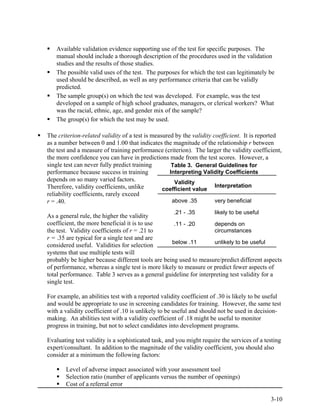
  • 69.
  • 70.
    CHAPTER 7 Using, Scoring, and Interpreting Assessment Instruments This chapter describes some of the most common assessment instrument scoring procedures. It discusses how to properly interpret results and how to use them effectively. Other issues regarding the proper use of assessment tools also are discussed. Chapter Highlights 1. Assessment instrument scoring procedures 2. Test interpretation methods: norm and criterion-referenced tests 3. Interpreting test results 4. Using test results in counseling 5. Using test results in training and development programs 6. Minimizing adverse impact Principle of Assessment Discussed Ensure that scores are interpreted properly. 1. Assessment instrument scoring procedures Test publishers may offer one or more ways to score the tests you purchase. Available options may range from hand scoring by your staff to machine scanning and scoring done by the publisher. All options have their advantages and disadvantages. When you select the tests for use, investigate the available scoring options. Your staff’s time, turnaround time for test results, and cost may all play a part in your purchasing decision. Hand scoring. The answer sheet is scored by counting the number of correct responses or by categorizing responses, often with the aid of a stencil. These scores may then have to be converted from the raw score count to a form that is more meaningful, such as a percentile or standard score. Staff must be trained on proper hand scoring procedures and raw score conversion. This method is more prone to error than machine scoring. To improve accuracy, scoring should be double checked. Hand scoring a test may take more time and effort, but it also may be the least expensive method when there are only a small number of tests to score. Computer-based scoring. Tests can be scored using a computer and test scoring software purchased from the test publisher. When the test is administered in a paper-and-pencil format, raw scores and identification information must be key-entered by staff following the completion of the test session. Converted scores and interpretive reports can be printed 7-1
  • 71.
    immediately. When thetest is administered on the computer, scores are most often generated automatically upon completion of the test; there is no need to key-enter raw scores or identifying information. This is one of the major advantages of computer-based testing. Optical scanning. Machine scorable answer sheets are now readily available for many multiple choice tests. They are quickly scanned and scored by an optical mark reader. You may be able to score these answer sheets in-house or send them to the test publisher for scoring. On-site. You will need a personal computer system (computer, monitor, and printer), an optical reader, and special test scoring software from the publisher. Some scanning programs not only generate test scores, but also provide test users with individual or group interpretive reports. Scanning systems can be costly, and the staff must learn to operate the scanner and the computer program that does the test scoring and reporting. However, using a scanner is much more efficient than hand scoring or key-entering raw scores when testing volume is heavy. Mail-in and fax scoring. In many cases the completed machine-scannable answer sheets can be mailed or faxed to the test publisher. The publisher scores the answer sheets and returns the scores and test reports to the employer. Test publishers generally charge a fee for each test scored and for each report generated. For mail-in service, there is a delay of several days between mailing answer sheets and receipt of the test results from the service. Overnight mail by private or public carrier will shorten the wait, but will add to the cost. Some publishers offer a scoring service by fax machine. This will considerably shorten the turn-around time, but greater care must be taken to protect the confidentiality of the results. 2. Test interpretation methods: norm and criterion-referenced tests Assessment instruments are used to make inferences about people’s knowledge, skills, abilities, interests, traits, and values. What does the test score mean? To help answer this question, consider what the test is designed to accomplish. Does the test compare one person’s score to those obtained by others in an occupation, or does it measure the absolute level of skill an individual has obtained? These two methods are described below. Norm-referenced test interpretation. In norm-referenced test interpretation, the scores that the applicant receives are compared with the test performance of a particular reference group. In this case, the reference group is the norm group. The norm group generally consists of large representative samples of individuals from specific populations, such as high school students, clerical workers, or electricians. It is their average test performance and the distribution of their scores that set the standard and become the test norms of the group. Interest, personality, and values inventories are norm-referenced instruments. The test manual usually will provide detailed descriptions of the norm groups and the test norms. To ensure valid scores and meaningful interpretation of norm-referenced tests, make sure that your target group is similar to the norm group. Compare educational levels; 7-2
  • 72.
    occupational, language, andcultural backgrounds; and other demographic characteristics of the individuals making up the two groups to determine their similarity. Criterion-referenced test interpretation. In criterion-referenced tests, the test score indicates the amount of skill or knowledge the test taker possesses in a particular subject or content area. The test score is not used to indicate how well the person does compared to others; it relates solely to the test taker’s degree of competence in the specific area assessed. Criterion-referenced assessment is used in selecting for, and monitoring progress in, training and development programs. A particular test score generally is chosen as the minimum acceptable level of competence. How is a level of competence chosen? The test publisher may develop a mechanism that converts test scores into proficiency standards, or the company may use its own experience to relate test scores to competence standards. It is important to ensure that all inferences you make on the basis of test results are well-founded. Only use tests for which sufficient information is available to guide and support score interpretation. Read the test manual for instructions in properly interpreting the test results. This leads to the next principle of assessment. Principle of Assessment Ensure that scores are interpreted properly. 3. Interpreting test results Test results usually are presented in terms of numerical scores, such as raw scores, standard scores, and percentile scores. In order to interpret test scores properly, you need to understand the scoring system used. Types of scores Raw scores. These refer to the unadjusted scores on the test. Usually the raw score represents the number of items answered correctly, as in mental ability or achievement tests. Some types of assessment tools, such as work value inventories and personality inventories, have no “right” or “wrong” answers. In such cases, the raw score may represent the number of positive responses for a particular trait. Raw scores do not provide much useful information. Consider a test taker who gets 25 out of 50 questions correct on a math test. It’s hard to know whether 25 is a good score or a poor score. When you compare the results to all the other individuals who took the same test, you may discover that this was the highest score on the test. In general, for norm-referenced tests, it is important to see where a particular score lies within the context of the scores of other people. Adjusting or converting raw scores into standard scores or percentiles will provide you with this kind of information. For criterion-referenced tests, it is important to see what a particular score indicates about proficiency or competence. Standard scores. Standard scores are converted raw scores. They indicate where a person’s score lies in comparison to a reference group. For example, if the test manual 7-3
  • 73.
    indicates that theaverage or mean score for the group on a test is 50, then an individual who gets a higher score is above average, and an individual who gets a lower score is below average. Standard scores are discussed in more detail below in the section on standard score distributions. Percentile score. A percentile score is another type of converted score. An individual’s raw score is converted to a number indicating the percent of people in the norm group who scored below the test taker. For example, a score at the 70th percentile means that the individual’s score is the same as or higher than the scores of 70% of those who took the test. The 50th percentile is known as the median and represents the middle score of the distribution. Score distribution Normal curve. A great many human characteristics, such as height, weight, math ability, and typing skill, are distributed in the population at large in a typical pattern. This pattern of distribution is known as the normal curve and has a symmetrical bell- shaped appearance. The curve is illustrated in Figure 2. As you can see, a large number of individual cases cluster in the middle of the curve. The farther from the middle or average you go, the fewer the cases. In general, distributions of test scores follow the same normal curve pattern. Most individuals get scores in the middle range. As the extremes are approached, fewer and fewer cases exist, indicating that progressively fewer individuals get low scores (left of center) and high scores (right of center). Figure 2. The normal curve illustrating standard score and percentile distribution. Standard score distribution. There are two characteristics of a standard score distribution that are reported in test manuals. One is the mean, a measure of central tendency; the other is the standard deviation, a measure of the variability of the distribution. • Mean. The most commonly used measure of central tendency is the mean or arithmetic average score. Test developers generally assign an arbitrary number to represent the mean standard score when they convert from raw scores to 7-4
  • 74.
    standard scores. Lookat Figure 2. Test A and Test B are two tests with different standard score means. Notice that Test A has a mean of 100 and Test B has a mean of 50. If an individual got a score of 50 on Test A, that person did very poorly. However, a score of 50 on Test B would be an average score. • Standard deviation. The standard deviation is the most commonly used measure of variability. It is used to describe the distribution of scores around the mean. Figure 2 shows the percent of cases 1, 2, and 3 standard deviations (sd) above the mean and 1, 2, and 3 standard deviations below the mean. As you can see, 34% of the cases lie between the mean and +1 sd, and 34% of the cases lie between the mean and -1 sd. Thus, approximately 68% of the cases lie between -1 and +1 standard deviations. Notice that for Test A, the standard deviation is 20, and 68% of the test takers score between 80 and 120. For Test B the standard deviation is 10, and 68% of the test takers score between 40 and 60. Percentile distribution. The bottom horizontal line below the curve in Figure 2 is labeled “Percentiles.” It represents the distribution of scores in percentile units. Notice that the median is in the same position as the mean on the normal curve. By knowing the percentile score of an individual, you already know how that individual compares with others in the group. An individual at the 98th percentile scored the same or better than 98% of the individuals in the group. This is equivalent to getting a standard score of 140 on Test A or 70 on Test B. 4. Using test results in counseling The scoring and interpretation of test instruments have been addressed, but there are additional issues related to using results specifically in counseling settings. These relate to how results are given to examinees or clients and how they are reported within an agency. Guidelines for the test interpretation session. Before discussing results with clients, it is important for the counselor to review the results thoroughly and formulate a plan for the post-test discussion. Initially, the counselor may need to refer to the test manual to solidify his or her knowledge of the test itself. The test manual will discuss applications of the test, describe populations used to norm the instrument and suggest ways to interpret the results. Understanding the strengths and limitations of the assessment instrument will enable the counselor to relate assessment results to the client’s needs. The counselor should review the client’s pattern of results in the context of other information about the client (e.g., results from other assessment tools, educational background, and vocational history). The post-test session should aim to inform clients of the results, enlist clients' active participation in test interpretation, and help clients to formulate education, training, or career plans. It is advisable to get the client’s reactions to the testing session before beginning a discussion of the client’s results. This conversation might address how he or she felt about the assessment procedures and how the client thought he or she performed. 7-5
  • 75.
    To open thediscussion of test results, the counselor should review the purposes for which the tests were administered. It is usually better to discuss results in terms of specific goals, rather than as scores alone. Numerical scores often have very little meaning to clients. Clients should be provided with information about the implications of the scores. If specific scores are discussed, their meaning should be made clear in terms of career or occupational goals. If a battery of tests was given, it is helpful to remind the client what questions or parts of the test are associated with each score (e.g., “your clerical score comes from the part in which you had to decide whether the names were similar or different”). The counselor should explain what each of the scores is intended to indicate in terms the client can understand. For example, rather than telling a client he or she got a 70 on a work style scale, it would be more meaningful to explain that this indicates a preference for working with others rather than working alone. The post-test session should leave clients with a picture of their skills, abilities, interests, or values as indicated by the assessment results. If the scores seem to be inconsistent with a client's vocational plans, the counselor should discuss the scores within the context of other available information about the person and reach some conclusions, if possible. A low score on a skills test may not indicate that the client should jettison his or her plan to pursue a job requiring those skills, but it might call for added steps to reach the goal. For example, the client may want to pursue more education or training to obtain the necessary skills. Your program can help the client obtain the necessary preparation to move forward toward the client’s goals. In some cases, the client may want to consider changing career plans, but this should never be done on the basis of one test score alone. Results should be conveyed in terms of probabilities, rather than as definitive predictions. It is important to suggest options to clients rather than closing career doors. Test scores should be viewed together with other relevant factors such as education, work history, recreational activities, and other test scores, rather than in isolation. If the test generates a profile, it is important to view the whole pattern as well as the individual scores. The profile can give you a more complete picture of the client. The individual scores may pinpoint particularly strong characteristics of the client, areas that need improvement, or areas that are not important to the client. Some instruments also provide scales that report the consistency of the client’s profile; if such scales indicate that the client may be distorting the truth or failing to concentrate, it is advisable to probe the client’s reaction to the test with particular care. It can be fruitful to look at clients’ scores on individual scales in relation to their patterns of results as well as in comparison to the relevant population. For example, an interest scale score may reflect an average level of interest compared to the population, but it may represent a particular client’s highest score. In the case of flat profiles, with no particular highs or lows, the counselor might find it useful to discuss the client’s life experiences to elicit preferences. Sometimes, the flatness of the client’s profile may have led the client to counseling in the first place. Poor test results. Counselors may shy away from suggesting ability or achievement tests for clients because the counselors fear poor results. It may be a wise decision not to test, 7-6
  • 76.
    especially when theavailable assessment tools are not appropriate given the client’s educational level. Often, however, useful information about clients’’ abilities and skills can best be obtained from tests. In such cases, it can be a disservice to clients not to test them. One argument in favor of testing is that many clients, especially if they are reserved or inarticulate, may produce more positive test results than the counselor anticipates. In such cases, test scores may introduce many possible career directions to discuss with the client. Another argument for testing is that clients are best positioned for vocational choice if they show their strengths and weaknesses. They also can seek education and training to help improve their weaknesses and maybe even make them strengths. When the client and counselor agree to an assessment plan, they are forming a contract of sorts. The client agrees to take the assessment instruments with sufficient concentration to produce valid results and to participate actively in the post-test session. In return, the counselor agrees to review the assessment results with the client and to work with the client in integrating the results with all other client information to help formulate a vocational plan. Both the counselor and client should recognize that low scores are possible. Low scores should not be given undue weight in the test interpretation session, but they also should not be overlooked or downplayed. If recognized as a possibility before the assessment takes place, low scores can be treated as useful information, not as barriers to discussion. Conveying low scores can be uncomfortable for the counselor, but it is an important part of providing feedback to a client. The counselor’s role is to discuss the client’s scores with objectivity and empathy, without being judgmental, moralistic, or showing pity. It is the counselor’s responsibility to help clients understand their strengths and weaknesses. If a score falls below the counselor’s and/or the client’s expectations, the counselor could explore reasons for the discrepancy (e.g., poor mathematics scores might indicate the client has “rusty” math skills), but should not necessarily downplay the validity of the score. If the area of weakness impinges on the client’s vocational plans, those plans could either be rethought or the counselor might discuss ways to compensate for the weakness, such as remediation. Most importantly, the test score should not be regarded as the last word on a client’s aptitude or motivation; the whole-person approach asserts that other test scores, educational and vocational history, interests, and life experiences also must be considered. Conducting group test interpretation. Group sessions allow counselors to use their time more efficiently, while giving clients the opportunity to interact with peers. A well-run group session can help the client to stay focused on the task. It also can generate questions that might be of interest to clients who might not have thought to raise those questions in individual sessions. The major function of the group test interpretation session is to convey information about the test results to a number of clients at one time. Self assessments are ideal for group interpretations since results are written for the client. The counselor presents information about the test, explains what the scores mean, and shows how to use the results in career 7-7
  • 77.
    planning. Clients aregiven only their own scores; they do not see others’ test scores. In a well-run group session, the counselor does not need to speak to each member individually to interpret his or her scores; the general presentation permits each client to draw conclusions from his or her own test results. The counselor suggests to clients areas on which to focus, such as highest aptitudes and interests. Often counselors have resource books available at the session that clients can use to assist them in their planning. When forming a group, it is reasonable to select clients who have some similarity in educational or vocational background. Because test interpretation groups are often formed before test results are known, test score similarity usually is not a major consideration in group membership. However, after tests are scored, counselors should review the results to see whether there are clients who have unusually low scores or scores that are highly incompatible with the clients’ histories. These clients might be scheduled for individual test interpretation. Counselor assessment instrument write-ups. The form and content of a write-up are often governed by agency policy. As such, write-ups of test scores may vary as widely as the goals of the agency and the counseling program. Generally, the write-up is used to summarize the client’s situation for the counselor and for other professionals who might inherit the case in the future or might be consulted. The write-up may be used to document the client’s progress for the purpose of agency review. Frequently, the act of writing helps to clarify the counselor’s thinking regarding the case. Generally, the counseling write-up contains a brief description of the client, an overview of the present situation that brought the individual to counseling, a description of the evaluation procedure, observations of the client's behavior in counseling, a review of the test scores, client's views, counselor conclusions, recommendations, and a summary. The write-up should describe how test results have been integrated with all other information about the client. The principle of confidentiality and its converse, freedom of information, are important considerations. Write-ups of test scores should be written as if they might be seen by all who are entitled to access. In many agency settings, counseling write-ups can function as legal documents; accuracy is paramount in such cases and comprehensibility to laypersons can be important. As with any confidential information, only those staff members who need to see test write-ups should have access to them. Freedom of information laws assert clients' rights to see their records; keep this in mind when characterizing clients and their behavior. 5. Using test results in training and development programs In training and development programs, tests are used in several ways: to help clients identify their training needs, for selection into training and development programs, for monitoring individual progress through programs, and for evaluating the effectiveness of programs. 7-8
  • 78.
    Identify training needs.Test results can be used to identify training needs for clients or for employees. Usually, some standard of performance on a test has been established to be associated with adequate job performance and scores falling below that level indicate the need for training. For example, we may have information that successful auto mechanics score above the 50th percentile on a mechanical abilities test. If a client scores below this, it may indicate the need for more training. Selection into training and development programs. The rank-ordering of test results, the use of cut-off scores, or some combination of these approaches is commonly used to assess the qualifications of people and to make selection decisions about them. Many programs may use a variety of tests and procedures in their assessment of candidates for training and development programs. In general, you can use a “multiple hurdles” approach or a “total assessment” approach, or a combination of the two. These are described below. Rank-ordering is a process of arranging candidates on a list from highest score to lowest score based on their test results. In rank-order selection, candidates are chosen on a top- down basis. A cut-off score is the minimum score that a candidate must have to qualify for entry into a training or development program. Generally the cut-off score is set at a level which is determined directly related to training success. Candidates who score below this cut-off generally are not considered for training. Multiple hurdles approach. In this approach, candidates must pass each test or procedure (usually by scoring above a cut-off score) to continue within the assessment process. It may be used to reduce the total cost of assessment by administering less costly screening devices to everyone, but having only those who do well take the more expensive tests or other assessment tools. Total assessment approach. In this approach, test takers are administered every test and procedure in the assessment program. The information gathered is used in a flexible or counterbalanced manner. This allows a high score on one test to be counterbalanced with a low score on another. For example, an applicant who performs poorly on a written test, but shows great enthusiasm for learning and is a very hard worker, may still be a candidate for training or development. A key decision in using the total assessment approach is determining the relative weights to assign to each assessment instrument in the program. Figure 3 is a simple example of combining assessment results from several tests and procedures to generate a weighted composite score. 7-9
  • 79.
    Assessment Assigned Assessment instrument Weighted total score (0-100) weight Interview 80 8 640 Mechanical ability test 60 10 600 H.S. course work 90 5 450 Total Score: 1,690 Figure 3. Score-sheet for selection into machinist training: Candidate A. A company is selecting employee candidates to train for entry-level machinist. The assessment instruments consist of a structured interview, a mechanical ability test, and high school course work. After consultation with relevant staff and experts, a weight of 8 is assigned for the interview, 10 for the test, and 5 for course work. A sample score sheet for one candidate, Candidate A, is shown above. As you can see, although Candidate A scored lowest on the mechanical ability test, the weights of all of the assessment instruments as a composite allowed him/her to continue on as a candidate for the machinist training rather than being eliminated for consideration as a result of the one low score. Monitoring individual progress through training/development. Tests are an important part of monitoring an individual’s progress in training and development programs. Individuals can benefit from specific feedback about their test results. It can help them to identify strengths and weaknesses and help point to the need for further training, or establish that they have achieved mastery of relevant material. Test results should be maintained confidentially in appropriate personnel files, and only staff who have a need to know the information, and a right to it, should be allowed access. Evaluating program effectiveness. Tests can be used to monitor the overall effectiveness of training programs, usually by pre-testing and post-testing trainees to establish their change in knowledge, skill, or ability. This may even be accomplished using some of the same instruments that are used to monitor individual progress. 7-10
  • 80.
    6. Minimizing adverse impact A well-designed assessment program will improve clients’’ ability to make effective career, training, and development related decisions. However, some predictors of job performance may exhibit adverse impact. As a test user, there are several good testing practices to follow to minimize the likelihood of adverse impact in conducting assessments for selection and referral purposes for training. Be clear about what needs to be measured and for what purpose. Use only assessment tools that are job-related and valid, and only use them in the way they were designed to be used. Use assessment tools that are appropriate for the target population. Do not use assessment tools that are biased or unfair to any group of people. Consider whether there are alternative assessment methods to use. Consider whether there is another way to use the test that either is free of or reduces adverse impact. To minimize the possibility of adverse impact, it is recommended that a test be used as only one part of a comprehensive assessment process. That is, apply the whole-person approach to your personnel assessment program. This approach will allow you to improve your assessment of the individual and reduce the effect of differences in average scores between groups on a single test. 7-11
  • 81.
  • 82.
    CHAPTER 8 Issues and Concerns With Assessment It is important to remember that an assessment instrument, like any tool, is most effective when used properly and can be very counterproductive when used inappropriately. In previous chapters, you have read about the advantages of using tests and procedures as part of your workforce development program. You also have read about the limitations of tests in providing a consistently accurate and complete picture of an individual’s career-related qualifications and potential. This chapter highlights some important issues and concerns surrounding these limitations. Careful attention to these issues and concerns will help you produce a fair and effective assessment program. Chapter Highlights 1. Deciding whether or not to use tests 2. Test anxiety 3. Fallibility of test scores 4. Appeals process and retesting 5. Qualifications of assessment staff 6. Misuse or overuse of tests 7. Ethnic, linguistic, and cultural differences and biases 8. Testing people with disabilities 1. Deciding whether or not to use tests How successful is your current assessment program? Is it in need of improvement? The decision to use a test is an important one. You need to carefully consider several technical, administrative, and practical matters. In counseling settings, consider how much additional time and effort will be involved in expanding your assessment program. As in every business decision, you will want to determine whether the potential benefits outweigh the expenditure of time and effort. Be sure to factor in all the costs, such as purchase of tests and staff time, and balance these against all the benefits, including potential increases in the effectiveness of the assessment process. Before expanding your assessment program or deciding to use tests in training and development programs, it is important to have a clear picture of your organization’s needs, the benefits you can expect, and the costs you will incur. 8-1
  • 83.
    2. Test anxiety Many people are intimidated at the mere thought of taking a test. Some may fear that testing will expose their weaknesses, and some may fear that tests will not measure what they really can do on the job. Also, some people may view certain tests as an invasion of privacy. This is especially true of personality tests. Fear or mistrust of tests can lower the scores of some otherwise qualified candidates or clients. To reduce these feelings, it is important to take the time to explain a few things about the testing program before administering a test. Any explanation should, at a minimum, cover the following topics: why the test is being administered, confidentiality of test results, and how the test results will be used in the assessment process. 3. Fallibility of test scores All assessment tools and procedures are subject to measurement errors. This means that a test neither measures a characteristic with perfect accuracy for all people nor fully accounts for their knowledge, skills, abilities, or other characteristics. Thus, there will always be some errors in selection or referral decisions that are made based on assessment results. This is true of all assessment procedures, regardless of how objective or standardized they might be. It is, therefore, important not to rely entirely on any one assessment instrument in making counseling or training decisions. Using a variety of assessment tools will help you obtain a fuller and more accurate picture of an individual. Consider such information as an evaluation of a person’s education, work experience, and other job-relevant factors in addition to standardized test results. 4. Appeals process and retesting Every test taker should have a fair chance to demonstrate his or her best performance on an assessment procedure. However, at times this might not occur. If the results may not be valid for an individual, consider retesting or using alternative assessment procedures before screening the individual. There are external circumstances or conditions that could invalidate the test results. These may include the test taker’s state of mind or health at the time of the test, the conditions under which the test is given, and his or her familiarity with particular questions on the test. To give some specific examples, a person who has a child at home with the measles may not be able to concentrate on taking a vocabulary test. Someone sitting next to a noisy air conditioner may not 8-2
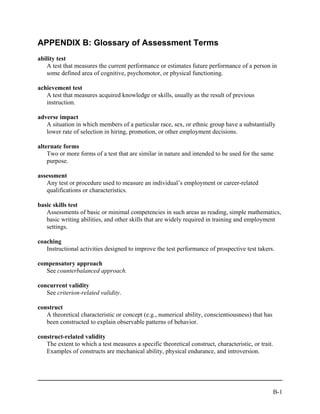
  • 84.
    be able toconcentrate on the test questions. On another day, under different circumstances, these individuals might obtain a different score. If you believe that the test was not valid for an individual, you should consider a retest. If other versions of the test are not available, consider alternative means of assessment. Check the test manual for advice from the publisher regarding retesting. It is advisable to develop a policy on handling complaints regarding testing and appeals for retesting, so that these concerns can be resolved fairly and consistently. 5. Qualifications of assessment staff Test results may not be accurate if the tests have not been administered and scored properly, or if the results are not interpreted appropriately. The usefulness of test results depends on proper administration, scoring, and interpretation. Qualified individuals must be chosen to administer and score tests and interpret test results. These individuals must be trained appropriately. Test manuals usually will specify the qualifications and training needed to administer and score the tests and interpret results. 6. Misuse or overuse of tests A single test cannot be expected to be valid in all situations and for all groups of people. A test generally is developed to measure specific characteristics or to predict specific performance criteria for a particular group. For example, a test with items designed to assess the interests of adults may not be valid for identifying interests of junior high school students. In addition, test results usually provide specific information that is valid for a specific amount of time. Therefore, it is unlikely to be appropriate to consider a client for entry into a career development program based on his or her test scores on a proficiency test taken 5 years earlier. The test manual and independent reviews of the test remain your best guides for administering, scoring, and interpreting the test. 7. Ethnic, linguistic, and cultural differences and biases The American workforce is made up of a diverse array of ethnic and cultural groups, including many persons for whom English is not the primary language. Some of these individuals may experience difficulty on standardized tests due to cultural differences or lack of mastery of the English language. Depending on the nature of the job for which they are applying, this could mean that their test scores will not accurately predict their true job potential. 8-3
  • 85.
    Before selecting newtests, consider the composition of your potential client or candidate population. Are the tests appropriate for all of them? The test manuals may provide assistance in determining this. If you need further clarification, contact the test publisher. There may be cases where appropriate standardized tests are not available for certain groups. You may have to rely on other assessment techniques, such as interviews and evaluations of education and work experience to make your assessment decisions. 8. Testing people with disabilities The Americans with Disabilities Act protects qualified individuals with disabilities from discrimination in all aspects of employment and in the job-seeking process, including counseling and testing. Your staff should be trained to evaluate requests for reasonable accommodation and provide these accommodations if they are necessary and would not cause “undue hardship.” These situations must be handled with professionalism and sensitivity. Properly handled, this can be accomplished without compromising the integrity of the assessment process. Accommodation may involve ensuring physical accessibility to the test site, modifying test equipment or tests, or providing other forms of assistance. Giving extra time for certain kinds of tests to test takers with dyslexia or other learning disabilities and administering a Braille version of a test for the blind may be examples of reasonable accommodation. See Chapters 2 and 6 for further discussions on testing people with disabilities. 8-4
  • 86.
    CHAPTER 9 A Review: Principles of Assessment Assessment tools, when used appropriately, can improve the quality of an agency’s services by helping clients, counselors, and job placement specialists gather valuable information that can be used to help clients make appropriate career decisions. Employers can effectively use assessment instruments to measure job-relevant skills and capabilities of employees in training and development programs. To use assessment tools properly, administrators and staff must be aware of the inherent limitations of any assessment procedure, as well as the legal and professional issues involved when using assessment tools. The Guide is organized around 13 important assessment principles and their applications. This final chapter brings all the principles together. They are listed below in the order of their appearance in the text, with the chapter number in parentheses. Together, the 13 principles provide a comprehensive framework for conducting an effective assessment program. Use assessment tools in a purposeful manner (Chapter 1) Assessment instruments, like other tools, are helpful when used properly, but can be useless, harmful, or illegal when used inappropriately. Often, inappropriate use results from not having a clear understanding of what you want to measure and why you want to measure it. You should be clear about what you want to accomplish with your assessment program in order to select the proper tools to achieve those goals. In selecting your assessment tools, always keep in mind the knowledge, skills, abilities, characteristics, and personal traits you want to measure, and the population to be assessed. Once you are clear about your purpose, you will be better able to select appropriate assessment tools and use those tools in an effective manner. Only use tests that are appropriate for your particular purpose. Use the whole-person approach to assessment (Chapter 1) An assessment instrument may provide you with important career- or training-relevant information about an individual. However, no assessment tool is 100% reliable or valid; all are subject to errors, both in measuring job-relevant characteristics and in predicting job performance. Moreover, a single assessment instrument only provides you with a limited view of a person's qualifications. Using a variety of tools to measure skills, abilities, and other job- relevant characteristics provides you with a solid basis upon which to make important career and development decisions and minimizes adverse impact. 9-1
  • 87.
    Use only assessmentinstruments that are unbiased and fair to all groups (Chapter 2) Using unbiased and fair tests will enable you to provide the most appropriate assessment services to clients. You should review the fairness evidence associated with assessment instruments before selecting tools by examining the test manual and independent test reviews. Use only reliable assessment instruments and procedures (Chapter 3) If a person takes the same test again, will he or she get a similar score, or a very different score? A reliable instrument will provide accurate and consistent scores. To meaningfully interpret test scores and make useful career or employment-related decisions, use only reliable tools. Test manuals usually will provide a statistic known as the reliability coefficient, giving you an indication of a test's reliability. The higher the reliability coefficient, the more confidence you can have that the score is accurate. Use only assessment procedures and instruments that have been demonstrated to be valid for the specific purpose for which they are being used (Chapter 3) Validity is the most important issue in selecting assessment tools. It refers to (1) the characteristic the assessment instrument measures, and (2) how well the instrument measures the characteristic. Validity is not a property of the assessment instrument itself; it relates to how the instrument is being used. A test's validity is established in reference to a specific purpose; it may not be valid for different purposes. For example, a test that may be valid for assessing someone’s job knowledge may not be valid for predicting his or her leadership skills. You must be sure that the instrument is valid for the purpose for which it is to be used. Selecting a commercially developed instrument does not relieve you of this responsibility. The test manual usually provides a statistic, the validity coefficient, which will give an indication of the test's validity for a specific purpose under specific circumstances. It measures the degree of relationship between test performance and job performance (i.e., job-relatedness of the test). Use assessment tools that are appropriate for the target population (Chapter 3) An assessment tool usually is developed for use with a specific group; it may not be valid for other groups. For example, a test designed to predict the work values of adults may not be valid for use with junior high school students. It is possible that many junior high school students are not vocationally mature enough for the assessment tool to be meaningful, or perhaps the reading level of the test is not suitable for junior high school students. Tests should be appropriate for the individuals you want to test, that is, your target population. 9-2
  • 88.
    The manual shouldindicate the group or groups the test is designed to assess. Your target population should be similar to the group on which the test was developed or normed. In determining the appropriateness of an instrument for your target group, also consider such factors as reading levels, cultural backgrounds, and language barriers. Use assessment instruments for which understandable and comprehensive documentation is available (Chapter 5) Are the instructions for administration and interpretation understandable? Is the information sufficiently comprehensive to evaluate the suitability of the instrument for your needs? Carefully evaluate the documentation provided by the test publisher to be sure that the tools you select do the job you want them to do and furnish you with the information you need. If the documentation is not understandable or complete, you run the risk of selecting inappropriate instruments. Test manuals should provide information about both the development and psychometric characteristics of tests. They should cover topics such as procedures for administration, scoring and interpretation, the recommended uses of an instrument, the groups for whom the test is appropriate, and test norms. They also should include a description of the validation procedures used and evidence of validity, reliability, and test fairness. Ensure that administration staff are properly trained (Chapter 6) Assessment instruments must be administered properly to obtain valid results. Consult the test publisher and administration manual for guidelines on the qualifications and training required for test administrators. These requirements will vary depending on the nature and complexity of the test. Only suitable staff should be selected. Administrators should be given ample time to learn their responsibilities and should practice by administering tests to other staff before administering tests to applicants. Some test publishers may run training sessions for test administration and interpretation. Administration staff also should be trained to handle special situations with sensitivity. An example would be responding to a request for accommodation based on a disability. Ensure that testing conditions are suitable for all test takers (Chapter 6) There are various extraneous influences that may affect the reliability and validity of an assessment procedure. For example, noise in the testing room, poor lighting, inaccurate timing, and damaged test equipment may adversely affect test takers. Staff should ensure that the testing environment is suitable and that administration procedures are uniform for all test takers. 9-3
  • 89.
    Provide reasonable accommodationin the assessment process for people with disabilities (Chapter 6) To ensure that qualified individuals with disabilities have an equal chance to demonstrate their potential, accommodations in the assessment process may be necessary. Under the ADA, reasonable accommodation may involve ensuring physical accessibility to the test site, modifying test equipment or the testing process, or providing qualified assistance to the test taker. For example, administering a Braille version of a test, allowing extra time to complete the test, or supplying a reader may be appropriate. It is important to become familiar with the types of accommodations that can be made without invalidating test results. If reasonable accommodation involving test administration cannot be made, consider alternative assessment strategies. Maintain assessment instrument security (Chapter 6) All materials used in the assessment process, whether paper-and-pencil or computer-based, must be kept secure. Lack of security may result in some test takers having access to test questions beforehand, thus invalidating their scores. To prevent this, test administrators should, for example, keep testing materials in locked rooms or cabinets and limit access to those materials to staff involved in the assessment process. Some instruments used in counseling and in self-assessments are not held to the same strict standards of security. The purpose of testing often will dictate the importance of security for test materials. Security is also the responsibility of test developers. The security of a test may become compromised over time. To protect security, test developers periodically introduce new forms of tests. Maintain confidentiality of assessment results (Chapter 6) Assessment results are highly personal. Workforce development professionals must respect the test taker’s right to confidentiality. Assessment results should be shared only with those who have a legitimate need to know. This would include staff involved in interpreting assessment results or making work-related decisions. Personal information should not be released to other organizations or individuals without the informed consent of the test taker. Ensure that scores are interpreted properly (Chapter 7) Tests are used to make inferences about people’s knowledge, skills, abilities, traits, interests, and values. The inferences should be reasonable, well-founded, and not based upon stereotypes. If test scores are not interpreted properly, the conclusions drawn from them are likely to be invalid, thus leading to poor decision making. Ensure that there is solid evidence to justify your test score interpretations and the decisions you make based on those scores. The test manual should provide instructions for properly interpreting test results. 9-4
  • 90.
    APPENDIX A: Sourcesof Additional Information on Assessment in Workforce Development The following list of reference materials provides sources of information on specific topics and issues relating to testing and assessment. The main text has referred to many of the publications listed below. Others are included as general reference documents and as recommended readings. American Educational Research Association, American Psychological Association and National Council on Measurement in Education. (1999). Standards for Educational and Psychological Testing. Washington, DC: American Educational Research Association. (Or current version.) American Society for Training and Development. (1996). Training and Development Handbook: A Guide to Human Resource Development (4th ed.). New York: McGraw-Hill. Anastasi, A., & Urbina, S. (1997). Psychological Testing (7th edition). New York: Macmillan. Arvey, R. D., & Faley, R. H. (1988). Fairness in Selecting Employees. Reading, MA: Addison- Wesley. Association for Assessment in Counseling. (2003). Responsibilities of Users of Standardized Tests (RUST) (3rd edition). Alexandria, VA: Author. Association for Assessment in Counseling. (2003). Standards for Multicultural Assessment (2nd ed.). Alexandria, VA: Author. Boudreau, J. (1996). Cumulative Supplement to Employment Testing Manual. Boston: Warren, Gorham & Lamont. Bruyère, S.M., & O’Keeffe, J. (Eds.). (1994). Implications of the Americans with Disabilities Act for Psychology. Washington, DC: American Psychological Association. Bureau of National Affairs. (1990). The Americans with Disabilities Act: A Practical and Legal Guide to Impact, Enforcement, and Compliance. Washington, DC: Author. Bureau of National Affairs Policy and Practice Series. (1992-1995). Fair Employment Practices Manual #8. Washington, DC: Author. Buros Institute of Mental Measurements. Various. Mental Measurements Yearbook. Lincoln, NE: University of Nebraska Press. Buros Institute of Mental Measurements. Various. Tests in Print. Lincoln, NE: University of Nebraska Press. A-1
  • 91.
    Camara, W. J.& Brown, D. C. (1995). Educational and employment testing: Changing concepts in measurement and policy. Educational Measurement: Issues and Practice, 14 (1), 5-11. Cronbach, L. J. (1988). Five perspectives on the validity argument. In H. Wainer & H.I. Braun (Eds.), Test Validity (pp. 3-17). Hillsdale, NJ: Erlbaum. Douglas, J. A., Feld, D. E. & Asquith N. (1989). Employment Testing Manual. Boston, MA: Warren, Gorham & Lamont. Equal Employment Opportunity Commission. (1978). The Office of Personnel Management, U.S. Department of Justice and U.S. Department of Labor (1979). Questions and Answers Clarifying and Interpreting the Uniform Guidelines on Employee Selection Procedures. 29 CFR Part 1607 (1988). Equal Employment Opportunity Commission. (1978). The Office of Personnel Management, U.S. Department of Justice and U.S. Department of Labor (1979). Uniform Guidelines on Employee Selection Procedures. 41 CFR Part 603 (1978). Equal Employment Opportunity Commission. (1992). A Technical Assistance Manual on the Employment Provisions (Title I) of the Americans with Disabilities Act. Washington, DC: U.S. Government Printing Office. Equal Employment Opportunity Commission. (1992). EEOC Technical Assistance Manual on Employment Provisions of the Americans with Disabilities Act; ADA Enforcement Guidance: Preemployment Disability Related Questions and Medical Examinations. Equal Employment Opportunity Commission & U.S. Department of Justice. (1991). Americans with Disabilities Act Handbook. Washington, DC: Author. French, W. L. (2003). Human resources management (5th edition). Houghton Mifflin Co.: Boston, MA. Guion, R. M. (1997). Assessment, Measurement, and Prediction for Personnel Decisions. Mahwah, NJ: Lawrence Erlbaum Associates. Guion, R. M. (1980). On trinitarian doctrines of validity. Professional Psychology, 11, 385-398. Hogan J., & Hogan, R. (Eds.) (1984-1990). Business and Industry Testing: Current Practices and Test Reviews. Austin, TX: PRO-ED. Joint Committee on Standards for Educational Evaluation. (1994). The program evaluation standards. Thousand Oaks, CA: Sage Joint Committee on Testing Practices. (2004). Code of Fair Testing Practices in Education. Washington, DC: Author. A-2
  • 92.
    Keyser, D. J.,& Sweetland, R. C. (Eds.). (1984-2005). Test Critiques. (Vols. I-XI). Austin, TX: PRO-ED. Messick, S. (1989). Validity. In R.L. Linn (Ed.) Educational Measurement (3rd ed., pp. 13-103). New York: American Council for Education, Macmillan. Murphy, K. R., & Davidshofer, C. O. (1988). Psychological Testing: Principles and Applications. Englewood Cliffs, NJ: Prentice Hall. Nunnally, J. C. (1978). Psychometric Theory (2nd ed.). New York: McGraw-Hill. Prediger, D. J. (1994). Multicultural assessment standards: A compilation for counselors. Measurement and Evaluation in Counseling and Development, 27, 68-73. Society for Industrial and Organizational Psychology, Inc. (2003). Principles for the Validation and Use of Personnel Selection Procedures (4th ed.). Bowling Green, OH: Author. U.S. Department of Justice. (1991). The Americans with Disabilities Act: Questions and Answers. Washington, DC: Civil Rights Division, U.S. Department of Justice. U.S. Department of Labor, Employment and Training Administration. (1993). JTPA: Improving Assessment: A Technical Assistance Guide. Washington, DC: Author. U.S. Office of Personnel Management. (1994). Guide for Administering Written Employment Examinations to Persons with Disabilities. Washington, DC: Author. A-3
  • 93.
  • 94.
    APPENDIX B: Glossaryof Assessment Terms ability test A test that measures the current performance or estimates future performance of a person in some defined area of cognitive, psychomotor, or physical functioning. achievement test A test that measures acquired knowledge or skills, usually as the result of previous instruction. adverse impact A situation in which members of a particular race, sex, or ethnic group have a substantially lower rate of selection in hiring, promotion, or other employment decisions. alternate forms Two or more forms of a test that are similar in nature and intended to be used for the same purpose. assessment Any test or procedure used to measure an individual’s employment or career-related qualifications or characteristics. basic skills test Assessments of basic or minimal competencies in such areas as reading, simple mathematics, basic writing abilities, and other skills that are widely required in training and employment settings. coaching Instructional activities designed to improve the test performance of prospective test takers. compensatory approach See counterbalanced approach. concurrent validity See criterion-related validity. construct A theoretical characteristic or concept (e.g., numerical ability, conscientiousness) that has been constructed to explain observable patterns of behavior. construct-related validity The extent to which a test measures a specific theoretical construct, characteristic, or trait. Examples of constructs are mechanical ability, physical endurance, and introversion. B-1
  • 95.
    content-related validity The extent to which the content of a test samples or represents the subject area or behavior it is intended to measure. converted score A raw score that has been converted by numerical transformation (for example, to percentile ranks or standard scores) to facilitate comparison of individual scores with group norms. correlation A statistic that indicates the degree to which two variables relate to each other, such as a test score and job performance, or one test with another test. counterbalanced approach An approach to personnel assessment that allows high scores in one or more areas to be counterbalanced with low scores in another area. criterion A measure of performance, such as productivity rate, accident rate, or supervisory ratings. Test scores are used to predict criteria. criterion-related validity The degree to which scores on an assessment instrument correlate with some external criterion, such as job performance. When the assessment instrument and the criterion are measured at about the same time, it is called concurrent validity; when the criterion is measured at some future time, it is called predictive validity. derived score See converted score. equivalent forms See alternate forms. expectancy table A table that shows the probability of different criterion outcomes for each test score. hurdles approach See multiple hurdles approach. inventory A questionnaire or checklist that elicits information about an individual in such areas as work values, interests, attitudes, and motivation. job analysis A systematic process used to identify the tasks, duties, responsibilities, and working conditions associated with a job and the knowledge, skills, abilities and other characteristics required to perform that job. B-2
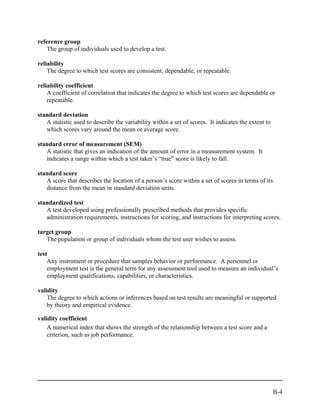
  • 96.
    mean Theaverage score in a group of scores, computed by adding all the scores and dividing the sum by the number of cases. median The middle score in a group of ranked scores. It is the point or score that divides the group into two equal parts. The median is also known as the 50th percentile. multiple hurdles approach An approach to selection decisions that requires a candidate to pass all tests in sequence in order to qualify. normal curve A mathematical curve that is the basis of many statistical analyses. The curve is bilaterally symmetrical, with a single bell-shaped peak in the center. Most distributions of human traits, such as height, mathematical ability, and manual dexterity, approximate the normal curve. norm group The population sample that is used to determine where a person’s results fall in a specified distribution of scores. norms Descriptive statistics that are used to summarize the test performance of a specified group, such as a sample of workers in a specific occupation. Norms often are assumed to represent a larger population, such as all workers in an occupation. parallel forms See alternate forms. percentile score The score on a test below which a given percentage of scores fall. For example, a score at the 65th percentile is equal to or higher than the scores obtained by 65% of the people who took the test. predictive validity See criterion-related validity. rank ordering The process of ranking individuals based on their relative test scores, from the highest to the lowest score. raw score The obtained score on a test, usually determined by counting the number of correct answers. B-3
  • 97.
    reference group The group of individuals used to develop a test. reliability The degree to which test scores are consistent, dependable, or repeatable. reliability coefficient A coefficient of correlation that indicates the degree to which test scores are dependable or repeatable. standard deviation A statistic used to describe the variability within a set of scores. It indicates the extent to which scores vary around the mean or average score. standard error of measurement (SEM) A statistic that gives an indication of the amount of error in a measurement system. It indicates a range within which a test taker’s “true” score is likely to fall. standard score A score that describes the location of a person’s score within a set of scores in terms of its distance from the mean in standard deviation units. standardized test A test developed using professionally prescribed methods that provides specific administration requirements, instructions for scoring, and instructions for interpreting scores. target group The population or group of individuals whom the test user wishes to assess. test Any instrument or procedure that samples behavior or performance. A personnel or employment test is the general term for any assessment tool used to measure an individual’s employment qualifications, capabilities, or characteristics. validity The degree to which actions or inferences based on test results are meaningful or supported by theory and empirical evidence. validity coefficient A numerical index that shows the strength of the relationship between a test score and a criterion, such as job performance. B-4