
HUMAN
RESOURCE
ACCOUNTING
HRA: CONCEPT
• “the process of identifying and
measuring data about human resources
and communicating this information to
interested parties”.
• “Human Resource Accounting is basically
an information system that tells
management what changes are
occurring over time to the human
resources of the business. HRA also
involves accounting for investment in
people and their replacement costs, and
also the economic value of people in an
organization,”
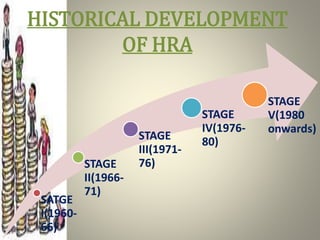
HISTORICAL DEVELOPMENT
OF HRA
SATGE
I(1960-
66)
STAGE
II(1966-
71)
STAGE
III(1971-
76)
STAGE
IV(1976-
80)
STAGE
V(1980
onwards)
NEED FOR HRA
• HRA systems can be put to use for taking a
variety of managerial decisions
• Organizations can actually find out how
much they can earn from an individual
• HRA reflects the extent to which
organization contributes to society’s
human capital by investing in its
development.
• It provides a sound and effective basis of
human asset control
• Helps to know whether the asset is
appreciated, depleted or conserved
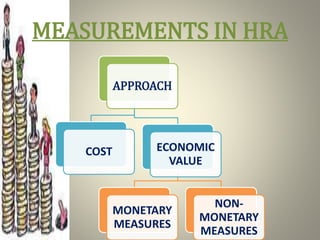
MEASUREMENTS IN HRA
APPROACH
COST ECONOMIC
VALUE
MONETARY
MEASURES
NON-
MONETARY
MEASURES
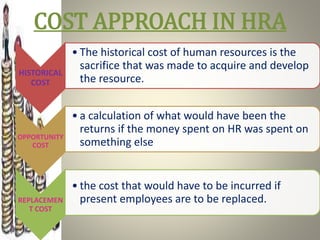
COST APPROACH IN HRA
HISTORICAL
COST
• The historical cost of human resources is the
sacrifice that was made to acquire and develop
the resource.
OPPORTUNITY
COST
• a calculation of what would have been the
returns if the money spent on HR was spent on
something else
REPLACEMEN
T COST
• the cost that would have to be incurred if
present employees are to be replaced.
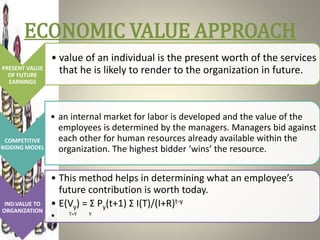
ECONOMIC VALUE APPROACH
PRESENT VALUE
OF FUTURE
EARNINGS
• value of an individual is the present worth of the services
that he is likely to render to the organization in future.
COMPETITIVE
BIDDING MODEL
• an internal market for labor is developed and the value of the
employees is determined by the managers. Managers bid against
each other for human resources already available within the
organization. The highest bidder ‘wins’ the resource.
IND.VALUE TO
ORGANIZATION
• This method helps in determining what an employee’s
future contribution is worth today.
• E(Vy) = Σ Py(t+1) Σ I(T)/(I+R)t-y
• T=Y Y
NON MONETARY MEASURES
• Skills or capability inventory
• Assessment of potential
• Attitude measurements
DETERRANTS TO HRA
• Lack of an industry standard
• The need for extensive research
• Not an economically viable option for
small and medium companies
• Difficult to predict as to what is going
to be your future requirements
Human resource accounting

Human resource accounting

  • 1.
  • 2.
    HRA: CONCEPT • “theprocess of identifying and measuring data about human resources and communicating this information to interested parties”. • “Human Resource Accounting is basically an information system that tells management what changes are occurring over time to the human resources of the business. HRA also involves accounting for investment in people and their replacement costs, and also the economic value of people in an organization,”
  • 3.
  • 4.
    NEED FOR HRA •HRA systems can be put to use for taking a variety of managerial decisions • Organizations can actually find out how much they can earn from an individual • HRA reflects the extent to which organization contributes to society’s human capital by investing in its development. • It provides a sound and effective basis of human asset control • Helps to know whether the asset is appreciated, depleted or conserved
  • 5.
    MEASUREMENTS IN HRA APPROACH COSTECONOMIC VALUE MONETARY MEASURES NON- MONETARY MEASURES
  • 6.
    COST APPROACH INHRA HISTORICAL COST • The historical cost of human resources is the sacrifice that was made to acquire and develop the resource. OPPORTUNITY COST • a calculation of what would have been the returns if the money spent on HR was spent on something else REPLACEMEN T COST • the cost that would have to be incurred if present employees are to be replaced.
  • 8.
    ECONOMIC VALUE APPROACH PRESENTVALUE OF FUTURE EARNINGS • value of an individual is the present worth of the services that he is likely to render to the organization in future. COMPETITIVE BIDDING MODEL • an internal market for labor is developed and the value of the employees is determined by the managers. Managers bid against each other for human resources already available within the organization. The highest bidder ‘wins’ the resource. IND.VALUE TO ORGANIZATION • This method helps in determining what an employee’s future contribution is worth today. • E(Vy) = Σ Py(t+1) Σ I(T)/(I+R)t-y • T=Y Y
  • 9.
    NON MONETARY MEASURES •Skills or capability inventory • Assessment of potential • Attitude measurements
  • 10.
    DETERRANTS TO HRA •Lack of an industry standard • The need for extensive research • Not an economically viable option for small and medium companies • Difficult to predict as to what is going to be your future requirements

Editor's Notes

  • #3 HRA, thus, not only involves measurement of all the costs/investments associated with the recruitment, placement, training and development of employees, but also the quantification of the economic value of the people in an organization.
  • #4 This marks the beginning of academic interest in the area of HRA. However, the focus was primarily on deriving HRA concepts from other studies Stage 2: The focus here was more on developing and validating different models for HRA. These models covered both costs and the monetary and non-monetary value of HR. The aim was to develop some tools that would help the organizations in assessing and managing their human resource/asset in a more realistic manner. Stage 3: rapid growth of research in the area. The focus in most cases was on the issues of application of HRA in business organizations. Stage 4:the organizations realized that to clarify the issues relating to HRA needs more research but they were not ready to invest large sums of money into it. Stage 5: renewal of interests due to shifting of economy from a manufacturing to a service one the survival, growth and profits of the organizations were perceived to be dependent more on the intellectual assets of the companies than on the physical assets, the need was felt to have more accurate measures for HR costs, investments and value. from mid 90s the focus has been on greater application of HRA to business management.
  • #5  HRA is a management tool which is designed to assist senior management in understanding the long term cost and benefit implications of their HR decisions so that better business decisions can be taken. If such accounting is not done, then the management runs the risk of taking decisions that may improve profits in the short run but may also have severe repercussions in future. For example, very often organizations hire young people from outside on very high salaries because of an immediate business requirement. Later on, however, they find that the de-motivating impact of this move on the existing experienced staff has caused immense long term harm by reducing their productivity and by creating salary distortions across the organizational structure. 2.like recruitment planning, turnover analysis, personnel advancement analysis, Not only can they measure the return on capital employed on total organizational assets (including the human assets), but the resources can also be planned accordingly. 4. in a business environment where corporate social responsibility is rapidly gaining ground 3. , as the intellectual assets of a company are often worth three or four times the tangible book value. Human capital also provides expert services such as consulting, financial planning and assurance services, which are valuable, and very much in demand.
  • #6 The cost approach which involves methods based on the costs incurred by the company, with regard to an employee. 2. The economic value approach which includes methods based on the economic value of the human resources and their contribution to the company’s gains. This approach looks at human resources as assets and tries to identify the stream of benefits flowing from the asset. The non-monetary methods for assessing the economic value of human resources also measure the Human Resource but not in dollar or money terms. Rather they rely on various indices or ratings and rankings. These methods may be used as surrogates of monetary methods and also have a predictive value. The non-monetary methods may refer to a simple inventory of skills and capabilities of people within an organization or to the application of some behavioral measurement technique to assess the benefits gained from the Human resource of an organization.
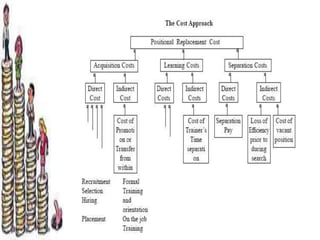
  • #7 These include the costs of recruiting, selection, hiring, placement, orientation, and on the job training. 3. Such costs have two dimensions- positional replacement costs or the costs incurred to replace the services rendered by an employee only to a particular position; and personal replacement cost or the cost incurred to replace all the services expected to be rendered by the employee at the various positions that he might have occupied during his work life in the organization.
  • #9 As an individual moves from one position to another, at the same level or at different levels, the profile of the services provided by him is likely to change. The present cumulative value of all the possible services that may be rendered by him during his/her association with the organization, is the value of the individual. Typically, this value is uncertain and has two dimensions. The first is the expected conditional value of the individual. This is the amount that the organization could potentially realize from the services of an individual during his/her productive service life in the organization. It is composed of three factors: l productivity or performance (set of services that an individual is expected to provide in his/her present position); l transferability (set of services that he/she is expected to provide if and when he/ she is in different positions at the same level); l promo ability (set of services that are expected when the individual is in higher level positions). These three factors depend, to a great extent, on individual determinants like activation level of the individual (his motivation and energy level) and organizational determinants like opportunity to use these skills or roles and the reward system. The second dimension of an individual value is the expected realizable value, which is a function of the expected conditional value, and the probability that the individual will remain in the organization for the duration of his/her productive service life. Since individuals are not owned by the organization and are free to leave, ascertaining the probability of their turnover becomes important. 2. where an organization had several divisions seeking the same employee, the employee should be allocated to the highest bidder and the bid price incorporated into that division’s investment base. For example a value of a professional athlete’s service is often determined by how much money a particular team, acting in an open competitive market is willing to pay him or her. 3.According to this model, the value of human capital embodied in a person who is ‘y’ years old, is the present value of his/her future earnings from employment and can be calculated by using the following formula: E(Vy) = Σ Py(t+1) Σ I(T)/(I+R)t-y T=Y Y where E (Vy) = expected value of a ‘y’ year old person’s human capital T = the person’s retirement age Py (t) = probability of the person leaving the organization I(t) = expected earnings of the person in period I r = discount rate
  • #10 is a simple listing of the education, knowledge, experience and skills of the firm’s human resources. determines a person’s capacity for promotion and development. It usually employs a trait approach in which the traits essential for a position are identified. The extent to which the person possesses these traits is then assessed. are used to assess employees’ attitudes towards their job, pay, working conditions, etc., in order to determine their job satisfaction and dissatisfaction.
  • #11 This means that every company has to evolve its own standard, which can become a tedious process, considering that most of them are still involved in improving their business. Many companies do not want to go into the intricacies of finding the value of their human resources. Considering the dynamism of this industry, it is very difficult to predict as to what is going to be your future requirements and how technology is going to shape in the near future.