Prestige institute of
management, gwalior


      Class Presentation
              of
         strategiC hrm
              on
   human resourCe aCCounting


                    Presented by:
                    neha sharma
                    mba 4 th sem
meaning of human resourCe
    aCCounting

 Human Resources accounting, also known as Human
Asset Accounting, involved identifying, measuring,
capturing, tracking and analyzing the potential of the
human resources of a company and communicating the
resultant information to the stakeholders of the
company. It was a method by which a cost was
assigned to every employee when recruited, and the
value that the employee would generate in the future.
Human Resource accounting reflected the potential of
the human resources of an organization in monetary
terms, in its financial statements.
definitions of human resourCe
               aCCounting
AAA Definition:
  “ The process of identifying and measuring data about human
resources and communicating this information to the interested parties
”
Stephen Knauf (1983):
  “ The measurement and quantification of human organizational inputs
such as recruiting, training, experience and commitment ”
Eric Flamholtz
  “ Accounting for people as organizational resources. It is the
measurement of the cost and value of people for the organization ”
why hra?
   It furnishes cost/value information for making management
    decisions about acquiring, allocating, developing, and
    maintaining human resources in order to attain cost-
    effectiveness;
   It allows management personnel to monitor effectively the use
    of human resources;
   It provides a sound and effective basis of human asset control,
    that is, whether the asset is appreciated, depleted or conserved;
   It helps in the development of management principles by
    classifying the financial consequences of various practices.
need for hra
HR Accounting is very much needed to provide effective & efficient
 management within the organization.
 * If there is any change in the structure of manpower, it is HRA which
 provides information on it to the management.
 * HRA provides qualitative information & also assess the cost incurred
 in personnel.
 * It gives a platform to the management by providing factors for better
 decision-making for future investment.
 * The return on Investment on human capital is best evaluated through
 HRA.
 * HRA communicates to the organization & public about the worth of
 human resources & also its proper allocation within the organization.
 * HR helps the management in developing principles by classifying the
 financial consequences of the various practices.
Valuation aPProaChes of
human resourCe

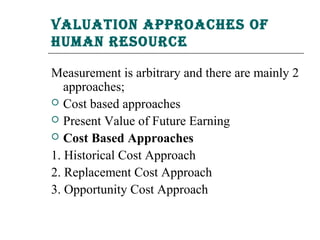
Measurement is arbitrary and there are mainly 2
   approaches;
 Cost based approaches
 Present Value of Future Earning
 Cost Based Approaches

1. Historical Cost Approach
2. Replacement Cost Approach
3. Opportunity Cost Approach
historiCal Cost aPProaCh
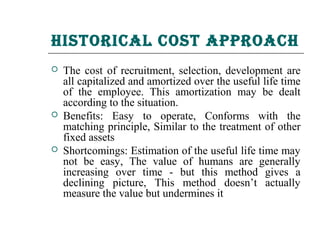
   The cost of recruitment, selection, development are
    all capitalized and amortized over the useful life time
    of the employee. This amortization may be dealt
    according to the situation.
   Benefits: Easy to operate, Conforms with the
    matching principle, Similar to the treatment of other
    fixed assets
   Shortcomings: Estimation of the useful life time may
    not be easy, The value of humans are generally
    increasing over time - but this method gives a
    declining picture, This method doesn’t actually
    measure the value but undermines it
rePlaCement Cost
       aPProaCh
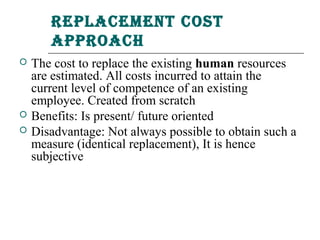
   The cost to replace the existing human resources
    are estimated. All costs incurred to attain the
    current level of competence of an existing
    employee. Created from scratch
   Benefits: Is present/ future oriented
   Disadvantage: Not always possible to obtain such a
    measure (identical replacement), It is hence
    subjective
oPPortunity Cost
     aPProaCh
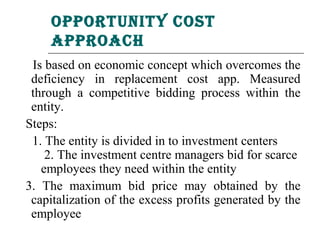
 Is based on economic concept which overcomes the
 deficiency in replacement cost app. Measured
 through a competitive bidding process within the
 entity.
Steps:
 1. The entity is divided in to investment centers
    2. The investment centre managers bid for scarce
   employees they need within the entity
3. The maximum bid price may obtained by the
 capitalization of the excess profits generated by the
 employee
Present Value of future
                  earnings

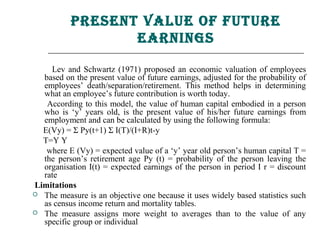
    Lev and Schwartz (1971) proposed an economic valuation of employees
  based on the present value of future earnings, adjusted for the probability of
  employees’ death/separation/retirement. This method helps in determining
  what an employee’s future contribution is worth today.
   According to this model, the value of human capital embodied in a person
  who is ‘y’ years old, is the present value of his/her future earnings from
  employment and can be calculated by using the following formula:
  E(Vy) = Σ Py(t+1) Σ I(T)/(I+R)t-y
  T=Y Y
   where E (Vy) = expected value of a ‘y’ year old person’s human capital T =
  the person’s retirement age Py (t) = probability of the person leaving the
  organisation I(t) = expected earnings of the person in period I r = discount
  rate
Limitations
 The measure is an objective one because it uses widely based statistics such
  as census income return and mortality tables.
 The measure assigns more weight to averages than to the value of any
  specific group or individual
inVestment Pattern
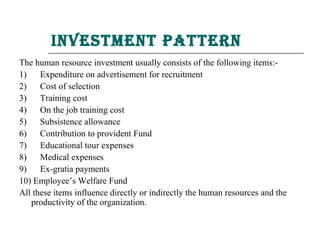
The human resource investment usually consists of the following items:-
1)    Expenditure on advertisement for recruitment
2)    Cost of selection
3)    Training cost
4)    On the job training cost
5)    Subsistence allowance
6)    Contribution to provident Fund
7)    Educational tour expenses
8)    Medical expenses
9)    Ex-gratia payments
10) Employee’s Welfare Fund
All these items influence directly or indirectly the human resources and the
   productivity of the organization.
hra in india
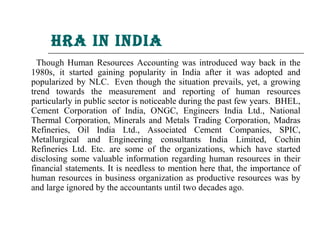
  Though Human Resources Accounting was introduced way back in the
1980s, it started gaining popularity in India after it was adopted and
popularized by NLC. Even though the situation prevails, yet, a growing
trend towards the measurement and reporting of human resources
particularly in public sector is noticeable during the past few years. BHEL,
Cement Corporation of India, ONGC, Engineers India Ltd., National
Thermal Corporation, Minerals and Metals Trading Corporation, Madras
Refineries, Oil India Ltd., Associated Cement Companies, SPIC,
Metallurgical and Engineering consultants India Limited, Cochin
Refineries Ltd. Etc. are some of the organizations, which have started
disclosing some valuable information regarding human resources in their
financial statements. It is needless to mention here that, the importance of
human resources in business organization as productive resources was by
and large ignored by the accountants until two decades ago.
ConClusion
Thank You

Hr accounting

  • 1.
    Prestige institute of management,gwalior Class Presentation of strategiC hrm on human resourCe aCCounting Presented by: neha sharma mba 4 th sem
  • 2.
    meaning of humanresourCe aCCounting Human Resources accounting, also known as Human Asset Accounting, involved identifying, measuring, capturing, tracking and analyzing the potential of the human resources of a company and communicating the resultant information to the stakeholders of the company. It was a method by which a cost was assigned to every employee when recruited, and the value that the employee would generate in the future. Human Resource accounting reflected the potential of the human resources of an organization in monetary terms, in its financial statements.
  • 3.
    definitions of humanresourCe aCCounting AAA Definition: “ The process of identifying and measuring data about human resources and communicating this information to the interested parties ” Stephen Knauf (1983): “ The measurement and quantification of human organizational inputs such as recruiting, training, experience and commitment ” Eric Flamholtz “ Accounting for people as organizational resources. It is the measurement of the cost and value of people for the organization ”
  • 4.
    why hra?  It furnishes cost/value information for making management decisions about acquiring, allocating, developing, and maintaining human resources in order to attain cost- effectiveness;  It allows management personnel to monitor effectively the use of human resources;  It provides a sound and effective basis of human asset control, that is, whether the asset is appreciated, depleted or conserved;  It helps in the development of management principles by classifying the financial consequences of various practices.
  • 5.
    need for hra HRAccounting is very much needed to provide effective & efficient management within the organization. * If there is any change in the structure of manpower, it is HRA which provides information on it to the management. * HRA provides qualitative information & also assess the cost incurred in personnel. * It gives a platform to the management by providing factors for better decision-making for future investment. * The return on Investment on human capital is best evaluated through HRA. * HRA communicates to the organization & public about the worth of human resources & also its proper allocation within the organization. * HR helps the management in developing principles by classifying the financial consequences of the various practices.
  • 6.
    Valuation aPProaChes of humanresourCe Measurement is arbitrary and there are mainly 2 approaches;  Cost based approaches  Present Value of Future Earning  Cost Based Approaches 1. Historical Cost Approach 2. Replacement Cost Approach 3. Opportunity Cost Approach
  • 7.
    historiCal Cost aPProaCh  The cost of recruitment, selection, development are all capitalized and amortized over the useful life time of the employee. This amortization may be dealt according to the situation.  Benefits: Easy to operate, Conforms with the matching principle, Similar to the treatment of other fixed assets  Shortcomings: Estimation of the useful life time may not be easy, The value of humans are generally increasing over time - but this method gives a declining picture, This method doesn’t actually measure the value but undermines it
  • 8.
    rePlaCement Cost aPProaCh  The cost to replace the existing human resources are estimated. All costs incurred to attain the current level of competence of an existing employee. Created from scratch  Benefits: Is present/ future oriented  Disadvantage: Not always possible to obtain such a measure (identical replacement), It is hence subjective
  • 9.
    oPPortunity Cost aPProaCh Is based on economic concept which overcomes the deficiency in replacement cost app. Measured through a competitive bidding process within the entity. Steps: 1. The entity is divided in to investment centers 2. The investment centre managers bid for scarce employees they need within the entity 3. The maximum bid price may obtained by the capitalization of the excess profits generated by the employee
  • 10.
    Present Value offuture earnings Lev and Schwartz (1971) proposed an economic valuation of employees based on the present value of future earnings, adjusted for the probability of employees’ death/separation/retirement. This method helps in determining what an employee’s future contribution is worth today. According to this model, the value of human capital embodied in a person who is ‘y’ years old, is the present value of his/her future earnings from employment and can be calculated by using the following formula: E(Vy) = Σ Py(t+1) Σ I(T)/(I+R)t-y T=Y Y where E (Vy) = expected value of a ‘y’ year old person’s human capital T = the person’s retirement age Py (t) = probability of the person leaving the organisation I(t) = expected earnings of the person in period I r = discount rate Limitations  The measure is an objective one because it uses widely based statistics such as census income return and mortality tables.  The measure assigns more weight to averages than to the value of any specific group or individual
  • 11.
    inVestment Pattern The humanresource investment usually consists of the following items:- 1) Expenditure on advertisement for recruitment 2) Cost of selection 3) Training cost 4) On the job training cost 5) Subsistence allowance 6) Contribution to provident Fund 7) Educational tour expenses 8) Medical expenses 9) Ex-gratia payments 10) Employee’s Welfare Fund All these items influence directly or indirectly the human resources and the productivity of the organization.
  • 12.
    hra in india Though Human Resources Accounting was introduced way back in the 1980s, it started gaining popularity in India after it was adopted and popularized by NLC. Even though the situation prevails, yet, a growing trend towards the measurement and reporting of human resources particularly in public sector is noticeable during the past few years. BHEL, Cement Corporation of India, ONGC, Engineers India Ltd., National Thermal Corporation, Minerals and Metals Trading Corporation, Madras Refineries, Oil India Ltd., Associated Cement Companies, SPIC, Metallurgical and Engineering consultants India Limited, Cochin Refineries Ltd. Etc. are some of the organizations, which have started disclosing some valuable information regarding human resources in their financial statements. It is needless to mention here that, the importance of human resources in business organization as productive resources was by and large ignored by the accountants until two decades ago.
  • 13.
  • 14.