Compensation & Performance Management
Unit 1 – Introduction to Compensation, Buss 1703
What is compensation?
• Compensation is a systematic approach to
providing monetary & non monetary value to
employees in exchange for work performed.
• Compensation may be defined as money
received in performance of work and many kinds
of benefits that an organization provides to
their employees.
Why think of Compensation?
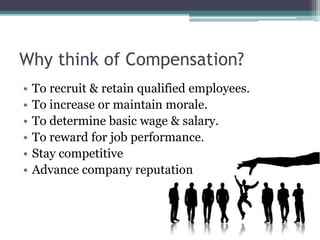
• To recruit & retain qualified employees.
• To increase or maintain morale.
• To determine basic wage & salary.
• To reward for job performance.
• Stay competitive
• Advance company reputation
From a theoretical Perspective
Get it right! Don’t pay more.. Don’t pay less
• Address expectations of the employees
▫ Attend to the Market pay and use salary surveys
▫ Evaluate what others are paying in the same field
▫ Align pay to strategy as expectations increase
▫ Vroom’s Expectancy Theory
• Address Internal Equity in the Organization
▫ Offer wage differentials acceptable to employees
▫ Consider different tasks performed
▫ Consider seniority of various positions
▫ Use a job evaluation tool to understand the differences
▫ Adam’s Equity Theory
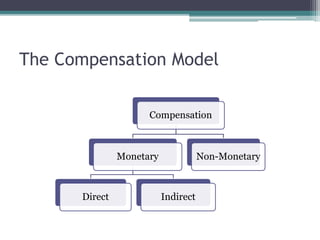
The Compensation Model
Compensation
Monetary
Direct Indirect
Non-Monetary
Class Activity
• Discuss Direct and Indirect monetary
compensation. What are the available options?
Direct Compensation
• Base Pay
• Bonus
• Long term incentives
(Stock options)
• Profit sharing
▫ Distribution plan - Now
▫ Deferred plan - Later
Indirect Compensation
• Insurance (health,
Life).
• Leaves (sick, annual,
emergency)
• Uniform
• Staff Welfare
• Phones/laptop
• Retirement programs
Non-Monetary Compensation
• Enhance dignity & satisfaction from work
performed.
• Promote social relationship with co-workers.
• Allocate sufficient resources to perform work
assignments.
• Offer supportive leadership & management.
• Enhance physiological health, intellectual
growth.
What should you keep in Mind?
• Job descriptions
• Job analysis
• Job evaluation:
▫ Arrange jobs in their order of importance and complexity for the
company.
• Pay structure
• Salary surveys
▫ Find out what other companies in comparable jobs are paying.
Factors Affecting Compensation
External Internal
• Demand & supply of labor
• Cost of living
• Society
• Labor unions
• The economy
• Can you think of Others?
• Compensation policy
• The org. ability to pay
• Job analysis & description
• Employee
• Can you think of Others?
Different Payment Schemes based on..
• Time Wage Plan
▫ Full Time Employees
• Piece Wage Plan
▫ Part-Time Employment
• Others
▫ Contractual
▫ Temporary
▫ Internships
▫ Deputation
Compensation Based on Performance
• Variable compensation programs are designed to
pay employees in accordance with the performance
of the employee.
• Why do it?
▫ Objective of these programs is to motivate the
employees and groups and to make a difference
between performers & non performers.
• Methods
▫ Production incentives
▫ Profit sharing
▫ Gain sharing (team)
▫ Bonus

Compensation and Performance Management

  • 1.
    Compensation & PerformanceManagement Unit 1 – Introduction to Compensation, Buss 1703
  • 2.
    What is compensation? •Compensation is a systematic approach to providing monetary & non monetary value to employees in exchange for work performed. • Compensation may be defined as money received in performance of work and many kinds of benefits that an organization provides to their employees.
  • 3.
    Why think ofCompensation? • To recruit & retain qualified employees. • To increase or maintain morale. • To determine basic wage & salary. • To reward for job performance. • Stay competitive • Advance company reputation
  • 4.
    From a theoreticalPerspective Get it right! Don’t pay more.. Don’t pay less • Address expectations of the employees ▫ Attend to the Market pay and use salary surveys ▫ Evaluate what others are paying in the same field ▫ Align pay to strategy as expectations increase ▫ Vroom’s Expectancy Theory • Address Internal Equity in the Organization ▫ Offer wage differentials acceptable to employees ▫ Consider different tasks performed ▫ Consider seniority of various positions ▫ Use a job evaluation tool to understand the differences ▫ Adam’s Equity Theory
  • 5.
  • 6.
    Class Activity • DiscussDirect and Indirect monetary compensation. What are the available options?
  • 7.
    Direct Compensation • BasePay • Bonus • Long term incentives (Stock options) • Profit sharing ▫ Distribution plan - Now ▫ Deferred plan - Later
  • 8.
    Indirect Compensation • Insurance(health, Life). • Leaves (sick, annual, emergency) • Uniform • Staff Welfare • Phones/laptop • Retirement programs
  • 9.
    Non-Monetary Compensation • Enhancedignity & satisfaction from work performed. • Promote social relationship with co-workers. • Allocate sufficient resources to perform work assignments. • Offer supportive leadership & management. • Enhance physiological health, intellectual growth.
  • 10.
    What should youkeep in Mind? • Job descriptions • Job analysis • Job evaluation: ▫ Arrange jobs in their order of importance and complexity for the company. • Pay structure • Salary surveys ▫ Find out what other companies in comparable jobs are paying.
  • 11.
    Factors Affecting Compensation ExternalInternal • Demand & supply of labor • Cost of living • Society • Labor unions • The economy • Can you think of Others? • Compensation policy • The org. ability to pay • Job analysis & description • Employee • Can you think of Others?
  • 12.
    Different Payment Schemesbased on.. • Time Wage Plan ▫ Full Time Employees • Piece Wage Plan ▫ Part-Time Employment • Others ▫ Contractual ▫ Temporary ▫ Internships ▫ Deputation
  • 13.
    Compensation Based onPerformance • Variable compensation programs are designed to pay employees in accordance with the performance of the employee. • Why do it? ▫ Objective of these programs is to motivate the employees and groups and to make a difference between performers & non performers. • Methods ▫ Production incentives ▫ Profit sharing ▫ Gain sharing (team) ▫ Bonus