McGraw-Hill/Irwin Copyright © 2008 by The McGraw-Hill Companies, Inc. All rights reserved.
Chapter 7
Distribution
Strategies
7-2
7.1 Introduction
 Focus on the distribution function.
 Various possible distribution strategies, and the
opportunities and challenges associated with these
strategies.
 Two fundamental distribution strategies:
 Items can be directly shipped from the supplier or
manufacturer to the retail stores or end customer
 Use intermediate inventory storage points (typically
warehouses and/or distribution centers).
 Issues with warehouses
 Manufacturing strategy (make-to-stock vs. make-to-order)
 Number of warehouses
 Inventory policy
 Inventory turn over ratio
 Internal warehouses vs. outside distributor
 Owned by a single firm or by a variety of firms
7-3
7.2 Direct Shipment Distribution
Strategies
 Advantages:
 The retailer avoids the expenses of operating a distribution
center
 Lead times are reduced.
 Disadvantages:
 Risk-pooling effects are negated
 Manufacturer and distributor transportation costs increase
 Commonly used scenarios:
 Retail store requires fully loaded trucks
 Often mandated by powerful retailers
 Lead time is critical.
 Manufacturer may be reluctant but may have no choice
 Prevalent in the grocery industry
 lead times are critical because of perishable goods.
7-4
7.3. Intermediate Inventory
Storage Point Strategies
 Variety of characteristics distinguish different
strategies.
 Length of time inventory is stored at warehouses and
distribution centers.
 Strategies:
 Traditional warehousing strategy
 distribution centers and warehouses hold stock inventory
 provide their downstream customers with inventory as
needed.
 Cross-docking strategy
 warehouses and distribution centers serve as transfer points
for inventory
 no inventory is held at these transfer points.
 Centralized pooling and transshipment strategies
 may be useful when there is a large variety of different
products
7-5
Traditional Warehousing
Inventory management and risk pooling
key factors
Other factors also play a significant role
Centralized vs Decentralized Management
Central vs Local Facilities
7-6
Centralized vs Decentralized
Management
 Decentralized system
 Each facility identifies its most effective strategy without
considering the impact on the other facilities in the supply
chain.
 Leads to local optimization.
 Centralized system
 decisions are made at a central location for the entire
supply network.
 Typical objective: minimize the total cost of the system
subject to satisfying some service-level requirements.
 Centralized control leads to global optimization.
 At least as effective as the decentralized system.
 Allow use of coordinated strategies
 If system cannot be centralized
 often helpful to form partnerships to approach the
advantages of a centralized system.
7-7
Central vs. Local Facilities
 Centralized facilities
 Employ both fewer warehouses and distribution centers
 Facilities are located further from customers.
 Other factors:
 Safety stock. Lower safety stock levels with centralized
facilities
 Overhead. Lower total overhead cost with centralized facilities
 Economies of scale. Greater economies of scale with
centralized facilities
 Lead time. Lead time to market reduced with local facilities
 Service.
 Utilization of risk pooling better with centralized
 Shipping times better with local
 Transportation costs.
 Costs between production facilities and warehouses higher with
local
 Costs from warehouses to retailers lesser with local
7-8
A Hybrid Decision
Some products use centralized strategy
while others use local strategy
Not an either or decision
Varying degrees of centralization and
localization due to the varying levels of
advantages and disadvantages
7-9
Cross-Docking
 Popularized by Wal-Mart
 Warehouses function as inventory coordination
points rather than as inventory storage points.
 Goods arriving at warehouses from the
manufacturer:
 are transferred to vehicles serving the retailers
 are delivered to the retailers as rapidly as possible.
 Goods spend very little time in storage at the
warehouse
 Often less than 12 hours
 Limits inventory costs and decreases lead times
7-10
Issues with Cross-Docking
 Require a significant start-up investment and are
very difficult to manage
 Supply chain partners must be linked with
advanced information systems for coordination
 A fast and responsive transportation system is
necessary
 Forecasts are critical, necessitating the sharing
of information.
 Effective only for large distribution systems
 Sufficient volume every day to allow shipments of fully
loaded trucks from the suppliers to the warehouses.
 Sufficient demand at retail outlets to receive full
truckload quantities
7-11
Centralized Pooled Systems
Perform Better
 For the same inventory level, a centralized system
provides:
 higher service level
 higher sales
 Push-pull supply chain
 Moving from a push supply chain
 Dealers have to order before demand is realized
 To a push-pull supply chain
 Dealers pull from regional distribution centers.
 Implications:
 End consumers will see better customer service
 More cars are available to them.
7-12
Other Factors
 Will GM sell more cars to GM dealers?
 Total number of cars ordered by dealers will not
necessarily increase, even as customer service
increases.
 What about the dealers?
 Dealers have access to more inventory
Potentially can sell more.
 Levels out the playing field between dealers.
Small dealers would favor such a system Competitive
advantage of large dealers wiped out
7-13
Customer Search
If the customer arrives at a dealer and
does not find the item
Switches to another dealer
Helps the manufacturer sell more products
Which system is better under customer
search?
No impact on the centralized system
7-14
Impact on Decentralized System
 If a dealer knows that its competitors do not keep
enough inventory
 this dealer should raise the inventory level to satisfy:
 its own demand
 demand of customers who initially approach other dealers
with limited inventory.
 If a dealer knows that its competitors has significant
inventory
 this dealer will reduce the inventory level
 It is not likely to see customers who switch
 Dealer’s strategy depends on its competitor’s
strategy.
 Dealers may/may not know their competitor strategy
 not clear how they decide on their inventory level.
 not clear about the impact of search on the manufacturer
7-15
Nash Equilibrium (Game Theory)
If two competitors are making decisions,
they have reached Nash equilibrium if they
have both made a decision
Both have decided on an amount to order
neither can improve their expected profit by
changing the order amount if the other dealer
doesn’t change his order amount.
7-16
Critical Search Level
Presence of a critical search level
manufacturer prefers the centralized system
below the level
otherwise, manufacturer prefers the
decentralized system.
Manufacturer always prefers a higher
search level
7-17
How Can the Search Level Be
Increased?
 Increase brand loyalty
 customers will more likely search for a particular
brand at another retailer if their first choice does not
have the product in inventory.
 Information technology initiatives to increase
communication between retailers
 increases the ease with which customers can search
in the system
 higher likelihood that customers will search in the
system
7-18
Transshipment
Shipment of items between different
facilities at the same level in the supply
chain to meet some immediate need
Occurs mostly at the retail level
Can be achieved:
with advanced information systems
Shipping costs are reasonable
Retailers have same owner
7-19
Retailers with Different Owners
May not want to do transshipments
Distributor Integration strategies may be
adopted
Not clear regarding inventory levels
A retailer’s strategy depends on competitors’
strategies
7-20
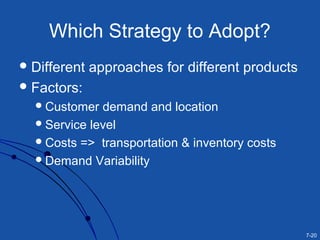
Which Strategy to Adopt?
Different approaches for different products
Factors:
Customer demand and location
Service level
Costs => transportation & inventory costs
Demand Variability
7-21
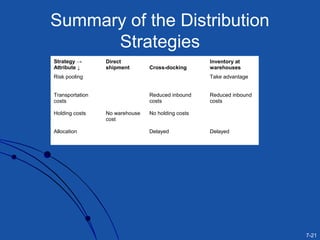
Summary of the Distribution
Strategies
Strategy →
Attribute ↓
Direct
shipment Cross-docking
Inventory at
warehouses
Risk pooling Take advantage
Transportation
costs
Reduced inbound
costs
Reduced inbound
costs
Holding costs No warehouse
cost
No holding costs
Allocation Delayed Delayed
7-22
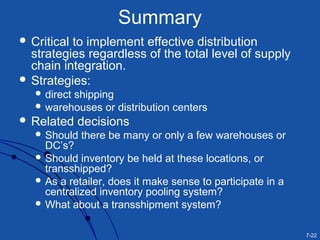
Summary
 Critical to implement effective distribution
strategies regardless of the total level of supply
chain integration.
 Strategies:
 direct shipping
 warehouses or distribution centers
 Related decisions
 Should there be many or only a few warehouses or
DC’s?
 Should inventory be held at these locations, or
transshipped?
 As a retailer, does it make sense to participate in a
centralized inventory pooling system?
 What about a transshipment system?

Distribution stratergies

  • 1.
    McGraw-Hill/Irwin Copyright ©2008 by The McGraw-Hill Companies, Inc. All rights reserved. Chapter 7 Distribution Strategies
  • 2.
    7-2 7.1 Introduction  Focuson the distribution function.  Various possible distribution strategies, and the opportunities and challenges associated with these strategies.  Two fundamental distribution strategies:  Items can be directly shipped from the supplier or manufacturer to the retail stores or end customer  Use intermediate inventory storage points (typically warehouses and/or distribution centers).  Issues with warehouses  Manufacturing strategy (make-to-stock vs. make-to-order)  Number of warehouses  Inventory policy  Inventory turn over ratio  Internal warehouses vs. outside distributor  Owned by a single firm or by a variety of firms
  • 3.
    7-3 7.2 Direct ShipmentDistribution Strategies  Advantages:  The retailer avoids the expenses of operating a distribution center  Lead times are reduced.  Disadvantages:  Risk-pooling effects are negated  Manufacturer and distributor transportation costs increase  Commonly used scenarios:  Retail store requires fully loaded trucks  Often mandated by powerful retailers  Lead time is critical.  Manufacturer may be reluctant but may have no choice  Prevalent in the grocery industry  lead times are critical because of perishable goods.
  • 4.
    7-4 7.3. Intermediate Inventory StoragePoint Strategies  Variety of characteristics distinguish different strategies.  Length of time inventory is stored at warehouses and distribution centers.  Strategies:  Traditional warehousing strategy  distribution centers and warehouses hold stock inventory  provide their downstream customers with inventory as needed.  Cross-docking strategy  warehouses and distribution centers serve as transfer points for inventory  no inventory is held at these transfer points.  Centralized pooling and transshipment strategies  may be useful when there is a large variety of different products
  • 5.
    7-5 Traditional Warehousing Inventory managementand risk pooling key factors Other factors also play a significant role Centralized vs Decentralized Management Central vs Local Facilities
  • 6.
    7-6 Centralized vs Decentralized Management Decentralized system  Each facility identifies its most effective strategy without considering the impact on the other facilities in the supply chain.  Leads to local optimization.  Centralized system  decisions are made at a central location for the entire supply network.  Typical objective: minimize the total cost of the system subject to satisfying some service-level requirements.  Centralized control leads to global optimization.  At least as effective as the decentralized system.  Allow use of coordinated strategies  If system cannot be centralized  often helpful to form partnerships to approach the advantages of a centralized system.
  • 7.
    7-7 Central vs. LocalFacilities  Centralized facilities  Employ both fewer warehouses and distribution centers  Facilities are located further from customers.  Other factors:  Safety stock. Lower safety stock levels with centralized facilities  Overhead. Lower total overhead cost with centralized facilities  Economies of scale. Greater economies of scale with centralized facilities  Lead time. Lead time to market reduced with local facilities  Service.  Utilization of risk pooling better with centralized  Shipping times better with local  Transportation costs.  Costs between production facilities and warehouses higher with local  Costs from warehouses to retailers lesser with local
  • 8.
    7-8 A Hybrid Decision Someproducts use centralized strategy while others use local strategy Not an either or decision Varying degrees of centralization and localization due to the varying levels of advantages and disadvantages
  • 9.
    7-9 Cross-Docking  Popularized byWal-Mart  Warehouses function as inventory coordination points rather than as inventory storage points.  Goods arriving at warehouses from the manufacturer:  are transferred to vehicles serving the retailers  are delivered to the retailers as rapidly as possible.  Goods spend very little time in storage at the warehouse  Often less than 12 hours  Limits inventory costs and decreases lead times
  • 10.
    7-10 Issues with Cross-Docking Require a significant start-up investment and are very difficult to manage  Supply chain partners must be linked with advanced information systems for coordination  A fast and responsive transportation system is necessary  Forecasts are critical, necessitating the sharing of information.  Effective only for large distribution systems  Sufficient volume every day to allow shipments of fully loaded trucks from the suppliers to the warehouses.  Sufficient demand at retail outlets to receive full truckload quantities
  • 11.
    7-11 Centralized Pooled Systems PerformBetter  For the same inventory level, a centralized system provides:  higher service level  higher sales  Push-pull supply chain  Moving from a push supply chain  Dealers have to order before demand is realized  To a push-pull supply chain  Dealers pull from regional distribution centers.  Implications:  End consumers will see better customer service  More cars are available to them.
  • 12.
    7-12 Other Factors  WillGM sell more cars to GM dealers?  Total number of cars ordered by dealers will not necessarily increase, even as customer service increases.  What about the dealers?  Dealers have access to more inventory Potentially can sell more.  Levels out the playing field between dealers. Small dealers would favor such a system Competitive advantage of large dealers wiped out
  • 13.
    7-13 Customer Search If thecustomer arrives at a dealer and does not find the item Switches to another dealer Helps the manufacturer sell more products Which system is better under customer search? No impact on the centralized system
  • 14.
    7-14 Impact on DecentralizedSystem  If a dealer knows that its competitors do not keep enough inventory  this dealer should raise the inventory level to satisfy:  its own demand  demand of customers who initially approach other dealers with limited inventory.  If a dealer knows that its competitors has significant inventory  this dealer will reduce the inventory level  It is not likely to see customers who switch  Dealer’s strategy depends on its competitor’s strategy.  Dealers may/may not know their competitor strategy  not clear how they decide on their inventory level.  not clear about the impact of search on the manufacturer
  • 15.
    7-15 Nash Equilibrium (GameTheory) If two competitors are making decisions, they have reached Nash equilibrium if they have both made a decision Both have decided on an amount to order neither can improve their expected profit by changing the order amount if the other dealer doesn’t change his order amount.
  • 16.
    7-16 Critical Search Level Presenceof a critical search level manufacturer prefers the centralized system below the level otherwise, manufacturer prefers the decentralized system. Manufacturer always prefers a higher search level
  • 17.
    7-17 How Can theSearch Level Be Increased?  Increase brand loyalty  customers will more likely search for a particular brand at another retailer if their first choice does not have the product in inventory.  Information technology initiatives to increase communication between retailers  increases the ease with which customers can search in the system  higher likelihood that customers will search in the system
  • 18.
    7-18 Transshipment Shipment of itemsbetween different facilities at the same level in the supply chain to meet some immediate need Occurs mostly at the retail level Can be achieved: with advanced information systems Shipping costs are reasonable Retailers have same owner
  • 19.
    7-19 Retailers with DifferentOwners May not want to do transshipments Distributor Integration strategies may be adopted Not clear regarding inventory levels A retailer’s strategy depends on competitors’ strategies
  • 20.
    7-20 Which Strategy toAdopt? Different approaches for different products Factors: Customer demand and location Service level Costs => transportation & inventory costs Demand Variability
  • 21.
    7-21 Summary of theDistribution Strategies Strategy → Attribute ↓ Direct shipment Cross-docking Inventory at warehouses Risk pooling Take advantage Transportation costs Reduced inbound costs Reduced inbound costs Holding costs No warehouse cost No holding costs Allocation Delayed Delayed
  • 22.
    7-22 Summary  Critical toimplement effective distribution strategies regardless of the total level of supply chain integration.  Strategies:  direct shipping  warehouses or distribution centers  Related decisions  Should there be many or only a few warehouses or DC’s?  Should inventory be held at these locations, or transshipped?  As a retailer, does it make sense to participate in a centralized inventory pooling system?  What about a transshipment system?