
 Introduction
 Objectives of HRA
 Importance of HRA
 Limitations
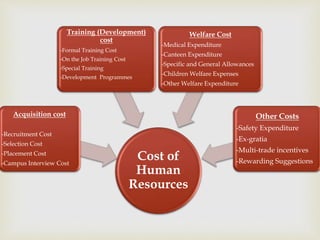
 Cost of Human Resources
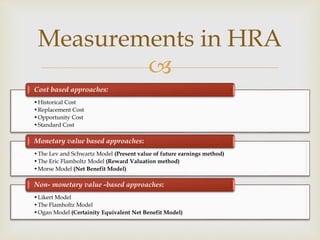
 Measurements in HRA
Contents

 Process of identifying and measuring data about
human resources and communicating this
information to interested parties
 Quantification of the economic value of the people in
an organization
 Measurement and reporting of the cost and value of
people in organizational resources : Flamholtz
 Art of valuing, recording and presenting
systematically the worth of human resources in the
books of account of an organization
Introduction

1. Valuation of human resources
2. Recording the valuation in the books of account
3. Disclosure of the information in the financial
statements of the business
Contd…

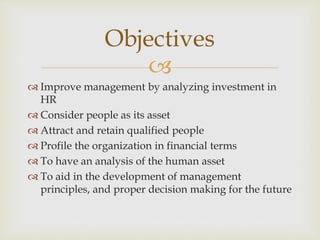
 Improve management by analyzing investment in
HR
 Consider people as its asset
 Attract and retain qualified people
 Profile the organization in financial terms
 To have an analysis of the human asset
 To aid in the development of management
principles, and proper decision making for the future
Objectives

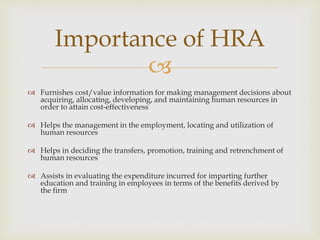
 Furnishes cost/value information for making management decisions about
acquiring, allocating, developing, and maintaining human resources in
order to attain cost-effectiveness
 Helps the management in the employment, locating and utilization of
human resources
 Helps in deciding the transfers, promotion, training and retrenchment of
human resources
 Assists in evaluating the expenditure incurred for imparting further
education and training in employees in terms of the benefits derived by
the firm
Importance of HRA

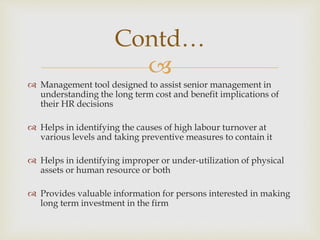
 Management tool designed to assist senior management in
understanding the long term cost and benefit implications of
their HR decisions
 Helps in identifying the causes of high labour turnover at
various levels and taking preventive measures to contain it
 Helps in identifying improper or under-utilization of physical
assets or human resource or both
 Provides valuable information for persons interested in making
long term investment in the firm
Contd…

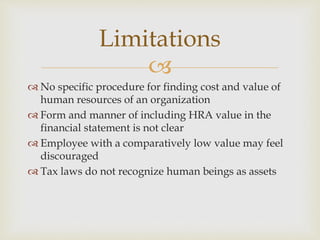
 No specific procedure for finding cost and value of
human resources of an organization
 Form and manner of including HRA value in the
financial statement is not clear
 Employee with a comparatively low value may feel
discouraged
 Tax laws do not recognize human beings as assets
Limitations
Cost of
Human
Resources
Acquisition cost
-Recruitment Cost
-Selection Cost
-Placement Cost
-Campus Interview Cost
Training (Development)
cost
-Formal Training Cost
-On the Job Training Cost
-Special Training
-Development Programmes
Welfare Cost
-Medical Expenditure
-Canteen Expenditure
-Specific and General Allowances
-Children Welfare Expenses
-Other Welfare Expenditure
Other Costs
-Safety Expenditure
-Ex-gratia
-Multi-trade incentives
-Rewarding Suggestions

Measurements in HRA
•Historical Cost
•Replacement Cost
•Opportunity Cost
•Standard Cost
Cost based approaches:
•The Lev and Schwartz Model (Present value of future earnings method)
•The Eric Flamholtz Model (Reward Valuation method)
•Morse Model (Net Benefit Model)
Monetary value based approaches:
•Likert Model
•The Flamholtz Model
•Ogan Model (Certainity Equivalent Net Benefit Model)
Non- monetary value -based approaches:

Cost
It is a sacrifice incurred to obtain some anticipated
benefit or service
Two portions :
Expense
Asset
COST APPROACH

 Historical cost
Sacrifice that was made to acquire and develop the
resource
 Opportunity cost
Money to be spent on HR was spent on something else
 Replacement cost
Cost incurred in the replacement of present employees
Types of Cost

 This approach was developed by William C. Pyle nd R.G.
Barry corporation, a leisure footwear manufacturer based on
Columbus, Ohio (USA) in 1967
 In this approach, actual cost incurred on recruiting, hiring,
training and development the human resources of the
organisation are capitalised and amortised over the expected
useful life of the human resources.
 Thus a proper recording of the expenditure made on hiring,
selecting, training and developing the employees is
maintained and a proportion of it is written off to the income
of the next few years during which human resources will
provide service.
Historical Cost Approach

 This approach was first suggested by Rensis Likert, and was
developed by Eric G. Flamholtz
 Human resources of an organisation are to be valued on the
assumption that a new similar organisation has to be created
from scratch and what would be the cost to the firm if the
existing resources were required to be replaced with other
persons of equivalent talents and experience.
 It takes into consideration all cost involved in recruiting,
hiring, training and developing the replacement to the present
level of proficiency and familiarity with the organisation.
 This approach is more realistic as it incorporates the current
value of company’s human resources in its financial statements
prepared at the end of the year.
Replacement Cost Approach

 This method was first advocated by Hc Kiman and
Jones
 Opportunity cost is the value of an asset when there is
an alternative use of it. There is no opportunity cost for
those employees that are not scarce and also those at
the top will not be available for auction. As such, only
scarce people should comprise the value of human
resources.
 This method can work for some of the people at shop
floor and middle order management.
Opportunity Cost

Lev & Schwartz advocated the estimation of future
earnings during the remaining service life of the
employee and then arriving at the present value by
discounting the estimated earnings at the cost of
capital. The assumptions in this method are realistic
and scientific.
The method has practical applicability when the
availability of quantifiable and analyzable data is
concerned.
The Lev and Schwartz Model

According to this model, the value of human resources
is ascertained in the following ways:
 All employees are classified into specific groups
according to age, experience, and skill.
 Average annual earnings are determined for various
ranges of age.
 The total earnings each group will get up to
retirement age are calculated.
 The total earnings calculated as above are discounted
at the rate of the cost of capital.
 The value thus arrived at will be the value of human
resources/assets.

This is an improvement on the present value of the
future earnings model since it considers the possibility
or probability of an employee’s movement from one role
to another in his career and of leaving the firm earlier,
that is, death or retirement.
The model suggests a five-step approach for assessing
the value of an individual to the organization:
The Eric Flamholtz Model

 Forecasting the period will remain in the
organization, i.e., his expected service life;
 Identifying the services states, i.e., the roles that they
might occupy, including, of course, the time at which
he will leave the organization;
 Estimating the value derived by the organization
when a person occupies a particular position for a
specified period;
 Estimating the probability of occupying each
possible mutually exclusive state at specified future
times; and
 Discounting the value at a predetermined rate to get
the present value of human resources.

 Under this model, the value of human resources is
equivalent to the present value of the enterprise’s net
benefits from its employees’ service. The following
steps are involved in this approach:
 The gross value of the services to be rendered by the
employees in their individual and collective capacity.
 The value of direct and indirect future payments to
the employees is determined.
 The excess of the value of future human
resources over the value of future payments is
ascertained. This represents the net benefit to the
enterprise because of human resources.
Morse Model

Rensis Likert, in the 1960s, was the first to research HRA(Human
Resource Accounting) and emphasized the importance of strong
pressures on HR’s qualitative variables and its benefits in the
long run.
The Likert Model is a non-monetary value-based model.
According to Likert’s model, the human variable can be divided
into three categories:
 Causal variables;
 Intervening variables; and
 End-result variables.
The interaction between the causal and intervening
variables affects the end-result variables through job satisfaction,
costs, productivity, and earnings.
Likert Model

Pekin Ogan (1976) was the pioneer of the Net benefit model.
This is an extension of the “net benefit approach,” as suggested
by Morse.
According to this approach, the certainty with which the net
benefits in the future will accrue should also be considered
while determining the value of human resources.
The approach requires the determination of the following:
 Net benefit from each employee.
 Certain factors at which the benefits will be available.
 The net benefits from all employees multiplied by their
certainty factor will give certainty-equivalent net benefits.
Ogan’s Model

The traditional accounting practices ignored the value of human
factors in the organization and preferred treating them as expense
and expendable. This fundamentally lopsided attitude towards
human resources decisively goes against the employees’ interests.
For instance, the cost of training incurred to update the skills and
knowledge of the employees were treated only as an expense and not
as an investment.
Although human resource accounting is still in its infancy as far as its
development is concerned, a few approaches are available to study
human resource accounting.
However, none of these approaches has found universal acceptance
because they have inbuilt contradictions, incompleteness, or inability.
Thus far, these approaches have failed to fulfill the basic requirements
of traditional accounting concepts and practices like the double-entry
concept.
It is still challenging to determine the value of the organization’s
human resources through different methods, and accounting
techniques have already been opposed to human resource
accounting.
Conclusion

Thank you

HRM UNIT 3 hr-accounting-ppt-1.pptx

  • 2.
      Introduction  Objectivesof HRA  Importance of HRA  Limitations  Cost of Human Resources  Measurements in HRA Contents
  • 3.
      Process ofidentifying and measuring data about human resources and communicating this information to interested parties  Quantification of the economic value of the people in an organization  Measurement and reporting of the cost and value of people in organizational resources : Flamholtz  Art of valuing, recording and presenting systematically the worth of human resources in the books of account of an organization Introduction
  • 4.
     1. Valuation ofhuman resources 2. Recording the valuation in the books of account 3. Disclosure of the information in the financial statements of the business Contd…
  • 5.
      Improve managementby analyzing investment in HR  Consider people as its asset  Attract and retain qualified people  Profile the organization in financial terms  To have an analysis of the human asset  To aid in the development of management principles, and proper decision making for the future Objectives
  • 6.
      Furnishes cost/valueinformation for making management decisions about acquiring, allocating, developing, and maintaining human resources in order to attain cost-effectiveness  Helps the management in the employment, locating and utilization of human resources  Helps in deciding the transfers, promotion, training and retrenchment of human resources  Assists in evaluating the expenditure incurred for imparting further education and training in employees in terms of the benefits derived by the firm Importance of HRA
  • 7.
      Management tooldesigned to assist senior management in understanding the long term cost and benefit implications of their HR decisions  Helps in identifying the causes of high labour turnover at various levels and taking preventive measures to contain it  Helps in identifying improper or under-utilization of physical assets or human resource or both  Provides valuable information for persons interested in making long term investment in the firm Contd…
  • 8.
      No specificprocedure for finding cost and value of human resources of an organization  Form and manner of including HRA value in the financial statement is not clear  Employee with a comparatively low value may feel discouraged  Tax laws do not recognize human beings as assets Limitations
  • 9.
    Cost of Human Resources Acquisition cost -RecruitmentCost -Selection Cost -Placement Cost -Campus Interview Cost Training (Development) cost -Formal Training Cost -On the Job Training Cost -Special Training -Development Programmes Welfare Cost -Medical Expenditure -Canteen Expenditure -Specific and General Allowances -Children Welfare Expenses -Other Welfare Expenditure Other Costs -Safety Expenditure -Ex-gratia -Multi-trade incentives -Rewarding Suggestions
  • 10.
     Measurements in HRA •HistoricalCost •Replacement Cost •Opportunity Cost •Standard Cost Cost based approaches: •The Lev and Schwartz Model (Present value of future earnings method) •The Eric Flamholtz Model (Reward Valuation method) •Morse Model (Net Benefit Model) Monetary value based approaches: •Likert Model •The Flamholtz Model •Ogan Model (Certainity Equivalent Net Benefit Model) Non- monetary value -based approaches:
  • 11.
     Cost It is asacrifice incurred to obtain some anticipated benefit or service Two portions : Expense Asset COST APPROACH
  • 12.
      Historical cost Sacrificethat was made to acquire and develop the resource  Opportunity cost Money to be spent on HR was spent on something else  Replacement cost Cost incurred in the replacement of present employees Types of Cost
  • 13.
      This approachwas developed by William C. Pyle nd R.G. Barry corporation, a leisure footwear manufacturer based on Columbus, Ohio (USA) in 1967  In this approach, actual cost incurred on recruiting, hiring, training and development the human resources of the organisation are capitalised and amortised over the expected useful life of the human resources.  Thus a proper recording of the expenditure made on hiring, selecting, training and developing the employees is maintained and a proportion of it is written off to the income of the next few years during which human resources will provide service. Historical Cost Approach
  • 14.
      This approachwas first suggested by Rensis Likert, and was developed by Eric G. Flamholtz  Human resources of an organisation are to be valued on the assumption that a new similar organisation has to be created from scratch and what would be the cost to the firm if the existing resources were required to be replaced with other persons of equivalent talents and experience.  It takes into consideration all cost involved in recruiting, hiring, training and developing the replacement to the present level of proficiency and familiarity with the organisation.  This approach is more realistic as it incorporates the current value of company’s human resources in its financial statements prepared at the end of the year. Replacement Cost Approach
  • 15.
      This methodwas first advocated by Hc Kiman and Jones  Opportunity cost is the value of an asset when there is an alternative use of it. There is no opportunity cost for those employees that are not scarce and also those at the top will not be available for auction. As such, only scarce people should comprise the value of human resources.  This method can work for some of the people at shop floor and middle order management. Opportunity Cost
  • 16.
     Lev & Schwartzadvocated the estimation of future earnings during the remaining service life of the employee and then arriving at the present value by discounting the estimated earnings at the cost of capital. The assumptions in this method are realistic and scientific. The method has practical applicability when the availability of quantifiable and analyzable data is concerned. The Lev and Schwartz Model
  • 17.
     According to thismodel, the value of human resources is ascertained in the following ways:  All employees are classified into specific groups according to age, experience, and skill.  Average annual earnings are determined for various ranges of age.  The total earnings each group will get up to retirement age are calculated.  The total earnings calculated as above are discounted at the rate of the cost of capital.  The value thus arrived at will be the value of human resources/assets.
  • 18.
     This is animprovement on the present value of the future earnings model since it considers the possibility or probability of an employee’s movement from one role to another in his career and of leaving the firm earlier, that is, death or retirement. The model suggests a five-step approach for assessing the value of an individual to the organization: The Eric Flamholtz Model
  • 19.
      Forecasting theperiod will remain in the organization, i.e., his expected service life;  Identifying the services states, i.e., the roles that they might occupy, including, of course, the time at which he will leave the organization;  Estimating the value derived by the organization when a person occupies a particular position for a specified period;  Estimating the probability of occupying each possible mutually exclusive state at specified future times; and  Discounting the value at a predetermined rate to get the present value of human resources.
  • 20.
      Under thismodel, the value of human resources is equivalent to the present value of the enterprise’s net benefits from its employees’ service. The following steps are involved in this approach:  The gross value of the services to be rendered by the employees in their individual and collective capacity.  The value of direct and indirect future payments to the employees is determined.  The excess of the value of future human resources over the value of future payments is ascertained. This represents the net benefit to the enterprise because of human resources. Morse Model
  • 21.
     Rensis Likert, inthe 1960s, was the first to research HRA(Human Resource Accounting) and emphasized the importance of strong pressures on HR’s qualitative variables and its benefits in the long run. The Likert Model is a non-monetary value-based model. According to Likert’s model, the human variable can be divided into three categories:  Causal variables;  Intervening variables; and  End-result variables. The interaction between the causal and intervening variables affects the end-result variables through job satisfaction, costs, productivity, and earnings. Likert Model
  • 22.
     Pekin Ogan (1976)was the pioneer of the Net benefit model. This is an extension of the “net benefit approach,” as suggested by Morse. According to this approach, the certainty with which the net benefits in the future will accrue should also be considered while determining the value of human resources. The approach requires the determination of the following:  Net benefit from each employee.  Certain factors at which the benefits will be available.  The net benefits from all employees multiplied by their certainty factor will give certainty-equivalent net benefits. Ogan’s Model
  • 23.
     The traditional accountingpractices ignored the value of human factors in the organization and preferred treating them as expense and expendable. This fundamentally lopsided attitude towards human resources decisively goes against the employees’ interests. For instance, the cost of training incurred to update the skills and knowledge of the employees were treated only as an expense and not as an investment. Although human resource accounting is still in its infancy as far as its development is concerned, a few approaches are available to study human resource accounting. However, none of these approaches has found universal acceptance because they have inbuilt contradictions, incompleteness, or inability. Thus far, these approaches have failed to fulfill the basic requirements of traditional accounting concepts and practices like the double-entry concept. It is still challenging to determine the value of the organization’s human resources through different methods, and accounting techniques have already been opposed to human resource accounting. Conclusion
  • 24.