Advanced Corporate Accounting
Presented by
Dr. K. Punitha Devi
Head & Asst. Prof.
Department of Commerce (CA)
Bon Secours College for Women, Thanjvaur
Human Resource Accounting
Introduction:
Human Resources are the most valuable resources of
any organization. A success or failure of an organization
depends very much on the quality of human assets deployed
in the organization. Different organizations employ different
classes of workers according to the requirements of the job
or work. A firm with incompetent human assets is sure to run
through if physical resources within its command.
Human Resource Accounting in India:
Companies Act. 1956 mandates the enclosure of
statement showing the names of each and every employee of
a company employed in a given financial year and the
emoluments received by them which shall not be less than
the sum prescribed in companies (particulars of employees)
rules. Except this requirement, Companies Act does not call
for any disclosure of employees as asset.
However, certain elite companies in India such as
BHEL. HMT, MMTC, CCI, SPIC, Infosys NGC, display
employees as human assets in their published accounts.
Meaning of HRA:
HRA refers to accounting for people as an ‘organizational
resource’. It involves measuring the costs incurred by business firms
and other organizations to recruit, select, hire, train and develop
‘human aspects’. It also includes measuring the economic value of
people to organizations. It serves both the internal and external users,
providing management (internal users).
Definition of HRA:
The American Accounting Association’s, “ HRA is the process
of identifying and measuring data about human resources and
communicating this information to interested parties”.
Salient features of HRA adopted by them:
 Most of these companies follow the model developed by Lev and
Schwartz for valuing human assets.
 These companies adopt different discounting factors. Hence there will
be different valuations of human assets deployed in their facilities.
 HR accounting is given as a supplementary statement. It is not
integrated into financial statement.
 These companies spend chunk of amount on recruiting, training and
development of human assets. But they do not capitalise these
expenses. It is simply charged to income statement tof financial year
in which it is incurred. This is quite contrary to HR accounting
practices.
 The reports enclosed by these companies disclose information like
value added per employee ratio of human to non-human capital, ratio
of turnover etc.
Objectives of HRA:
(i) Information of human assets for decision making purpose:
Furnishing quantitative information on human resources
deployed across the organisation for the managers and investors to
arrive at vital decisions.
(ii) Evaluating the return on Human Resource Investment:
Measuring the return on investment made over human capital.
(iii) Communication of value of human assets:
Communicating the worth of human resources deployed
across the organisation to the organisation and the society at large.
(iv) Effective monitoring the Human Resources:
Enabling the management to effectively monitor and oversee
the human assets of the organisation for the purpose of optimum
utilisation of these resources.
(ii) Improving the quality of Human Resources:
Improving the quality of human resources and thereby
improving the quality of goods and services delivered by the
organisation.
Advantages of HRA:
(i) HRA provides relevant information to the management enabling it
to take appropriate decisions in matters relating to human resources
like recruitment, selection, hiring, training and development etc.
(ii) It helps management to judge the adequacy or other wise of the
resource and go in for further recruitment, if necessary
(iii) It brings in awareness in the employees about their levels of
efficiency and performance and thereby proides an opportunity for
their improvement.
(iv) It recognises the importance of an individual and thus promote the
intellectual and social growth thereby facilitating the achievement
of economic goals of the organisation as well.
(v) It is useful to an investor or an analyst to get the complete picture
about the effectiveness of application of funds by the organisation.
(vi) It also helps management to reorient their attitudes towards labour
and in improving their leadership styles.
Limitations of HRA:
(i) There are no specific and clear-out guidelines for ascertaining
‘cost’ and ‘value’ of human resources of an organisation. The
existing valuation methods suffer from many drawbacks.
(ii) If the cost of measuring human resource value is higher thab the
benefits derived from it, the entire effort would be a waste and
uncalled for.
(iii) The life of human resources is uncertain and therefore, valuing
them under uncertainty seems unrealistic.
(iv) No law considers human resource as an asset, making human
resource accounting just a theoretical concept.
(v) The much needed empirical evidence is yet to be found to support the
hypothesis that HRA, as a managerial tool, facilitates better and
effective management of human resources.
(vi) The behaviour of human resources being unpredictable in nature the
output in any form is difficult to estimate, proving every model as
insufficient and incomplete.
(vii) There is constant fear of opposition from the trade unions. Placing
the value of employees on record would prompt them to seek
rewards and compensation based on such valuation.
(viii) When the existing pay structure, promotion policies, training
policies etc., are not structured, human resource valuation based on
such weak structure may not be appropriate.
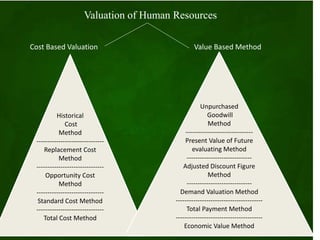
Valuation of Human Resources
Cost Based Valuation Value Based Method
Historical
Cost
Method
-------------------------------
Replacement Cost
Method
-------------------------------
Opportunity Cost
Method
-------------------------------
Standard Cost Method
-------------------------------
Total Cost Method
Unpurchased
Goodwill
Method
-------------------------------
Present Value of Future
evaluating Method
------------------------------
Adjusted Discount Figure
Method
------------------------------
Demand Valuation Method
----------------------------------------
Total Payment Method
----------------------------------------
Economic Value Method
Cost Based Method
Historical Cost Method:
This method developed by William C. Pyle and R.G. Barry
Corporation, U.S.A. in 1967.
Methodology of Valuation:
Costs of recruiting, selecting, hiring, training and developing
human resources are capitalised and amortised over the expected life
of the human resources.
Sudden Death of Human Assets:
The entire unamortised amount in respect of deceased human
asset is charged to the revenue account of the year of expiry of human
asset concerned
Benefits:
Simplicity:
It is simple to understand and calculate.
No behavioural problem:
Does not create behavioural problem like other methods.
Problem and controlling HR investment:
Useful in calculating return on investment made on human capital
of organisation and thereby planning and controlling human resources
developed initiatives.
Limitations
Limited use to investors:
As historical cost method does not give correct value of human, it
is of limited use to investors assets.
Limited use for decision making:
Historical costs are of no use for decision making of management
of an enterprise.
Inability to gauge the potential benefit of HR:
Capitalised figure does not convey potential benefits which may
accrue to organisation from human assets.
Replacement Cost Method
This Method suggested by Rennis Likert and developed by
Eric Clamhosltz.
Methodology of Valuation:
Human resources are valued at replacement cost. In other
words human are valued at the cost at which they can be recruited
currently in the job market for certain position. For instance post of
stenographer is valued at the cost at which a new stenographer can be
recruited in the job market.
Benefits
Realistic Method
This method is more realistic as it exhibits the human assets
across the organisation at their current value.
Shortcomings – subjective Consideration:
Determination of a Replacement value may ne influenced by
subjective consideration. Therefore, valuation of human assets a differ
person to person.
Controversy
It is debatable whether to take positional replacement cost or
personal replacement cost for valuation of human assets. Positional
replacement cost denotes the cost of acquiring , training and developing
human assets connected with a given position. The personal replacement
cost refers to investment of economic resources scarified if a person
presently employed in a specified position were to be replaced today.
Opportunity Cost or Competitive Bidding Method
This method was conceptualised by Hekimiah and Jones.
Value of Executive Cadre Employees:
This method can be applied for evaluating the human assets
employed in executive cadre.
Methodology:
The value of human resources is ascertained in terms of
employees ability to do other jobs. Suppose an employee has no
alternative use, he has no value under this method. In other words, the
value of an employee of one department is determined in terms of offers
made by other department of the organisation towards his service.
Standard Cost Method
This method was propounded by David Watson.
Methodology:
Calculation of Standard Cost per Employee:
Standard cost per grade of employee for recruiting, selecting,
hiring, training and developing, is determined year after year afresh.
Aggregation of Standard Cost of all Employees:
The standard cost thus arrived for its employees across the
organisation is aggregated. This gives the overall value of human
resources of the organisation.
Effective control Measures:
This method is useful in controlling the cost of recruitment. The
standard set for various competencies are also helpful to compare the
actuals and analyse the variation from standard.
Total Cost Method:
This method was advocated by Prof. N. Das Gupta.
Methodology:
Total expenditure incurred by the organisation towards education
and training of the employees so as to make him efficient/ fit for the
organisation’s requirement is considered to be value of an employee.
This value is adjusted in term of age, experience, seniority,
performance etc., of the human asset.
Value Based Methods of Human Resource Valuation
Unpurchased Goodwill Method:
This method developed by Hermanson.
Methodology:
Profits in excess of normal earnings are capitalised to arrive at the
value of human resources.
Drawbacks:
Little use of decision making:
It is of little value to decision makers as it is purely based on historical
cost approach.
Flawed Assumption:
Assumptions that human assets are unwanted and excess profit is
attributable to human resources are said to be flawed.
Assumptions of zero value to human assets when earnings are
normal is called in question.
Present Value of Future Earnings Method
Model developed by Lev and Schwartz.
Methodology:
Future earnings of an employee or grades of employees are estimated upto the age of
retirement and discounted at a rate appropriate to the person or the group to which he/she
belongs to arrive at the value of human resource.
Merits
i) Assessing quality of labour force:
This model helps in assessing whether an organisation has an ageing labour force or
younger labour force.
ii) Simple Method:
This method is simple to understand and easy to calculate.
iii) Ascertaining labour intensiveness:
Human values assessed through this formula when compared with non-human capital
methods helps in ascertaining the degree of labour intensiveness.
Demerits
Non-consideration of certain contingencies:
Accurate estimation of future earnings is challenging as some employee may earn
promotions earlier than estimated period due to their skill competence and knowledge
upgradation. Similarly, some may die or exit on various grounds. This method does not provide
for those contingencies.
Over or under salary fixation due to faulty assumption:
Human capital is assumed to be equal to present value of total earnings. Hence there
may arise over or under fixation of salary and hereby misjudging the value of human capital.
Non consideration of synergistic effect:
This method does not consider synergistic effort your fact of teamwork of
employees the sum of human capital value of individual employee may add to human
capital value of the organisation. Non- consideration of this synergistic effect mass
the valuation of human capital after organisation.
Adjuster Discount figure Wage Method
Author:
Hemanson developed this model.
Methodology:
The value of human asset is found by discounting their future compensation as done
in Lev and Schwartz model.
Efficiency ratio:
This value is adjusted bye by applying efficiency ratio.
Indications of ratio:
 One indicates that firm’s average rate return is equal to the average return for the
economy.
 Ratio greater than one indicates higher than normal earnings.
 Ratio less than one indicates the earnings of the firm are less than their normal
earnings of all forms in the industry.
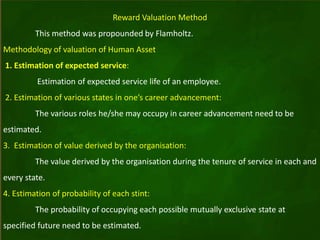
Reward Valuation Method
This method was propounded by Flamholtz.
Methodology of valuation of Human Asset
1. Estimation of expected service:
Estimation of expected service life of an employee.
2. Estimation of various states in one’s career advancement:
The various roles he/she may occupy in career advancement need to be
estimated.
3. Estimation of value derived by the organisation:
The value derived by the organisation during the tenure of service in each and
every state.
4. Estimation of probability of each stint:
The probability of occupying each possible mutually exclusive state at
specified future need to be estimated.
5. Discounting expected rewards:
The expected service rewards to arrive at present value needs to be
discounted.
Drawbacks:
Estimation of probability of each state:
Estimation of probability of occupation of each and every state by an
employee in his career advancement and estimation of economic reward at each
state in cumbrances to laborious and time consuming.
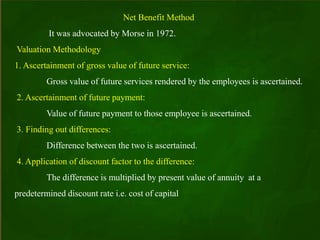
Net Benefit Method
It was advocated by Morse in 1972.
Valuation Methodology
1. Ascertainment of gross value of future service:
Gross value of future services rendered by the employees is ascertained.
2. Ascertainment of future payment:
Value of future payment to those employee is ascertained.
3. Finding out differences:
Difference between the two is ascertained.
4. Application of discount factor to the difference:
The difference is multiplied by present value of annuity at a
predetermined discount rate i.e. cost of capital
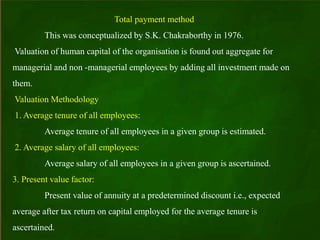
Total payment method
This was conceptualized by S.K. Chakraborthy in 1976.
Valuation of human capital of the organisation is found out aggregate for
managerial and non -managerial employees by adding all investment made on
them.
Valuation Methodology
1. Average tenure of all employees:
Average tenure of all employees in a given group is estimated.
2. Average salary of all employees:
Average salary of all employees in a given group is ascertained.
3. Present value factor:
Present value of annuity at a predetermined discount i.e., expected
average after tax return on capital employed for the average tenure is
ascertained.
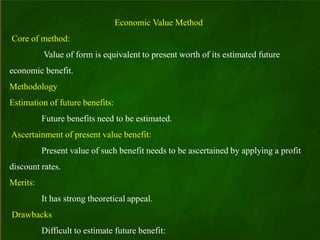
Economic Value Method
Core of method:
Value of form is equivalent to present worth of its estimated future
economic benefit.
Methodology
Estimation of future benefits:
Future benefits need to be estimated.
Ascertainment of present value benefit:
Present value of such benefit needs to be ascertained by applying a profit
discount rates.
Merits:
It has strong theoretical appeal.
Drawbacks
Difficult to estimate future benefit:
Thank you

Human Resource Accounting

  • 1.
    Advanced Corporate Accounting Presentedby Dr. K. Punitha Devi Head & Asst. Prof. Department of Commerce (CA) Bon Secours College for Women, Thanjvaur
  • 2.
    Human Resource Accounting Introduction: HumanResources are the most valuable resources of any organization. A success or failure of an organization depends very much on the quality of human assets deployed in the organization. Different organizations employ different classes of workers according to the requirements of the job or work. A firm with incompetent human assets is sure to run through if physical resources within its command.
  • 3.
    Human Resource Accountingin India: Companies Act. 1956 mandates the enclosure of statement showing the names of each and every employee of a company employed in a given financial year and the emoluments received by them which shall not be less than the sum prescribed in companies (particulars of employees) rules. Except this requirement, Companies Act does not call for any disclosure of employees as asset. However, certain elite companies in India such as BHEL. HMT, MMTC, CCI, SPIC, Infosys NGC, display employees as human assets in their published accounts.
  • 4.
    Meaning of HRA: HRArefers to accounting for people as an ‘organizational resource’. It involves measuring the costs incurred by business firms and other organizations to recruit, select, hire, train and develop ‘human aspects’. It also includes measuring the economic value of people to organizations. It serves both the internal and external users, providing management (internal users). Definition of HRA: The American Accounting Association’s, “ HRA is the process of identifying and measuring data about human resources and communicating this information to interested parties”.
  • 5.
    Salient features ofHRA adopted by them:  Most of these companies follow the model developed by Lev and Schwartz for valuing human assets.  These companies adopt different discounting factors. Hence there will be different valuations of human assets deployed in their facilities.  HR accounting is given as a supplementary statement. It is not integrated into financial statement.  These companies spend chunk of amount on recruiting, training and development of human assets. But they do not capitalise these expenses. It is simply charged to income statement tof financial year in which it is incurred. This is quite contrary to HR accounting practices.  The reports enclosed by these companies disclose information like value added per employee ratio of human to non-human capital, ratio of turnover etc.
  • 6.
    Objectives of HRA: (i)Information of human assets for decision making purpose: Furnishing quantitative information on human resources deployed across the organisation for the managers and investors to arrive at vital decisions. (ii) Evaluating the return on Human Resource Investment: Measuring the return on investment made over human capital. (iii) Communication of value of human assets: Communicating the worth of human resources deployed across the organisation to the organisation and the society at large. (iv) Effective monitoring the Human Resources: Enabling the management to effectively monitor and oversee the human assets of the organisation for the purpose of optimum utilisation of these resources. (ii) Improving the quality of Human Resources: Improving the quality of human resources and thereby improving the quality of goods and services delivered by the organisation.
  • 7.
    Advantages of HRA: (i)HRA provides relevant information to the management enabling it to take appropriate decisions in matters relating to human resources like recruitment, selection, hiring, training and development etc. (ii) It helps management to judge the adequacy or other wise of the resource and go in for further recruitment, if necessary (iii) It brings in awareness in the employees about their levels of efficiency and performance and thereby proides an opportunity for their improvement. (iv) It recognises the importance of an individual and thus promote the intellectual and social growth thereby facilitating the achievement of economic goals of the organisation as well.
  • 8.
    (v) It isuseful to an investor or an analyst to get the complete picture about the effectiveness of application of funds by the organisation. (vi) It also helps management to reorient their attitudes towards labour and in improving their leadership styles. Limitations of HRA: (i) There are no specific and clear-out guidelines for ascertaining ‘cost’ and ‘value’ of human resources of an organisation. The existing valuation methods suffer from many drawbacks. (ii) If the cost of measuring human resource value is higher thab the benefits derived from it, the entire effort would be a waste and uncalled for. (iii) The life of human resources is uncertain and therefore, valuing them under uncertainty seems unrealistic.
  • 9.
    (iv) No lawconsiders human resource as an asset, making human resource accounting just a theoretical concept. (v) The much needed empirical evidence is yet to be found to support the hypothesis that HRA, as a managerial tool, facilitates better and effective management of human resources. (vi) The behaviour of human resources being unpredictable in nature the output in any form is difficult to estimate, proving every model as insufficient and incomplete. (vii) There is constant fear of opposition from the trade unions. Placing the value of employees on record would prompt them to seek rewards and compensation based on such valuation. (viii) When the existing pay structure, promotion policies, training policies etc., are not structured, human resource valuation based on such weak structure may not be appropriate.
  • 10.
    Valuation of HumanResources Cost Based Valuation Value Based Method Historical Cost Method ------------------------------- Replacement Cost Method ------------------------------- Opportunity Cost Method ------------------------------- Standard Cost Method ------------------------------- Total Cost Method Unpurchased Goodwill Method ------------------------------- Present Value of Future evaluating Method ------------------------------ Adjusted Discount Figure Method ------------------------------ Demand Valuation Method ---------------------------------------- Total Payment Method ---------------------------------------- Economic Value Method
  • 11.
    Cost Based Method HistoricalCost Method: This method developed by William C. Pyle and R.G. Barry Corporation, U.S.A. in 1967. Methodology of Valuation: Costs of recruiting, selecting, hiring, training and developing human resources are capitalised and amortised over the expected life of the human resources. Sudden Death of Human Assets: The entire unamortised amount in respect of deceased human asset is charged to the revenue account of the year of expiry of human asset concerned Benefits: Simplicity: It is simple to understand and calculate.
  • 12.
    No behavioural problem: Doesnot create behavioural problem like other methods. Problem and controlling HR investment: Useful in calculating return on investment made on human capital of organisation and thereby planning and controlling human resources developed initiatives. Limitations Limited use to investors: As historical cost method does not give correct value of human, it is of limited use to investors assets. Limited use for decision making: Historical costs are of no use for decision making of management of an enterprise. Inability to gauge the potential benefit of HR: Capitalised figure does not convey potential benefits which may accrue to organisation from human assets.
  • 13.
    Replacement Cost Method ThisMethod suggested by Rennis Likert and developed by Eric Clamhosltz. Methodology of Valuation: Human resources are valued at replacement cost. In other words human are valued at the cost at which they can be recruited currently in the job market for certain position. For instance post of stenographer is valued at the cost at which a new stenographer can be recruited in the job market. Benefits Realistic Method This method is more realistic as it exhibits the human assets across the organisation at their current value.
  • 14.
    Shortcomings – subjectiveConsideration: Determination of a Replacement value may ne influenced by subjective consideration. Therefore, valuation of human assets a differ person to person. Controversy It is debatable whether to take positional replacement cost or personal replacement cost for valuation of human assets. Positional replacement cost denotes the cost of acquiring , training and developing human assets connected with a given position. The personal replacement cost refers to investment of economic resources scarified if a person presently employed in a specified position were to be replaced today.
  • 15.
    Opportunity Cost orCompetitive Bidding Method This method was conceptualised by Hekimiah and Jones. Value of Executive Cadre Employees: This method can be applied for evaluating the human assets employed in executive cadre. Methodology: The value of human resources is ascertained in terms of employees ability to do other jobs. Suppose an employee has no alternative use, he has no value under this method. In other words, the value of an employee of one department is determined in terms of offers made by other department of the organisation towards his service.
  • 16.
    Standard Cost Method Thismethod was propounded by David Watson. Methodology: Calculation of Standard Cost per Employee: Standard cost per grade of employee for recruiting, selecting, hiring, training and developing, is determined year after year afresh. Aggregation of Standard Cost of all Employees: The standard cost thus arrived for its employees across the organisation is aggregated. This gives the overall value of human resources of the organisation. Effective control Measures: This method is useful in controlling the cost of recruitment. The standard set for various competencies are also helpful to compare the actuals and analyse the variation from standard.
  • 17.
    Total Cost Method: Thismethod was advocated by Prof. N. Das Gupta. Methodology: Total expenditure incurred by the organisation towards education and training of the employees so as to make him efficient/ fit for the organisation’s requirement is considered to be value of an employee. This value is adjusted in term of age, experience, seniority, performance etc., of the human asset.
  • 18.
    Value Based Methodsof Human Resource Valuation Unpurchased Goodwill Method: This method developed by Hermanson. Methodology: Profits in excess of normal earnings are capitalised to arrive at the value of human resources. Drawbacks: Little use of decision making: It is of little value to decision makers as it is purely based on historical cost approach. Flawed Assumption: Assumptions that human assets are unwanted and excess profit is attributable to human resources are said to be flawed. Assumptions of zero value to human assets when earnings are normal is called in question.
  • 19.
    Present Value ofFuture Earnings Method Model developed by Lev and Schwartz. Methodology: Future earnings of an employee or grades of employees are estimated upto the age of retirement and discounted at a rate appropriate to the person or the group to which he/she belongs to arrive at the value of human resource. Merits i) Assessing quality of labour force: This model helps in assessing whether an organisation has an ageing labour force or younger labour force. ii) Simple Method: This method is simple to understand and easy to calculate. iii) Ascertaining labour intensiveness: Human values assessed through this formula when compared with non-human capital methods helps in ascertaining the degree of labour intensiveness.
  • 20.
    Demerits Non-consideration of certaincontingencies: Accurate estimation of future earnings is challenging as some employee may earn promotions earlier than estimated period due to their skill competence and knowledge upgradation. Similarly, some may die or exit on various grounds. This method does not provide for those contingencies. Over or under salary fixation due to faulty assumption: Human capital is assumed to be equal to present value of total earnings. Hence there may arise over or under fixation of salary and hereby misjudging the value of human capital. Non consideration of synergistic effect: This method does not consider synergistic effort your fact of teamwork of employees the sum of human capital value of individual employee may add to human capital value of the organisation. Non- consideration of this synergistic effect mass the valuation of human capital after organisation.
  • 21.
    Adjuster Discount figureWage Method Author: Hemanson developed this model. Methodology: The value of human asset is found by discounting their future compensation as done in Lev and Schwartz model. Efficiency ratio: This value is adjusted bye by applying efficiency ratio. Indications of ratio:  One indicates that firm’s average rate return is equal to the average return for the economy.  Ratio greater than one indicates higher than normal earnings.  Ratio less than one indicates the earnings of the firm are less than their normal earnings of all forms in the industry.
  • 22.
    Reward Valuation Method Thismethod was propounded by Flamholtz. Methodology of valuation of Human Asset 1. Estimation of expected service: Estimation of expected service life of an employee. 2. Estimation of various states in one’s career advancement: The various roles he/she may occupy in career advancement need to be estimated. 3. Estimation of value derived by the organisation: The value derived by the organisation during the tenure of service in each and every state. 4. Estimation of probability of each stint: The probability of occupying each possible mutually exclusive state at specified future need to be estimated.
  • 23.
    5. Discounting expectedrewards: The expected service rewards to arrive at present value needs to be discounted. Drawbacks: Estimation of probability of each state: Estimation of probability of occupation of each and every state by an employee in his career advancement and estimation of economic reward at each state in cumbrances to laborious and time consuming.
  • 24.
    Net Benefit Method Itwas advocated by Morse in 1972. Valuation Methodology 1. Ascertainment of gross value of future service: Gross value of future services rendered by the employees is ascertained. 2. Ascertainment of future payment: Value of future payment to those employee is ascertained. 3. Finding out differences: Difference between the two is ascertained. 4. Application of discount factor to the difference: The difference is multiplied by present value of annuity at a predetermined discount rate i.e. cost of capital
  • 25.
    Total payment method Thiswas conceptualized by S.K. Chakraborthy in 1976. Valuation of human capital of the organisation is found out aggregate for managerial and non -managerial employees by adding all investment made on them. Valuation Methodology 1. Average tenure of all employees: Average tenure of all employees in a given group is estimated. 2. Average salary of all employees: Average salary of all employees in a given group is ascertained. 3. Present value factor: Present value of annuity at a predetermined discount i.e., expected average after tax return on capital employed for the average tenure is ascertained.
  • 26.
    Economic Value Method Coreof method: Value of form is equivalent to present worth of its estimated future economic benefit. Methodology Estimation of future benefits: Future benefits need to be estimated. Ascertainment of present value benefit: Present value of such benefit needs to be ascertained by applying a profit discount rates. Merits: It has strong theoretical appeal. Drawbacks Difficult to estimate future benefit:
  • 27.