HUMAN RESOURCE 
ACCOUNTING
GROUP MEMBERS 
 Mayur 
 Prajakta 
 Ashwini 
 Savita
INTRODUCTION OF HRA 
“ One asset is amitted & its worth 
I want to know, 
That asset is the value of men 
Who run the show.”
DEFINITION OF HRA 
Management consultant Stephen Knauf has 
defined HRA as: 
 Human resource is the measurement and quantification of 
organizational input such as recruiting, training experience and 
commitment. 
The American Accounting Society Committee on 
HRA defines it as: 
 HRA is the process of identifying and measuring data about human 
resources and communicating this information to interested parties.
OBJECTIVES OF HRA 
• Improve management by analyzing investment in HR 
• Provides cost value information. 
• Consider people as its asset. 
• Attract and retain qualified people. 
• Enable management of the organization to effectively monitor the 
use of human resources. 
•To aid in the development of management principles and proper 
decision making for the future.
METHODS OF HRA 
I. Historical Cost Method. 
II. Replacement Cost Method. 
III. Opportunity Cost Method. 
IV. Return On Efforts Employed 
Method. 
V. Reward Valuation Method.
I. HISTORICAL COST METHOD 
 This method developed by Brummet, Flamholtz and 
Pyle. 
 This method the actual cost incurred on recruiting, 
selecting, placing & developing.
ADVANTAGES 
 This method is simple to understand and easy to work out. 
 The traditional accounting concept of matching cost with revenue 
is followed in this method.
LIMITATIONS 
 It is very difficult to estimate the number of years an employee will 
be with the firm 
 It is difficult to determine the number of years over which the 
effect of investment on employees will be realized.
II. REPLACEMENT COST METHOD 
 This method was developed by Renis Likert and Eric G. 
Falmholtz. 
 In this method cost of recruiting, selecting, training etc. of new 
employees to reach the level of competence of existing 
employees are measured.
ADVANTAGES 
 This method has the advantage of adjusting the human value of 
price trends in the economy and thereby provides more realistic value 
in inflationary times. 
 It has the advantage of present oriented.
LIMITATIONS 
 It may not always be possible to obtain such a measure for a 
particular employee. 
 It is not always possible to find out the exact replacement of an 
employee.
III.OPPORTUNITY COST METHOD 
 To overcome the limitations of replacement cost method, Hekimian 
and Jones Suggested the use of opportunity cost method which 
determine the value of human resource on the basis of an 
employee’s value in alternative use. 
 The value of an employee would be high if he has several 
alternative uses for employment in the various division of an 
enterprise.
ADVANTAGES 
 This method ensures optional allocation of human resources. 
 It provides a quantitative base for planning, evaluating and 
developing human resources of an organization.
LIMITATIONS 
 This method fails to accommodate the possibility of hiring of 
employees of similar efficiency, experience and skills. 
 The application of this method is doubtful unless the alternative 
use of an employees service available in an organization are traced 
out.
IV. RETURN ON EFFORTS 
EMPLOYED METHOD 
 This method measures the value of firms human resources on the 
basis of efforts made by the individual for organizational benefits. 
 Depends upon the position of employee, degree of excellence and 
experience.
ADVANTAGES 
 It makes possible inter-divisional comparison which ensures 
effective competition. 
 It assist the management in regulating the various functions of an 
organization.
LIMITATIONS 
 It is more an index of efficiency rather than a valuation method. 
 Management finds it difficult to measure and express the 
individual efforts in monetary value.
V. REWARD VALUATION METHOD 
 This model is developed by Flamholtz, this method seeks to measure 
the value of human resources on the basis of an employees value to an 
organization at various states (roles). 
Employees value involves following steps:- 
a. Estimation of employees service life. 
b. Identification of set of service states (roles) 
c. Estimation of employees service state (roles) at specified future 
times.
ADVANTAGES 
 It is the most scientific model as it demonstrates the impact of the 
concept of human asset upon the management. 
 It is matured model as it takes into consideration the employees 
withdrawal from the organization earlier than death or retirement.
LIMITATIONS 
 This method does not indicate the method of estimating the future 
compensation flow of employees. 
 It is practically difficult to determine the probability of employees 
career movement within the organization and of his exit from 
organization.
COST OF HUMAN RESOURCES 
1. Acquisition Cost 
2. Training and Development Cost 
3. Welfare Cost 
4. Other Cost
1. ACQUSITION COST 
It refers to the cost incurred in acquiring the right man for the right job 
at the right time in a right quantity. 
a) Recruitment Cost:- 
ex: cost of recruiting material, administrative expenses, advertising 
costs, agency fees, recruiters salary and travel and outside cost. 
b) Selection Cost:- 
ex: cost of application banks, administrative cost of processing 
applications, conducting tests and interviews, medical examinations 
and salaries. 
c) Placement Cost: 
ex: depends upon the placement, individuals ability and attitude.
2. TRAINING & DEVELOPMENT 
COST 
It refers to the sacrifice that must be made to train a person either 
to provide expected level of performance or to enrich individuals 
skills. 
a) Formal Training Cost: 
refers to the cost incurred in conventional training for the 
orientation of an individual. 
b) On the Job Training Cost: 
once the employee is placed on the job, he must be trained to 
do job efficiently and effectively.
2. TRAINING & DEVELOPMENT 
COST 
C) Special Training Cost: 
To achieve the performance standards sometimes special 

training programmers may be devised. 
d) Development Programmers: 
Employees may be allowed to participate in development 
programs may range from ordinary lectures to international 
conferences and seminars. Involves cost such as delegated fees, 
travel cost, loss output etc.
3. WELFARE COST 
A vital function of an employer to provide an atmosphere to the 
employees to perform their work in healthy, congenial climate 
conducive to good health and high morale. 
a) Welfare Amenities Within The Organization: 
ex: creches, rest shelters and canteens, latrines and urinals, 
washing and bathing facilities, drinking water and occupational 
safety etc. 
b) Welfare Outside The Organization: 
ex: Social insurance measures, maternity benefits, medical 
facilities, educational facilities, housing, holiday homes and leave , 
travel facilities etc.
4. OTHER COSTS 
In India, Factories Act 1948 has made statutory provisions wit regard to employees health, 
safety and welfare as follows: 
I. Health Of Workers: 
• Cleanliness, disposal of waste and effluents 
• Ventilation and temperature 
• Dust and fumes 
• Over crowding 
• Lighting 
• Drinking water 
• Latrines and urinals
4. OTHER COSTS 
II. Safety Of The Workers: 
• Fencing of machinary 
• Hoist and lifts 
• Pressure plant 
• Precaution against danger fumes. 
III. Welfare of Workers: 
• Washing facilities 
• Facilities for storing and drying clothing 
• First aid appliances 
• Canteens 
• Welfare officers
EVALUATION OF HUMAN 
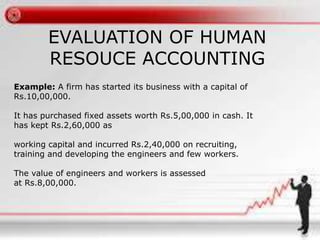
RESOUCE ACCOUNTING 
Example: A firm has started its business with a capital of 
Rs.10,00,000. 
It has purchased fixed assets worth Rs.5,00,000 in cash. It 
has kept Rs.2,60,000 as 
working capital and incurred Rs.2,40,000 on recruiting, 
training and developing the engineers and few workers. 
The value of engineers and workers is assessed 
at Rs.8,00,000.
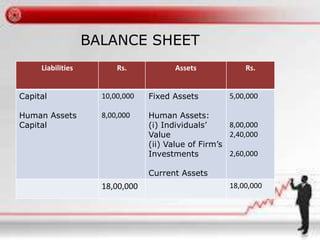
BALANCE SHEET 
Liabilities Rs. Assets Rs. 
Capital 
Human Assets 
Capital 
10,00,000 
8,00,000 
Fixed Assets 
Human Assets: 
(i) Individuals’ 
Value 
(ii) Value of Firm’s 
Investments 
Current Assets 
5,00,000 
8,00,000 
2,40,000 
2,60,000 
18,00,000 18,00,000
ADVANTAGES OF HRA 
 Helps in the employment, locating and utilization of human 
resources. 
 Helps in deciding the transfers, promotion, training and 
retrenchment 
 Provides valuable information to person in making long term 
investment. 
 Helps in identifying improper utilization oh human resource. 
Helps in identifying the causes of high labor turnover.
DISADVANTAGES OF HRA 
 The valuation of human assets is based on assumptions 
 The HRA may leads to dehumanization. 
 No standards of HRA 
 Employee with a comparatively low value may feel discouraged.
Human Resource Accounting (MBA)

Human Resource Accounting (MBA)

  • 1.
  • 2.
    GROUP MEMBERS Mayur  Prajakta  Ashwini  Savita
  • 3.
    INTRODUCTION OF HRA “ One asset is amitted & its worth I want to know, That asset is the value of men Who run the show.”
  • 4.
    DEFINITION OF HRA Management consultant Stephen Knauf has defined HRA as:  Human resource is the measurement and quantification of organizational input such as recruiting, training experience and commitment. The American Accounting Society Committee on HRA defines it as:  HRA is the process of identifying and measuring data about human resources and communicating this information to interested parties.
  • 5.
    OBJECTIVES OF HRA • Improve management by analyzing investment in HR • Provides cost value information. • Consider people as its asset. • Attract and retain qualified people. • Enable management of the organization to effectively monitor the use of human resources. •To aid in the development of management principles and proper decision making for the future.
  • 6.
    METHODS OF HRA I. Historical Cost Method. II. Replacement Cost Method. III. Opportunity Cost Method. IV. Return On Efforts Employed Method. V. Reward Valuation Method.
  • 7.
    I. HISTORICAL COSTMETHOD  This method developed by Brummet, Flamholtz and Pyle.  This method the actual cost incurred on recruiting, selecting, placing & developing.
  • 8.
    ADVANTAGES  Thismethod is simple to understand and easy to work out.  The traditional accounting concept of matching cost with revenue is followed in this method.
  • 9.
    LIMITATIONS  Itis very difficult to estimate the number of years an employee will be with the firm  It is difficult to determine the number of years over which the effect of investment on employees will be realized.
  • 10.
    II. REPLACEMENT COSTMETHOD  This method was developed by Renis Likert and Eric G. Falmholtz.  In this method cost of recruiting, selecting, training etc. of new employees to reach the level of competence of existing employees are measured.
  • 11.
    ADVANTAGES  Thismethod has the advantage of adjusting the human value of price trends in the economy and thereby provides more realistic value in inflationary times.  It has the advantage of present oriented.
  • 12.
    LIMITATIONS  Itmay not always be possible to obtain such a measure for a particular employee.  It is not always possible to find out the exact replacement of an employee.
  • 13.
    III.OPPORTUNITY COST METHOD  To overcome the limitations of replacement cost method, Hekimian and Jones Suggested the use of opportunity cost method which determine the value of human resource on the basis of an employee’s value in alternative use.  The value of an employee would be high if he has several alternative uses for employment in the various division of an enterprise.
  • 14.
    ADVANTAGES  Thismethod ensures optional allocation of human resources.  It provides a quantitative base for planning, evaluating and developing human resources of an organization.
  • 15.
    LIMITATIONS  Thismethod fails to accommodate the possibility of hiring of employees of similar efficiency, experience and skills.  The application of this method is doubtful unless the alternative use of an employees service available in an organization are traced out.
  • 16.
    IV. RETURN ONEFFORTS EMPLOYED METHOD  This method measures the value of firms human resources on the basis of efforts made by the individual for organizational benefits.  Depends upon the position of employee, degree of excellence and experience.
  • 17.
    ADVANTAGES  Itmakes possible inter-divisional comparison which ensures effective competition.  It assist the management in regulating the various functions of an organization.
  • 18.
    LIMITATIONS  Itis more an index of efficiency rather than a valuation method.  Management finds it difficult to measure and express the individual efforts in monetary value.
  • 19.
    V. REWARD VALUATIONMETHOD  This model is developed by Flamholtz, this method seeks to measure the value of human resources on the basis of an employees value to an organization at various states (roles). Employees value involves following steps:- a. Estimation of employees service life. b. Identification of set of service states (roles) c. Estimation of employees service state (roles) at specified future times.
  • 20.
    ADVANTAGES  Itis the most scientific model as it demonstrates the impact of the concept of human asset upon the management.  It is matured model as it takes into consideration the employees withdrawal from the organization earlier than death or retirement.
  • 21.
    LIMITATIONS  Thismethod does not indicate the method of estimating the future compensation flow of employees.  It is practically difficult to determine the probability of employees career movement within the organization and of his exit from organization.
  • 22.
    COST OF HUMANRESOURCES 1. Acquisition Cost 2. Training and Development Cost 3. Welfare Cost 4. Other Cost
  • 23.
    1. ACQUSITION COST It refers to the cost incurred in acquiring the right man for the right job at the right time in a right quantity. a) Recruitment Cost:- ex: cost of recruiting material, administrative expenses, advertising costs, agency fees, recruiters salary and travel and outside cost. b) Selection Cost:- ex: cost of application banks, administrative cost of processing applications, conducting tests and interviews, medical examinations and salaries. c) Placement Cost: ex: depends upon the placement, individuals ability and attitude.
  • 24.
    2. TRAINING &DEVELOPMENT COST It refers to the sacrifice that must be made to train a person either to provide expected level of performance or to enrich individuals skills. a) Formal Training Cost: refers to the cost incurred in conventional training for the orientation of an individual. b) On the Job Training Cost: once the employee is placed on the job, he must be trained to do job efficiently and effectively.
  • 25.
    2. TRAINING &DEVELOPMENT COST C) Special Training Cost: To achieve the performance standards sometimes special training programmers may be devised. d) Development Programmers: Employees may be allowed to participate in development programs may range from ordinary lectures to international conferences and seminars. Involves cost such as delegated fees, travel cost, loss output etc.
  • 26.
    3. WELFARE COST A vital function of an employer to provide an atmosphere to the employees to perform their work in healthy, congenial climate conducive to good health and high morale. a) Welfare Amenities Within The Organization: ex: creches, rest shelters and canteens, latrines and urinals, washing and bathing facilities, drinking water and occupational safety etc. b) Welfare Outside The Organization: ex: Social insurance measures, maternity benefits, medical facilities, educational facilities, housing, holiday homes and leave , travel facilities etc.
  • 27.
    4. OTHER COSTS In India, Factories Act 1948 has made statutory provisions wit regard to employees health, safety and welfare as follows: I. Health Of Workers: • Cleanliness, disposal of waste and effluents • Ventilation and temperature • Dust and fumes • Over crowding • Lighting • Drinking water • Latrines and urinals
  • 28.
    4. OTHER COSTS II. Safety Of The Workers: • Fencing of machinary • Hoist and lifts • Pressure plant • Precaution against danger fumes. III. Welfare of Workers: • Washing facilities • Facilities for storing and drying clothing • First aid appliances • Canteens • Welfare officers
  • 29.
    EVALUATION OF HUMAN RESOUCE ACCOUNTING Example: A firm has started its business with a capital of Rs.10,00,000. It has purchased fixed assets worth Rs.5,00,000 in cash. It has kept Rs.2,60,000 as working capital and incurred Rs.2,40,000 on recruiting, training and developing the engineers and few workers. The value of engineers and workers is assessed at Rs.8,00,000.
  • 30.
    BALANCE SHEET LiabilitiesRs. Assets Rs. Capital Human Assets Capital 10,00,000 8,00,000 Fixed Assets Human Assets: (i) Individuals’ Value (ii) Value of Firm’s Investments Current Assets 5,00,000 8,00,000 2,40,000 2,60,000 18,00,000 18,00,000
  • 31.
    ADVANTAGES OF HRA  Helps in the employment, locating and utilization of human resources.  Helps in deciding the transfers, promotion, training and retrenchment  Provides valuable information to person in making long term investment.  Helps in identifying improper utilization oh human resource. Helps in identifying the causes of high labor turnover.
  • 32.
    DISADVANTAGES OF HRA  The valuation of human assets is based on assumptions  The HRA may leads to dehumanization.  No standards of HRA  Employee with a comparatively low value may feel discouraged.