DNA
Deoxyribonucleic Acid
Scientists
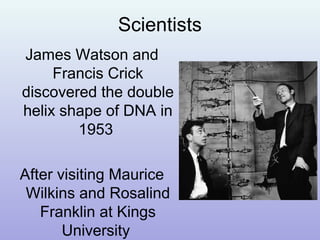
James Watson and
Francis Crick
discovered the double
helix shape of DNA in
1953
After visiting Maurice
Wilkins and Rosalind
Franklin at Kings
University
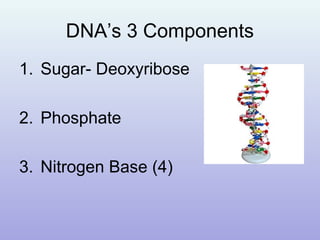
DNA’s 3 Components
1. Sugar- Deoxyribose
2. Phosphate
3. Nitrogen Base (4)
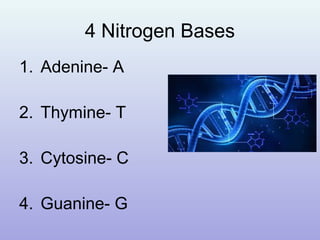
4 Nitrogen Bases
1. Adenine- A
2. Thymine- T
3. Cytosine- C
4. Guanine- G
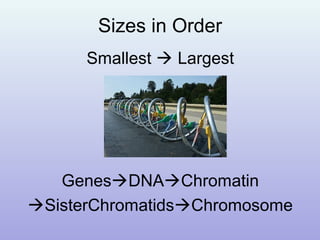
Sizes in Order
Smallest  Largest
GenesDNAChromatin
SisterChromatidsChromosome
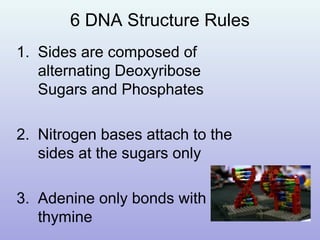
6 DNA Structure Rules
1. Sides are composed of
alternating Deoxyribose
Sugars and Phosphates
2. Nitrogen bases attach to the
sides at the sugars only
3. Adenine only bonds with
thymine
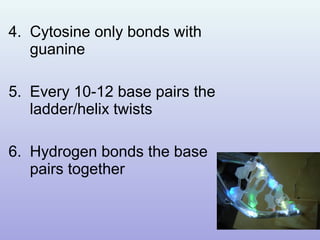
4. Cytosine only bonds with
guanine
5. Every 10-12 base pairs the
ladder/helix twists
6. Hydrogen bonds the base
pairs together
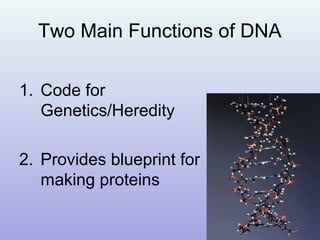
Two Main Functions of DNA
1. Code for
Genetics/Heredity
2. Provides blueprint for
making proteins
Shape of DNA
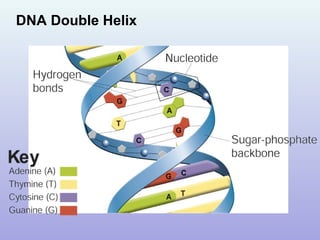
• DNA is made of nucleotides
• Nucleotides - 1 sugar, 1 phosphate, and 1 letter.
• Nucleotides can be in any order
• The “backbone” is the sugar/phosphate groups
DNA Double Helix
Mutations
Any changes that are made to the genetic
material (DNA)
Mutagens – any substance that causes a
mutation
Examples: Ultraviolet Light, X-rays,
Medicines, etc.
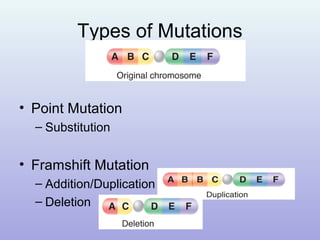
Types of Mutations
• Point Mutation
– Substitution
• Framshift Mutation
– Addition/Duplication
– Deletion
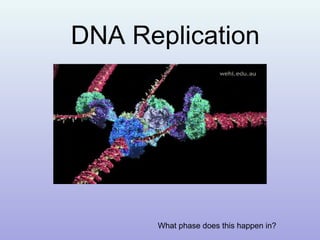
DNA Replication
What phase does this happen in?
Enzymes
• Helicase – unzips the original ladder
• Polymerase-brings the free floating
nucleotides to the original strands
• Ligase – rezips the ladder of the replicated
strands
– DRAWING
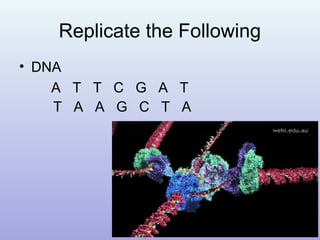
Replicate the Following
• DNA
A T T C G A T
T A A G C T A
RNA
Ribonucleic Acid
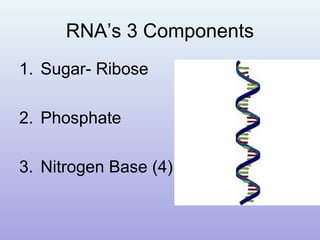
RNA’s 3 Components
1. Sugar- Ribose
2. Phosphate
3. Nitrogen Base (4)
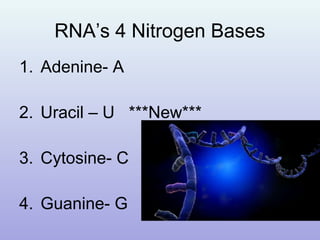
RNA’s 4 Nitrogen Bases
1. Adenine- A
2. Uracil – U ***New***
3. Cytosine- C
4. Guanine- G
3 Main Differences
1. The sugar in RNA is ribose instead of
deoxyribose.
2. RNA is single-stranded.
3. RNA contains uracil in place of thymine.
3 Types of RNA:
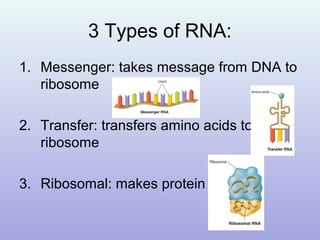
1. Messenger: takes message from DNA to
ribosome
2. Transfer: transfers amino acids to
ribosome
3. Ribosomal: makes protein
The Genetic Code = Making Proteins
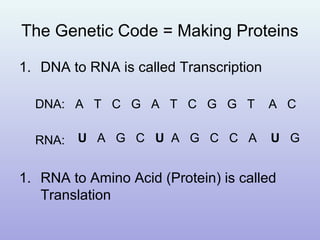
1. DNA to RNA is called Transcription
DNA: A T C G A T C G G T A C
RNA:
1. RNA to Amino Acid (Protein) is called
Translation
U A G C U A G C C A U G
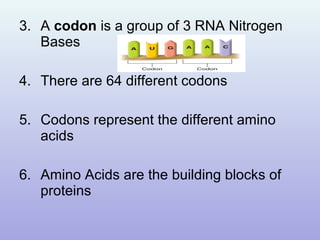
3. A codon is a group of 3 RNA Nitrogen
Bases
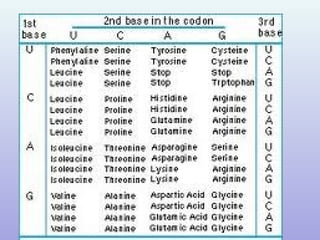
4. There are 64 different codons
5. Codons represent the different amino
acids
6. Amino Acids are the building blocks of
proteins
7. There are 20 different amino acids
8. From START (AUG) to a STOP (UGA,
UAA, UAG) codon is a protein
9. Genes are located on chromosomes &
contain instructions for making proteins
10.Protein is found in blood, muscle, and
body organs
The Genetic Code
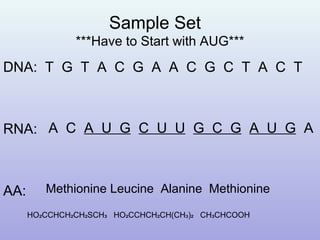
Sample Set
***Have to Start with AUG***
DNA: T G T A C G A A C G C T A C T
RNA:
AA:
A C A U G C U U G C G A U G A
Methionine Leucine Alanine Methionine
HO CCHCH CH SCH HO CCHCH CH(CH ) CH CHCOOH₂ ₂ ₂ ₃ ₂ ₂ ₃ ₂ ₃
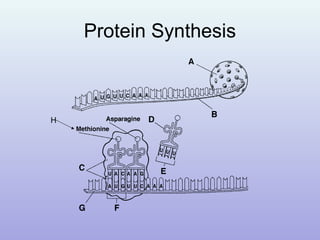
Protein Synthesis
H
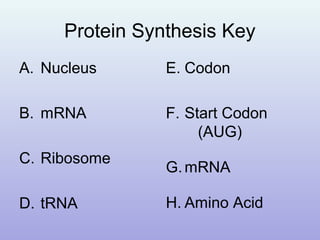
Protein Synthesis Key
A. Nucleus
B. mRNA
C. Ribosome
D. tRNA
E. Codon
F. Start Codon
(AUG)
G.mRNA
H. Amino Acid

Dna and rna

  • 1.
  • 2.
    Scientists James Watson and FrancisCrick discovered the double helix shape of DNA in 1953 After visiting Maurice Wilkins and Rosalind Franklin at Kings University
  • 3.
    DNA’s 3 Components 1.Sugar- Deoxyribose 2. Phosphate 3. Nitrogen Base (4)
  • 4.
    4 Nitrogen Bases 1.Adenine- A 2. Thymine- T 3. Cytosine- C 4. Guanine- G
  • 5.
    Sizes in Order Smallest Largest GenesDNAChromatin SisterChromatidsChromosome
  • 6.
    6 DNA StructureRules 1. Sides are composed of alternating Deoxyribose Sugars and Phosphates 2. Nitrogen bases attach to the sides at the sugars only 3. Adenine only bonds with thymine
  • 7.
    4. Cytosine onlybonds with guanine 5. Every 10-12 base pairs the ladder/helix twists 6. Hydrogen bonds the base pairs together
  • 8.
    Two Main Functionsof DNA 1. Code for Genetics/Heredity 2. Provides blueprint for making proteins
  • 9.
    Shape of DNA •DNA is made of nucleotides • Nucleotides - 1 sugar, 1 phosphate, and 1 letter. • Nucleotides can be in any order • The “backbone” is the sugar/phosphate groups
  • 10.
  • 11.
    Mutations Any changes thatare made to the genetic material (DNA) Mutagens – any substance that causes a mutation Examples: Ultraviolet Light, X-rays, Medicines, etc.
  • 12.
    Types of Mutations •Point Mutation – Substitution • Framshift Mutation – Addition/Duplication – Deletion
  • 13.
    DNA Replication What phasedoes this happen in?
  • 14.
    Enzymes • Helicase –unzips the original ladder • Polymerase-brings the free floating nucleotides to the original strands • Ligase – rezips the ladder of the replicated strands – DRAWING
  • 15.
    Replicate the Following •DNA A T T C G A T T A A G C T A
  • 16.
  • 17.
    RNA’s 3 Components 1.Sugar- Ribose 2. Phosphate 3. Nitrogen Base (4)
  • 18.
    RNA’s 4 NitrogenBases 1. Adenine- A 2. Uracil – U ***New*** 3. Cytosine- C 4. Guanine- G
  • 19.
    3 Main Differences 1.The sugar in RNA is ribose instead of deoxyribose. 2. RNA is single-stranded. 3. RNA contains uracil in place of thymine.
  • 20.
    3 Types ofRNA: 1. Messenger: takes message from DNA to ribosome 2. Transfer: transfers amino acids to ribosome 3. Ribosomal: makes protein
  • 21.
    The Genetic Code= Making Proteins 1. DNA to RNA is called Transcription DNA: A T C G A T C G G T A C RNA: 1. RNA to Amino Acid (Protein) is called Translation U A G C U A G C C A U G
  • 22.
    3. A codonis a group of 3 RNA Nitrogen Bases 4. There are 64 different codons 5. Codons represent the different amino acids 6. Amino Acids are the building blocks of proteins
  • 23.
    7. There are20 different amino acids 8. From START (AUG) to a STOP (UGA, UAA, UAG) codon is a protein 9. Genes are located on chromosomes & contain instructions for making proteins 10.Protein is found in blood, muscle, and body organs
  • 25.
  • 26.
    Sample Set ***Have toStart with AUG*** DNA: T G T A C G A A C G C T A C T RNA: AA: A C A U G C U U G C G A U G A Methionine Leucine Alanine Methionine HO CCHCH CH SCH HO CCHCH CH(CH ) CH CHCOOH₂ ₂ ₂ ₃ ₂ ₂ ₃ ₂ ₃
  • 27.
  • 28.
    Protein Synthesis Key A.Nucleus B. mRNA C. Ribosome D. tRNA E. Codon F. Start Codon (AUG) G.mRNA H. Amino Acid

Editor's Notes

  • #11 DNA is a double helix in which two strands are wound around each other. Each strand is made up of a chain of nucleotides. The two strands are held together by hydrogen bonds between adenine and thymine and between guanine and cytosine.
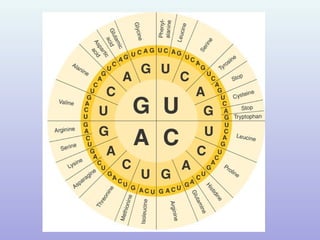
  • #22 A codon is a group of three nucleotides on messenger RNA that specify a particular amino acid.
  • #26 The genetic code shows the amino acid to which each of the 64 possible codons corresponds. To decode a codon, start at the middle of the circle and move outward.